

PTSD, depression and anxiety among former abductees in Northern Uganda
Open accessThe DOI matches its Crossref record; 53 of the 53 references it cites were found in a registry or an index.
Abstract
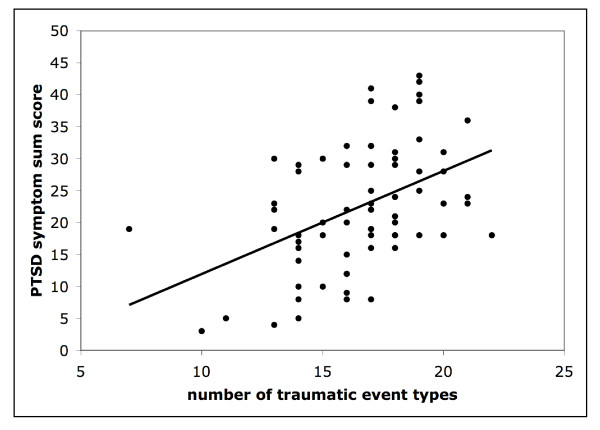
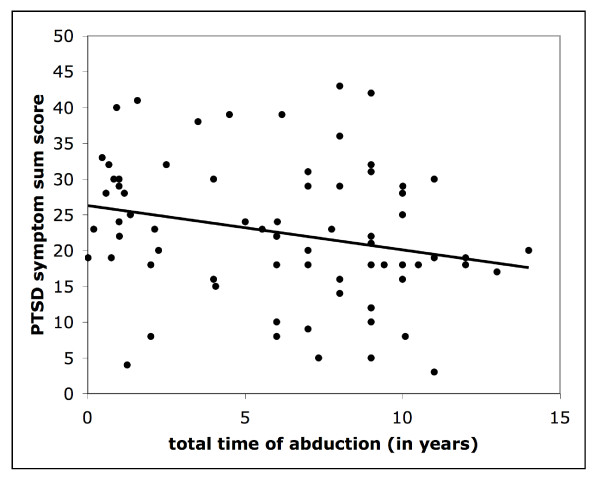
BACKGROUND: The population in Northern Uganda has been exposed to extreme levels of traumatic stress and thousands abducted forcibly became rebel combatants. METHODS: Using structured interviews, the prevalence and severity of posttraumatic stress disorder (PTSD), depression and anxiety was assessed in 72 former abducted adults, 62 of them being former child soldiers. RESULTS: As retrospective reports of exposure to traumatic stress increased, anxiety and PTSD occurrence increased (r = .45). 49% of respondents were diagnosed with PTSD, 70% presented with symptoms of depression, and 59% with those of anxiety. In a multiple linear regression analysis four factors could best explain the development of PTSD symptoms: male respondents (sex) living in an IDP-Camp (location) with a kinship murdered in the war (family members killed in the war) and having experienced a high number of traumatic events (number of traumatic events) were more likely to develop symptoms of PTSD than others. In disagreement to a simple dose-response-effect though, we also observed a negative correlation between the time spent with the rebels and the PTSD symptom level. CONCLUSIONS: Former abductees continue to suffer from severe mental ill-health. Adaptation to the living condition of rebels, however, may lower trauma-related mental suffering.
Overview
The claims and statistics of this paper haven’t been checked yet.
Free: it reads the open-access text and checks the first 5 claims that cite a source we can check. Create a free account to check every claim.
Integrity signals
Registry
Cites
Statistics
Figures
Verification
Claims the paper makes
The claims and statistics of this paper haven’t been checked yet.
Free: it reads the open-access text and checks the first 5 claims that cite a source we can check. Create a free account to check every claim.
Claims other papers make about this one
Each is checked against this paper’s own text: does it say what the citing paper says it does?
In the citing paper
“The higher prevalence rate of psychiatric disorders has been recognized in a number of countries and regions; Posttraumatic Stress Disorder (PTSD) [4], depression, and anxiety [5], disproportionately affect those whose lives are, or have been, affected by war, with particular damaging effects of direct exposure to violence [4].”
Self-check
Percentages, sums and reported differences re-computed from the paper’s own numbers.
The self-check needs the paper’s full text.
Citations
Cites
Posttraumatic Stress Disorder in the National Comorbidity Survey
Kessler, R. C. (1995) · Archives of General Psychiatry · doi:10.1001/archpsyc.1995.03950240066012 · Cited by 10,379
(1992) · Cited by 5,228
The Hopkins Symptom Checklist (HSCL): A self-report symptom inventory
Derogatis, L. R., Lipman, R. S., Rickels, K., Uhlenhuth, E. H., & Covi, L. (1974) · Behavioral Science · doi:10.1002/bs.3830190102 · Cited by 4,604 · cited 1×
“For the assessment of depression and anxiety the 25 items from the short version of the “Hopkins Symptom Checklist” (HSCL-25) was used [30].”
MethodTraumatic Events and Posttraumatic Stress Disorder in an Urban Population of Young Adults
Breslau, N. (1991) · Archives of General Psychiatry · doi:10.1001/archpsyc.1991.01810270028003 · Cited by 2,506
New and old wars: organized violence in a global era
(1999) · Choice Reviews Online · doi:10.5860/choice.36-6532 · Cited by 2,096
Silove, D., Sinnerbrink, I., Field, A., Manicavasagar, V., & Steel, Z. (1997) · British Journal of Psychiatry · doi:10.1192/bjp.170.4.351 · Cited by 749
(1987) · American Journal of Psychiatry · doi:10.1176/ajp.144.4.497 · Cited by 712 · cited 1×
“The scale has been translated in other languages [31,32] and applied in refugee populations [13,33-37].”
BackgroundPosttraumatic growth after war: A study with former refugees and displaced people in Sarajevo
Powell, S., Rosner, R., Butollo, W., Tedeschi, R. G., & Calhoun, L. G. (2003) · Journal of Clinical Psychology · doi:10.1002/jclp.10117 · Cited by 467
Neuner, F., Schauer, M., Karunakara, U., Klaschik, C., Robert, C., & Elbert, T. (2004) · BMC Psychiatry · doi:10.1186/1471-244x-4-34 · Cited by 466
Self-citationMollica, R. F. (1999) · JAMA · doi:10.1001/jama.282.5.433 · Cited by 459
Mollica, R. F., McInnes, K., Pool, C., & Tor, S. (1998) · British Journal of Psychiatry · doi:10.1192/bjp.173.6.482 · Cited by 425 · cited 3×
“Also the correlation between the exposure to traumatic stressors and symptoms of PTSD is higher than the correlation between traumatic event load and symptoms of depression, since the presence of at least one traumatic event is not only a prerequisite for the diagnosis of PTSD, but also the existence of a dosage relat…”
BackgroundResultCatani, C., Jacob, N., Schauer, E., Kohila, M., & Neuner, F. (2008) · BMC Psychiatry · doi:10.1186/1471-244x-8-33 · Cited by 423
Mental Health, Social Functioning, and Attitudes of Kosovar Albanians Following the War in Kosovo
Cardozo, B. L. (2000) · JAMA · doi:10.1001/jama.284.5.569 · Cited by 416
Mental Health Symptoms Following War and Repression in Eastern Afghanistan
Scholte, W. F. (2004) · JAMA · doi:10.1001/jama.292.5.585 · Cited by 380
Post-traumatic stress in former Ugandan child soldiers
Derluyn, I., Broekaert, E., Schuyten, G., & Temmerman, E. D. (2004) · The Lancet · doi:10.1016/s0140-6736(04)15734-6 · Cited by 352
Roberts, B., Ocaka, K. F., Browne, J., Oyok, T., & Sondorp, E. (2008) · BMC Psychiatry · doi:10.1186/1471-244x-8-38 · Cited by 319
Bayer, C. P., Klasen, F., & Adam, H. (2007) · JAMA · doi:10.1001/jama.298.5.555 · Cited by 294
Shrestha, N. M., Sharma, B., Van Ommeren, M., Regmi, S., Makaju, R., Komproe, I., Shrestha, G. B., & de Jong, J. T. V. M. (1998) · JAMA · doi:10.1001/jama.280.5.443 · Cited by 281 · cited 3×
“Again, this is consistent with refugee studies from war regions [12,13,45].”
BackgroundResultMOLLICA, R. F., MCINNES, K., PHAM, T., SMITH FAWZI, M. C., MURPHY, E., & LIN, L. (1998) · The Journal of Nervous & Mental Disease · doi:10.1097/00005053-199809000-00005 · Cited by 272
A 3‐year follow‐up study of psychosocial functioning and general symptoms in settled refugees
Lie, B. (2002) · Acta Psychiatrica Scandinavica · doi:10.1034/j.1600-0447.2002.01436.x · Cited by 270
(1994) · American Journal of Psychiatry · doi:10.1176/ajp.151.1.76 · Cited by 254
Lifespan Development and the Brain: The Perspective of Biocultural Co-Constructivism
(2006) · Cambridge University Press eBooks · doi:10.1017/cbo9780511499722 · Cited by 216
Posttraumatic Resilience in Former Ugandan Child Soldiers
Klasen, F., Oettingen, G., Daniels, J., Post, M., Hoyer, C., & Adam, H. (2010) · Child Development · doi:10.1111/j.1467-8624.2010.01456.x · Cited by 211
Ten years after the genocide: Trauma confrontation and posttraumatic stress in Rwandan adolescents
Schaal, S., & Elbert, T. (2006) · Journal of Traumatic Stress · doi:10.1002/jts.20104 · Cited by 188
Self-citationMental health of Kosovan Albanian refugees in the UK
Turner, S. W., Bowie, C., Dunn, G., Shapo, L., & Yule, W. (2003) · British Journal of Psychiatry · doi:10.1192/bjp.182.5.444 · Cited by 183
Fascination violence: on mind and brain of man hunters
Elbert, T. R., Weierstall, R., & Schauer, M. (2010) · European Archives of Psychiatry and Clinical Neuroscience · doi:10.1007/s00406-010-0144-8 · Cited by 183
Self-citationPost-Traumatic Stress Diagnostic Scale (PDS)
McCarthy, S. (2008) · Occupational Medicine · doi:10.1093/occmed/kqn062 · Cited by 177
Psychological trauma: Burnt into memory
Elbert, T., & Schauer, M. (2002) · Nature · doi:10.1038/419883a · Cited by 172
Self-citationDoes PTSD Transcend Cultural Barriers? A Study From the Khmer Adolescent Refugee Project
Sack, W. H., Seeley, J. R., & Clarke, G. N. (1997) · Journal of the American Academy of Child & Adolescent Psychiatry · doi:10.1097/00004583-199701000-00017 · Cited by 169
PREVALENCE OF DEPRESSION IN RURAL RWANDA BASED ON SYMPTOM AND FUNCTIONAL CRITERIA
BOLTON, P., NEUGEBAUER, R., & NDOGONI, L. (2002) · The Journal of Nervous and Mental Disease · doi:10.1097/00005053-200209000-00009 · Cited by 167
Onyut, L. P., Neuner, F., Ertl, V., Schauer, E., Odenwald, M., & Elbert, T. (2009) · Conflict and Health · doi:10.1186/1752-1505-3-6 · Cited by 165
Self-citation(2004) · PubMed Central · Cited by 163
Self-citationThe Psychological Impact of Child Soldiering
Schauer, E., & Elbert, T. R. (2010) · Springer eBooks · doi:10.1007/978-1-4419-5722-1_14 · Cited by 152
Self-citationKolassa, I.-T., Ertl, V., Eckart, C., Glöckner, F., Kolassa, S., Papassotiropoulos, A., de Quervain, D. J.-F., & Elbert, T. (2010) · The Journal of Clinical Psychiatry · doi:10.4088/jcp.08m04787blu · Cited by 150
Self-citationStructural and Functional Neuroplasticity in Relation to Traumatic Stress
Kolassa, I.-T., & Elbert, T. (2007) · Current Directions in Psychological Science · doi:10.1111/j.1467-8721.2007.00529.x · Cited by 134
Self-citationTorture and its sequel—a comparison between victims from six countries
Moisander, P. A., & Edston, E. (2003) · Forensic Science International · doi:10.1016/j.forsciint.2003.07.008 · Cited by 121
Validation of a mental health assessment in an African conflict population.
Ertl, V., Pfeiffer, A., Saile, R., Schauer, E., Elbert, T., & Neuner, F. (2010) · Psychological Assessment · doi:10.1037/a0018810 · Cited by 118
Self-citationThe validity of posttraumatic stress disorder among vietnamese refugees
Fawzi, M. C. S., Pham, T., Lin, L., Nguyen, T. V., Ngo, D., Murphy, E., & Mollica, R. F. (1997) · Journal of Traumatic Stress · doi:10.1002/jts.2490100109 · Cited by 102
Mental health status of Cambodian refugees ten years after leaving their homes.
Carlson, E. B., & Rosser-Hogan, R. (1993) · American Journal of Orthopsychiatry · doi:10.1037/h0079422 · Cited by 101
Pham, P. N., Vinck, P., & Stover, E. (2009) · BMC Psychiatry · doi:10.1186/1471-244x-9-23 · Cited by 99
Puri, B. K., Counsell, S. J., Ross, B. M., Hamilton, G., Bustos, M. G., & Treasaden, I. H. (2008) · BMC Psychiatry · doi:10.1186/1471-244x-8-s1-s2 · Cited by 89
The Influence of Organized Violence and Terror on Brain and Mind: A Co-Constructive Perspective
Elbert, T., Rockstroh, B., Kolassa, I.-T., Schauer, M., & Neuner, F. (2006) · Lifespan Development and the Brain · doi:10.1017/cbo9780511499722.017 · Cited by 88
Self-citationReturning home: resettlement of formerly abducted children in Northern Uganda
Corbin, J. N. (2008) · Disasters · doi:10.1111/j.1467-7717.2008.01042.x · Cited by 80
Post-traumatic stress in former Ugandan child soldiers
McKay, S. A., & Wessells, M. (2004) · The Lancet · doi:10.1016/s0140-6736(04)16211-9 · Cited by 73
Weierstall, R., Schalinski, I., Crombach, A., Hecker, T., & Elbert, T. (2012) · BMC Psychiatry · doi:10.1186/1471-244x-12-41 · Cited by 69
Self-citationHinton, W. L., Du, N., Chen, Y.-C. J., Tran, C. G., Newman, T. B., & Lu, F. G. (1994) · Journal of General Internal Medicine · doi:10.1007/bf02600124 · Cited by 69
The Prevalence and Longitudinal Course of PTSD: Implications for the Neurobiological Models of PTSD
MCFARLANE, A. C. (1997) · Annals of the New York Academy of Sciences · doi:10.1111/j.1749-6632.1997.tb48265.x · Cited by 60
Gerritsen, A. A., Bramsen, I., Devillé, W., van Willigen, L. H., Hovens, J. E., & van der Ploeg, H. M. (2004) · BMC Public Health · doi:10.1186/1471-2458-4-7 · Cited by 47
Amone‐P’Olak, K. (2007) · Journal of Refugee Studies · doi:10.1093/jrs/fem036 · Cited by 45
Trauma Rehabilitation After War and Conflict: Community and Individual Perspectives
Martz, E. (2010) · Cited by 42
Health problems of refugees in The Netherlands.
van Willigen, L. H. M., Hondius, A. J. K., & van der Ploeg, H. M. (1995) · PubMed · Cited by 29
Psychological and Neurobiological Consequences of the Gulf War Experience
Southwick, S. M. (2000) · Defense Technical Information Center (DTIC) · doi:10.21236/ada409998 · Cited by 2
Psychological and Neurobiological Consequences of the Gulf War Experience
Southwick, S. M. (2000) · Defense Technical Information Center (DTIC) · doi:10.21236/ada396650 · Cited by 1
Research works printed but not linked: 5
- Foa EB Posttraumatic stress diagnostic scale (PDS) 1995 Minneapolis: National Computer Systems
- Santa-Maria ML Posttraumatic stress among Latin American immigrants: implication of family separations and disruption of attachments PhD thesis 2004 Florida State University, College of Human Science
- Mollica RF Wyshak G de Marneffe D Tu B Yang T Khuon F Coelho RC Lavelle J Hopkins Symptoms Checklist 25 (HSCL-25): manual Cambodian, Laotian and Vietnamese versions Torture 1996 6 Suppl 1 35 42
- Flanagan AY Three ways of translating instruments in cross-cultural research E-Research Newsletter - Creating a Community Between Cross-Cultural Practitioners and Researchers 1999 1
- Annan J Blattman C Survey of War affected Youth 2006 Kampala: United Nations Children Fund (UNICEF)
Cited by
Betancourt, T. S., Borisova, I., Williams, T. P., Meyers‐Ohki, S. E., Rubin‐Smith, J. E., Annan, J., & Kohrt, B. A. (2013) · Journal of Child Psychology and Psychiatry · doi:10.1111/j.1469-7610.2012.02620.x · Cited by 279
Stress, Mental Health, and Burnout in National Humanitarian Aid Workers in Gulu, Northern Uganda
Ager, A., Pasha, E., Yu, G., Duke, T., Eriksson, C., & Cardozo, B. L. (2012) · Journal of Traumatic Stress · doi:10.1002/jts.21764 · Cited by 136
Haroz, E. E., Murray, L. K., Bolton, P. A., Betancourt, T. S., & Bass, J. (2013) · Journal of Research on Adolescence · doi:10.1111/j.1532-7795.2012.00802.x · Cited by 134
Ibrahim, H., Ertl, V., Catani, C., Ismail, A. A., & Neuner, F. (2018) · BMC Medicine · doi:10.1186/s12916-018-1140-5 · Cited by 124
Mugisha, J., Muyinda, H., Wandiembe, P., & Kinyanda, E. (2015) · BMC Psychiatry · doi:10.1186/s12888-015-0551-5 · Cited by 82
Metadata
- Authors
- Pfeiffer, A., & Elbert, T.
- Affiliations
- University of Konstanz (DE)
- Corresponding author
- Pfeiffer, Anett
- ORCID
- Elbert, Thomas
- Venue
- Conflict and Health
- Published
- 2011-08-26
- Volume
- 5
- Issue
- 1
- Pages
- 14-14
- ISSN
- 1752-1505 (ISSN-L)
- PMC
- PMC3171296
- OpenAlex
- W2109526504
- Cited by
- 71
- References
- 53
- Citations by year
- 2026: 3 · 2025: 5 · 2024: 3 · 2023: 2 · 2022: 5 · 2021: 4 · 2020: 5 · 2019: 4 · 2018: 4 · 2017: 7 · 2016: 3 · 2015: 10 · 2014: 2 · 2013: 9 · 2012: 3
- FWCI
- 4.83
- Type
- journal article
- Language
- en
- Open access
- gold
- doi.org
- Licence
- cc-by
- creativecommons.org/licenses/by/2.0 (tdm)
- Locations
- Conflict and Health (publishedVersion, cc-by)
- Europe PMC (PubMed Central) (publishedVersion, cc-by)
- PubMed Central (publishedVersion, cc-by)
- PubMed (publishedVersion)
- DOAJ (DOAJ: Directory of Open Access Journals) (submittedVersion, cc-by-sa)
- KOPS (University of Konstanz) (submittedVersion, cc-by)
- Funders
- Deutsche Forschungsgemeinschaft
- Topics
- Social Sciences › Psychology › Clinical Psychology › Posttraumatic Stress Disorder Research
- Social Sciences › Psychology › Clinical Psychology › Migration, Health and Trauma
- Social Sciences › Sociology and Political Science › Conflict, Peace, and Violence in Colombia
- Keywords
- post-traumatic stress disorder, depression, anxiety, former child soldiers, Northern Uganda conflict, trauma exposure, internally displaced persons
About these checks
Registry, retraction, Cites and statistics results are computed, not judged, with one exception: a printed reference that no index lists is read once by a model before it counts as a citation error. Claims are extracted by a model and kept only when their quote appears verbatim in the text; each cited source is then checked, with a model’s help, for whether it says what the claim relies on. Those verdicts can be wrong — read the claim’s quote and the cited source before relying on one.
Statistics and arithmetic are recomputed, not judged.
Confidence bands are shown only for fields calibrated on our annotated test set. None is calibrated yet, so no band is shown.
What counts as a claim ›How we measure confidence ›How we check this ›
Are you an author, or do you see a problem with this page? Request a review
Data sources
Bibliographic data: Semantic Scholar, OpenAlex, Crossref.
Contains information from the Semantic Scholar Academic Graph Datasets, made available under the ODC Attribution License (ODC-BY 1.0).
Semantic Scholar’s data is described in: Kinney, R., et al. (2023). The Semantic Scholar Open Data Platform. arXiv:2301.10140.
