

Rwanda – lasting imprints of a genocide: trauma, mental health and psychosocial conditions in survivors, former prisoners and their children
Open accessThe DOI matches its Crossref record; 71 of the 72 references it cites were found in a registry or an index.
Abstract
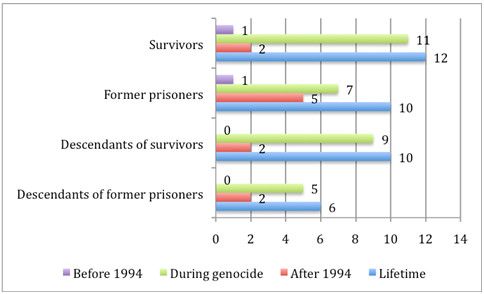
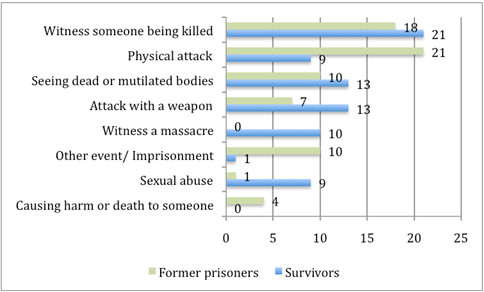
BACKGROUND: The 1994 genocide of the Tutsi in Rwanda left about one million people dead in a period of only three months. The present study aimed to examine the level of trauma exposure, psychopathology, and risk factors for posttraumatic stress disorder (PTSD) in survivors and former prisoners accused of participation in the genocide as well as in their respective descendants. METHODS: A community-based survey was conducted in four sectors of the Muhanga district in the Southern Province of Rwanda from May to July 2010. Genocide survivors (n = 90), former prisoners (n = 83) and their respective descendants were interviewed by trained local psychologists. The PTSD Symptom Scale Interview (PSS-I) was used to assess PTSD, the Hopkins Symptom Checklist (HSCL-25) to assess symptoms of depression and anxiety and the relevant section of the M.I.N.I. to assess the risk for suicidality. RESULTS: Survivors reported that they had experienced on average twelve different traumatic event types in comparison to ten different types of traumatic stressors in the group of former prisoners. According to the PSS-I, the worst events reported by survivors were mainly linked to witnessing violence throughout the period of the genocide, whereas former prisoners emphasized being physically attacked, referring to their time spent in refugee camps or to their imprisonment. In the parent generation, when compared to former prisoners, survivors indicated being more affected by depressive symptoms (M = 20.7 (SD = 7.8) versus M = 19.0 (SD = 6.4), U = 2993, p < .05) and anxiety symptoms (M = 17.2 (SD = 7.6) versus M = 15.4 (SD = 7.8), U = 2951, p < .05) but not with regard to the PTSD diagnosis (25% versus 22%, χ2(1,171) = .182, p = .669).A regression analysis of the data of the parent generation revealed that the exposure to traumatic stressors, the level of physical illness and the level of social integration were predictors for the symptom severity of PTSD, whereas economic status, age and gender were not. Descendants of genocide survivors presented with more symptoms than descendants of former prisoners with regard to all assessed mental disorders. CONCLUSIONS: Our study demonstrated particular long-term consequences of massive organized violence, such as war and genocide, on mental health and psychosocial conditions. Differences between families of survivors and families of former prisoners accused for participation in the Rwandan genocide are reflected in the mental health of the next generation.
Overview
The claims and statistics of this paper haven’t been checked yet.
Free: it reads the open-access text and checks the first 5 claims that cite a source we can check. Create a free account to check every claim.
Integrity signals
Registry
Cites
Statistics
Figures
Verification
Claims the paper makes
The claims and statistics of this paper haven’t been checked yet.
Free: it reads the open-access text and checks the first 5 claims that cite a source we can check. Create a free account to check every claim.
Claims other papers make about this one
Each is checked against this paper’s own text: does it say what the citing paper says it does?
The source backs part of the claim, not all of it — or backs it for a different population, condition or comparison.
In the citing paper
“There is an established link between political imprisonment and the development of PTS and other severe mental health sequelae [30–32].”
From Masculinity and mental health treatment initiation for former political prisoners in Yangon, Myanmar – a qualitative investigation (2021) · cites this paper as [31]
Experimental — accuracy not yet measured
Self-check
Percentages, sums and reported differences re-computed from the paper’s own numbers.
The self-check needs the paper’s full text.
Citations
Cites
(1998) · The Journal of Clinical Psychiatry · Cited by 19,139
Journal of Clinical Psychiatry
(2018) · Journal of Clinical Psychiatry · doi:10.5505/kpd · Cited by 13,651
(1998) · PubMed · Cited by 10,216
The Hopkins Symptom Checklist (HSCL): A self-report symptom inventory
Derogatis, L. R., Lipman, R. S., Rickels, K., Uhlenhuth, E. H., & Covi, L. (1974) · Behavioral Science · doi:10.1002/bs.3830190102 · Cited by 4,604 · cited 3×
“Nettelbladt P, Hansson L, Stefansson CG, Borgquist L, Nordström G: Test characteristics of the Hopkins Symptom Check List-25 (HSCL-25) in Sweden, using the Present State Examiniation (PSE-9) as a caseness criterion.”
MethodSocial Psychiatry and Psychiatric Epidemiology
(2013) · Social Psychiatry and Psychiatric Epidemiology · doi:10.1007/127.1433-9285 · Cited by 1,307
When Victims Become Killers: Colonialism, Nativism, and the Genocide in Rwanda
Mamdani, M. (2001) · Princeton University Press eBooks · doi:10.1515/9781400851720 · Cited by 1,240
Chronic pain and posttraumatic stress disorder: Mutual maintenance?
Sharp, T. J., & Harvey, A. G. (2001) · Clinical Psychology Review · doi:10.1016/s0272-7358(00)00071-4 · Cited by 779 · cited 1×
“With regard to the hypothesis that both syndromes mutually maintain each other as, for instance, acute pain proves to be mediated by symptoms of arousal and vice versa [48,49], this offers an alternative explanation of why PTSD continues to occur at this level, even 16 years after the genocide.”
BackgroundSilove, D., Sinnerbrink, I., Field, A., Manicavasagar, V., & Steel, Z. (1997) · British Journal of Psychiatry · doi:10.1192/bjp.170.4.351 · Cited by 749
Mental Health of Cambodian Refugees 2 Decades After Resettlement in the United States
Marshall, G. N. (2005) · JAMA · doi:10.1001/jama.294.5.571 · Cited by 667
Trauma, PTSD, and Resilience: A Review of the Literature
Agaibi, C. E., & Wilson, J. P. (2005) · Trauma, Violence, & Abuse · doi:10.1177/1524838005277438 · Cited by 662
The Order of Genocide: Race, Power, and War in Rwanda
Walle, N. V. D., & Straus, S. (2006) · Foreign Affairs · doi:10.2307/20032198 · Cited by 610 · cited 3×
“Straus S: The order of Genocide: Race, Power, and War in Rwanda.”
ResultKilling neighbors: webs of violence in Rwanda
(2010) · Choice Reviews Online · doi:10.5860/choice.47-2817 · Cited by 527
Comparison of the PTSD Symptom Scale-Interview Version and the Clinician-Administered PTSD Scale
Foa, E. B., & Tolin, D. F. (2000) · Journal of Traumatic Stress · doi:10.1023/a:1007781909213 · Cited by 507 · cited 5×
“Diagnostic status and symptom severity of PTSD were determined using the PTSD Symptom Scale Interview (PSS-I) [13], which assesses the 17 symptom criteria in the previous month according to the DSM-IV.”
MethodInfluentialSeminars in Clinical Neuropsychiatry
Brannan, S. K. (1997) · JAMA: The Journal of the American Medical Association · doi:10.1001/jama.1997.03550100099053 · Cited by 432
Mollica, R. F., McInnes, K., Pool, C., & Tor, S. (1998) · British Journal of Psychiatry · doi:10.1192/bjp.173.6.482 · Cited by 425 · cited 1×
“The presently observed dose-effect of the number of traumatic event types on the PTSD symptom severity score – highlighting the impact of cumulative stress on mental health – has already been widely discussed [44,45].”
BackgroundCatani, C., Jacob, N., Schauer, E., Kohila, M., & Neuner, F. (2008) · BMC Psychiatry · doi:10.1186/1471-244x-8-33 · Cited by 423
Gender, social support, and PTSD in victims of violent crime
Andrews, B., Brewin, C. R., & Rose, S. (2003) · Journal of Traumatic Stress · doi:10.1023/a:1024478305142 · Cited by 401
Mental Health Symptoms Following War and Repression in Eastern Afghanistan
Scholte, W. F. (2004) · JAMA · doi:10.1001/jama.292.5.585 · Cited by 380 · cited 1×
“Overall, the present study demonstrated a high degree of co-morbidity between diverse disorders, as postulated earlier [33-35].”
ResultStaub, E. (2006) · Political Psychology · doi:10.1111/j.1467-9221.2006.00541.x · Cited by 373
Trauma and PTSD Symptoms in Rwanda: Implications for Attitudes Toward Justice and Reconciliation
Pham, P. N., Weinstein, H. M., & Longman, T. (2004) · JAMA · doi:10.1001/jama.292.5.602 · Cited by 371 · cited 2×
“Apart from these family issues, when referring to previous studies the broader social climate is in question as well, thereby demonstrating a clear association between mental health problems such as PTSD and feelings of hatred and revenge in the aftermath of conflict [22,43].”
BackgroundResultMy Neighbor, My Enemy: Justice and Community in the Aftermath of Mass Atrocity
(2004) · Cambridge University Press eBooks · doi:10.1017/cbo9780511720352 · Cited by 363
When Victims Become Killers: Colonialism, Nativism, and the Genocide in Rwanda
Janzen, J. M., & Mamdani, M. (2003) · Contemporary Sociology · doi:10.2307/1556580 · Cited by 312
When Victims Become Killers: Colonialism, Nativism, and the Genocide in Rwanda
Koopman, J., & Mamdani, M. (2002) · The International Journal of African Historical Studies · doi:10.2307/3097623 · Cited by 310
Trauma exposure and psychological reactions to genocide among Rwandan children
Dyregrov, A., Gupta, L., Gjestad, R., & Mukanoheli, E. (2000) · Journal of Traumatic Stress · doi:10.1023/a:1007759112499 · Cited by 304 · cited 2×
“These findings are in line with other studies conducted in Rwanda [4,5,9].”
BackgroundResultTruth-Telling as Talking Cure? Insecurity and Retraumatization in the Rwandan Gacaca Courts
Brounéus, K. (2008) · Security Dialogue · doi:10.1177/0967010607086823 · Cited by 281
Nettelbladt, P., Hansson, L., Stefansson, C. G., Borgquist, L., & Nordstr�m, G. (1993) · Social Psychiatry and Psychiatric Epidemiology · doi:10.1007/bf00801743 · Cited by 269
Psychopathology in children of Holocaust survivors: a review of the research literature.
Kellermann, N. P. F. (2001) · PubMed · Cited by 250
Perkonigg, A., Pfister, H., Stein, M. B., Höfler, M., Lieb, R., Maercker, A., & Wittchen, H.-U. (2005) · American Journal of Psychiatry · doi:10.1176/appi.ajp.162.7.1320 · Cited by 247 · cited 1×
“Adverse experiences throughout their prison time such as malnutrition, lack of appropriate health care, overcrowded detention conditions or physical harassment and attacks might have added new traumatic events to the already existing fear network [28], and feelings of hopelessness and helplessness over the years might…”
BackgroundPhysical health and post-traumatic stress disorder: review and synthesis.
Schnurr, P. P., & Jankowski, M. K. (1999) · PubMed · Cited by 239
Remembering to Forget: Chosen Amnesia as a Strategy for Local Coexistence in Post-Genocide Rwanda
Buckley-Zistel, S. (2006) · Africa · doi:10.3366/afr.2006.76.2.131 · Cited by 234 · cited 1×
“Alliances that had previously been made between, for example, genocide widows and wives of prisoners, were thereby once again put into question [54,55].”
BackgroundSpontaneous remission from PTSD depends on the number of traumatic event types experienced.
Kolassa, I.-T., Ertl, V., Eckart, C., Kolassa, S., Onyut, L. P., & Elbert, T. (2010) · Psychological Trauma: Theory, Research, Practice, and Policy · doi:10.1037/a0019362 · Cited by 230 · cited 1×
“These differences might be due to recovery over time [25] but might also be linked to differences in exposure to genocide within the same province.”
BackgroundSelf-citationSabin, M. (2003) · JAMA · doi:10.1001/jama.290.5.635 · Cited by 202 · cited 1×
“survivors suffered from PTSD, clinically relevant depression and/or anxiety, reflecting the serious mental health situation as well as the long-term consequences of massive violence even 16 years following the genocide [36-38].”
BackgroundBrounéus, K. (2010) · Journal of Conflict Resolution · doi:10.1177/0022002709360322 · Cited by 201 · cited 3×
“When relying on these results, our findings are consistent with earlier reported studies on survivors and widows or on the general Rwandan population [6,7,20,23,29], even though no comparable data are available for former prisoners.”
BackgroundResultTen years after the genocide: Trauma confrontation and posttraumatic stress in Rwandan adolescents
Schaal, S., & Elbert, T. (2006) · Journal of Traumatic Stress · doi:10.1002/jts.20104 · Cited by 188 · cited 4×
“These findings are in line with other studies conducted in Rwanda [4,5,9].”
BackgroundMethodResultInfluentialSelf-citationEthnocultural aspects of posttraumatic stress disorder.
Marsella, A. J., Friedman, M. J., & Spain, E. H. (1994) · Cited by 170
How many perpetrators were there in the Rwandan genocide? An estimate
Straus, S. (2004) · Journal of Genocide Research · doi:10.1080/1462352042000194728 · Cited by 169 · cited 1×
“Looting, destroying property and genocidal acts including murder and sexual violence were common [1].”
BackgroundPREVALENCE OF DEPRESSION IN RURAL RWANDA BASED ON SYMPTOM AND FUNCTIONAL CRITERIA
BOLTON, P., NEUGEBAUER, R., & NDOGONI, L. (2002) · The Journal of Nervous and Mental Disease · doi:10.1097/00005053-200209000-00009 · Cited by 167 · cited 3×
“When relying on these results, our findings are consistent with earlier reported studies on survivors and widows or on the general Rwandan population [6,7,20,23,29], even though no comparable data are available for former prisoners.”
MethodResultCardozo, B. L., Kaiser, R., Gotway, C. A., & Agani, F. (2003) · Journal of Traumatic Stress · doi:10.1023/a:1024413918346 · Cited by 162
Neugebauer, R., Fisher, P. W., Turner, J. B., Yamabe, S., Sarsfield, J. A., & Stehling-Ariza, T. (2009) · International Journal of Epidemiology · doi:10.1093/ije/dyn375 · Cited by 155
Mental and physical health in Rwanda 14 years after the genocide
Munyandamutsa, N., Mahoro Nkubamugisha, P., Gex-Fabry, M., & Eytan, A. (2012) · Social Psychiatry and Psychiatric Epidemiology · doi:10.1007/s00127-012-0494-9 · Cited by 149
Remembering to Forget: Chosen Amnesia as a Strategy for Local Coexistence in Post-Genocide Rwanda
Buckley-Zistel, S. (2006) · Africa · doi:10.1353/afr.2006.0010 · Cited by 149
Jones, A. (2002) · Journal of Genocide Research · doi:10.1080/14623520120113900 · Cited by 140 · cited 1×
“As the primary targets of genocidal acts were men and boys, genocide survivors proved to be mainly women, whereas genocide-related crimes were mainly committed by men [10].”
BackgroundSupport for the mutual maintenance of pain and post-traumatic stress disorder symptoms
Liedl, A., O'Donnell, M., Creamer, M., Silove, D., McFarlane, A., Knaevelsrud, C., & Bryant, R. A. (2010) · Psychological Medicine · doi:10.1017/s0033291709991310 · Cited by 139
Validation of a mental health assessment in an African conflict population.
Ertl, V., Pfeiffer, A., Saile, R., Schauer, E., Elbert, T., & Neuner, F. (2010) · Psychological Assessment · doi:10.1037/a0018810 · Cited by 118 · cited 2×
“[16] critically discussed the unevaluated adjustment of a cut-off score developed in a different context – that is, for example, not appropriate to the given East African situation.”
BackgroundSelf-citationMemory, identity, and community in Rwanda
Longman, T., & Rutagengwa, T. (2004) · Cambridge University Press eBooks · doi:10.1017/cbo9780511720352.012 · Cited by 106
Smith Fawzi, M. C., Murphy, E., Pham, T., Lin, L., Poole, C., & Mollica, R. F. (1997) · Acta Psychiatrica Scandinavica · doi:10.1111/j.1600-0447.1997.tb00379.x · Cited by 104
THE MENTAL HEALTH OF WAR-WOUNDED REFUGEES: AN 8-YEAR FOLLOW-UP
HERMANSSON, A.-C., TIMPKA, T., & THYBERG, M. (2002) · The Journal of Nervous and Mental Disease · doi:10.1097/00005053-200206000-00005 · Cited by 89
Ethnocultural aspects of posttraumatic stress disorder: issues, research, and clinical applications
(1997) · Choice Reviews Online · doi:10.5860/choice.34-3585 · Cited by 87
PTSD and the "building block" effect of psychological trauma among West Nile Africans
Schauer, M., Neuner, F., Karunakara, U. K., Klaschik, C., Robert, C., & Elbert, T. R. (2003) · KOPS (University of Konstanz) · Cited by 86
Self-citationCommunity based sociotherapy in Byumba, Rwanda
Richters, A., Dekker, C., & Scholte, W. F. (2008) · Intervention · doi:10.1097/wtf.0b013e328307ed33 · Cited by 83
Hagengimana, A., Hinton, D. E., Bird, B. L., Pollack, M. H., & Pitman, R. K. (2003) · Psychiatry Research · doi:10.1016/s0165-1781(02)00301-3 · Cited by 73
Ingando Solidarity Camps: Reconciliation and Political Indoctrination in Post-Genocide RwandaPreprint
Mgbako, C. A. (2005) · SSRN Electronic Journal · Cited by 72
Posttraumatic stress disorder: An overview of the concept.
Friedman, M. J., & Marsella, A. J. (1996) · American Psychological Association eBooks · doi:10.1037/10555-001 · Cited by 69 · cited 1×
“Overall, the present study demonstrated a high degree of co-morbidity between diverse disorders, as postulated earlier [33-35].”
ResultOnyut, L. P., Neuner, F., Schauer, E., Ertl, V., Odenwald, M. G., Schauer, M., & Elbert, T. R. (2004) · KOPS (University of Konstanz) · Cited by 66
Self-citationIngando Solidarity Camps: Reconciliation and Political Indoctrination in Post-Genocide Rwanda Note
Mgbako, C. A. (2005) · FLASH - Fordham Law Archive of Scholarship & History (Fordham University) · Cited by 66
Schaal, S., Weierstall, R., Dusingizemungu, J., & Elbert, T. (2012) · Journal of Traumatic Stress · doi:10.1002/jts.21728 · Cited by 64
Self-citationRestorative Justice and Collective Responsibility: Lessons for and from the Rwandan Genocide
Drumbl, M. A. (2002) · Contemporary Justice Review · doi:10.1080/10282580210831 · Cited by 49 · cited 1×
“This also includes the notion of being innocent and a victim of “someone else’s war” [59], as, in the present study, released prisoners frequently reported physical attack or incarceration as their worst experiences according to the PSS-I.”
BackgroundHolocaust Perpetrators and Their Children: A Paradoxical Morality
Bar‐On, D. (1989) · Journal of Humanistic Psychology · doi:10.1177/0022167889294002 · Cited by 47
(2001) · Lynne Rienner Publishers eBooks · doi:10.1515/9781685850296 · Cited by 45
Schaal, S., Dusingizemungu, J.-P., Jacob, N., & Elbert, T. (2011) · European Journal of Psychotraumatology · doi:10.3402/ejpt.v2i0.6343 · Cited by 40 · cited 7×
“Recent research on vulnerable groups such as orphans showed lower PTSD rates, between 24% and 34% [5,7,40].”
BackgroundResultInfluentialSelf-citationUne Colline Entre Mille ou Le Calms Avant la Tempete: Transformations et Blocages du Rwanda Rural
Lemarchand, R., & de Lame, D. (2000) · African Studies Review · doi:10.2307/524990 · Cited by 34
A prospective study of the relation between posttraumatic stress and physical health symptoms
Engelhard, I. M., van den Hout, M., Weerts, J. M. P., Hox, J. J., & van Doornen, L. J. P. (2009) · Redalyc (Universidad Autónoma del Estado de México) · Cited by 29
Building peace and security after genocide: the contribution of thegacacacourts of Rwanda
Wielenga, C., & Harris, G. (2011) · African Security Review · doi:10.1080/10246029.2011.561008 · Cited by 23 · cited 1×
“A large portion of our sample of former prisoners was released within about the same period of time and therefore took part “in the government confession program” that provided a reduced sentence for perpetrators who admitted guilt and remorse [56,57].”
BackgroundConséquences psychologiques des massacres de 1994 au Rwanda
Sydor, G., & Philippot, P. (2007) · Santé mentale au Québec · doi:10.7202/032389ar · Cited by 23 · cited 1×
“Recent research on vulnerable groups such as orphans showed lower PTSD rates, between 24% and 34% [5,7,40].”
BackgroundEthnocultural Aspects of Posttraumatic Stress Disorder
Spring, D. (1999) · Art Therapy · doi:10.1080/07421656.1999.10759351 · Cited by 22
Trauma and PTSD Symptoms in Rwanda
Nemery, B. (2004) · JAMA · doi:10.1001/jama.292.17.2082-a · Cited by 22
Advancing the field of traumatic stress: The devil is in the details
Weiss, D. S., Delucchi, K., & Shumway, M. (2012) · Journal of Traumatic Stress · doi:10.1002/jts.21671 · Cited by 21
Housing Supply and Regulation: A Study of the Rental Housing Market
Appelbaum, R. P., & Gilderbloom, J. I. “. (1983) · The Journal of Applied Behavioral Science · doi:10.1177/002188638301900102 · Cited by 16
1 Civil Wars, Women, and Gender Relations: An Overview
Kumar, K., Newbury, C., Baldwin, H., Benjamin, J. A., Buck, T., Morton, A. L., Nan, S. A., Zurikashvili, F., Walsh, M., & Garrard‐Burnett, V. (2001) · Lynne Rienner Publishers eBooks · doi:10.1515/9781685850296-004 · Cited by 9
Jacob, N. (2010) · KOPS (University of Konstanz) · Cited by 6
[Psychological consequences of the 1994 massacres in Rwanda].
Sydor, G., & Philippot, P. (1996) · PubMed · Cited by 5
Research works printed but not linked: 6
- Human Rights Watch: Justice Compromised. The Legacy of Rwanda' s Community-Based Gacaca Courts. New York: HRW; 2011.
- Programme National de la Santé Mentale (PNSM): Prevalence de l'état de stress post-traumatique dans la population rwandaise. Kigali: Ministère de la Santé; 2009.
- Des Forges A: Leave none to tell the story. New York: Human Rights Watch and Fédération internationale des ligues des droits de l'homme; 1999.
- National Unity and Reconciliation Commission (NURC): The causes of violence after the 1994 genocide in Rwanda. Kigali: Republic of Rwanda; 2008.
- Programme National de la Santé Mentale (PNSM): Guide en Santé Mentale dans le contexte des Juridictions Gacaca. Kigali: Ministère de la Santé; 2004.
- Hatzfeld J: La stratégie des antilopes. Paris: Editions du Seuil; 2007.
Cited by
Hoppen, T. H., Priebe, S., Vetter, I., & Morina, N. (2021) · BMJ Global Health · doi:10.1136/bmjgh-2021-006303 · Cited by 223
Hoppen, T. H., & Morina, N. (2019) · European Journal of Psychotraumatology · doi:10.1080/20008198.2019.1578637 · Cited by 180
Canetti, D., Elad-Strenger, J., Lavi, I., Guy, D., & Bar-Tal, D. (2017) · Journal of Conflict Resolution · doi:10.1177/0022002715569771 · Cited by 140
Mugisha, J., Muyinda, H., Wandiembe, P., & Kinyanda, E. (2015) · BMC Psychiatry · doi:10.1186/s12888-015-0551-5 · Cited by 82
How to Forget the Unforgettable? On Collective Trauma, Cultural Identity, and Mnemotechnologies
Aydin, C. (2017) · Identity · doi:10.1080/15283488.2017.1340160 · Cited by 95
“Descendants of the 1994 Tutsi genocide survivors in Rwanda were at high risk of developing mental health problems, had a high trauma load, and missed family integration and support even 16 years after the genocide (Rieder and Elbert, 2013).”
Background
Metadata
- Authors
- Rieder, H., & Elbert, T.
- Affiliations
- University of Konstanz (DE)
- Corresponding author
- Rieder, Heide
- ORCID
- Elbert, Thomas
- Venue
- Conflict and Health
- Published
- 2013-03-26
- Volume
- 7
- Issue
- 1
- Pages
- 6-6
- ISSN
- 1752-1505 (ISSN-L)
- PMC
- PMC3620568
- OpenAlex
- W2141081205
- Cited by
- 112
- References
- 72
- Citations by year
- 2026: 7 · 2025: 8 · 2024: 13 · 2023: 8 · 2022: 9 · 2021: 14 · 2020: 9 · 2019: 5 · 2018: 9 · 2017: 10 · 2016: 8 · 2015: 5 · 2014: 5 · 2013: 2
- FWCI
- 7.41
- Type
- journal article
- Language
- en
- Open access
- gold
- doi.org
- Licence
- cc-by
- creativecommons.org/licenses/by/2.0 (tdm)
- Locations
- Conflict and Health (publishedVersion, cc-by)
- Europe PMC (PubMed Central) (publishedVersion, cc-by)
- PubMed Central (publishedVersion, cc-by)
- PubMed (publishedVersion)
- KOPS (University of Konstanz) (submittedVersion, cc-by)
- Funders
- Deutsche Forschungsgemeinschaft
- Topics
- Social Sciences › Psychology › Clinical Psychology › Posttraumatic Stress Disorder Research
- Social Sciences › Arts and Humanities › History › Memory, violence, and history
- Social Sciences › Psychology › Clinical Psychology › Migration, Health and Trauma
- Keywords
- Rwandan genocide, genocide survivors, former prisoners, post-traumatic stress disorder, trauma exposure, depression, anxiety, suicidality, witnessing violence, refugee camps, social integration, physical illness, intergenerational trauma
About these checks
Registry, retraction, Cites and statistics results are computed, not judged, with one exception: a printed reference that no index lists is read once by a model before it counts as a citation error. Claims are extracted by a model and kept only when their quote appears verbatim in the text; each cited source is then checked, with a model’s help, for whether it says what the claim relies on. Those verdicts can be wrong — read the claim’s quote and the cited source before relying on one.
Statistics and arithmetic are recomputed, not judged.
Confidence bands are shown only for fields calibrated on our annotated test set. None is calibrated yet, so no band is shown.
What counts as a claim ›How we measure confidence ›How we check this ›
Are you an author, or do you see a problem with this page? Request a review
Data sources
Bibliographic data: Semantic Scholar, OpenAlex, Crossref.
Contains information from the Semantic Scholar Academic Graph Datasets, made available under the ODC Attribution License (ODC-BY 1.0).
Semantic Scholar’s data is described in: Kinney, R., et al. (2023). The Semantic Scholar Open Data Platform. arXiv:2301.10140.
