

Rwanda – lasting imprints of a genocide: trauma, mental health and psychosocial conditions in survivors, former prisoners and their children
Open accessThe DOI matches its Crossref record; 71 of the 72 references it cites were found in a registry or an index.
Abstract
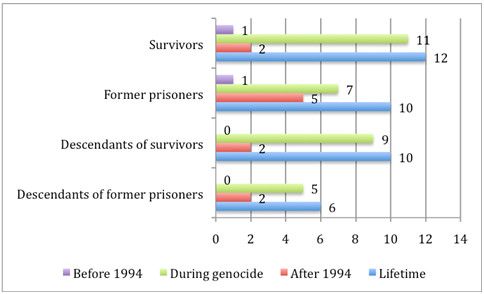
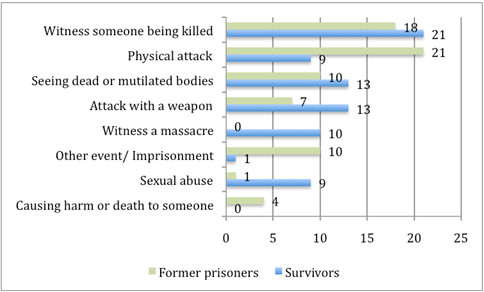
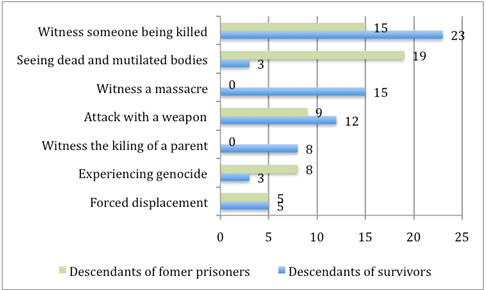
BACKGROUND: The 1994 genocide of the Tutsi in Rwanda left about one million people dead in a period of only three months. The present study aimed to examine the level of trauma exposure, psychopathology, and risk factors for posttraumatic stress disorder (PTSD) in survivors and former prisoners accused of participation in the genocide as well as in their respective descendants. METHODS: A community-based survey was conducted in four sectors of the Muhanga district in the Southern Province of Rwanda from May to July 2010. Genocide survivors (n = 90), former prisoners (n = 83) and their respective descendants were interviewed by trained local psychologists. The PTSD Symptom Scale Interview (PSS-I) was used to assess PTSD, the Hopkins Symptom Checklist (HSCL-25) to assess symptoms of depression and anxiety and the relevant section of the M.I.N.I. to assess the risk for suicidality. RESULTS: Survivors reported that they had experienced on average twelve different traumatic event types in comparison to ten different types of traumatic stressors in the group of former prisoners. According to the PSS-I, the worst events reported by survivors were mainly linked to witnessing violence throughout the period of the genocide, whereas former prisoners emphasized being physically attacked, referring to their time spent in refugee camps or to their imprisonment. In the parent generation, when compared to former prisoners, survivors indicated being more affected by depressive symptoms (M = 20.7 (SD = 7.8) versus M = 19.0 (SD = 6.4), U = 2993, p < .05) and anxiety symptoms (M = 17.2 (SD = 7.6) versus M = 15.4 (SD = 7.8), U = 2951, p < .05) but not with regard to the PTSD diagnosis (25% versus 22%, χ2(1,171) = .182, p = .669).A regression analysis of the data of the parent generation revealed that the exposure to traumatic stressors, the level of physical illness and the level of social integration were predictors for the symptom severity of PTSD, whereas economic status, age and gender were not. Descendants of genocide survivors presented with more symptoms than descendants of former prisoners with regard to all assessed mental disorders. CONCLUSIONS: Our study demonstrated particular long-term consequences of massive organized violence, such as war and genocide, on mental health and psychosocial conditions. Differences between families of survivors and families of former prisoners accused for participation in the Rwandan genocide are reflected in the mental health of the next generation.
Overview
The claims and statistics of this paper haven’t been checked yet.
Free: it reads the open-access text and checks the first 5 claims that cite a source we can check. Create a free account to check every claim.
Integrity signals
Registry
Cites
Statistics
Figures
Verification
Claims the paper makes
The claims and statistics of this paper haven’t been checked yet.
Free: it reads the open-access text and checks the first 5 claims that cite a source we can check. Create a free account to check every claim.
Claims other papers make about this one
Each is checked against this paper’s own text: does it say what the citing paper says it does?
The source backs part of the claim, not all of it — or backs it for a different population, condition or comparison.
In the citing paper
“There is an established link between political imprisonment and the development of PTS and other severe mental health sequelae [30–32].”
From Masculinity and mental health treatment initiation for former political prisoners in Yangon, Myanmar – a qualitative investigation (2021) · cites this paper as [31]
Experimental — accuracy not yet measured
Self-check
Percentages, sums and reported differences re-computed from the paper’s own numbers.
The self-check needs the paper’s full text.
Citations
Cites
(1998) · The Journal of Clinical Psychiatry · Cited by 19,139
Journal of Clinical Psychiatry
(2018) · Journal of Clinical Psychiatry · doi:10.5505/kpd · Cited by 13,651
(1998) · PubMed · Cited by 10,216
The Hopkins Symptom Checklist (HSCL): A self-report symptom inventory
Derogatis, L. R., Lipman, R. S., Rickels, K., Uhlenhuth, E. H., & Covi, L. (1974) · Behavioral Science · doi:10.1002/bs.3830190102 · Cited by 4,604 · cited 3×
“Nettelbladt P, Hansson L, Stefansson CG, Borgquist L, Nordström G: Test characteristics of the Hopkins Symptom Check List-25 (HSCL-25) in Sweden, using the Present State Examiniation (PSE-9) as a caseness criterion.”
MethodSocial Psychiatry and Psychiatric Epidemiology
(2013) · Social Psychiatry and Psychiatric Epidemiology · doi:10.1007/127.1433-9285 · Cited by 1,307
When Victims Become Killers: Colonialism, Nativism, and the Genocide in Rwanda
Mamdani, M. (2001) · Princeton University Press eBooks · doi:10.1515/9781400851720 · Cited by 1,240
Chronic pain and posttraumatic stress disorder: Mutual maintenance?
Sharp, T. J., & Harvey, A. G. (2001) · Clinical Psychology Review · doi:10.1016/s0272-7358(00)00071-4 · Cited by 779 · cited 1×
“With regard to the hypothesis that both syndromes mutually maintain each other as, for instance, acute pain proves to be mediated by symptoms of arousal and vice versa [48,49], this offers an alternative explanation of why PTSD continues to occur at this level, even 16 years after the genocide.”
BackgroundSilove, D., Sinnerbrink, I., Field, A., Manicavasagar, V., & Steel, Z. (1997) · British Journal of Psychiatry · doi:10.1192/bjp.170.4.351 · Cited by 749
Mental Health of Cambodian Refugees 2 Decades After Resettlement in the United States
Marshall, G. N. (2005) · JAMA · doi:10.1001/jama.294.5.571 · Cited by 667
Trauma, PTSD, and Resilience: A Review of the Literature
Agaibi, C. E., & Wilson, J. P. (2005) · Trauma, Violence, & Abuse · doi:10.1177/1524838005277438 · Cited by 662
Research works printed but not linked: 6
- Human Rights Watch: Justice Compromised. The Legacy of Rwanda' s Community-Based Gacaca Courts. New York: HRW; 2011.
- Programme National de la Santé Mentale (PNSM): Prevalence de l'état de stress post-traumatique dans la population rwandaise. Kigali: Ministère de la Santé; 2009.
- Des Forges A: Leave none to tell the story. New York: Human Rights Watch and Fédération internationale des ligues des droits de l'homme; 1999.
- National Unity and Reconciliation Commission (NURC): The causes of violence after the 1994 genocide in Rwanda. Kigali: Republic of Rwanda; 2008.
- Programme National de la Santé Mentale (PNSM): Guide en Santé Mentale dans le contexte des Juridictions Gacaca. Kigali: Ministère de la Santé; 2004.
- Hatzfeld J: La stratégie des antilopes. Paris: Editions du Seuil; 2007.
Cited by
Hoppen, T. H., Priebe, S., Vetter, I., & Morina, N. (2021) · BMJ Global Health · doi:10.1136/bmjgh-2021-006303 · Cited by 223
Hoppen, T. H., & Morina, N. (2019) · European Journal of Psychotraumatology · doi:10.1080/20008198.2019.1578637 · Cited by 180
Canetti, D., Elad-Strenger, J., Lavi, I., Guy, D., & Bar-Tal, D. (2017) · Journal of Conflict Resolution · doi:10.1177/0022002715569771 · Cited by 140
Mugisha, J., Muyinda, H., Wandiembe, P., & Kinyanda, E. (2015) · BMC Psychiatry · doi:10.1186/s12888-015-0551-5 · Cited by 82
How to Forget the Unforgettable? On Collective Trauma, Cultural Identity, and Mnemotechnologies
Aydin, C. (2017) · Identity · doi:10.1080/15283488.2017.1340160 · Cited by 95
“Descendants of the 1994 Tutsi genocide survivors in Rwanda were at high risk of developing mental health problems, had a high trauma load, and missed family integration and support even 16 years after the genocide (Rieder and Elbert, 2013).”
BackgroundMadoro, D., Kerebih, H., Habtamu, Y., tsadik, M. G., Mokona, H., Molla, A., Wondie, T., & Yohannes, K. (2020) · Neuropsychiatric Disease and Treatment · doi:10.2147/ndt.s267307 · Cited by 100
Everyday suffering outside prison walls: A legacy of community justice in post-genocide Rwanda
Rutayisire, T., & Richters, A. (2014) · Social Science & Medicine · doi:10.1016/j.socscimed.2014.06.009 · Cited by 66
Ahmed, S. H., Zakai, A., Zahid, M., Jawad, M. Y., Fu, R., & Chaiton, M. (2024) · General Psychiatry · doi:10.1136/gpsych-2023-101438 · Cited by 92
Umubyeyi, A., Mogren, I., Ntaganira, J., & Krantz, G. (2014) · BMC Psychiatry · doi:10.1186/s12888-014-0315-7 · Cited by 57
“A recent study investigating the trauma exposure related to the Rwandan genocide establish a clear picture of long-term imprints, where a good proportion of the study population was diagnosed with depressive and anxiety symptoms associated with the genocide 17 years later [19].”
BackgroundRieder, H., & Elbert, T. (2013) · European Journal of Psychotraumatology · doi:10.3402/ejpt.v4i0.21329 · Cited by 54
“Recent research has shown that the latter still display a significant level of PTSD after being released (Rieder & Elbert, 2013) and reintegration into former families may cause familial conflicts.”
BackgroundMethodSelf-citationBurchert, S., Stammel, N., & Knaevelsrud, C. (2017) · Psychiatry Research · doi:10.1016/j.psychres.2017.04.033 · Cited by 44
“Nearly identical lists are often used in this field of research (Kolassa et al., 2010; Rieder and Elbert, 2013) but these often require a certain”
BackgroundSeponski, D. M., Lahar, C. J., Khann, S., Kao, S., & Schunert, T. (2018) · Journal of Mental Health · doi:10.1080/09638237.2018.1466039 · Cited by 44
“The mental health needs of the survivors of genocide who remain in their homelands are complicated and differ from those who are resettled elsewhere (Bolton et al., 2013; Rieder & Elbert, 2013).”
BackgroundThe road to sustainable Kigali: A contextualized analysis of the challenges
Baffoe, G., Ahmad, S., & Bhandari, R. (2020) · Cities · doi:10.1016/j.cities.2020.102838 · Cited by 35
Musanabaganwa, C., Wani, A. H., Donglasan, J., Fatumo, S., Jansen, S., Mutabaruka, J., Rutembesa, E., Uwineza, A., Hermans, E. J., Roozendaal, B., et al. (2022) · Epigenomics · doi:10.2217/epi-2021-0310 · Cited by 35
Scott, J. A., Mullen, C., Rouhani, S. A., Kuwert, P., Greiner, A. L., Albutt, K. H., Burkhardt, G., Onyango, M. A., VanRooyen, M. J., & Bartels, S. A. (2017) · International Journal of Mental Health Systems · doi:10.1186/s13033-017-0171-1 · Cited by 43
Berckmoes, L. H., Eichelsheim, V. I., Rutayisire, T., Richters, A., & Holá, B. (2017) · Societies · doi:10.3390/soc7030024 · Cited by 41
“Together with other risk factors or vulnerabilities at different system levels, compromised caregiving may contribute to putting society at risk for new episodes of violence or conflict [22,24,29].”
BackgroundValidating the Children’s Depression Inventory in the context of Rwanda
Binagwaho, A., Fawzi, M. C. S., Agbonyitor, M., Nsanzimana, S., Karema, C., Remera, E., Mutabazi, V., Shyirambere, C., Cyamatare, P., Nutt, C. T., et al. (2016) · BMC Pediatrics · doi:10.1186/s12887-016-0565-2 · Cited by 32
“It has been shown that when a community experiences widespread trauma which greatly affects the social and cultural fabric, children of the following generations often continue to display symptoms of psychological trauma [15].”
BackgroundThe Psychological Consequences of the Holodomor in Ukraine
Горбунова, В., & Klymchuk, V. (2020) · East/West Journal of Ukrainian Studies · doi:10.21226/ewjus609 · Cited by 50
Rurangirwa, A. A., Mogren, I., Ntaganira, J., Govender, K., & Krantz, G. (2018) · BMJ Open · doi:10.1136/bmjopen-2018-021807 · Cited by 25
Exposure to genocide and risk of suicide in Rwanda: a population-based case–control study
Rubanzana, W., Hedt‐Gauthier, B., Ntaganira, J., & Freeman, M. (2014) · Journal of Epidemiology & Community Health · doi:10.1136/jech-2014-204307 · Cited by 26
“This study suggests that effective psychosocial support is needed in order to achieve total reintegration of perpetrators in the Rwanda society.”
BackgroundPalliative Care in Rwanda: Aiming for Universal Access
Krakauer, E. L., Muhimpundu, M. A., Mukasahaha, D., Tayari, J.-C., Ntizimira, C. R., Uhagaze, B., Mugwaneza, T., Ruzima, A., Mpanumusingo, E., Magnus, G., et al. (2017) · Journal of Pain and Symptom Management · doi:10.1016/j.jpainsymman.2017.03.037 · Cited by 21
Rugema, L., Mogren, I., Ntaganira, J., & Krantz, G. (2013) · BMC Public Health · doi:10.1186/1471-2458-13-1235 · Cited by 21
McGinty, G., Fox, R. J., Roberts, B., Makhashvili, N., Javakhishvili, J. D., & Hyland, P. (2023) · Journal of Loss and Trauma · doi:10.1080/15325024.2023.2217002 · Cited by 28
“PTSD among IDPs can range from 3 to 88% (Pham et al., 2004; Rieder & Elbert, 2013).”
BackgroundGebreyesus, A., Gebremariam, G., Kidanu, K. G., Welu, S. G., Haftu, H., Nigusse, A. T., Shishay, F., & Mamo, L. (2024) · Discover Mental Health · doi:10.1007/s44192-024-00069-2 · Cited by 17
“Additionally, in IDP centers, these individuals continue to take on roles as organizers and community members, which exposes them to secondary trauma when working with people who have experienced traumatic events and share their stories [5, 43–45].”
BackgroundGebreyesus, A., Nigusse, A. T., Shishay, F., Mamo, L., Gebremedhin, T., Tsegay, K., Gebremariam, G., Kidanu, K. G., Welu, S. G., & Tesfay, F. H. (2024) · BMC Psychiatry · doi:10.1186/s12888-023-05333-3 · Cited by 28
“Displaced survivors who experienced multiple war events perceived multiple negative effects of war on their life domains related to individuals who lived in war areas [6, 7].”
BackgroundRubanzana, W., Ntaganira, J., Freeman, M., & Hedt‐Gauthier, B. (2015) · BMC Public Health · doi:10.1186/s12889-015-2145-z · Cited by 16
“Over a period of approximately one hundred days as many as 1,000,000 Rwandans became victims of mass murder [10].”
BackgroundLindert, J., Knobler, H. Y., Kawachi, I., Bain, P. A., Abramowitz, M. Z., McKee, C., Reinharz, S., & McKee, M. (2016) · International Journal of Epidemiology · doi:10.1093/ije/dyw161 · Cited by 15
Kagoyire, M. G., Kangabe, J., & Ingabire, M. C. (2023) · BMC Psychology · doi:10.1186/s40359-023-01129-y · Cited by 49
“This study was largely informed by the previous study which found that the trauma experienced by Rwandan mothers who survived genocidal rape was often transmitted to their children, suggesting that mental health needs linger decades after genocide [1, 8].”
ResultIs 2020 the year when primatologists should cancel fieldwork? A reply
Trivedy, C. (2020) · American Journal of Primatology · doi:10.1002/ajp.23173 · Cited by 14
“People living key primate areas such as Rwanda and Cameroon which have experienced violent conflict and may already have pre‐ existing mental health issues which may be exacerbated by the current pandemic (Rieder & Elbert, 2013; Sousa, Mohandas, & Javed, 2020).”
BackgroundRudahindwa, S., Mutesa, L., Rutembesa, E., Mutabaruka, J., Qu, A., Wildman, D. E., Jansen, S., & Uddin, M. (2020) · Open Research Africa · doi:10.12688/aasopenres.12848.2 · Cited by 14
“%) among women survivors 4,7 Work published in 2013 analyzing PTSD prevalence among Rwandan widows, pris-oners of war, and their descendants reported that high exposure to war and genocide was one of the greatest predictors of PTSD 6 .”
Tonui, B. C. (2022) · Psychiatry Research · doi:10.1016/j.psychres.2022.114642 · Cited by 13
A comparative study of psychotic and affective symptoms in Rwandan and Kenyan students
Owoso, A., Jansen, S., Ndetei, D. M., Musau, A., Mutiso, V., Mudenge, C., Ngirababyeyi, A., Gasovya, A., & Mamah, D. T. (2017) · Epidemiology and Psychiatric Sciences · doi:10.1017/s2045796016001074 · Cited by 15
“symptoms in Rwandan and Kenyan students”
BackgroundMutuyimana, C., Cassady, C., Sezibera, V., & Nsabimana, E. (2021) · European Journal of Psychotraumatology · doi:10.1080/20008198.2021.2005345 · Cited by 14
“Genocide against the Tutsi, and violent retaliatory attacks until 1998 terrified the inhabitants of Rwanda (Rieder & Elbert, 2013).”
BackgroundInfluentialBonumwezi, J. L., Grapin, S. L., Uddin, M., Coyle, S., Habintwali, D., & Lowe, S. R. (2024) · Social Science & Medicine · doi:10.1016/j.socscimed.2024.116837 · Cited by 13
Ndungu, J., Ramsoomar, L., Willan, S., Washington, L., Ngcobo-Sithole, M. B., & Gibbs, A. (2020) · Journal of Affective Disorders Reports · doi:10.1016/j.jadr.2020.100022 · Cited by 17
Sargsyan, V., Tenorio, A., Uwera, M., Gasirikare, A., Habyarimana, J. A., Salcido, J. S., Felner, C., & Rasheed, M. A. (2023) · BMC Pediatrics · doi:10.1186/s12887-023-04239-z · Cited by 14
“A mean score of 1.75 (sum score divided by the number of items) was defined as the cut-off point for syndromal depression and anxiety based on previous studies [27, 28].”
MethodInfluentialBreed, A., Uwihoreye, C., Ndushabandi, E., Elliott, M., & Pells, K. (2022) · Journal of Applied Arts and Health · doi:10.1386/jaah_00094_1 · Cited by 13
Rudahindwa, S., Mutesa, L., Rutembesa, E., Mutabaruka, J., Qu, A., Wildman, D. E., Jansen, S., & Uddin, M. (2018) · AAS Open Research · doi:10.12688/aasopenres.12848.1 · Cited by 13
Pells, K., Breed, A., Uwihoreye, C., Ndushabandi, E., Elliott, M., & Nzahabwanayo, S. (2021) · Culture Medicine and Psychiatry · doi:10.1007/s11013-021-09760-3 · Cited by 18
“…literature, the evidence on ITT in Rwanda as clinical condition is mixed, with some studies finding effects (Perroud et al. 2014) others not (Roth et al. 2014) and others finding differences between population groups, such as between children of survivors and of prisoners (Rieder and Elbert 2013).”
ResultJansen, S., Niyonsenga, J., Ingabire, M. C., Jansen, A., Nzabonimpa, E., Ingabire, N., Kangabe, J., Sarabwe, E., Richters, A., Rutayisire, T., et al. (2022) · Trials · doi:10.1186/s13063-022-06994-3 · Cited by 13
“Many Rwandans fled to neighboring countries and part of them came back a few years later [9, 10].”
BackgroundJin, J., Weiman, K., Brémault‐Phillips, S., & Vermetten, E. H. G. J. M. (2022) · Frontiers in Psychiatry · doi:10.3389/fpsyt.2022.880442 · Cited by 12
“, Srebrenica and Rwanda) in a variety of ways which, in turn, can lead to differential later life health outcomes (9).”
BackgroundMukamana, D., Collins, A., & Rosa, W. E. (2018) · Research and theory for nursing practice · doi:10.1891/1541-6577.32.2.125 · Cited by 10
Lakin, D. P., Win, K. S., Aung, H., Soe, K. N. C., Kyi, B., Marcell, A. V., Tol, W. A., & Bass, J. K. (2021) · BMC Public Health · doi:10.1186/s12889-021-10249-2 · Cited by 7
Mukangabire, P., Moreland, P., Kanazayire, C., Rutayisire, R., Nkurunziza, A., Musengimana, D., & Kagabo, I. (2021) · Rwanda Journal of Medicine and Health Sciences · doi:10.4314/rjmhs.v4i1.4 · Cited by 7
“It has been evidenced that in the community which experienced a traumatic event such a genocide, children of the next generation often manifest the psychological trauma symptoms .[26] Rwanda has experienced genocide against Tutsis, and depression has been documented in Rwandan children.”
BackgroundAbdulah, D. M., Abdulla, B. M. O., & Liamputtong, P. (2022) · International Journal of Social Psychiatry · doi:10.1177/00207640211068981 · Cited by 7
“The prisoners might feel that there is no chance to return to their home due to long staying at the prison (Rieder & Elbert, 2013).”
BackgroundInfluentialPeace and the politics of memory
Mannergren, J., Björkdahl, A., Buckley-Zistel, S., Kappler, S., & Williams, T. (2024) · Manchester University Press eBooks · doi:10.7765/9781526178329 · Cited by 17
Eichelsheim, V., Berckmoes, L., Hola, B., Rutayisire, T., & Richters, A. (2019) · Intervention Journal of Mental Health and Psychosocial Support in Conflict Affected Areas · doi:10.4103/1571-8883.239711 · Cited by 7
“…intergenerational transmission In Rwanda, one cannot go past the fact that, in many families, children grow up in single-parent households, face difficult economic circumstances and have limited access to institutional support, education and (mental) health care (also refer Rieder & Elbert, 2013).”
BackgroundSocioeconomics and Major Disabilities: Characteristics of Working-Age Adults in Rwanda
Kiregu, J., Murindahabi, N. K., Tumusiime, D. K., Thomson, D. R., Hedt‐Gauthier, B., & Ahayo, A. (2016) · PLoS ONE · doi:10.1371/journal.pone.0153741 · Cited by 9
“Rwanda’s 1994 genocide brought about the brutal murder of up to 1 million people [16], [17], and left scores disfigured and psychologically scarred [18], [19].”
BackgroundMahmood, H. N., Ahmed, D. R., Neldner, S., & Neuner, F. (2024) · Current Psychology · doi:10.1007/s12144-024-05863-3 · Cited by 8
“…(Denkinger et al., 2021; Ahmed & Heun, 2023), Rohingya refugees (Hossain et al., 2021), and Rwan-dan genocide (Munyandamutsa et al., 2012 ; Rieder & Elbert, 2013; Rugema et al., 2015; Schaal et al., 2009), consistently underscore the profound and persistent mental health challenges faced…”
Lesley, E., Bonumwezi, J., Taing, S., Marea, C. X., Balasubramanian, S., & Minasovi, G. (2024) · SSM - Mental Health · doi:10.1016/j.ssmmh.2024.100328 · Cited by 8
Genocide Rape Trauma Management: An Integrated Framework for Supporting Survivors
Mukamana, D., Brysiewicz, P., Collins, A., & Rosa, W. E. (2017) · Advances in Nursing Science · doi:10.1097/ans.0000000000000177 · Cited by 9
Current and Future Costs of Intractable Conflicts—Can They Create Attitude Change?
Rosler, N., Hameiri, B., Bar‐Tal, D., Christophe, D., & Azaria-Tamir, S. (2021) · Frontiers in Psychology · doi:10.3389/fpsyg.2021.681883 · Cited by 9
“It entails severe negative psychological effects on the entire population, manifested by continuous emotional and physiological arousal of symptoms, such as chronic sense of anxiety, fear and insecurity, ongoing stress, and post-traumatic stress disorder (PTSD) (BarTal, 2001; Canetti-Nisim et al., 2009; Gallagher et a…”
BackgroundPosttraumatic stress disorder and psychological distress in Rwandan refugees living in Zambia
Mwanamwambwa, V., & Pillay, B. J. (2021) · South African Journal of Psychology · doi:10.1177/00812463211031812 · Cited by 10
“In addition, our study demonstrated that there are long-term consequences of violence and trauma experiences (Rieder & Elbert, 2013).”
BackgroundTadesse, G., Nakie, G., Fentahun, S., Andualem, F., Tinsae, T., Kibralew, G., & Rtbey, G. (2025) · BMC Public Health · doi:10.1186/s12889-025-22232-2 · Cited by 7
“In comparison to individuals who lived in war zones, displaced survivors who witnessed multiple war events reported numerous detrimental effects on various aspects of their lives [5, 6].”
Platt, J., Pozen, J., Ntaganira, J., Sezibera, V., & Neugebauer, R. (2021) · Journal of Traumatic Stress · doi:10.1002/jts.22693 · Cited by 7
The Home Stay Exhibitions: The Home and the Image as Hyperlocal Sites of Peacebuilding
Fairey, T. (2024) · Journal of Intervention and Statebuilding · doi:10.1080/17502977.2024.2312489 · Cited by 5
Kang, E., Delzell, D. A. P., Mbonyingabo, C., & Ngendahayo, S. (2016) · Peace and Conflict Journal of Peace Psychology · doi:10.1037/pac0000180 · Cited by 5
Joseph, S. (2018) · The Humanistic Psychologist · doi:10.1037/hum0000088 · Cited by 5
“…carried out before and after their participation in gacaca trials, supports the notion that such social rituals are important for transforming emotions and enhancing social integration (Rime et al, 2011), which in turn is known to be associated with lower trauma symptoms (Rieder & Elbert, 2013).”
BackgroundPitaloka, D., & Dutta, M. J. (2018) · Springer eBooks · doi:10.1007/978-981-13-2005-7_16 · Cited by 6
The challenge of managing headache disorders in a tertiary referral neurology clinic in Rwanda
Kaputu-Kalala-Malu, C., Walker, T. D., Ntumba-Tshitenge, O., Mafuta, E. M., Tugirimana, P. L., & Misson, J. P. (2016) · Neurosciences · doi:10.17712/nsj.2016.2.20150640 · Cited by 7
Musculoskeletal Injuries and Outcomes Pre- and Post- Emergency Medicine Training Program
Mattson, P. C., Nteziryayo, E., Aluisio, A. R., Henry, M., Rosenberg, N., Mutabazi, Z. A., Nyinawankusi, J. D., Byiringiro, J. C., Levine, A. C., & Karim, N. (2019) · Western Journal of Emergency Medicine · doi:10.5811/westjem.2019.7.41448 · Cited by 5
Murengera, E. M., Niyonsenga, J., Rutembesa, E., Sezibera, V., & Nshimiyimana, A. (2025) · PLOS mental health. · doi:10.1371/journal.pmen.0000287 · Cited by 5
An Epidemiological Perspective on the Investigation of Genocide
Tammes, P. (2022) · Frontiers in Epidemiology · doi:10.3389/fepid.2022.844895 · Cited by 4
A Systematic Review on Intergenerational Transmission of Genocide-Related Trauma
Kim, T., & Jordan, L. P. (2025) · Trauma Violence & Abuse · doi:10.1177/15248380251361043 · Cited by 3
“…et al., 2022; Kagoyire et al., 2023; Kanh & Denov, 2022; Kim et al., 2022; Malander et al., 2016; Mutuyimana et al., 2021; Ngwenya & Harris, 2015; Rieder & Elbert, 2013a, 2013b; Roth et al., 2014; Rousseau et al., 1999, 2003; Sack et al., 1994; Sangalang et al., 2017; Shrira et al., 2019; Song…”
InfluentialGender dynamics and aspirational disparities in agriculture
Villacis, A. H., Bruns, S., Tabe‐Ojong, M. P. J., Ortega, D. L., & Mishra, A. K. (2024) · Applied Economic Perspectives and Policy · doi:10.1002/aepp.13486 · Cited by 7
History, trauma and remembering in Kivu Ruhorahoza’s Grey Matter (2011)
Cieplak, P. A. (2016) · Journal of African Cultural Studies · doi:10.1080/13696815.2016.1244476 · Cited by 4
Rehabilitation for Survivors of the 1994 Genocide in Rwanda: What Are the Lessons Learned?
Uwamaliya, P., & Smith, G. (2017) · Issues in Mental Health Nursing · doi:10.1080/01612840.2017.1280574 · Cited by 3
Violence Exposure and Mental Health States
Lindert, J. (2014) · Springer eBooks · doi:10.1007/978-94-017-8999-8_3 · Cited by 3
Kagee, A. (2018) · Social Work/Maatskaplike Werk · doi:10.15270/54-3-648 · Cited by 9
“Social Work/Maatskaplike Werk 2018:54(3) Among Rwandan survivors of the 1994 genocide, 81% had experienced a traumatic event and 25% met the criteria for post-traumatic stress (Rieder & Elbert, 2013).”
BackgroundKasen, S., Ntaganira, J., Sezibera, V., Pozen, J., & Neugebauer, R. (2021) · Social Psychiatry and Psychiatric Epidemiology · doi:10.1007/s00127-021-02058-0 · Cited by 2
“Rieder and Elbert [18] found a nearly comparable combined rate of moderate and severe suicide intent (6.”
BackgroundResultInfluentialPost War Psychological Morbidity among Internally Displaced, Married Females in Northern Sri Lanka
Attidiya, D. S. R., Wickramasinghe, A., & Balasuriya, A. (2016) · Journal of Trauma & Treatment · doi:10.4172/2167-1222.1000327 · Cited by 2
“The PSSR-17 is a questionnaire used to assess combat stress and PTSD among post war refugees in different countries [6].”
BackgroundThe significance of HIV and non-communicable diseases in Africa
Von, H. A. D., Asiimwe‐Kateera, B., White, R., & Gishoma, D. (2018) · Rwanda Journal of Medicine and Health Sciences · doi:10.4314/rjmhs.v1i1.8 · Cited by 2
“The significance of managing Human Immunodeficiency Virus (HIV) and reducing the risk of non-communicable diseases (NCDs) is vital to the health and development of Africa given that;1) ART therapy can lead to metabolic complications;[1] 2) NCDs, particularly cardiovascular disease (CVD), are on the rise in Africa;[2,3…”
BackgroundBerckmoes, L. H. (2022) · Oxford University Press eBooks · doi:10.1093/oxfordhb/9780190915629.013.24 · Cited by 8
TRANSITIONAL JUSTICE: HOW A LACK OF LEGITIMACY IS HINDERING DEMOCRATIZATION
Khan, S. J. (2014) · Cited by 2
When Do Domestic Violence Laws Work? The Role of Social NormsPreprint
Sanin, D. (2024) · SSRN Electronic Journal · doi:10.2139/ssrn.4967673 · Cited by 7
Mukasakindi, H., Nshimyiryo, A., Smith, S. L., Mukandayisenga, V., Ndayisaba, A., Mulindabigwi, A., Kateera, F., Karema, N., Mubiligi, J. M., Cubaka, V. K., et al. (2025) · BMC Psychiatry · doi:10.1186/s12888-025-07610-9 · Cited by 2
“Rwanda experiences high rates of mental health conditions, partially attributable to the 1994 genocide against the Tutsi [14].”
Understanding female household heads’ barriers to profiting from coffee in Southern Rwanda
Gerard, A., García, M. A., López, M. C., Bizoza, A. R., & Vuguziga, B. (2025) · Journal of Eastern African Studies · doi:10.1080/17531055.2025.2605718 · Cited by 1
Stakeholder perspectives on promoting health enhancing sport through the Rwanda Sports Policy
Mukaruzima, L., Duhamahoro, J., & Frantz, J. M. (2023) · International Journal of Sport Policy and Politics · doi:10.1080/19406940.2023.2228835 · Cited by 1
“…acts of murder and sexual violence to the loss of families and social connections, the long-term negative effects on individuals’ physical, mental, and spiritual wellbeing were being nursed by financial difficulties, loss of trust in humanity, and desperation (Rieder and Elbert 2013, Straus 2004).”
BackgroundMelkam, M., Takelle, G. M., Kibralew, G., & Nakie, G. (2025) · Frontiers in Public Health · doi:10.3389/fpubh.2025.1386566 · Cited by 4
Ubaldo, R., & Hintjens, H. M. (2020) · Cultural Studies · doi:10.1080/09502386.2020.1755709 · Cited by 1
Mutuyimana, C., Sezibera, V., & Cassady, C. (2021) · Springer eBooks · doi:10.1007/978-3-030-83707-5_11 · Cited by 3
Insulating the borderlands : policing and state reach in Rwanda
Lamarque, H. (2021) · SOAS Research Online (SOAS University of London) · doi:10.25501/soas.00026483 · Cited by 6
Sabey, C. (2019) · uO Research (University of Ottawa) · doi:10.20381/ruor-24179 · Cited by 3
Tlapek, S. (2015) · Open Scholarship Institutional Repository (Washington University in St. Louis) · doi:10.7936/k7542kv5 · Cited by 2
“The survey used the Kinyarwanda version of the Posttraumatic Stress Disorder Symptom Scale Inventory (PSS-I) to assess symptoms of PTSD (Foa & Tolin, 2000; Onyut et al., 2004; Rieder & Elbert, 2013).”
BackgroundMethodInfluential(2015) · International journal of Nursing Didactics · doi:10.15520/ijnd.2015.vol5.iss10.69.21-28
“Of the four selected macroeconomic variables entered in an OLS regression (Table 5), two emerged as factors of the murder rate (F[5, 19] = 24.”
BackgroundParental and Early Developmental Stress Impact on Neurodevelopmental and Neuropsychiatric Disorders
Nugent, B. M., Chan, J. C., Jašarević, E., & Bale, T. L. (2016) · Elsevier eBooks · doi:10.1016/b978-0-12-803592-4.00097-3
Zorzetto, S., Tavano, A., Inglese, G. D., Cardamone, G., & Inglese, S. (2017) · RIVISTA SPERIMENTALE DI FRENIATRIA · doi:10.3280/rsf2017-003003
Storr, C. L., Lakin, D. P., & Tol, W. A. (2019) · Oxford University Press eBooks · doi:10.1093/oso/9780190916602.003.0013
Landry, J. (2019) · Carleton University's Institutional Repository (MacOdrum Library, Carleton University) · doi:10.22215/etd/2019-13541
“Over two million people fled the country as refugees to neighbouring states, with the majority not re-entering the country until after 1996; many who re-entered were immediately incarcerated (Rieder and Elbert 2013).”
BackgroundInfluentialUnderstanding youth with substance use disorders (SUDs) in Rwanda: A health promotion perspective
Ngamije, J., & Yadufashije, C. (2020) · Asian Journal of Medical Sciences · doi:10.3126/ajms.v11i4.28123
Stories Without Endings: Lived Experiences of Yazidi Women in Winnipeg
Borgardt, K. (2020) · Mspace (University of Manitoba)
NYIRIMANA, V., RUTAKAYILE, B., Mudenge, C., Musafili, A., Cassady, C., & Yubahwe, J. (2021) · Research Square · doi:10.21203/rs.3.rs-701678/v1
“Moreover, witnessing the killing of someone, seeing dead, mutilated bodies and physical attack with weapons have been proven to be the most upsetting traumatic experiences during community violence (Rieder & Elbert, 2013).”
BackgroundSimbi, C. M. C., Zhang, Y., & Wang, Z. (2021) · Research Square · doi:10.21203/rs.3.rs-730323/v1
Caspar, É. A., Pech, G. P., Gishoma, D., & Kanazayire (2022) · doi:10.31234/osf.io/8bu3k
Lee, S. (2017) · Manchester University Press eBooks · doi:10.7765/9781526104601.00014
A Home for the ‘Wandering Aramean’—In Germany?
Speliopoulos, E. B. (2022) · Religions · doi:10.3390/rel13121176
Abuelaish, I., Siddiqua, A., Yousufzai, S. J., & Barakat, C. (2023) · International Journal of Environmental Research and Public Health · doi:10.3390/ijerph20166599
The issue of the genocide of the Ukrainian people in modern conditions (Historical aspect)
Stadnyk, O., Kuzminets, N. P., Shpytalenko, G., Bryl, K., & Hutsalo, L. (2023) · International Journal of Advances in Applied Sciences · doi:10.21833/ijaas.2023.12.010 · Cited by 1
Mannergren, J., Björkdahl, A., Buckley-Zistel, S., Kappler, S., & Williams, T. (2024) · Manchester University Press eBooks · doi:10.7765/9781526178329.00015
Dempsey, N., Sarkar, R., & Bassed, R. (2024) · Forensic Science International · doi:10.1016/j.forsciint.2024.112305
Metadata
- Authors
- Rieder, H., & Elbert, T.
- Affiliations
- University of Konstanz (DE)
- Corresponding author
- Rieder, Heide
- ORCID
- Elbert, Thomas
- Venue
- Conflict and Health
- Published
- 2013-03-26
- Volume
- 7
- Issue
- 1
- Pages
- 6-6
- ISSN
- 1752-1505 (ISSN-L)
- PMC
- PMC3620568
- OpenAlex
- W2141081205
- Cited by
- 112
- References
- 72
- Citations by year
- 2026: 7 · 2025: 8 · 2024: 13 · 2023: 8 · 2022: 9 · 2021: 14 · 2020: 9 · 2019: 5 · 2018: 9 · 2017: 10 · 2016: 8 · 2015: 5 · 2014: 5 · 2013: 2
- FWCI
- 7.41
- Type
- journal article
- Language
- en
- Open access
- gold
- doi.org
- Licence
- cc-by
- creativecommons.org/licenses/by/2.0 (tdm)
- Locations
- Conflict and Health (publishedVersion, cc-by)
- Europe PMC (PubMed Central) (publishedVersion, cc-by)
- PubMed Central (publishedVersion, cc-by)
- PubMed (publishedVersion)
- KOPS (University of Konstanz) (submittedVersion, cc-by)
- Funders
- Deutsche Forschungsgemeinschaft
- Topics
- Social Sciences › Psychology › Clinical Psychology › Posttraumatic Stress Disorder Research
- Social Sciences › Arts and Humanities › History › Memory, violence, and history
- Social Sciences › Psychology › Clinical Psychology › Migration, Health and Trauma
- Keywords
- Rwandan genocide, genocide survivors, former prisoners, post-traumatic stress disorder, trauma exposure, depression, anxiety, suicidality, witnessing violence, refugee camps, social integration, physical illness, intergenerational trauma
About these checks
Registry, retraction, Cites and statistics results are computed, not judged, with one exception: a printed reference that no index lists is read once by a model before it counts as a citation error. Claims are extracted by a model and kept only when their quote appears verbatim in the text; each cited source is then checked, with a model’s help, for whether it says what the claim relies on. Those verdicts can be wrong — read the claim’s quote and the cited source before relying on one.
Statistics and arithmetic are recomputed, not judged.
Confidence bands are shown only for fields calibrated on our annotated test set. None is calibrated yet, so no band is shown.
What counts as a claim ›How we measure confidence ›How we check this ›
Are you an author, or do you see a problem with this page? Request a review
Data sources
Bibliographic data: Semantic Scholar, OpenAlex, Crossref.
Contains information from the Semantic Scholar Academic Graph Datasets, made available under the ODC Attribution License (ODC-BY 1.0).
Semantic Scholar’s data is described in: Kinney, R., et al. (2023). The Semantic Scholar Open Data Platform. arXiv:2301.10140.
