

Effectiveness of lithium in subjects with treatment-resistant depression and suicide risk: results and lessons of an underpowered randomised clinical trial
Open accessThe DOI matches its Crossref record; 20 of the 20 references it cites were found in a registry or an index.
Abstract
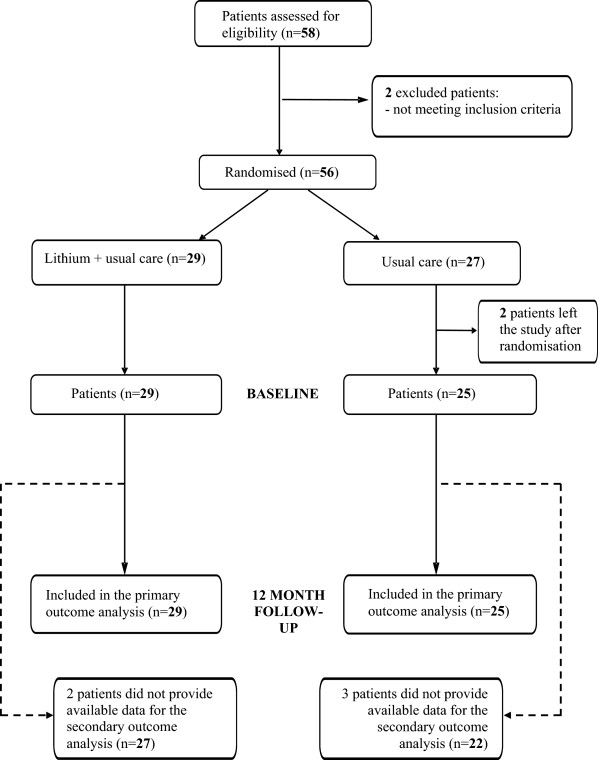
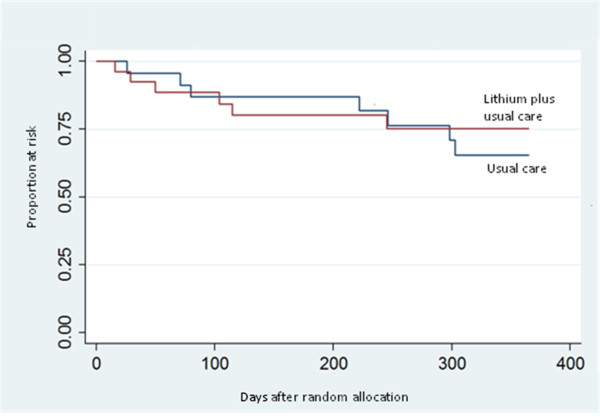
BACKGROUND: As lithium treatment might be effective in reducing the risk of deliberate self-harm (DSH) in adult patients with unipolar affective disorders, we designed a pragmatic randomised trial to assess its efficacy in more than 200 patients with treatment-resistant depression. However, we randomised 56 patients only. The aim of this report is therefore twofold: first, to disseminate the results of this underpowered study which may be incorporated into future meta-analytical reviews; second, to analyse some critical aspects of the study which might explain failure to reach the target sample size. METHODS: We carried out a randomised, parallel group, assessor-blinded superiority clinical trial. Adults with a diagnosis of major depression, an episode of DSH in the previous 12 months and inadequate response to at least two antidepressants given sequentially at an adequate dose for an adequate time for the current depressive episode were allocated to add lithium to usual care (intervention arm) versus usual care alone (control arm). Suicide completion and acts of DSH during the 12 months of follow-up constituted the composite primary outcome. RESULTS: Of 58 patients screened for inclusion, 29 were allocated to lithium plus usual care and 27 were assigned to usual care without lithium. Six patients in the lithium plus usual care group and seven in the usual care group committed acts of DSH during the follow-up phase. The survival probability did not differ between the two treatment arms (Chi2 = 0.17, p =0.676). With regard to changes in the severity of depressive symptomatology from baseline to endpoint, no significant differences were detected. CONCLUSIONS: The present study failed to achieve the minimum sample size needed to detect a clinically meaningful difference between the two treatment arms. Consequently, the finding that lithium, in addition to usual care, did not exert a positive effect in terms of reduction of DSH after 12 months of follow-up is likely due to the lack of sufficient statistical power to detect a difference, if a difference existed. The dissemination of the results of this underpowered study will inform future meta-analytical reviews on lithium and suicide-related outcomes. TRIAL REGISTRATION: ClinicalTrials.gov identifier: NCT00927550.
Overview
The claims and statistics of this paper haven’t been checked yet.
Free: it reads the open-access text and checks the first 5 claims that cite a source we can check. Create a free account to check every claim.
Integrity signals
Registry
Cites
Statistics
Figures
Verification
Claims the paper makes
The claims and statistics of this paper haven’t been checked yet.
Free: it reads the open-access text and checks the first 5 claims that cite a source we can check. Create a free account to check every claim.
Claims other papers make about this one
Each is checked against this paper’s own text: does it say what the citing paper says it does?
The source backs part of the claim, not all of it — or backs it for a different population, condition or comparison.
In the citing paper
“Two of four RCTs showed benefit for suicidal behavior with lithium compared with various other medications.(55, 58, 79, 80)”
From Improving Suicide Prevention Through Evidence-Based Strategies: A Systematic Review (2021) · cites this paper as [79]
Experimental — accuracy not yet measuredThe cited source says what the claim attributes to it.
In the citing paper
“However, several RCTs that compared lithium to either placebo or to other mood stabilizers have been unable to demonstrate this effect 297,298 , although some had very modest sample sizes 299 .”
From Suicide and suicide risk (2019) · cites this paper as [298]
Self-check
Percentages, sums and reported differences re-computed from the paper’s own numbers.
The self-check needs the paper’s full text.
Citations
Cites
1 retracted
Psychosocial and pharmacological treatments for deliberate self harm
Hawton, K. K., Townsend, E., Arensman, E., Gunnell, D., Hazell, P., House, A., & van Heeringen, K. (1999) · Cochrane Database of Systematic Reviews · doi:10.1002/14651858.cd001764 · Cited by 231 · cited 1×
“Background There is some evidence that lithium treatment might be effective in reducing the risk of suicide-related outcomes in patients with treatment-resistant depression (TRD) [1-3].”
BackgroundRetracted(1998) · The Journal of Clinical Psychiatry · Cited by 19,139
(1998) · PubMed · Cited by 10,216
Moher, D., Schulz, K. F., & Altman, D. G. (2001) · The Lancet · doi:10.1016/s0140-6736(00)04337-3 · Cited by 5,373
Rush, A. J., Trivedi, M. H., Ibrahim, H. M., Carmody, T. J., Arnow, B., Klein, D. N., Markowitz, J. C., Ninan, P. T., Kornstein, S., Manber, R., et al. (2003) · Biological Psychiatry · doi:10.1016/s0006-3223(02)01866-8 · Cited by 3,829
Moher, D., Schulz, K. F., & Altman, D. G. (2001) · BMC Medical Research Methodology · doi:10.1186/1471-2288-1-2 · Cited by 2,755 · cited 1×
“All phases of the trial were recorded following the CONSORT statement [6,7].”
MethodImproving the reporting of pragmatic trials: An extension of the CONSORT statement
Zwarenstein, M., Treweek, S., Gagnier, J. J., Altman, D. G., Tunis, S., Haynes, B., Oxman, A. D., Moher, D., & groups, F. T. C. A. P. T. I. H. (. (2008) · BMJ · doi:10.1136/bmj.a2390 · Cited by 1,813 · cited 1×
“All phases of the trial were recorded following the CONSORT statement [6,7].”
MethodBupropion-SR, Sertraline, or Venlafaxine-XR after Failure of SSRIs for Depression
Rush, A. J., Trivedi, M. H., Wisniewski, S. R., Stewart, J. W., Nierenberg, A. A., Thase, M. E., Ritz, L., Biggs, M. M., Warden, D., Luther, J. F., et al. (2006) · New England Journal of Medicine · doi:10.1056/nejmoa052963 · Cited by 1,033
Lithium in the prevention of suicide in mood disorders: updated systematic review and meta-analysis
Cipriani, A., Hawton, K., Stockton, S., & Geddes, J. R. (2013) · BMJ · doi:10.1136/bmj.f3646 · Cited by 920 · cited 1×
“95) [4].”
Self-citationCipriani, A., Pretty, H., Hawton, K., & Geddes, J. R. (2005) · American Journal of Psychiatry · doi:10.1176/appi.ajp.162.10.1805 · Cited by 617 · cited 6×
“Patients with a diagnosis of TRD and history of DSH were randomly allocated to (i) add lithium to usual care or (ii) usual care without lithium.”
BackgroundInfluentialSelf-citationHawton, K., Arensman, E., Townsend, E., Bremner, S., Feldman, E., Goldney, R., Gunnell, D., Hazell, P., van Heeringen, K., House, A., et al. (1998) · BMJ · doi:10.1136/bmj.317.7156.441 · Cited by 426
Treatment-resistant depression: Definitions, review of the evidence, and algorithmic approach
McIntyre, R. S., Filteau, M.-J., Martin, L., Patry, S., Carvalho, A., Cha, D. S., Barakat, M., & Miguelez, M. (2014) · Journal of Affective Disorders · doi:10.1016/j.jad.2013.10.043 · Cited by 421 · cited 1×
“(SGAs) have been increasingly tested in clinical trials and used in clinical practice [16].”
BackgroundSpielmans, G. I., Berman, M. I., Linardatos, E., Rosenlicht, N. Z., Perry, A., & Tsai, A. C. (2013) · PLoS Medicine · doi:10.1371/journal.pmed.1001403 · Cited by 275 · cited 1×
“A recent systematic review identified 14 randomised trials of aripiprazole, olanzapine/fluoxetine combination, quetiapine, and risperidone [17].”
BackgroundLithium Treatment Reduces Suicide Risk in Recurrent Major Depressive Disorder
Guzzetta, F., Tondo, L., Centorrino, F., & Baldessarini, R. J. (2007) · The Journal of Clinical Psychiatry · doi:10.4088/jcp.v68n0304 · Cited by 208 · cited 1×
“power [11], it is likely that only systematic reviews of clinical trial data, by pooling together all available studies, will have a chance of detecting clinically meaningful differences.”
BackgroundThe bipolar spectrum: Conceptions and misconceptions
Ghaemi, S. N., & Dalley, S. (2014) · Australian & New Zealand Journal of Psychiatry · doi:10.1177/0004867413504830 · Cited by 88 · cited 1×
“patients with a history of depressive episodes and some acts of DSH were considered cases belonging to the so-called bipolar spectrum, being therefore ineligible for the study [14].”
BackgroundAre clinical trial data shared sufficiently today? No
Goldacre, B. M. (2013) · BMJ · doi:10.1136/bmj.f1880 · Cited by 60
Barbui, C., Accordini, S., Nosè, M., Stroup, T. S., Purgato, M., Girlanda, F., Esposito, E., Veronese, A., Tansella, M., & Cipriani, A. (2011) · Journal of Clinical Psychopharmacology · doi:10.1097/jcp.0b013e318219cba3 · Cited by 51 · cited 1×
“finalised effectively [12,13].”
Self-citationCipriani, A., Accordini, S., Nosè, M., Purgato, M., Girlanda, F., Tansella, M., & Barbui, C. (2013) · Journal of Clinical Psychopharmacology · doi:10.1097/jcp.0b013e318296884f · Cited by 39 · cited 1×
“finalised effectively [12,13].”
Self-citationLithium-Induced Neurotoxicity: Clinical Presentations, Pathophysiology, and Treatment
Ivkovic, A., & Stern, T. A. (2013) · Psychosomatics · doi:10.1016/j.psym.2013.11.007 · Cited by 30 · cited 1×
“People who survive a poisoning episode may develop persistent neurotoxicity [15].”
BackgroundCipriani, A., Girlanda, F., Agrimi, E., Barichello, A., Beneduce, R., Bighelli, I., Bisoffi, G., Bisogno, A., Bortolaso, P., Boso, M., et al. (2013) · BMC Psychiatry · doi:10.1186/1471-244x-13-212 · Cited by 22 · cited 3×
“A sample size calculation [5] revealed that 210 patients would have 80% power to show a clinically significant advantage associated with lithium treatment.”
BackgroundMethodInfluentialSelf-citation
Cited by
Turecki, G., Brent, D. A., Gunnell, D., O’Connor, R. C., Oquendo, M. A., Pirkis, J., & Stanley, B. H. (2019) · Nature Reviews Disease Primers · doi:10.1038/s41572-019-0121-0 · Cited by 1,074
Improving Suicide Prevention Through Evidence-Based Strategies: A Systematic Review
Mann, J. J., Michel, C. A., & Auerbach, R. P. (2021) · American Journal of Psychiatry · doi:10.1176/appi.ajp.2020.20060864 · Cited by 655
Lithium and suicide in mood disorders: Updated meta‐review of the scientific literature
Smith, K. A., & Cipriani, A. (2017) · Bipolar Disorders · doi:10.1111/bdi.12543 · Cited by 247
Self-citationAugmentation therapies for treatment-resistant depression: systematic review and meta-analysis
Strawbridge, R., Carter, B., Marwood, L., Bandelow, B., Tsapekos, D., Nikolova, V. L., Taylor, R., Mantingh, T., de Angel, V., Patrick, F., et al. (2019) · British Journal of Psychiatry · doi:10.1192/bjp.2018.233 · Cited by 140
Lithium and suicide prevention in mood disorders and in the general population: A systematic review
Del Matto, L., Muscas, M., Murru, A., Verdolini, N., Anmella, G., Fico, G., Corponi, F., Carvalho, A. F., Samalin, L., Carpiniello, B., et al. (2020) · Neuroscience & Biobehavioral Reviews · doi:10.1016/j.neubiorev.2020.06.017 · Cited by 120
Metadata
- Authors
- Girlanda, F., Cipriani, A., Agrimi, E., Appino, M. G., Barichello, A., Beneduce, R., Bighelli, I., Bisoffi, G., Bisogno, A., Bortolaso, P., Boso, M., Calandra, C., Cascone, L., Castellazzi, M., Corbascio, C., Parise, V. F., Gardellin, F., Gennaro, D., Hanife, B., Lintas, C., Lorusso, M., Luca, A., Luca, M., Luchetta, C., Lucii, C., Maio, F., Marsilio, A., Mattei, C., Moretti, D., Nosè, M., Occhionero, G., Papanti, D., Pecile, D., Percudani, M., Prestia, D., Purgato, M., Restaino, F., Romeo, S., Sciarma, T., Strizzolo, S., Tamborini, S., Todarello, O., Tozzi, F., Ziero, S., Zotos, S., & Barbui, C.
- Affiliations
- University of Verona (IT)
- Istituti Ospitalieri di Cremona (IT)
- Azienda Sanitaria Locale N. 2 Savonese (IT)
- Centro San Giovanni di Dio Fatebenefratelli (IT)
- Azienda Ospedaliera Universitaria Integrata Verona (IT)
- Azienda Sanitaria Locale Salerno (IT)
- Ospedale di Circolo e Fondazione Macchi (IT)
- University of Pavia (IT)
- Policlinico Universitario di Catania (IT)
- Azienda Sanitaria Locale di Asti (IT)
- Azienda Ospedaliera Nazionale SS. Antonio e Biagio e Cesare Arrigo (IT)
- University of Bari Aldo Moro (IT)
- Azienda Sanitaria Universitaria Integrata di Trieste (IT)
- University of Genoa (IT)
- University of Perugia (IT)
- Corresponding author
- Barbui, Corrado
- ORCID
- Venue
- BMC Research Notes
- Published
- 2014-10-17
- Volume
- 7
- Issue
- 1
- Pages
- 731-731
- ISSN
- 1756-0500 (ISSN-L)
- PMC
- PMC4210495
- OpenAlex
- W1998751922
- Cited by
- 33
- References
- 20
- Citations by year
- 2026: 3 · 2025: 3 · 2024: 1 · 2023: 4 · 2022: 5 · 2021: 4 · 2020: 2 · 2019: 4 · 2018: 3 · 2017: 3 · 2015: 1
- FWCI
- 1.02
- Type
- journal article
- Language
- en
- Open access
- gold
- doi.org
- Licence
- cc-by
- Locations
- BMC Research Notes (publishedVersion, cc-by)
- Europe PMC (PubMed Central) (publishedVersion, cc-by)
- PubMed Central (publishedVersion, cc-by)
- PubMed (publishedVersion)
- CINECA IRIS Institutional Research Information System (University of Bari Aldo Moro) (submittedVersion)
- Funders
- Agenzia Italiana del Farmaco, Ministero della Salute
- Topics
- Health Sciences › Medicine › Psychiatry and Mental health › Bipolar Disorder and Treatment
- Health Sciences › Medicine › Pharmacology (medical) › Treatment of Major Depression
- Social Sciences › Psychology › Clinical Psychology › Suicide and Self-Harm Studies
- Keywords
- lithium, treatment-resistant depression, suicide risk, self-harm, suicide completion, underpowered trials, sample size, unipolar affective disorder, depression severity
- MeSH terms
- Suicide Prevention, Adult, Affect, Antidepressive Agents, Depression, Drug Therapy, Combination, Female, Humans, Italy, Male, Psychiatric Status Rating Scales, Research Design, Severity of Illness Index, Suicide, Time Factors, Antipsychotic Agents, Treatment Outcome, Lithium Compounds, Sample Size, Antimanic Agents, Kaplan-Meier Estimate, Suicidal Ideation
About these checks
Registry, retraction, Cites and statistics results are computed, not judged, with one exception: a printed reference that no index lists is read once by a model before it counts as a citation error. Claims are extracted by a model and kept only when their quote appears verbatim in the text; each cited source is then checked, with a model’s help, for whether it says what the claim relies on. Those verdicts can be wrong — read the claim’s quote and the cited source before relying on one.
Statistics and arithmetic are recomputed, not judged.
Confidence bands are shown only for fields calibrated on our annotated test set. None is calibrated yet, so no band is shown.
What counts as a claim ›How we measure confidence ›How we check this ›
Are you an author, or do you see a problem with this page? Request a review
Data sources
Bibliographic data: Semantic Scholar, OpenAlex, Crossref.
Contains information from the Semantic Scholar Academic Graph Datasets, made available under the ODC Attribution License (ODC-BY 1.0).
Semantic Scholar’s data is described in: Kinney, R., et al. (2023). The Semantic Scholar Open Data Platform. arXiv:2301.10140.
