

Cotton pest management practices and the selection of pyrethroid resistance in Anopheles gambiae population in Northern Benin
Open accessThe DOI matches its Crossref record; 36 of the 36 references it cites were found in a registry or an index.
Abstract
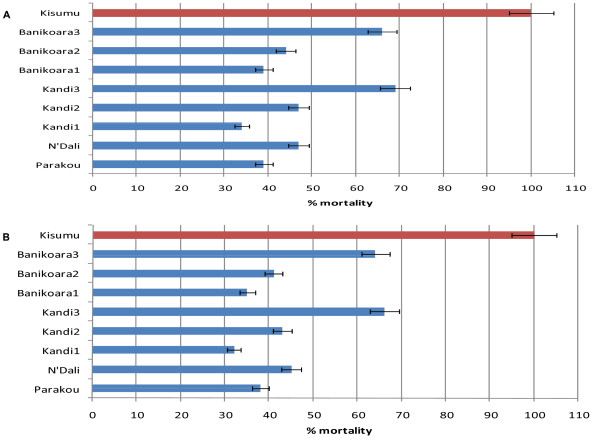
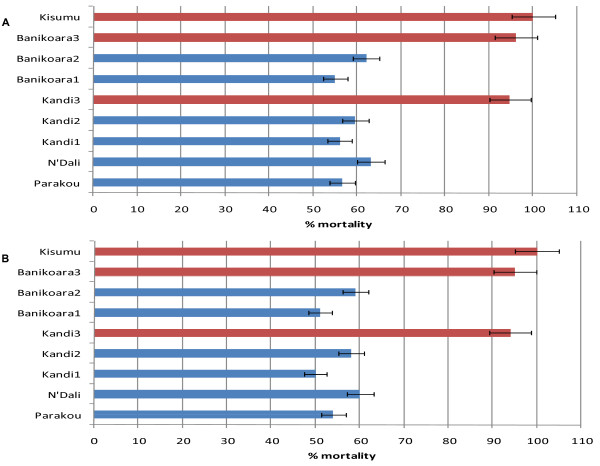
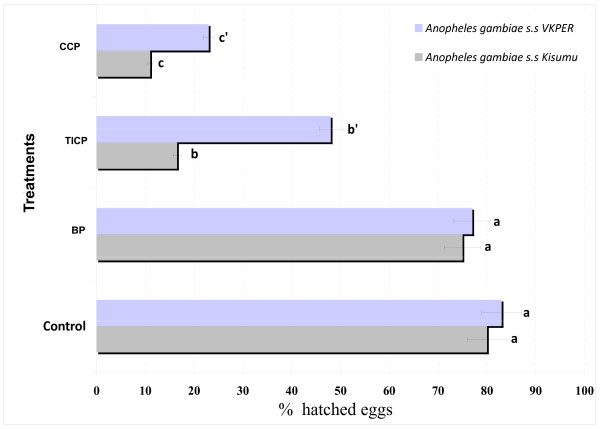
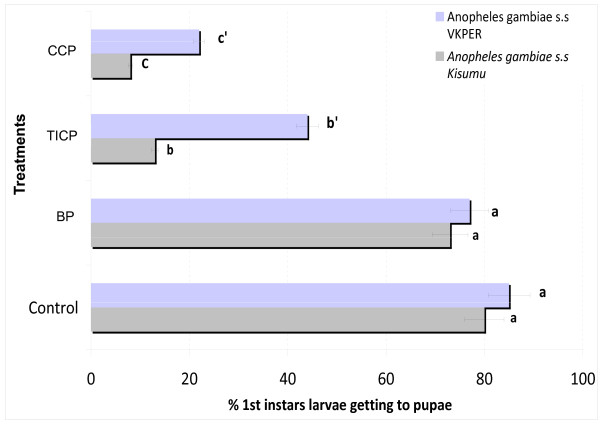
BACKGROUND: Pyrethroid insecticides, carbamate and organophosphate are the classes of insecticides commonly used in agriculture for crop protection in Benin. Pyrethroids remain the only class of insecticides recommended by the WHO for impregnation of bed nets. Unfortunately, the high level of pyrethroid resistance in Anopheles gambiae s.l., threatens to undermine the success of pyrethroid treated nets. This study focuses on the investigation of agricultural practices in cotton growing areas, and their direct impact on larval populations of An. gambiae in surrounding breeding sites. METHODS: The protocol was based on the collection of agro-sociological data where farmers were subjected to semi-structured questionnaires based on the strategies used for crop protection. This was complemented by bioassay tests to assess the susceptibility of malaria vectors to various insecticides. Molecular analysis was performed to characterize the resistance genes and the molecular forms of An. gambiae. Insecticide residues in soil samples from breeding sites were investigated to determine major factors that can inhibit the normal growth of mosquito larvae by exposing susceptible and resistant laboratory strains. RESULTS: There is a common use by local farmers of mineral fertilizer NPK at 200 kg/ha and urea at 50 kg/hectare following insecticide treatments in both the Calendar Control Program (CCP) and the Targeted Intermittent Control Program (TICP). By contrast, no chemicals are involved in Biological Program (BP) where farmers use organic and natural fertilizers which include animal excreta.Susceptibility test results confirmed a high resistance to DDT. Mean mortality of An. gambiae collected from the farms practicing CCP, TICP and BP methods were 33%, 42% and 65% respectively. An. gambiae populations from areas using the CCP and TICP programs showed resistance to permethrin with mortality of 50% and 58% respectively. By contrast, bioassay test results of An. gambiae from BP areas gave a high level of susceptibility to permethrin with an average mortality of 94%.Molecular analysis identified An. gambiae s.s, and An. arabiensis with a high predominance of An. gambiae s.s (90%). The two molecular forms, M and S, were also determined with a high frequency of the S form (96%).The Kdr gene seemed the main target- site resistance mechanism detected in CCP, TICP, and BP areas at the rates ranging from 32 to 78%. The frequency of ace-1R gene was very low (< 0.1).The presence of inhibiting factors in soil samples under insecticide treatments were found and affected negatively in delaying the development of An. gambiae larval populations. CONCLUSIONS: This research shows that Kdr has spread widely in An. gambiae, mainly in CCP and TICP areas where pyrethroids are extensively used. To reduce the negative impact of pesticides use in cotton crop protection, the application of BP-like programs, which do not appear to select for vector resistance would be useful. These results could serve as scientific evidence of the spread of resistance due to a massive agricultural use of insecticides and contribute to the management of pesticides usage on cotton crops hence reducing the selection pressure of insecticides on An. gambiae populations.
Overview
The claims and statistics of this paper haven’t been checked yet.
Free: it reads the open-access text and checks the first 5 claims that cite a source we can check. Create a free account to check every claim.
Integrity signals
Registry
Cites
Statistics
Figures
Verification
Claims the paper makes
The claims and statistics of this paper haven’t been checked yet.
Free: it reads the open-access text and checks the first 5 claims that cite a source we can check. Create a free account to check every claim.
Claims other papers make about this one
Each is checked against this paper’s own text: does it say what the citing paper says it does?
The cited source says what the claim attributes to it.
In the citing paper
“there are voluminous amounts of literature confirming the relationship between pesticide used in agriculture and emergence of insecticide resistance in disease vectors [95, 116–120].”
From Evolution of insecticide resistance and its mechanisms in Anopheles stephensi in the WHO Eastern Mediterranean Region (2020) · cites this paper as [119]
Self-check
Percentages, sums and reported differences re-computed from the paper’s own numbers.
The self-check needs the paper’s full text.
Citations
Cites
GENEPOP (Version 1.2): Population Genetics Software for Exact Tests and Ecumenicism
Raymond, M., & Rousset, F. (1995) · Journal of Heredity · doi:10.1093/oxfordjournals.jhered.a111573 · Cited by 15,397
Identification of Single Specimens of the Anopheles Gambiae Complex by the Polymerase Chain Reaction
Scott, J. A., Brogdon, W. G., & Collins, F. H. (1993) · The American Journal of Tropical Medicine and Hygiene · doi:10.4269/ajtmh.1993.49.520 · Cited by 1,659
Martinez‐Torres, D., Chandre, F., Williamson, M. S., Darriet, F., Bergé, J. B., Devonshire, A. L., Guillet, P., Pasteur, N., & Pauron, D. (1998) · Insect Molecular Biology · doi:10.1046/j.1365-2583.1998.72062.x · Cited by 1,040
Self-citation(1935) · Economic Record · doi:10.1111/j.1475-4932.1935.tb02774.x · Cited by 712
N’Guessan, R., Corbel, V., Akogbéto, M., & Rowland, M. (2007) · Emerging Infectious Diseases · doi:10.3201/eid1302.060631 · Cited by 548 · cited 1×
“In the last decade, the emergence of resistance in populations of An. gambiae to common classes of insecticides used in public health has been reported in many African countries including Kenya [8], Cote d’Ivoire [9], Benin [ 10-14 ], Niger [15], Burkina Faso [16,17], Mali [18], Nigeria [19], South Africa [20], and Ca…”
BackgroundSelf-citationAnopheles funestus resistant to pyrethroid insecticides in South Africa
Hargreaves, K., Koekemoer, L. L., Brooke, B. D., Hunt, R. H., Mthembu, J., & Coetzee, M. (2000) · Medical and Veterinary Entomology · doi:10.1046/j.1365-2915.2000.00234.x · Cited by 530 · cited 4×
“A recent report by Yadouleton et al.[37] showed that agricultural practices in urban areas seem to have contributed to the emergence of insecticide resistance in Anopheles populations.”
BackgroundResultInfluentialWeill, M., Malcolm, C., Chandre, F., Mogensen, K., Berthomieu, A., Marquine, M., & Raymond, M. (2004) · Insect Molecular Biology · doi:10.1111/j.1365-2583.2004.00452.x · Cited by 513
Self-citationDiabate, A., Baldet, T., Chandre, F., Akoobeto, M., Guiguemde, T. R., Darriet, F., Brengues, C., Guillet, P., Hemingway, J., Small, G. J., et al. (2002) · The American journal of tropical medicine and hygiene · doi:10.4269/ajtmh.2002.67.617 · Cited by 459 · cited 11×
“In 2000, a study in Burkina Faso by Diabate et al. [17] reported higher levels of kdr alleles frequency in An. gambiae collected from cotton-growing areas constantly subjected to insecticide treatments, as compared to the low frequency of kdr recorded in rural areas where farmers are restricted to low or no use of pes…”
BackgroundInfluentialSelf-citationCorbel, V., N’Guessan, R., Brengues, C., Chandre, F., Djogbenou, L., Martin, T., Akogbéto, M., Hougard, J. M., & Rowland, M. (2007) · Acta Tropica · doi:10.1016/j.actatropica.2007.01.005 · Cited by 382
Self-citationStatus of pyrethroid resistance in Anopheles gambiae sensu lato.
Chandre, F., Darrier, F., Manga, L., Akogbeto, M. C., Faye, O., Mouchet, J., & Guillet, P. (1999) · Europe PMC (PubMed Central) · Cited by 380
Self-citation
Research works printed but not linked: 6
- Ministère de la santé Annuaire des statistiques sanitaires 2006 2009 Cotonou
- Akogbéto M Yakoubou S Résistance des vecteurs du paludisme vis-à-vis des pyréthrinoïdes utilisés pour l'imprégnation des moustiquaires au Bénin, Afrique de l'Ouest Bull Soc Pathol Exot 1999 92 123 130 10399604
- WABI The cross-border integration of the cotton sub-sector. West African Borders and Integration Network Coton et Fibres Tropicales 2003 112 54 71
- WHO World Malaria Report 2008 2008 World Health Organzation, Geneva
- WHO World Malaria Report 1998 1998 World Health Organzation, Geneva
- Hargreaves K Koekemoer LL Brooke BD Hunt RH Mthembu J Coetzee M Anopheles funestus resistant to pyrethroid insecticides in South Africa Med Vet Entomol 2000 14 1 9 10.1046/j.1365-2915.2000.00234.x 10872862 · DOI · Paper page
Cited by
Items 101–156 of 156
Evolution of Resistance to Insecticides in Disease Vectors
Nwane, P. B., Binyang, A., Mbakop, L. R., & Etang, J. (2024) · Elsevier eBooks · doi:10.1016/b978-0-443-28818-0.00006-9 · Cited by 4
Ahadji‐Dabla, K. M., Ngoagouni, C., Dery, B. D., Apetogbo, Y., Ketoh, G. K., & Glitho, I. A. (2019) · International Journal of Biological and Chemical Sciences · doi:10.4314/ijbcs.v13i3.36 · Cited by 4
Self-citationOrondo, P. W., Nyanjom, S. G., Atieli, H., Githure, J. I., Ondeto, B. M., Ochwedo, K. O., Omondi, C. J., Kazura, J. W., Lee, M., Zhou, G., et al. (2021) · Research Square · doi:10.21203/rs.3.rs-139000/v1 · Cited by 4
Biomarkers of Vector Bites: Arthropod Immunogenic Salivary Proteins in Vector-Borne Diseases Control
Doucouré, S., Cornélie, S., Drame, P. M., Marié, A., Elanga-Ndille, E., Mathieu-Daudé, F., Mouchet, F., Poinsignon, A., & Remoué, F. (2015) · Biomarkers in disease · doi:10.1007/978-94-007-7696-8_10 · Cited by 4
Hoyochi, I., Aïkpon, R. Y., Sovi, A., Konkon, A. K., Zoungbédji, D. M., Kpanou, C. D., Azondékon, R., Salako, A. S., Koukpo, C. Z., Sossoukpè, E., et al. (2025) · Malaria Journal · doi:10.1186/s12936-025-05596-z · Cited by 3
Self-citationRugalema, G. H., & Mnyone, L. L. (2020) · Journal of Entomology and Zoology Studies · Cited by 3
Bardosh, K., Ryan, S. J., Ebi, K. L., Welburn, S. C., & Singer, B. H. (2018) · Infectious Diseases of Poverty · doi:10.1186/s40249-018-0387-6 · Cited by 3
Rugalema, G. H., & Mnyone, L. L. (2020) · Research Square · doi:10.21203/rs.3.rs-36506/v1 · Cited by 3
Alfa, D. A., Gbofan, F. N., Mongbo, R., & Egrot, M. (2018) · Presses universitaires de Rennes eBooks · doi:10.4000/books.pur.149817 · Cited by 3
Genetic components of insecticide resistance in Anopheles arabiensis
Howell, P. I. (2018) · University of Liverpool · doi:10.17638/03027687 · Cited by 2
Anges, Y., Badou, Y., Falilath, S., Hounkanrin, G., Tchibozo, C., Adewumi, P., & Lamine, B.-M. (2023) · Malawi Medical Journal · doi:10.4314/mmj.v35i3.6 · Cited by 2
Health Challenges: Increasing Global Impacts
Molia, S., Bonnet, P., & Ratnadass, A. (2014) · Springer eBooks · doi:10.1007/978-94-017-9358-2_12 · Cited by 2
Zoungbédji, D. M., Padonou, G. G., Konkon, A. K., Konkon, Salako, A. S., Adoha, C. J., Fassinou, A. J. Y. H., Sina, H., Baba-Mouss, L., & Akogbeto, M. C. (2023) · International Journal of Mosquito Research · doi:10.22271/23487941.2023.v10.i3a.677 · Cited by 2
Self-citationEsterase Mediated Insecticide Resistance in the Southern House Mosquito, Culex quinquefasciatus
Pokhrel, V. (2022) · Louisiana State University · doi:10.31390/gradschool_dissertations.5990 · Cited by 1
Kacou, A. P., Edi, C., Fodjo, B. K., Yokoly, F. N., Zahouli, J. Z. B., Kouamé, J. K. I., Malone, D. J., & Koudou, B. G. (2024) · Medical and Veterinary Entomology · doi:10.1111/mve.12759 · Cited by 1
Tabbabi, A., Daaboub, J., Cheikh, R. B., Laamari, A., Feriani, M., Boubaker, C., Jha, I. B., & Cheikh, H. B. (2019) · Journal of Entomological Science · doi:10.18474/jes18-48 · Cited by 1
Osse, R. A., Hougbe, S. Z., Ahouandjinou, M. J., Sidick, A., Affolabi, Z.-K., Koumodji, K. D., Tokponnon, F., Aïkpon, R. Y., Sovi, A., Orou, H. A. S., et al. (2026) · Malaria Journal · doi:10.1186/s12936-026-05932-x · Cited by 1
Self-citationMatiya, D. J., Philbert, A., Kidima, W. B., Kaaya, R. D., & Matowo, J. (2022) · Transactions of the Royal Society of South Africa · doi:10.1080/0035919x.2022.2156934 · Cited by 1
INVESTIGATIONS ON THE DETOXIFICATION MECHANISMS OF THE MALARIA VECTOR ANOPHELES STEPHENSI
Ferrari, M. (2018) · Archivio Istituzionale della Ricerca (Universita Degli Studi Di Milano) · doi:10.13130/ferrari-marco_phd2018-02-21 · Cited by 1
Kataki, A. S. (2025) · Journal of Biological Control · doi:10.18311/jbc/2025/47870 · Cited by 1
Anges, Y., Wilfried, D., Klotoé, J. R., Michel, S., Chabi, C., Agbanrin, R., Géraldo, H., Sidick, A., Fabrice, A., & Martin, A. (2018) · International Journal of Progressive Sciences and Technologies · doi:10.52155/ijpsat.v9.2.519 · Cited by 1
Martin, T. (2013) · Agritrop (Cirad) · Cited by 1
Self-citationBiomarkers of Vector Bites: Arthropod Immunogenic Salivary Proteins in Vector-Borne Diseases Control
Doucouré, S., Cornélie, S., Drame, P. M., Marié, A., Elanga-Ndille, E., Mathieu-Daudé, F., Mouchet, F., Poinsignon, A., & Remoué, F. (2014) · Springer eBooks · doi:10.1007/978-94-007-7740-8_10-1 · Cited by 1
Sonhafouo-Chiana, N., Nkahe, D. L., Kopya, E., Awono-Ambene, P. H., Wanji, S., Wondji, C. S., & Antonio‐Nkondjio, C. (2022) · Figshare · doi:10.6084/m9.figshare.19977002
Sonhafouo-Chiana, N., Nkahe, D. L., Kopya, E., Awono-Ambene, P. H., Wanji, S., Wondji, C. S., & Antonio‐Nkondjio, C. (2022) · Figshare · doi:10.6084/m9.figshare.19976996
Résistances aux insecticides chez les Culicidae vecteurs en territoires insulaires
Pocquet, N. (2014) · theses.fr (ABES) · doi:10.70675/e6ba6a1ez65d1z4682z8e10z76702b3315ce
Assogba, B. S., Pasteur, N., Makoundou, P., Unal, S., Baba-Moussa, L., Labbé, P., & Weill, M. (2020) · Figshare · doi:10.6084/m9.figshare.11986368
Akoton, R., Sovegnon, P. M., Djihinto, O., Medjigbodo, A. A., Agonhossou, R., Saizonou, H. D. M., Tchigossou, G., Atoyebi, S. M., Tossou, E., Zeukeng, F., et al. (2024) · Figshare · doi:10.6084/m9.figshare.24892961
Akoton, R., Sovegnon, P. M., Djihinto, O., Medjigbodo, A. A., Agonhossou, R., Saizonou, H. D. M., Tchigossou, G., Atoyebi, S. M., Tossou, E., Zeukeng, F., et al. (2023) · Figshare · doi:10.6084/m9.figshare.24892817
Govoétchan, R., Sovi, A., Osse, R. A., & Akogbeto, M. C. (2022) · International Journal of Mosquito Research · doi:10.22271/23487941.2022.v9.i6a.639
Self-citationSadia, C. G., Bonneville, J., Zoh, M. G., Fodjo, B. K., Kouadio, F.-P. A., Oyou, S. K., Koudou, B. G., Adepo-Gourene, B. A., Reynaud, S., David, J., et al. (2024) · Figshare · doi:10.6084/m9.figshare.25347274
Sadia, C. G., Bonneville, J., Zoh, M. G., Fodjo, B. K., Kouadio, F.-P. A., Oyou, S. K., Koudou, B. G., Adepo-Gourene, B. A., Reynaud, S., David, J., et al. (2024) · Figshare · doi:10.6084/m9.figshare.26689430
Sadia, C. G., Bonneville, J., Zoh, M. G., Fodjo, B. K., Kouadio, F.-P. A., Oyou, S. K., Koudou, B. G., Adepo-Gourene, B. A., Reynaud, S., David, J., et al. (2024) · Figshare · doi:10.6084/m9.figshare.25347052
Sadia, C. G., Bonneville, J., Zoh, M. G., Fodjo, B. K., Kouadio, F.-P. A., Oyou, S. K., Koudou, B. G., Adepo-Gourene, B. A., Reynaud, S., David, J., et al. (2024) · Figshare · doi:10.6084/m9.figshare.26689424
Sadia, C. G., Bonneville, J., Zoh, M. G., Fodjo, B. K., Kouadio, F.-P. A., Oyou, S. K., Koudou, B. G., Adepo-Gourene, B. A., Reynaud, S., David, J., et al. (2024) · Figshare · doi:10.6084/m9.figshare.26689427
N'Dille, C. E. E. (2014) · theses.fr (ABES) · doi:10.70675/66ab66c3z1f91z4cd9zb560z14600858fe8d
Etude de la résistance cuticulaire chez Anopheles gambiae
Yahouédo, G. A. (2017) · theses.fr (ABES) · doi:10.70675/e0e731a9z0253z41d9z9c5bzee1d0b4ba178
Tsegaye, A., Demissew, A., Hawaria, D., Abossie, A., Getachew, H., Habtamu, K., Degefa, T., Wang, X., Lee, M.-C., Zhou, G., et al. (2023) · Figshare · doi:10.6084/m9.figshare.24571872
Negri, A. (2020) · IRIS Research product catalog (Sapienza University of Rome)
Tokponnon, T. F., Dabou, Z. S., Kotannou, E. A., Kouagou, O., Houmenou, D. G., Ahouandjinou, M. J., Towakinou, L., Agassounon, B., Houessinon, F., Idayath, G., et al. (2025) · Journal of Biomedical Science and Engineering · doi:10.4236/jbise.2025.187021
Self-citationAbdu, H. (2015) · Abertay Research Portal (Abertay University)
(2024) · Journal of Community Medicine and Public Health Reports · doi:10.38207/jcmphr/2024/jul05100490
Anges, Y., du Benin., L. D. F. H. V. E. D. A., Gado, D., Badou, Y., du Benin., L. D. F. H. V. E. D. A., Falilath, S., du Benin., L. D. F. H. V. E. D. A., Hounkanrin, G., du Benin., L. D. F. H. V. E. D. A., Tchibozo, C., et al. (2022) · International Journal of Advanced Research · doi:10.21474/ijar01/15143
Wafula, R. (2016) · DukeSpace (Duke University)
EFFECTIVENESS OF THE MOST COMMONLY USED MOSQUITOES REPELLENT IN HOUSEHOLDS IN NIAMEYCITY (NIGER)
Toudou, B. I. M., Doumma, A., & Hima, M. K. (2022) · International Journal of Advanced Research · doi:10.21474/ijar01/15122
Yadouleton, A. (2023) · Journal of Biodiversity and Environmental Sciences (JBES) · doi:10.5281/zenodo.17934935
Self-citationAnges, Y., Agbanrin, R., Klotoé, J. R., Fabrice, A., Géraldo, H., Tchibozo, C., & Martin, A. (2018) · International Journal of Progressive Sciences and Technologies
Asaia Paratransgenesis in Mosquitoes
Mancini, M. V., & Favia, G. (2022) · CABI eBooks · doi:10.1079/9781800621176.0015
Falilath, S., Anges, Y., Badou, Y., Hounkanrin, G., Tchibozo, C., Agbanrin, R., Adewumi, P., & Lamine, B.-M. (2023) · Journal of Biodiversity and Environmental Sciences (JBES) · doi:10.5281/zenodo.10167507
Trends in Insecticide Application Strategies for Cotton Pest Management
Muhammad Saleem*, A. A. (2025) · Annual Methodological Archive Research Review · doi:10.5281/zenodo.17338330
Metadata
- Authors
- Yadouleton, A., Martin, T., Padonou, G., Chandre, F., Asidi, A., Djogbenou, L., Dabiré, R., Aïkpon, R., Boko, M., Glitho, I., & Akogbeto, M.
- Affiliations
- Centre de Coopération Internationale en Recherche Agronomique pour le Développement (FR)
- Institut de Recherche pour le Développement (FR)
- Centre Muraz (BF)
- Université d'Abomey-Calavi (BJ)
- University of Lomé (TG)
- Venue
- Parasites & Vectors
- Published
- 2011-04-13
- Volume
- 4
- Issue
- 1
- Pages
- 60-60
- ISSN
- 1756-3305 (ISSN-L)
- PMC
- PMC3082239
- OpenAlex
- W2096555530
- Cited by
- 132
- References
- 36
- Citations by year
- 2026: 1 · 2025: 5 · 2024: 11 · 2023: 10 · 2022: 13 · 2021: 3 · 2020: 14 · 2019: 5 · 2018: 8 · 2017: 11 · 2016: 9 · 2015: 9 · 2014: 14 · 2013: 9 · 2012: 7
- FWCI
- 10.38
- Type
- journal article
- Language
- en
- Open access
- gold
- doi.org
- Licence
- cc-by
- creativecommons.org/licenses/by/2.0 (tdm)
- Locations
- Parasites & Vectors (publishedVersion, cc-by)
- Europe PMC (PubMed Central) (publishedVersion, cc-by)
- PubMed Central (publishedVersion, cc-by)
- PubMed (publishedVersion)
- Agritrop (Cirad) (submittedVersion)
- DOAJ (DOAJ: Directory of Open Access Journals) (submittedVersion)
- Topics
- Health Sciences › Medicine › Public Health, Environmental and Occupational Health › Malaria Research and Control
- Life Sciences › Biochemistry, Genetics and Molecular Biology › Molecular Biology › Insect Resistance and Genetics
- Health Sciences › Medicine › Public Health, Environmental and Occupational Health › Dengue and Mosquito Control Research
- Keywords
- Anopheles gambiae, pyrethroid resistance, insecticide resistance, cotton pest management, malaria vectors, permethrin, DDT, kdr gene, insecticide-treated nets, larval susceptibility, organic farming, NPK fertilizer, Anopheles arabiensis, northern Benin
- MeSH terms
- Animals, Anopheles, Benin, Gossypium, Female, Humans, Insecticide Resistance, Insecticides, Pest Control, Pyrethrins, Surveys and Questionnaires, Selection, Genetic, Survival Analysis, Parasitic Sensitivity Tests
About these checks
Registry, retraction, Cites and statistics results are computed, not judged, with one exception: a printed reference that no index lists is read once by a model before it counts as a citation error. Claims are extracted by a model and kept only when their quote appears verbatim in the text; each cited source is then checked, with a model’s help, for whether it says what the claim relies on. Those verdicts can be wrong — read the claim’s quote and the cited source before relying on one.
Statistics and arithmetic are recomputed, not judged.
Confidence bands are shown only for fields calibrated on our annotated test set. None is calibrated yet, so no band is shown.
What counts as a claim ›How we measure confidence ›How we check this ›
Are you an author, or do you see a problem with this page? Request a review
Data sources
Bibliographic data: Semantic Scholar, OpenAlex, Crossref.
Contains information from the Semantic Scholar Academic Graph Datasets, made available under the ODC Attribution License (ODC-BY 1.0).
Semantic Scholar’s data is described in: Kinney, R., et al. (2023). The Semantic Scholar Open Data Platform. arXiv:2301.10140.
