

The occurrence and management of fluid retention associated with TKI therapy in CML, with a focus on dasatinib
Open accessThe DOI matches its Crossref record; 30 of the 30 references it cites were found in a registry or an index.
Abstract
Tyrosine kinase inhibitors (TKIs) like dasatinib and nilotinib are indicated as second-line treatment for chronic myeloid leukemia resistant or intolerant to the current first-line TKI imatinib. These are agents are well tolerated, but potent and as such should be monitored for potentially serious side-effects like fluid retention and pleural effusions. Here we present key clinical trial data and safety considerations for all FDA approved TKIs in context for effective management of fluid retention and pleural effusions. Altering the dasatinib regimen from 70 mg twice daily to 100 mg daily reduces the risk of pleural effusion for patients taking dasatinib. Should pleural effusion develop, dasatinib should be interrupted until the condition resolves. Patients with a history of pleural effusion risk factors should be monitored closely while taking dasatinib. Patients receiving imatinib and nilotinib are not without risk of fluid retention. All patients should also be educated to recognize and report key symptoms of fluid retention or pleural effusion. Pleural effusions are generally managed by dose interruption/reduction and other supportive measures in patients with chronic myeloid leukemia receiving dasatinib therapy.
Overview
The claims and statistics of this paper haven’t been checked yet.
Free: it reads the open-access text and checks the first 5 claims that cite a source we can check. Create a free account to check every claim.
Integrity signals
Registry
Cites
Statistics
Figures
Verification
Claims the paper makes
The claims and statistics of this paper haven’t been checked yet.
Free: it reads the open-access text and checks the first 5 claims that cite a source we can check. Create a free account to check every claim.
Claims other papers make about this one
Each is checked against this paper’s own text: does it say what the citing paper says it does?
In the citing paper
“Intermittent dosing regimens have the benefit of reducing the risk of associated medication side effects, which could include D-associated myelosuppression, fluid retention, hemorrhage, difficulty breathing, and myocardial dysfunction (44).”
From Senolytic Therapy to Modulate the Progression of Alzheimer's Disease (SToMP-AD): A Pilot Clinical Trial (2022) · cites this paper as [44]
Self-check
Percentages, sums and reported differences re-computed from the paper’s own numbers.
The self-check needs the paper’s full text.
Citations
Cites
Five-Year Follow-up of Patients Receiving Imatinib for Chronic Myeloid Leukemia
Druker, B. J., Guilhot, F., O'Brien, S. G., Gathmann, I., Kantarjian, H., Gattermann, N., Deininger, M. W. N., Silver, R. T., Goldman, J. M., Stone, R. M., et al. (2006) · New England Journal of Medicine · doi:10.1056/nejmoa062867 · Cited by 3,488 · cited 1×
“In the pivotal phase III study of imatinib, 23% of patients faced initial, inherent (primary) resistance, and a further 4% of patients presented with intolerance to the agent [ 9 ,10].”
BackgroundBenson, A. B., Abrams, T. A., Ben-Josef, E., Bloomston, P. M., Botha, J. F., Clary, B. M., Covey, A., Curley, S. A., D'Angelica, M. I., Davila, R., et al. (2009) · Journal of the National Comprehensive Cancer Network · doi:10.6004/jnccn.2009.0027 · Cited by 2,268
Sawyers, C. L. (1999) · New England Journal of Medicine · doi:10.1056/nejm199904293401706 · Cited by 1,621
Philadelphia chromosomal breakpoints are clustered within a limited region, bcr, on chromosome 22
GROFFEN, J., STEPHENSON, J., HEISTERKAMP, N., DEKLEIN, A., BARTRAM, C., & GROSVELD, G. (1984) · Cell · doi:10.1016/0092-8674(84)90077-1 · Cited by 1,599
Lombardo, L. J., Lee, F. Y., Chen, P., Norris, D., Barrish, J. C., Behnia, K., Castaneda, S., Cornelius, L. A. M., Das, J., Doweyko, A. M., et al. (2004) · Journal of Medicinal Chemistry · doi:10.1021/jm049486a · Cited by 1,297
Tyrosine Kinase Activity and Transformation Potency of bcr-abl Oncogene Products
Lugo, T. G., Pendergast, A.-M., Muller, A. J., & Witte, O. N. (1990) · Science · doi:10.1126/science.2408149 · Cited by 1,281 · cited 11×
“This genetic abnormality results from a reciprocal translocation between chromosomes 9 and 22, leading to the formation of the pathogenic tyrosine kinase signal transduction protein, BCR-ABL [4-6].”
BackgroundInfluentialO'Hare, T., Walters, D. K., Stoffregen, E. P., Jia, T., Manley, P. W., Mestan, J., Cowan-Jacob, S. W., Lee, F. Y., Heinrich, M. C., Deininger, M. W. N., et al. (2005) · Cancer Research · doi:10.1158/0008-5472.can-05-0259 · Cited by 1,036 · cited 1×
“This agent has 325fold greater activity against unmutated BCR-ABL in vitro than imatinib, and displays activity in all but one of the known imatinib-resistant BCR-ABL mutations (i.e., T315I) [ 15-17 ].”
BackgroundBartram, C. R., de Klein, A., Hagemeijer, A., van Agthoven, T., van Kessel, A. G., Bootsma, D., Grosveld, G., Ferguson-Smith, M. A., Davies, T., Stone, M., et al. (1983) · Nature · doi:10.1038/306277a0 · Cited by 747 · cited 1×
“This genetic abnormality results from a reciprocal translocation between chromosomes 9 and 22, leading to the formation of the pathogenic tyrosine kinase signal transduction protein, BCR-ABL [4-6].”
BackgroundKantarjian, H. M., Giles, F., Gattermann, N., Bhalla, K., Alimena, G., Palandri, F., Ossenkoppele, G. J., Nicolini, F.-E., O'Brien, S. G., Litzow, M., et al. (2007) · Blood · doi:10.1182/blood-2007-03-080689 · Cited by 746 · cited 2×
“The activity of nilotinib (400 mg orally twice daily) in patients with all phases of CML resistant or intolerant to imatinib has been confirmed in phase II studies [ 30-32 ].”
BackgroundRix, U., Hantschel, O., Dürnberger, G., Remsing Rix, L. L., Planyavsky, M., Fernbach, N. V., Kaupe, I., Bennett, K. L., Valent, P., Colinge, J., et al. (2007) · Blood · doi:10.1182/blood-2007-07-102061 · Cited by 671 · cited 1×
“It has been suggested that dasatinib may inhibit the function of normal T cells [27], and bind major regulators of the immune system [28].”
Background
Research works printed but not linked: 2
- Le Coutre P Larson R Kantarjian H A phase II study of nilotinib, a novel tyrosine kinase inhibitor administered to imatinib-resistant or -intolerant patients with Philadelphia-positive chronic myelogenous leukemia in accelerated phase Haematologica 2007 92 suppl 1 557
- Ottmann O Larson R Kantarjian H Nilotinib monotherapy in patients with imatinib-resistant or -intolerant Ph+ chronic myelogenous leukemia (CML) in blast crisis or relapsed/refractory Ph+ acute lymphoblastic leukemia Haematologica 2007 92 suppl 1 556
Cited by
on behalf of the Intensive Care in Hematological and Oncological Patients (iCHOP) Collaborative Group, Kroschinsky, F., Stölzel, F., von Bonin, S., Beutel, G., Kochanek, M., Kiehl, M., & Schellongowski, P. (2017) · Critical Care · doi:10.1186/s13054-017-1678-1 · Cited by 500
Targeted therapies in pulmonary arterial hypertension
Montani, D., Chaumais, M.-C., Guignabert, C., Günther, S., Girerd, B., Jaïs, X., Algalarrondo, V., Price, L. C., Savale, L., Sitbon, O., et al. (2014) · Pharmacology & Therapeutics · doi:10.1016/j.pharmthera.2013.10.002 · Cited by 213
Gonzales, M. M., Garbarino, V. R., Marques Zilli, E., Petersen, R. C., Kirkland, J. L., Tchkonia, T., Musi, N., Seshadri, S., Craft, S., & Orr, M. E. (2022) · The Journal of Prevention of Alzheimer's Disease · doi:10.14283/jpad.2021.62 · Cited by 203
“Intermittent dosing regimens have the benefit of reducing the risk of associated medication side effects, which could include D-associated myelosuppression, fluid retention, hemorrhage, difficulty breathing, and myocardial dysfunction (44).”
BackgroundFirst-line treatment for chronic myeloid leukemia: dasatinib, nilotinib, or imatinib
Wei, G., Rafiyath, S., & Liu, D. (2010) · Journal of Hematology & Oncology · doi:10.1186/1756-8722-3-47 · Cited by 170
“Pleural effusion is rare with nilotinib and imatinib but is a more prominent side effect of dasatinib treatment [26,27].”
BackgroundPhillips, K. M., Pinilla-Ibarz, J. A., Sotomayor, E. M., Lee, M., Jim, H., Small, B. J., Sokol, L., Lancet, J. E., Tinsley, S., Sweet, K. L., et al. (2012) · Supportive Care in Cancer · doi:10.1007/s00520-012-1630-5 · Cited by 150
“For example, pleural effusions (of which dry cough, chest pain, and dyspnea could be symptoms) may be more common among patients taking dasatinib [23], rashes may be more common in those taking nilotinib [22], and gastrointestinal upset and edema may be more common among patients taking imatinib [22].”
BackgroundJabbour, E. J., Deininger, M. W., & Hochhaus, A. (2010) · Leukemia · doi:10.1038/leu.2010.215 · Cited by 115
Cortes, J. E., Jiménez, C. A., Mauro, M. J., Geyer, A., Pinilla-Ibarz, J. A., & Smith, B. D. (2016) · Clinical Lymphoma Myeloma & Leukemia · doi:10.1016/j.clml.2016.09.012 · Cited by 99
Clinical Approach to Cardiovascular Toxicity of Oral Antineoplastic Agents
Rao, V. U., Reeves, D. J., Chugh, A. R., O’Quinn, R. P., Fradley, M. G., Raghavendra, M., Dent, S. F., Barac, A., & Lenihan, D. J. (2021) · Journal of the American College of Cardiology · doi:10.1016/j.jacc.2021.04.009 · Cited by 76
A critical role for Lyn kinase in strengthening endothelial integrity and barrier function
Han, J., Zhang, G., Welch, E. J., Liang, Y., Fu, J., Vogel, S. M., Lowell, C. A., Du, X., Cheresh, D. A., Malik, A. B., et al. (2013) · Blood · doi:10.1182/blood-2013-03-491423 · Cited by 70
Drug-Induced Pulmonary Disease
Dulohery, M. M., Maldonado, F., & Limper, A. H. (2015) · Elsevier eBooks · doi:10.1016/b978-1-4557-3383-5.00071-3 · Cited by 66
Latagliata, R., Breccia, M., Fava, C., Stagno, F., Tiribelli, M., Luciano, L., Gozzini, A., Gugliotta, G., Annunziata, M., Cavazzini, F., et al. (2012) · Hematological Oncology · doi:10.1002/hon.2020 · Cited by 66
“Pleural effusions are themost common extra-hematological toxicity observed during dasatinib treatment; their occurrence often requires treatment discontinuation that might impair the otherwise high efficacy of the drug [7,8].”
BackgroundGao, F., Xu, T., Zang, F., Luo, Y., & Pan, D. (2024) · Drug Design Development and Therapy · doi:10.2147/dddt.s469331 · Cited by 65
“164 This section describes the mechanisms involved in the occurrence of cardiotoxicity associated with each representative drug generation.”
BackgroundKrauth, M., Herndlhofer, S., Schmook, M. T., Mitterbauer‐Hohendanner, G., Schlögl, E., & Valent, P. (2010) · Haematologica · doi:10.3324/haematol.2010.030494 · Cited by 59
“Whereas diuretics alone are usually without a long-lasting effect, glucocorticosteroids are often effective in these patients.(14,21,22) Therefore, we also applied low-dose glucocortico isteroids.”
BackgroundCornelison, M., Jabbour, E., & Welch, M. (2012) · The Journal of Supportive Oncology · doi:10.1016/j.suponc.2011.08.001 · Cited by 59
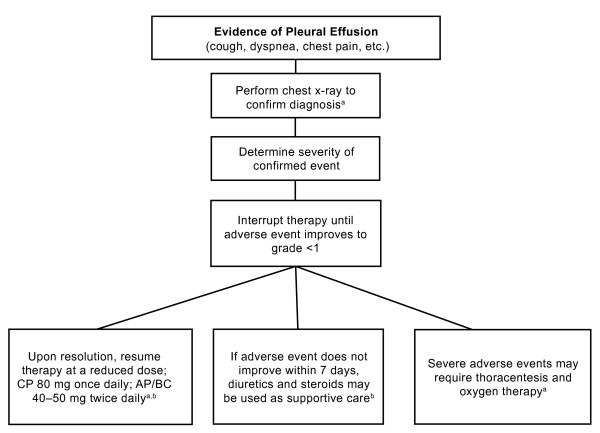
“Patients should be educated to eport symptoms of chest pain, dyspnea, and dry cough as oon as they occur.(48) If pleural effusion is confirmed by X-ray, reatment interruption is suggested until the AE improves to rade 1; oral steroids can quickly reduce symptoms.”
BackgroundConchon, M., Freitas, C. M. B. D. M., Rego, M. A. D. C., & Braga, J. W. R. (2010) · Revista Brasileira de Hematologia e Hemoterapia · doi:10.5581/1516-8484.20110034 · Cited by 42
“The degree of dyspnea is correlated with the extent of pleural effusion.(21) The diagnosis must be confirmed by an imaging scan (chest X-ray).”
BackgroundInfluentialNovo, G., Lisi, D. D., Bronte, E., Macaione, F., Accurso, V., Badalamenti, G., Rinaldi, G., Siragusa, S. M., Novo, S., & Russo, A. D. (2020) · Oncology · doi:10.1159/000505486 · Cited by 39
Kim, K. W., Shinagare, A. B., Krajewski, K. M., Pyo, J., Tirumani, S. H., Jagannathan, J. P., & Ramaiya, N. H. (2015) · Korean Journal of Radiology · doi:10.3348/kjr.2015.16.2.304 · Cited by 38
“Dasatinib, which is also an ABL inhibitor like imatinib, specifically causes pleural and pericardial effusion without subcutaneous edema, through its preferential action on the Src kinases within the pleural and pericardial mesothelial cells (22).”
BackgroundEşkazan, A. E., Soysal, T., Öngören, Ş., Gültürk, E., Ferhanoğlu, B., & Aydın, Y. (2011) · Haematologica · doi:10.3324/haematol.2011.040048 · Cited by 31
“Pleural effusions occurring during dasatinib are managed by treatment interruption and supportive therapy.(4)”
BackgroundManaging chronic myeloid leukemia patients intolerant to tyrosine kinase inhibitor therapy
DeAngelo, D. J. (2012) · Blood Cancer Journal · doi:10.1038/bcj.2012.30 · Cited by 29
Barclay, R. A., Mensah, G. A., Cowen, M., DeMarino, C., Kim, Y., Pinto, D. O., Erickson, J. W., & Kashanchi, F. (2020) · Viruses · doi:10.3390/v12060665 · Cited by 28
“Another caveat we sought to address was the specificity of dasatinib, which has been shown to inhibit other kinases besides c‐Src [61].”
BackgroundMethodDasatinib-Induced Chylothorax in Chronic Myeloid Leukemia
Baloch, Z. Q., Abbas, S. A., Bhatti, H., Braver, Y., & Ali, S. K. (2017) · Baylor University Medical Center Proceedings · doi:10.1080/08998280.2017.11929535 · Cited by 25
Cobll1 is linked to drug resistance and blastic transformation in chronic myeloid leukemia
Sh, H., Kim, S.-H., Kim, H.-J., Lee, Y., Choi, S.-Y., Park, G., Kim, J. H., Lee, A., Kim, Y., Choi, J.-M., et al. (2017) · Leukemia · doi:10.1038/leu.2017.72 · Cited by 25
Mehra, N., Varmeziar, A., Chen, X., Kronick, O., Fisher, R., Kota, V. K., & Mitchell, C. S. (2022) · Cancers · doi:10.3390/cancers14194686 · Cited by 23
“Imatinib and dasatinib had strong associations with edema [54].”
BackgroundDankwa, S., Dols, M.-M., Wei, L., Glennon, E. K. K., Kain, H. S., Kaushansky, A., & Smith, J. D. (2021) · Cell chemical biology · doi:10.1016/j.chembiol.2021.06.004 · Cited by 20
Wong, S., & Mirshahidi, H. (2011) · Annals of Pharmacotherapy · doi:10.1345/aph.1p784 · Cited by 17
Huang, J., Cai, J., Ye, Q., Jiang, Q., Lin, H., & Wu, L. (2023) · BMJ Open · doi:10.1136/bmjopen-2022-071456 · Cited by 16
Giehl, M., Leitner, A., Haferlach, C., DUESBERG, P. H., Hofmann, W., Hofheinz, R., Seifarth, W., Hochhaus, A., & Fabarius, A. C. (2010) · European Journal Of Haematology · doi:10.1111/j.1600-0609.2010.01459.x · Cited by 15
Dasatinib Induced Cardiac Tamponade- A Rare Association
Wattal, S. (2017) · JOURNAL OF CLINICAL AND DIAGNOSTIC RESEARCH · doi:10.7860/jcdr/2017/24633.9418 · Cited by 14
Cellier, M., Bourneau‐Martin, D., Abbara, C., Crosnier, A., Lagarce, L., Garnier, A., & Briet, M. B. (2023) · Cancers · doi:10.3390/cancers15072041 · Cited by 15
Kaiafa, G. D., Kakaletsis, N., Savopoulos, C. G., Perifanis, V., Giannouli, A., Papadopoulos, N., Zisekas, S., & Hatzitolios, A. I. (2013) · Journal of Clinical Pharmacy and Therapeutics · doi:10.1111/jcpt.12107 · Cited by 13
“Pleural effusions are the most common extra-haematological toxicity observed during dasatinib treatment.(11,12) Pathogenesis of pleural effusions is still unclear: a possible role of cytokines such as platelet-derived growth factor receptor (PDGFR)-b and vascular endothelial growth factor (VEGF) in causing endothelial…”
BackgroundOzaki, K., Ohkubo, T., Yamada, T., Yoshioka, K., Ichijo, M., Majima, T., Kudo, S., Akashi, T., Honda, K., Ito, E., et al. (2018) · Internal Medicine · doi:10.2169/internalmedicine.1238-18 · Cited by 13
“This effect may be because these drugs bind an off-target kinase (PDGFR beta expressed in pericytes), perhaps triggering an autoimmune reaction (14-17).”
BackgroundKeraliya, A. R., Rosenthal, M. H., Krajewski, K. M., Jagannathan, J. P., Shinagare, A. B., Tirumani, S. H., & Ramaiya, N. H. (2015) · American Journal of Roentgenology · doi:10.2214/ajr.15.14459 · Cited by 12
“Baseline chest radiography is recommended before starting therapy with dasatinib, and patients are asked to report symptoms such as chest pain, dyspnea, and dry cough promptly during the course of treatment [52] (Fig.”
BackgroundGuérin, A., Wu, E. Q., Bollu, V. K., Williams, D., Guo, A. X., de Leon, D. P., & Quintás‐Cardama, A. (2012) · Journal of Medical Economics · doi:10.3111/13696998.2012.693896 · Cited by 9
Clinical and Nonclinical Adverse Effects of Kinase Inhibitors
Keller, D. A., Brennan, R., & Leach, K. L. (2015) · Methods and principles in medicinal chemistry · doi:10.1002/9783527673643.ch16 · Cited by 8
Dasatinib-Induced Pleural and Pericardial Effusions
Hailan, Y. M. A., Elyas, A. A., Abdulla, M. A.-J., & Yassin, M. A. (2021) · Cureus · doi:10.7759/cureus.19024 · Cited by 7
“Treatment of dasatinib-induced pleural effusions is dose interruption, introducing diuretics with or without steroids [8-10].”
BackgroundSevere dyspnoea in a patient with chronic myelogenous leukaemia on a tyrosine kinase inhibitor
Ustun, C., Randall, N., Podgaetz, E., Amin, K., & Dincer, E. H. (2015) · Thorax · doi:10.1136/thoraxjnl-2015-206841 · Cited by 7
Imaging of Chemotherapy-related Iatrogenic Abdominal and Pelvic Conditions
Viswanathan, C., Truong, M. T., Sagebiel, T. L., Garg, N., & Bhosale, P. (2014) · Radiologic Clinics of North America · doi:10.1016/j.rcl.2014.05.008 · Cited by 7
“targeted therapies TKIs, dasatinib, erlotinib, imatinib, and sunitinib, may cause fluid retention.(44) In one series, fluid retention/edema was seen in 71% of patients treated with imatinib for chronic myelogenous leukemia.”
BackgroundBurden of Tyrosine Kinase Inhibitor Failure in Patients with Chronic Myeloid Leukemia
Barnes, P. K. G. (2015) · Journal of Leukemia · doi:10.4172/2329-6917.1000170 · Cited by 6
“Pleural effusion (PE) is a side effect that occurs very infrequently during imatinib treatment (0% to 2%) [55] and nilotinib treatment (1%) [56], but it is a relatively common side effect during dasatinib therapy (14% to 30%) [57].”
BackgroundAoyama, R., Ishikawa, J., & Harada, K. (2019) · Journal of Cardiology · doi:10.1016/j.jjcc.2019.07.008 · Cited by 6
Pasquale, R., Bucelli, C., Bellani, V., Zappa, M., Iurlo, A., & Cattaneo, D. (2022) · Frontiers in Oncology · doi:10.3389/fonc.2022.1012268 · Cited by 6
Pleural Effusion: A Rare Side Effect of Nilotinib—A Case Report
Teke, H. Ü., Akay, O. M., Sahin, D. G., Karagülle, M., Gündüz, E., & Andıç, N. (2014) · Case Reports in Medicine · doi:10.1155/2014/203939 · Cited by 6
“The incidence of dasatinib related pleural effusion is about 7–35% [2].”
BackgroundSpontaneous regression of dasatinib-related primary effusion lymphoma-like lymphoma
Hayashino, K., Meguri, Y., Yukawa, R., Komura, A., Nakamura, M., Yoshida, C., Yamamoto, K., Oda, W., & Imajo, K. (2022) · International Journal of Hematology · doi:10.1007/s12185-022-03449-y · Cited by 5
Johnson, G., Baviriseaty, N., Massanet, N. F., & Kooper, J. (2023) · Journal of Oncology Pharmacy Practice · doi:10.1177/10781552231171925 · Cited by 5
Satoh, K., Morisawa, S., Okuyama, M., & Nakae, H. (2021) · BMJ Case Reports · doi:10.1136/bcr-2021-243671 · Cited by 5
Kelly, K. R., Swords, R. T., Mahalingam, D., & Giles, F. J. (2010) · Leukemia & lymphoma/Leukemia and lymphoma · doi:10.3109/10428194.2010.491135 · Cited by 5
“Effusions are most commonly treated with dose interruption until the effusion resolves to less than grade 1 [55].”
BackgroundErratum: Cobll1 is linked to drug resistance and blastic transformation in chronic myeloid leukemia
Han, S. H., Kim, S.-H., Kim, H.-J., Lee, Y., Choi, S.-Y., Park, G.-H., Kim, D.-H., Lee, A., Kim, J. H., Choi, J.-M., et al. (2017) · Leukemia · doi:10.1038/leu.2017.107 · Cited by 4
Hwang, W., Chen, T., Lin, H., Chang, M., Hsiao, P., Bai, L., Kuo, C., Chen, Y., Liu, T., Gau, J., et al. (2022) · International Journal of Hematology · doi:10.1007/s12185-022-03311-1 · Cited by 3
“9% in the multicenter phase III study that led to its approval), but these events were relatively uncommon with nilotinib treatment [17].”
Background7.10 Cell-Extracellular Matrix Mechanobiology in Cancer
Kumar, S. (2012) · Elsevier eBooks · doi:10.1016/b978-0-12-374920-8.00712-8 · Cited by 3
Pleural Effusion Secondary to Dasatinib Following Allogenic Hematopoietic Stem Cell Transplantation
Alrubaye, R., Fadel, C. A., Adewunmi, C. Y., & Lopez, L. D. R. (2021) · American Journal of Case Reports · doi:10.12659/ajcr.932711 · Cited by 2
“Thoracentesis is strongly recommended in patients with massive bilateral pleural effusions with hypoxia [12] and to exclude alternative causes, especially in patients with a high risk of infection secondary to recent HSCT, as in the present case.”
BackgroundWu, W., Chen, R.-F., Cheng, C.-C., Wei, J.-L., Lin, C.-F., You, R.-I., Chen, Y., Lee, M., & Chen, Y. (2022) · Pharmaceutics · doi:10.3390/pharmaceutics14122698 · Cited by 2
Abdelmaksoud, B. (2019) · Biomedical Journal of Scientific & Technical Research · doi:10.26717/bjstr.2019.19.003233 · Cited by 2
“5 per 100,000 population incidence rate every year in US and accounted for about 15% of all leukemia’s in adults [7].”
BackgroundPonatinib use in two pediatric patients with relapsed Ph + ALL with ABL1 kinase domain mutations
Gruner, S. E., Sayeed, H., Ferguson, L. S., Perez, C. R., Rouce, R. H., Fisher, K. E., & Rau, R. E. (2019) · Pediatric Hematology and Oncology · doi:10.1080/08880018.2019.1656685 · Cited by 2
“Fluid retention, specifically pleural effusion, is a known toxicity of all TKIs, reported most commonly with dasatinib.(15) Based on a single-arm, open-label, international, multicenter trial in 449 adult patients with CML or PhþALL treated with ponatinib, fluid retention of any grade occurred in 23% (103/ 449) of pat…”
BackgroundDasatinib-induced cervicofacial oedema in chronic myeloid leukaemia blast crisis
Ledesma, M. M. P., Amadore, R. A., Ong, A. J., & Quero-Taggaoa, A. K. H. (2026) · BMJ Case Reports · doi:10.1136/bcr-2026-275506 · Cited by 1
Dasatinib in the first-line treatment of chronic myeloid leukemia
Ault, P. S. (2012) · Community Oncology · doi:10.1016/j.cmonc.2012.10.004 · Cited by 1
Salih, A. K. S. U. (2012) · International Journal of Hematology and Oncology · doi:10.4999/uhod.12003 · Cited by 1
Treatment with Tyrosine Kinase Inhibitors in Chronic Myeloproliferative Neoplasms: Pros and Cons
Khaled, S. A. A. (2016) · American Journal of Internal Medicine · doi:10.11648/j.ajim.20160404.12 · Cited by 1
“[39] When considering hematological side effects isolated cytopenia occurred when TKIs used as first line drugs, while pancytopenia occurred when they were used as second line.”
BackgroundColitis and chronic bleeding in patients treated with dasatinib
Campiotti, L., Suter, M. B., Elena, B., Uccella, S., Am, G., & Guasti, L. (2017) · Journal of Cancer Research & Therapy · doi:10.14312/2052-4994.2017-6 · Cited by 1
“The most common side effect of dasatinib is hematologic toxicity, while the most common non-hematologic side effects are pleural and pericardial effusions [1].”
BackgroundDasatinib: A rare cause of recurrent cardiac tamponade
Akçay, M., & Çoksevim, M. (2022) · Journal of Experimental and Clinical Medicine · doi:10.52142/omujecm.39.2.59 · Cited by 1
“diuretics, short-term corticosteroid therapy, fluid drainage, and modification in CML maintenance therapy (13,14).”
BackgroundPulmonary Toxicity of Imatinib and Other BCR-ABL Tyrosine Kinase Inhibitors
Vincent, F. (2010) · Springer eBooks · doi:10.1007/978-3-642-15742-4_63
“Guidelines for managing pleural effusions during dasatinib treatment have been developed (Fig. 63.1) [ 24 , 28].”
BackgroundInfluentialMesilato de imatinib induzindo derrame pleural bilateral e tamponamento cardíaco
Kulchetscki, R. M., Vieira, A. C., Cury, V. B. S., dos Santos, F. D., Marques, G. L., & Magalhães, F. L. G. M. (2015) · Revista Médica da UFPR · doi:10.5380/rmu.v2i1.40674
Missiry, E., & Ahmed, M. M. M. (2017)
Cardiovascular Damage Induced by Anti-BCR-ABL TKIs
Novo, G., Lisi, D. D., Fiúza, M., & Pinto, F. J. (2018) · Current clinical pathology · doi:10.1007/978-3-319-93402-0_6
Onkolojide Moleküler Hedefli Tedaviler
Teker, H. T., Gökoğlu, M., Yılmaz, H. Ö., Yurtsever, İ., Duran, G. G., Işık, U., Tacar, S. Y., Demir, N., Yıldız, H. İ., Aslan, F., et al. (2022) · Akademisyen Kitabevi eBooks · doi:10.37609/akya.1478
Missiry, M. E. (2017) · Työväentutkimus Vuosikirja
Pleural effusion in GIST: Imatinib, an unforeseen culprit
Jacob, A., & Zacharia, G. S. (2026) · Journal of Rare Diseases · doi:10.1007/s44162-026-00158-6
“Also, TKI inhibitors are reported to cause T-cell dysfunction contributing to immune perturbations [10, 11].”
Zhang, X., Jhou, H., Chen, H.-Y., Xiao, N., Chen, P., & Lee, C. (2026) · JCO Oncology Practice · doi:10.1200/op-25-01316
Abdulla, K. N., Hade, I. M., Jumaa, A., Hussein, S., Abdulkareem, A., & Yasin, Y. S. (2026) · Asian Pacific Journal of Cancer Prevention · doi:10.31557/apjcp.2026.27.10.3755
“The physiological underpinnings of this association are not immediately apparent, but may be attributable to dasatinib’s well-documented effects on fluid retention and renal tubular dysfunction [35].”
Leczenie celowane przewlekłej białaczki szpikowej a układ sercowo-naczyniowy
Szmit, S., Wiktor-Jędrzejczak, W., & Torbicki, A. (2013) · Oncoreview
Metadata
- Authors
- Masiello, D., Gorospe, G., & Yang, A. S.
- Affiliations
- University of Southern California (US)
- Corresponding author
- Yang, Allen S
- Venue
- Journal of Hematology & Oncology
- Published
- 2009-11-12
- Volume
- 2
- Issue
- 1
- Pages
- 46-46
- ISSN
- 1756-8722 (ISSN-L)
- PMC
- PMC2785832
- OpenAlex
- W2120222130
- Cited by
- 66
- References
- 30
- Citations by year
- 2026: 3 · 2024: 1 · 2023: 3 · 2022: 6 · 2021: 6 · 2020: 2 · 2019: 3 · 2018: 2 · 2017: 6 · 2016: 2 · 2015: 8 · 2014: 2 · 2013: 4 · 2012: 8
- FWCI
- 3.78
- Type
- journal article
- Language
- en
- Open access
- gold
- doi.org
- Licence
- cc-by
- creativecommons.org/licenses/by/2.0 (tdm)
- Locations
- Journal of Hematology & Oncology (publishedVersion, cc-by)
- PubMed Central (publishedVersion, cc-by)
- PubMed (publishedVersion)
- DOAJ (DOAJ: Directory of Open Access Journals) (submittedVersion)
- Funders
- Kenneth T. and Eileen L. Norris Foundation
- Bristol-Myers Squibb
- Celgene
- Eisai
- Topics
- Health Sciences › Medicine › Hematology › Chronic Myeloid Leukemia Treatments
- Health Sciences › Medicine › Hematology › Chronic Lymphocytic Leukemia Research
- Life Sciences › Pharmacology, Toxicology and Pharmaceutics › Toxicology › Pharmacovigilance and Adverse Drug Reactions
- Keywords
- fluid retention, pleural effusion, dasatinib, tyrosine kinase inhibitors, chronic myeloid leukemia, nilotinib, imatinib, dose interruption, dose reduction, adverse drug reactions, second-line therapy
- MeSH terms
- Dasatinib, Algorithms, Humans, Pleural Effusion, Protein-Tyrosine Kinases, Pyrimidines, Thiazoles, Water-Electrolyte Imbalance, Leukemia, Myelogenous, Chronic, BCR-ABL Positive, Incidence, Protein Kinase Inhibitors
About these checks
Registry, retraction, Cites and statistics results are computed, not judged, with one exception: a printed reference that no index lists is read once by a model before it counts as a citation error. Claims are extracted by a model and kept only when their quote appears verbatim in the text; each cited source is then checked, with a model’s help, for whether it says what the claim relies on. Those verdicts can be wrong — read the claim’s quote and the cited source before relying on one.
Statistics and arithmetic are recomputed, not judged.
Confidence bands are shown only for fields calibrated on our annotated test set. None is calibrated yet, so no band is shown.
What counts as a claim ›How we measure confidence ›How we check this ›
Are you an author, or do you see a problem with this page? Request a review
Data sources
Bibliographic data: Semantic Scholar, OpenAlex, Crossref.
Contains information from the Semantic Scholar Academic Graph Datasets, made available under the ODC Attribution License (ODC-BY 1.0).
Semantic Scholar’s data is described in: Kinney, R., et al. (2023). The Semantic Scholar Open Data Platform. arXiv:2301.10140.
