

Understanding of and adherence to advice after telephone counselling by nurse: a survey among callers to a primary emergency out-of-hours service in Norway
Open accessThe DOI matches its Crossref record; 30 of the 30 references it cites were found in a registry or an index.
Abstract
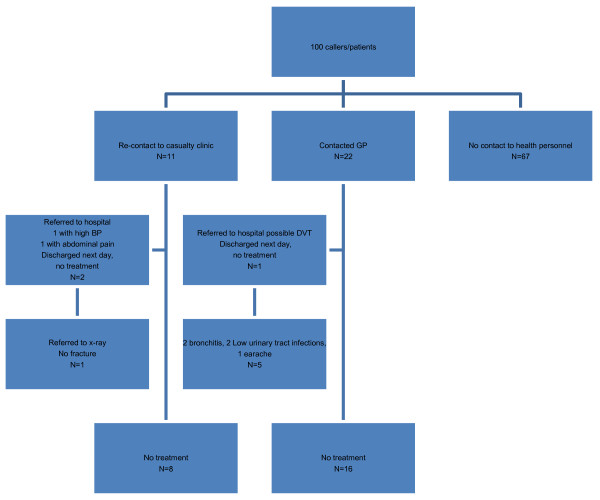
BACKGROUND: To investigate how callers understand the information given by telephone by registered nurses in a casualty clinic, to what degree the advice was followed, and the final outcome of the condition for the patients. METHODS: The study was conducted at a large out-of-hours inter-municipality casualty clinic in Norway during April and May 2010. Telephone interviews were performed with 100 callers/patients who had received information and advice by a nurse as a sole response. Six topics from the interview guide were compared with the telephone record files to check whether the caller had understood the advice. In addition, questions were asked about how the caller followed the advice provided and the patient's outcome. RESULTS: 99 out of 100 interviewed callers stated that they had understood the nurse's advice, but interpreted from the telephone records, the total agreement for all six topics was 82.6%. 93 callers/patients stated that they followed the advice and 11 re-contacted the casualty clinic. 22 contacted their GP for the same complaints the same week, of whom five patients received medical treatment and one was hospitalised. There were significant difference between the native-Norwegian and the non-native Norwegian regarding whether they trusted the nurse (p = 0.017), and if they got relevant answers to their questions (p = 0.005). CONCLUSION: Callers to the out-of-hours service seem to understand the advice given by the registered nurses, and a large majority of the patients did not contact their GP or other health services again with the same complaints. PRACTICE IMPLICATION: Medical and communicative training must be an important part of the continuous improvement strategy within the out-of-hour services.
Overview
The claims and statistics of this paper haven’t been checked yet.
Free: it reads the open-access text and checks the first 5 claims that cite a source we can check. Create a free account to check every claim.
Integrity signals
Registry
Cites
Statistics
Figures
Verification
Claims the paper makes
The claims and statistics of this paper haven’t been checked yet.
Free: it reads the open-access text and checks the first 5 claims that cite a source we can check. Create a free account to check every claim.
Self-check
Percentages, sums and reported differences re-computed from the paper’s own numbers.
The self-check needs the paper’s full text.
Citations
Cites
Substitution of doctors by nurses in primary care
Laurant, M., Reeves, D., Hermens, R., Braspenning, J., Grol, R., & Sibbald, B. (2005) · Cochrane Database of Systematic Reviews · doi:10.1002/14651858.cd001271.pub2 · Cited by 935 · cited 2×
“[5] Did the caller get information on why a patient could wait and see in that particular situation? If relevant, the reason for why they could wait and see was written down.”
BackgroundLattimer, V., George, S., Thompson, F., Thomas, E., Mullee, M., Turnbull, J., Smith, H., Moore, M., Bond, H., & Glasper, A. (1998) · BMJ · doi:10.1136/bmj.317.7165.1054 · Cited by 371 · cited 3×
“Some previous studies indicate that advice given by nurses only delay consultation by a general practitioner [GP], while other studies claim to show that nurse advice reduce the GP’s workload [8-14].”
ResultTelephone consultation and triage: effects on health care use and patient satisfaction
Bunn, F., Byrne, G., & Kendall, S. (2004) · Cochrane Database of Systematic Reviews · doi:10.1002/14651858.cd004180.pub2 · Cited by 241 · cited 1×
“Some previous studies indicate that advice given by nurses only delay consultation by a general practitioner [GP], while other studies claim to show that nurse advice reduce the GP’s workload [8-14].”
ResultBunn, F., Byrne, G., & Kendall, S. A. (2005) · Europe PMC (PubMed Central) · doi:10.25405/ncl.34619904 · Cited by 236
‘Your ears become your eyes’: managing the absence of visibility in NHS Direct
Pettinari, C. J., & Jessopp, L. (2001) · Journal of Advanced Nursing · doi:10.1046/j.1365-2648.2001.02031.x · Cited by 136 · cited 1×
“Nurses need to be aware of the caller’s vulnerability and try to build a relationship of trust quite early in the conversation [26].”
BackgroundTelephone nurses' experience of problems with telephone advice in Sweden
Wahlberg, A. C., Cedersund, E., & Wredling, R. (2003) · Journal of Clinical Nursing · doi:10.1046/j.1365-2702.2003.00702.x · Cited by 117 · cited 2×
“Telephone consultation and triage by nurses constitute an important and central part of the out-of-hours services in several countries [1-7].”
BackgroundQuality of communication during telephone triage at Dutch out-of-hours centres
Derkx, H., Rethans, J., Maiburg, B., Winkens, R. A. G., Muijtjens, A. M. M., van Rooij, H., & Knottnerus, J. A. (2009) · Patient Education and Counseling · doi:10.1016/j.pec.2008.08.002 · Cited by 89 · cited 1×
“Telephone consultation and triage by nurses constitute an important and central part of the out-of-hours services in several countries [1-7].”
BackgroundOperators' experiences of emergency calls
Forslund, K., Kihlgren, A. L., & Kihlgren, M. (2004) · Journal of Telemedicine and Telecare · doi:10.1258/1357633042026323 · Cited by 75 · cited 1×
“Good medical knowledge and communication skills are necessary to meet the callers’ needs, and callers’/patients’ levels of knowledge vary [27-29].”
BackgroundTelephone nursing: Calls and caller satisfaction
Wahlberg, A. C., & Wredling, R. (1999) · International Journal of Nursing Practice · doi:10.1046/j.1440-172x.1999.00179.x · Cited by 72 · cited 2×
“Several papers state that patients generally have a good understanding of the advice given, but very few compare the patient’s answers with a telephone record file [13,15-20].”
BackgroundResultEmergency Communications with Limited-English-Proficiency Populations
Meischke, H. W., Chavez, D., Bradley, S., Rea, T. D., & Eisenberg, M. S. (2010) · Prehospital Emergency Care · doi:10.3109/10903120903524948 · Cited by 63 · cited 1×
“Good medical knowledge and communication skills are necessary to meet the callers’ needs, and callers’/patients’ levels of knowledge vary [27-29].”
Background
Cited by
The Empirical Foundations of Telemedicine Interventions in Primary Care
Bashshur, R. L., Howell, J. D., Krupinski, E. A., Harms, K. M., Bashshur, N., & Doarn, C. R. (2016) · Telemedicine and e-Health · doi:10.1089/tmj.2016.0045 · Cited by 370
“’’ Another survey (n = 100) was conducted in Norway in 2011, which focused on patients’ understanding of and adherence to advice of telephone counseling by nurses.(64) The survey was conducted by telephone with patients who had received counseling by a nurse over the telephone during off-hours.”
Malpractice claims regarding calls to Swedish telephone advice nursing: what went wrong and why?
Ernesäter, A., Winblad, U., Engström, M., & Holmström, I. K. (2012) · Journal of Telemedicine and Telecare · doi:10.1258/jtt.2012.120416 · Cited by 71
Ernesäter, A., Engström, M., Winblad, U., & Holmström, I. K. (2014) · BMJ Open · doi:10.1136/bmjopen-2014-005961 · Cited by 50
Tran, D. T., Gibson, A., Randall, D., Havard, A., Byrne, M. W., Robinson, M., Lawler, A., & Jorm, L. R. (2017) · BMC Health Services Research · doi:10.1186/s12913-017-2458-y · Cited by 35
“Although follow-up surveys or phone interviews are able to identify the reasons why patients did not follow the advice provided, these study designs are subject to bias in selfreport of compliance [13, 14] and relatively small sample size [12, 13, 15, 16].”
BackgroundTelephone triage utilization among patients with limited English proficiency
Njeru, J. W., Damodaran, S., North, F., Jacobson, D. J., Wilson, P. M., Sauver, J. L. S., Breitkopf, C. R., & Wieland, M. L. (2017) · BMC Health Services Research · doi:10.1186/s12913-017-2651-z · Cited by 32
“Non-native Swedish speakers utilized a national phone triage service less frequently compared to native speakers, while non-native Norwegian speakers reported less trust in recommendation/advise given to them by nurses through telephone triage [18, 19].”
Background
Metadata
- Authors
- Hansen, E., & Hunskaar, S.
- Affiliations
- University of Bergen (NO)
- Corresponding author
- Hansen, Elisabeth
- ORCID
- Hunskaar, Steinar
- Venue
- Scandinavian Journal of Trauma, Resuscitation and Emergency Medicine
- Published
- 2011
- Volume
- 19
- Issue
- 1
- Pages
- 48
- ISSN
- 1757-7241 (ISSN-L)
- PMC
- PMC3177778
- OpenAlex
- W2168054237
- Semantic Scholar
- ebe1c79473351df03486aa515921872975e33d65
- Cited by
- 28
- References
- 29
- Citations by year
- 2025: 1 · 2024: 7 · 2022: 1 · 2021: 1 · 2020: 1 · 2019: 4 · 2018: 1 · 2017: 4 · 2016: 1 · 2014: 4 · 2013: 2 · 2012: 1
- FWCI
- 2.59
- Type
- journal article
- Language
- en
- Open access
- gold
- doi.org
- Licence
- cc-by
- Locations
- Scandinavian Journal of Trauma Resuscitation and Emergency Medicine (publishedVersion, cc-by)
- PubMed Central (publishedVersion, cc-by)
- PubMed (publishedVersion)
- NORA - Norwegian Open Research Archives (submittedVersion, cc-by)
- DOAJ (DOAJ: Directory of Open Access Journals) (submittedVersion)
- Topics
- Health Sciences › Medicine › Emergency Medicine › Emergency and Acute Care Studies
- Health Sciences › Health Professions › General Health Professions › Patient-Provider Communication in Healthcare
- Health Sciences › Health Professions › General Health Professions › Health Literacy and Information Accessibility
- Keywords
- telephone counseling, patient understanding, patient trust, non-native speakers, patient outcomes
- MeSH terms
- Adolescent, Adult, Aged, Child, Child, Preschool, Counseling, Emergencies, Emergency Service, Hospital, Female, Humans, Infant, Infant, Newborn, Male, Middle Aged, Norway, Nurses, Patient Compliance, Surveys and Questionnaires, Retrospective Studies, Remote Consultation, After-Hours Care, Young Adult
About these checks
Registry, retraction, Cites and statistics results are computed, not judged, with one exception: a printed reference that no index lists is read once by a model before it counts as a citation error. Claims are extracted by a model and kept only when their quote appears verbatim in the text; each cited source is then checked, with a model’s help, for whether it says what the claim relies on. Those verdicts can be wrong — read the claim’s quote and the cited source before relying on one.
Statistics and arithmetic are recomputed, not judged.
Confidence bands are shown only for fields calibrated on our annotated test set. None is calibrated yet, so no band is shown.
What counts as a claim ›How we measure confidence ›How we check this ›
Are you an author, or do you see a problem with this page? Request a review
How to cite
Cite CoChat for the checks on this page, and the paper for its own findings.
- This page
- CoChat. (2026). Citation check: Understanding of and adherence to advice after telephone counselling by nurse: a survey among callers to a primary emergency out-of-hours service in Norway. https://app.cochat.ai/papers/10.1186/1757-7241-19-48
- The paper
- Hansen, E., & Hunskaar, S. (2011). Understanding of and adherence to advice after telephone counselling by nurse: a survey among callers to a primary emergency out-of-hours service in Norway. Scandinavian Journal of Trauma, Resuscitation and Emergency Medicine. https://doi.org/10.1186/1757-7241-19-48
Data sources
Bibliographic data: Semantic Scholar, OpenAlex, Crossref.
Contains information from the Semantic Scholar Academic Graph Datasets, made available under the ODC Attribution License (ODC-BY 1.0).
Semantic Scholar’s data is described in: Kinney, R., et al. (2023). The Semantic Scholar Open Data Platform. arXiv:2301.10140.
