

The DOI matches its Crossref record; 34 of the 34 references it cites were found in a registry or an index.
Improving IQ measurement in intellectual disabilities using true deviation from population norms
Open accessAbstract
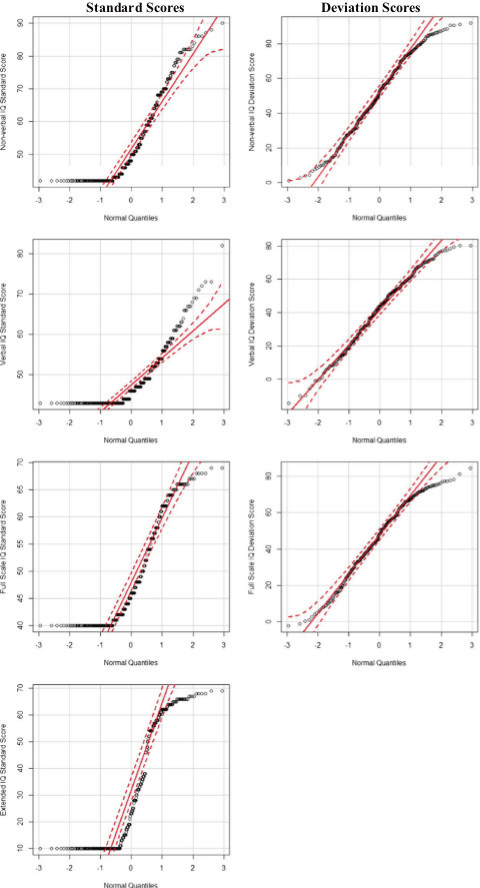
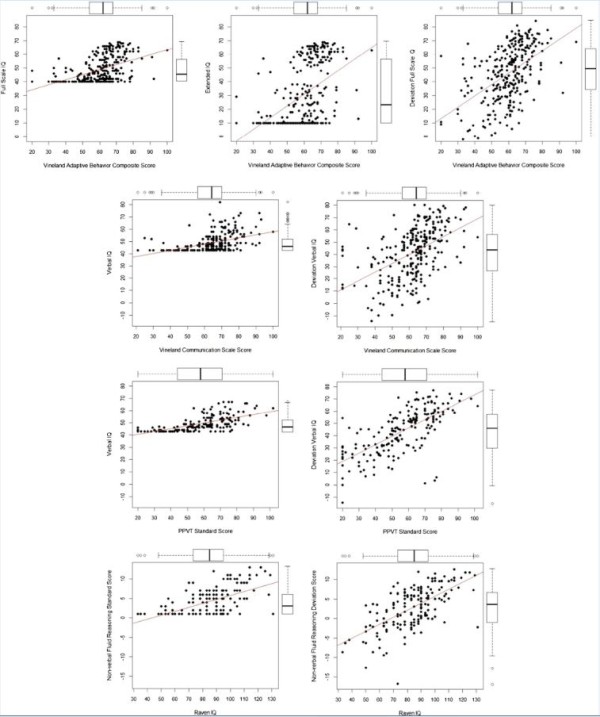
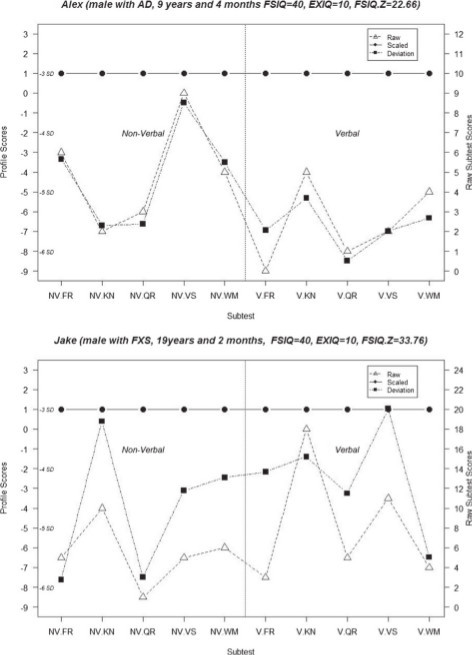
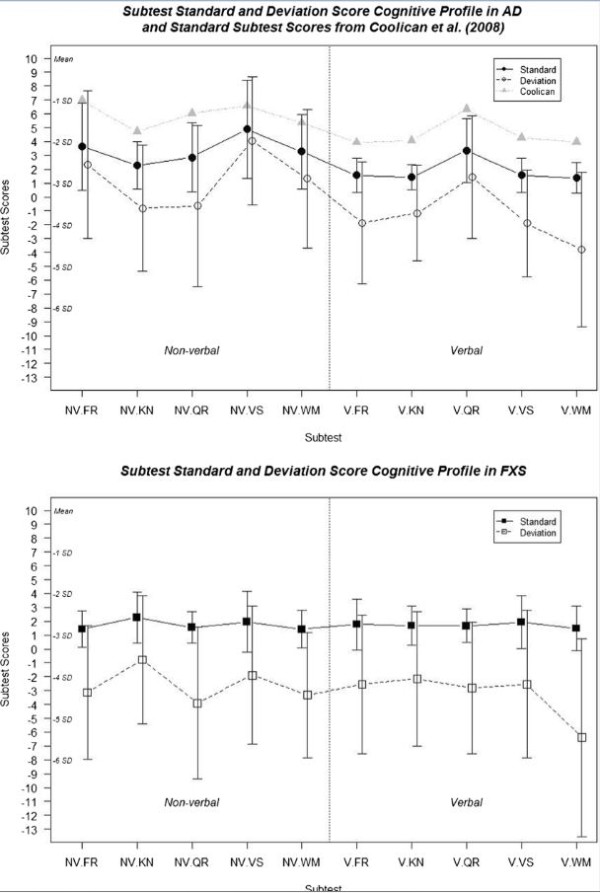
BACKGROUND: Intellectual disability (ID) is characterized by global cognitive deficits, yet the very IQ tests used to assess ID have limited range and precision in this population, especially for more impaired individuals. METHODS: We describe the development and validation of a method of raw z-score transformation (based on general population norms) that ameliorates floor effects and improves the precision of IQ measurement in ID using the Stanford Binet 5 (SB5) in fragile X syndrome (FXS; n = 106), the leading inherited cause of ID, and in individuals with idiopathic autism spectrum disorder (ASD; n = 205). We compared the distributional characteristics and Q-Q plots from the standardized scores with the deviation z-scores. Additionally, we examined the relationship between both scoring methods and multiple criterion measures. RESULTS: We found evidence that substantial and meaningful variation in cognitive ability on standardized IQ tests among individuals with ID is lost when converting raw scores to standardized scaled, index and IQ scores. Use of the deviation z- score method rectifies this problem, and accounts for significant additional variance in criterion validation measures, above and beyond the usual IQ scores. Additionally, individual and group-level cognitive strengths and weaknesses are recovered using deviation scores. CONCLUSION: Traditional methods for generating IQ scores in lower functioning individuals with ID are inaccurate and inadequate, leading to erroneously flat profiles. However assessment of cognitive abilities is substantially improved by measuring true deviation in performance from standardization sample norms. This work has important implications for standardized test development, clinical assessment, and research for which IQ is an important measure of interest in individuals with neurodevelopmental disorders and other forms of cognitive impairment.
Overview
The claims and statistics of this paper haven’t been checked yet.
Run the check — free, no account needed. It reads the open-access text and checks the sources it cites.
Integrity signals
Registry
Cites
Statistics
Figures
Verification
Claims the paper makes
The claims and statistics of this paper haven’t been checked yet.
Run the check — free, no account needed. It reads the open-access text and checks the sources it cites.
Claims other papers make about this one
Each is checked against this paper’s own text: does it say what the citing paper says it does?
The cited source says what the claim attributes to it.
In the citing paper
“However, a particular challenge for measuring change in ID is the potential for floor effects (Hessl et al., 2009; Sansone et al., 2014), which may lead to a mischaracterization of a potentially meaningful change over time in individuals with ID (Bishop et al., 2015; Thurm et al., 2020).”
From NIH Toolbox Cognition Battery Feasibility in Individuals With Williams Syndrome (2022) · cites this paper as Sansone et al., 2014
In the citing paper
“re-scoring of the Wechsler Intelligence Scale for Children (WISC)92 and Stanford–Binet10 for populations with intellectual disability has been completed, yielding much more sensitive estimates of true ability below the traditional test floor.”
From Drug development for neurodevelopmental disorders: lessons learned from fragile X syndrome (2018) · cites this paper as [10]
Self-check
Percentages, sums and reported differences re-computed from the paper’s own numbers.
The self-check needs the paper’s full text.
Citations
Cites
R: A Language and Environment for Statistical Computing
R Core Team (2000) · doi:10.32614/r.manuals · Cited by 355,893
Diagnostic and Statistical Manual of Mental Disorders
American Psychiatric Association (2013) · doi:10.1176/appi.books.9780890425596 · Cited by 116,369
Diagnostic and Statistical Manual of Mental Disorders
Williams, J. B. W., & First, M. B. (2013) · Oxford University Press eBooks · doi:10.1093/acrefore/9780199975839.013.104 · Cited by 109,845
Lord, C., Rutter, M., & Le Couteur, A. (1994) · Journal of Autism and Developmental Disorders · doi:10.1007/bf02172145 · Cited by 9,065
(1998) · Cited by 4,172
Peabody Picture Vocabulary Test
Campbell, J. M., & Dommestrup, A. K. (2010) · The Corsini Encyclopedia of Psychology · doi:10.1002/9780470479216.corpsy0649 · Cited by 3,787
Mullen Scales of Early Learning
Bradley‐Johnson, S. (1997) · Psychology in the Schools · doi:10.1002/(sici)1520-6807(199710)34:4 · Cited by 2,329
Epidemiological Surveys of Autism and Other Pervasive Developmental Disorders: An Update
Fombonne, E. (2003) · Journal of Autism and Developmental Disorders · doi:10.1023/a:1025054610557 · Cited by 1,505
Abnormal dendritic spines in fragile X knockout mice: Maturation and pruning deficits
Comery, T. A., Harris, J. B., Willems, P. J., Oostra, B. A., Irwin, S. A., Weiler, I. J., & Greenough, W. T. (1997) · Proceedings of the National Academy of Sciences · doi:10.1073/pnas.94.10.5401 · Cited by 1,046
Devys, D., Lutz, Y., Rouyer, N., Bellocq, J., & Mandel, J. (1993) · Nature Genetics · doi:10.1038/ng0893-335 · Cited by 781
Research works printed but not linked: 2
- Roid G: Stanford-Binet Intelligence Scales - Examiner’s Manual. 2003, Itasca, IL: Riverside Publishing, 5
- Sparrow S, Balla D, Cicchetti D: Vineland Adaptive Behavior Scales-Interview Edition. 1984, Circle Pines, MN: American Guidance Service
Cited by
Sorted by citations
Items 101–148 of 148
Vulnerability Heatmapping in Debris Management
Walker, R. G., Yoon, S., Chang, A., & Jung, J. (2024) · Journal of Management in Engineering · doi:10.1061/jmenea.meeng-5507 · Cited by 3
Thurman, A. J., Nunnally, A. D., Nguyen, V. H., Berry‐Kravis, E., Sterling, A. M., Edgin, J. O., Hamilton, D., Aschkenasy, J. R., & Abbeduto, L. (2024) · Journal of Autism and Developmental Disorders · doi:10.1007/s10803-024-06535-8 · Cited by 3
Self-citationScholle, P., Herrera, G., Sevilla, J., & Brosnan, M. (2020) · Journal of Enabling Technologies · doi:10.1108/jet-06-2020-0025 · Cited by 3
Green, E. M., & Stroud, L. A. (2023) · Health · doi:10.4236/health.2023.152010 · Cited by 3
Nowell, K. P., Goin‐Kochel, R. P., McQuillin, S. D., & Mire, S. S. (2017) · Review Journal of Autism and Developmental Disorders · doi:10.1007/s40489-017-0118-0 · Cited by 5
Condy, E. E., Kaat, A. J., Becker, L., Sullivan, N. R., Soorya, L. V., Berger, N. I., Berry‐Kravis, E., Michalak, C., & Thurm, A. E. (2021) · Research in Developmental Disabilities · doi:10.1016/j.ridd.2021.103993 · Cited by 3
Self-citationFarmer, C., Thurm, A. E., Troy, J. D., & Kaat, A. J. (2022) · doi:10.31234/osf.io/p4vjx · Cited by 3
Norris, J. E., Stefano, L. A. D., McKinney, W. S., Schmitt, L., Miyakoshi, M., Gross, C., Piloto, S., Heald, B., Pedapati, E. V., Erickson, C. A., et al. (2025) · medRxiv · doi:10.1101/2025.01.29.25321365 · Cited by 3
Anesthesia, extremely premature infants and full-scale intelligence quotient at 5 years of age
Fifen, J. J., Siddique, M., Lodha, A., Walker, A. M., Benlamri, A., Tang, S., Makarchuk, S., Lodha, A. K., & McAllister, D. L. (2025) · Pediatric Research · doi:10.1038/s41390-025-04023-y · Cited by 2
McKinney, W. S., Corsmeier, A., Dapore, A. E., Groß, C., Dominick, K. C., Erickson, C. A., & Schmitt, L. (2025) · Frontiers in Psychiatry · doi:10.3389/fpsyt.2025.1636987 · Cited by 2
Souski, H., Benmakhlouf, Y., & Mechita, M. B. (2025) · International Journal of Developmental Neuroscience · doi:10.1002/jdn.70054 · Cited by 3
Gene Therapy for Fragile X Syndrome, Challenges, and Promises
Velinov, M. T. (2025) · The Journal of Gene Medicine · doi:10.1002/jgm.70049 · Cited by 2
Ellis, K., Pearson, E., Murray, C. A., Jenner, L., Bissell, S., Trower, H., Smith, K., Groves, L., Jones, B., Williams, N. J., et al. (2023) · International review of research in developmental disabilities · doi:10.1016/bs.irrdd.2023.07.003 · Cited by 2
Berry‐Kravis, E. (2022) · American Journal on Intellectual and Developmental Disabilities · doi:10.1352/1944-7558-127.2.90 · Cited by 2
Self-citationProcessing Speed in Gifted Children: A Clinical Neuropsychological Perspective
Beljan, P., Gardner, J. M., & Homaijani, D. (2024) · Roeper Review · doi:10.1080/02783193.2024.2309396 · Cited by 2
Pedapati, E. V., Ethridge, L. E., DeStefano, L. A., Liu, Y., Miyakoshi, M., Sweeney, J. A., Schmitt, L., Gilbert, D. L., Wu, S. W., Liu, R., et al. (2022) · medRxiv · doi:10.1101/2022.05.10.22274929 · Cited by 2
Talbott, M. R., Dufek, S., & Young, G. (2023) · International review of research in developmental disabilities · doi:10.1016/bs.irrdd.2023.07.002 · Cited by 1
Relationship between anxiety and executive functioning among youth with Down syndrome
Snodgrass, N. A., Fidler, D. J., Patel, L., Denne, E., Smith, J. L., Weber, S., & Esbensen, A. J. (2025) · Research in Developmental Disabilities · doi:10.1016/j.ridd.2025.105056 · Cited by 1
Counting and subitizing skills in children with Down syndrome and autism spectrum disorder
Kobayashi, W., Koizumi, M., & Kojima, M. (2025) · Frontiers in Education · doi:10.3389/feduc.2025.1587968 · Cited by 1
Kim, S. Y., Youngstrom, E. A., Norris, M., Levine, A. S., Butter, E. M., & Stephenson, K. G. (2025) · Assessment · doi:10.1177/10731911251369977 · Cited by 2
Self-harming behaviors among forensic psychiatric patients living with intellectual disability
Kaggwa, M. M., Abaatyo, J., Davids, A., Brenton, L., Komar, M. A., Bradford, J., Chaimowitz, G. A., & Olagunju, A. T. (2025) · BMC Psychiatry · doi:10.1186/s12888-025-07431-w · Cited by 1
A Short Report of Parent Reports on Executive Functions
Morin, L. (2023) · Psychology & Psychological Research International Journal · doi:10.23880/pprij-16000322
Coleman, J., & Riley, K. (2019) · Elsevier eBooks · doi:10.1016/b978-0-12-809324-5.21365-5 · Cited by 1
Altered Frontal Connectivity as a Mechanism for Executive Function Deficits in Fragile X SyndromePreprint
Schmitt, L., Li, J., Liu, R., Horn, P. S., Sweeney, J. A., Erickson, C. A., & Pedapati, E. V. (2022) · Research Square · doi:10.21203/rs.3.rs-1643318/v1 · Cited by 1
Villagomez, A. N. (2019) · Carolina Digital Repository (University of North Carolina at Chapel Hill) · doi:10.17615/avqx-3h48
Boggs, A. E., Schmitt, L., McLane, R. D., Adayev, T., LaFauci, G., Dominick, K. C., Gross, C., Horn, P. S., & Erickson, C. A. (2021) · Research Square · doi:10.21203/rs.3.rs-850436/v1
Fiksinski, A. M. (2022) · Utrecht University Repository (Utrecht University) · doi:10.33540/615
Pedapati, E. V., Sweeney, J. A., Schmitt, L., Ethridge, L. E., Miyakoshi, M., Liu, R., Smith, E. G., Shaffer, R. C., Wu, S. W., Gilbert, D. L., et al. (2022) · medRxiv · doi:10.1101/2022.02.24.22271485
Boggs, A. E., Schmitt, L., McLane, R. D., Adayev, T., LaFauci, G., Dominick, K. C., Groß, C., Horn, P. S., & Erickson, C. A. (2021) · Research Square · doi:10.21203/rs.3.rs-850436/v2
Farmer, C. (2022) · Autism and child psychopathology series · doi:10.1007/978-3-030-88538-0_48
Karadechev, P. (2022) · VBN Forskningsportal (Aalborg Universitet) · doi:10.54337/aau504490503
Talapatra, D., Snider, L. A., Coleman, J., Thompson, T., Reinhardt, J. S., Hessl, D. R., & Riley, K. (2023) · Journal of Applied Research in Intellectual Disabilities · doi:10.1111/jar.13137
Self-citationDebris Management with Vulnerability Heatmapping and Indexing
Walker, R., & Yoon, S. (2024) · ASCE International Conference on Computing in Civil Engineering (i3CE) · doi:10.1061/9780784485248.038
Lu, L., Sarkar, A. K., Dao, L., Liu, Y., Ma, C., Thwin, P. H., Chang, X., Yoshida, G., Li, A., Wang, C., et al. (2024) · bioRxiv (Cold Spring Harbor Laboratory) · doi:10.1101/2024.10.14.618205
Soltani, A., Fidler, D. J., Patel, L., Voth, K., & Esbensen, A. J. (2025) · American Journal on Intellectual and Developmental Disabilities · doi:10.1352/1944-7558-130.2.146
McKinney, W. S., Nelson, M. N., Shaffer, R. C., Dominick, K. C., Erickson, C. A., & Schmitt, L. (2025) · Journal of Autism and Developmental Disorders · doi:10.1007/s10803-025-07062-w
Schmitt, L. M., Li, J., Liu, R., Horn, P. S., Sweeney, J. A., Erickson, C. A., & Pedapati, E. V. (2024) · Figshare · doi:10.6084/m9.figshare.26552614
Schmitt, L. M., Li, J., Liu, R., Horn, P. S., Sweeney, J. A., Erickson, C. A., & Pedapati, E. V. (2024) · Figshare · doi:10.6084/m9.figshare.26552605
Schmitt, L. M., Li, J., Liu, R., Horn, P. S., Sweeney, J. A., Erickson, C. A., & Pedapati, E. V. (2024) · Figshare · doi:10.6084/m9.figshare.26552608
Schmitt, L. M., Li, J., Liu, R., Horn, P. S., Sweeney, J. A., Erickson, C. A., & Pedapati, E. V. (2024) · Figshare · doi:10.6084/m9.figshare.26552611
Abbeduto, L., Berry‐Kravis, E., Sterling, A. M., Sherman, S., Edgin, J. O., McDuffie, A. S., Hoffmann, A., Hamilton, D., Nelson, M., Aschkenasy, J. R., et al. (2020) · Figshare · doi:10.6084/m9.figshare.12023523
Self-citationSchmitt, L. M., Li, J., Liu, R., Horn, P. S., Sweeney, J. A., Erickson, C. A., & Pedapati, E. V. (2024) · Figshare · doi:10.6084/m9.figshare.26552602
Channell, M. M., Mattie, L. J., Hamilton, D. R., Capone, G. T., Mahone, E. M., Sherman, S. L., Rosser, T. C., Reeves, R. H., & Kalb, L. G. (2021) · Figshare · doi:10.6084/m9.figshare.14450697
Comparing feedback learning and arousal responses in Down, Fragile X, and Williams syndromes
Hallman, A. E. Z., Willfors, C., Frick, M. A., Nordgren, A., & Kleberg, J. L. (2026) · npj Science of Learning · doi:10.1038/s41539-026-00438-2
The m6A-mediated epi-transcriptomic dysregulation drives synaptic dysfunction in fragile X syndrome
Lu, L., Sarkar, A. K., Dao, L., Liu, Y., Ma, C., Thwin, P. H., Chang, X., Yoshida, G., Li, A., Wang, C., et al. (2026) · Molecular Psychiatry · doi:10.1038/s41380-026-03800-3
Zhuang, Q., Zhang, Q., Yang, C., Liu, M., Li, X., Wang, Y., & Gao, F. (2026) · iScience · doi:10.1016/j.isci.2026.117114
Jorge, L., Oliveira, J., Canário, N., Afonso, S., Quental, H., & Castelo-Branco, M. S. (2026) · Acta Psychologica · doi:10.1016/j.actpsy.2026.107658
Association between FMR1 mRNA levels and clinical phenotypes in Fragile X syndromePreprint
Heald, B., McKinney, W. S., Schmitt, L., Dominick, K. C., Lacher, R. K., Piloto, S., Groß, C., & Erickson, C. A. (2026) · Research Square · doi:10.21203/rs.3.rs-11053577/v1
Metadata
- Authors
- Sansone, S. M., Schneider, A., Bickel, E., Berry-Kravis, E., Prescott, C., & Hessl, D.
- Affiliations
- University of California Davis Medical Center (US)
- Rush University Medical Center (US)
- Corresponding author
- Hessl, David
- Venue
- Journal of Neurodevelopmental Disorders
- Published
- 2014-07-08
- Volume
- 6
- Issue
- 1
- Pages
- 16-16
- ISSN
- 1866-1947 (ISSN-L)
- 1866-1955
- PMC
- PMC4613563
- OpenAlex
- W2122684341
- Cited by
- 148
- References
- 34
- Citations by year
- 2026: 5 · 2025: 15 · 2024: 14 · 2023: 19 · 2022: 26 · 2021: 24 · 2020: 17 · 2019: 13 · 2018: 3 · 2017: 6 · 2016: 3 · 2015: 3
- FWCI
- 3.98
- Type
- journal article
- Language
- en
- Open access
- gold
- doi.org
- Licence
- cc-by
- Locations
- Journal of Neurodevelopmental Disorders (publishedVersion, cc-by)
- Europe PMC (PubMed Central) (publishedVersion, cc-by)
- PubMed Central (publishedVersion, cc-by)
- PubMed (publishedVersion)
- eScholarship (California Digital Library) (submittedVersion)
- eScholarship (California Digital Library) (submittedVersion, cc-by)
- Funders
- Autism Speaks
- National Fragile X Foundation
- University of California, Davis
- National Institute of Mental Health (U24MH081810)
- University of California Davis School of Medicine
- Topics
- Health Sciences › Medicine › Public Health, Environmental and Occupational Health › Down syndrome and intellectual disability research
- Life Sciences › Biochemistry, Genetics and Molecular Biology › Genetics › Genetics and Neurodevelopmental Disorders
- Social Sciences › Psychology › Experimental and Cognitive Psychology › Cognitive Abilities and Testing
- Keywords
- intellectual disability, IQ assessment, floor effect, fragile X syndrome, autism spectrum disorder, neurodevelopmental disorders
About these checks
Registry, retraction, Cites and statistics results are computed, not judged, with one exception: a printed reference that no index lists is read once by a model before it counts as a citation error. Claims are extracted by a model and kept only when their quote appears verbatim in the text; each cited source is then checked, with a model’s help, for whether it says what the claim relies on. Those verdicts can be wrong — read the claim’s quote and the cited source before relying on one.
Statistics and arithmetic are recomputed, not judged.
Confidence bands are shown only for fields calibrated on our annotated test set. None is calibrated yet, so no band is shown.
What counts as a claim ›How we measure confidence ›How we check this ›
Are you an author, or do you see a problem with this page? Request a review
