

The DOI matches its Crossref record; 18 of the 18 references it cites were found in a registry or an index.
Prenatal versus postnatal sex steroid hormone effects on autistic traits in children at 18 to 24 months of age
Open accessAbstract
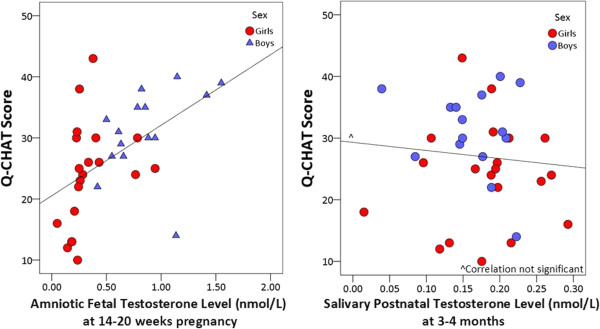
BACKGROUND: Studies of prenatal exposure to sex steroid hormones predict autistic traits in children at 18 to 24 and at 96 months of age. However, it is not known whether postnatal exposure to these hormones has a similar effect. This study compares prenatal and postnatal sex steroid hormone levels in relation to autistic traits in 18 to 24-month-old children.Fetal testosterone (fT) and fetal estradiol (fE) levels were measured in amniotic fluid from pregnant women (n = 35) following routine second-trimester amniocentesis. Saliva samples were collected from these children when they reached three to four months of age and were analyzed for postnatal testosterone (pT) levels. Mothers were asked to complete the Quantitative Checklist for Autism in Toddlers (Q-CHAT), a measure of autistic traits in children 18 to 24 months old. FINDING: fT (but not pT) levels were positively associated with scores on the Q-CHAT. fE and pT levels showed no sex differences and no relationships with fT levels. fT levels were the only variable that predicted Q-CHAT scores. CONCLUSIONS: These preliminary findings are consistent with the hypothesis that prenatal (but not postnatal) androgen exposure, coinciding with the critical period for sexual differentiation of the brain, is associated with the development of autistic traits in 18 to 24 month old toddlers. However, it is recognized that further work with a larger sample population is needed before the effects of postnatal androgen exposure on autistic traits can be ruled out. These results are also in line with the fetal androgen theory of autism, which suggests that prenatal, organizational effects of androgen hormones influence the development of autistic traits in later life.
Overview
The claims and statistics of this paper haven’t been checked yet.
Run the check — free, no account needed. It reads the open-access text and checks the sources it cites.
Integrity signals
Registry
Cites
Statistics
Figures
Verification
Claims the paper makes
The claims and statistics of this paper haven’t been checked yet.
Run the check — free, no account needed. It reads the open-access text and checks the sources it cites.
Self-check
Percentages, sums and reported differences re-computed from the paper’s own numbers.
The self-check needs the paper’s full text.
Citations
Cites
Practical Statistics for Medical Research.
Walter, S., & Altman, D. G. (1992) · Biometrics · doi:10.2307/2532320 · Cited by 11,666
Practical Statistics for Medical Research
Altman, D. G. (1990) · doi:10.1201/9780429258589 · Cited by 10,668
Williams Textbook of Endocrinology
Melmed, S., & Polonsky, K. S. (2016) · Elsevier eBooks · doi:10.1016/c2013-0-15980-6 · Cited by 3,715
Human behavioral sex differences: A role for gonadal hormones during early development?
Collaer, M. L., & Hines, M. (1995) · Psychological Bulletin · doi:10.1037/0033-2909.118.1.55 · Cited by 779
Geschwind, D. H. (2009) · Annual Review of Medicine · doi:10.1146/annurev.med.60.053107.121225 · Cited by 512
Fetal testosterone and autistic traits
Auyeung, B., Baron‐Cohen, S., Ashwin, E., Knickmeyer, R., Taylor, K., & Hackett, G. (2009) · British Journal of Psychology · doi:10.1348/000712608x311731 · Cited by 462
Self-citationChapman, E., Baron-Cohen, S., Auyeung, B., Knickmeyer, R., Taylor, K., & Hackett, G. (2006) · Social Neuroscience · doi:10.1080/17470910600992239 · Cited by 389
Self-citationAllison, C., Baron-Cohen, S., Wheelwright, S., Charman, T., Richler, J., Pasco, G., & Brayne, C. (2008) · Journal of Autism and Developmental Disorders · doi:10.1007/s10803-007-0509-7 · Cited by 327
Self-citationFoetal testosterone and eye contact in 12-month-old human infants
Lutchmaya, S., Baron‐Cohen, S., & Raggatt, P. R. (2002) · Infant Behavior and Development · doi:10.1016/s0163-6383(02)00094-2 · Cited by 322
Self-citationFoetal testosterone, social relationships, and restricted interests in children
Knickmeyer, R. C., Baron‐Cohen, S., Raggatt, P. R., & Taylor, K. (2004) · Journal of Child Psychology and Psychiatry · doi:10.1111/j.1469-7610.2004.00349.x · Cited by 288
Self-citationBrief Report: “The Autism Epidemic”. The Registered Prevalence of Autism in a Swedish Urban Area
Gillberg, C., Cederlund, M., Lamberg, K., & Zeijlon, L. (2006) · Journal of Autism and Developmental Disorders · doi:10.1007/s10803-006-0081-6 · Cited by 235
Foetal testosterone and vocabulary size in 18- and 24-month-old infants
Lutchmaya, S., Baron‐Cohen, S., & Raggatt, P. R. (2001) · Infant Behavior and Development · doi:10.1016/s0163-6383(02)00087-5 · Cited by 234
Self-citationFoetal testosterone and autistic traits in 18 to 24-month-old children
Auyeung, B., Taylor, K., Hackett, G., & Baron-Cohen, S. (2010) · Molecular Autism · doi:10.1186/2040-2392-1-11 · Cited by 208
Self-citationMain, K. M., Schmidt, I. M., & Skakkebæk, N. E. (2000) · The Journal of Clinical Endocrinology & Metabolism · doi:10.1210/jcem.85.12.7058 · Cited by 133
Foetal testosterone and the child systemizing quotient
Auyeung, B., Baron-Cohen, S., Chapman, E., Knickmeyer, R., Taylor, K., & Hackett, G. (2006) · European Journal of Endocrinology · doi:10.1530/eje.1.02260 · Cited by 123
Self-citationThe Fetal Hormonal Environment and its Effect on the Morphogenesis of the Genital System
Smail, P. J., Reyes, F. I., Winter, J. S. D., & Faiman, C. (1981) · Springer eBooks · doi:10.1007/978-94-010-3719-8_2 · Cited by 107
Hormone–behavior associations in early infancy
Alexander, G. M., Wilcox, T. G., & Farmer, M. E. (2009) · Hormones and Behavior · doi:10.1016/j.yhbeh.2009.08.003 · Cited by 51
Williams Textbook of Endocrinology, 10th edition
Griffith, R. B. J. R. (2004) · Journal of Pediatric and Adolescent Gynecology · doi:10.1016/j.jpag.2004.03.047 · Cited by 46
Research works printed but not linked: 1
- 10.1210/jc.85.12.4905 · DOI
Cited by
Sorted by citations
Sex differences in autism spectrum disorder: a review
Ferri, S. L., Abel, T., & Brodkin, E. S. (2018) · Current Psychiatry Reports · doi:10.1007/s11920-018-0874-2 · Cited by 392
Early androgen exposure and human gender development
Hines, M., Constantinescu, M., & Spencer, D. (2015) · Biology of Sex Differences · doi:10.1186/s13293-015-0022-1 · Cited by 263
Plasma and Fecal Metabolite Profiles in Autism Spectrum Disorder
Needham, B. D., Adame, M. D., Serena, G., Rose, D. R., Preston, G. M., Conrad, M. C., Campbell, A. S., Donabedian, D. H., Fasano, A., Ashwood, P., et al. (2020) · Biological Psychiatry · doi:10.1016/j.biopsych.2020.09.025 · Cited by 254
Alaerts, K., Swinnen, S. P., & Wenderoth, N. (2016) · Social Cognitive and Affective Neuroscience · doi:10.1093/scan/nsw027 · Cited by 193
Etiologies underlying sex differences in autism spectrum disorders
Schaafsma, S. M., & Pfaff, D. W. (2014) · Frontiers in Neuroendocrinology · doi:10.1016/j.yfrne.2014.03.006 · Cited by 178
Metadata
- Authors
- Auyeung, B., Ahluwalia, J., Thomson, L., Taylor, K., Hackett, G., O’Donnell, K. J., & Baron-Cohen, S.
- Affiliations
- Rosie Hospital (GB)
- Addenbrooke's Hospital (GB)
- Douglas Mental Health University Institute (CA)
- Venue
- Molecular Autism
- Published
- 2012
- Volume
- 3
- Issue
- 1
- Pages
- 17
- ISSN
- 2040-2392 (ISSN-L)
- PMC
- PMC3554559
- OpenAlex
- W2148934707
- Cited by
- 106
- References
- 18
- Citations by year
- 2026: 3 · 2025: 8 · 2024: 4 · 2023: 6 · 2022: 5 · 2021: 10 · 2020: 16 · 2019: 6 · 2018: 7 · 2017: 8 · 2016: 12 · 2015: 6 · 2014: 10 · 2013: 5
- FWCI
- 3.44
- Type
- journal article
- Language
- en
- Open access
- gold
- doi.org
- Licence
- cc-by
- Locations
- Molecular Autism (publishedVersion, cc-by)
- Europe PMC (PubMed Central) (publishedVersion, cc-by)
- PubMed Central (publishedVersion, cc-by)
- PubMed (publishedVersion)
- Apollo (University of Cambridge) (submittedVersion, cc-by)
- DOAJ (DOAJ: Directory of Open Access Journals) (submittedVersion)
- Edinburgh Research Explorer (University of Edinburgh) (submittedVersion, other-oa)
- Funders
- Wellcome Trust
- National Institute for Health and Care Research
- Medical Research Council
- Trinity College, University of Cambridge
- Topics
- Life Sciences › Neuroscience › Cognitive Neuroscience › Autism Spectrum Disorder Research
- Health Sciences › Medicine › Endocrinology, Diabetes and Metabolism › Sexual Differentiation and Disorders
- Life Sciences › Neuroscience › Endocrine and Autonomic Systems › Neuroendocrine regulation and behavior
- Keywords
- autistic traits, sex hormones, prenatal androgen exposure, fetal testosterone, amniotic fluid, saliva testosterone, toddlers, sexual differentiation of the brain
About these checks
Registry, retraction, Cites and statistics results are computed, not judged, with one exception: a printed reference that no index lists is read once by a model before it counts as a citation error. Claims are extracted by a model and kept only when their quote appears verbatim in the text; each cited source is then checked, with a model’s help, for whether it says what the claim relies on. Those verdicts can be wrong — read the claim’s quote and the cited source before relying on one.
Statistics and arithmetic are recomputed, not judged.
Confidence bands are shown only for fields calibrated on our annotated test set. None is calibrated yet, so no band is shown.
What counts as a claim ›How we measure confidence ›How we check this ›
Are you an author, or do you see a problem with this page? Request a review
