

Nuclear receptors from the ctenophore Mnemiopsis leidyi lack a zinc-finger DNA-binding domain: lineage-specific loss or ancestral condition in the emergence of the nuclear receptor superfamily?
Open accessThe DOI matches its Crossref record; 53 of the 53 references it cites were found in a registry or an index.
Abstract
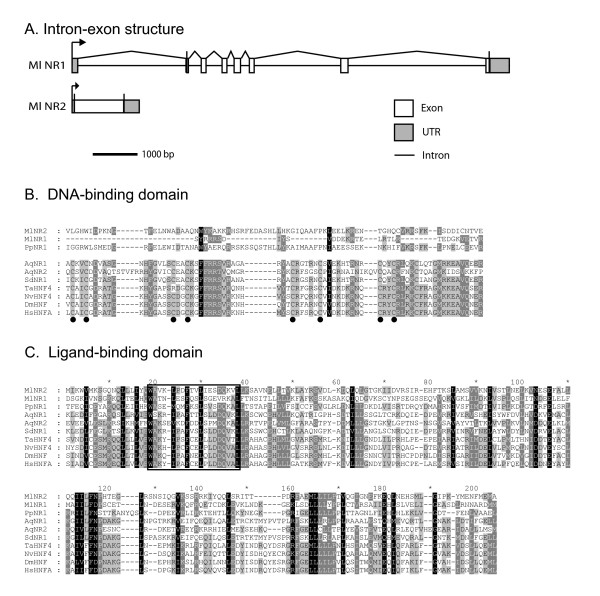
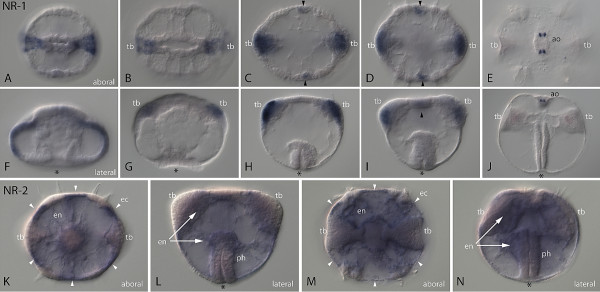
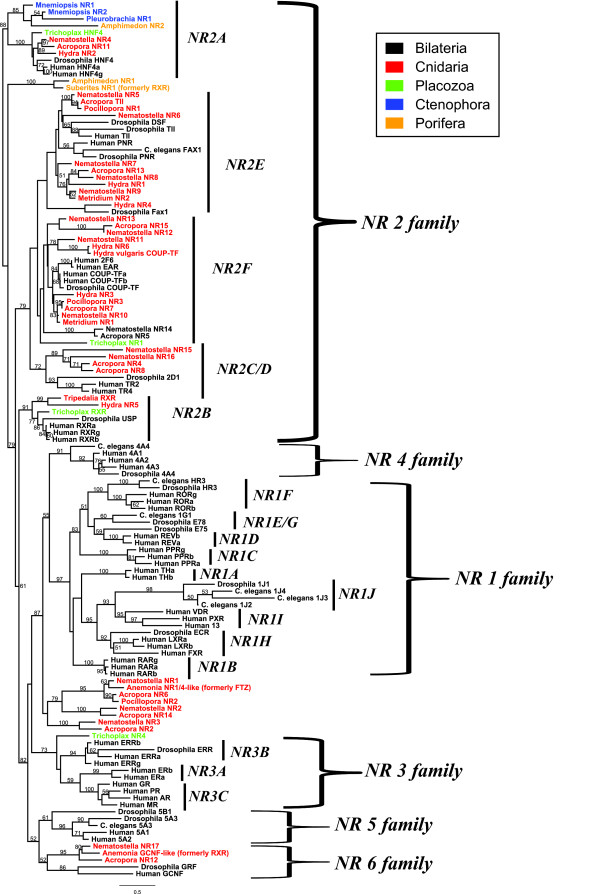
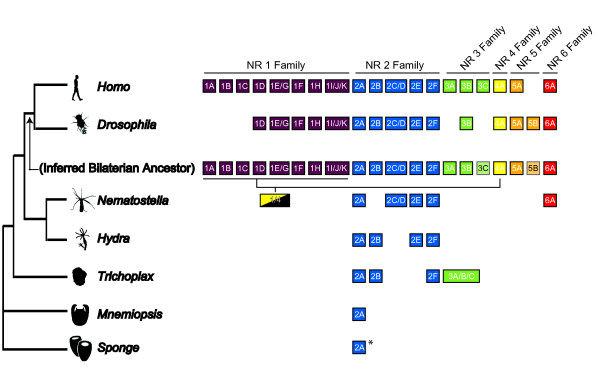
Background: Nuclear receptors (NRs) are an ancient superfamily of metazoan transcription factors that play critical roles in regulation of reproduction, development, and energetic homeostasis. Although the evolutionary relationships among NRs are well-described in two prominent clades of animals (deuterostomes and protostomes), comparatively little information has been reported on the diversity of NRs in early diverging metazoans. Here, we identified NRs from the phylum Ctenophora and used a phylogenomic approach to explore the emergence of the NR superfamily in the animal kingdom. In addition, to gain insight into conserved or novel functions, we examined NR expression during ctenophore development. Results: We report the first described NRs from the phylum Ctenophora: two from Mnemiopsis leidyi and one from Pleurobrachia pileus. All ctenophore NRs contained a ligand-binding domain and grouped with NRs from the subfamily NR2A (HNF4). Surprisingly, all the ctenophore NRs lacked the highly conserved DNA-binding domain (DBD). NRs from Mnemiopsis were expressed in different regions of developing ctenophores. One was broadly expressed in the endoderm during gastrulation. The second was initially expressed in the ectoderm during gastrulation, in regions corresponding to the future tentacles; subsequent expression was restricted to the apical organ. Phylogenetic analyses of NRs from ctenophores, sponges, cnidarians, and a placozoan support the hypothesis that expansion of the superfamily occurred in a step-wise fashion, with initial radiations in NR family 2, followed by representatives of NR families 3, 6, and 1/4 originating prior to the appearance of the bilaterian ancestor. Conclusions: Our study provides the first description of NRs from ctenophores, including the full complement from Mnemiopsis. Ctenophores have the least diverse NR complement of any animal phylum with representatives that cluster with only one subfamily (NR2A). Ctenophores and sponges have a similarly restricted NR complement supporting the hypothesis that the original NR was HNF4-like and that these lineages are the first two branches from the animal tree. The absence of a zinc-finger DNA-binding domain in the two ctenophore species suggests two hypotheses: this domain may have been secondarily lost within the ctenophore lineage or, if ctenophores are the first branch off the animal tree, the original NR may have lacked the canonical DBD. Phylogenomic analyses and categorization of NRs from all four early diverging animal phyla compared with the complement from bilaterians suggest the rate of NR diversification prior to the cnidarian-bilaterian split was relatively modest, with independent radiations of several NR subfamilies within the cnidarian lineage.
Overview
The claims and statistics of this paper haven’t been checked yet.
Free: it reads the open-access text and checks the first 5 claims that cite a source we can check. Create a free account to check every claim.
Integrity signals
Registry
Cites
Statistics
Figures
Verification
Claims the paper makes
The claims and statistics of this paper haven’t been checked yet.
Free: it reads the open-access text and checks the first 5 claims that cite a source we can check. Create a free account to check every claim.
Claims other papers make about this one
Each is checked against this paper’s own text: does it say what the citing paper says it does?
The source backs part of the claim, not all of it — or backs it for a different population, condition or comparison.
In the citing paper
“The pattern of presence and absence of gene families and signaling pathway components seen in previous studies is consistent with these results (32–36).”
From The Genome of the Ctenophore Mnemiopsis leidyi and Its Implications for Cell Type Evolution (2013) · cites this paper as [35]
Experimental — accuracy not yet measured
Self-check
Percentages, sums and reported differences re-computed from the paper’s own numbers.
The self-check needs the paper’s full text.
Citations
Cites
1 retracted
Distinct Repressive Properties of the Mammalian and Fish Orphan Nuclear Receptors SHP and DAX-1
Park, Y., Teyssier, C., Vanacker, J.-M., & Choi, H. (2007) · Molecules and Cells · doi:10.1016/s1016-8478(23)10723-0 · Cited by 4 · cited 1×
“Within the bilaterians, NR domain structure has been modified in particular lineages, including duplication of the DBD in a novel protostome NR subfamily [33], loss of the DBD from vertebrate DAX1 (NR0B1) and SHP (NR0B2) [34,35], and loss of a conserved LBD in some NRs from insects (for example, knirps [36]) and nemat…”
BackgroundRetractedMUSCLE: multiple sequence alignment with high accuracy and high throughput
Edgar, R. C. (2004) · Nucleic Acids Research · doi:10.1093/nar/gkh340 · Cited by 44,662 · cited 1×
“6 [24] and edited manually in the case of clear errors.”
BackgroundMRBAYES: Bayesian inference of phylogenetic trees.
Huelsenbeck, J. P., & Ronquist, F. (2001) · Bioinformatics · doi:10.1093/bioinformatics/17.8.754 · Cited by 21,937 · cited 1×
“2 [26] using a JTT+G+F matrix (model determined by RAxML model picker) and a trimmed alignment containing the DBD and most of the LBD, beginning in helix 3.”
MethodRAxML-VI-HPC: maximum likelihood-based phylogenetic analyses with thousands of taxa and mixed models
Stamatakis, A. (2006) · Bioinformatics · doi:10.1093/bioinformatics/btl446 · Cited by 15,582
Broad phylogenomic sampling improves resolution of the animal tree of life
Dunn, C. W., Hejnol, A., Matus, D. Q., Pang, K., Browne, W. E., Smith, S. A., Seaver, E., Rouse, G. W., Obst, M., Edgecombe, G. D., et al. (2008) · Nature · doi:10.1038/nature06614 · Cited by 1,921 · cited 2×
“The apparent phylogenetic position of ctenophores in relation to other animal phyla has varied among studies, with recent analyses placing them at the base of the animal tree [13,14], as a sister clade with other non-bilaterians to the Bilateria [15], in one clade with cnidarians [16], or as an outgroup to a clade of…”
BackgroundSelf-citationA unified nomenclature system for the nuclear receptor superfamily
(1999) · Cell · doi:10.1016/s0092-8674(00)80726-6 · Cited by 1,208
The Trichoplax genome and the nature of placozoans
Srivastava, M., Begovic, E., Chapman, J., Putnam, N. H., Hellsten, U., Kawashima, T., Kuo, A., Mitros, T., Salamov, A., Carpenter, M. L., et al. (2008) · Nature · doi:10.1038/nature07191 · Cited by 889 · cited 1×
“NRs have been reported from three of the four classes of cnidarians (Anthozoa [3,5], Cubozoa [9], and Hydrozoa [2]), including the full complement from the sea anemone Nematostella vectensis [5], two sponges [4,6,10], and one placozoan [11,12].”
BackgroundOrphan Nuclear Receptors: From Gene to Function*
Giguère, V. (1999) · Endocrine Reviews · doi:10.1210/edrv.20.5.0378 · Cited by 855
Chapman, J. A., Kirkness, E. F., Simakov, O., Hampson, S. E., Mitros, T., Weinmaier, T., Rattei, T., Balasubramanian, P. G., Borman, J., Busam, D., et al. (2010) · Nature · doi:10.1038/nature08830 · Cited by 810 · cited 2×
“We identified six NRs from the recently completed genome of the hydrozoan Hydra magnipapillata [30].”
BackgroundAssessing the root of bilaterian animals with scalable phylogenomic methods
Hejnol, A., Obst, M., Stamatakis, A., Ott, M., Rouse, G. W., Edgecombe, G. D., Martinez, P., Baguñà, J., Bailly, X., Jondelius, U., et al. (2009) · Proceedings of the Royal Society B: Biological Sciences · doi:10.1098/rspb.2009.0896 · Cited by 747
Self-citation
Cited by
The Genome of the Ctenophore Mnemiopsis leidyi and Its Implications for Cell Type Evolution
Ryan, J. F., Pang, K., Schnitzler, C. E., Nguyen, A.-D., Moreland, R. T., Simmons, D. K., Koch, B. J., Francis, W. R., Havlak, P., Program, N. C. S., et al. (2013) · Science · doi:10.1126/science.1242592 · Cited by 682
Self-citationAnimal phylogeny and its evolutionary implications
Dunn, C. W., Giribet, G., Edgecombe, G. D., & Hejnol, A. (2014) · Annual Review of Ecology, Evolution, and Systematics · doi:10.1146/annurev-ecolsys-120213-091627 · Cited by 401
“…genome reduction All animals except Ctenophora Paired domains linked to homeodomains (Ryan et al. 2010), NR2A genes include DNA binding domain (Reitzel et al. 2011), Drosha microRNA processing (Maxwell et al. 2012) Parahoxozoa Hox and ParaHox genes (Ryan et al. 2010) Planulozoa (sensu…”
BackgroundThe hidden biology of sponges and ctenophores
Dunn, C. W., Leys, S. P., & Haddock, S. H. D. (2015) · Trends in Ecology & Evolution · doi:10.1016/j.tree.2015.03.003 · Cited by 212
Fahrbach, S. E., Smagghe, G., & Velarde, R. A. (2012) · Annual Review of Entomology · doi:10.1146/annurev-ento-120710-100607 · Cited by 144
Baker, M. E., Nelson, D. R., & Studer, R. A. (2014) · The Journal of Steroid Biochemistry and Molecular Biology · doi:10.1016/j.jsbmb.2014.10.020 · Cited by 106
Phylogenetic evidence for the modular evolution of metazoan signalling pathways
Babonis, L. S., & Martindale, M. Q. (2017) · Philosophical Transactions of the Royal Society B: Biological Sciences · doi:10.1098/rstb.2015.0477 · Cited by 90
Self-citationPett, W., Ryan, J. F., Pang, K., Mullikin, J. C., Martindale, M. Q., Baxevanis, A. D., & Lavrov, D. V. (2011) · Mitochondrial DNA · doi:10.3109/19401736.2011.624611 · Cited by 89
“Another set of studies utilized whole genome data from all four non-bilaterian phyla, including the ctenophore Mnemiopsis leidyi, to examine gene superfamilies (Ryan et al. 2010; Reitzel et al. 2011) and signaling pathway components (Pang et al.”
BackgroundSelf-citationEvolution of thyroid hormone signaling in animals: Non-genomic and genomic modes of action
Taylor, E., & Heyland, A. (2017) · Molecular and Cellular Endocrinology · doi:10.1016/j.mce.2017.05.019 · Cited by 90
Reitzel, A. M., Tarrant, A. M., & Levy, O. (2013) · Integrative and Comparative Biology · doi:10.1093/icb/ict024 · Cited by 85
“Comparative genomic analysis of the nuclear receptors has clearly shown that cnidarians, as well as other early-diverging phyla, do not contain members of the nuclear receptor 1 (NR1) family, including homologs of REV-ERB and ROR (Reitzel and Tarrant 2009; Reitzel et al. 2011).”
BackgroundSelf-citationOuadah-Boussouf, N., & Babin, P. J. (2016) · Toxicology and Applied Pharmacology · doi:10.1016/j.taap.2016.01.014 · Cited by 67
Maxwell, E. K., Ryan, J. F., Schnitzler, C. E., Browne, W. E., & Baxevanis, A. D. (2012) · BMC Genomics · doi:10.1186/1471-2164-13-714 · Cited by 59
“Recent phylogenomic analyses suggest that Ctenophora may be the earliest branching metazoan lineage [31,32], and genomic studies of a number of gene superclasses [33,34] and signaling pathways [35] in Mnemiopsis are consistent with this theory.”
ResultSelf-citationThe evolution of animal genomes
Dunn, C. W., & Ryan, J. F. (2015) · Current Opinion in Genetics & Development · doi:10.1016/j.gde.2015.08.006 · Cited by 66
Self-citationEvolution of Nuclear Receptors and Ligand Signaling
Holzer, G., Markov, G. V., & Laudet, V. (2017) · Current topics in developmental biology/Current Topics in Developmental Biology · doi:10.1016/bs.ctdb.2017.02.003 · Cited by 52
Simmons, D. K., Pang, K., & Martindale, M. Q. (2012) · EvoDevo · doi:10.1186/2041-9139-3-2 · Cited by 38
“Recent gene content studies [45-47] give support for Porifera and Ctenophora diverging prior to the ParaHoxozoa (Placozoa, Cnidaria, Bilaterian) during early animal evolution.”
Self-citationBabonis, L. S., DeBiasse, M. B., Francis, W. R., Christianson, L. M., Moss, A. G., Haddock, S. H. D., Martindale, M. Q., & Ryan, J. F. (2018) · Molecular Biology and Evolution · doi:10.1093/molbev/msy171 · Cited by 37
“MlNR2 was expressed in both tentacle bulbs and comb rows but was not differentially expressed.”
BackgroundInfluentialSelf-citationA customized Web portal for the genome of the ctenophore Mnemiopsis leidyi
Moreland, R. T., Nguyen, A.-D., Ryan, J. F., Schnitzler, C. E., Koch, B. J., Siewert, K., Wolfsberg, T. G., & Baxevanis, A. D. (2014) · BMC Genomics · doi:10.1186/1471-2164-15-316 · Cited by 34
Self-citationZieger, E., & Schubert, M. (2016) · International review of cytology · doi:10.1016/bs.ircmb.2016.09.001 · Cited by 34
Function and Evolution of Nuclear Receptors in Environmental-Dependent Postembryonic Development
Taubenheim, J., Kortmann, C., & Fraune, S. (2021) · Frontiers in Cell and Developmental Biology · doi:10.3389/fcell.2021.653792 · Cited by 32
Fischer, A., Pang, K., Henry, J. J., & Martindale, M. Q. (2014) · EvoDevo · doi:10.1186/2041-9139-5-4 · Cited by 30
“These planes are defined by axes of rotational symmetry around the oral-aboral axis because diagonally opposed quadrants are more identical to one another than adjacent quadrants [3-610,13,15].”
BackgroundResultSelf-citationCheng, Y., Li, Y., Li, W., Song, Y., Zeng, R., & Lǚ, K. (2020) · Genomics · doi:10.1016/j.ygeno.2020.08.002 · Cited by 26
Ctenophores: an evolutionary-developmental perspective
Jager, M., & Manuel, M. (2016) · Current Opinion in Genetics & Development · doi:10.1016/j.gde.2016.05.020 · Cited by 27
Presnell, J. S., Bubel, M. M., Knowles, T., Patry, W. L., & Browne, W. E. (2022) · Nature Protocols · doi:10.1038/s41596-022-00702-w · Cited by 28
Reitzel, A. M., Macrander, J., Mané‐Padrós, D., Fang, B., Sladek, F. M., & Tarrant, A. M. (2018) · The Journal of Steroid Biochemistry and Molecular Biology · doi:10.1016/j.jsbmb.2018.02.010 · Cited by 23
Self-citationEvolution of non-genomic nuclear receptor function
Taylor, E., & Heyland, A. (2021) · Molecular and Cellular Endocrinology · doi:10.1016/j.mce.2021.111468 · Cited by 23
ENPD - A Database of Eukaryotic Nucleic Acid Binding Proteins: Linking Gene Regulations to Proteins
Leung, R. W. T., Jiang, X., Chu, K. H., & Qin, J. (2018) · Nucleic Acids Research · doi:10.1093/nar/gky1112 · Cited by 22
Martindale, M. Q., & Henry, J. Q. (2015) · Evolutionary Developmental Biology of Invertebrates 1 · doi:10.1007/978-3-7091-1862-7_8 · Cited by 18
Self-citationNovotný, J. P., Chughtai, A. A., Kostrouchová, M., Kostrouchová, V., Kostrouch, D., Kaššák, F., Kaňa, R., Schierwater, B., Kostrouchová, M., & Kostrouch, Z. (2017) · PeerJ · doi:10.7717/peerj.3789 · Cited by 19
“Nevertheless, the ctenophore Mnemiopsis contains two orthologues of NR2A (HNF4) that lack the DNA binding domain (Reitzel et al., 2011).”
BackgroundAnnalora, A. J., Marcus, C. B., & Iversen, P. L. (2020) · Drug Metabolism and Disposition · doi:10.1124/dmd.119.089102 · Cited by 16
“These small NR genes may resemble the common ancestor for all modern NR genes, having linked a primitive DNA binding element to an endo-xenobiotic sensor/receptor for the first time (Reitzel et al., 2011).”
BackgroundEvolution of sodium channels and the new view of early nervous system evolution
Liebeskind, B. J. (2011) · Communicative & Integrative Biology · doi:10.4161/cib.17069 · Cited by 12
Cheng, Y., Chen, J., Mukhtar, I., & Chen, J. (2021) · Frontiers in Marine Science · doi:10.3389/fmars.2021.653447 · Cited by 7
Madaloz, T. Z., dos Santos, K., Zacchi, F. L., Bainy, A. C. D., & Razzera, G. (2023) · Chemosphere · doi:10.1016/j.chemosphere.2023.139877 · Cited by 2
Duan, M., Zhou, Y., Li, Z., Shi, X., Hua, Z., Gao, Z., & Yang, D. C. (2026) · International Journal of Molecular Sciences · doi:10.3390/ijms27041739 · Cited by 1
Evidence that nuclear receptors are related to terpene synthases
Houston, D. R., Hanna, J. G., Lathe, J. C., Hillier, S. G., & Lathe, R. (2022) · Journal of Molecular Endocrinology · doi:10.1530/jme-21-0156 · Cited by 2
Goksøyr, S. Ø., Karlsen, O. A., Ruivo, R., Castro, L. F. C., & Goksøyr, A. (2026) · ACS ES&T Toxicology · doi:10.1021/acsesttox.6c00014
Metadata
- Authors
- Reitzel, A. M., Pang, K., Ryan, J. F., Mullikin, J. C., Martindale, M. Q., Baxevanis, A. D., & Tarrant, A. M.
- Affiliations
- Woods Hole Oceanographic Institution (US)
- University of Hawaiʻi at Mānoa (US)
- National Institutes of Health (US)
- Corresponding author
- Tarrant, Ann M
- ORCID
- Venue
- EvoDevo
- Published
- 2011-02-03
- Volume
- 2
- Issue
- 1
- Pages
- 3-3
- ISSN
- 2041-9139 (ISSN-L)
- PMC
- PMC3038971
- OpenAlex
- W2136536343
- Cited by
- 36
- References
- 53
- Citations by year
- 2026: 2 · 2023: 1 · 2022: 2 · 2021: 3 · 2020: 2 · 2018: 3 · 2017: 3 · 2016: 5 · 2015: 3 · 2014: 4 · 2013: 2 · 2012: 3
- FWCI
- 2.67
- Type
- journal article
- Language
- en
- Open access
- gold
- doi.org
- Licence
- cc-by
- Locations
- EvoDevo (publishedVersion, cc-by)
- PubMed Central (publishedVersion, cc-by)
- PubMed (publishedVersion)
- DOAJ (DOAJ: Directory of Open Access Journals) (submittedVersion)
- Funders
- National Science Foundation
- National Aeronautics and Space Administration
- Woods Hole Oceanographic Institution (F32HD062178)
- National Institutes of Health
- National Human Genome Research Institute
- National Institute of Child Health and Human Development
- Eunice Kennedy Shriver National Institute of Child Health and Human Development
- Topics
- Life Sciences › Agricultural and Biological Sciences › Animal Science and Zoology › Marine Invertebrate Physiology and Ecology
- Life Sciences › Biochemistry, Genetics and Molecular Biology › Molecular Biology › Developmental Biology and Gene Regulation
- Life Sciences › Biochemistry, Genetics and Molecular Biology › Molecular Biology › Nuclear Receptors and Signaling
- Keywords
- Mnemiopsis leidyi, Pleurobrachia pileus, Ctenophora, HNF4, NR2A, phylogenomics, metazoan origin, transcription factors, ligand-binding domain
About these checks
Registry, retraction, Cites and statistics results are computed, not judged, with one exception: a printed reference that no index lists is read once by a model before it counts as a citation error. Claims are extracted by a model and kept only when their quote appears verbatim in the text; each cited source is then checked, with a model’s help, for whether it says what the claim relies on. Those verdicts can be wrong — read the claim’s quote and the cited source before relying on one.
Statistics and arithmetic are recomputed, not judged.
Confidence bands are shown only for fields calibrated on our annotated test set. None is calibrated yet, so no band is shown.
What counts as a claim ›How we measure confidence ›How we check this ›
Are you an author, or do you see a problem with this page? Request a review
Data sources
Bibliographic data: Semantic Scholar, OpenAlex, Crossref.
Contains information from the Semantic Scholar Academic Graph Datasets, made available under the ODC Attribution License (ODC-BY 1.0).
Semantic Scholar’s data is described in: Kinney, R., et al. (2023). The Semantic Scholar Open Data Platform. arXiv:2301.10140.
