

Tight junctions at the blood brain barrier: physiological architecture and disease-associated dysregulation
Open accessThe DOI matches its Crossref record; 182 of the 182 references it cites were found in a registry or an index.
Abstract
The Blood–brain barrier (BBB), present at the level of the endothelium of cerebral blood vessels, selectively restricts the blood-to-brain paracellular diffusion of compounds; it is mandatory for cerebral homeostasis and proper neuronal function. The barrier properties of these specialized endothelial cells notably depend on tight junctions (TJs) between adjacent cells: TJs are dynamic structures consisting of a number of transmembrane and membrane-associated cytoplasmic proteins, which are assembled in a multimolecular complex and acting as a platform for intracellular signaling. Although the structural composition of these complexes has been well described in the recent years, our knowledge about their functional regulation still remains fragmentary. Importantly, pericytes, embedded in the vascular basement membrane, and perivascular microglial cells, astrocytes and neurons contribute to the regulation of endothelial TJs and BBB function, altogether constituting the so-called neurovascular unit. The present review summarizes our current understanding of the structure and functional regulation of endothelial TJs at the BBB. Accumulating evidence points to a correlation between BBB dysfunction, alteration of TJ complexes and progression of a variety of CNS diseases, such as stroke, multiple sclerosis and brain tumors, as well as neurodegenerative diseases like Parkinson’s and Alzheimer’s diseases. Understanding how TJ integrity is controlled may thus help improve drug delivery across the BBB and the design of therapeutic strategies for neurological disorders.
Overview
The claims and statistics of this paper haven’t been checked yet.
Free: it reads the open-access text and checks the first 5 claims that cite a source we can check. Create a free account to check every claim.
Integrity signals
Registry
Cites
Statistics
Figures
Verification
Claims the paper makes
The claims and statistics of this paper haven’t been checked yet.
Free: it reads the open-access text and checks the first 5 claims that cite a source we can check. Create a free account to check every claim.
Claims other papers make about this one
Each is checked against this paper’s own text: does it say what the citing paper says it does?
The source backs part of the claim, not all of it — or backs it for a different population, condition or comparison.
In the citing paper
“Immortalized human microvascular brain endothelial (hCMEC/D3) cells were chosen as the cell line as they (i) are able to form contact-inhibited monolayers when grown on collagen type 1, a key component of the BBB basement membrane, and (ii) express tight and adherens junctions, which help regulate the structural integrity and permeability of the BBB.35,36”
From Predictive High-Throughput Platform for Dual Screening of mRNA Lipid Nanoparticle Blood–Brain Barrier Transfection and Crossing (2024) · cites this paper as [36]
Experimental — accuracy not yet measuredThe cited source says what the claim attributes to it.
In the citing paper
“In the BBB, tight junctions are the main functional components in sustaining the permeability barrier and controlling tissue homeostasis.88–91”
From The blood–brain barrier: Structure, regulation and drug delivery (2023) · cites this paper as [88]
Self-check
Percentages, sums and reported differences re-computed from the paper’s own numbers.
The self-check needs the paper’s full text.
Citations
Cites
Astrocyte-endothelial interactions at the blood-brain barrier
Abbott, N. J., Rönnbäck, L., & Hansson, E. (2006) · Nature Reviews Neuroscience · doi:10.1038/nrn1824 · Cited by 5,595 · cited 1×
“Development and maintenance of the BBB requires functional interactions between endothelial cells and perivascular cells of the NVU: whereas astrocytes have been well documented to regulate BBB formation and integrity [76,77], only recently was the role of pericytes unraveled (for reviews: [78-80]).”
Structure and function of the blood–brain barrier
Abbott, N. J., Patabendige, A. A. K., Dolman, D. E. M., Yusof, S. R., & Begley, D. J. (2010) · Neurobiology of Disease · doi:10.1016/j.nbd.2009.07.030 · Cited by 5,185 · cited 1×
“The BBB maintains the homeostasis of the central nervous system (CNS) by (i) strictly limiting the passive diffusion of polar substances from the blood to the brain, (ii) mediating the transport of nutrients to the brain parenchyma as well as the efflux from the brain of toxic metabolites and xenobiotics, (iii) regula…”
Pericytes regulate the blood–brain barrier
Armulik, A., Genové, G., Mäe, M., Nisancioglu, M. H., Wallgard, E., Niaudet, C., He, L., Norlin, J., Lindblom, P., Strittmatter, K., et al. (2010) · Nature · doi:10.1038/nature09522 · Cited by 2,843 · cited 2×
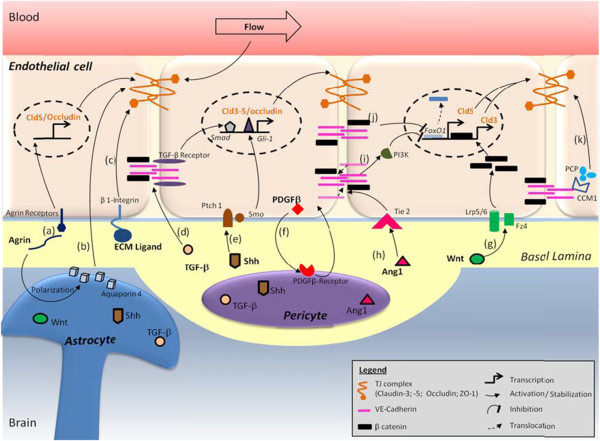
“(a) The basal lamina protein agrin increases claudin-5 (Cld5) and occludin expression [92]; (b) Aquaporin-4 density, regulated by agrin, stabilizes TJ complexes through ZO-1 expression [93]; (c) β1-integrin engagement stabilizes Cld5 localization at the TJ [94]; (d) astrocyte/pericyte-secreted TGF-β induces Cld5 trans…”
Occludin: a novel integral membrane protein localizing at tight junctions.
Furuse, M., Hirase, T., Itoh, M., Nagafuchi, A., Yonemura, S., Tsukita, S., & Tsukita, S. (1993) · The Journal of cell biology · doi:10.1083/jcb.123.6.1777 · Cited by 2,580 · cited 1×
“Occludin (60kDa), a tetraspan integral membrane protein, was the first TJ-specific protein identified [12,13] in epithelial cells and shown to be functionally important for barrier function [14].”
Multifunctional strands in tight junctions
Tsukita, S., Furuse, M., & Itoh, M. (2001) · Nature Reviews Molecular Cell Biology · doi:10.1038/35067088 · Cited by 2,509 · cited 2×
“TJs constitute the most apical intercellular junctional complex in polarized epithelium and endothelium, with three key biological functions: a barrier to paracellular diffusion of bloodborne polar substances [4], a fence preventing the lateral diffusion of lipids and integral membrane proteins, thus maintaining cell…”
Pericytes are required for blood–brain barrier integrity during embryogenesis
Daneman, R., Zhou, L., Kebede, A. A., & Barres, B. A. (2010) · Nature · doi:10.1038/nature09513 · Cited by 2,128 · cited 1×
“In addition, more recent reports established that pericytes also actively contribute to BBB formation during development by the release of several growth factors and morphogens [88-91].”
Size-selective loosening of the blood-brain barrier in claudin-5–deficient mice
Nitta, T., Hata, M., Gotoh, S., Seo, Y., Sasaki, H., Hashimoto, N., Furuse, M., & Tsukita, S. (2003) · The Journal of Cell Biology · doi:10.1083/jcb.200302070 · Cited by 1,917 · cited 2×
“Brain endothelial cells predominantly express claudin-3 and claudin-5 [41,42], claudin-12 likely being also expressed [43,44].”
Stevenson, B. R., Siliciano, J. D., Mooseker, M. S., & Goodenough, D. A. (1986) · The Journal of cell biology · doi:10.1083/jcb.103.3.755 · Cited by 1,638 · cited 1×
“Among them, the PDZ domaincontaining, membrane-associated guanylate kinase (MAGUK) family members have been largely documented: zonula occludens-1 (ZO-1, 225kDa) [52], ZO-2 (160kDa) [53], and ZO-3 (130kDa) [54].”
Astrocytes induce blood–brain barrier properties in endothelial cells
Janzer, R. C., & Raff, M. C. (1987) · Nature · doi:10.1038/325253a0 · Cited by 1,626 · cited 1×
“Development and maintenance of the BBB requires functional interactions between endothelial cells and perivascular cells of the NVU: whereas astrocytes have been well documented to regulate BBB formation and integrity [76,77], only recently was the role of pericytes unraveled (for reviews: [78-80]).”
Fanning, A. S., Jameson, B. J., Jesaitis, L. A., & Anderson, J. M. (1998) · Journal of Biological Chemistry · doi:10.1074/jbc.273.45.29745 · Cited by 1,432 · cited 3×
“Among them, the PDZ domaincontaining, membrane-associated guanylate kinase (MAGUK) family members have been largely documented: zonula occludens-1 (ZO-1, 225kDa) [52], ZO-2 (160kDa) [53], and ZO-3 (130kDa) [54].”
Cited by
Items 601–654 of 654
Catalão, C. H. R., Beeghly, C., Iwunze, N., Barichello, T., & Giridharan, V. V. (2025) · Neuromethods · doi:10.1007/978-1-0716-4474-4_17
Srinivasan, B., & Kolli, A. R. (2025) · Neuromethods · doi:10.1007/978-1-0716-4474-4_8 · Cited by 1
Pharmacokinetic Considerations for Drugs Targeting the Central Nervous System (CNS)
Jiménez, E. M., Rosas, M., Pérez, M. E. M., Romero‐Nava, R., Aguayo-Cerón, K. A., & Rodríguez, M. H. (2025) · Pharmaceutical science. · doi:10.5772/intechopen.1012435
Weiner, S., Junkkari, A., Sauer, M., Luikku, A. J., Rauramaa, T. H., Kokkola, T., Herukka, S.-K., Blennow, K., Zetterberg, H., Leinonen, V., et al. (2024) · Figshare · doi:10.6084/m9.figshare.26594234
Weiner, S., Junkkari, A., Sauer, M., Luikku, A. J., Rauramaa, T. H., Kokkola, T., Herukka, S.-K., Blennow, K., Zetterberg, H., Leinonen, V., et al. (2024) · Figshare · doi:10.6084/m9.figshare.26594237
Li, C., Chen, S. Y., Siedhoff, H. R., Grant, D., Liu, P., Balderrama, A., Jackson, M., Zuckerman, A., Greenlief, C. M., Kobeissy, F., et al. (2023) · Figshare · doi:10.6084/m9.figshare.24098374
Weiner, S., Junkkari, A., Sauer, M., Luikku, A. J., Rauramaa, T. H., Kokkola, T., Herukka, S.-K., Blennow, K., Zetterberg, H., Leinonen, V., et al. (2024) · Figshare · doi:10.6084/m9.figshare.26594231
Li, C., Chen, S. Y., Siedhoff, H. R., Grant, D., Liu, P., Balderrama, A., Jackson, M., Zuckerman, A., Greenlief, C. M., Kobeissy, F., et al. (2023) · Figshare · doi:10.6084/m9.figshare.24098380
Aragón-González, A., Shaw, A. C., Kok, J. R., Roussel, F. S., Santos Souza, C. D., Granger, S. M., Vetter, T. A., de Diego, Y., Meyer, K., Beal, S. N., et al. (2024) · Figshare · doi:10.6084/m9.figshare.25591279
Li, C., Chen, S. Y., Siedhoff, H. R., Grant, D., Liu, P., Balderrama, A., Jackson, M., Zuckerman, A., Greenlief, C. M., Kobeissy, F., et al. (2023) · Figshare · doi:10.6084/m9.figshare.24098371
Aragón-González, A., Shaw, A. C., Kok, J. R., Roussel, F. S., Santos Souza, C. D., Granger, S. M., Vetter, T. A., de Diego, Y., Meyer, K., Beal, S. N., et al. (2024) · Figshare · doi:10.6084/m9.figshare.25591483
Zhao, J., Wang, A., & Li, X. (2026) · Biochemistry and Biophysics Reports · doi:10.1016/j.bbrep.2026.102479 · Cited by 3
“Consequently, barrier integrity is the result of a complex interplay involving the assembly, disassembly, and recycling of TJPs complexes [22].”
Kanat, S., Çiğdem, B., Gökçe, Ş. F., Yavuz, H., & Doğan, H. O. (2026) · Cumhuriyet Science Journal · doi:10.17776/csj.1790961
Physiological strategies for brain delivery
Carter, D. A. G. (2026) · Advances in pharmacology · doi:10.1016/bs.apha.2026.02.007
Potey, C. (2013) · theses.fr (ABES) · doi:10.70675/a32cd53dze390z4eb8z8998z2d0b3d7b3a83
“Elles participent au maintien de l’intégrité de la jonction et interagissent avec les claudines et le cytosquelette (Luissint et al., 2012).”
BackgroundIn vivo peptide biomarker screening for molecular imaging in eae neuroinflammation
Sanchez, J. V. (2013) · theses.fr (ABES) · doi:10.70675/16e10b38zf166z4d75za5a5zcce4ba71673a
L’encéphalopathie hépatique au cours de la cirrhose, de la physiopathologie au traitement
Mouri, S. (2019) · theses.fr (ABES) · doi:10.70675/8f930d70z155fz4424z90dbz5435c0243d0f
Safieddine, S. (2020) · theses.fr (ABES) · doi:10.70675/94c9f9cbz7d3fz4cacza2bdzb32748bc0d62
In vivo analysis and manipulation of an invasive brain tumour
Gualtieri, M. (2022) · theses.fr (ABES) · doi:10.70675/6bf7d7a9z9182z4c41zbedfz4e25b63c375e
Presset, A. (2022) · theses.fr (ABES) · doi:10.70675/dcdf978cz83d8z4a59z99afzcc06e380823b
Feng, S., Zhou, C., Tie, Y., Zhao, Z., Li, M., & Si, L. (2026) · Veterinary Sciences · doi:10.3390/vetsci13040405
“Among these, zonula occludens-1 (ZO-1) and Claudin-5 are critical for maintaining BBB integrity [39,40].”
Karaman, İ. P., Coşkun, Ö., Şenol, N., Şahin, U., & Çömlekçı, S. (2026) · Applied Sciences · doi:10.3390/app16084012
Moëlo, C., Kronqvist, N., & Johansson, J. (2026) · Advanced Biology · doi:10.1002/adbi.202500721 · Cited by 1
“The BBB is a complex and multilevel system composed of tight junctions that seal the paracellular space between the brain vascular endothelial cells [ 4, 5 ].”
BBB dynamics: the lifespan perspective
Ren, X. S. (2026) · Scientific Reports · doi:10.1038/s41598-026-49410-5
Lin, C., Xu, Y., Zou, S., & Pan, J. (2026) · Research Square · doi:10.21203/rs.3.rs-9592808/v1
Hucklesby, J. J. W., Gao, C. Y., Graham, E. S., & Angel, C. E. (2026) · bioRxiv (Cold Spring Harbor Laboratory) · doi:10.64898/2026.05.27.728289
“This likely explains why BBB breakdown is strongly associated with poor neurological outcomes and increased complication rates following ischemic stroke and thrombolytic therapy [26,29,30] .”
Yang, Q., Li, Z. T., Tan, Z., Wang, X., Hao, S., He, Y., Zhong, X., Li, J., Xue, Y., Yu, T., et al. (2026) · ACS Applied Materials & Interfaces · doi:10.1021/acsami.6c03017
Bernardo-Cervantes, A. G., & Castañeda‐Cabral, J. L. (2026) · Neurophysiology · doi:10.1007/s11062-026-10026-0 · Cited by 1
Gemuh, B. S., Ghogomu, S. M., Cho‐Ngwa, F., & Ayiseh, R. B. (2026) · Acta Tropica · doi:10.1016/j.actatropica.2026.108216
Lewy, T., Sierra, M. A., Pourshadi, N., Hoffmann, H.-H., Dinnon, K. H., Gola, A., Wang, W., Chen, H.-A., Quirk, C., Zhang, H., et al. (2026) · Immunity · doi:10.1016/j.immuni.2026.06.009
Zaccarelli‐Magalhães, J., Udo, M. S. B., Smith, D. J., Langman, J., Matuguma, L. H., Gomes, G. N., Rodriguez, P., Husan, A., Zhang, Q., Kevil, C. G., et al. (2026) · British Journal of Pharmacology · doi:10.1111/bph.70535
Progranulin haploinsufficiency remodels the cerebral microvasculature and neurovascular unitPreprint
Chakraborty, S., Weick, M., Franciosa, S. A., Tabrizi, Z., Swinehart, C., Moore, G. R., Lee, D., Bhatt, N. N., Cano, A., Poorva, P., et al. (2026) · bioRxiv (Cold Spring Harbor Laboratory) · doi:10.64898/2026.07.20.738719
“The integral membrane proteins Claudin-5 and Occludin are central to tight-junction integrity 26-28 .”
Ren, S., Wang, Y., Zhang, H., Pan, C., Shen, X., Chen, W., Zhou, L., Wang, X., & Kong, Q. (2026) · BMC Medicine · doi:10.1186/s12916-026-05077-3
“As a core component of the tight junction complex, the expression level of CLDN5 directly determines BBB permeability [50–52].”
Crossing the Blood–Brain Barrier: Challenges, Strategies and Emerging Technologies
Jadhav, S., Ahire, S. M., Chitte, N. R., Pawar, P. S., -, I. S., & Shewale, V. V. (2026) · Asian Journal of Research in Pharmaceutical Sciences · doi:10.52711/2231-5659.2026.00035
Shiino, S., Pascale, C. L., Motazedian, K., Lesser, E., Dumont, A., & Martinez, A. N. (2026) · Journal of Molecular Neuroscience · doi:10.1007/s12031-026-02576-z
“…redox homeostasis Blood-brain barrier (BBB) (Abbott et al. 2010; Chehaibi et al. 2017; Di Paola et al. 2010; Fan et al. 2008; Iwashita et al. 2007; Luissint et al. 2012; Mondal et al. 2024 ; Polak et al. 2005; Tang et al. 2020; Teng et al. 2016 ; Wu et al. 2010; Yin et al. 2011a ) Preserves BBB…”
Indoxyl Sulfate-Mediated Blood–Brain Barrier Damage in Chronic Kidney Disease
Hernandez, L. N., Strizzi, C. T., Rosina, M., Schwarz, A., Kronqvist, N., Arefin, S., Stenvinkel, P., & Kublickiene, K. R. (2026) · Toxins · doi:10.3390/toxins18080334
“This barrier function is primarily mediated by endothelial cells which are interconnected by tight junction proteins such as claudin-5, occludin and JAM-1 [17].”
MarĂ, D., Akter, K. A., Jadhav, S., & Abbruscato, T. J. (2026) · Toxicological Sciences · doi:10.1093/toxsci/kfag105
Biomedical Materials and Fabrication Methods for Construction of In Vitro Neurovascular Unit Models
Xu, Y., Yu, W., Li, Y., & Zhang, L. (2026) · Materials · doi:10.3390/ma19173590 · Cited by 1
Cao, Y., Wu, X., Yao, J., Lou, H., Sun, Y., Jiang, J., Song, Y., Meng, X., Du, C., Da, D., et al. (2026) · Frontiers in Neurology · doi:10.3389/fneur.2026.1909220
Zhang, S., Yuan, S., Feng, S., Chen, L., Bai, Y., Wang, H., Jin, Z., & Hu, S. S. (2026) · Journal of Controlled Release · doi:10.1016/j.jconrel.2026.115337 · Cited by 1
Zhou, L., Ke, J., Zhang, S., Xiao, S., Zhang, H., Liu, S., Liu, L., Liu, M., Lu, Z., & Zheng, S. G. (2026) · Cancer Biology & Therapy · doi:10.1080/15384047.2026.2725357
“40 In the current study, RNA sequencing data and qPCR results ruled out that miR-103b significantly downregulated TJP1 and TJP3 in HUVECs and U251 cells.”
Nanoparticles and the gut-microbiome: a dual strategy for oral brain delivery
Negahdari, R., Pouyanfar, N., Masoudifar, R., Aftabi, P., Fendereski, F., Anvari, Z., Masoumi, N., Faizi, M., & Ghorbani‐Bidkorbeh, F. (2026) · International Journal of Pharmaceutics · doi:10.1016/j.ijpharm.2026.127477
León‐Arcia, K., Martínez-Orozco, H., Crespo, M., Díaz-Cintra, S. Y., & Soto-Rojas, L. O. (2026) · Journal of Molecular Neuroscience · doi:10.1007/s12031-026-02610-0
“1 ), establishing high transendothelial elec - trical resistance that necessitates solute transport through specific transcellular influx and efflux systems (Förster 2008; Luissint et al. 2012; Castro Dias et al. 2019 ).”
Turpin, V., Morael, J., Cergneux, A. J. C., Blair, H., Cintado, E., Majumdar, A., Muthughavi, K., Mateu, B., Tessier, C., Morales, L., et al. (2026) · Brain Behavior and Immunity · doi:10.1016/j.bbi.2026.107070
“Tight junctions represent determinant structural components of both brain barriers, as their network alteration is typically associated with impaired barrier function and neuroinflammation (30, 39, 40, 53, 54).”
Zhao, Y., & Huang, W. (2026) · Clinical and Translational Science · doi:10.1111/cts.70744
Bespalov, M., Shirokova, L., Mazunina, E. P., Kozlova, S. R., Bykonia, E. N., Vasileva, O., Konovalova, S. P., Venediktova, Y. B., Vorontsova, M. S., Gushchin, V., et al. (2026) · Pathophysiology · doi:10.3390/pathophysiology33040081
Rigney, S. (2015) · Dominican Scholar (Dominican University of California) · doi:10.33015/dominican.edu/2015.bio.07
Metadata
- Authors
- Luissint, A.-C., Artus, C., Glacial, F., Ganeshamoorthy, K., & Couraud, P.-O.
- Affiliations
- Inserm (FR)
- Centre National de la Recherche Scientifique (FR)
- Corresponding author
- Couraud, Pierre-Olivier
- Venue
- Fluids and Barriers of the CNS
- Published
- 2012-11-09
- Volume
- 9
- Issue
- 1
- Pages
- 23-23
- ISSN
- 2045-8118 (ISSN-L)
- PMC
- PMC3542074
- OpenAlex
- W2129553803
- Cited by
- 654
- References
- 182
- Citations by year
- 2026: 48 · 2025: 72 · 2024: 53 · 2023: 71 · 2022: 60 · 2021: 45 · 2020: 63 · 2019: 54 · 2018: 52 · 2017: 31 · 2016: 23 · 2015: 24 · 2014: 30 · 2013: 26
- FWCI
- 12.86
- Type
- journal article
- Language
- en
- Open access
- gold
- doi.org
- Licence
- cc-by
- Locations
- Fluids and Barriers of the CNS (publishedVersion, cc-by)
- PubMed Central (publishedVersion, cc-by)
- PubMed (publishedVersion)
- HAL (submittedVersion, other-oa)
- DOAJ (DOAJ: Directory of Open Access Journals) (submittedVersion, cc-by-sa)
- Topics
- Life Sciences › Neuroscience › Neurology › Barrier Structure and Function Studies
- Health Sciences › Medicine › Oncology › Drug Transport and Resistance Mechanisms
- Health Sciences › Medicine › Immunology and Allergy › Cell Adhesion Molecules Research
- Keywords
- tight junctions, blood-brain barrier, endothelial cells, neurovascular unit, paracellular diffusion, BBB dysfunction, pericytes, microglia, astrocytes, stroke, multiple sclerosis, brain tumors, Parkinson's disease, Alzheimer's disease, central nervous system disorders
About these checks
Registry, retraction, Cites and statistics results are computed, not judged, with one exception: a printed reference that no index lists is read once by a model before it counts as a citation error. Claims are extracted by a model and kept only when their quote appears verbatim in the text; each cited source is then checked, with a model’s help, for whether it says what the claim relies on. Those verdicts can be wrong — read the claim’s quote and the cited source before relying on one.
Statistics and arithmetic are recomputed, not judged.
Confidence bands are shown only for fields calibrated on our annotated test set. None is calibrated yet, so no band is shown.
What counts as a claim ›How we measure confidence ›How we check this ›
Are you an author, or do you see a problem with this page? Request a review
Data sources
Bibliographic data: Semantic Scholar, OpenAlex, Crossref.
Contains information from the Semantic Scholar Academic Graph Datasets, made available under the ODC Attribution License (ODC-BY 1.0).
Semantic Scholar’s data is described in: Kinney, R., et al. (2023). The Semantic Scholar Open Data Platform. arXiv:2301.10140.
