

Auto-titrating versus fixed continuous positive airway pressure for the treatment of obstructive sleep apnea: a systematic review with meta-analyses
Open accessThe DOI matches its Crossref record; 37 of the 38 references it cites were found in a registry or an index.
Abstract
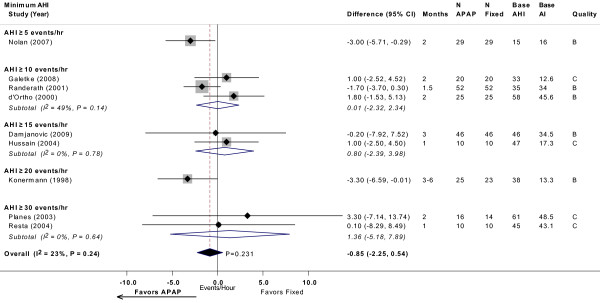
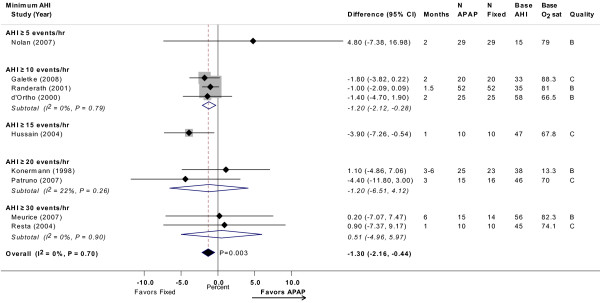
Background: Obstructive sleep apnea is a relatively common disorder that can lead to lost productivity and cardiovascular disease. The form of positive airway treatment that should be offered is unclear. Methods: MEDLINE and the Cochrane Central Trials registry were searched for English language randomized controlled trials comparing auto-titrating positive airway pressure (APAP) with continuous positive airway pressure (CPAP) in adults with obstructive sleep apnea (inception through 9/2010). Six researchers extracted information on study design, potential bias, patient characteristics, interventions and outcomes. Data for each study were extracted by one reviewer and confirmed by another. Random effects model meta-analyses were performed for selected outcomes. Results: Twenty-four randomized controlled trials met the inclusion criteria. In individual studies, APAP and fixed CPAP resulted in similar changes from baseline in the apnea-hypopnea index, most other sleep study measures and quality of life. By meta-analysis, APAP improved compliance by 11 minutes per night (95% CI, 3 to 19 minutes) and reduced sleepiness as measured by the Epworth Sleepiness Scale by 0.5 points (95% CI, 0.8 to 0.2 point reduction) compared with fixed CPAP. Fixed CPAP improved minimum oxygen saturation by 1.3% more than APAP (95% CI, 0.4 to 2.2%). Studies had relatively short follow-up and generally excluded patients with significant comorbidities. No study reported on objective clinical outcomes. Conclusions: Statistically significant differences were found but clinical importance is unclear. Because the treatment effects are similar between APAP and CPAP, the therapy of choice may depend on other factors such as patient preference, specific reasons for non-compliance and cost.
Overview
The claims and statistics of this paper haven’t been checked yet.
Free: it reads the open-access text and checks the first 5 claims that cite a source we can check. Create a free account to check every claim.
Integrity signals
Registry
Cites
Statistics
Figures
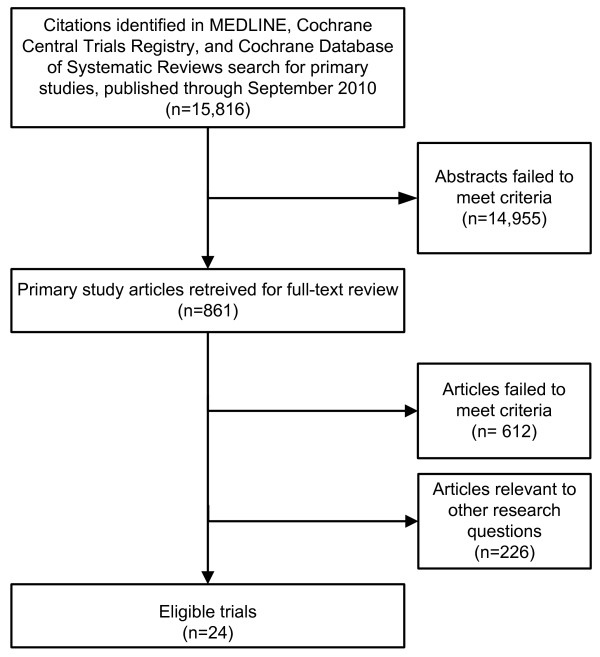
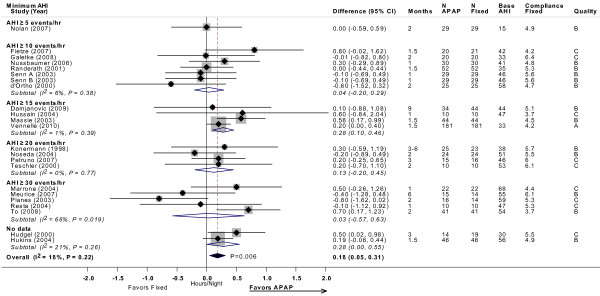
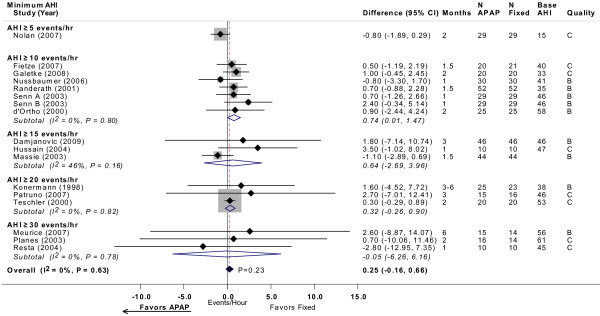
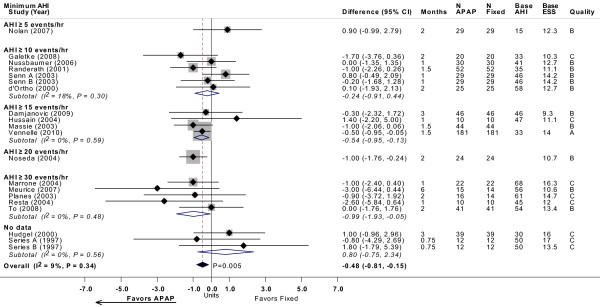
Verification
Claims the paper makes
The claims and statistics of this paper haven’t been checked yet.
Free: it reads the open-access text and checks the first 5 claims that cite a source we can check. Create a free account to check every claim.
Claims other papers make about this one
Each is checked against this paper’s own text: does it say what the citing paper says it does?
The source backs part of the claim, not all of it — or backs it for a different population, condition or comparison.
In the citing paper
“Two SRs39,1035 evaluated the differences between APAP and CPAP devices. Both modalities resulted in a clinically significant reduction of the AHI, sleepiness as measured by the ESS, and QOL. There was no significant difference between the two treatment modalities.”
From International Consensus Statement on Obstructive Sleep Apnea (2023) · cites this paper as [1035]
Experimental — accuracy not yet measuredThe source backs part of the claim, not all of it — or backs it for a different population, condition or comparison.
In the citing paper
“The large meta review performed by Ip et al.1035 included three RCTs that evaluated the effect of APAP and CPAP on BP and found that there was no significant difference between the two modalities.”
From International Consensus Statement on Obstructive Sleep Apnea (2023) · cites this paper as [1035]
Experimental — accuracy not yet measuredThe cited source says what the claim attributes to it.
In the citing paper
“The systemic review by Ip et al.1035 demonstrated that APAP reduced ESS score by 0.5 points when compared to CPAP, though this increased benefit is likely not clinically relevant.”
From International Consensus Statement on Obstructive Sleep Apnea (2023) · cites this paper as [1035]
The cited source says what the claim attributes to it.
In the citing paper
“APAP was shown to have no added benefit in BP reduction when compared to CPAP.”
From International Consensus Statement on Obstructive Sleep Apnea (2023) · cites this paper as [1035]
The cited source says what the claim attributes to it.
In the citing paper
“While the SR by Ip et al.1035 did show an 11-min increase in PAP usage per day with APAP therapy, this is likely to be clinically insignificant.”
From International Consensus Statement on Obstructive Sleep Apnea (2023) · cites this paper as [1035]
Self-check
Percentages, sums and reported differences re-computed from the paper’s own numbers.
The self-check needs the paper’s full text.
Citations
Cites
Measuring inconsistency in meta-analyses
Higgins, J. P. T., Thompson, S. G., Deeks, J. J., & Altman, D. G. (2003) · BMJ · doi:10.1136/bmj.327.7414.557 · Cited by 63,139 · cited 1×
“An I(2) index ≥50% was used to indicate medium-to-high heterogeneity [9].”
MethodMeta-analysis in clinical trials
DerSimonian, R., & Laird, N. (1986) · Controlled Clinical Trials · doi:10.1016/0197-2456(86)90046-2 · Cited by 39,552 · cited 1×
“We performed random effects model meta-analyses of differences of selected continuous variables between interventions where there were at least three unique similar studies [8].”
MethodThe International Classification of Sleep Disorders: Diagnostic and Coding Manual
Daroff, R. B. (1991) · Neurology · doi:10.1212/wnl.41.1.160 · Cited by 5,014
Sleep Disordered Breathing and Mortality: Eighteen-Year Follow-up of the Wisconsin Sleep Cohort
(2008) · Sleep · doi:10.5665/sleep/31.8.1071 · Cited by 1,853
Sleep-Disordered Breathing and Mortality: A Prospective Cohort Study
Punjabi, N. M., Caffo, B. S., Goodwin, J. L., Gottlieb, D. J., Newman, A. B., O'Connor, G. T., Rapoport, D. M., Redline, S., Resnick, H. E., Robbins, J. A., et al. (2009) · PLoS Medicine · doi:10.1371/journal.pmed.1000132 · Cited by 1,482 · cited 1×
“Higher AHI is used as a marker for more severe disease [35] and is associated with greater mortality [1,36-38]; however, our power to find any differences based on baseline AHI was low, particularly since the study eligibility categories overlapped.”
BackgroundPrevalence of Symptoms and Risk of Sleep Apnea in the US Population
Hiestand, D. M., Britz, P., Goldman, M., & Phillips, B. (2006) · Chest · doi:10.1378/chest.130.3.780 · Cited by 451
Mortality in Sleep Apnea Patients: A Multivariate Analysis of Risk Factors
Lavie, P., Herer, P., Peled, R., Berger, I., Yoffe, N., Zomer, J., & Rubin, A.-H. E. (1995) · Sleep · doi:10.1093/sleep/18.3.149 · Cited by 396 · cited 1×
“Higher AHI is used as a marker for more severe disease [35] and is associated with greater mortality [1,36-38]; however, our power to find any differences based on baseline AHI was low, particularly since the study eligibility categories overlapped.”
BackgroundSemi-automated screening of biomedical citations for systematic reviews
Wallace, B. C., Trikalinos, T. A., Lau, J., Brodley, C., & Schmid, C. H. (2010) · BMC Bioinformatics · doi:10.1186/1471-2105-11-55 · Cited by 351 · cited 1×
“We used a computerized screening program, abstrackr, to automate the screening of abstracts for the selection of eligible articles for full-text screening [7].”
MethodIncreasing Sleep Duration for a Healthier (and Less Obese?) Population Tomorrow
Young, T. (2008) · Sleep · doi:10.1093/sleep/31.5.593 · Cited by 327
All-cause mortality in males with sleep apnoea syndrome: declining mortality rates with age
Lavie, P., Lavie, L., & Herer, P. (2005) · European Respiratory Journal · doi:10.1183/09031936.05.00051504 · Cited by 319 · cited 1×
“Higher AHI is used as a marker for more severe disease [35] and is associated with greater mortality [1,36-38]; however, our power to find any differences based on baseline AHI was low, particularly since the study eligibility categories overlapped.”
Background
Research works printed but not linked: 1
- 6. Balk EM, Moorthy D, Obadan NO, Patel K, Ip S, Chung M, Bannuru RR, Kitsios GD, Sen S, Iovin RC, Gaylor JM, D'Ambrosio C, Lau J: Diagnosis and treatment of obstructive sleep apnea in adults. AHRQ Comparative Effectiveness Reviews Rockville, MD: Agency for Healthcare Research and Quality; 2011, Report No.: 11-EHC052.
Cited by
Items 101–148 of 148
Síndrome de apnea-hipopnea del sueño
Mangadoa, N. G., Egea, C., Vives, E. C., Saiz, A., & Ramos, P. D. L. (2016) · Monografías de Archivos de Bronconeumología · Cited by 1
Correvon, N., Fasquel, L., Yazdani, P., Michotte, J.-B., Dugernier, J., & Contal, O. (2022) · Frontiers in Medical Technology · doi:10.3389/fmedt.2022.891390 · Cited by 1
Pazarlı, A. C., & Köseoğlu, H. İ. (2023) · Springer eBooks · doi:10.1007/978-3-031-28963-7_26 · Cited by 2
Positive Airway Pressure Therapies: Advances of the Decade
Alsaeed, M., Hawsawi, Y. M., & BaHammam, A. S. (2023) · Progress in Sleep Research · doi:10.1007/978-981-99-7901-1_2 · Cited by 1
The latest on positive airway pressure for pediatric obstructive sleep apnea
Escobar, N. S., Lim, A. Y. L., & Amin, R. (2024) · Expert Review of Respiratory Medicine · doi:10.1080/17476348.2024.2375428 · Cited by 1
“A 2019 Cochrane review found that adults using APAP likely increased machine usage by approximately 13 minutes per night compared to CPAP, but there was no clinically meaningful difference in daytime sleepiness scores [53].”
Assefa, S. Z., Diaz‐Abad, M., & Scharf, S. M. (2017) · InTech eBooks · doi:10.5772/66816 · Cited by 2
“Because the treatment effects are similar between APAP and CPAP, the therapy of choice may depend on other factors such as patient preference, specific reasons for non-compliance and cost [62].”
BackgroundBartley, J. (2017) · Journal of Otolaryngology-ENT Research · doi:10.15406/joentr.2017.07.00202 · Cited by 1
Long-Term Oxygen Therapy: In a Perfect World
Pruitt, W. C. (2013) · Respiratory Care · doi:10.4187/respcare.02811 · Cited by 1
Mokhlesi, B., & Carter, J. R. (2016) · Thorax · doi:10.1136/thoraxjnl-2016-208718 · Cited by 1
Sleep well with home automation
Zheng, Y., & Yee, B. J. (2023) · Respirology · doi:10.1111/resp.14601 · Cited by 1
“3,4,6,7 In a recent publication in Respirology , the PREDIVARIUS trial published by Bironneau et al. 8 compared two modes of CPAP (fixed CPAP or auto-adjusting CPAP) in patients with treatment-naïve severe obstructive sleep apnoea in a multi-centre parallel group randomized control trial.”
BackgroundAutotitrating Positive Airway Pressure
Imamura, S., & Kushida, C. A. (2013) · Elsevier eBooks · doi:10.1016/b978-0-12-378610-4.00359-4
Jhamb, M., Brown, L. K., & Unruh, M. L. (2014) · American Journal of Kidney Diseases · doi:10.1053/j.ajkd.2014.03.008
Schotland, H. M. (2014) · Cambridge University Press eBooks · doi:10.1017/cbo9781139583848.027
Earing, C. (2015) · Bangor University Research Portal (Bangor University)
Positive airway pressure to treat obstructive sleep apnea
Chervin, R. D. (2014) · Cambridge University Press eBooks · doi:10.1017/cbo9781139583848.078
Current status of autotitrating continuous positive airway pressure: a review
Shrivastava, D. K. (2015) · Indian Journal of Sleep Medicine · doi:10.5005/ijsm-10-2-53
Anästhesie bei Patienten mit Schlafapnoesyndrom
Schnoor, J. (2019) · Springer Reference Medizin · doi:10.1007/978-3-662-54507-2_100
The ABCs of Sleep Apnea Management
Turino, C., Barbé, F., & Sánchez‐de‐la‐Torre, M. (2015) · Barcelona Respiratory Network · doi:10.23866/brnrev:2015-m0006
The Therapeutic Means of Obstructive Sleep Apnea Syndrome (OSAS)
Elena-Corina, J. (2018) · Internal Medicine · doi:10.2478/inmed-2018-0004
Kim, S. S., & Yang, K. I. (2018) · Journal of Sleep Medicine · doi:10.13078/jsm.18012
Meurice, J.-C. (2019) · Revue des Maladies Respiratoires Actualités · doi:10.1016/s1877-1203(19)30048-5 · Cited by 1
Sekizuka, H., Hoshide, S., Osada, N., Akashi, Y. J., & Kario, K. (2019) · Journal of St Marianna University · doi:10.17264/stmarieng.10.103
Is brain function impaired in moderate sleep apnoea: Before and after six months of APAP
Buckley, R. J. (2021) · Otago University Research Archive (University of Otago)
Chen, Y.-L., Chuang, L., Lin, S., Huang, H.-Y., Liu, G.-H., Hsu, H.-F., & Chen, N. (2021) · Medicina · doi:10.3390/medicina57090915 · Cited by 1
“To improve the above conditions, advanced PAP features, including auto-titrating CPAP [8,9], bi-level PAP [10–12], and expiratory pressure relief [13–16], were developed to decrease discomfort from high-pressure airflow that may reduce patient compliance with recommended treatment.”
BackgroundLehockey, K. A. (2014) · The Scholarship East Carolina University's Institutional Repository (East Carolina University) · Cited by 1
Autotitrating positive airway pressure
Wang, W., & Kushida, C. A. (2022) · Elsevier eBooks · doi:10.1016/b978-0-12-822963-7.00327-3
Autotitrating Positive Airway Pressure☆
Imamura, S., & Kushida, C. A. (2017) · Elsevier eBooks · doi:10.1016/b978-0-12-809324-5.01196-2
Chuang, L., Lin, S., & Chen, N. (2019) · Journal of Clinical Sleep Medicine · doi:10.5664/jcsm.8048
Anästhesie bei Patienten mit Schlafapnoesyndrom
Schnoor, J. (2016) · Springer eBooks · doi:10.1007/978-3-662-45539-5_100-1
Soft Styles of Motivating Patients to Adopt CPAP
Khullar, A. (2022) · Springer eBooks · doi:10.1007/978-3-030-93146-9_4
Asad, F., Sahito, A. A., Fasih-ur-Rahman, Moin, M., Ubedullah, U., & Rahman, S.-U. (2022) · Pakistan Journal of Medical and Health Sciences · doi:10.53350/pjmhs221610485 · Cited by 1
Technology Approaches for Chronic Noninvasive Ventilatory Support in Chronic Respiratory Conditions
Tan, H., & Winck, J. C. (2023) · Springer eBooks · doi:10.1007/978-3-031-30010-3_7
Somnolence diurne excessive au cours du syndrome d’apnées hypopnées obstructives du sommeil (SAHOS)
Bironneau, V., & Meurice, J. C. (2023) · Médecine du Sommeil · doi:10.1016/j.msom.2023.08.002 · Cited by 1
New Ventilatory Modes in Sleep-Disordered Breathing: Key Topics and Clinical Implications
BaHammam, A. S., Alsaeed, M., & Hawsawi, Y. M. (2023) · Springer eBooks · doi:10.1007/978-3-031-28963-7_25
ประมวลศัพท์เรื่องเวชศาสตร์การนอนหลับ
ชัยศุภมงคลลาภ, ก. (2016) · Chula Digiverse · doi:10.58837/chula.is.2016.3
Pugongchai, A., Leelasittikul, K., & Saiphoklang, N. (2024) · Journal of the Medical Association of Thailand · doi:10.12688/f1000research.144758.1 · Cited by 1
Belov, A. M. (2025) · doi:10.18093/978-5-6052509-1-3-2024-4-16-50
Simplifying CPAP Therapy: Is Fixed Pressure the Way Forward?
BaHammam, A. S. (2025) · Respirology · doi:10.1111/resp.70042
Punina, A. A., & Gribova, N. P. (2025) · Русский медицинский журнал · doi:10.32364/2225-2282-2025-4-1
Diagnostic et traitement du syndrome d’apnées-hypopnées obstructives du sommeil de l’adulte
Bironneau, V., & Meurice, J. C. (2025) · Encyclopédie médico-chirurgicale. Pneumologie · doi:10.1016/s1155-195x(25)45857-5
Monitoring Airway Resistance for Obstructive Sleep Apnea Using a Leak-Based BiPAP System
Clifton, J. A., Hill, J. F., Guy, E. F. S., Holder-Pearson, L. R., Baglyas, S., Benyó, B. I., & Chase, J. G. (2025) · Annual International Conference of the IEEE Engineering in Medicine and Biology Society (EMBC) · doi:10.1109/embc58623.2025.11254627
Munteanu, I., Diaconu, G. A., Gheorghevici, C., Feraru, N., Burdușel, B., Coca, C. C., Mihaltan, F. D., Mahler, B., Chirila, S. I., & Herdea, V. (2025) · Life · doi:10.3390/life16010048
“Overall, both modalities demonstrated comparable outcomes in AHI reduction, sleep quality, and quality of life, suggesting the acceptability of either approach depending on patient needs [23].”
Baran, B., Kumsar, M. S., Doğmaz, G., Yetkin, N. A., Rabahoğlu, B., Tutar, N., Oymak, F. S., & Gülmez, İ. (2025) · Sağlık Bilimleri Dergisi · doi:10.34108/eujhs.1790064
Escribá-Alepuz, J., Herrero, L., Saura, A., Lloris, A., Cercas, O., Segrelles, J., Pinel, J., Palop, M., Ramos, G., Estévez, E., et al. (2026) · Sleep And Breathing · doi:10.1007/s11325-025-03481-2 · Cited by 1
“Auto-titration has been proposed as a common standard practice in OSA titration [17, 21, 22] and treatment [6, 19 , 21, 23 ] because no significant differences on residual AHI, compliance and use were found and an improvement in the Epworth Sleepiness Scale (ESS) or the Functional Outcomes of Sleep…”
Huang, Y.-C., Lan, C., Su, W., Kuo, I., Tzeng, I., & Yang, M. (2026) · Journal of Otolaryngology - Head and Neck Surgery · doi:10.1177/19160216261468697
Syndrome d'apnée du sommeil en périopératoire
Marson, H. (2021) · Arnette eBooks · doi:10.3917/arne.lioti.2021.01.0183
Metadata
- Authors
- Ip, S., D'Ambrosio, C., Patel, K., Obadan, N., Kitsios, G. D., Chung, M., & Balk, E. M.
- Affiliations
- Tufts University (US)
- Corresponding author
- Balk, Ethan M
- Venue
- Systematic Reviews
- Published
- 2012-03-08
- Volume
- 1
- Issue
- 1
- Pages
- 20-20
- ISSN
- 2046-4053 (ISSN-L)
- PMC
- PMC3351715
- OpenAlex
- W2129453959
- Cited by
- 148
- References
- 38
- Citations by year
- 2026: 4 · 2025: 8 · 2024: 10 · 2023: 9 · 2022: 10 · 2021: 10 · 2020: 7 · 2019: 7 · 2018: 8 · 2017: 18 · 2016: 11 · 2015: 16 · 2014: 13 · 2013: 13 · 2012: 3
- FWCI
- 1.55
- Type
- journal article
- Language
- en
- Open access
- gold
- doi.org
- Licence
- Locations
- Systematic Reviews (publishedVersion, cc-by)
- PubMed Central (publishedVersion, cc-by)
- PubMed (publishedVersion)
- DOAJ (DOAJ: Directory of Open Access Journals) (submittedVersion)
- Funders
- U.S. Department of Health and Human Services
- Agency for Healthcare Research and Quality
- U.S. Public Health Service (290 2007 1055 L)
- Topics
- Health Sciences › Medicine › Physiology (medical) › Obstructive Sleep Apnea Research
- Social Sciences › Psychology › Experimental and Cognitive Psychology › Sleep and related disorders
- Health Sciences › Medicine › Pulmonary and Respiratory Medicine › Respiratory Support and Mechanisms
- Keywords
- obstructive sleep apnea, auto-titrating CPAP, continuous positive airway pressure, CPAP adherence, sleepiness, Epworth Sleepiness Scale, oxygen saturation, apnea-hypopnea index, quality of life, CPAP titration
- MeSH terms
- Adult, Humans, Positive-Pressure Respiration, Randomized Controlled Trials as Topic, Sleep Apnea, Obstructive, Continuous Positive Airway Pressure
About these checks
Registry, retraction, Cites and statistics results are computed, not judged, with one exception: a printed reference that no index lists is read once by a model before it counts as a citation error. Claims are extracted by a model and kept only when their quote appears verbatim in the text; each cited source is then checked, with a model’s help, for whether it says what the claim relies on. Those verdicts can be wrong — read the claim’s quote and the cited source before relying on one.
Statistics and arithmetic are recomputed, not judged.
Confidence bands are shown only for fields calibrated on our annotated test set. None is calibrated yet, so no band is shown.
What counts as a claim ›How we measure confidence ›How we check this ›
Are you an author, or do you see a problem with this page? Request a review
Data sources
Bibliographic data: Semantic Scholar, OpenAlex, Crossref.
Contains information from the Semantic Scholar Academic Graph Datasets, made available under the ODC Attribution License (ODC-BY 1.0).
Semantic Scholar’s data is described in: Kinney, R., et al. (2023). The Semantic Scholar Open Data Platform. arXiv:2301.10140.
