

The DOI matches its Crossref record; 32 of the 33 references it cites were found in a registry or an index.
The comparative recall of Google Scholar versus PubMed in identical searches for biomedical systematic reviews: a review of searches used in systematic reviews
Open accessAbstract
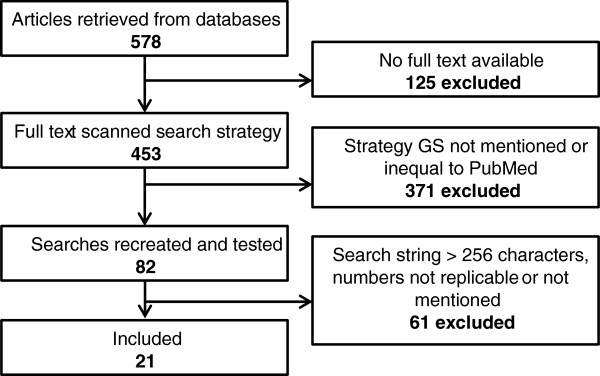
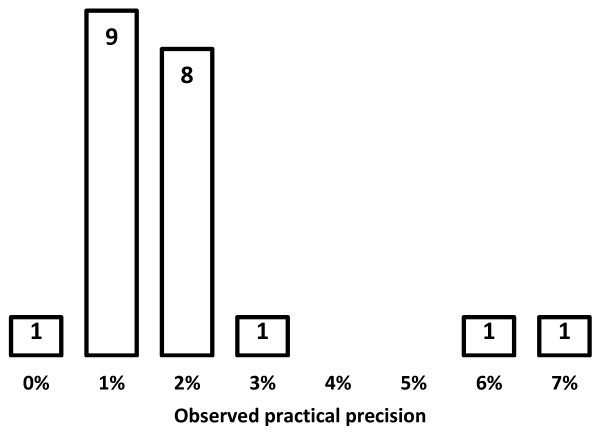
BACKGROUND: The usefulness of Google Scholar (GS) as a bibliographic database for biomedical systematic review (SR) searching is a subject of current interest and debate in research circles. Recent research has suggested GS might even be used alone in SR searching. This assertion is challenged here by testing whether GS can locate all studies included in 21 previously published SRs. Second, it examines the recall of GS, taking into account the maximum number of items that can be viewed, and tests whether more complete searches created by an information specialist will improve recall compared to the searches used in the 21 published SRs. METHODS: The authors identified 21 biomedical SRs that had used GS and PubMed as information sources and reported their use of identical, reproducible search strategies in both databases. These search strategies were rerun in GS and PubMed, and analyzed as to their coverage and recall. Efforts were made to improve searches that underperformed in each database. RESULTS: GS' overall coverage was higher than PubMed (98% versus 91%) and overall recall is higher in GS: 80% of the references included in the 21 SRs were returned by the original searches in GS versus 68% in PubMed. Only 72% of the included references could be used as they were listed among the first 1,000 hits (the maximum number shown). Practical precision (the number of included references retrieved in the first 1,000, divided by 1,000) was on average 1.9%, which is only slightly lower than in other published SRs. Improving searches with the lowest recall resulted in an increase in recall from 48% to 66% in GS and, in PubMed, from 60% to 85%. CONCLUSIONS: Although its coverage and precision are acceptable, GS, because of its incomplete recall, should not be used as a single source in SR searching. A specialized, curated medical database such as PubMed provides experienced searchers with tools and functionality that help improve recall, and numerous options in order to optimize precision. Searches for SRs should be performed by experienced searchers creating searches that maximize recall for as many databases as deemed necessary by the search expert.
Overview
The claims and statistics of this paper haven’t been checked yet.
Run the check — free, no account needed. It reads the open-access text and checks the sources it cites.
Integrity signals
Registry
Cites
Statistics
Figures
Verification
Claims the paper makes
The claims and statistics of this paper haven’t been checked yet.
Run the check — free, no account needed. It reads the open-access text and checks the sources it cites.
Claims other papers make about this one
Each is checked against this paper’s own text: does it say what the citing paper says it does?
The cited source says what the claim attributes to it.
In the citing paper
“Previous studies have also calculated precision and recall of search systems from data reported by specific evidence‐synthesis studies.24, 32, 33, 34”
The cited source says what the claim attributes to it.
In the citing paper
“Quality criteria have previously been used to evaluate search systems in terms of recall and precision indicating their suitability of search in general and systematic search in particular.”
The cited source says what the claim attributes to it.
In the citing paper
“The distinction between principal and supplementary resources for systematic reviews was also used in previous assessments of search system qualities.33, 57”
The cited source says what the claim attributes to it.
In the citing paper
“Until now, studies have largely examined the suitability of search systems for certain scholarly tasks for individual systems or by comparing a few systems.33, 50, 95”
The cited source says what the claim attributes to it.
In the citing paper
“Our findings support the criticism of Bramer et al,33 Bramer et al,34 and Boeker et al25 and indicate that Google Scholar's coverage and recall is an inadequate reason to use it as principal search system in systematic searches.53”
Self-check
Percentages, sums and reported differences re-computed from the paper’s own numbers.
The self-check needs the paper’s full text.
Citations
Cites
Preferred Reporting Items for Systematic Reviews and Meta-Analyses: the PRISMA statement
Moher, D., Liberati, A., Tetzlaff, J., Altman, D. G., & for the PRISMA Group (2009) · BMJ · doi:10.1136/bmj.b2535 · Cited by 83,823
Preferred Reporting Items for Systematic Reviews and Meta-Analyses: The PRISMA Statement
Moher, D., Liberati, A., Tetzlaff, J., Altman, D. G., & The PRISMA Group (2009) · PLoS Medicine · doi:10.1371/journal.pmed.1000097 · Cited by 64,042
Preferred reporting items for systematic reviews and meta-analyses: The PRISMA statement
Moher, D., Liberati, A., Tetzlaff, J., Altman, D. G., & the PRISMA Group* (2009) · Annals of Internal Medicine · doi:10.7326/0003-4819-151-4-200908180-00135 · Cited by 37,554
Cochrane Handbook for Systematic Reviews of Interventions Version 5.0.1. The Cochrane Collaboration
Higgins, J., Green, S. R., & Higgins, J. (2008) · Cited by 5,544
Comparison of PubMed, Scopus, Web of Science, and Google Scholar: strengths and weaknesses
Falagas, M. E., Pitsouni, E. I., Malietzis, G. A., & Pappas, G. (2008) · The FASEB Journal · doi:10.1096/fj.07-9492lsf · Cited by 5,039
Is the coverage of google scholar enough to be used alone for systematic reviews
Gehanno, J.-F., Rollin, L., & Darmoni, S. (2013) · BMC Medical Informatics and Decision Making · doi:10.1186/1472-6947-13-7 · Cited by 357
Systematic reviews need systematic searchers.
(2005) · Europe PMC (PubMed Central) · Cited by 257
Boeker, M., Vach, W., & Motschall, E. (2013) · BMC Medical Research Methodology · doi:10.1186/1471-2288-13-131 · Cited by 225
Tober, M. (2011) · Medical Laser Application · doi:10.1016/j.mla.2011.05.006 · Cited by 192
Google Scholar is not enough to be used alone for systematic reviews
Giustini, D., & Kamel Boulos, M. N. (2013) · Online Journal of Public Health Informatics · doi:10.5210/ojphi.v5i2.4623 · Cited by 187
Self-citationComparing test searches in PubMed and Google Scholar
Shultz, M. (2007) · Journal of the Medical Library Association : JMLA · doi:10.3163/1536-5050.95.4.442 · Cited by 174
Should meta-analysts search Embase in addition to Medline?
Sampson, M. (2003) · Journal of Clinical Epidemiology · doi:10.1016/s0895-4356(03)00110-0 · Cited by 160
A longitudinal study of Google Scholar coverage between 2012 and 2013
Harzing, A.-W. K. (2013) · Scientometrics · doi:10.1007/s11192-013-0975-y · Cited by 141
Searching one or two databases was insufficient for meta-analysis of observational studies
Lemeshow, A. R., Blum, R. E., Berlin, J. A., Stoto, M. A., & Colditz, G. A. (2005) · Journal of Clinical Epidemiology · doi:10.1016/j.jclinepi.2005.03.004 · Cited by 137
Retrieving Clinical Evidence: A Comparison of PubMed and Google Scholar for Quick Clinical Searches
Shariff, S. Z., Bejaimal, S. A., Sontrop, J. M., Iansavichus, A. V., Haynes, R. B., Weir, M. A., & Garg, A. X. (2013) · Journal of Medical Internet Research · doi:10.2196/jmir.2624 · Cited by 119
Medical literature searches: a comparison of P ub M ed and G oogle S cholar
Nourbakhsh, E., Nugent, R., Wang, H., Çevik, C., & NUGENT, K. M. (2012) · Health Information & Libraries Journal · doi:10.1111/j.1471-1842.2012.00992.x · Cited by 118
How Google is changing medicine
Giustini, D. (2005) · BMJ · doi:10.1136/bmj.331.7531.1487 · Cited by 118
Self-citationActive Assistance Technology for Health-Related Behavior Change: An Interdisciplinary Review
Kennedy, C. M., powell, J. A., Payne, T. H., Ainsworth, J. D., Boyd, A., & Buchan, I. E. (2012) · Journal of Medical Internet Research · doi:10.2196/jmir.1893 · Cited by 111
Poor reporting and inadequate searches were apparent in systematic reviews of adverse effects
Golder, S., Loke, Y. K., & McIntosh, H. M. (2008) · Journal of Clinical Epidemiology · doi:10.1016/j.jclinepi.2007.06.005 · Cited by 97
Which resources should be used to identify RCT/CCTs for systematic reviews: a systematic review
Crumley, E. T., Wiebe, N., Cramer, K., Klassen, T. P., & Hartling, L. (2005) · BMC Medical Research Methodology · doi:10.1186/1471-2288-5-24 · Cited by 95
Google Scholar Search Performance: Comparative Recall and Precision
Walters, W. H. (2009) · portal Libraries and the Academy · doi:10.1353/pla.0.0034 · Cited by 93
Betrán, A. P., Say, L., Gülmezoglu, A. M., Allen, T., & Hampson, L. (2005) · BMC Medical Research Methodology · doi:10.1186/1471-2288-5-6 · Cited by 83
Precision of healthcare systematic review searches in a cross‐sectional sample
Sampson, M., Tetzlaff, J., & Urquhart, C. (2011) · Research Synthesis Methods · doi:10.1002/jrsm.42 · Cited by 80
Google Scholar: A source for clinicians?
Henderson, J. (2005) · Canadian Medical Association Journal · doi:10.1503/cmaj.050404 · Cited by 76
Google Scholar's Dramatic Coverage Improvement Five Years after Debut
Chen, X. (2010) · Serials Review · doi:10.1016/j.serrev.2010.08.002 · Cited by 66
Google Scholar Versus PubMed in Locating Primary Literature to Answer Drug-Related Questions
Freeman, M. K., Lauderdale, S. A., Kendrach, M. G., & Woolley, T. W. (2009) · Annals of Pharmacotherapy · doi:10.1345/aph.1l223 · Cited by 63
Topfer, L.-A., Parada, A., Menon, D., Noorani, H. Z., Perras, C., & Serra‐Prat, M. (1999) · International Journal of Technology Assessment in Health Care · doi:10.1017/s0266462399015226 · Cited by 59
Watson, R., & Richardson, P. H. (1999) · British Journal of Medical Psychology · doi:10.1348/000711299160220 · Cited by 53
Sackett, D. L. (1994) · ACP Journal Club · doi:10.7326/acpjc-1994-120-3-a11 · Cited by 49
Haase, A., Follmann, M., Skipka, G., & Kirchner, H. (2007) · BMC Medical Research Methodology · doi:10.1186/1471-2288-7-28 · Cited by 36
Mastrangelo, G., Fadda, E., Rossi, C. R., Zamprogno, E., Buja, A., & Cegolon, L. (2010) · BMC Research Notes · doi:10.1186/1756-0500-3-131 · Cited by 21
Comparison of PubMed and Google Scholar Literature Searches
Anders, M. E., & Evans, D. P. (2010) · Respiratory Care · doi:10.4187/respcare.10550578 · Cited by 3
Cited by
Sorted by citations
Gusenbauer, M., & Haddaway, N. R. (2020) · Research Synthesis Methods · doi:10.1002/jrsm.1378 · Cited by 2,379
“33,50,95 Our methods allowed a comprehensive review of many different search systems.”
BackgroundMethodResultBramer, W. M., Rethlefsen, M. L., Kleijnen, J., & Franco, O. H. (2017) · Systematic Reviews · doi:10.1186/s13643-017-0644-y · Cited by 2,114
“Nevertheless others have concluded that a single database is not sufficient to retrieve all references for systematic reviews [18, 19].”
BackgroundSelf-citationA systematic approach to searching: an efficient and complete method to develop literature searches
Bramer, W. M., De Jonge, G. B., Rethlefsen, M. L., Mast, F., & Kleijnen, J. (2018) · Journal of the Medical Library Association · doi:10.5195/jmla.2018.283 · Cited by 863
Self-citationHalevi, G., Moed, H., & Bar-Ilan, J. (2017) · Journal of Informetrics · doi:10.1016/j.joi.2017.06.005 · Cited by 488
Yao, X. I., Wang, X., Speicher, P. J., Hwang, E. S., Cheng, P., Harpole, D. H., Berry, M. F., Schrag, D., & Pang, H. (2017) · JNCI Journal of the National Cancer Institute · doi:10.1093/jnci/djw323 · Cited by 396
Metadata
- Authors
- Bramer, W. M., Giustini, D., Kramer, B. M., & Anderson, P.
- Affiliations
- Erasmus MC (NL)
- University of British Columbia (CA)
- Utrecht University (NL)
- Corresponding author
- Bramer, Wichor M
- Venue
- Systematic Reviews
- Published
- 2013-12
- Volume
- 2
- Issue
- 1
- Pages
- 115-115
- ISSN
- 2046-4053 (ISSN-L)
- PMC
- PMC3882110
- OpenAlex
- W2100684744
- Cited by
- 139
- References
- 33
- Citations by year
- 2026: 5 · 2025: 11 · 2024: 11 · 2023: 5 · 2022: 16 · 2021: 13 · 2020: 10 · 2019: 17 · 2018: 7 · 2017: 15 · 2016: 15 · 2015: 10 · 2014: 4
- FWCI
- 1.98
- Type
- journal article
- Language
- en
- Open access
- gold
- doi.org
- Licence
- Locations
- Systematic Reviews (publishedVersion, cc-by)
- Europe PMC (PubMed Central) (publishedVersion, cc-by)
- PubMed Central (publishedVersion, cc-by)
- PubMed (publishedVersion)
- RePub (Erasmus University Rotterdam) (submittedVersion, other-oa)
- cIRcle (University of British Columbia) (submittedVersion, cc-by)
- Deep Blue (University of Michigan) (submittedVersion)
- RePub (Erasmus University Rotterdam) (submittedVersion)
- Topics
- Social Sciences › Decision Sciences › Statistics, Probability and Uncertainty › Meta-analysis and systematic reviews
- Physical Sciences › Computer Science › Information Systems › Information Retrieval and Search Behavior
- Social Sciences › Library and Information Sciences › scientometrics and bibliometrics research
- Keywords
- Google Scholar, PubMed, search precision, information retrieval, database comparison
- MeSH terms
- Systematic Reviews as Topic, Humans, Information Storage and Retrieval, Internet, PubMed, Search Engine
About these checks
Registry, retraction, Cites and statistics results are computed, not judged, with one exception: a printed reference that no index lists is read once by a model before it counts as a citation error. Claims are extracted by a model and kept only when their quote appears verbatim in the text; each cited source is then checked, with a model’s help, for whether it says what the claim relies on. Those verdicts can be wrong — read the claim’s quote and the cited source before relying on one.
Statistics and arithmetic are recomputed, not judged.
Confidence bands are shown only for fields calibrated on our annotated test set. None is calibrated yet, so no band is shown.
What counts as a claim ›How we measure confidence ›How we check this ›
Are you an author, or do you see a problem with this page? Request a review
