

Clinical trials registries are under-utilized in the conduct of systematic reviews: a cross-sectional analysis
Open accessThe DOI matches its Crossref record; 59 of the 60 references it cites were found in a registry or an index.
Abstract
BACKGROUND: Publication bias is a major threat to the validity of systematic reviews. Searches of clinical trials registries can help to identify unpublished trials, though little is known about how often these resources are utilized. We assessed the usage and results of registry searches reported in systematic reviews published in major general medical journals. METHODS: This cross-sectional analysis includes data from systematic reviews assessing medical interventions which were published in one of six major general medical journals between July 2012 and June 2013. Two authors independently examined each published systematic review and all available supplementary materials to determine whether at least one clinical trials registry was searched. RESULTS: Of the 117 included systematic reviews, 41 (35%) reported searching a trials registry. Of the 29 reviews which also provided detailed registry search results, 15 (52%) identified at least one completed trial and 18 (62%) identified at least one ongoing trial. CONCLUSIONS: Clinical trials registry searches are not routinely included in systematic reviews published in major medical journals. Routine examination of registry databases may allow a more accurate characterization of publication and outcome reporting biases and improve the validity of estimated effects of medical treatments.
Overview
The claims and statistics of this paper haven’t been checked yet.
Free: it reads the open-access text and checks the first 5 claims that cite a source we can check. Create a free account to check every claim.
Integrity signals
Registry
Cites
Statistics
Figures
Verification
Claims the paper makes
The claims and statistics of this paper haven’t been checked yet.
Free: it reads the open-access text and checks the first 5 claims that cite a source we can check. Create a free account to check every claim.
Claims other papers make about this one
Each is checked against this paper’s own text: does it say what the citing paper says it does?
The cited source says what the claim attributes to it.
In the citing paper
“Clinical trial registries are sometimes used to identify trials for inclusion in systematic reviews.30–32”
From Systematic review protocol assessing the processes for linking clinical trial registries and their published results (2016) · cites this paper as [30]
Self-check
Percentages, sums and reported differences re-computed from the paper’s own numbers.
The self-check needs the paper’s full text.
Citations
Cites
Liberati, A., Altman, D. G., Tetzlaff, J., Mulrow, C., Gøtzsche, P. C., Ioannidis, J. P. A., Clarke, M., Devereaux, P. J., Kleijnen, J., & Moher, D. (2009) · PLoS Medicine · doi:10.1371/journal.pmed.1000100 · Cited by 28,164 · cited 2×
“The PRISMA Statement, which has been endorsed by the World Association of Medical Editors, the Cochrane Collaboration, and numerous other organizations and journals, and provides a guide to the reporting of systematic reviews, does not explicitly advise authors to search trial registries [1].”
MethodCochrane Handbook for Systematic Reviews of Interventions: Cochrane Book Series
(2008) · doi:10.1002/9780470712184 · Cited by 25,048
Liberati, A., Altman, D. G., Tetzlaff, J., Mulrow, C., Gøtzsche, P. C., Ioannidis, J. P. A., Clarke, M., Devereaux, P. J., Kleijnen, J., & Moher, D. (2009) · Journal of Clinical Epidemiology · doi:10.1016/j.jclinepi.2009.06.006 · Cited by 10,578
Cochrane Handbook for Systematic Reviews of Interventions Version 5.0.1. The Cochrane Collaboration
Higgins, J. P. T., Green, S. R., & Higgins, J. P. T. (2008) · Cited by 7,261
Systematic reviews: CRD's guidance for undertaking reviews in health care
Tacconelli, E. (2010) · The Lancet Infectious Diseases · doi:10.1016/s1473-3099(10)70065-7 · Cited by 3,245
Leucht, S., Cipriani, A., Spineli, L., Mavridis, D., Örey, D., Richter, F., Samara, M., Barbui, C., Engel, R. R., Geddes, J. R., et al. (2013) · The Lancet · doi:10.1016/s0140-6736(13)60733-3 · Cited by 2,561 · cited 1×
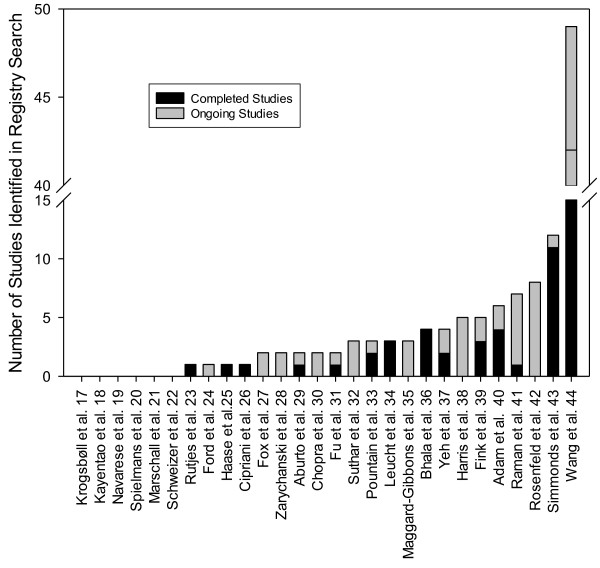
“Figure 1 Registry search results by systematic review [17-44].”
BackgroundComparison of two methods to detect publication bias in meta-analysis.
Peters, J. L. (2006) · JAMA · doi:10.1001/jama.295.6.676 · Cited by 2,278 · cited 1×
“These methods, which include the inspection and testing of funnel plots, are now routinely performed and explicitly mentioned in the guidelines for the reporting of systematic reviews [1-3].”
MethodChan, A.-W., Hróbjartsson, A., Haahr, M. T., Gøtzsche, P. C., & Altman, D. G. (2004) · JAMA · doi:10.1001/jama.291.20.2457 · Cited by 1,845 · cited 1×
“Second, even when trial results are published, examining registry entries can help review authors identify outcome reporting bias by allowing them to compare a priori planned outcomes to reported outcomes [51,52].”
BackgroundThe case of the misleading funnel plot
Lau, J., Ioannidis, J. P. A., Terrin, N., Schmid, C. H., & Olkin, I. (2006) · BMJ · doi:10.1136/bmj.333.7568.597 · Cited by 1,766
Cited by
Page, M. J., Shamseer, L., Altman, D. G., Tetzlaff, J., Sampson, M., Tricco, A. C., Catalá-López, F., Li, L., Reid, E. K., Sarkis-Onofre, R., et al. (2016) · PLOS Medicine · doi:10.1371/journal.pmed.1002028 · Cited by 768
“, trial registries, regulatory databases), despite their ability to reduce the impact of reporting biases [34,35].”
BackgroundGuidance to best tools and practices for systematic reviews
Kolaski, K., Logan, L. R., & Ioannidis, J. P. A. (2023) · Systematic Reviews · doi:10.1186/s13643-023-02255-9 · Cited by 241
Cooper, C., Booth, A., Britten, N., & Garside, R. (2017) · Systematic Reviews · doi:10.1186/s13643-017-0625-1 · Cited by 137
“The studies focused on the searching of the registers [38] and the advantages and disadvantages of doing so [39, 40].”
BackgroundResultInfluentialBaudard, M., Yavchitz, A., Ravaud, P., Perrodeau, E., & Boutron, I. (2017) · BMJ · doi:10.1136/bmj.j448 · Cited by 107
“3 24-26 Finally, searching trial registries in general represented a low burden.”
BackgroundSearching clinical trials registers: guide for systematic reviewers
Hunter, K. E., Webster, A. C., Page, M. J., Willson, M., McDonald, S., Berber, S., Skeers, P., Tan-Koay, A. G., Parkhill, A., & Seidler, A. L. (2022) · BMJ · doi:10.1136/bmj-2021-068791 · Cited by 85
Time-to-update of systematic reviews relative to the availability of new evidence
Bashir, R., Surian, D., & Dunn, A. G. (2018) · Systematic Reviews · doi:10.1186/s13643-018-0856-9 · Cited by 72
Database selection in systematic reviews: an insight through clinical neurology
Vassar, M., Yerokhin, V., Sinnett, P. M., Weiher, M., Muckelrath, H., Carr, B., Varney, L., & Cook, G. (2017) · Health Information & Libraries Journal · doi:10.1111/hir.12176 · Cited by 58
Meerpohl, J. J., Schell, L. K., Bassler, D., Gallus, S., Kleijnen, J., Kulig, M., La Vecchia, C., Marušić, A., Ravaud, P., Reis, A., et al. (2015) · BMJ Open · doi:10.1136/bmjopen-2014-006666 · Cited by 57
Guidance to best tools and practices for systematic reviews
Kolaski, K., Logan, L. R., & Ioannidis, J. P. A. (2023) · JBI Evidence Synthesis · doi:10.11124/jbies-23-00139 · Cited by 63
Lindsley, K., Fusco, N., Li, T., Scholten, R., & Hooft, L. (2022) · Journal of Clinical Epidemiology · doi:10.1016/j.jclinepi.2022.01.012 · Cited by 52
Bashir, R., Bourgeois, F. T., & Dunn, A. G. (2017) · Systematic Reviews · doi:10.1186/s13643-017-0518-3 · Cited by 47
“These included links to or from protocols [34–37], conference or meeting abstracts [38–42], internal company documents [17], Food and Drug Administration (FDA) documents or new drug approvals [43–47], or other databases of published articles [48, 49].”
BackgroundFrandsen, T. F., Gildberg, F. A., & Tingleff, E. B. (2019) · Journal of Clinical Epidemiology · doi:10.1016/j.jclinepi.2019.06.013 · Cited by 53
“Although the number of databases searched in systematic reviews has increased over time (17, 18), qualitative systematic reviews are often based on literature searches in a few databases even though the retrieval of relevant studies is considerably diminished if only a few databases are included (19-21).”
BackgroundFrandsen, T. F., Eriksen, M. B., Hammer, D. M. G., & Christensen, J. B. (2019) · Journal of Clinical Epidemiology · doi:10.1016/j.jclinepi.2019.04.015 · Cited by 44
“Choice of database and searching multiple databases must be considered intertwined and can be formulated as a question of which databases to search and how many (6-12).”
BackgroundJones, C. W., Safferman, M. R., Adams, A., & Platts‐Mills, T. F. (2017) · BMJ Open · doi:10.1136/bmjopen-2017-017719 · Cited by 50
Self-citationObstacles to the reuse of study metadata in ClinicalTrials.gov
Miron, L., Gonçalves, R. S., & Musen, M. A. (2020) · Scientific Data · doi:10.1038/s41597-020-00780-z · Cited by 41
“Age 2 minimum_age, maximum_age ‘N/A|([1-9][09]*(Year|Years|Month|Months|Week|Weeks|Day|Days| Hour|Hours|Minute|Minutes))’”
Facilitating Prospective Registration of Diagnostic Accuracy Studies: A STARD Initiative
Korevaar, D. A., Hooft, L., Askie, L. M., Barbour, V., Faure, H., Gatsonis, C. A., Hunter, K. E., Kressel, H. Y., Lippman, H., McInnes, M. D. F., et al. (2017) · Clinical Chemistry · doi:10.1373/clinchem.2017.272765 · Cited by 36
Methodological quality of systematic reviews on treatments for osteoporosis: A cross-sectional study
Tsoi, A. K., Ho, L. T. F., Wu, I. X. Y., Wong, C. H. L., Ho, R. S. T., Lim, J. Y. Y., Mao, C., Lee, E. K. P., & Chung, V. C. (2020) · Bone · doi:10.1016/j.bone.2020.115541 · Cited by 32
Observational studies and registers. Their quality and role in modern evidence-based medicine
Martsevich, S. Y., Кутишенко, Н. П., Lukina, Y. V., Lukyanov, М. М., & Drapkina, O. M. (2021) · CARDIOVASCULAR THERAPY AND PREVENTION · doi:10.15829/1728-8800-2021-2786 · Cited by 31
Guidance to best tools and practices for systematic reviews1
Kolaski, K., Logan, L. R., & Ioannidis, J. P. A. (2023) · Journal of Pediatric Rehabilitation Medicine · doi:10.3233/prm-230019 · Cited by 52
“The gray literature and a search of trials may also reveal important details about topics that would otherwise be missed [149, 150, 151].”
van Valkenhoef, G., Loane, R. F., & Zarin, D. A. (2016) · Systematic Reviews · doi:10.1186/s13643-016-0283-8 · Cited by 28
“Recommendations for systematic reviewers Systematic reviewers cannot afford to ignore registry data when conducting systematic reviews [20], because registry data is key to determining how many studies have been done and how many have not published their results.”
Baseline results of a living systematic review for COVID-19 clinical trial registrations
Maguire, B., McLean, A. R. D., Rashan, S., Antonio, E. S., Bagaria, J., Bentounsi, Z., Brack, M., Caldwell, F., Carrara, V. I., Citarella, B. W., et al. (2020) · Wellcome Open Research · doi:10.12688/wellcomeopenres.15933.1 · Cited by 29
Guidance to best tools and practices for systematic reviews
Kolaski, K., Logan, L. R., & Ioannidis, J. P. A. (2023) · British Journal of Pharmacology · doi:10.1111/bph.16100 · Cited by 33
“The gray literature and a search of trials may also reveal important details about topics that would otherwise be missed (Baudard et al., 2017; Fanelli et al., 2017; Jones et al., 2014).”
BackgroundBorysowski, J., Wnukiewicz‐Kozłowska, A., & Górski, A. (2020) · British Journal of Clinical Pharmacology · doi:10.1111/bcp.14223 · Cited by 32
“Another important problem is that clinical trial registers are not routinely included in systematic reviews, even those published by top-tier medical journals.(15)”
BackgroundJørgensen, L., Gøtzsche, P. C., & Jefferson, T. (2018) · Systematic Reviews · doi:10.1186/s13643-018-0675-z · Cited by 28
“- Mean participants per study 3602 [2; 189,629] 1773 [2; 34,206] 6726 [24; 189,629] 2592 [90; 12,000] 1767 [12; 24,000] 8560 [200; 24,000] 1054 [12; 20,000] 1493 [45; 10,000] NA”
Guidance to best tools and practices for systematic reviews
Kolaski, K., Logan, L. R., & Ioannidis, J. P. A. (2023) · BMC Infectious Diseases · doi:10.1186/s12879-023-08304-x · Cited by 27
Utilization of Clinical Trials Registries in Obstetrics and Gynecology Systematic Reviews
Bibens, M. E., Chong, A. B., & Vassar, M. B. (2016) · Obstetrics and Gynecology · doi:10.1097/aog.0000000000001204 · Cited by 23
“Thirty-five percent of studies from high-impact general medical journals reported searching trials registries, which roughly doubles the number we found in the obstetric and gynecologic literature.(9) Overall, their use is still quite low.”
BackgroundA web-based tool for automatically linking clinical trials to their publications
Smalheiser, N. R., & Holt, A. W. (2022) · Journal of the American Medical Informatics Association · doi:10.1093/jamia/ocab290 · Cited by 20
Guidance to Best Tools and Practices for Systematic Reviews
Kolaski, K., Logan, L. R., & Ioannidis, J. P. A. (2023) · JBJS Reviews · doi:10.2106/jbjs.rvw.23.00077 · Cited by 28
DeVito, N. J., Morley, J., Smith, J. A., Drysdale, H., Goldacre, B., & Heneghan, C. (2024) · BMJ Medicine · doi:10.1136/bmjmed-2023-000738 · Cited by 18
Systematic Reviewers in Clinical Neurology Do Not Routinely Search Clinical Trials Registries
Sinnett, P., Carr, B., Cook, G., Mucklerath, H., Varney, L., Weiher, M., Yerokhin, V., & Vassar, M. B. (2015) · PLoS ONE · doi:10.1371/journal.pone.0134596 · Cited by 17
“[9], we used the World Health Organization’s Trial Registries List Version 2.”
MethodUmberham, B. A., Detweiler, B., Sims, M. T., & Vassar, M. B. (2017) · European Journal of Anaesthesiology · doi:10.1097/eja.0000000000000671 · Cited by 17
Developing timely insights into comparative effectiveness research with a text-mining pipeline
Chang, M., Chang, M., Reed, J. Z., Milward, D., Xu, J. J., & Cornell, W. D. (2016) · Drug Discovery Today · doi:10.1016/j.drudis.2016.01.012 · Cited by 18
Alqaidoom, Z., Nguyen, P., Awadh, M., & Page, M. J. (2022) · Research Synthesis Methods · doi:10.1002/jrsm.1583 · Cited by 18
“7–16 In a cross-sectional study of 117 systematic reviews that were published between 1 July 2012, and 30 June 2013, in six high impact medical journals, only 41 (35%) reviews reported searching a trials register.(15) This study and others have found the percentage of reviews searching trials registers varied from one…”
BackgroundKong, W. Y., Saber, H., Marawar, R., & Basha, M. M. (2021) · Epilepsy Research · doi:10.1016/j.eplepsyres.2021.106613 · Cited by 14
Scherer, R. W., Huynh, L. Y., Ervin, A., & Dickersin, K. (2015) · PLoS ONE · doi:10.1371/journal.pone.0130619 · Cited by 17
“Currently, about one third of systematic reviewers access clinical trial registries to identify trials for inclusion in systematic reviews [11] even though there is evidence that ClinicalTrials.”
BackgroundTrial Registry Use in Surgery Systematic Reviews: A Cross-Sectional Study
Gray, H. M., Simpson, A., Bowers, A., Johnson, A., & Vassar, M. B. (2019) · Journal of Surgical Research · doi:10.1016/j.jss.2019.09.067 · Cited by 13
Piuzzi, N. S., Ng, M. K., Chughtai, M., Khlopas, A., Ramkumar, P. N., Harwin, S. F., Mont, M. A., Bauer, T. W., & Muschler, G. F. (2019) · Orthopedics · doi:10.3928/01477447-20190118-04 · Cited by 11
Bashir, R., & Dunn, A. G. (2016) · BMJ Open · doi:10.1136/bmjopen-2016-013048 · Cited by 10
Guidance to best tools and practices for systematic reviews
Kolaski, K., Logan, L. R., & Ioannidis, J. P. A. (2023) · Acta Anaesthesiologica Scandinavica · doi:10.1111/aas.14295 · Cited by 11
“The gray literature and a search of trials may also reveal important details about topics that would otherwise be missed (Baudard et al., 2017; Fanelli et al., 2017; Jones et al., 2014).”
BackgroundCooper, C., Court, R. A., Kotas, E., & Schauberger, U. (2021) · Research Synthesis Methods · doi:10.1002/jrsm.1477 · Cited by 10
Biocić, M., Fidahić, M., Cikes, K., & Puljak, L. (2019) · Research Synthesis Methods · doi:10.1002/jrsm.1375 · Cited by 10
“Prevalence of searching clinical trial registries ranged from 6% in clinical neurology SRs published between 2008 and 2014,(26) 18% in obstetrics and gynecology SRs published between 2007 and 2015,(23) 20% in SRs published in the six highest-impact emergency medicine journals in 2013,(25) and 35% of SRs assessing medi…”
BackgroundYerokhin, V., Carr, B., Sneed, G., & Vassar, M. B. (2016) · BMC Research Notes · doi:10.1186/s13104-016-2280-3 · Cited by 9
Systematic Reviews and Meta‐Analysis
Crombie, I. (2021) · Wiley eBooks · doi:10.1002/9781394322183.ch5 · Cited by 9
Boden, C., Bidonde, J., & Busch, A. J. (2017) · Journal of Clinical Epidemiology · doi:10.1016/j.jclinepi.2017.04.021 · Cited by 11
Examining Bias in Published Surgical Glaucoma Clinical Trials
Michael, R., Zhang, H., McIntyre, S., Cape, L., & Toren, A. (2023) · Journal of Glaucoma · doi:10.1097/ijg.0000000000002262 · Cited by 6
“25,26 Indeed, a systematic review by Jones et al 9 found that almost a third of clinical trials presented an identi fi ed discrepancy between their registered and published primary outcomes.”
BackgroundCiechanowicz, S., Kim, J., Mak, K., Blake, L., Carvalho, B., & Sultan, P. (2023) · International Journal of Obstetric Anesthesia · doi:10.1016/j.ijoa.2023.103927 · Cited by 6
Pradhan, R., Garnick, K., Barkondaj, B., Jordan, H. S., Ash, A. S., & Yu, H. (2018) · Journal of Clinical Epidemiology · doi:10.1016/j.jclinepi.2018.05.024 · Cited by 6
Huang, A., Komukai, S., Friede, T., & Hattori, S. (2021) · Research Synthesis Methods · doi:10.1002/jrsm.1506 · Cited by 11
“, study design, target sample size, development phase), they are used only as a tool to search for studies.(23) Information on unpublished studies provided by clinical trial registries is not formally incorporated in the analyses.”
MethodSoftware engineering principles address current problems in the systematic review ecosystem
Bashir, R., & Dunn, A. G. (2018) · Journal of Clinical Epidemiology · doi:10.1016/j.jclinepi.2018.12.014 · Cited by 6
Clinical Trial Information Mediator
Krauth, C., Kuchinke, W., Eckert, M., Bergmann, R., Braasch, B., Karakoyun, T., & Ohmann, C. (2016) · Journal of Biomedical Informatics · doi:10.1016/j.jbi.2016.08.012 · Cited by 5
Infrequent use of clinical trials registries in published systematic reviews in urology
Aro, T., Koo, K., & Matlaga, B. R. (2019) · World Journal of Urology · doi:10.1007/s00345-019-02914-4 · Cited by 4
Nature and reporting characteristics of UK health technology assessment systematic reviews
Carroll, C., & Kaltenthaler, E. (2018) · BMC Medical Research Methodology · doi:10.1186/s12874-018-0498-6 · Cited by 4
“All of these elements have particular implications for informing decisionmaking, especially the importance of sourcing unpublished data [17, 18] and clarifying uncertainties within the evidence-base and review itself.”
BackgroundDatabase choices in endocrine systematic reviews
Vassar, M. B., Carr, B., Kash-Holley, M., DeWitt, E., Koller, C., Day, J. M., Day, K., Herrmann, D., & Holzmann, M. (2015) · Journal of the Medical Library Association JMLA · doi:10.3163/1536-5050.103.4.005 · Cited by 3
“Clinical trials registries have also been suggested as a viable source for unpublished trial data for inclusion in systematic reviews [5].”
BackgroundNagendrababu, V., Faggion, C. M., Gopinath, V. K., Narasimhan, S., Duncan, H. F., Levin, L., Abbott, P. V., & Dummer, P. M. H. (2023) · Dental Traumatology · doi:10.1111/edt.12872 · Cited by 3
Fuller, K., Bowers, A., & Vassar, M. B. (2019) · BMJ Evidence-Based Medicine · doi:10.1136/bmjebm-2019-111207 · Cited by 4
A review of clinical trial registry use in dermatology systematic reviews
Combs, T., Atakpo, P., & Vassar, M. B. (2018) · British Journal of Dermatology · doi:10.1111/bjd.16438 · Cited by 1
From the Roman Empire to the New Millennium. Data access and sharing from healthy ageing cohorts
Gambaro, E., Gramaglia, C. M., Faggiano, F., & Zeppegno, P. (2020) · Preventive Medicine Reports · doi:10.1016/j.pmedr.2020.101186
Bidonde, J., Meneses-Echavez, J. F., Busch, A. J., & Boden, C. (2020) · Journal of Clinical Epidemiology · doi:10.1016/j.jclinepi.2020.09.025
Hedin, R. J., & Vassar, M. B. (2017) · Anesthesia & Analgesia · doi:10.1213/ane.0000000000001978
The applicability and utilization of systematic reviews for clinical practice
Lindsley, K. B. (2022) · Utrecht University Repository (Utrecht University) · doi:10.33540/1513
Cooper, C., Gonçalves, D. C., Rose, C. J., Court, R. A., Premji, Z., Brown, A., Tomlinson, E., O'Sullivan, J., Carroll, J., Freitag, N., et al. (2025) · Cochrane Database of Systematic Reviews · doi:10.1002/14651858.cd015679
Metadata
- Authors
- Jones, C. W., Keil, L. G., Weaver, M. A., & Platts-Mills, T. F.
- Affiliations
- Cooper Medical School of Rowan University (US)
- University of North Carolina at Chapel Hill (US)
- Corresponding author
- Jones, Christopher W
- Venue
- Systematic Reviews
- Published
- 2014-10-27
- Volume
- 3
- Issue
- 1
- Pages
- 126-126
- ISSN
- 2046-4053 (ISSN-L)
- PMC
- PMC4217330
- OpenAlex
- W2128502974
- Cited by
- 61
- References
- 60
- Citations by year
- 2025: 1 · 2024: 1 · 2023: 10 · 2022: 4 · 2021: 6 · 2020: 6 · 2019: 7 · 2018: 6 · 2017: 9 · 2016: 7 · 2015: 4
- FWCI
- 1.83
- Type
- journal article
- Language
- en
- Open access
- gold
- doi.org
- Licence
- Locations
- Systematic Reviews (publishedVersion, cc-by)
- Europe PMC (PubMed Central) (publishedVersion, cc-by)
- PubMed Central (publishedVersion, cc-by)
- PubMed (publishedVersion)
- Carolina Digital Repository (University of North Carolina at Chapel Hill) (submittedVersion, cc-by)
- Funders
- National Institute on Aging (K23AG038548)
- Topics
- Social Sciences › Decision Sciences › Statistics, Probability and Uncertainty › Meta-analysis and systematic reviews
- Health Sciences › Nursing › Issues, ethics and legal aspects › Pharmaceutical industry and healthcare
- Social Sciences › Library and Information Sciences › Academic Publishing and Open Access
- Keywords
- clinical trial registries, publication bias, unpublished trials, systematic review methodology, selective reporting, medical interventions, general medical journals
- MeSH terms
- Clinical Trials as Topic, Cross-Sectional Studies, Humans, Registries, Review Literature as Topic, Information Storage and Retrieval, Publication Bias
About these checks
Registry, retraction, Cites and statistics results are computed, not judged, with one exception: a printed reference that no index lists is read once by a model before it counts as a citation error. Claims are extracted by a model and kept only when their quote appears verbatim in the text; each cited source is then checked, with a model’s help, for whether it says what the claim relies on. Those verdicts can be wrong — read the claim’s quote and the cited source before relying on one.
Statistics and arithmetic are recomputed, not judged.
Confidence bands are shown only for fields calibrated on our annotated test set. None is calibrated yet, so no band is shown.
What counts as a claim ›How we measure confidence ›How we check this ›
Are you an author, or do you see a problem with this page? Request a review
Data sources
Bibliographic data: Semantic Scholar, OpenAlex, Crossref.
Contains information from the Semantic Scholar Academic Graph Datasets, made available under the ODC Attribution License (ODC-BY 1.0).
Semantic Scholar’s data is described in: Kinney, R., et al. (2023). The Semantic Scholar Open Data Platform. arXiv:2301.10140.
