

The DOI matches its Crossref record; 279 of the 280 references it cites were found in a registry or an index.
The composition and stability of the vaginal microbiota of normal pregnant women is different from that of non-pregnant women
Open accessAbstract
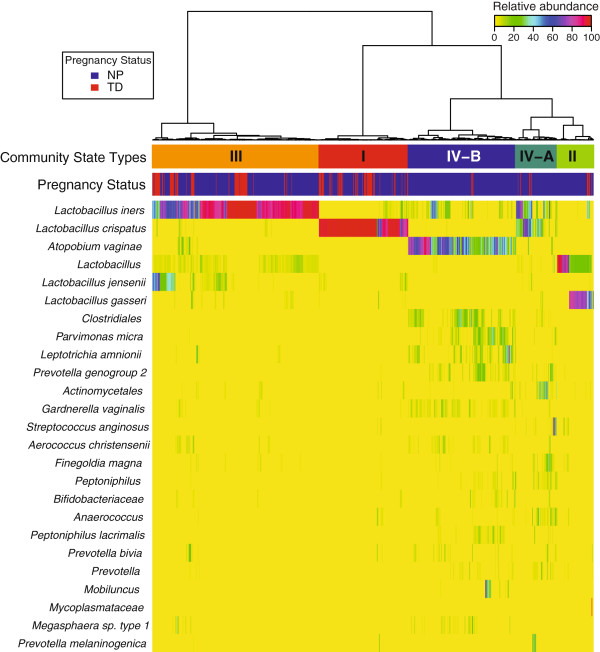
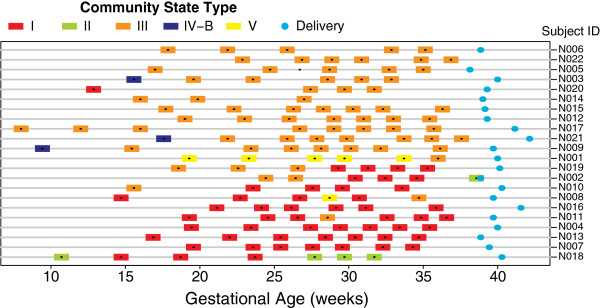
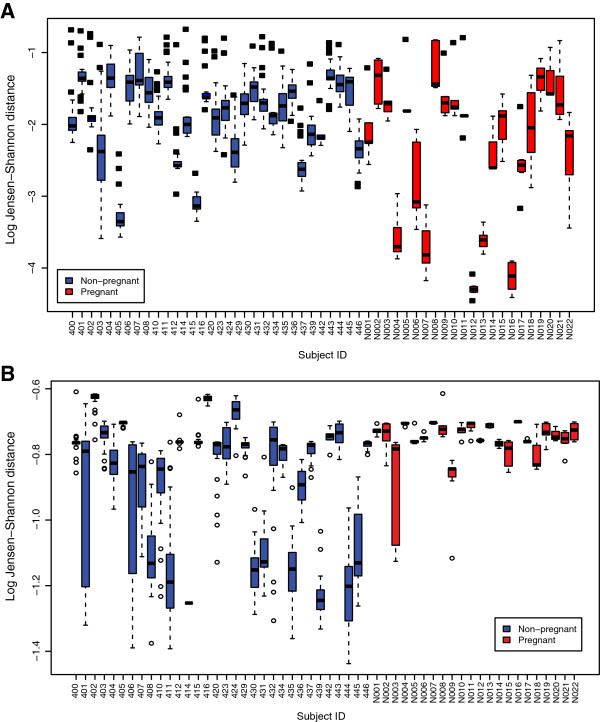
BACKGROUND: This study was undertaken to characterize the vaginal microbiota throughout normal human pregnancy using sequence-based techniques. We compared the vaginal microbial composition of non-pregnant patients with a group of pregnant women who delivered at term. RESULTS: A retrospective case-control longitudinal study was designed and included non-pregnant women (n = 32) and pregnant women who delivered at term (38 to 42 weeks) without complications (n = 22). Serial samples of vaginal fluid were collected from both non-pregnant and pregnant patients. A 16S rRNA gene sequence-based survey was conducted using pyrosequencing to characterize the structure and stability of the vaginal microbiota. Linear mixed effects models and generalized estimating equations were used to identify the phylotypes whose relative abundance was different between the two study groups. The vaginal microbiota of normal pregnant women was different from that of non-pregnant women (higher abundance of Lactobacillus vaginalis, L. crispatus, L. gasseri and L. jensenii and lower abundance of 22 other phylotypes in pregnant women). Bacterial community state type (CST) IV-B or CST IV-A characterized by high relative abundance of species of genus Atopobium as well as the presence of Prevotella, Sneathia, Gardnerella, Ruminococcaceae, Parvimonas, Mobiluncus and other taxa previously shown to be associated with bacterial vaginosis were less frequent in normal pregnancy. The stability of the vaginal microbiota of pregnant women was higher than that of non-pregnant women; however, during normal pregnancy, bacterial communities shift almost exclusively from one CST dominated by Lactobacillus spp. to another CST dominated by Lactobacillus spp. CONCLUSION: We report the first longitudinal study of the vaginal microbiota in normal pregnancy. Differences in the composition and stability of the microbial community between pregnant and non-pregnant women were observed. Lactobacillus spp. were the predominant members of the microbial community in normal pregnancy. These results can serve as the basis to study the relationship between the vaginal microbiome and adverse pregnancy outcomes.
Overview
The claims and statistics of this paper haven’t been checked yet.
Run the check — free, no account needed. It reads the open-access text and checks the sources it cites.
Integrity signals
Registry
Cites
Statistics
Figures
Verification
Claims the paper makes
The claims and statistics of this paper haven’t been checked yet.
Run the check — free, no account needed. It reads the open-access text and checks the sources it cites.
Claims other papers make about this one
Each is checked against this paper’s own text: does it say what the citing paper says it does?
The cited source says what the claim attributes to it.
In the citing paper
“Five major subcategories of cervicovaginal bacterial species were identified and defined as Community State Types (CSTs).”
The cited source says what the claim attributes to it.
In the citing paper
“Among the four groups, there was a high prevalence of lactobacilli. In particular, L. crispatus prevailed in CST I, L. gasseri in CST II, L. iners in CST III, and L. jensenii in CST V. In the remaining Community state type (CST IV) predominate anaerobic bacteria, such G. vaginalis , Atopobium vaginae , and Megasphaera spp., similar to the vaginal microbiota in bacterial vaginosis [27, 28].”
Self-check
Percentages, sums and reported differences re-computed from the paper’s own numbers.
The self-check needs the paper’s full text.
Citations
Cites
Metagenomic biomarker discovery and explanation
Segata, N., Izard, J., Waldron, L., Gevers, D., Miropolsky, L., Garrett, W. S., & Huttenhower, C. (2011) · Genome Biology · doi:10.1186/gb-2011-12-6-r60 · Cited by 16,192
Differential expression analysis for sequence count data
Anders, S., & Huber, W. (2010) · Genome Biology · doi:10.1186/gb-2010-11-10-r106 · Cited by 15,581
UCHIME improves sensitivity and speed of chimera detection
Edgar, R. C., Haas, B. J., Clemente, J. C., Quince, C., & Knight, R. (2011) · Bioinformatics · doi:10.1093/bioinformatics/btr381 · Cited by 15,114
An obesity-associated gut microbiome with increased capacity for energy harvest
Turnbaugh, P. J., Ley, R. E., Mahowald, M. A., Magrini, V., Mardis, E. R., & Gordon, J. I. (2006) · Nature · doi:10.1038/nature05414 · Cited by 12,444
A human gut microbial gene catalogue established by metagenomic sequencing
MetaHIT Consortium, Qin, J., Li, R., Raes, J., Arumugam, M., Burgdorf, K. S., Manichanh, C., Nielsen, T., Pons, N., Levenez, F., et al. (2010) · Nature · doi:10.1038/nature08821 · Cited by 11,624
Phylogenetic identification and in situ detection of individual microbial cells without cultivation
Amann, R., Ludwig, W., & SCHLEIFER, K. H. (1995) · Microbiological Reviews · doi:10.1128/mr.59.1.143-169.1995 · Cited by 9,218
Human gut microbes associated with obesity
Ley, R. E., Turnbaugh, P. J., Klein, S., & Gordon, J. I. (2006) · Nature · doi:10.1038/4441022a · Cited by 8,785
Diversity of the Human Intestinal Microbial Flora
Eckburg, P. B., Bik, E. M., Bernstein, C. N., Purdom, E., Dethlefsen, L., Sargent, M., Gill, S. R., Nelson, K. E., & Relman, D. A. (2005) · Science · doi:10.1126/science.1110591 · Cited by 7,913
Turnbaugh, P. J., Ley, R. E., Hamady, M., Fraser-Liggett, C. M., Knight, R., & Gordon, J. I. (2007) · Nature · doi:10.1038/nature06244 · Cited by 6,091
Divergence measures based on the Shannon entropy
Lin, J.-H. (1991) · IEEE Transactions on Information Theory · doi:10.1109/18.61115 · Cited by 5,877
Research works printed but not linked: 2
- Döderlein A: Das Scheidensekret und seine Bedeutung fuerdas Puerperalfieber. Die Arten des Scheidensekretes. 1892, 11: 699-
- Højsgaard S, Halekoh U, Yan J: The R package geepack for generalized estimating equations. J Stat Softw. 2006, 15: 1-11.
Cited by
Sorted by citations
Current understanding of the human microbiome
Gilbert, J. A., Blaser, M. J., Caporaso, J. G., Jansson, J. K., Lynch, S. V., & Knight, R. (2018) · Nature Medicine · doi:10.1038/nm.4517 · Cited by 2,609
Preterm labor: One syndrome, many causes
Romero, R., Dey, S. K., & Fisher, S. J. (2014) · Science · doi:10.1126/science.1251816 · Cited by 1,984
Self-citationThe central nervous system and the gut microbiome
Sharon, G., Sampson, T. R., Geschwind, D. H., & Mazmanian, S. K. (2016) · Cell · doi:10.1016/j.cell.2016.10.027 · Cited by 1,513
The microbiome in early life: Implications for health outcomes
Tamburini, S., Shen, N., Wu, H. C., & Clemente, J. C. (2016) · Nature Medicine · doi:10.1038/nm.4142 · Cited by 1,213
Temporal and spatial variation of the human microbiota during pregnancy
DiGiulio, D. B., Callahan, B. J., McMurdie, P. J., Costello, E. K., Lyell, D. J., Robaczewska, A., Sun, C. L., Goltsman, D. S. A., Wong, R. J., Shaw, G., et al. (2015) · Proceedings of the National Academy of Sciences · doi:10.1073/pnas.1502875112 · Cited by 1,129
Metadata
- Authors
- Romero, R., Hassan, S. S., Gajer, P., Tarca, A. L., Fadrosh, D. W., Nikita, L., Galuppi, M., Lamont, R. F., Chaemsaithong, P., Miranda, J., Chaiworapongsa, T., & Ravel, J.
- Affiliations
- National Institutes of Health (US)
- University of Maryland, Baltimore (US)
- Corresponding author
- Romero, Roberto
- Ravel, Jacques
- ORCID
- Venue
- Microbiome
- Published
- 2014-02-03
- Volume
- 2
- Issue
- 1
- Pages
- 10-10
- ISSN
- 2049-2618 (ISSN-L)
- PMC
- PMC3916806
- OpenAlex
- W2100318919
- Cited by
- 852
- References
- 280
- Citations by year
- 2026: 34 · 2025: 43 · 2024: 77 · 2023: 85 · 2022: 72 · 2021: 106 · 2020: 94 · 2019: 104 · 2018: 54 · 2017: 66 · 2016: 49 · 2015: 43 · 2014: 23
- FWCI
- 49.25
- Type
- journal article
- Language
- en
- Update notices
- erratum (2014-04-15)
- Open access
- gold
- doi.org
- Licence
- cc-by
- Locations
- Microbiome (publishedVersion, cc-by)
- Europe PMC (PubMed Central) (publishedVersion, cc-by)
- PubMed Central (publishedVersion, cc-by)
- PubMed (publishedVersion)
- University of Southern Denmark Research Portal (University of Southern Denmark) (publishedVersion)
- Human Biology (submittedVersion)
- Funders
- U.S. Department of Health and Human Services
- Wayne State University
- National Institutes of Health
- National Institute of Child Health and Human Development
- Eunice Kennedy Shriver National Institute of Child Health and Human Development
- Topics
- Life Sciences › Immunology and Microbiology › Microbiology › Reproductive tract infections research
- Life Sciences › Biochemistry, Genetics and Molecular Biology › Molecular Biology › Gut microbiota and health
- Health Sciences › Dentistry › Periodontics › Oral microbiology and periodontitis research
- Keywords
- vaginal microbiota, pregnancy, Lactobacillus, microbiome stability, bacterial vaginosis, Atopobium, Gardnerella, term birth
About these checks
Registry, retraction, Cites and statistics results are computed, not judged, with one exception: a printed reference that no index lists is read once by a model before it counts as a citation error. Claims are extracted by a model and kept only when their quote appears verbatim in the text; each cited source is then checked, with a model’s help, for whether it says what the claim relies on. Those verdicts can be wrong — read the claim’s quote and the cited source before relying on one.
Statistics and arithmetic are recomputed, not judged.
Confidence bands are shown only for fields calibrated on our annotated test set. None is calibrated yet, so no band is shown.
What counts as a claim ›How we measure confidence ›How we check this ›
Are you an author, or do you see a problem with this page? Request a review
