

The DOI matches its Crossref record; 23 of the 23 references it cites were found in a registry or an index.
Antibiotic sales in rural and urban pharmacies in northern Vietnam: an observational study
Open accessAbstract
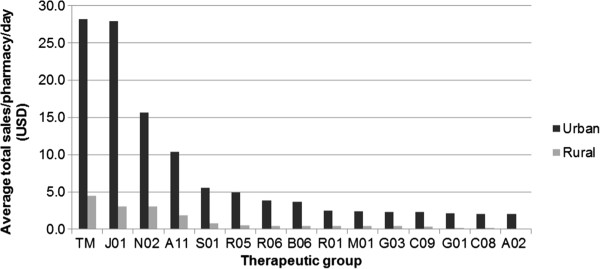
BACKGROUND: The irrational overuse of antibiotics should be minimized as it drives the development of antibiotic resistance, but changing these practices is challenging. A better understanding is needed of practices and economic incentives for antibiotic dispensing in order to design effective interventions to reduce inappropriate antibiotic use. Here we report on both quantitative and qualitative aspects of antibiotic sales in private pharmacies in northern Vietnam. METHOD: A cross-sectional study was conducted in which all drug sales were observed and recorded for three consecutive days at thirty private pharmacies, 15 urban and 15 rural, in the Hanoi region in 2010. The proportion of antibiotics to total drug sales was assessed and the revenue was calculated for rural and urban settings. Pharmacists and drug sellers were interviewed by a semi-structured questionnaire and in-depth interviews to understand the incentive structure of antibiotic dispensing. RESULTS: In total 2953 drug sale transactions (2083 urban and 870 rural) were observed. Antibiotics contributed 24% and 18% to the total revenue of pharmacies in urban and rural, respectively. Most antibiotics were sold without a prescription: 88% in urban and 91% in rural pharmacies. The most frequent reported reason for buying antibiotics was cough in the urban setting (32%) and fever in the rural area (22%). Consumers commonly requested antibiotics without having a prescription: 50% in urban and 28% in rural area. The qualitative data revealed that drug sellers and customer's knowledge of antibiotics and antibiotic resistance were low, particularly in rural area. CONCLUSION: Over the counter sales of antibiotic without a prescription remains a major problem in Vietnam. Suggested areas of improvement are enforcement of regulations and pricing policies and educational programs to increase the knowledge of drug sellers as well as to increase community awareness to reduce demand-side pressure for drug sellers to dispense antibiotics inappropriately.
Overview
The claims and statistics of this paper haven’t been checked yet.
Run the check — free, no account needed. It reads the open-access text and checks the sources it cites.
Integrity signals
Registry
Cites
Statistics
Figures
Verification
Claims the paper makes
The claims and statistics of this paper haven’t been checked yet.
Run the check — free, no account needed. It reads the open-access text and checks the sources it cites.
Claims other papers make about this one
Each is checked against this paper’s own text: does it say what the citing paper says it does?
The cited source doesn’t support the claim as written.
In the citing paper
“This observation parallels findings by Nga et al in Vietnam, which noted that pharmacies in residential areas were more likely to dispense antibiotics without a prescription than those in rural settings. 19”
From Evaluation of antibiotic dispensing without prescription by community pharmacies: a simulated patient study (2025) · cites this paper as [19]
Checked by a reasoning model — may be wrong.
Experimental — accuracy not yet measuredThe source backs part of the claim, not all of it — or backs it for a different population, condition or comparison.
In the citing paper
“Such inconsistency in dispensing practice will, in the long run, cost those CDROs that are adhering to the ethical and regulatory standards by losing trust of customers and eventually hurting their business [24, 40, 42, 46–49].”
From No prescription? No problem: drivers of non-prescribed sale of antibiotics among community drug retail outlets in low and middle income countries: a systematic review of qualitative studies (2021) · cites this paper as [48]
Experimental — accuracy not yet measuredThe source backs part of the claim, not all of it — or backs it for a different population, condition or comparison.
In the citing paper
“In such environments where customer satisfaction or need is of a central value, most CDRO staff opt to respond to customer’s request and need without properly scrutinising the consequences or repercussion of their actions [24, 39, 40, 42–44, 46–48].”
From No prescription? No problem: drivers of non-prescribed sale of antibiotics among community drug retail outlets in low and middle income countries: a systematic review of qualitative studies (2021) · cites this paper as [48]
Experimental — accuracy not yet measuredThe source backs part of the claim, not all of it — or backs it for a different population, condition or comparison.
In the citing paper
“if they experience poor satisfaction with the services of health facilities in nearby areas (e.g. prolonged waiting time due to the overcrowded services, doctors unable/unwilling to have enough consultation time with patients and less quality service) [40–42, 47–49]”
From No prescription? No problem: drivers of non-prescribed sale of antibiotics among community drug retail outlets in low and middle income countries: a systematic review of qualitative studies (2021) · cites this paper as [48]
Experimental — accuracy not yet measuredThe cited source says what the claim attributes to it.
In the citing paper
“Nearly all (n = 10) [24, 39–43, 45, 46, 48, 49] met seven or more of the 10 JBI appraisal checklist criteria for qualitative studies.”
The cited source says what the claim attributes to it.
In the citing paper
“if they feel like their condition is not severe enough to visit a doctor [48]”
The cited source says what the claim attributes to it.
In the citing paper
“In addition, CDRO staff reported lack of knowledge regarding the regulatory frameworks governing antibiotic dispensing and/or being misinformed about these policies (e.g. assuming some types of antibiotics are permitted to be sold as OTC medicines) [48].”
The cited source says what the claim attributes to it.
In the citing paper
“This tells us that drivers may not be similar between urban and rural CDROs [48, 75].”
Self-check
Percentages, sums and reported differences re-computed from the paper’s own numbers.
The self-check needs the paper’s full text.
Citations
Cites
Graneheim, U. H., & Lundman, B. (2004) · Nurse Education Today · doi:10.1016/j.nedt.2003.10.001 · Cited by 20,772 · cited 1×
“The main themes and connections were used to identify important causes of inappropriate antibiotic dispensing in urban and rural pharmacies [17].”
BackgroundHuttner, B. D., Goossens, H., Verheij, T. J., & Harbarth, S. (2009) · The Lancet Infectious Diseases · doi:10.1016/s1473-3099(09)70305-6 · Cited by 591
The impact of antibiotic use on resistance development and persistence
Barbosa, T. M., & Levy, S. B. (2000) · Drug Resistance Updates · doi:10.1054/drup.2000.0167 · Cited by 492 · cited 1×
“low dose, too short duration, or treatment of self-limiting infections) provides an avoidable additional pressure leading to more antibiotic resistance [1-3].”
BackgroundNon prescribed sale of antibiotics in Riyadh, Saudi Arabia: A Cross Sectional Study
Abdulhak, A. A. B., Al-Tannir, M. A., Almansor, M. A., Almohaya, M. S., Onazi, A. S., Marei, M. A., AlDosary, O., Obeidat, S. A., Obeidat, M. A., Riaz, M. A., et al. (2011) · BMC Public Health · doi:10.1186/1471-2458-11-538 · Cited by 239 · cited 1×
“Similar studies in Saudi Arabia and India had comparable results: 78% and 94% of visited pharmacies dispensed over the counter antibiotics [20,21].”
ResultDrug utilisation and self-medication in rural communities in Vietnam
Okumura, J., Wakai, S., & Umenai, T. (2002) · Social Science & Medicine · doi:10.1016/s0277-9536(01)00155-1 · Cited by 183 · cited 1×
“care system, and obtain medicines via self-medication or private pharmacies [9,10].”
BackgroundThe Sale of Antibiotics without Prescription in Pharmacies in Catalonia, Spain
Llor, C., & Cots, J. M. (2009) · Clinical Infectious Diseases · doi:10.1086/598183 · Cited by 176 · cited 1×
“; licensee BioMed Central Ltd Commons Attribution License (http://creativec reproduction in any medium, provided the or community setting, where antibiotics are readily dispensed for self-limiting upper respiratory tract infections without a prescription [4-8].”
BackgroundFamily self-medication and antibiotics abuse for children and juveniles in a Chinese city
Bi, P., Tong, S., & Parton, K. A. (2000) · Social Science & Medicine · doi:10.1016/s0277-9536(99)00304-4 · Cited by 162 · cited 1×
“; licensee BioMed Central Ltd Commons Attribution License (http://creativec reproduction in any medium, provided the or community setting, where antibiotics are readily dispensed for self-limiting upper respiratory tract infections without a prescription [4-8].”
BackgroundLarsson, M., Kronvall, G., Chúc, N. T. K., Karlsson, I., Lager, F., Hanh, H. D., Tomson, G. B., & Falkenberg, T. (2000) · Tropical Medicine & International Health · doi:10.1046/j.1365-3156.2000.00630.x · Cited by 127 · cited 1×
“67 percent of the participants consulted the pharmacist while 11 percent decided themselves about antibiotic use [12].”
BackgroundFilaBavi, a demographic surveillance site, an epidemiological field laboratory in Vietnam
Chúc, N. T. K., & Diwan, V. K. (2003) · Scandinavian Journal of Public Health · doi:10.1080/14034950310015031 · Cited by 118 · cited 1×
“The two study sites are: Bavi (site name: FilaBavi [14]) and Dong Da (site name: Dodalab [15]).”
BackgroundAntibiotic use following a Korean national policy to prohibit medication dispensing by physicians
Park, S., Soumerai, S. B., Adams, A. S., Finkelstein, J. A., Jang, S., & Ross-Degnan, D. (2005) · Health Policy and Planning · doi:10.1093/heapol/czi033 · Cited by 107 · cited 1×
“Similarly, inappropriate antibiotic prescribing in viral illness remarkable declined as in Korea by prohibiting prescribers from dispensing medications themselves [25].”
BackgroundThe sale of antibiotics without prescription in pharmacies in Damascus, Syria
Al‐Faham, Z., Habboub, G., & Takriti, F. (2011) · The Journal of Infection in Developing Countries · doi:10.3855/jidc.1248 · Cited by 95 · cited 1×
“This proportion increased up to 97% when the client simulators insisted on buying antibiotics [19].”
BackgroundImpacto de medidas regulatorias en la tendencia de consumo comunitario de antibióticos en Chile
Luis Bavestrello, F., Ángela Cabello, M., & Dunny Casanova, Z. (2002) · Revista médica de Chile · doi:10.4067/s0034-98872002001100009 · Cited by 83
Nyazema, N. Z., Viberg, N., Khoza, S., Vyas, S., Kumaranayake, L., Tomson, G. B., & Lundborg, C. S. (2007) · Journal of Antimicrobial Chemotherapy · doi:10.1093/jac/dkm013 · Cited by 75
Choice of healthcare provider following reform in Vietnam
Thuan, N. T. B., Löfgren, C., Lindholm, L. H., & Chúc, N. T. K. (2008) · BMC Health Services Research · doi:10.1186/1472-6963-8-162 · Cited by 74 · cited 2×
“The relative higher costs of the health care system explain the preference for selfmedication, which results in many cases of inappropriate drug use [10].”
BackgroundHoa, N. Q., Larson, M., Chúc, N. T. K., Eriksson, B., Trung, N. V., & Lundborg, C. S. (2009) · Tropical Medicine & International Health · doi:10.1111/j.1365-3156.2009.02267.x · Cited by 46 · cited 2×
“Only 27 percent of the pharmacy staff had correct knowledge about antibiotic use and resistance [8].”
BackgroundSelf-citationLanders, T., Ferng, Y., McLoughlin, J. W., Barrett, A. E., & Larson, E. (2010) · Journal of the American Academy of Nurse Practitioners · doi:10.1111/j.1745-7599.2010.00539.x · Cited by 43 · cited 1×
“; licensee BioMed Central Ltd Commons Attribution License (http://creativec reproduction in any medium, provided the or community setting, where antibiotics are readily dispensed for self-limiting upper respiratory tract infections without a prescription [4-8].”
BackgroundA qualitative study about self-medication in the community among market vendors in Fuzhou, China
Wen, Y., Lieber, E., Wan, D., Hong, Y., & NIMH Collaborative HIV/STD Prevention Trial Group (2011) · Health & Social Care in the Community · doi:10.1111/j.1365-2524.2011.01009.x · Cited by 39
Salunkhe, S. D., V.A.Pandit, Dawane, J., Sarda, K., & More, C. (2013) · International Journal of Pharma and Bio Sciences · Cited by 25
(2010) · Southern Med Review · Cited by 23
Arroll, B., Kenealy, T. W., & Falloon, K. (2008) · PubMed · Cited by 22
DodaLab: An urban health and demographic surveillance site, the first three years in Hanoi, Vietnam
Toàn, T. K., Eriksson, B., Nguyen, C. T. K., Horby, P., Bondjers, G., & Petzold, M. (2012) · Scandinavian Journal of Public Health · doi:10.1177/1403494812464444 · Cited by 18 · cited 2×
“Dong Da is the biggest urban district of Hanoi with the public health care system including a district hospital with 300 beds, 3 regional polyclinics, 1 antenatal clinic, 21 commune health stations and 278 private pharmacies located in this district [15].”
BackgroundSelf-citationLarsson, M. (2003) · Figshare · Cited by 15
Acute respiratory tract infections: When are antibiotics indicated?
Werner, K. A., & Deasy, J. (2009) · JAAPA · doi:10.1097/01720610-200904000-00007 · Cited by 8 · cited 1×
“The most frequent reason for buying antibiotics was acute upper respiratory tract infections, which are generally selflimiting [22,23].”
Background
Research works printed but not linked: 8
- World Health Organization Report: WHO Global Strategy for Containment Resistance to Antimicrobial Drugs. 2001, Geneva: WHO report, WHO/CDS/CSR/DRS/2001.2
- Tilak JD-M: Bacterial resistance to antibiotics: a growing public health problem. McMaster Univ Med J. 2011, 8: 58-61.
- World Health Organization: WHO Fact Book WHO/EMP/MAR/2009.3. Medicines Use in Primary Care in Developing and Transitional Countries. 2009, Geneva: World Health Organization
- Vietnam Ministry of Health: Vietnam Ministry of Health Decision No 1847/2003/QD-BYT about Regulation of Drug Prescribing and Selling Prescription Only. 2003, Hanoi, Vietnam: Vietnam Ministry of Health
- Hoa NQ: PhD Thesis. High Antibiotic Use and Resistance among Children Under Five. 2010, Sweden: Department of Public Health Sciences, Karolinska Institutet
- Bavestrello L, Cabello A, Casanova D: Impact of regulatory measures in the trends of community consumption of antibiotics in Chile. Revista medica de Chile. 2002, 130 (11): 1265-1272.
- Nguyen KV, FL H, Wertheim & Group: Report from the GARP Vietnam National Working Group. Situation Analysis: Antibiotic Use and Resistance in Vietnam. 2010, Hanoi, Vietnam: GARP Vietnam
- Vietnam Government Office: Vietnam Government Decree No 79/2006/NĐ-CP on Implementing some articles of Drug Law. 2006, Hanoi, Vietnam: Vietnam Government Office
Cited by
Sorted by citations
Antibiotic stewardship in low- and middle-income countries: the same but different?
Cox, J. A., Vlieghe, E., Mendelson, M., Wertheim, H., Ndegwa, L., Villegas, M. V., Gould, I., & Levy Hara, G. (2017) · Clinical Microbiology and Infection · doi:10.1016/j.cmi.2017.07.010 · Cited by 529
“155 Perverse financial incentives for prescribers and drug providers, legal concerns and patient demands are 156 additional drivers of antibiotic overuse(19, 34-36).”
BackgroundSelf-citationTrần, N. H., Hoang, L., Nghiem, L. D., Nguyen, N. M. H., Ngo, H. H., Guo, W., Trịnh, Q. T., Mai, N. H., Chen, H., Nguyen, D. D., et al. (2019) · The Science of The Total Environment · doi:10.1016/j.scitotenv.2019.07.092 · Cited by 256
Self-citationA current perspective on antimicrobial resistance in Southeast Asia
Zellweger, R. M., Carrique-Mas, J. J., Limmathurotsakul, D., Day, N., Thwaites, G. E., Baker, S. G., on behalf of the Southeast Asia Antimicrobial Resistance Network, Members of the Southeast Asia Antimicrobial Resistance Network, Ashley, E., Balogh, K. D., et al. (2017) · Journal of Antimicrobial Chemotherapy · doi:10.1093/jac/dkx260 · Cited by 207
Self-citationPerformance of retail pharmacies in low- and middle-income Asian settings: a systematic review
Miller, R., & Goodman, C. (2016) · Health Policy and Planning · doi:10.1093/heapol/czw007 · Cited by 225
“These include honouring improper prescriptions, such as those that are out of date, and selling POMs without a prescription (Dua et al. 1994; Larsson et al. 2006; Kotwani et al. 2012; Nga et al. 2014).”
BackgroundInfluentialGodman, B., Haque, M., McKimm, J., Abu Bakar, M., Sneddon, J., Wale, J., Campbell, S., Martin, A. P., Hoxha, I., Abilova, V., et al. (2020) · Current Medical Research and Opinion · doi:10.1080/03007995.2019.1700947 · Cited by 171
Metadata
- Authors
- Nga, D. T. T., Chuc, N. T. K., Hoa, N. P., Hoa, N. Q., Nguyen, N. T. T., Loan, H. T., Toan, T. K., Phuc, H. D., Horby, P., Van Yen, N., Van Kinh, N., & Wertheim, H. F.
- Affiliations
- Oxford University Clinical Research Unit (VN)
- Hanoi Medical University (VN)
- Institute of Mathematics (VN)
- University of Oxford (GB)
- Corresponding author
- Nga, Do Thi Thuy
- Nguyen, Nguyen Thi Thuy
- Venue
- BMC Pharmacology and Toxicology
- Published
- 2014-02-20
- Volume
- 15
- Issue
- 1
- Pages
- 6-6
- ISSN
- 2050-6511 (ISSN-L)
- PMC
- PMC3946644
- OpenAlex
- W2164556138
- Cited by
- 228
- References
- 23
- Citations by year
- 2026: 10 · 2025: 13 · 2024: 17 · 2023: 18 · 2022: 28 · 2021: 31 · 2020: 17 · 2019: 26 · 2018: 25 · 2017: 16 · 2016: 15 · 2015: 9 · 2014: 3
- FWCI
- 11.97
- Type
- journal article
- Language
- en
- Open access
- gold
- doi.org
- Licence
- Locations
- BMC Pharmacology and Toxicology (publishedVersion, cc-by)
- Europe PMC (PubMed Central) (publishedVersion, cc-by)
- PubMed Central (publishedVersion, cc-by)
- PubMed (publishedVersion)
- Greater South Information System
- Funders
- Wellcome Trust
- Topics
- Health Sciences › Medicine › Infectious Diseases › Antibiotic Use and Resistance
- Health Sciences › Health Professions › Pharmacy › Pharmacy and Medical Practices
- Health Sciences › Nursing › Issues, ethics and legal aspects › Pharmaceutical industry and healthcare
- Keywords
- antibiotic sales, prescription drug sales, inappropriate antibiotic use, antibiotic resistance, private pharmacies, urban-rural differences, Hanoi, Vietnam
- MeSH terms
- Anti-Bacterial Agents, Commerce, Nonprescription Drugs, Health Knowledge, Attitudes, Practice, Pharmacies, Surveys and Questionnaires, Rural Population, Urban Population, Vietnam, Drug Resistance, Bacterial
About these checks
Registry, retraction, Cites and statistics results are computed, not judged, with one exception: a printed reference that no index lists is read once by a model before it counts as a citation error. Claims are extracted by a model and kept only when their quote appears verbatim in the text; each cited source is then checked, with a model’s help, for whether it says what the claim relies on. Those verdicts can be wrong — read the claim’s quote and the cited source before relying on one.
Statistics and arithmetic are recomputed, not judged.
Confidence bands are shown only for fields calibrated on our annotated test set. None is calibrated yet, so no band is shown.
What counts as a claim ›How we measure confidence ›How we check this ›
Are you an author, or do you see a problem with this page? Request a review
