

The DOI matches its Crossref record; 38 of the 41 references it cites were found in a registry or an index.
Validation of the 10-item Chinese perceived stress scale in elderly service workers: one-factor versus two-factor structure
Open accessAbstract
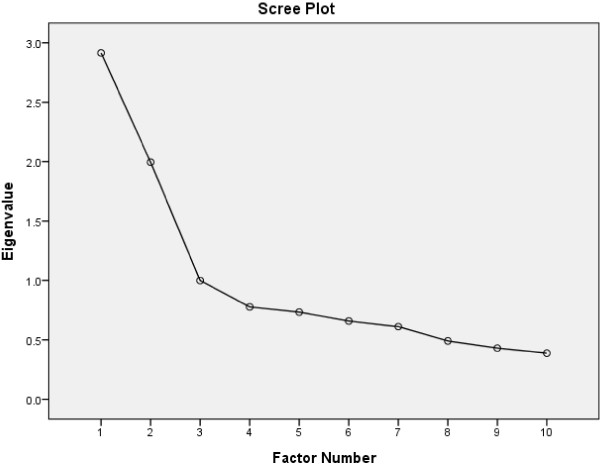
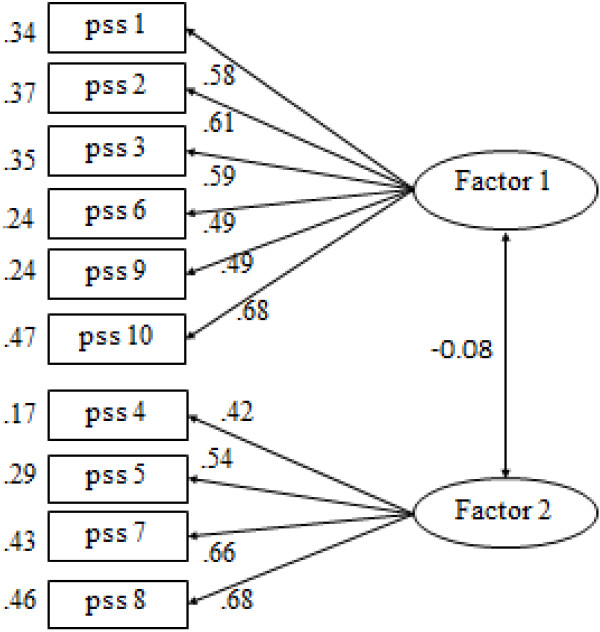
BACKGROUND: Despite its popularity, the psychometric properties of the 10-item Chinese Perceived Stress Scale (CPSS-10) in working adults are yet to be evaluated. METHODS: This study examined CPSS-10 in elderly service workers through a questionnaire survey. The sample was randomly split into two for exploratory (EFA) and confirmatory factor analysis (CFA). RESULTS: A high response rate (93%) was achieved, resulting in 992 completed questionnaires. EFA with the first split sample favored a two-factor over a one-factor solution. The second factor had eigenvalue 2.00 and provided 19.95% explained variance. In CFA with the second split sample, the two-factor structure showed satisfactory goodness-of-fit (CFI = 0.93, RMSEA = 0.06) while the one-factor structure showed poor data fit (CFI = 0.62, RMSEA = 0.14). Further analyses on the two-factor structure revealed that the whole scale and two subscales had acceptable internal consistency (Cronbach's alphas = 0.67 to 0.78). The total score was positively associated with perceived workload and burnout (r = 0.17 to 0.48), but negatively with work engagement (r = -0.13 to -0.30). In contrary to previous studies, a low inter-factor correlation (r = -0.08) was revealed. CONCLUSIONS: CPSS-10 showed a stable two-factor structure with satisfactory internal consistency and construct validity.
Overview
The claims and statistics of this paper haven’t been checked yet.
Run the check — free, no account needed. It reads the open-access text and checks the sources it cites.
Integrity signals
Registry
Cites
Statistics
Figures
Verification
Claims the paper makes
The claims and statistics of this paper haven’t been checked yet.
Run the check — free, no account needed. It reads the open-access text and checks the sources it cites.
Claims other papers make about this one
Each is checked against this paper’s own text: does it say what the citing paper says it does?
The cited source says what the claim attributes to it.
In the citing paper
“Stress was measured by the Chinese validated Perceived Stress Scale (PSS) [52].”
Self-check
Percentages, sums and reported differences re-computed from the paper’s own numbers.
The self-check needs the paper’s full text.
Citations
Cites
A Global Measure of Perceived Stress
Cohen, S., Kamarck, T., & Mermelstein, R. (1983) · Journal of Health and Social Behavior · doi:10.2307/2136404 · Cited by 32,807
Eysenck, H. J. (1985) · Behaviour Research and Therapy · doi:10.1016/0005-7967(85)90087-7 · Cited by 32,038
“Stress: appraisal and coping,”
Folkman, S. (2013) · Encyclopedia of Behavioral Medicine · doi:10.1007/978-1-4419-1005-9_215 · Cited by 27,833
(1991) · Cited by 15,554
Hu, L.-T., & Bentler, P. M. (1998) · Psychological Methods · doi:10.1037/1082-989x.3.4.424 · Cited by 12,298
Costello, A. B., & Osborne, J. (2005) · University of Massachusetts Amherst · doi:10.7275/jyj1-4868 · Cited by 10,297
The measurement of engagement and burnout: a two sample confirmatory factor analytic approach.
Schaufeli, W. B., Salanova, M., González-romá, V., & Bakker, A. B. (2002) · Journal of Happiness Studies · doi:10.1023/a:1015630930326 · Cited by 10,014
Schermelleh-Engel, K., Moosbrugger, H., & Müller, H. (2003) · Department of Psychology - University of Koblenz-Landau · doi:10.23668/psycharchives.12784 · Cited by 8,975
(1996) · Consulting Psychologists Press eBooks · Cited by 7,863
(1988) · Cited by 4,111
The social psychology of health
(1989) · Choice Reviews Online · doi:10.5860/choice.26-5686 · Cited by 1,797
Further psychometric support for the 10-item version of the Perceived Stress Scale
Roberti, J. W., Harrington, L. N., & Storch, E. A. (2006) · Journal of College Counseling · doi:10.1002/j.2161-1882.2006.tb00100.x · Cited by 984 · cited 3×
“Regarding the scale’s dimensionality, most researchers have found evidence for a two-factor structure (Eskin & Parr 1996; Wang et al. 2011; Wongpakaran & Wongpakaran 2010; Orucu & Demir 2009; Otto et al. 2004; Roberti et al. 2006; Reis et al. 2010).”
BackgroundMethodPerceived Stress Scale: Reliability and Validity Study in Brazil
Siqueira Reis, R., Ferreira Hino, A. A., & Romélio Rodriguez Añez, C. (2010) · Journal of Health Psychology · doi:10.1177/1359105309346343 · Cited by 698
The Social Psychology of Health.
Gold, D. T., Spacapan, S., & Oskamp, S. (1990) · Contemporary Sociology A Journal of Reviews · doi:10.2307/2073512 · Cited by 640
Negative life events, perceived stress, negative affect, and susceptibility to the common cold.
Cohen, S., Tyrrell, D. A. J., & Smith, A. P. (1993) · Journal of Personality and Social Psychology · doi:10.1037//0022-3514.64.1.131 · Cited by 623
Leung, D. Y., Lam, T.-H., & Chan, S. S. (2010) · BMC Public Health · doi:10.1186/1471-2458-10-513 · Cited by 562
Hewitt, P., Flett, G., & Mosher, S. (1992) · Journal of Psychopathology and Behavioral Assessment · doi:10.1007/bf00962631 · Cited by 437
Factor Structure of the Perceived Stress Scale (PSS) in a Sample from Mexico
Ramírez, M. T. G., & Hernández, R. L. (2007) · The Spanish Journal of Psychology · doi:10.1017/s1138741600006466 · Cited by 418
Psychometric properties of the French versions of the Perceived Stress Scale
Lesage, F., Berjot, S., & Deschamps, F. (2012) · International Journal of Occupational Medicine and Environmental Health · doi:10.2478/s13382-012-0024-8 · Cited by 392
Practical Assessment, Research and Evaluation, 2000.
Rudner, L. M., & Schaefer, W. D. (2000) · Practical assessment, research & evaluation · Cited by 337
Perceived stress in survivors of suicide: psychometric properties of the Perceived Stress Scale.
Mitchell, A. M., Crane, P. A., & Kim, Y. (2008) · Research in Nursing & Health · doi:10.1002/nur.20284 · Cited by 283 · cited 3×
“With the second split sample, CFA revealed a poor fit for the one-factor model suggested by Mitchell, Crane, and Kim (Mitchell et al. 2008).”
BackgroundMethodInfluentialGao, L., Chan, S. W., & Mao, Q. (2008) · Research in Nursing & Health · doi:10.1002/nur.20306 · Cited by 275
Psychometric Properties of the Chinese Version of the Perceived Stress Scale in Policewomen
Wang, Z., Chen, J., Ritsher, J. B., Zhang, H., Jia, X., Qiu, J., & Xiao, Z. (2011) · PLoS ONE · doi:10.1371/journal.pone.0028610 · Cited by 258
The Thai version of the PSS-10: An Investigation of its psychometric properties
Wongpakaran, N., & Wongpakaran, T. (2010) · BioPsychoSocial Medicine · doi:10.1186/1751-0759-4-6 · Cited by 223
Psychometric evaluation of perceived stress scale for Turkish university students
Örücü, M. Ç., & Demir, A. (2008) · Stress and Health · doi:10.1002/smi.1218 · Cited by 208
Prosser, D., Johnson, S., Kuipers, E., SZMUKLER, G. I., Bebbington, P., & Thornicroft, G. (1997) · Journal of Psychosomatic Research · doi:10.1016/s0022-3999(97)00086-x · Cited by 151
A Japanese version of the perceived stress scale: translation and preliminary test
Mimura, C., & Griffiths, P. (2003) · International Journal of Nursing Studies · doi:10.1016/j.ijnurstu.2003.10.009 · Cited by 146
Durán, A., Extremera, N., Rey, L., Fernández‐Berrocal, P., & Montalbán, F. M. (2006) · PubMed · Cited by 143
Mimura, C., & Griffiths, P. (2008) · BMC Psychiatry · doi:10.1186/1471-244x-8-85 · Cited by 131
Rø, K. I., Tyssen, R., Hoffart, A., Sexton, H. C., Aasland, O. G., & Gude, T. (2010) · BMC Public Health · doi:10.1186/1471-2458-10-213 · Cited by 122
Extended Time Test Accommodation: Directions for Future Research and Practice
Stretch, L. S., & Osborne, J. W. (2020) · doi:10.7275/cs6a-4s02 · Cited by 120
Lee, S., & Crockett, M. S. (1994) · Issues in Mental Health Nursing · doi:10.3109/01612849409006918 · Cited by 113
Subjective sleep disturbance and its correlates in middle-aged Hong Kong Chinese women
Chung, K., & Tang, M. K. (2005) · Maturitas · doi:10.1016/j.maturitas.2005.07.001 · Cited by 84
Emotional control in Chinese female cancer survivors
Ho, R., Chan, C., & Ho, S. M. Y. (2004) · Psycho-Oncology · doi:10.1002/pon.799 · Cited by 66
Otto, M. W., D, M. F. M., Penava, S. J., Bless, E. P., Muller, R. T., & Rosenbaum, J. F. (1997) · Cognitive Therapy and Research · doi:10.1023/a:1021980209878 · Cited by 38
van Doornen, L. J. P., Houtveen, J. H., Langelaan, S., Bakker, A. B., van Rhenen, W., & Schaufeli, W. B. (2009) · Stress and Health · doi:10.1002/smi.1279 · Cited by 33
Ng, S., Fong, T. C. T., & Wang, X. L. (2011) · Aging & Mental Health · doi:10.1080/13607863.2011.556602 · Cited by 22
Self-citation(1984) · Medical Entomology and Zoology
Research works printed but not linked: 2
- Eskin M, Parr D: Introducing a Swedish version of an instrument measuring mental stress. 1996, Stockholm: Department of Psychology, University of Stockholm
- Schaufeli WB, Bakker AB: Utrecht work engagement scale: preliminary manual. 2003, Utrecht: Occupational Health Psychology Unit, Utrecht University
Cited by
Sorted by citations
Psychometric properties of the perceived stress scale in a community sample of Chinese
Huang, F., Wang, H., Wang, Z., Zhang, J., Du, W., Su, C., Jia, X., Ouyang, Y., Wang, Y., Li, L., et al. (2020) · BMC Psychiatry · doi:10.1186/s12888-020-02520-4 · Cited by 267
Shi, M., Wang, X., Bian, Y., & Wang, L. (2015) · BMC Medical Education · doi:10.1186/s12909-015-0297-2 · Cited by 214
Qi, M., Li, P., Moyle, W., Weeks, B. K., & Jones, C. (2020) · International Journal of Environmental Research and Public Health · doi:10.3390/ijerph17186494 · Cited by 203
Lu, W. H., Bian, Q., Wang, W., Wu, X., Wang, Z., & Zhao, M. (2017) · PLoS ONE · doi:10.1371/journal.pone.0189543 · Cited by 192
Liu, X., Zhao, Y., Li, J., Dai, J., Wang, X., & Wang, S. (2020) · Frontiers in Psychology · doi:10.3389/fpsyg.2020.00537 · Cited by 154
Metadata
- Authors
- Ng, S.-M.
- Venue
- BMC Psychology
- Published
- 2013-06-19
- Volume
- 1
- Issue
- 1
- Pages
- 9-9
- ISSN
- 2050-7283 (ISSN-L)
- PMC
- PMC4269992
- OpenAlex
- W2134989464
- Cited by
- 121
- References
- 41
- Citations by year
- 2026: 5 · 2025: 10 · 2024: 9 · 2023: 11 · 2022: 20 · 2021: 22 · 2020: 12 · 2019: 6 · 2018: 4 · 2017: 11 · 2016: 5 · 2015: 4 · 2014: 2
- FWCI
- 5.02
- Type
- journal article
- Language
- en
- Open access
- gold
- doi.org
- Licence
- Locations
- BMC Psychology (publishedVersion, cc-by)
- Europe PMC (PubMed Central) (publishedVersion, cc-by)
- PubMed Central (publishedVersion, cc-by)
- PubMed (publishedVersion)
- The HKU Scholars Hub (University of Hong Kong) (submittedVersion, cc-by-nc-nd)
- Topics
- Social Sciences › Decision Sciences › Management Science and Operations Research › Psychometric Methodologies and Testing
- Social Sciences › Psychology › Social Psychology › Stress and Burnout Research
- Social Sciences › Psychology › Clinical Psychology › Health and Well-being Studies
- Keywords
- perceived stress, scale validation, factor structure, two-factor model, burnout, work engagement, perceived workload, psychometric properties
About these checks
Registry, retraction, Cites and statistics results are computed, not judged, with one exception: a printed reference that no index lists is read once by a model before it counts as a citation error. Claims are extracted by a model and kept only when their quote appears verbatim in the text; each cited source is then checked, with a model’s help, for whether it says what the claim relies on. Those verdicts can be wrong — read the claim’s quote and the cited source before relying on one.
Statistics and arithmetic are recomputed, not judged.
Confidence bands are shown only for fields calibrated on our annotated test set. None is calibrated yet, so no band is shown.
What counts as a claim ›How we measure confidence ›How we check this ›
Are you an author, or do you see a problem with this page? Request a review
