

The DOI matches its Crossref record; 8 of the 9 references it cites were found in a registry or an index.
An ontology for cell types
Open accessAbstract
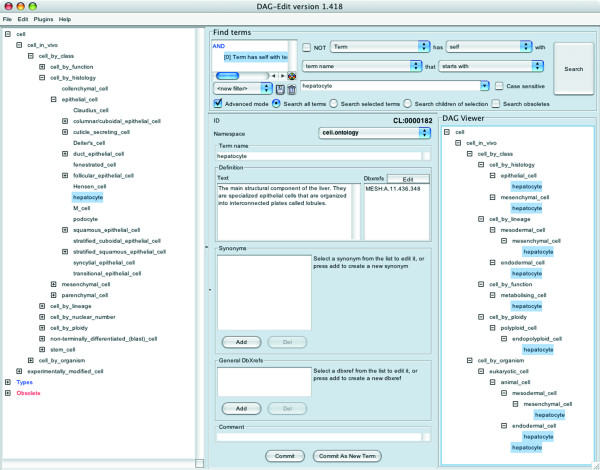
We describe an ontology for cell types that covers the prokaryotic, fungal, animal and plant worlds. It includes over 680 cell types. These cell types are classified under several generic categories and are organized as a directed acyclic graph. The ontology is available in the formats adopted by the Open Biological Ontologies umbrella and is designed to be used in the context of model organism genome and other biological databases. The ontology is freely available at http://obo.sourceforge.net/ and can be viewed using standard ontology visualization tools such as OBO-Edit and COBrA.
Overview
The claims and statistics of this paper haven’t been checked yet.
Run the check — free, no account needed. It reads the open-access text and checks the sources it cites.
Integrity signals
Registry
Cites
Statistics
Figures
Verification
Claims the paper makes
The claims and statistics of this paper haven’t been checked yet.
Run the check — free, no account needed. It reads the open-access text and checks the sources it cites.
Claims other papers make about this one
Each is checked against this paper’s own text: does it say what the citing paper says it does?
In the citing paper
“The Gene Ontology (GO) (Ashburner et al., 2000), Cell Ontology (CL) (Bard et al., 2005; Diehl et al., 2016), Human Phenotype Ontology (HPO) (Robinson et al., 2008) and related projects provide a set of widely used, manually curated ontologies that attempt to hierarchically factor entities such as biological processes, components and functions (GO), cell types (CL), and human phenotypes (HPO) into”
From Mapping the multiscale structure of biological systems (2021) · cites this paper as Bard et al., 2005
Self-check
Percentages, sums and reported differences re-computed from the paper’s own numbers.
The self-check needs the paper’s full text.
Citations
Cites
Alberts, B., Johnson, A., Lewis, J. H., Morgan, D. O., RAFF, M. C., Roberts, K. J., & Walter, P. (2017) · W.W. Norton eBooks · doi:10.1201/9781315735368 · Cited by 7,937
WARWICK, R., Williams, P. L., Dyson, M., & Bannister, L. (1985) · British Journal of Radiology · doi:10.1259/0007-1285-58-694-1029 · Cited by 4,532
The molecular biology of the cell
Arnstein, H. R. V. (1986) · FEBS Letters · doi:10.1016/0014-5793(86)80238-1 · Cited by 1,396
Creating the Gene Ontology Resource: Design and ImplementationPreprint
The Gene Ontology Consortium (2001) · Genome Research · doi:10.1101/gr.180801 · Cited by 957
MOLECULAR BIOLOGY OF THE CELL, 5TH EDITION
Fenderson, B. A. (2008) · Shock · doi:10.1097/01.shk.0000286288.33338.f6 · Cited by 829
Creating the gene ontology resource: design and implementation.
Blake, J. A., Corradi, J., Eppig, J. T., Hill, D. P., Richardson, J. E., & Ringwald, M. (2001) · The Mouseion at the JAXlibrary (Jackson Laboratory) · Cited by 826
Kiehart, D. P., Franke, J. D., Chee, M. K., Montague, R. A., Chen, T.-L., Roote, J., & Ashburner, M. (2004) · Genetics · doi:10.1534/genetics.104.026369 · Cited by 70
Self-citationDrysdale, R. (2001) · Briefings in Bioinformatics · doi:10.1093/bib/2.1.68 · Cited by 33
Research works printed but not linked: 1
- Esau K: The Anatomy of Seed Plants. 1977, New York: John Wiley, 2
Cited by
Sorted by citations
Items 401–416 of 416
Wu, L., Nguyen, M. A., Yang, Z., Potluri, S., Sivagnanam, S., Kirchberger, N. C., Joshi, A. S., Ahn, K. J., Tumulty, J. S., Cabrera, E. C., et al. (2026) · bioRxiv (Cold Spring Harbor Laboratory) · doi:10.64898/2026.02.01.703134
Bedhiafi, W. (2017) · theses.fr (ABES) · doi:10.70675/d63cc072z8a6dz4d88zabdbzd4b304c6abf3
Development of new computational methods for a synthetic gene set annotation
Ayllón-Benítez, A. (2019) · theses.fr (ABES) · doi:10.70675/e4ca6537z5926z484fz9de9z8ae5b1e1f63a
Danlos, F. (2021) · theses.fr (ABES) · doi:10.70675/ff8cb58bzc391z43f8zbd32zc8c4b2cdc725
李光鹏, You, Y., Fu, Y., Zhou, W., Tang, F., Kong, J., & Tian, L. (2026) · bioRxiv (Cold Spring Harbor Laboratory) · doi:10.64898/2026.04.20.719773
Using Biological Networks to Guide Biomedical Prediction
Zhao, X., Kong, J., Pu, K., Churas, C., Parker, J. A., & Ideker, T. (2026) · Methods in molecular biology · doi:10.1007/978-1-0716-5408-8_3
Scaling recipes for single-cell RNA sequencing foundation models: when do scaling laws hold?Preprint
Borra, F., Cirò, G., Castellini, A., Gatti, G., Tangherloni, A., & Buffa, F. M. (2026) · bioRxiv (Cold Spring Harbor Laboratory) · doi:10.64898/2026.08.31.747783
FAIRsharing record for: MGI Mouse Gene Expression Database
FAIRsharing Team, et al. (2018) · FAIRsharing.org · doi:10.25504/fairsharing.q9neh8
FAIRsharing record for: UBER anatomy ONtology
FAIRsharing Team (2015) · FAIRsharing.org · doi:10.25504/fairsharing.4c0b6b
FAIRsharing record for: MetaSRA
FAIRsharing Team, & Lister, A. (2018) · FAIRsharing.org · doi:10.25504/fairsharing.zs8uwa
NP-KG: Knowledge Graph Framework for Natural Product-Drug Interactions
Taneja, S. B. (2022) · Zenodo (CERN European Organization for Nuclear Research) · doi:10.5281/zenodo.6814507
FAIRsharing record for: SoftWare Ontology
FAIRsharing Team, & Lister, A. (2015) · FAIRsharing.org · doi:10.25504/fairsharing.sp3szt
FAIRsharing record for: Cellular Microscopy Phenotype Ontology
FAIRsharing Team (2018) · FAIRsharing.org · doi:10.25504/fairsharing.knp11s
FAIRsharing record for: Cell Ontology
FAIRsharing Team (2015) · FAIRsharing.org · doi:10.25504/fairsharing.j9y503
A computational framework for harnessing data and knowledge for bioprocess design
Zhang, J. (2013) · UCL Discovery (University College London)
Metadata
- Authors
- Bard, J., Rhee, S. Y., & Ashburner, M.
- Affiliations
- University of Edinburgh (GB)
- Carnegie Institution for Science (US)
- European Bioinformatics Institute (GB)
- Corresponding author
- Ashburner, Michael
- Venue
- Genome biology
- Published
- 2005-01-14
- Volume
- 6
- Issue
- 2
- Pages
- R21-R21
- ISSN
- 1465-6906 (ISSN-L)
- 1474-760X
- PMC
- PMC551541
- OpenAlex
- W1757909678
- Cited by
- 416
- References
- 9
- Citations by year
- 2026: 8 · 2025: 6 · 2024: 10 · 2023: 15 · 2022: 14 · 2021: 23 · 2020: 23 · 2019: 23 · 2018: 17 · 2017: 16 · 2016: 15 · 2015: 14 · 2014: 17 · 2013: 24 · 2012: 25
- FWCI
- 9.70
- Type
- journal article
- Language
- en
- Open access
- gold
- doi.org
- Locations
- Genome biology (publishedVersion, cc-by)
- Europe PMC (PubMed Central) (publishedVersion)
- PubMed Central (publishedVersion)
- PubMed (publishedVersion)
- Apollo (University of Cambridge) (submittedVersion, cc-by)
- Funders
- National Science Foundation (9978564, 0321666)
- National Institutes of Health
- Medical Research Council
- Biotechnology and Biological Sciences Research Council
- Topics
- Health Sciences › Medicine › Health Informatics › Biomedical Text Mining and Ontologies
- Physical Sciences › Computer Science › Artificial Intelligence › Semantic Web and Ontologies
- Life Sciences › Biochemistry, Genetics and Molecular Biology › Molecular Biology › Bioinformatics and Genomic Networks
- Keywords
- cell types, ontology (information science), cell type classification, prokaryotic cells, fungal cells, animal cells, plant cells, directed acyclic graphs, biological databases
- MeSH terms
- Animals, Computer Graphics, Eukaryotic Cells, Humans, Prokaryotic Cells, Databases, Factual, Vocabulary, Controlled, Internet, Databases, Genetic, Mice
About these checks
Registry, retraction, Cites and statistics results are computed, not judged, with one exception: a printed reference that no index lists is read once by a model before it counts as a citation error. Claims are extracted by a model and kept only when their quote appears verbatim in the text; each cited source is then checked, with a model’s help, for whether it says what the claim relies on. Those verdicts can be wrong — read the claim’s quote and the cited source before relying on one.
Statistics and arithmetic are recomputed, not judged.
Confidence bands are shown only for fields calibrated on our annotated test set. None is calibrated yet, so no band is shown.
What counts as a claim ›How we measure confidence ›How we check this ›
Are you an author, or do you see a problem with this page? Request a review
