

Single-pulse transcranial magnetic stimulation (sTMS) for the acute treatment of migraine: evaluation of outcome data for the UK post market pilot program
Open accessThe DOI matches its Crossref record; 30 of the 31 references it cites were found in a registry or an index.
Abstract
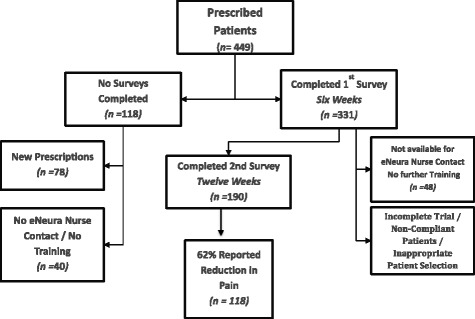
Background: Single pulse transcranial magnetic stimulation (sTMS) is a novel treatment for acute migraine. Previous randomised controlled data demonstrated that sTMS is effective and well tolerated in the treatment of migraine with aura. The aim of the programme reported here was to evaluate patient responses in the setting of routine clinical practice. Methods: Migraine patients with and without aura treating with sTMS had an initial review (n = 426) and training call, and then participated in telephone surveys at week six (n = 331) and week 12 during a 3-month treatment period (n = 190). Results: Of patients surveyed with 3 month data (n = 190; episodic, n = 59; chronic, n = 131), 62 % reported pain relief, finding the device effective at reducing or alleviating migraine pain; in addition there was relief reported of associated features: nausea- 52 %; photophobia- 55 %; and phonophobia- 53 %. At 3 months there was a reduction in monthly headache days for episodic migraine, from 12 (median, 8–13 IQ range) to 9 (4–12) and for chronic migraine, a reduction from 24 (median, 16–30 IQ range) to 16 (10–30). There were no serious or unanticipated adverse events. Conclusion: sTMS may be a valuable addition to options for the treatment of both episodic and chronic migraine.
Overview
The claims and statistics of this paper haven’t been checked yet.
Free: it reads the open-access text and checks the first 5 claims that cite a source we can check. Create a free account to check every claim.
Integrity signals
Registry
Cites
Statistics
Figures
Verification
Claims the paper makes
The claims and statistics of this paper haven’t been checked yet.
Free: it reads the open-access text and checks the first 5 claims that cite a source we can check. Create a free account to check every claim.
Claims other papers make about this one
Each is checked against this paper’s own text: does it say what the citing paper says it does?
The source backs part of the claim, not all of it — or backs it for a different population, condition or comparison.
In the citing paper
“In migraines, especially with aura, single-pulse TMS studies report significant reductions in monthly headache days, sustained up to 12 months in difficult-to-treat cohorts [107,108,109,110,111,119,120,121,122], while results for chronic migraine remain inconclusive [117,122].”
From The Heart’s Electromagnetic Field in Emotions, Empathy and Human Connection: Biosensor-Derived Insights into Heart–Brain Axis Mechanisms and a Basis for Novel BioMagnetoTherapies (2026) · cites this paper as [121]
Experimental — accuracy not yet measured
Self-check
Percentages, sums and reported differences re-computed from the paper’s own numbers.
The self-check needs the paper’s full text.
Citations
Cites
Murray, C. J. L., Vos, T., Lozano, R., Naghavi, M., Flaxman, A. D., Michaud, C., Ezzati, M., Shibuya, K., Salomon, J. A., Abdalla, S., et al. (2012) · The Lancet · doi:10.1016/s0140-6736(12)61689-4 · Cited by 8,888
The International Classification of Headache Disorders, 3rd edition (beta version)
Headache Classification Committee of the International Headache Society (IHS) (2013) · Cephalalgia · doi:10.1177/0333102413485658 · Cited by 8,229
NON-INVASIVE MAGNETIC STIMULATION OF HUMAN MOTOR CORTEX
Barker, A. T., Jalinous, R., & Freeston, I. L. (1985) · The Lancet · doi:10.1016/s0140-6736(85)92413-4 · Cited by 4,460 · cited 1×
“Transcranial magnetic stimulation (TMS) was first described in 1985 [8] and followed seminal work by Merton, Morton and Marsden [9] who had used electrical stimulation of the cortex to dissect questions around the cortical influence on motor reflexes [9–11], and had found the stimulus painful to subjects.”
BackgroundInterplay between Cortical Spreading Depolarization and Seizures
Kramer, D. R., Fujii, T., Ohiorhenuan, I., & Liu, C. Y. (2017) · Stereotactic and Functional Neurosurgery · doi:10.1159/000452841 · Cited by 3,696
Migraine — Current Understanding and Treatment
Goadsby, P. J., Lipton, R. B., & Ferrari, M. D. (2002) · New England Journal of Medicine · doi:10.1056/nejmra010917 · Cited by 1,918
Self-citationTranscranial magnetic stimulation in neurology
Kobayashi, M., & Pascual-Leone, A. (2003) · The Lancet Neurology · doi:10.1016/s1474-4422(03)00321-1 · Cited by 1,297 · cited 2×
“This frequency was 11 [6, 16] at 6 weeks and 8 [3, 13] at 12 weeks.”
BackgroundPathophysiology of the migraine aura: The spreading depression theory
Lauritzen, M. (1994) · Brain · doi:10.1093/brain/117.1.199 · Cited by 1,151
An international study to assess reliability of the Migraine Disability Assessment (MIDAS) score
Stewart, W. F., Lipton, R. B., Whyte, J., Dowson, A., Kolodner, K., Liberman, J. N., & Sawyer, J. (1999) · Neurology · doi:10.1212/wnl.53.5.988 · Cited by 621 · cited 1×
“Over time, it also became important to measure the impact of the benefit to patients [25].”
BackgroundThe clinical diagnostic utility of transcranial magnetic stimulation: Report of an IFCN committee
Chen, R., Cros, D., Curra, A., Di Lazzaro, V., Lefaucheur, J.-P., Magistris, M. R., Mills, K., Rösler, K. M., Triggs, W. J., Ugawa, Y., et al. (2008) · Clinical Neurophysiology · doi:10.1016/j.clinph.2007.10.014 · Cited by 612
Diencephalic and brainstem mechanisms in migraine
Akerman, S., Holland, P. R., & Goadsby, P. J. (2011) · Nature Reviews Neuroscience · doi:10.1038/nrn3057 · Cited by 532 · cited 1×
“While much has been determined about the biology of migraine in recent times [4], and the future is promising [5], much needs to be done for the burden on patients and society that migraine brings.”
BackgroundSelf-citation
Research works printed but not linked: 4
- Mohammad YM Kothari R Hughes G Krumah MN Fischell S Fischell R Transcranial magnetic stimulation (TMS) relieves migraine headache Eur J Neurol 2006 13 Suppl 2 23
- Holland PR Schembri C Fredrick J Goadsby PJ Transcranial magnetic stimulation for the treatment of migraine aura? Cephalalgia 2009 29 Suppl 1 22
- Bhola R Lipscombe S Giffin N Elrington G Weatherall M Ahmed F Update of the UK post market pilot programme with single pulse transcranial magnetic stimulation (sTMS) for acute treatment of migraine Cephalalgia 2013 33 973
- Ahmed F, Goadsby PJ, Bhola R, Reinhold T, Bruggenjurgen B. Treatment cost analysis of refractory chronic migraine patients in a UK NHS setting [Abstract]. Cephalalgia. 2015;35:in press.
Cited by
Items 101–137 of 137
The Physics, Mechanism, and Application of Transcranial Magnetic Stimulation (TMS)
Gupta, A. (2023) · International Journal of Science and Research (IJSR) · doi:10.21275/sr23927192431 · Cited by 1
Acute treatments: neuromodulation and peripheral nerve blocks
Sebastianelli, G., Viganò, A., & Puledda, F. (2025) · Elsevier eBooks · doi:10.1016/b978-0-443-23649-5.00004-9 · Cited by 1
Neuromodulation and Non-Pharmacological Treatment of Migraine
Samsam, M. (2016) · Neuro - Open Journal · doi:10.17140/noj-3-e006
Bhola, R., & Greenwood, F. (2018) · British Journal of Neuroscience Nursing · doi:10.12968/bjnn.2018.14.5.215 · Cited by 1
Self-citationLantéri‐Minet, M., & Donnet, A. (2019) · Headache · doi:10.1007/978-3-030-14121-9_11 · Cited by 1
Mirza, B., & Akel, W. (2021) · Neuro - Open Journal · doi:10.17140/noj-8-136 · Cited by 2
Mallick‐Searle, T., & Moriarty, M. (2022) · Springer eBooks · doi:10.1007/978-3-031-06322-0_7 · Cited by 1
Neuromodulation dans le traitement des céphalées primaires
Lantéri‐Minet, M. (2018) · Pratique Neurologique - FMC · doi:10.1016/j.praneu.2018.02.002 · Cited by 1
Repetitive Transcranial Magnetic Stimulation
Brighina, F., Fierro, B., & Cosentino, G. (2019) · Headache · doi:10.1007/978-3-030-14121-9_9 · Cited by 1
Aranha, R. E. L. D. B., Alves, N. T., Andrade, S. M., Fernández‐Calvo, B., & de Oliveira, E. A. (2020) · Research Society and Development · doi:10.33448/rsd-v9i8.5768
Transcranial Electrical Stimulation in Migraine – How Does It Work and What Can We Learn from It?
O’Hare, L., & Griffiths, R. (2022) · OBM Neurobiology · doi:10.21926/obm.neurobiol.2204145 · Cited by 1
Guérzoni, S., & Pellesi, L. (2026) · Expert Review of Neurotherapeutics · doi:10.1080/14737175.2026.2701917 · Cited by 1
“Single-pulse transcranial magnetic stimulation has regulatory approval for acute and preventive migraine treatment [10].”
Neurostimulation in the Management of Chronic Migraine
Shumate, D. A., & Freitag, F. G. (2018) · Springer eBooks · doi:10.1007/978-3-319-91491-6_25
Methods of neurostimulation in the treatment of headaches
Múdra, J., & Petričková, S. (2018) · Neurologie pro praxi · doi:10.36290/neu.2018.116
“Zistili, že 62 % pacientov udávalo zmiernenie bolestí, 52 % zmiernenie nauzey, 55 % fotofóbie a 53 % fonofóbie (Bhola et al., 2015).”
BackgroundInfluentialMinimally Invasive Interventions for Headache
Severyn, S. A., Afifi, A. M., & MacKenzie, E. L. (2020) · Springer eBooks · doi:10.1007/978-3-030-36794-7_12
Kriener, N. (2021) · eDiss (Georg-August-Universität Göttingen) · doi:10.53846/goediss-8496
Ky, L., Uyên, N. T., Van, N. T., Xuong, N. T., Thanh, C. M., Tuan, N. T., & Thuc, V. T. M. (2021) · Genetics and Molecular Research · doi:10.4238/gmr18732 · Cited by 1
Prophylaxis of Migraine Protocols and Options
Dayal, R., & Sulindro, A. D. (2021) · Springer eBooks · doi:10.1007/978-3-030-75239-2_4 · Cited by 2
Aktürk, T., Saçmacı, H., Ünal, H. A., Tanık, N., & İnan, L. E. (2021) · Neurology Asia · doi:10.54029/2021cdz
“Posttreatment 2nd month 3 (1-6) 4 (2-9) 0.”
Application of Brain Stimulation Techniques during Pregnancy
Goyal, N., Sinha, P., Kelkar, R., & Vidya, K. L. (2021) · Indian Journal of Private Psychiatry · doi:10.5005/jp-journals-10067-0087
Sheikh, H. U. (2021) · Springer eBooks · doi:10.1007/978-3-030-71513-7_10
Neuromodulation for Prevention and Treatment of Headache Disorders
Shirane, R., Kim, E., Riveros, D., & Sheikh, H. U. (2022) · touchREVIEWS in Neurology · doi:10.17925/usn.2022.18.2.103
Emerging Treatment Options in Migraine
Karsan, N., Ong, J. J. Y., & Goadsby, P. J. (2018) · EMJ Neurology · doi:10.33590/emjneurol/10310359
Self-citationMagnetic stimulation for acute migraine headache. What is being stimulated?
McComas, A. J. (2023) · Clinical Neurophysiology · doi:10.1016/j.clinph.2023.02.167
Mikellides, G. (2023) · Research Publications (Maastricht University) · doi:10.26481/dis.20230911gm
Shen, J. W., & Starling, A. J. (2024) · Elsevier eBooks · doi:10.1016/b978-0-443-24705-7.00032-6
Transcranial magnetic stimulation (TMS)
Batri, A. J., Joseph, C., Yeh, T.-C., & Santhosh, R. (2024) · Elsevier eBooks · doi:10.1016/b978-0-443-23557-3.00014-0
Transcranial Magnetic Stimulation
Cherchi, M. (2025) · Springer eBooks · doi:10.1007/978-3-031-94841-1_258
Lloyd, J., & Andreou, A. P. (2025) · Springer eBooks · doi:10.1007/978-3-031-86923-5_22
Tackling migraines head-on: insights into pathophysiology, management and treatment
Balmith, M., Maré, M. G. J., Basson, C., Nyane, N., Ditshego, R., & Flepisi, B. T. (2025) · SA pharmaceutical journal. · doi:10.36303/sapj.3054
Vandenbussche, N., & Moreno-Ajona, D. (2025) · Elsevier eBooks · doi:10.1016/b978-0-443-23649-5.00007-4
Treatments to use in special circumstances: children, pregnancy, elderly
Karsan, N., & Prabhakar, P. (2025) · Elsevier eBooks · doi:10.1016/b978-0-443-23649-5.00013-x
Stimulating discussion: neuromodulation for migraine in pregnancy
Panza, G. A., Godorecci, M., Johnson, M. A. L., Kuruvilla, D. E., & Seibel-Seamon, J. (2026) · Current Opinion in Obstetrics & Gynecology · doi:10.1097/gco.0000000000001075 · Cited by 1
“The first study [27] that examined neuromodulation for migraine in pregnancy included a description of three pregnant patients who used single-pulse transcranial magnetic stimulation for the acute treatment of migraine.”
Mismatch negativity-like responses in nitroglycerin-elicited migraine model
Li, X., Zhang, J., Liu, Q., Zhang, L., Zhao, S., Zhao, H., Zhao, R., Jing, Y., & Yu, L. (2026) · Scientific Reports · doi:10.1038/s41598-026-45645-4
“During the 3-month treatment period, in addition to reduced migraine pain, 53% of subjects reported significant relief from auditory hypersensitivity 4 .”
Intervention and modulation part II: Neuromodulation for headaches and facial pains
Rangon, C.-M., Schuster, N. M., & DeJulio, P. A. (2026) · Elsevier eBooks · doi:10.1016/b978-0-323-95313-9.00029-0
Metadata
- Authors
- Bhola, R., Kinsella, E., Giffin, N., Lipscombe, S., Ahmed, F., Weatherall, M., & Goadsby, P. J.
- Affiliations
- Royal United Hospital (GB)
- Royal Sussex County Hospital (GB)
- Hull Royal Infirmary (GB)
- Charing Cross Hospital (GB)
- King's College London (GB)
- Corresponding author
- Goadsby, Peter J
- Venue
- The Journal of Headache and Pain
- Published
- 2015-06-03
- Volume
- 16
- Issue
- 1
- Pages
- 535-535
- ISSN
- 1129-2369 (ISSN-L)
- 1129-2377
- PMC
- PMC4463955
- OpenAlex
- W1509044825
- Cited by
- 138
- References
- 31
- Citations by year
- 2026: 6 · 2025: 9 · 2024: 6 · 2023: 9 · 2022: 8 · 2021: 16 · 2020: 14 · 2019: 18 · 2018: 21 · 2017: 10 · 2016: 19
- FWCI
- 13.52
- Type
- journal article
- Language
- en
- Open access
- gold
- doi.org
- Locations
- The Journal of Headache and Pain (publishedVersion, cc-by)
- PubMed Central (publishedVersion, cc-by)
- PubMed (publishedVersion)
- eScholarship (California Digital Library) (submittedVersion)
- Research Portal (King's College London) (submittedVersion, cc-by)
- Topics
- Health Sciences › Medicine › Clinical Neurology › Migraine and Headache Studies
- Life Sciences › Neuroscience › Neurology › Transcranial Magnetic Stimulation Studies
- Health Sciences › Dentistry › Oral Surgery › Temporomandibular Joint Disorders
- Keywords
- single-pulse transcranial magnetic stimulation, acute migraine treatment, migraine with aura, episodic migraine, chronic migraine, headache days, analgesia, photophobia, phonophobia, nausea, real-world effectiveness, patient-reported outcomes
- MeSH terms
- Adult, Double-Blind Method, Female, Humans, Male, Middle Aged, Migraine Disorders, Nausea, Pilot Projects, Hyperacusis, Outcome Assessment, Health Care, Photophobia, Transcranial Magnetic Stimulation
About these checks
Registry, retraction, Cites and statistics results are computed, not judged, with one exception: a printed reference that no index lists is read once by a model before it counts as a citation error. Claims are extracted by a model and kept only when their quote appears verbatim in the text; each cited source is then checked, with a model’s help, for whether it says what the claim relies on. Those verdicts can be wrong — read the claim’s quote and the cited source before relying on one.
Statistics and arithmetic are recomputed, not judged.
Confidence bands are shown only for fields calibrated on our annotated test set. None is calibrated yet, so no band is shown.
What counts as a claim ›How we measure confidence ›How we check this ›
Are you an author, or do you see a problem with this page? Request a review
Data sources
Bibliographic data: Semantic Scholar, OpenAlex, Crossref.
Contains information from the Semantic Scholar Academic Graph Datasets, made available under the ODC Attribution License (ODC-BY 1.0).
Semantic Scholar’s data is described in: Kinney, R., et al. (2023). The Semantic Scholar Open Data Platform. arXiv:2301.10140.
