

The DOI matches its Crossref record; 30 of the 30 references it cites were found in a registry or an index.
Validation of the Generalized Anxiety Disorder-7 (GAD-7) and GAD-2 in patients with migraine
Open accessAbstract
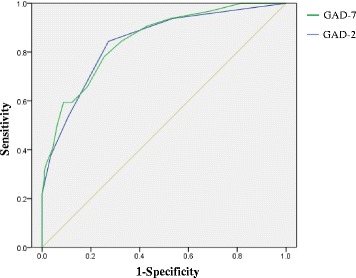
BACKGROUND: Psychiatric problems have been commonly reported in patients with migraine. This study investigated the reliability and validity of the Generalized Anxiety Disorder-7 (GAD-7) and Generalized Anxiety Disorder-2 (GAD-2) in patients with migraine. METHODS: Subjects were recruited from a headache clinic and a neuropsychologist examined their GAD using the Mini International Neuropsychiatric Interview-Plus Version 5.0.0 (MINI). Subjects completed several instruments, including the GAD-7, the Beck Anxiety Inventory (BAI), the Migraine Disability Assessment Scale (MIDAS), the Headache Impact Test-6 (HIT-6), and the Migraine-Specific Quality of Life (MSQoL). RESULTS: Among 146 participants, 32 patients (21.9 %) had GAD as determined by the MINI. Cronbach's α for the GAD-7 and GAD-2 were 0.915 and 0.820, respectively. At a cutoff score of 5, the GAD-7 had a sensitivity of 78.1 %, a specificity of 74.6 %, a positive predictive value (PPV) of 46.3 %, and a negative predictive value (NPV) of 92.4 %. At a cutoff score of 1, the GAD-2 had a sensitivity of 84.4 %, a specificity of 72.8 %, a PPV of 46.6 %, and a NPV of 94.3 %. The scores of the GAD-7 and GAD-2 well correlated with the BAI score, the MIDAS score, the HIT-6 score, and the MSQoL score. CONCLUSIONS: The GAD-7 and GAD-2 are both reliable and valid screening instruments for GAD in patients with migraine.
Overview
The claims and statistics of this paper haven’t been checked yet.
Run the check — free, no account needed. It reads the open-access text and checks the sources it cites.
Integrity signals
Registry
Cites
Statistics
Figures
Verification
Claims the paper makes
The claims and statistics of this paper haven’t been checked yet.
Run the check — free, no account needed. It reads the open-access text and checks the sources it cites.
Claims other papers make about this one
Each is checked against this paper’s own text: does it say what the citing paper says it does?
The cited source says what the claim attributes to it.
In the citing paper
“The GAD-7 has shown strong internal consistency (Cronbach’s α = 0.92) [57] and is validated for chronic pain patients with migraine [58].”
From ACTsmart: Guided Smartphone-Delivered Acceptance and Commitment Therapy for Chronic Pain—A Pilot Trial. (2021) · cites this paper as [58]
Self-check
Percentages, sums and reported differences re-computed from the paper’s own numbers.
The self-check needs the paper’s full text.
Citations
Cites
A Brief Measure for Assessing Generalized Anxiety Disorder: The GAD-7
Spitzer, R. L., Kroenke, K., Williams, J. B. W., & Löwe, B. (2006) · Archives of Internal Medicine · doi:10.1001/archinte.166.10.1092 · Cited by 31,765
(1998) · The Journal of Clinical Psychiatry · Cited by 19,139
(1998) · PubMed · Cited by 10,216
The International Classification of Headache Disorders, 3rd edition (beta version)
Headache Classification Committee of the International Headache Society (IHS) (2013) · Cephalalgia · doi:10.1177/0333102413485658 · Cited by 8,229
The mini international neuropsychiatric interview
Lecrubier, Y., Sheehan, D. V., Hergueta, T., & Weiller, E. (1998) · European Psychiatry · doi:10.1016/s0924-9338(99)80239-9 · Cited by 5,899
Anxiety disorders in primary care: prevalence, impairment, comorbidity, and detection
Kroenke, K., Spitzer, R. L., Williams, J. B. W., Monahan, P. O., & Löwe, B. (2007) · Annals of Internal Medicine · doi:10.7326/0003-4819-146-5-200703060-00004 · Cited by 4,741
The global burden of headache: A documentation of headache prevalence and disability worldwide
Stovner, L., Hagen, K., Jensen, R., Katsarava, Z., Lipton, R., Scher, A., Steiner, T., & Zwart, J.-A. (2007) · Cephalalgia · doi:10.1111/j.1468-2982.2007.01288.x · Cited by 2,444
A six-item short-form survey for measuring headache impact: The HIT-6™
Kosinski, M., Bayliss, M. S., Bjorner, J. B., Ware, J. E., Garber, W. H., Batenhorst, A., Cady, R., Dahlöf, C. G. H., Dowson, A., & Tepper, S. (2003) · Quality of Life Research · doi:10.1023/a:1026119331193 · Cited by 1,376
Garcia-Campayo, J., Zamorano, E., Ruiz, M. A., Pardo, A., Perez-Paramo, M., Lopez-Gomez, V., Freire, O., & Rejas, J. (2010) · Health and Quality of Life Outcomes · doi:10.1186/1477-7525-8-8 · Cited by 673
McWilliams, L. A., Goodwin, R. D., & Cox, B. J. (2004) · Pain · doi:10.1016/j.pain.2004.06.002 · Cited by 562
Research works printed but not linked: 3
- Yook SP, Kim ZS (1997) A clinical study on the Korean version of Beck Anxiety Inventory: comparative study of patient and non-patient. Korean J Clin Psychol 16:185–197
- Lee HS, Chung CS, Song HJ, Park HS (2000) The reliability and validity of the MIDAS (Migraine Disability Assessment) Questionnaire for Korean migraine sufferers. J Korean Neurol Assoc 18:287–291
- Bayliss M, Batenhorst A (2002) The HIT-6™ a user’s guide. Quality Metric Incorporated, Lincoln
Cited by
Sorted by citations
Hinz, A., Klein, A. M., Brähler, E., Glaesmer, H., Luck, T., Riedel-Heller, S. G., Wirkner, K., & Hilbert, A. (2017) · Journal of Affective Disorders · doi:10.1016/j.jad.2016.12.012 · Cited by 443
Tiirikainen, K., Haravuori, H., Ranta, K., Kaltiala-Heino, R., & Marttunen, M. (2019) · Psychiatry Research · doi:10.1016/j.psychres.2018.12.004 · Cited by 345
“…sensitivity, speci fi city, reliability, and factorial, construct, and concurrent validity in many speci fi c subgroups, such as patients with migraine (Seo and Park, 2015), drug and alcohol users (Delgadillo et al., 2012), elderly people (Wild et al., 2014), and pregnant women (Zhong et al., 2015).”
BackgroundMigraine: A Review on Its History, Global Epidemiology, Risk Factors, and Comorbidities
Amiri, P., Kazeminasab, S., Nejadghaderi, S. A., Mohammadinasab, R., Pourfathi, H., Araj‐Khodaei, M., Sullman, M. J. M., Kolahi, A., & Safiri, S. (2022) · Frontiers in Neurology · doi:10.3389/fneur.2021.800605 · Cited by 408
Gong, Y., Zhou, H., Zhang, Y., Zhu, X., Wang, X., Shen, B., Xian, J., & Ding, Y. (2020) · Journal of Affective Disorders · doi:10.1016/j.jad.2020.12.129 · Cited by 269
The immediate impact of the 2019 novel coronavirus (COVID-19) outbreak on subjective sleep status
Lin, L.-Y., Wang, J., Ou-yang, X.-Y., Miao, Q., Chen, R., Liang, F.-X., Zhang, Y.-P., Tang, Q., & Wang, T. (2020) · Sleep Medicine · doi:10.1016/j.sleep.2020.05.018 · Cited by 260
“We used a cutoff score of 10 to determine whether a participant had major depression and a cutoff score of 10 to determine whether a participant had generalized anxiety disorder [40,41].”
Method
Metadata
- Authors
- Seo, J.-G., & Park, S.-P.
- Affiliations
- Kyungpook National University (KR)
- Corresponding author
- Park, Sung-Pa
- Venue
- The Journal of Headache and Pain
- Published
- 2015-11-23
- Volume
- 16
- Issue
- 1
- Pages
- 97-97
- ISSN
- 1129-2369 (ISSN-L)
- 1129-2377
- PMC
- PMC4656257
- OpenAlex
- W2173864200
- Cited by
- 341
- References
- 30
- Citations by year
- 2026: 40 · 2025: 36 · 2024: 53 · 2023: 46 · 2022: 36 · 2021: 49 · 2020: 26 · 2019: 25 · 2018: 19 · 2017: 3 · 2016: 8
- FWCI
- 8.11
- Type
- journal article
- Language
- en
- Open access
- gold
- doi.org
- Locations
- The Journal of Headache and Pain (publishedVersion, cc-by)
- PubMed Central (publishedVersion, cc-by)
- PubMed (publishedVersion)
- Topics
- Health Sciences › Medicine › Clinical Neurology › Migraine and Headache Studies
- Social Sciences › Psychology › Experimental and Cognitive Psychology › Anxiety, Depression, Psychometrics, Treatment, Cognitive Processes
- Health Sciences › Nursing › Research and Theory › Health Education and Validation
- Keywords
- Generalized Anxiety Disorder-7, GAD-2, generalized anxiety disorder, migraine, anxiety screening, psychometric validation, reliability statistics, sensitivity and specificity, migraine disability, migraine-related quality of life, headache impact
- MeSH terms
- Adolescent, Adult, Aged, Anxiety Disorders, Cross-Sectional Studies, Female, Humans, Male, Middle Aged, Migraine Disorders, Psychiatric Status Rating Scales, Psychometrics, Sensitivity and Specificity, Reproducibility of Results, Comorbidity, Young Adult
About these checks
Registry, retraction, Cites and statistics results are computed, not judged, with one exception: a printed reference that no index lists is read once by a model before it counts as a citation error. Claims are extracted by a model and kept only when their quote appears verbatim in the text; each cited source is then checked, with a model’s help, for whether it says what the claim relies on. Those verdicts can be wrong — read the claim’s quote and the cited source before relying on one.
Statistics and arithmetic are recomputed, not judged.
Confidence bands are shown only for fields calibrated on our annotated test set. None is calibrated yet, so no band is shown.
What counts as a claim ›How we measure confidence ›How we check this ›
Are you an author, or do you see a problem with this page? Request a review
