

The DOI matches its Crossref record; 91 of the 92 references it cites were found in a registry or an index.
Reported concepts for the treatment modalities and pain management of temporomandibular disorders
Open accessAbstract
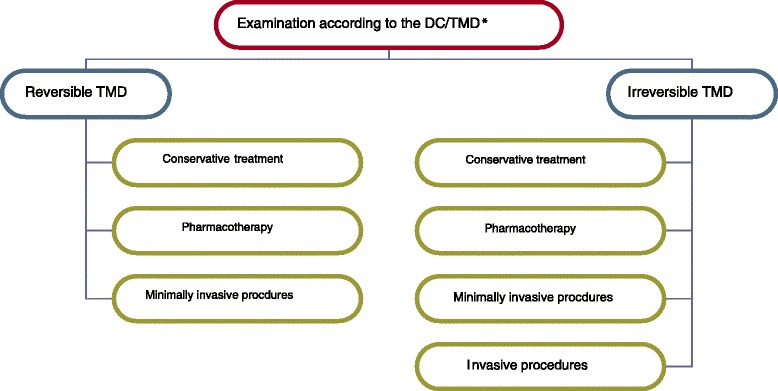
BACKGROUND: Pain related to temporomandibular disorders (TMD) is a common problem in modern societies. The aim of the article is to present the concepts of TMD pain clinical management. METHODS: A survey was performed using the PubMed, SCOPUS and CINAHL databases for documents published between 1994 and 2014. The following search keywords were selected using MeSH terms of the National Library of Medicine in combination: TMD pain, TMD, TMJ, TMJ disorders, occlusal splint, TMD physiotherapy, TMJ rheumatoid disorders and TMJ surgery. Original articles and review papers which presented the clinical relevance and practical validity regarding the possibility of application in TMD management have been included. Authors have excluded articles without outstanding practical aspect and evidence-based background. A first selection was carried out by reviewing titles and abstracts of all articles found according to the criteria. After that the full texts of potentially suitable articles were assessed. In line with these criteria, among 11467 results the writers have included 66 papers. RESULTS: The most commonly reported conservative treatments are massage therapy and individually fabricated occlusal splints. In addition to massage, other popular methods include manual therapy and taping, warming/cooling of aching joints, and light and laser therapy. Drugs are also commonly used. In the most severe cases of the temporomandibular joint degeneration, surgical restoration of the joint is sometimes applied. CONCLUSIONS: The authors concluded that conservative treatment including counselling, exercises, occlusal splint therapy, massage, manual therapy and others should be considered as a first choice therapy for TMD pain because of their low risk of side effects. In the case of severe acute pain or chronic pain resulting from serious disorders, inflammation and/or degeneration pharmacotherapy, minimally invasive and invasive procedures should be considered.
Overview
The claims and statistics of this paper haven’t been checked yet.
Run the check — free, no account needed. It reads the open-access text and checks the sources it cites.
Integrity signals
Registry
Cites
Statistics
Figures
Verification
Claims the paper makes
The claims and statistics of this paper haven’t been checked yet.
Run the check — free, no account needed. It reads the open-access text and checks the sources it cites.
Claims other papers make about this one
Each is checked against this paper’s own text: does it say what the citing paper says it does?
The cited source says what the claim attributes to it.
In the citing paper
“These interventions directly affect the muscular system, in order to reduce its excessive tension, and thus minimize pain in the area of the temporomandibular joints, and in muscles involved in the chewing process [1,3,19,20,21,22,23,24,25,26].”
From The Application of Manual Techniques in Masticatory Muscles Relaxation as Adjunctive Therapy in the Treatment of Temporomandibular Joint Disorders (2021) · cites this paper as [26]
Self-check
Percentages, sums and reported differences re-computed from the paper’s own numbers.
The self-check needs the paper’s full text.
Citations
Cites
Schiffman, E., Ohrbach, R., Truelove, E., Look, J., Anderson, G., Goulet, J.-P., List, T., Svensson, P., Gonzalez, Y., Lobbezoo, F., et al. (2014) · Journal of Oral & Facial Pain and Headache · doi:10.11607/jop.1151 · Cited by 4,567 · cited 1×
“Currently, temporomandibular disorders (TMD) refer to the causes responsible for the impaired function of the temporomandibular joints (TMJ) and the associated neuro-muscular system, which may provoke TMDrelated pain [1].”
BackgroundThe Glossary of Prosthodontic Terms
(2005) · Journal of Prosthetic Dentistry · doi:10.1016/j.prosdent.2005.03.013 · Cited by 1,318
LIDOCAINE INJECTION VERSUS DRY NEEDLING TO MYOFASCIAL TRIGGER POINT
Hong, C. (1994) · American Journal of Physical Medicine & Rehabilitation · doi:10.1097/00002060-199407000-00006 · Cited by 729
Epidemiology, Diagnosis, and Treatment of Temporomandibular Disorders
Liu, F., & Steinkeler, A. (2013) · Dental Clinics of North America · doi:10.1016/j.cden.2013.04.006 · Cited by 461
Abfractions: A New Classification of Hard Tissue Lesions of Teeth
Grippo, J. O. (1991) · Journal of Esthetic and Restorative Dentistry · doi:10.1111/j.1708-8240.1991.tb00799.x · Cited by 455
Clinical therapeutic applications of the Kinesio( !R)taping method
Kase, K., Wallis, J., & Kase, T. (2003) · Medical Entomology and Zoology · Cited by 443
Attrition, abrasion, corrosion and abfraction revisited
Grippo, J. O., Simring, M., & Schreiner, S. (2004) · The Journal of the American Dental Association · doi:10.14219/jada.archive.2004.0369 · Cited by 421
Shah, J., & Gilliams, E. A. (2008) · Journal of Bodywork & Movement Therapies · doi:10.1016/j.jbmt.2008.06.006 · Cited by 353
Pathophysiology of TMD pain - basic mechanisms and their implications for pharmacotherapy
Cairns, B. E. (2010) · Journal of Oral Rehabilitation · doi:10.1111/j.1365-2842.2010.02074.x · Cited by 337
Grippo, J. O., Simring, M., & Coleman, T. A. (2011) · Journal of Esthetic and Restorative Dentistry · doi:10.1111/j.1708-8240.2011.00487.x · Cited by 336
Research works printed but not linked: 5
- Sokalska J, Wieckiewicz W, Zenczak-Wieckiewicz D (2006) Influence of habit of chewing gum on condition of stomatognathic system. Dent Med Probl 43:567–570
- Bhat S (2010) Etiology of temporomandibular disorders: the journey so far. Int Dent SA 12:88–92
- Kogut G, Kwolek A (2006) Functional disturbances of the masticatory apparatus – diagnosis and treatment. Med Rehabil 10:44–56
- Wieckiewicz M, Paradowska A, Kawala B, Wieckiewicz W (2011) SAPHO syndrome as a possibile cause of masticatory system anomaly – a review of the literatue. Adv Clin Exp Med 20:521–525
- Gunson MJ, Arnett GW (2010) Condylar resorption, matrix metalloproteinases, and tetracyclines. RWISOJ 2:37–44
Cited by
Sorted by citations
Ferrillo, M., Giudice, A., Marotta, N., Fortunato, F., Venere, D. D., Ammendolia, A., Fiore, P., & Alessandro de, S. I. R. E. (2022) · International Journal of Molecular Sciences · doi:10.3390/ijms232012164 · Cited by 182
Pain Mechanisms and Centralized Pain in Temporomandibular Disorders
Harper, D., Schrepf, A., & Clauw, D. J. (2016) · Journal of Dental Research · doi:10.1177/0022034516657070 · Cited by 174
Dalewski, B., Kamińska, A., Szydlowski, M. J., Kozak, M., & Sobolewska, E. (2019) · Pain Research and Management · doi:10.1155/2019/7954291 · Cited by 101
Butts, R., Dunning, J. R., Pavkovich, R., Mettille, J., & Mourad, F. (2017) · Journal of Bodywork and Movement Therapies · doi:10.1016/j.jbmt.2017.05.021 · Cited by 94
Natural Polymers for the Maintenance of Oral Health: Review of Recent Advances and Perspectives
Paradowska-Stolarz, A. M., Wieckiewicz, M. A., Owczarek, A., & Weżgowiec, J. (2021) · International Journal of Molecular Sciences · doi:10.3390/ijms221910337 · Cited by 94
Self-citation
Metadata
- Authors
- Wieckiewicz, M., Boening, K., Wiland, P., Shiau, Y.-Y., & Paradowska-Stolarz, A.
- Affiliations
- Wroclaw Medical University (PL)
- Technische Universität Dresden (DE)
- University of Wrocław (PL)
- National Taiwan University (TW)
- Corresponding author
- Wieckiewicz, Mieszko
- Venue
- The Journal of Headache and Pain
- Published
- 2015-12
- Volume
- 16
- Issue
- 1
- Pages
- 106-106
- ISSN
- 1129-2369 (ISSN-L)
- 1129-2377
- PMC
- PMC4671990
- OpenAlex
- W2194133106
- Cited by
- 359
- References
- 92
- Citations by year
- 2026: 25 · 2025: 44 · 2024: 61 · 2023: 47 · 2022: 46 · 2021: 25 · 2020: 30 · 2019: 27 · 2018: 22 · 2017: 17 · 2016: 13 · 2015: 2
- FWCI
- 5.26
- Type
- journal article
- Language
- en
- Open access
- gold
- doi.org
- Locations
- The Journal of Headache and Pain (publishedVersion, cc-by)
- Europe PMC (PubMed Central) (publishedVersion, cc-by)
- PubMed Central (publishedVersion, cc-by)
- PubMed (publishedVersion)
- Topics
- Health Sciences › Dentistry › Oral Surgery › Temporomandibular Joint Disorders
- Health Sciences › Health Professions › Physical Therapy, Sports Therapy and Rehabilitation › Musculoskeletal pain and rehabilitation
- Health Sciences › Dentistry › General Dentistry › Occupational health in dentistry
- Keywords
- temporomandibular disorders, temporomandibular joint pain, pain management, occlusal splint, massage, manual therapy, taping, laser therapy, pharmacotherapy, conservative treatment, temporomandibular joint surgery, TMJ degeneration, physiotherapy
- MeSH terms
- Exercise Therapy, Facial Pain, Humans, Massage, Temporomandibular Joint Disorders, Treatment Outcome, Occlusal Splints, Chronic Pain, Pain Management
About these checks
Registry, retraction, Cites and statistics results are computed, not judged, with one exception: a printed reference that no index lists is read once by a model before it counts as a citation error. Claims are extracted by a model and kept only when their quote appears verbatim in the text; each cited source is then checked, with a model’s help, for whether it says what the claim relies on. Those verdicts can be wrong — read the claim’s quote and the cited source before relying on one.
Statistics and arithmetic are recomputed, not judged.
Confidence bands are shown only for fields calibrated on our annotated test set. None is calibrated yet, so no band is shown.
What counts as a claim ›How we measure confidence ›How we check this ›
Are you an author, or do you see a problem with this page? Request a review
