

Vision-based vehicle detection and counting system using deep learning in highway scenes
Open accessThe DOI matches its Crossref record; 43 of the 43 references it cites were found in a registry or an index; 1 of the 3 sources its claims cite were checked for support.
Abstract
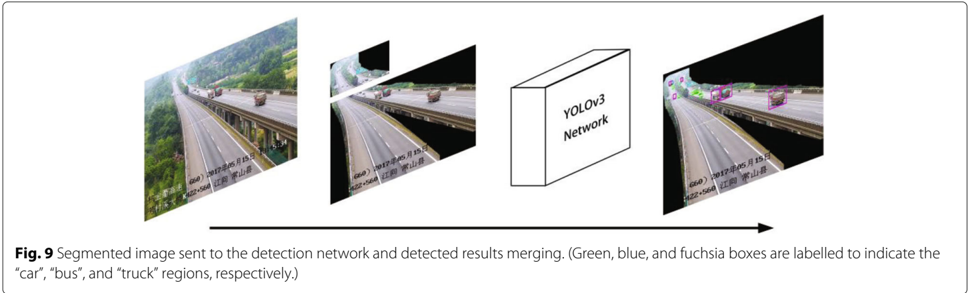
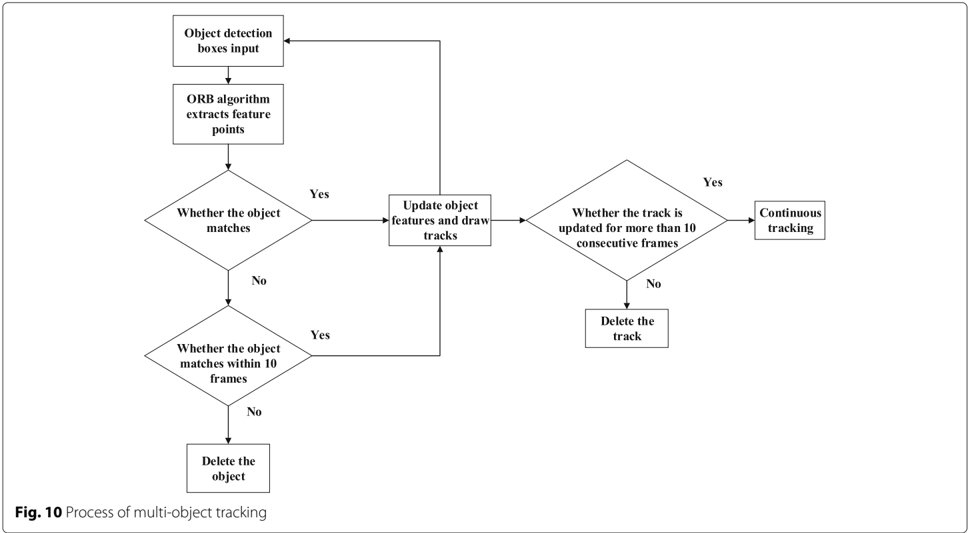
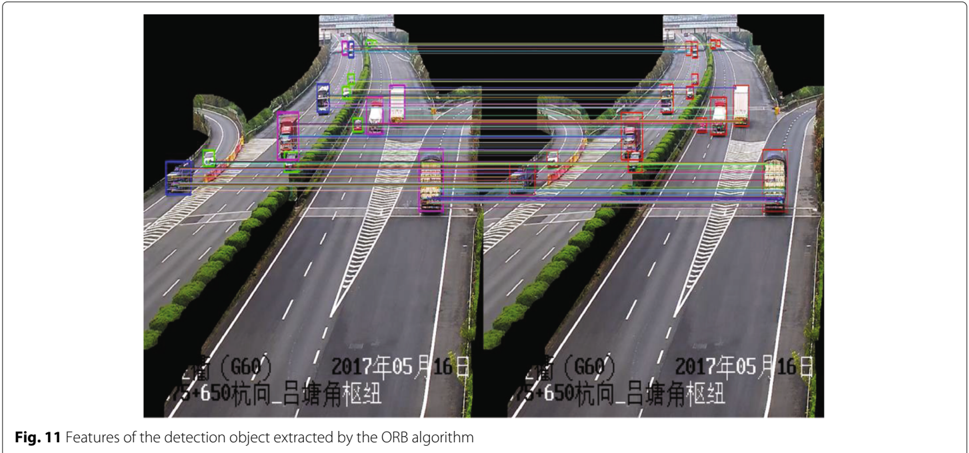
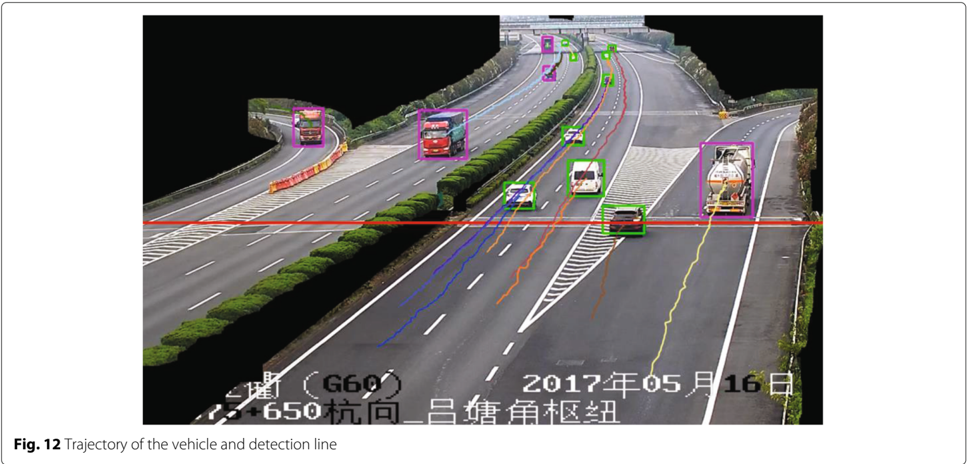
Intelligent vehicle detection and counting are becoming increasingly important in the field of highway management. However, due to the different sizes of vehicles, their detection remains a challenge that directly affects the accuracy of vehicle counts. To address this issue, this paper proposes a vision-based vehicle detection and counting system. A new high definition highway vehicle dataset with a total of 57,290 annotated instances in 11,129 images is published in this study. Compared with the existing public datasets, the proposed dataset contains annotated tiny objects in the image, which provides the complete data foundation for vehicle detection based on deep learning. In the proposed vehicle detection and counting system, the highway road surface in the image is first extracted and divided into a remote area and a proximal area by a newly proposed segmentation method; the method is crucial for improving vehicle detection. Then, the above two areas are placed into the YOLOv3 network to detect the type and location of the vehicle. Finally, the vehicle trajectories are obtained by the ORB algorithm, which can be used to judge the driving direction of the vehicle and obtain the number of different vehicles. Several highway surveillance videos based on different scenes are used to verify the proposed methods. The experimental results verify that using the proposed segmentation method can provide higher detection accuracy, especially for the detection of small vehicle objects. Moreover, the novel strategy described in this article performs notably well in judging driving direction and counting vehicles. This paper has general practical significance for the management and control of highway scenes.
Overview
CoChat Summary
## TL;DR
This paper proposes a highway-surveillance vehicle detection and counting system that combines road-surface segmentation, YOLOv3 detection, and ORB-based multi-object tracking. On the authors’ dataset of 11,129 images with 57,290 annotated instances, the system reports 87.88% mAP and near-real-time processing on tested videos.
## Key findings
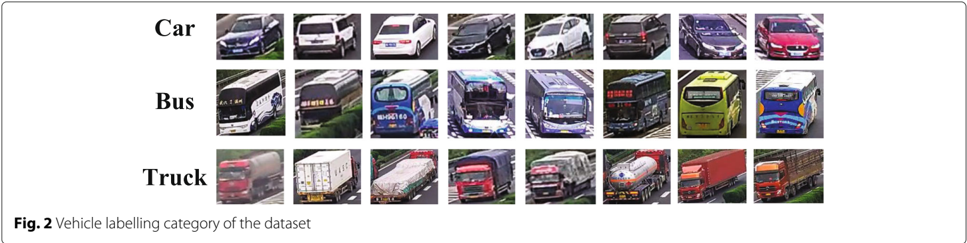
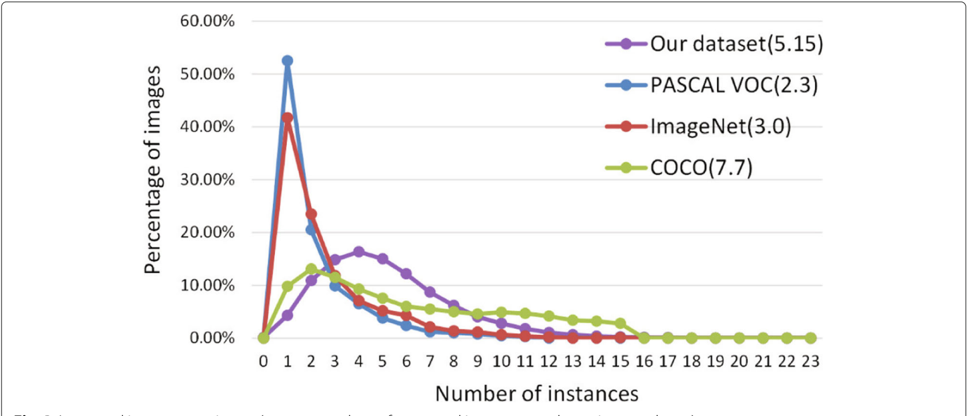
- The paper publishes a new high-definition highway vehicle dataset with 11,129 images and 57,290 annotated instances; the images are 1920 × 1080 RGB and average 5.15 instances per image.
- The proposed detection model achieved 87.88% mAP, with class APs of 86.46% (car), 88.57% (bus), and 88.61% (truck); the paper also reports 71.32% average IoU and 83.46% overall correct rate for object detection.
- For tracking/counting, the paper reports average accuracies of 92.3% for vehicle driving direction and 93.2% for vehicle counting.
- Compared with full-image detection, the proposed road-surface segmentation approach improved small-object detection; the table reports overall correct rates of 92.14% vs 14.96% in the remote area and 97.82% vs 82.80% in the proximal area, respectively.
## Methods
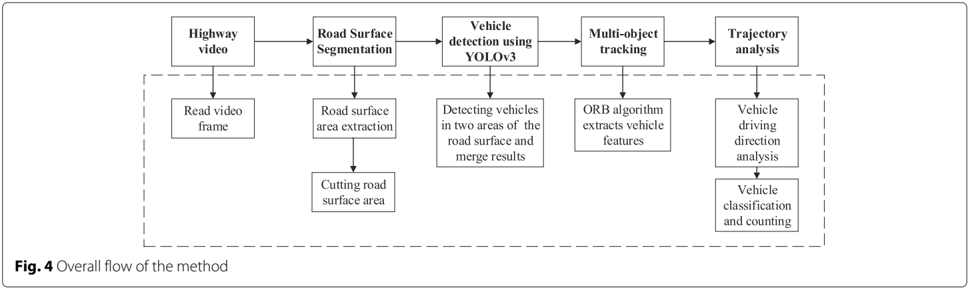
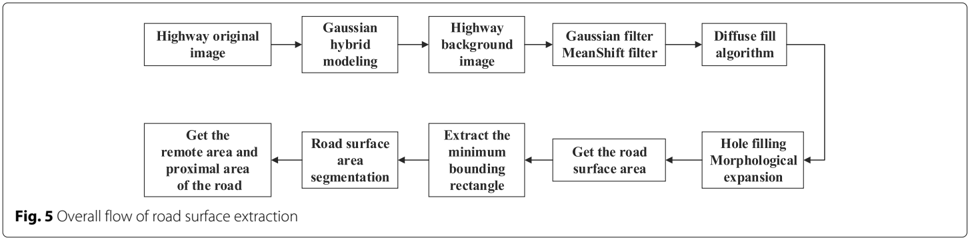
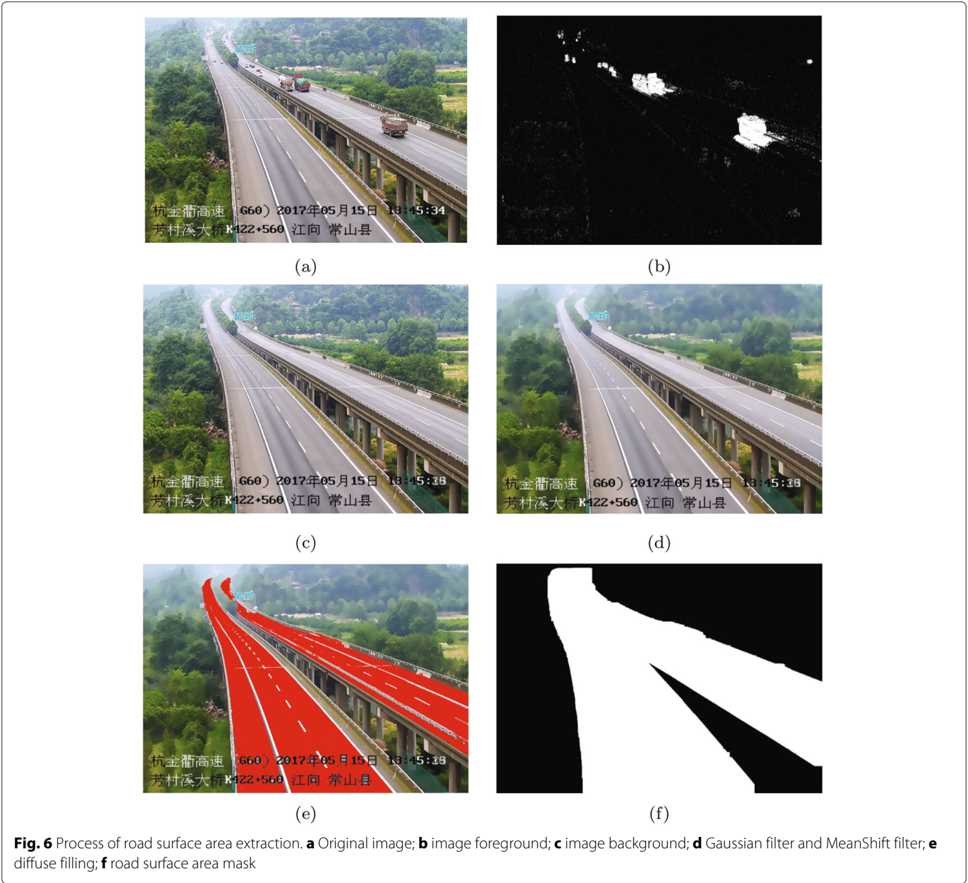
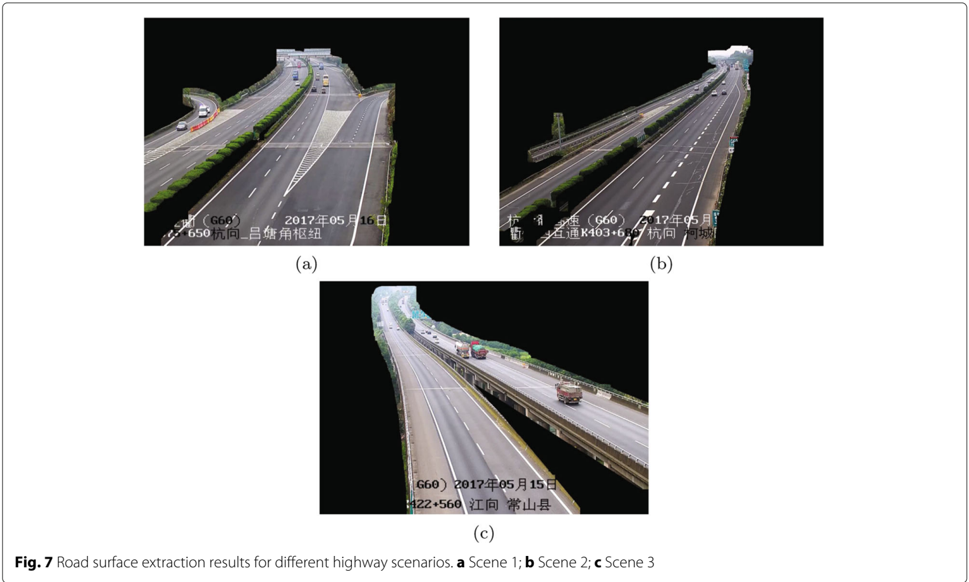
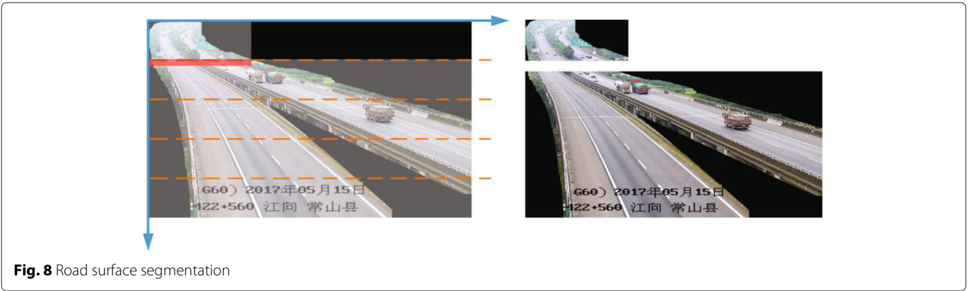
- Design: a pipeline that first extracts the highway road surface, then divides it into remote and proximal regions, detects vehicles with YOLOv3, and tracks them with ORB feature matching plus trajectory analysis.
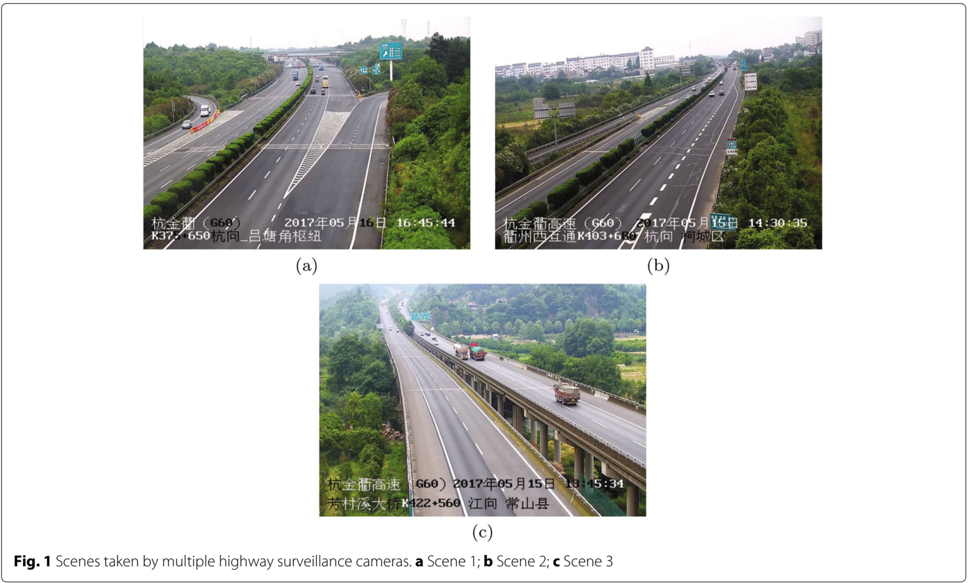
- Data/sample: a newly built dataset from highway surveillance video in Hangzhou, China, collected from 23 surveillance cameras across different scenes, times, and lighting conditions; the model was trained on an 80%/20% train-test split (8,904 training images and 2,225 test images).
- Main analysis: YOLOv3 training and evaluation using mAP/AP/precision/recall, comparison of detection counts against actual vehicle numbers, and trajectory-based counting using a detection line to infer direction and vehicle flow.
## Limitations
- The paper states that there are few public datasets for specific traffic scenes and that traffic images are often not publicly released due to copyright, privacy, and security issues.
- The authors note that the method is less effective when cars are small, occluded, or parallel in lanes, and that detection deviation in the remote area can still occur; this is stated in the paper.
- Evident from the text: the evaluation is limited to the authors’ own highway videos and dataset, so generalization beyond those scenes is not directly demonstrated in the provided text.
Model-written summary. Check it against the paper before relying on it.
Integrity signals
Registry
Cites
Statistics
Figures
Verification
Claims the paper makes
1 Valid · 2 Not valid · 1 Not checked · 56 Own results and interpretations
A result the paper reports from its own data — it cites no other source for it, so there is none to check. The quote shows it is in the paper.
In the paper
“A new high definition highway vehicle dataset with a total of 57,290 annotated instances in 11,129 images is published in this study.”
- Also stated in: § Vehicle dataset · plain
“As shown in Table 1, this dataset has a total of 11,129 images and 57,290 annotation boxes..”
§ Vision-based vehicle detection and counting system using deep learning in highway scenes > Abstract
plain- Asserted: passes — The authors put it forward as true.
- Checkable: passes — It can be checked against evidence.
- Load-bearing: passes — The paper’s conclusions depend on it.
- Based: passes — The paper gives a reason why it holds.
- Rests on an assumption not shown here.
- Also stated in: § Vehicle dataset · plain
A result the paper reports from its own data — it cites no other source for it, so there is none to check. The quote shows it is in the paper.
In the paper
“results verify that using the proposed segmentation method can provide higher detection accuracy, especially for the detection of small vehicle objects.”
§ Vision-based vehicle detection and counting system using deep learning in highway scenes > Abstract
plainstates a cause- Asserted: passes — The authors put it forward as true.
- Checkable: passes — It can be checked against evidence.
- Load-bearing: passes — The paper’s conclusions depend on it.
- Based: passes — The paper gives a reason why it holds.
- Rests on 3 assumptions not shown here.
A result the paper reports from its own data — it cites no other source for it, so there is none to check. The quote shows it is in the paper.
In the paper
“We obtained a final map value of 87.88%, which indicates that the method is a good way to locate and classify different vehicle objects.”
§ Vision-based vehicle detection and counting system using deep learning in highway scenes > Network training and vehicle detection
plain- Asserted: passes — The authors put it forward as true.
- Checkable: passes — It can be checked against evidence.
- Load-bearing: passes — The paper’s conclusions depend on it.
- Based: passes — The paper gives a reason why it holds.
A result the paper states — it cites no source for it, so there is none to check. The quote shows it is in the paper.
In the paper
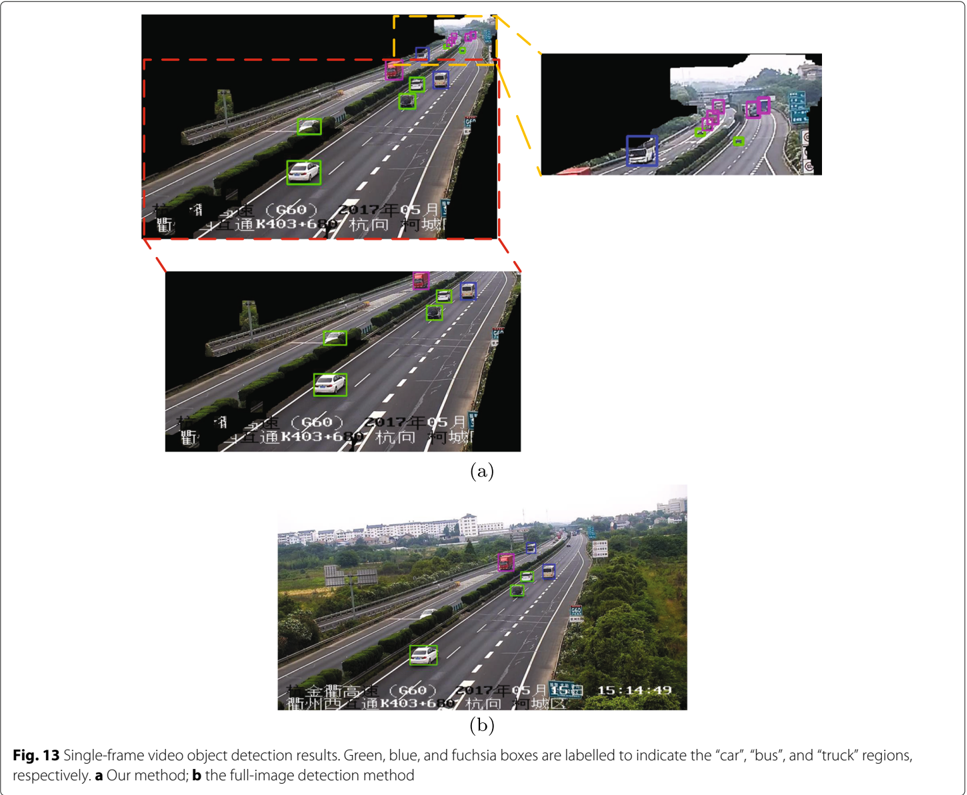
“At the same time, in the proximal area of the road, our method is also better than the full-image detection method.”
§ Vision-based vehicle detection and counting system using deep learning in highway scenes > Network training and vehicle detection
plainstates an association- Asserted: passes — The authors put it forward as true.
- Checkable: passes — It can be checked against evidence.
- Load-bearing: unclear — It is unclear whether the paper’s conclusions depend on it.
- Based: passes — The paper gives a reason why it holds.
A result the paper states — it cites no source for it, so there is none to check. The quote shows it is in the paper.
In the paper
“The full-image detection method did not detect a large number of small objects in the remote area of the road.”
§ Vision-based vehicle detection and counting system using deep learning in highway scenes > Network training and vehicle detection
plain- Asserted: passes — The authors put it forward as true.
- Checkable: passes — It can be checked against evidence.
- Load-bearing: passes — The paper’s conclusions depend on it.
- Based: passes — The paper gives a reason why it holds.
19 more claims
Create a free account to see all 60 claims and to verify the 1 reference still open.
- It may state two separate claims as one. 24
- Probably not a substantial claim. 18
- The quote only partly states this claim. 5
Claims other papers make about this one
Each is checked against this paper’s own text: does it say what the citing paper says it does?
The source backs part of the claim, not all of it — or backs it for a different population, condition or comparison.
In the citing paper
“Some studies have also segmented the road surface to achieve higher performance [25], which requires more computation work.”
From Real-Time Vehicle Classification and Tracking Using a Transfer Learning-Improved Deep Learning Network (2022) · cites this paper as [25]
Experimental — accuracy not yet measuredThe source backs part of the claim, not all of it — or backs it for a different population, condition or comparison.
In the citing paper
“Song et al. [25] improved the accuracy of detection and classification of cars, buses, and trucks from 49% to 95% by segmenting road pixels first, before object detection, using YOLOv3.”
From Real-Time Vehicle Classification and Tracking Using a Transfer Learning-Improved Deep Learning Network (2022) · cites this paper as [25]
Experimental — accuracy not yet measured
Citations
Cites
You Only Look Once: Unified, Real-Time Object Detection
Redmon, J., Divvala, S., Girshick, R., & Farhadi, A. (2016) · 2016 IEEE Conference on Computer Vision and Pattern Recognition (CVPR) · doi:10.1109/cvpr.2016.91 · Cited by 53,803
Rich Feature Hierarchies for Accurate Object Detection and Semantic Segmentation
Girshick, R., Donahue, J., Darrell, T., & Malik, J. (2014) · 2014 IEEE Conference on Computer Vision and Pattern Recognition · doi:10.1109/cvpr.2014.81 · Cited by 32,684
(2016) · Cited by 31,590
A Computational Approach to Edge Detection
Canny, J. (1986) · IEEE Transactions on Pattern Analysis and Machine Intelligence · doi:10.1109/tpami.1986.4767851 · Cited by 30,004
SSD: Single Shot MultiBox Detector
Liu, W., Anguelov, D., Erhan, D., Szegedy, C., Reed, S., Fu, C.-Y., & Berg, A. C. (2016) · Lecture Notes in Computer Science · doi:10.1007/978-3-319-46448-0_2 · Cited by 22,128
YOLO9000: Better, Faster, Stronger
Redmon, J., & Farhadi, A. (2017) · 2017 IEEE Conference on Computer Vision and Pattern Recognition (CVPR) · doi:10.1109/cvpr.2017.690 · Cited by 19,892
YOLOv3: An Incremental Improvement
Redmon, J., & Farhadi, A. (2018) · arXiv · doi:10.48550/arxiv.1804.02767 · Cited by 17,141
Are we ready for autonomous driving? The KITTI vision benchmark suite
Geiger, A., Lenz, P., & Urtasun, R. (2012) · 2012 IEEE Conference on Computer Vision and Pattern Recognition · doi:10.1109/cvpr.2012.6248074 · Cited by 14,897
Spatial Pyramid Pooling in Deep Convolutional Networks for Visual Recognition
He, K., Zhang, X., Ren, S., & Sun, J. (2015) · IEEE Transactions on Pattern Analysis and Machine Intelligence · doi:10.1109/tpami.2015.2389824 · Cited by 11,971
ORB: An efficient alternative to SIFT or SURF
Rublee, E., Rabaud, V., Konolige, K., & Bradski, G. (2011) · 2011 International Conference on Computer Vision · doi:10.1109/iccv.2011.6126544 · Cited by 11,037 · cited 1×
“The ORB feature point detection algorithm [29] is proposed for use in this work.”
Method
Cited by
Items 301–391 of 391
Robust Hierarchical Data Association for Multiple Object Tracking Under Abrupt Appearance Changes
Rudić, B., Helmel, C., Halmich, C., Putz, V., Haidacher, M., & Efrosinin, D. (2021) · International Conference on Electrical, Computer and Energy Technologies (ICECET) · doi:10.1109/icecet52533.2021.9698535 · Cited by 1
Deep Learning for Real-Time Vehicle Counting and Categorization in Traffic Videos
Burde, A. R. (2025) · INTERANTIONAL JOURNAL OF SCIENTIFIC RESEARCH IN ENGINEERING AND MANAGEMENT · doi:10.55041/ijsrem46005
Drone Nest Deployment on Expressways Using Traffic Flow Data and Graph Attention
Chen, H., Zhao, J., Jiao, Y., Zhao, H., Lai, J., & Wang, T. (2025) · IEEE International Conference on Unmanned Systems (ICUS) · doi:10.1109/icus66297.2025.11295385
Autonomous Platen Detection on ROS by YOLOv5
Li, K., Huang, X., & Wang, W. (2022) · Communications in computer and information science · doi:10.1007/978-981-19-4109-2_41
Annotation-efficient learning for object discovery and detection
Vo, H. V. (2022) · theses.fr (ABES) · doi:10.70675/aae8cd95z8e92z4d35z9384zafe56efdad87
Performance Evaluation of the Transfer Learning Model in Car Vehicle Detection
Asqav, D. F., Rahmawati, R., & Manurung, M. M. (2023) · Journal of Computer Engineering Electronics and Information Technology · doi:10.17509/coelite.v2i1.59716
Auto Rickshaw Detection for Autonomous Navigation in Real-Time ETW Setup
Pedapati, P. R., Chidambaram, R. K., Chavan, T. A., Ansar, A., & Sekar, N. K. (2025) · Signals and communication technology · doi:10.1007/978-3-031-68952-9_105
Modelling lateral vehicle arrivals in lane-free, heterogeneous traffic using a stochastic approach
Dang, M. T., Bui, T. A., & Nguyen, H. V. (2026) · Physica A Statistical Mechanics and its Applications · doi:10.1016/j.physa.2026.131528
Kuteynikov, I. A., Yashina, M., Tatashev, A. G., Lebedev, A. N., & Kuzmina, N. V. (2025) · Intelligent Technologies and Electronic Devices in Vehicle and Road Transport Complex (TIRVED) · doi:10.1109/tirved67702.2025.11367164
Research on Enhancing Accuracy in Vehicle Detection
Pandey, S., Meenakshi, B., Sneha, A., Charan, N., & Monesh, G. V. (2023) · International Conference on Power, Instrumentation, Control and Computing (PICC) · doi:10.1109/picc57976.2023.10142914 · Cited by 1
Real-time computer vision system for monitoring conveying systems
Halawa, F., Sadeghzadeh, S., & Mohammed, R. (2025) · The International Journal of Advanced Manufacturing Technology · doi:10.1007/s00170-025-17188-x · Cited by 3
Sankaranarayanan, M., Rupesh, P., Apparao, S. V. S., & Basha, O. K. (2026) · Smart innovation, systems and technologies · doi:10.1007/978-981-95-4161-4_36
Analysis of YOLO Models for Person Detection with Hazardous Objects
Singh, A., Debnath, D., Chauhan, D., et al. (2025) · Lecture notes in networks and systems · doi:10.1007/978-981-96-2179-8_10
Truckfier: A Multiclass Vehicle Detection and Counting Tool for Real-World Highway Scenarios
Regio, M. S., Souza, G. V., Rosa, R., Musse, S. R., Manssour, I. H., & Bordini, R. H. (2023) · Advances in intelligent systems and computing · doi:10.1007/978-3-031-28332-1_39 · Cited by 1
A Survey on Real-Time Traffic Signal Optimization using Deep Learning and Vehicle Tracking
Saini, A., & Srivastava, J. (2025) · International Conference on Intelligent Communication Technologies and Virtual Mobile Networks (ICICV) · doi:10.1109/icicv64824.2025.11085920
Patil, T., Patil, S., Nirpal, P., Madankar, G., & Bodireddy, M. (2022) · Algorithms for intelligent systems · doi:10.1007/978-981-19-3311-0_13
METODY PŘEDZPRACOVÁNÍ OBRAZU PRO AUTOMATICKOU DETEKCI ÚČASTNÍKŮ SILNIČNÍHO PROVOZU
Berg, J., Jilek, P., Pokorný, J., & Krmela, J. (2022) · Perner s Contacts · doi:10.46585/pc.2022.2.2389
A Wide-area Monitoring Technique of National Route using Visual IoT System
Kikuta, K., Murata, K. T., Nagatsuma, T., Tokairin, J., & Murakami, Y. (2026) · Journal of Information Processing · doi:10.2197/ipsjjip.34.368
Performance monitoring of deep learning vision systems during deployment
Rahman, Q. M. (2022) · Queensland University of Technology · doi:10.5204/thesis.eprints.229733
Enhanced Vehicle Tracking System Based on DeepNet Using Optimized Region-Based Shape Descriptors
Tuteja, S., Poddar, S., Karar, V., Tonk, R., & Kumar, M. (2026) · National Academy Science Letters · doi:10.1007/s40009-026-02331-3
Automatic Analysis of People in Thermal Imagery
Liu, J. (2022) · VBN Forskningsportal (Aalborg Universitet) · doi:10.54337/aau499830013
A Monocular Vision Based System for Detection of Drivable Road
Bhatlawande, S. S., Patil, A., Shilaskar, S., Patil, K., & Pingat, V. (2023) · International Conference on Cyber Physical Systems, Power Electronics and Electric Vehicles (ICPEEV) · doi:10.1109/icpeev58650.2023.10391905 · Cited by 1
V-DaT: A Robust method for Vehicle Detection and Tracking
Anuj, E. A. L. (2021) · Türk bilgisayar ve matematik eğitimi dergisi · doi:10.17762/turcomat.v12i2.2092
A Review of Traffic Congestion Prediction Using Machine Learning
Patel, K. C., & Patel, M. M. (2025) · Algorithms for intelligent systems · doi:10.1007/978-981-96-5265-5_9
Motorcyclist Violation Detection System Not Wearing a Helmet Using Yolo and CNN Algorithm
Sisfianto, A. E., Murti, M. A., & Fuadi, A. Z. (2026) · IEEE International Conference on Signals and Systems (ICSigSys) · doi:10.1109/icsigsys71160.2026.11613874
Traffic Volume Estimation from Environmental Audio Using Spectral Features and Deep Learning
Waranusast, R., Kruttanuchat, K., Pamee, P., & Pattanathaburt, P. (2026) · International Electrical Engineering Congress (iEECON) · doi:10.1109/ieecon68065.2026.11706995
Adaptive Traffic Light Control Based on a Neural Network to Improve Traffic Efficiency
Ivliev, V., Ivliev, E., Obukhov, P., Obukhov, A., & Ngọc, T. N. (2026) · Lecture notes in electrical engineering · doi:10.1007/978-3-032-14742-4_11
Tripathi, D., Sharma, K., Jain, I., Chaurasia, S., & Gupta, A. K. (2025) · IEEE World Conference on Applied Intelligence and Computing (AIC) · doi:10.1109/aic66080.2025.11212009
Surveillance Based Spotting and Categorization of Automobiles
Priyadharshini, K. V., Aswanthi, D. S., Nithya Bala, G., Sheela, X., & Subhanu, K. (2022) · International Conference on Intelligent Computing and Control Systems (ICICCS) · doi:10.1109/iciccs53718.2022.9788228
A Real-Time Object Dimension Estimation System
Pawar, S., Parsewar, S., Patil, S., Bhatlawande, S. S., & Shilaskar, S. (2023) · IEEE Pune Section International Conference (PuneCon) · doi:10.1109/punecon58714.2023.10450020 · Cited by 1
TagMe: GPS-Assisted Automatic Object Annotation in VideosPreprint
He, S., Bastani, F., Alizadeh, M., Balakrishnan, H., Cafarella, M., Kraska, T., & Madden, S. R. (2021) · arXiv (Cornell University) · doi:10.48550/arxiv.2103.13428 · Cited by 1
Development of an Application for Recognizing Automobile Vehicles
Kataev, G., Shabley, A. A., & Ваулин, С. Д. (2020) · International Multi-Conference on Industrial Engineering and Modern Technologies (FarEastCon) · doi:10.1109/fareastcon50210.2020.9271500
ML-based Individual Contribution Assessment of Basketball Players from Their Trajectories
Tanaka, T. Q., Uchiyama, A., & Yamaguchi, H. (2023) · IEEE International Conference on Mobile Data Management (MDM) · doi:10.1109/mdm58254.2023.00021
Omachi, S., & Omachi, M. (2022) · IEEE Transactions on Vehicular Technology · doi:10.1109/tvt.2022.3167048
Cheng, Z. (2024) · International Conference on Mechatronics and Computer Technology Engineering (MCTE) · doi:10.1109/mcte62870.2024.11117618
Deep CNN Framework for Object Detection and Classification System from Real Time Videos
BORRA, D. S. R. B. D. S. R. (2023) · Journal of Science and Technology · doi:10.46243/jst.2023.v8.i12.pp78-93
Active Learning for Multi-Class Vehicle Categorization and Traffic Analysis in complex environments
Lugo, G., Quinlan, J., Zhou, L., Sadik, M. N., & Cheng, I. (2023) · IEEE International Symposium on Multimedia (ISM) · doi:10.1109/ism59092.2023.00017
Manivarma, D., & Akilandeswari, A. (2023) · AIP conference proceedings · doi:10.1063/5.0159810
Deep Learning for Real-Time Vehicle Counting and Categorization in Traffic Videos
Burde, A. R. (2025) · INTERANTIONAL JOURNAL OF SCIENTIFIC RESEARCH IN ENGINEERING AND MANAGEMENT · doi:10.55041/ijsrem45971
Artificial Intelligence‐Based Smart Traffic Surveillance System for Vehicles
Husain, A. A., Maity, T., Rai, M., & Yadav, R. K. (2025) · Wiley eBooks · doi:10.1002/9781394245215.ch16
Estimation of Algorithms for Extracting Traffic Data Using Uav and Stationary CameraPreprint
Manjusha, M. K. S. R., Niveditha, R., & Sunitha, V. (2023) · SSRN Electronic Journal · doi:10.2139/ssrn.4588274
Real-Time Vehicle Recognition in Unconstrained Environments Using YOLOv3 and Filtering Techniques
Mandal, O. S., Kar, C., Dey, A., & Poray, J. (2025) · IEEE Applied Signal Processing Conference (ASPCON) · doi:10.1109/aspcon66877.2025.11389323
AI-Powered Vehicle Count Prediction for Smart City Traffic Management
Hemavathi, N., Sumathi, R., & Savithramma, R. M. (2025) · International Conference on Computational Robotics, Testing and Engineering Evaluation (ICCRTEE) · doi:10.1109/iccrtee64519.2025.11052998
Car Detection from Unmanned Aerial Vehicles Based on Deep Learning: A Comparative Study
Hossain, S., Waheed, S., & Abdullah, M. (2023) · Lecture notes in networks and systems · doi:10.1007/978-981-19-9483-8_6
Camera-Based Approach for Automated Counting Oil Drop in Industrial Lubrication Systems
Cao, H.-G., Liu, K. F.-R., & Chen, D. S.-H. (2024) · IEEE International Conference on Humanoid, Nanotechnology, Information Technology, Communication and Control, Environment, and Management (HNICEM) · doi:10.1109/hnicem64917.2024.11258670
Dhavakumar, P., Samuel, S., Jesvanth, S., & Saravanan, P. (2025) · Lecture notes in networks and systems · doi:10.1007/978-981-96-9245-3_42
Fitness test of vehicles using CNN.Preprint
Guharoy, R., Deshkar, D., Raskar, S., Dalvi, P., Foujdar, D., & Alimkar, N. (2023) · doi:10.36227/techrxiv.23531256.v2
Lane-Based Vehicle Counting System for Complex Traffic Scenes
Hu, Z., Liu, Z., Song, R., Li, K., Chen, S., Wang, Z., Li, Y., & Qi, X. (2026) · Information · doi:10.3390/info17070686
Modeling Real Time Object Identification Performance Evaluation with YOLO
Security Consultant, B., Joshi, A., Raturi, A., Security Consultant, B., Kumar, S., Security Consultant, B., Dumka, A., & Pant, I. (2022) · YMER Digital · doi:10.37896/ymer21.06/23
Vu, T., Pham, N. V., Thai, H. N., et al. (2026) · International Journal of Intelligent Transportation Systems Research · doi:10.1007/s13177-026-00634-9
Smart social junction traffic control using reinforcement learning on real data
Barzilai, O., Rika, H., & Hassine, Y. (2025) · Journal of Computational Social Science · doi:10.1007/s42001-025-00418-3
Fitness test of vehicles using CNN.Preprint
Guharoy, R., Raskar, S., Alimkar, N., Dalvi, P., & Foujdar, D. (2023) · TechRxiv · doi:10.36227/techrxiv.23531256
Sravanth, S., Shamitha, E., Sai, M., & Raju, Y. (2025) · Wiley eBooks · doi:10.1002/9781394233823.ch29 · Cited by 1
Machine Vison-Based System for Vehicle Classification and Counting Using YOLO
Refaie, E., & Faudzi, A. A. M. (2022) · Lecture notes in electrical engineering · doi:10.1007/978-981-16-8484-5_37 · Cited by 1
A LIGHTWEIGHT VEHICLE DETECTION USING SUPPORT VECTOR MACHINE
(2023) · International Research Journal of Modernization in Engineering Technology and Science · doi:10.56726/irjmets32674
Kumari, S., & Kumar, T. (2025) · Multimedia tools and applications · doi:10.1007/s11042-025-20921-z · Cited by 1
Region-Guided Vehicle Detection in Traffic Surveillance at Intersection
Wang, X. F., An, C., Su, H., Zhou, W., Xia, J., & Lu, Z. (2026) · IEEE Internet of Things Journal · doi:10.1109/jiot.2026.3710544
Real time car make and model detection for Indian market
Darapaneni, N., Konduru, V. R., Karthikeyan, Karthik, P., Prasanna, S., Darshini, D., Paduri, A. R., & Velavan, S. (2023) · AIP conference proceedings · doi:10.1063/5.0133483
Murugesh, T. S., Vasudevan, S. K., Pulari, S. R., et al. (2024) · Lecture notes in networks and systems · doi:10.1007/978-981-97-4228-8_28
Pe, A. J. L., Coching, J. K., Yeung, S. G. D., Akeboshi, W. W. N., Billones, R. K. C., Roxas, N. R., Fillone, A. M., & Dadios, E. P. (2023) · IEEE International Conference on Humanoid, Nanotechnology, Information Technology, Communication and Control, Environment, and Management (HNICEM) · doi:10.1109/hnicem60674.2023.10589161
Comprehensive Analysis of Video Surveillance System and Applications
Sharma, N. K., Rahamatkar, S., & Rathore, A. S. (2023) · BENTHAM SCIENCE PUBLISHERS eBooks · doi:10.2174/9789815123708123010004
A Study of Moving Vehicle Detection and Tracking Through Smart Surveillance System
Kumar, M., Ray, S., Yadav, D. K., & Tanwar, R. (2022) · Algorithms for intelligent systems · doi:10.1007/978-981-16-7136-4_23 · Cited by 1
Object detection analysis based on Machine Learning Algorithms
Javheri, P., Varma, Y., Patil, Y., & Rawat, P. B. S. (2023) · INTERANTIONAL JOURNAL OF SCIENTIFIC RESEARCH IN ENGINEERING AND MANAGEMENT · doi:10.55041/ijsrem19022
End-to-End Traffic Monitoring and Management in Real-Time Road Traffic
Amitha, I. C., Sreekanth, N. S., & Narayanan, N. K. (2022) · doi:10.1109/iatmsi56455.2022.10119300
Metadata
- Authors
- Song, H., Liang, H., Li, H., Dai, Z., & Yun, X.
- Affiliations
- Chang'an University (CN)
- Corresponding author
- Liang, Haoxiang
- Venue
- European Transport Research Review
- Published
- 2019-12
- Volume
- 11
- Issue
- 1
- ISSN
- 1866-8887 (ISSN-L)
- 1867-0717
- OpenAlex
- W2997192890
- Cited by
- 413
- References
- 40
- Citations by year
- 2026: 23 · 2025: 65 · 2024: 79 · 2023: 93 · 2022: 81 · 2021: 46 · 2020: 26
- FWCI
- 14.75
- Type
- journal article
- Language
- en
- Open access
- gold
- doi.org
- Licence
- cc-by
- creativecommons.org/licenses/by/4.0 (tdm)
- Locations
- European Transport Research Review (publishedVersion, cc-by)
- DOAJ (DOAJ: Directory of Open Access Journals) (submittedVersion, cc-by-sa)
- Funders
- National Natural Science Foundation of China (300102248402, No.61572083, 61572083)
- Fundamental Research Funds for the Central Universities
- Topics
- Physical Sciences › Computer Science › Computer Vision and Pattern Recognition › Advanced Neural Network Applications
- Physical Sciences › Computer Science › Computer Vision and Pattern Recognition › Video Surveillance and Tracking Methods
- Physical Sciences › Engineering › Automotive Engineering › Autonomous Vehicle Technology and Safety
- Keywords
- vehicle detection, vehicle counting, highway monitoring, small object detection, road surface segmentation, YOLOv3, ORB feature matching, vehicle trajectory tracking, freeway traffic control
About these checks
Registry, retraction, Cites and statistics results are computed, not judged, with one exception: a printed reference that no index lists is read once by a model before it counts as a citation error. Claims are extracted by a model and kept only when their quote appears verbatim in the text; each cited source is then checked, with a model’s help, for whether it says what the claim relies on. Those verdicts can be wrong — read the claim’s quote and the cited source before relying on one.
A language model drew the claims from the paper on 2026-10-10, under version 3 of the claim definition (model deepseek-v4.1-flash, prompt extract-v3).
A second model labelled each claim on 2026-10-10 (model jev-1.13-20260917, definition revision gold-guideline-v0.2).
Statistics and arithmetic are recomputed, not judged.
Confidence bands are shown only for fields calibrated on our annotated test set. None is calibrated yet, so no band is shown.
What counts as a claim ›How we measure confidence ›How we check this ›
Are you an author, or do you see a problem with this page? Request a review
Data sources
Bibliographic data: Semantic Scholar, OpenAlex, Crossref.
Contains information from the Semantic Scholar Academic Graph Datasets, made available under the ODC Attribution License (ODC-BY 1.0).
Semantic Scholar’s data is described in: Kinney, R., et al. (2023). The Semantic Scholar Open Data Platform. arXiv:2301.10140.
