

Accelerating genomic workflows using NVIDIA Parabricks
Open accessThe DOI matches its Crossref record; 26 of the 29 references it cites were found in a registry or an index; 7 of the 15 sources its claims cite were checked for support.
Abstract
BACKGROUND: As genome sequencing becomes better integrated into scientific research, government policy, and personalized medicine, the primary challenge for researchers is shifting from generating raw data to analyzing these vast datasets. Although much work has been done to reduce compute times using various configurations of traditional CPU computing infrastructures, Graphics Processing Units (GPUs) offer opportunities to accelerate genomic workflows by orders of magnitude. Here we benchmark one GPU-accelerated software suite called NVIDIA Parabricks on Amazon Web Services (AWS), Google Cloud Platform (GCP), and an NVIDIA DGX cluster. We benchmarked six variant calling pipelines, including two germline callers (HaplotypeCaller and DeepVariant) and four somatic callers (Mutect2, Muse, LoFreq, SomaticSniper). RESULTS: We achieved up to 65 × acceleration with germline variant callers, bringing HaplotypeCaller runtimes down from 36 h to 33 min on AWS, 35 min on GCP, and 24 min on the NVIDIA DGX. Somatic callers exhibited more variation between the number of GPUs and computing platforms. On cloud platforms, GPU-accelerated germline callers resulted in cost savings compared with CPU runs, whereas some somatic callers were more expensive than CPU runs because their GPU acceleration was not sufficient to overcome the increased GPU cost. CONCLUSIONS: Germline variant callers scaled well with the number of GPUs across platforms, whereas somatic variant callers exhibited more variation in the number of GPUs with the fastest runtimes, suggesting that, at least with the version of Parabricks used here, these workflows are less GPU optimized and require benchmarking on the platform of choice before being deployed at production scales. Our study demonstrates that GPUs can be used to greatly accelerate genomic workflows, thus bringing closer to grasp urgent societal advances in the areas of biosurveillance and personalized medicine.
Overview
CoChat Summary
TL;DR
This paper benchmarks NVIDIA Parabricks GPU-accelerated variant calling against CPU workflows on AWS, GCP, and an NVIDIA DGX cluster. Germline callers accelerated strongly and often reduced cost, while somatic callers varied by algorithm, GPU count, and platform and sometimes cost more than CPU runs.
Key findings
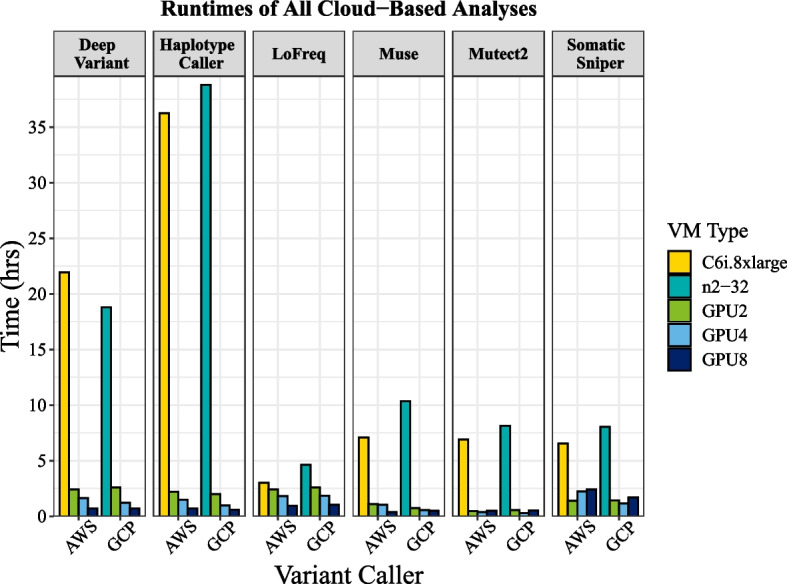
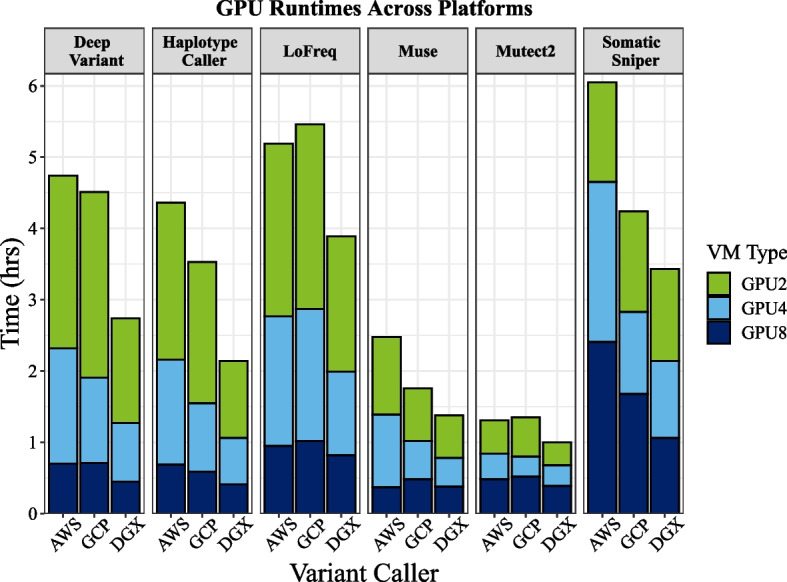
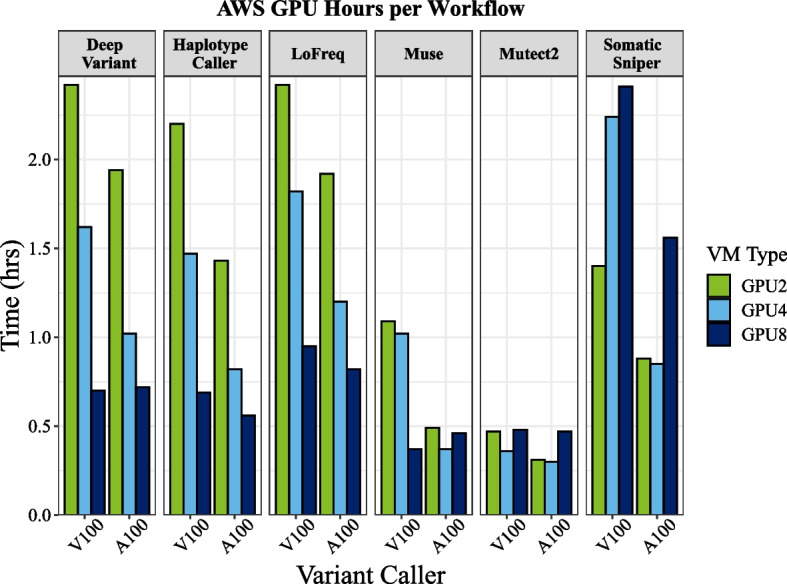
- Germline variant callers achieved up to 65× acceleration: HaplotypeCaller runtimes fell from 36 h on CPU to 33 min on AWS, 35 min on GCP, and 24 min on the NVIDIA DGX.
- On AWS, GPU acceleration reached up to 65.1× for HaplotypeCaller, 30.7× for DeepVariant, 56.8× for Mutect2, 7.7× for SomaticSniper, 18.9× for Muse, and 3.7× for LoFreq; on GCP, up to 65.8×, 26.5×, 29.3×, 7.0×, 21.8×, and 4.5× respectively.
- Germline callers scaled well with GPU number, but somatic callers showed more variation; for example, Mutect2 and SomaticSniper were sometimes faster with 4 GPUs than 8 GPUs.
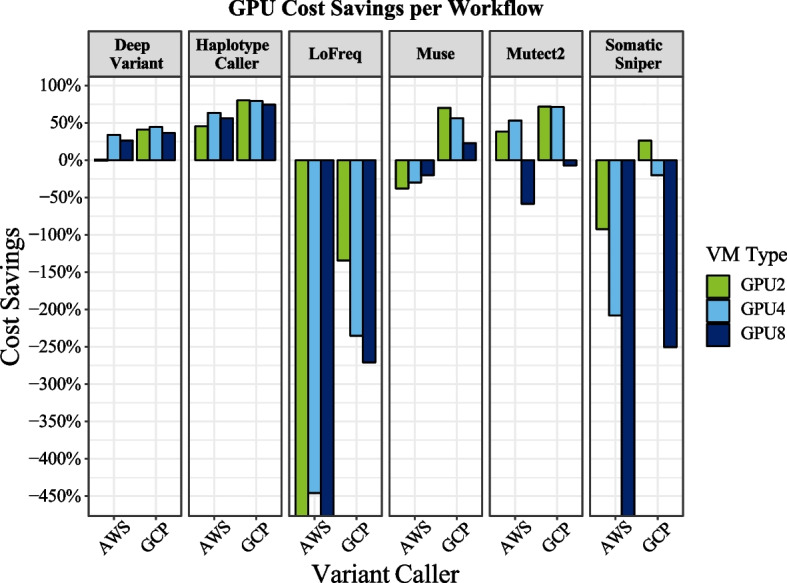
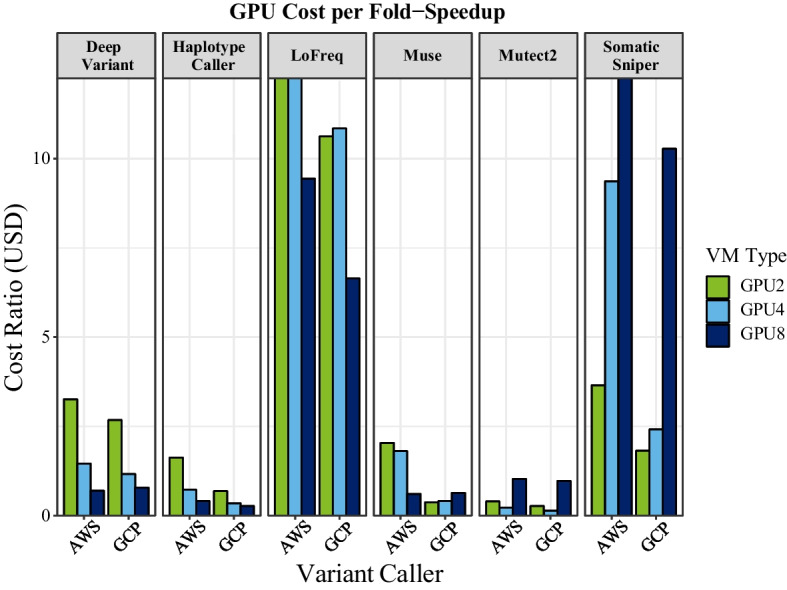
- GPU runs produced cost savings for most germline workflows, but poorly optimized somatic workflows could cost more: LoFreq CPU runs cost less than $9/sample on both platforms but as much as $30 with GPUs, and SomaticSniper CPU runs cost less than $14.5/sample but as much as $75 on AWS with 8 GPUs.
Methods
- Benchmarked six variant calling pipelines: two germline callers (HaplotypeCaller v4.2.0.0 and DeepVariant v1.1.0) and four somatic callers (Mutect2 v4.2.0.0, SomaticSniper v1.0.5.0, Muse v2.0, and LoFreq v2.1), using Parabricks v3.7.0-1 for GPU runs and Snakemake v6.6.1 CPU workflows as baselines.
- Used HG002 from Genome in a Bottle, down-sampled to 30× coverage with Samtools v1.9 and aligned to GRCh38; somatic benchmarking used synthetic tumor data generated with SomatoSim v1.0.0, adding 198 SNPs at variant allele frequencies from 0.001 to 0.4.
- Compared CPU and GPU configurations on AWS (c6i.8xlarge CPU; p3 V100 and p4 A100 GPU machines), GCP (n2-standard-32 CPU; a2-highgpu A100 GPU machines), and an NVIDIA DGX SuperPOD with up to 8 A100 GPUs, testing 2, 4, and 8 GPU configurations where possible.
Limitations
- The paper states that somatic findings used synthetic somatic data based on sites from a real patient, and some findings could be artifacts of the somatic variant sampling design.
- The paper states that AWS/GCP CPU runtime differences likely reflect processor generation differences, unless unaccounted-for factors also influenced variation; it also notes that comparisons between 2 and 4 A100 GPU machines were imprecise because AWS CPU limits could not be controlled for all workflows, biasing some comparisons toward AWS.
- The paper states that somatic callers were less GPU optimized with the Parabricks version tested and require benchmarking on the platform of choice before production deployment; the text also makes evident that this study benchmarks speed and cost, not variant-calling accuracy, and that DGX Parabricks runs were limited to a single DGX A100 system with 8 GPUs.
Model-written summary. Check it against the paper before relying on it.
Integrity signals
Registry
Cites
Statistics
Figures
Verification
Claims the paper makes
7 Valid · 2 Not valid · 6 Not checked · 57 Own results and interpretations
Every source the paper cites for this claim was checked and supports it.
In the paper
“However, one challenge to attaining these goals is the computational burden of analyzing large amounts of genomic sequence data [4].”
§ Accelerating genomic workflows using NVIDIA Parabricks > Background
What the sources say
- Supportedcites [4] Liu B Cloud-based bioinformatics workflow platform for large-scale next-generation sequencing analyses J Biomed Inform 2014 49 119 133 10.1016/j.jbi.2014.01.005 24462600 PMC4203338 source
The Introduction describes the large-scale computational analysis required for sequencing data and says the volume of genome data challenges computing systems. The Motivating scenario likewise says large datasets are difficult to analyze locally because of computation and storage requirements. The specific goals referenced by “these goals” are the citing authors’ framing, not a separate finding attributed to this source. (LLM, conf=0.92)
plainstates a cause- Asserted: passes — The authors put it forward as true.
- Checkable: passes — It can be checked against evidence.
- Load-bearing: passes — The paper’s conclusions depend on it.
- Based: passes — The paper gives a reason why it holds.
- Supported
Every source the paper cites for this claim was checked and supports it.
In the paper
“Different variant callers exhibit biases leading to slightly different variant calls [3].”
§ Accelerating genomic workflows using NVIDIA Parabricks > Discussion
What the sources say
- Supportedcites [3] Zhao S Agafonov O Azab A Stokowy T Hovig E Accuracy and efficiency of germline variant calling pipelines for human genome data Sci Rep 2020 10 1 1 12 10.1038/s41598-020-77218-4 33214604 PMC7678823 source
The Results section on genome contexts reports a pipeline-specific SNP-type bias in real data. The benchmarking Results also describe merging calls from different pipelines to reduce false negatives, showing that their variant calls differ. Page numbers are not provided in our copy. (LLM, conf=0.91)
plainstates a cause- Asserted: passes — The authors put it forward as true.
- Checkable: passes — It can be checked against evidence.
- Load-bearing: passes — The paper’s conclusions depend on it.
- Based: passes — The paper gives a reason why it holds.
- Supported
A result the paper reports from its own data — it cites no other source for it, so there is none to check. The quote shows it is in the paper.
In the paper
“For germline analyses, GCP performed faster for DeepVariant (18.8 h) compared with AWS (22 h)”
§ Accelerating genomic workflows using NVIDIA Parabricks > Results > CPU baseline across cloud platforms
plain- Asserted: passes — The authors put it forward as true.
- Checkable: passes — It can be checked against evidence.
- Load-bearing: unclear — It is unclear whether the paper’s conclusions depend on it.
- Based: passes — The paper gives a reason why it holds.
A result the paper reports from its own data — it cites no other source for it, so there is none to check. The quote shows it is in the paper.
In the paper
“CPU machine performance varied considerably between the c6i machine on AWS (c6i) compared with the n2 machine on GCP for most analyses.”
§ Accelerating genomic workflows using NVIDIA Parabricks > Results > CPU baseline across cloud platforms
plainstates an association- Asserted: passes — The authors put it forward as true.
- Checkable: passes — It can be checked against evidence.
- Load-bearing: unclear — It is unclear whether the paper’s conclusions depend on it.
- Based: passes — The paper gives a reason why it holds.
A result the paper reports from its own data — it cites no other source for it, so there is none to check. The quote shows it is in the paper.
In the paper
“Alternatively, somatic variant callers achieved speedups up to 56.8 × for the Mutect2 algorithm”
§ Accelerating genomic workflows using NVIDIA Parabricks > Background
plainstates a cause- Asserted: passes — The authors put it forward as true.
- Checkable: passes — It can be checked against evidence.
- Load-bearing: passes — The paper’s conclusions depend on it.
- Based: passes — The paper gives a reason why it holds.
18 more claims
Create a free account to see all 72 claims and every source verdict.
- Probably not a substantial claim. 16
- It may state two separate claims as one. 40
Self-check
Percentages, sums and reported differences re-computed from the paper’s own numbers.
Rated minor: it would not touch a result — a value no result rests on, a p-value that stays on the same side of the significance level, or a conflict that is clerical, resolved elsewhere in the paper, or outside its own findings.
In the paper
“Although the DGX cluster is composed of four DGX A100 components, resulting in a total of 48 A100 GPUs available”
§ Accelerating genomic workflows using NVIDIA Parabricks > Materials and methods > DGX configuration
Reported 48 · recomputed 32
Citations
Cites
The Sequence Alignment/Map format and SAMtools
Li, H., Handsaker, B., Wysoker, A., Fennell, T., Ruan, J., Homer, N., Marth, G., Abecasis, G., Durbin, R., & 1000 Genome Project Data Processing Subgroup (2009) · Bioinformatics · doi:10.1093/bioinformatics/btp352 · Cited by 62,041
A universal SNP and small-indel variant caller using deep neural networks
Poplin, R., Chang, P.-C., Alexander, D., Schwartz, S., Colthurst, T., Ku, A., Newburger, D., Dijamco, J., Nguyen, N., Afshar, P. T., et al. (2018) · Nature Biotechnology · doi:10.1038/nbt.4235 · Cited by 1,840
Wilm, A., Aw, P. P. K., Bertrand, D., Yeo, G. H. T., Ong, S. H., Wong, C. H., Khor, C. C., Petric, R., Hibberd, M. L., & Nagarajan, N. (2012) · Nucleic Acids Research · doi:10.1093/nar/gks918 · Cited by 1,372
Extensive sequencing of seven human genomes to characterize benchmark reference materials
Zook, J. M., Catoe, D., McDaniel, J., Vang, L., Spies, N., Sidow, A., Weng, Z., Liu, Y., Mason, C. E., Alexander, N., et al. (2016) · Scientific Data · doi:10.1038/sdata.2016.25 · Cited by 811 · cited 2×
“We conducted all benchmarking on the individual ‘HG002’ from the Genome in a Bottle Consortium [21, 22] hosted by the National Institute of Standards and Technology and made available as part of the Precision FDA Truth Challenge V2 (https:// preci sion.”
MethodSustainable data analysis with Snakemake
Mölder, F., Jablonski, K. P., Letcher, B., Hall, M. B., Tomkins-Tinch, C. H., Sochat, V., Forster, J., Lee, S., Twardziok, S. O., Kanitz, A., et al. (2021) · F1000Research · doi:10.12688/f1000research.29032.1 · Cited by 786
Towards a genomics-informed, real-time, global pathogen surveillance system
Gardy, J. L., & Loman, N. J. (2018) · Nature Reviews Genetics · doi:10.1038/nrg.2017.88 · Cited by 771 · cited 1×
“Pathogen biosurveillance benefits from rapid data processing to identify novel pathogens and could help policymakers to act more quickly during an outbreak [20].”
BackgroundSomaticSniper: identification of somatic point mutations in whole genome sequencing data
Larson, D. E., Harris, C. C., Chen, K., Koboldt, D. C., Abbott, T. E., Dooling, D. J., Ley, T. J., Mardis, E. R., Wilson, R. K., & Ding, L. (2012) · Bioinformatics · doi:10.1093/bioinformatics/btr665 · Cited by 661
Best practices for benchmarking germline small-variant calls in human genomes
the Global Alliance for Genomics and Health Benchmarking Team, Krusche, P., Trigg, L., Boutros, P. C., Mason, C. E., De La Vega, F. M., Moore, B. L., Gonzalez-Porta, M., Eberle, M. A., Tezak, Z., et al. (2019) · Nature Biotechnology · doi:10.1038/s41587-019-0054-x · Cited by 429
Cloud computing for genomic data analysis and collaboration
Langmead, B., & Nellore, A. (2018) · Nature Reviews Genetics · doi:10.1038/nrg.2017.113 · Cited by 310 · cited 3×
“07.20.498972 doi: bioRxiv preprint As the cost of genome sequencing continues to decrease, genomic datasets grow in both size and generation speed (Langmead & Nellore, 2018).”
BackgroundInfluentialFan, Y., Xi, L., Hughes, D. S. T., Zhang, J., Zhang, J., Futreal, P. A., Wheeler, D. A., & Wang, W. (2016) · Genome Biology · doi:10.1186/s13059-016-1029-6 · Cited by 286
Accuracy and efficiency of germline variant calling pipelines for human genome data
Zhao, S., Agafonov, O., Azab, A., Stokowy, T., & Hovig, E. (2020) · Scientific Reports · doi:10.1038/s41598-020-77218-4 · Cited by 118 · cited 2×
“Different variant callers exhibit biases leading to slightly different variant calls [3].”
BackgroundCloud Computing Enabled Big Multi-Omics Data Analytics
Koppad, S., Annappa, B., Gkoutos, G. V., & Acharjee, A. (2021) · Bioinformatics and Biology Insights · doi:10.1177/11779322211035921 · Cited by 103
Franke, K. R., & Crowgey, E. L. (2020) · Genomics & Informatics · doi:10.5808/gi.2020.18.1.e10 · Cited by 95
Cloud-based bioinformatics workflow platform for large-scale next-generation sequencing analyses
Liu, B., Madduri, R. K., Sotomayor, B., Chard, K., Lacinski, L., Dave, U. J., Li, J., Liu, C., & Foster, I. T. (2014) · Journal of Biomedical Informatics · doi:10.1016/j.jbi.2014.01.005 · Cited by 81 · cited 1×
“However, one challenge to attaining these goals is the computational burden of analyzing large amounts of genomic sequence data [4].”
BackgroundData Lakes, Clouds, and Commons: A Review of Platforms for Analyzing and Sharing Genomic Data
Grossman, R. L. (2019) · Trends in Genetics · doi:10.1016/j.tig.2018.12.006 · Cited by 75
Practical guide for managing large-scale human genome data in research
Tanjo, T., Kawai, Y., Tokunaga, K., Ogasawara, O., & Nagasaki, M. (2021) · Journal of Human Genetics · doi:10.1038/s10038-020-00862-1 · Cited by 62 · cited 1×
“Cloud computing addresses many of the challenges associated with large whole genome sequencing projects, which can suffer from siloed data, long download times, and slow workflow runtimes [7].”
BackgroundServerless computing in omics data analysis and integration
Grzesik, P., Augustyn, D. R., Wyciślik, Ł., & Mrozek, D. (2021) · Briefings in Bioinformatics · doi:10.1093/bib/bbab349 · Cited by 40
Krissaane, I., De Niz, C., Gutiérrez-Sacristán, A., Korodi, G., Ede, N., Kumar, R., Lyons, J., Manrai, A., Patel, C., Kohane, I., et al. (2020) · Journal of the American Medical Informatics Association · doi:10.1093/jamia/ocaa068 · Cited by 28 · cited 4×
“each variant caller to help optimize the ideal CPU machine type, particularly for designing cloud-based computing clusters [13].”
BackgroundMethodInfluentialPerspectives of using Cloud computing in integrative analysis of multi-omics data
Augustyn, D. R., Wyciślik, Ł., & Mrozek, D. (2021) · Briefings in Functional Genomics · doi:10.1093/bfgp/elab007 · Cited by 20
Eleven quick tips for architecting biomedical informatics workflows with cloud computing
Cole, B. S., & Moore, J. H. (2018) · PLOS Computational Biology · doi:10.1371/journal.pcbi.1005994 · Cited by 17 · cited 1×
“The first is the migration to Cloud for data analysis and storage, and the second is the use of Graphics Processing Units (GPUs) to accelerate data processing and analysis [5, 6].”
MethodHigh performance of a GPU-accelerated variant calling tool in genome data analysis
Zhang, Q., Liu, H., & Bu, F. (2021) · doi:10.1101/2021.12.12.472266 · Cited by 13
SomatoSim: precision simulation of somatic single nucleotide variants
Hawari, M. A., Hong, C. S., & Biesecker, L. G. (2021) · BMC Bioinformatics · doi:10.1186/s12859-021-04024-8 · Cited by 12
Applied genomics for identification of virulent biothreats and for disease outbreak surveillance
Nwadiugwu, M. C., & Monteiro, N. (2023) · Postgraduate Medical Journal · doi:10.1136/postgradmedj-2021-139916 · Cited by 11 · cited 1×
“These processes will greatly enhance aims such as whole genome biosurveillance and personalized medicine [2, 3].”
BackgroundHummingbird: efficient performance prediction for executing genomic applications in the cloud
Bahmani, A. H., Xing, Z., Krishnan, V., Ray, U., Mueller, F., Alavi, A., Tsao, P. S., Snyder, M. P., & Pan, C. (2021) · Bioinformatics · doi:10.1093/bioinformatics/btab161 · Cited by 4
Crowgey, E. L., Vats, P., Franke, K., Burnett, G., Sethia, A., Harkins, T., & Druley, T. E. (2021) · Cancer Research · doi:10.1158/1538-7445.am2021-165 · Cited by 3
Running Genomic Analyses in the Cloud
Leonard, C., Wood, S., Holmes, O., Waddell, N., Gorse, A., Hansen, D. T., & Pearson, J. V. (2019) · Studies in health technology and informatics · doi:10.3233/shti190787 · Cited by 3
Research works printed but not linked: 2
- Van der Auwera GA O’Connor BD Genomics in the cloud: using Docker, GATK, and WDL in Terra 2020 O’Reilly Media
- Li H. Aligning sequence reads, clone sequences and assembly contigs with BWA-MEM. ArXiv Prepr. ArXiv13033997; 2013.
Cited by
Patel, A., Göbel, K., Ille, S., Hinz, F. E., Schoebe, N., Bogumil, H., Meyer, J., Brehm, M., Dogan, H., Schrimpf, D., et al. (2025) · Nature Medicine · doi:10.1038/s41591-025-03562-5 · Cited by 70
Reference genome choice compromises population genetic analyses
Akopyan, M., Genchev, M., Armstrong, E. E., & Mooney, J. A. (2025) · Cell · doi:10.1016/j.cell.2025.08.034 · Cited by 57
From GPUs to AI and quantum: three waves of acceleration in bioinformatics
Schmidt, B., & Hildebrandt, A. (2024) · Drug Discovery Today · doi:10.1016/j.drudis.2024.103990 · Cited by 36
Cutting-Edge AI Technologies Meet Precision Medicine to Improve Cancer Care
Lin, P., Tsai, Y.-S., Yeh, Y., & Shen, M.-R. (2022) · Biomolecules · doi:10.3390/biom12081133 · Cited by 32
Digital Alchemy: The Rise of Machine and Deep Learning in Small-Molecule Drug Discovery
Manan, A., Baek, E., Ilyas, S., & Lee, D. (2025) · International Journal of Molecular Sciences · doi:10.3390/ijms26146807 · Cited by 32
Metadata
- Authors
- O’Connell, K. A., Yosufzai, Z. B., Campbell, R. A., Lobb, C. J., Engelken, H. T., Gorrell, L. M., Carlson, T. B., Catana, J. J., Mikdadi, D., Bonazzi, V. R., & Klenk, J. A.
- Affiliations
- Deloitte (United States) (US)
- Corresponding author
- Bonazzi, Vivien R.
- Klenk, Juergen A.
- Venue
- BMC Bioinformatics
- Published
- 2023-05-31
- Volume
- 24
- Issue
- 1
- Pages
- 221-221
- ISSN
- 1471-2105 (ISSN-L)
- PMC
- PMC10230726
- OpenAlex
- W4378907379
- Cited by
- 62
- References
- 29
- Citations by year
- 2026: 25 · 2025: 23 · 2024: 11 · 2023: 2
- FWCI
- 12.49
- Type
- journal article
- Language
- en
- Open access
- gold
- doi.org
- Licence
- cc-by
- creativecommons.org/licenses/by/4.0 (tdm)
- creativecommons.org/licenses/by/4.0 (vor)
- Locations
- BMC Bioinformatics (publishedVersion, cc-by)
- PubMed Central (publishedVersion, cc-by)
- PubMed (publishedVersion)
- DOAJ (DOAJ: Directory of Open Access Journals) (submittedVersion, cc-by-sa)
- Topics
- Physical Sciences › Computer Science › Hardware and Architecture › Parallel Computing and Optimization Techniques
- Life Sciences › Biochemistry, Genetics and Molecular Biology › Molecular Biology › Genomics and Phylogenetic Studies
- Social Sciences › Decision Sciences › Information Systems and Management › Scientific Computing and Data Management
- Keywords
- GPU acceleration, variant calling, HaplotypeCaller, DeepVariant, Mutect2, LoFreq, Amazon Web Services, Google Cloud Platform
- MeSH terms
- Computer Graphics, Software, Genomics, Workflow
About these checks
Registry, retraction, Cites and statistics results are computed, not judged, with one exception: a printed reference that no index lists is read once by a model before it counts as a citation error. Claims are extracted by a model and kept only when their quote appears verbatim in the text; each cited source is then checked, with a model’s help, for whether it says what the claim relies on. Those verdicts can be wrong — read the claim’s quote and the cited source before relying on one.
The claim verdicts this report counts are experimental: their accuracy is not yet measured.
A language model drew the claims from the paper on 2026-10-10, under version 3 of the claim definition (model deepseek-v4.1-flash, prompt extract-v3).
A second model labelled each claim on 2026-10-10 (model jev-1.13-20260917, definition revision gold-guideline-v0.2).
Cited sources are checked with a language model’s help (gpt-6-sol).
Statistics and arithmetic are recomputed, not judged.
Confidence bands are shown only for fields calibrated on our annotated test set. None is calibrated yet, so no band is shown.
What counts as a claim ›How we measure confidence ›How we check this ›
Are you an author, or do you see a problem with this page? Request a review
Data sources
Bibliographic data: Semantic Scholar, OpenAlex, Crossref.
Contains information from the Semantic Scholar Academic Graph Datasets, made available under the ODC Attribution License (ODC-BY 1.0).
Semantic Scholar’s data is described in: Kinney, R., et al. (2023). The Semantic Scholar Open Data Platform. arXiv:2301.10140.
