

Population-specific, recent positive directional selection suggests adaptation of human male reproductive genes to different environmental conditions
Open accessThe DOI matches its Crossref record; 76 of the 76 references it cites were found in a registry or an index.
Abstract
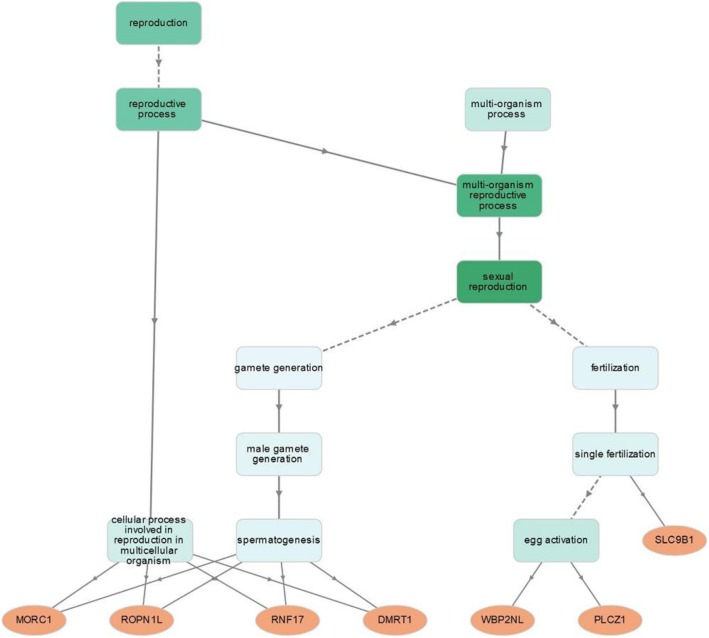
BACKGROUND: Recent human transcriptomic analyses revealed a very large number of testis-enriched genes, many of which are involved in spermatogenesis. This comprehensive transcriptomic data lead us to the question whether positive selection was a decisive force influencing the evolution and variability of testis-enriched genes in humans. We used two methodological approaches to detect different levels of positive selection, namely episodic positive diversifying selection (i.e., past selection) in the human lineage within primate phylogeny, potentially driven by sperm competition, and recent positive directional selection in contemporary human populations, which would indicate adaptation to different environments. RESULTS: In the human lineage (after correction for multiple testing) we found that only the gene TULP2, for which no functional data are yet available, is subject to episodic positive diversifying selection. Using less stringent statistical criteria (uncorrected p-values), also the gene SPATA16, which has a pivotal role in male fertility and for which episodes of adaptive evolution have been suggested, also displays a putative signal of diversifying selection in the human branch. At the same time, we found evidence for recent positive directional selection acting on several human testis-enriched genes (MORC1, SLC9B1, ROPN1L, DMRT1, PLCZ1, RNF17, FAM71D and WBP2NL) that play important roles in human spermatogenesis and fertilization. Most of these genes are population-specifically under positive selection. CONCLUSION: Episodic diversifying selection, possibly driven by sperm competition, was not an important force driving the evolution of testis-enriched genes in the human lineage. Population-specific, recent positive directional selection suggests an adaptation of male reproductive genes to different environmental conditions. Positive selection acts on eQTLS and sQTLs, indicating selective effects on important gene regulatory functions. In particular, the transcriptional diversity regulated by sQTLs in testis-enriched genes may be important for spermatocytes to respond to environmental and physiological stress.
Overview
The claims and statistics of this paper haven’t been checked yet.
Free: it reads the open-access text and checks the first 5 claims that cite a source we can check. Create a free account to check every claim.
Integrity signals
Registry
Cites
Statistics
Figures
Verification
Claims the paper makes
The claims and statistics of this paper haven’t been checked yet.
Free: it reads the open-access text and checks the first 5 claims that cite a source we can check. Create a free account to check every claim.
Claims other papers make about this one
Each is checked against this paper’s own text: does it say what the citing paper says it does?
The source backs part of the claim, not all of it — or backs it for a different population, condition or comparison.
In the citing paper
“Genes that provide even a minimal adaptive advantage can be rapidly selected, especially in small populations or those exposed to environmental stressors.”
From Origin and Evolution of Genes in Eukaryotes: Mechanisms, Dynamics, and Functional Implications (2025) · cites this paper as [59]
Experimental — accuracy not yet measuredThe source backs part of the claim, not all of it — or backs it for a different population, condition or comparison.
In the citing paper
“Selective pressure is one of the primary drivers of gene fixation.”
From Origin and Evolution of Genes in Eukaryotes: Mechanisms, Dynamics, and Functional Implications (2025) · cites this paper as [59]
Experimental — accuracy not yet measuredThe cited source says what the claim attributes to it.
In the citing paper
“Positive selection promotes the rapid expansion of genes that improve the fitness of the organism [59,60].”
From Origin and Evolution of Genes in Eukaryotes: Mechanisms, Dynamics, and Functional Implications (2025) · cites this paper as [59]
Self-check
Percentages, sums and reported differences re-computed from the paper’s own numbers.
The self-check needs the paper’s full text.
Citations
Cites
ESTIMATING F -STATISTICS FOR THE ANALYSIS OF POPULATION STRUCTURE
Weir, B. S., & Cockerham, C. C. (1984) · Evolution · doi:10.1111/j.1558-5646.1984.tb05657.x · Cited by 19,066 · cited 1×
“Pairwise FST were calculated for each SNP under positive selection using the Weir & Cockerham FST calculation [42], which is implemented in VCFtool v0.”
MethodThe variant call format and VCFtools
Danecek, P., Auton, A., Abecasis, G., Albers, C. A., Banks, E., DePristo, M. A., Handsaker, R. E., Lunter, G., Marth, G. T., Sherry, S. T., et al. (2011) · Bioinformatics · doi:10.1093/bioinformatics/btr330 · Cited by 16,200
Tissue-based map of the human proteome
Uhlén, M., Fagerberg, L., Hallström, B. M., Lindskog, C., Oksvold, P., Mardinoglu, A., Sivertsson, Å., Kampf, C., Sjöstedt, E., Asplund, A., et al. (2015) · Science · doi:10.1126/science.1260419 · Cited by 15,286
PAML 4: Phylogenetic Analysis by Maximum Likelihood
Yang, Z. (2007) · Molecular Biology and Evolution · doi:10.1093/molbev/msm088 · Cited by 13,879
Second-generation PLINK: rising to the challenge of larger and richer datasets
Chang, C. C., Chow, C. C., Tellier, L. C., Vattikuti, S., Purcell, S. M., & Lee, J. J. (2015) · Gigascience · doi:10.1186/s13742-015-0047-8 · Cited by 12,709
MUSCLE: a multiple sequence alignment method with reduced time and space complexity
Edgar, R. C. (2004) · BMC Bioinformatics · doi:10.1186/1471-2105-5-113 · Cited by 8,970
The Genotype-Tissue Expression (GTEx) pilot analysis: Multitissue gene regulation in humans
The GTEx Consortium, Ardlie, K. G., Deluca, D. S., Segrè, A. V., Sullivan, T. J., Young, T. R., Gelfand, E. T., Trowbridge, C. A., Maller, J. B., Tukiainen, T., et al. (2015) · Science · doi:10.1126/science.1262110 · Cited by 5,062
Mapping identifiers for the integration of genomic datasets with the R/Bioconductor package biomaRt
Durinck, S., Spellman, P. T., Birney, E., & Huber, W. (2009) · Nature Protocols · doi:10.1038/nprot.2009.97 · Cited by 4,197
AliView: a fast and lightweight alignment viewer and editor for large datasets
Larsson, A. (2014) · Bioinformatics · doi:10.1093/bioinformatics/btu531 · Cited by 3,640
A Map of Recent Positive Selection in the Human Genome
Voight, B. F., Kudaravalli, S., Wen, X., & Pritchard, J. K. (2006) · PLoS Biology · doi:10.1371/journal.pbio.0040072 · Cited by 2,893
Cited by
Christensen, K. A., Rondeau, E. B., Minkley, D. R., Sakhrani, D., Biagi, C. A., Flores, A., Withler, R. E., Pavey, S. A., Beacham, T. D., Godin, T., et al. (2020) · PLoS ONE · doi:10.1371/journal.pone.0240935 · Cited by 34
Genetic Affinities and Adaptation of the South-West Coast Populations of India
Kumar, L., Chowdhari, A., Sequeira, J. J., Mustak, M. S., Banerjee, M., & Kumarasamy Thangaraj, K. (2023) · Genome Biology and Evolution · doi:10.1093/gbe/evad225 · Cited by 17
Origin and Evolution of Genes in Eukaryotes: Mechanisms, Dynamics, and Functional Implications
Saccone, S., Brancato, D., Bruno, F., Coniglio, E., Sturiale, V., & Federico, C. (2025) · Genes · doi:10.3390/genes16060702 · Cited by 17
“Positive selection promotes the rapid expansion of genes that improve the fitness of the organism [59,60].”
Wang, H., Iida‐Norita, R., Mashiko, D., Pham, A. H., Miyata, H., & Ikawa, M. (2024) · PLoS Genetics · doi:10.1371/journal.pgen.1011337 · Cited by 15
“GARINs are all conserved in humans and GARIN2 is found under positive selection in Europeans [42].”
BackgroundInterplay of RNA m6A Modification-Related Geneset in Pan-Cancer
Zhang, B., Hao, Y., Liu, H., Wu, J., Lu, L., Wang, X., Bajpai, A. K., & Yang, X. (2024) · Biomedicines · doi:10.3390/biomedicines12102211 · Cited by 14
“In addition, we gather clinical information, mutation data, and miRNA expression data for these 28 types of cancer from the TCGA database [47,48].”
Metadata
- Authors
- Schaschl, H., & Wallner, B.
- Affiliations
- University of Vienna (AT)
- Corresponding author
- Schaschl, Helmut
- Venue
- BMC Evolutionary Biology
- Published
- 2020-02-13
- Volume
- 20
- Issue
- 1
- Pages
- 27-27
- ISSN
- 1471-2148 (ISSN-L)
- PMC
- PMC7020506
- OpenAlex
- W3012684880
- Cited by
- 24
- References
- 76
- Citations by year
- 2026: 3 · 2025: 1 · 2024: 3 · 2023: 12 · 2022: 1 · 2021: 2 · 2020: 2
- FWCI
- 2.64
- Type
- journal article
- Language
- en
- Open access
- gold
- doi.org
- Licence
- cc-by
- creativecommons.org/licenses/by/4.0/ (tdm)
- creativecommons.org/licenses/by/4.0/ (vor)
- Locations
- BMC Evolutionary Biology (publishedVersion, cc-by)
- PubMed Central (publishedVersion, cc-by)
- PubMed (publishedVersion)
- Phaidra (Universität Wien) (submittedVersion, cc-by-nc-nd)
- DOAJ (DOAJ: Directory of Open Access Journals) (submittedVersion, cc-by-sa)
- Topics
- Life Sciences › Biochemistry, Genetics and Molecular Biology › Genetics › Evolution and Genetic Dynamics
- Health Sciences › Medicine › Reproductive Medicine › Sperm and Testicular Function
- Life Sciences › Biochemistry, Genetics and Molecular Biology › Genetics › Forensic and Genetic Research
- Keywords
- episodic diversifying selection, spermatogenesis, sperm competition, human adaptation, DMRT1, expression quantitative trait loci, gene regulatory evolution, primate phylogeny
- MeSH terms
- Adaptation, Physiological, Animals, Environment, Genetics, Population, Geography, Humans, Male, Phylogeny, Reproduction, Selection, Genetic, Spermatogenesis, Testis, Evolution, Molecular, Polymorphism, Single Nucleotide, Gene Expression Profiling, Seminal Plasma Proteins, Transcriptome, Gene-Environment Interaction
About these checks
Registry, retraction, Cites and statistics results are computed, not judged, with one exception: a printed reference that no index lists is read once by a model before it counts as a citation error. Claims are extracted by a model and kept only when their quote appears verbatim in the text; each cited source is then checked, with a model’s help, for whether it says what the claim relies on. Those verdicts can be wrong — read the claim’s quote and the cited source before relying on one.
Statistics and arithmetic are recomputed, not judged.
Confidence bands are shown only for fields calibrated on our annotated test set. None is calibrated yet, so no band is shown.
What counts as a claim ›How we measure confidence ›How we check this ›
Are you an author, or do you see a problem with this page? Request a review
How to cite
Cite CoChat for the checks on this page, and the paper for its own findings.
- This page
- CoChat. (2026). Citation check: Population-specific, recent positive directional selection suggests adaptation of human male reproductive genes to different environmental conditions. https://app.cochat.ai/papers/10.1186/s12862-019-1575-0
- The paper
- Schaschl, H., & Wallner, B. (2020). Population-specific, recent positive directional selection suggests adaptation of human male reproductive genes to different environmental conditions. BMC Evolutionary Biology. https://doi.org/10.1186/s12862-019-1575-0
Data sources
Bibliographic data: Semantic Scholar, OpenAlex, Crossref.
Contains information from the Semantic Scholar Academic Graph Datasets, made available under the ODC Attribution License (ODC-BY 1.0).
Semantic Scholar’s data is described in: Kinney, R., et al. (2023). The Semantic Scholar Open Data Platform. arXiv:2301.10140.
