

Revised time estimation of the ancestral human chromosome 2 fusion
Open accessThe DOI matches its Crossref record; 40 of the 40 references it cites were found in a registry or an index; 7 of the 15 sources its claims cite were checked for support.
Abstract
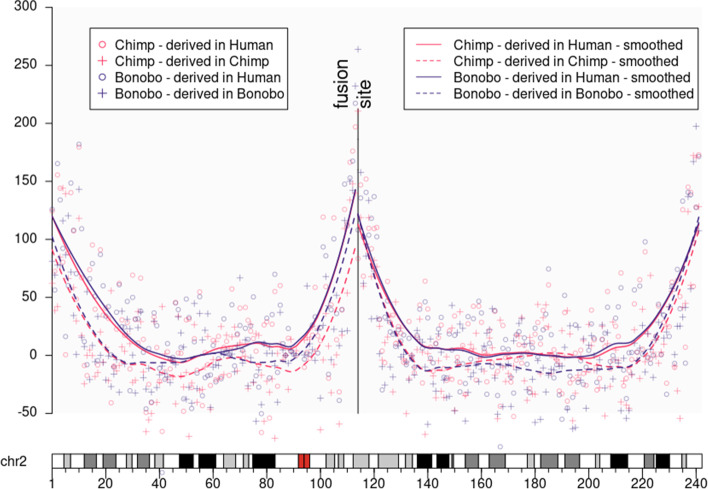
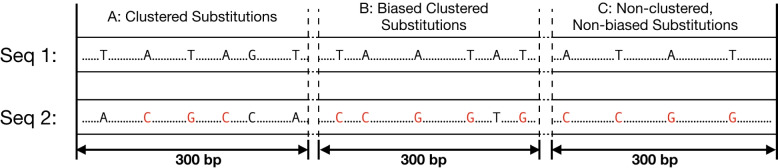
The reduction of the chromosome number from 48 in the Great Apes to 46 in modern humans is thought to result from the end-to-end fusion of two ancestral non-human primate chromosomes forming the human chromosome 2 (HSA2). Genomic signatures of this event are the presence of inverted telomeric repeats at the HSA2 fusion site and a block of degenerate satellite sequences that mark the remnants of the ancestral centromere. By analyzing the enrichment of these substitutions around the fusion site of HSA2 we estimated its formation time at 0.9 Mya with a 95% confidence interval of 0.4-1.5 Mya.
Overview
CoChat Summary
## TL;DR
The paper revises the estimated time of the ancestral human chromosome 2 fusion using an improved computation of UBCS statistics and reports a fusion date of about 0.9 Mya with a 95% confidence interval of 0.4–1.5 Mya. It also argues that the same UBCS framework can approximate evolutionary distances among Great Apes.
## Key findings
- Using chimpanzee-human comparisons around the HSA2 fusion site, the revised fusion date is estimated at ~0.9 Mya (95% CI: 0.4–1.5 Mya).
- Applying the same procedure to bonobo-human data gave 0.67 Mya (95% CI: 0–1.3 Mya); the authors note this is lower than expected and may reflect bonobo genome assembly quality.
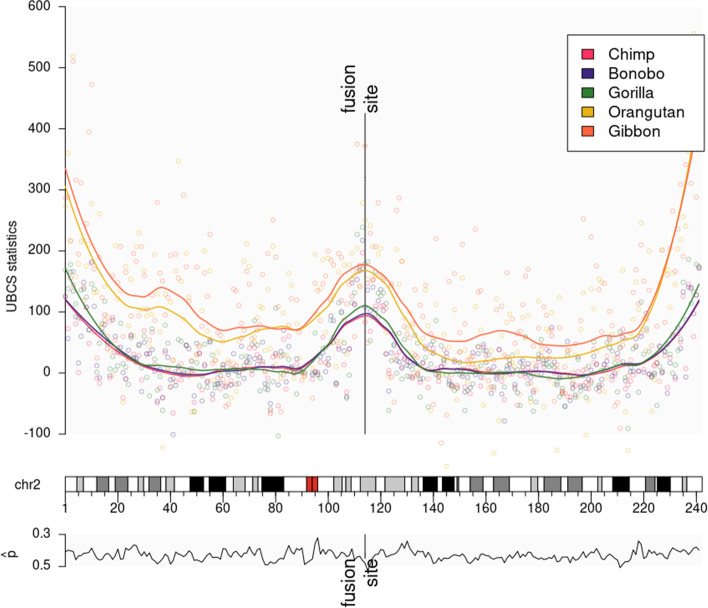
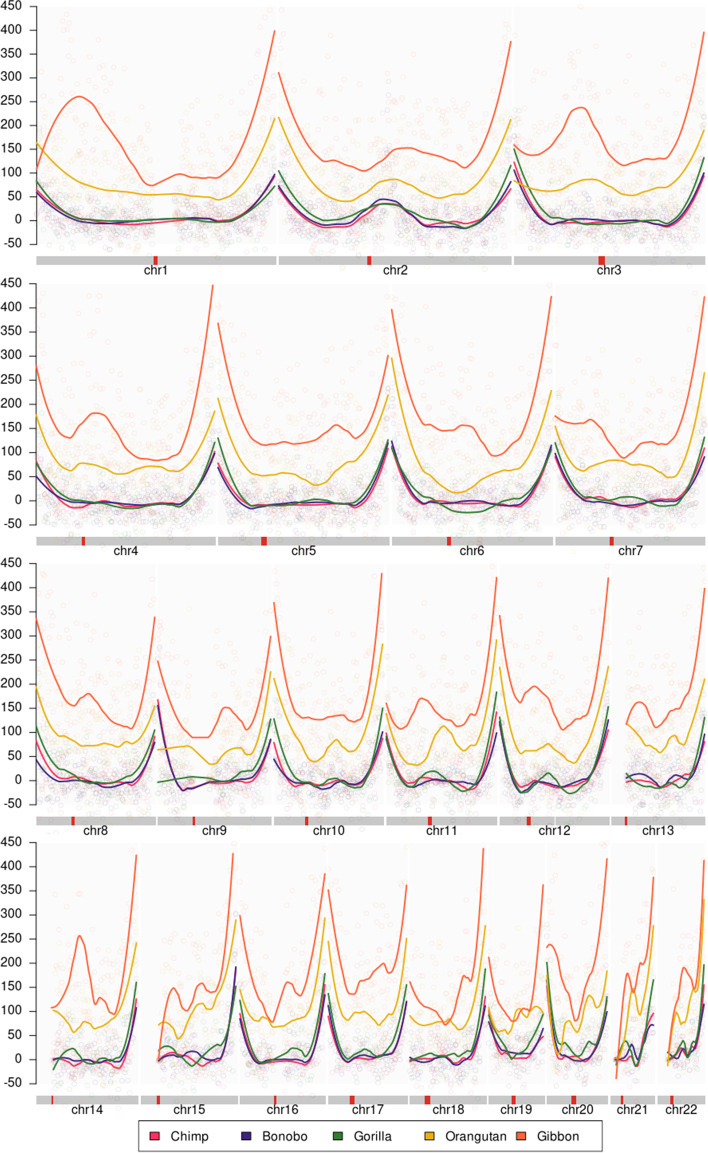
- The UBCS statistic is reported to be monotonic with evolutionary distance across the five species analyzed: human, chimpanzee, bonobo, gorilla, orangutan, and gibbon.
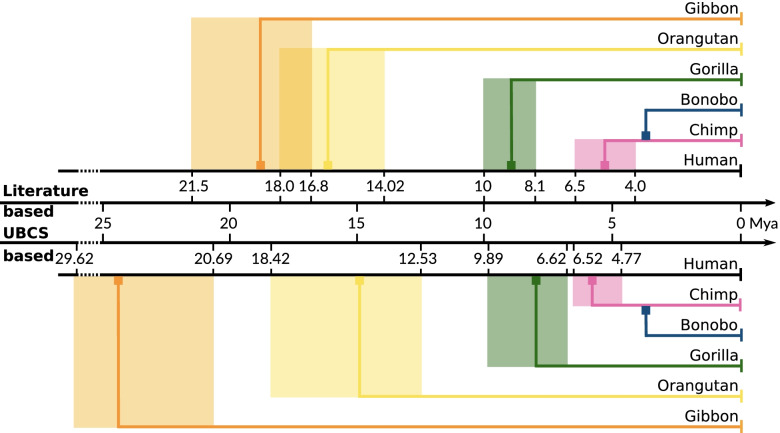
- Using the UBCS proportion framework, the paper estimates speciation times of chimpanzee/bonobo close to each other, and for other apes: gorilla 6.6–9.9 Mya, orangutan 12.5–18.4 Mya, gibbon 20.7–29.6 Mya.
## Methods
- The study uses modern human and Great Ape genomes downloaded from the UCSC Genome Browser, with analyses implemented in Python/R and orchestrated via Snakemake.
- It identifies single-nucleotide differences by reciprocal best alignments, filters them using an 11-bp window around each SND, and classifies substitutions as derived in target/query or inconclusive; A/T to C/G changes are treated as biased substitutions.
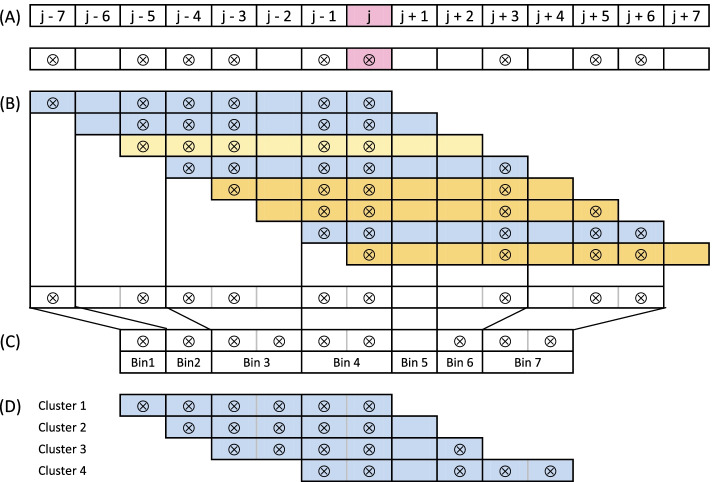
- The authors develop an enhanced algorithm for expected BCS counting using bin compression, dynamic programming, and inclusion-exclusion, then use UBCS proportions plus bootstrap confidence intervals (1000 resamples) to estimate fusion and speciation times.
## Limitations
- The authors state that the bonobo result may be distorted by the quality of the bonobo genome assembly.
- They note that the original Dreszer et al. approach made assumptions that are violated in the data, and that their own estimates for more distant ape divergences are less robust; this is stated in the paper.
- Evident from the text: the fusion-time method relies on a fixed human-chimpanzee split at 6 Mya and on rescaling assumptions for chimpanzee telomeric regions, so the estimate is model-dependent.
Model-written summary. Check it against the paper before relying on it.
Integrity signals
Registry
Cites
Statistics
Figures
Verification
Claims the paper makes
6 Valid · 2 Not valid · 3 Not checked · 16 Own results and interpretations
The cited sources support only part of this claim — read each source’s verdict below.
In the paper
“By analyzing the enrichment of these substitutions around the fusion site of HSA2 we estimated its formation time at 0.9 Mya with a 95% confidence interval of 0.4-1.5 Mya.”
- Also stated in: § Revised HSA2 fusion date · hedged
“we have re-estimated the ancestral fusion date using the comparisons between the chimpanzee and modern human genomes to approximately 0.9 Mya with a 95% confidence interval of 0.4 - 1.5 Mya.”
§ Revised time estimation of the ancestral human chromosome 2 fusion > Abstract > Results
What the sources say
- Partly supportedcites [11] Dreszer TR Wall GD Haussler D Pollard KS Biased clustered substitutions in the human genome: the footprints of male-driven biased gene conversion Genome Res. 2007 17 10 1420 30 10.1101/gr.6395807 17785536 PMC1987345 sourceExperimental — accuracy not yet measured
The ‘Dating the fusion of chromosome 2’ section confirms that the authors estimated the fusion date by comparing the human fusion-region UBCS peak with orthologous chimpanzee regions. But ‘Human chromosome 2 fusion retains bias’ reports 0.74 Mya with a 95% confidence interval of 0–2.81 Mya, not 0.9 Mya (0.4–1.5 Mya). (LLM, conf=0.90)
hedged- Asserted: passes — The authors put it forward as true.
- Checkable: passes — It can be checked against evidence.
- Load-bearing: passes — The paper’s conclusions depend on it.
- Based: passes — The paper gives a reason why it holds.
- Rests on 2 assumptions not shown here.
- Also stated in: § Revised HSA2 fusion date · hedged
The sources with a verdict support this claim; the rest weren’t checked yet, have no full text we could read, or their verdicts aren’t rated yet.
In the paper
“since the chimpanzee chromosomes 2A and 2B are capped with hyper-expanded segmental duplications and tandem repeats (StSats) not existing in the human genome [8, 40], we cannot measure the magnitude of the accumulation of BCS in those fragments comparing to the human reference.”
§ Revised time estimation of the ancestral human chromosome 2 fusion > Methods > UBCS based estimation of the fusion time
What the sources say
- Not checked — no full text of the sourcecites [8] Cheng Z Ventura M She X Khaitovich P Graves T Osoegawa K A genome-wide comparison of recent chimpanzee and human segmental duplications Nature. 2005 437 7055 88 93 10.1038/nature04000 16136132 source
- Supportedcites [40] Ventura M Catacchio CR Sajjadian S Vives L Sudmant PH Marques-Bonet T The evolution of African great ape subtelomeric heterochromatin and the fusion of human chromosome 2 Genome Res. 2012 22 6 1036 49 10.1101/gr.136556.111 22419167 PMC3371704 source
The Results section (“Subtelomeric cap distribution among gorilla and chimpanzee chromosomes”; page not provided) reports StSat caps on the short arms of chimpanzee chromosomes IIp and IIq. The Discussion (page not provided) describes chimpanzee caps as hyperexpanded segmental duplications interspersed with StSat and says this subterminal heterochromatin is absent from humans. The finding concerns the caps, not an absence of every constituent sequence from the human genome. (LLM, conf=0.91)
plain- Asserted: passes — The authors put it forward as true.
- Checkable: passes — It can be checked against evidence.
- Load-bearing: passes — The paper’s conclusions depend on it.
- Based: passes — The paper gives a reason why it holds.
Every source the paper cites for this claim was checked and supports it.
In the paper
“This assumption is clearly violated in the data and therefore we have devised a different estimation procedure.”
§ Revised time estimation of the ancestral human chromosome 2 fusion > Methods > UBCS based estimation of the fusion time
What the sources say
- Supportedcites [11] Dreszer TR Wall GD Haussler D Pollard KS Biased clustered substitutions in the human genome: the footprints of male-driven biased gene conversion Genome Res. 2007 17 10 1420 30 10.1101/gr.6395807 17785536 PMC1987345 source
In “Dating the fusion of chromosome 2” (page unavailable), Dreszer et al. use the relative heights of chimpanzee telomeric UBCS peaks to predict those on corresponding human chromosomes, reflecting the similarity assumption attributed to them. The assertion that the citing authors’ data violate that assumption is their own assessment, not a finding attributed to Dreszer et al. (LLM, conf=0.87)
boosted- Asserted: passes — The authors put it forward as true.
- Checkable: passes — It can be checked against evidence.
- Load-bearing: passes — The paper’s conclusions depend on it.
- Based: passes — The paper gives a reason why it holds.
- Supported
Every source the paper cites for this claim was checked and supports it.
In the paper
“These findings corroborated the theory that the Denisovans (and presumably also the Neandertals) had shared the fused HSA2 with modern humans.”
§ Revised time estimation of the ancestral human chromosome 2 fusion > Introduction > When did the fusion event occur? Time estimation approaches These genomic observations have raised questions about the time scope when this gross chromosomal aberration arose. Dreszer et al. [11] have proposed a time estimation method based on the analysis of the fixed substitutions in the human and chimpanzee genomes since their divergence from the common ancestor. The authors have referred to the biased gene conversions (BGCs) occurring due to the mutagenic recombination events [12] and the associated DNA repair processes to favor strong (GC) versus weak (AT) nucleotide pairs at the non-Watson-Crick heterozygous sites in heteroduplex DNA [13]. Importantly, it has been broadly discussed that BGC may be one of the main evolutionary mechanism [14, 15]. However, Dreszer et al. observed that particularly weak-to-strong (AT to GC) substitutions over-represented locally, e.g. clustering densely near the telomeres of the autosomal chromosomes. Furthermore, using the Unexpected Bias Clustered Substitutions (UBCS) statistics measuring the bias towards weak-to-strong substitutions among the clustered substitutions, a similar over-representation for human and chimpanzee orthologous regions was detected. This observation suggested the existence of a stable evolutionary force that had led to the formation of the biased clusters of substitutions. As expected, around the ancestral HSA2 fusion site, an additional local maximum of the UBCS statistic values was determined. To approximate the time of the fusion event Dreszer et al. assumed that: (i) human-chimpanzee split had occurred 6 Mya and (ii) the rate of the UBCS accumulation is constant. Based on that, they compared the reduction of the bias in the regions near the fusion site with the orthologous telomeric sites of the chimpanzee chromosomes 2A and 2B. As a result, they estimated the fusion time at 0.74 Mya with a 95% confidence interval 0-2.81 Mya. A phylogenetic analysis of the SVA elements (i.e. composite repetitive elements named after its main components, SINEs, VNTRs and Alus) was performed by Wang et al. [16]. The authors showed that within this hominid-specific retroposone family, both SVA-E and the SVA-F subfamilies are restricted to the human lineage. Additionally, based upon the nucleotide divergence, they estimated the expansion time of these subfamilies at 3.5 Mya (with a GC content-dependent range of 2.5-4.5 Mya), which provided a lower bound of the human-chimpanzee speciation event.
What the sources say
- Supportedcites [17] Meyer M Kircher M Gansauge MT Li H Racimo F Mallick S A high-coverage genome sequence from an archaic Denisovan individual Science. 2012 338 6104 222 6 10.1126/science.1224344 22936568 PMC3617501 source
The “Denisovan genomic features” section identifies human chromosome 2 as the product of a fusion and reports joined-repeat fragments in the Denisovan genome. It concludes that Denisovans and modern humans, and presumably Neandertals, shared a 46-chromosome karyotype. No page number is provided in our copy. (LLM, conf=0.93)
boostedstates an association- Asserted: passes — The authors put it forward as true.
- Checkable: passes — It can be checked against evidence.
- Load-bearing: passes — The paper’s conclusions depend on it.
- Based: passes — The paper gives a reason why it holds.
- Supported
A result the paper reports from its own data — it cites no other source for it, so there is none to check. The quote shows it is in the paper.
In the paper
“The proximal side maintains full compatibility between species, while on the distal side there is a double difference between species.”
§ Revised time estimation of the ancestral human chromosome 2 fusion > Results > Revised HSA2 fusion date
plainstates an association- Asserted: passes — The authors put it forward as true.
- Checkable: passes — It can be checked against evidence.
- Load-bearing: passes — The paper’s conclusions depend on it.
- Based: passes — The paper gives a reason why it holds.
10 more claims
Create a free account to see all 27 claims and to verify the 3 references still open.
- It may state two separate claims as one. 6
- The quote only partly states this claim. 1
- Probably not a substantial claim. 6
Self-check
Percentages, sums and reported differences re-computed from the paper’s own numbers.
Each contradiction between two passages listed here was confirmed by an independent check.
Rated minor: it would not touch a result — a value no result rests on, a p-value that stays on the same side of the significance level, or a conflict that is clerical, resolved elsewhere in the paper, or outside its own findings.
In the paper
§ Revised time estimation of the ancestral human chromosome 2 fusion > Results > Revised HSA2 fusion date
“Nonetheless, a time point was estimated as 0.67 Mya with 95% confidence interval 0-1.3 Mya.”
§ Revised time estimation of the ancestral human chromosome 2 fusion > Discussion
“Interestingly, our results suggest that the fusion might have occurred more recently, approximately 0.6 Mya.”
Citations
Cites
Fast and accurate short read alignment with Burrows-Wheeler transform
Li, H., & Durbin, R. (2009) · Bioinformatics · doi:10.1093/bioinformatics/btp324 · Cited by 58,607
The Human Genome Browser at UCSC
Kent, W. J., Sugnet, C. W., Furey, T. S., Roskin, K. M., Pringle, T. H., Zahler, A. M., & Haussler, A. D. (2002) · Genome Research · doi:10.1101/gr.229102 · Cited by 10,400 · cited 1×
“Using the UCSC Browser [29], we have observed that the genomic region distal to the HSA2 fusion site maps well to the near-telomeric region of chimpanzee chromosome 2B, and thus the corresponding UBCS statistics has high values (Fig.”
A draft sequence of the Neandertal genome
Green, R. E., Krause, J., Briggs, A. W., Maricic, T., Stenzel, U., Kircher, M., Patterson, N., Li, H., Zhai, W., Fritz, M. H.-Y., et al. (2010) · Science · doi:10.1126/science.1188021 · Cited by 4,318 · cited 1×
“[36] who presented a draft sequence of the Neandertal genome.”
Snakemake—a scalable bioinformatics workflow engine
Köster, J., & Rahmann, S. (2012) · Bioinformatics · doi:10.1093/bioinformatics/bts480 · Cited by 2,780
Genetic history of an archaic hominin group from Denisova Cave in Siberia
Reich, D., Green, R. E., Kircher, M., Krause, J., Patterson, N., Durand, E. Y., Viola, B., Briggs, A. W., Stenzel, U., Johnson, P. L. F., et al. (2010) · Nature · doi:10.1038/nature09710 · Cited by 1,991 · cited 1×
“More recently, mapping the sequenced reads from modern humans and ancient Hominini (French, Han, Papuan, San, Yoruba, Neandertal, Denisovan) to the chimpanzee reference sequence (pantro2 version) facilitated more precise speciation events dating [34].”
A high-coverage genome sequence from an archaic denisovan individual
Meyer, M., Kircher, M., Gansauge, M.-T., Li, H., Racimo, F., Mallick, S., Schraiber, J. G., Jay, F., Prüfer, K., de Filippo, C., et al. (2012) · Science · doi:10.1126/science.1224344 · Cited by 1,967 · cited 1×
“In support of these estimations, using the next generation sequencing (NGS) with a high read coverage, Meyer et al. [17] have reconstructed a genome of the Denisovans , an extinct relative of the Neandertals , and identified an evidence of the HSA2 fusion event.”
Insights into hominid evolution from the gorilla genome sequence
Scally, A., Dutheil, J. Y., Hillier, L. W., Jordan, G. E., Goodhead, I., Herrero, J., Hobolth, A., Lappalainen, T., Mailund, T., Marques-Bonet, T., et al. (2012) · Nature · doi:10.1038/nature10842 · Cited by 753 · cited 1×
“[26] based on assembly and analysis of a genome sequence and fossil evidence places the specialization event at approximately 10 Mya.”
Biased gene conversion and the evolution of mammalian genomic landscapes
Duret, L., & Galtier, N. (2009) · Annual Review of Genomics and Human Genetics · doi:10.1146/annurev-genom-082908-150001 · Cited by 737 · cited 1×
“Importantly, it has been broadly discussed that BGC may be one of the main evolutionary mechanism [14, 15].”
Systems biology and multi-omics integration: viewpoints from the metabolomics research community
Pinu, F. R., Beale, D. J., Paten, A. M., Kouremenos, K., Swarup, S., Schirra, H. J., & Wishart, D. (2019) · Metabolites · doi:10.3390/metabo9040076 · Cited by 723 · cited 1×
“A remedy to that could be to use multi-layer models that would bring together various types of genomic and other -omic data [32, 33].”
The Origin of Man: A Chromosomal Pictorial Legacy
Yunis, J. J., & Prakash, O. (1982) · Science · doi:10.1126/science.7063861 · Cited by 672 · cited 1×
“The ancestral chromosomal fusion, creating the human chromosome 2 (HSA2) and reduction of the chromosome number from 48 in the Great Apes to 46 in modern humans was described nearly four decades ago [1–3].”
Cited by
Genomic inference of a severe human bottleneck during the Early to Middle Pleistocene transition
Hu, W., Hao, Z.-Q., Du, P., Vincenzo, F. D., Manzi, G., Cui, J., Fu, Y., Pan, Y.-H., & Li, H. (2023) · Science · doi:10.1126/science.abq7487 · Cited by 202
Mackintosh, A., Vila, R., Martin, S. H., Setter, D., & Lohse, K. (2023) · Molecular Ecology · doi:10.1111/mec.17146 · Cited by 31
“For example, chromosome 2 of the human genome is the product of a fusion that happened approximately 900 kya (Poszewiecka et al., 2022), corresponding to ~ 3.6 N e generations in the past.”
InfluentialThe evolving three-dimensional landscape of human adaptation
Zeller, E., & Timmermann, A. (2024) · Science Advances · doi:10.1126/sciadv.adq3613 · Cited by 15
“Comparing the difference between pre-and post-MPT hominins, or potentially pre-and post-chromosome 2 fusion species ( 38 ), we can clearly see an increasing tolerance toward higher terrain roughness, increased biome diversity, lower temperatures, and higher rainfall extremes (fig.”
Large Inversions Shape Diversification and Genome Evolution in Common Quails
Ravagni, S., Montero‐Mendieta, S., Leonard, J. A., Webster, M. T., Christmas, M. J., Bunikis, I., Rodríguez‐Teijeiro, J. D., Sánchez-Donoso, I., & Vilà, C. (2025) · Molecular Ecology · doi:10.1111/mec.17740 · Cited by 5
“From the fusion event in human chromosome 2, where ancestral chromosomes remain distinct in other primates (Yunis and Prakash 1982; IJdo et al. 1991; Poszewiecka et al. 2022), to poly-ploidy in plant species that fosters genetic redundancy and adaptation (Adams and Wendel 2005; Hufton and…”
Poszewiecka, B., Gogolewski, K., Karolak, J. A., Stankiewicz, P., & Gambin, A. (2023) · Genome biology · doi:10.1186/s13059-023-03022-8 · Cited by 5
“Most recently, by re-analysing the enrichment of weak-to-strong (AT to GC) substitutions around the fusion site, we dated its formation at ~0.9 Mya with an upper boundary of ~1.5 Mya [58].”
BackgroundInfluentialSelf-citationGenome architecture evolution in an invasive copepod species complex
Du, Z., Wirtz, J., Zhou, Y., Jenstead, A., Opgenorth, T. A., Puls, A., Meyer, C. A., Gelembiuk, G. W., & Lee, C. E. (2025) · Nature Communications · doi:10.1038/s41467-025-65292-z · Cited by 12
“Version 1:”
Jiang, X., Zhang, L., Yang, Z., Yang, X., Ma, K., Yoo, D., Lu, Y., Zhang, S., Chen, J., Nie, Y., et al. (2024) · bioRxiv (Cold Spring Harbor Laboratory) · doi:10.1101/2024.12.12.628057 · Cited by 4
Enamel nanocrystal misorientation increased with meat-eating and agriculture
Gilbert, P. U. P. A., Green, D. R., Mahoney, P., Guatelli‐Steinberg, D., McGraw, W. S., Lagan, E. M., Manthi, F. K., Muteti, S., Ndiema, E., Rozzi, F. V. R., et al. (2026) · Nature · doi:10.1038/s41586-026-10583-8 · Cited by 3
“After diverging about 4–8 million years bp from the last common ancestor with chimpanzees 27,28 , hominins began incorporating meat into their diet about 2.0–1.5 million years ago (Ma); humans invented agriculture around 12,000 years bp, adopted it widely in the later Holocene, and ramped up…”
InfluentialMonogenism Revisited: New Perspectives on a Classical Controversy
Grygiel, W. P., & Lizak, O. (2025) · Religions · doi:10.3390/rel16060694 · Cited by 2
Aplf/Dna2 variants drive chromosomal fission and accelerate speciation in zokors
Wan, N., Duan, Q., Cai, Z., Zhu, Z., Wang, J.-O., Tian, Y., Shen, W., Li, B., Kuang, Z., Liang, X., et al. (2025) · Science Advances · doi:10.1126/sciadv.adt2282 · Cited by 6
“The parameter R2 denotes the ratio of UBCS values for SNDs derived in M. psilurus between two specific regions: (i) the initial telomeric region and (ii) a corresponding region of identical length located several megabases away from the telomere ( 34 ).”
InfluentialYang, Z., Zhang, L., Jiang, X., Yang, X., Ma, K., Yoo, D., Lu, Y., Zhang, S., Chen, J., Nie, Y., et al. (2025) · Cell Genomics · doi:10.1016/j.xgen.2025.101079 · Cited by 11
“34 The complex repetitive structure at the fusion site, subtelomeric repetitive regions, and the inactive centromere have made it challenging to reconstruct the evolutionary history and potential functional consequences of the fusion event.”
DNA repeats: origins, conservation, and role in human disease
Rana, A. K. (2026) · Genome Instability & Disease · doi:10.1007/s42764-025-00174-8 · Cited by 1
“A more recent milestone in human chromosomal evolution occurred approximately 0.9 million years ago, with the merger of chromosomes 2 A and 2B, differentiating humans from great apes (2n = 48) (Poszewiecka et al., 2022).”
InfluentialPartitioning the genomic journey to becoming Homo sapiensPreprint
Pagani, L., Bertazzon, R., Pankratov, V., Vallini, L., Marnetto, D., Morez, A., Delbrassine, H., Carollo, F., D’Esposito, M., Granata, I., et al. (2024) · bioRxiv (Cold Spring Harbor Laboratory) · doi:10.1101/2024.12.09.627480 · Cited by 2
Evolutionary Biology and Christian Responses
Peterson, M. L., Pawl, T. J., & Brammell, B. F. (2024) · Cambridge University Press eBooks · doi:10.1017/9781009268585.005
Zhou, S., Zhou, Y., Vincenzo, F. D., et al. (2025) · bioRxiv (Cold Spring Harbor Laboratory) · doi:10.1101/2025.02.01.636025
Herrera, R. J., & Garcia‐Bertrand, R. (2025) · Elsevier eBooks · doi:10.1016/b978-0-443-28919-4.00005-2
Koncepcja pierwotnego stanu stworzenia i ontycznej kondycji praludzi w świetle relacji religia–nauka
Słomka, M., & Bała, M. (2025) · Roczniki Filozoficzne · doi:10.18290/rf25734.8
Resolution of a human chromosomal mystery: Evolutionary complexity revealed
Rogers, J. (2026) · Cell Genomics · doi:10.1016/j.xgen.2025.101135
Singh, S., Shahadab, M., Sachin, K., Pandey, R. K., Trivedi, P., Mishra, A. K., & Jha, H. C. (2026) · Mammalian Genome · doi:10.1007/s00335-026-10228-1
Korotayev, A. (2026) · World-systems evolution and global futures · doi:10.1007/978-3-032-20517-9_13 · Cited by 2
Metadata
- Authors
- Poszewiecka, B., Gogolewski, K., Stankiewicz, P., & Gambin, A.
- Affiliations
- University of Warsaw (PL)
- Baylor College of Medicine (US)
- Corresponding author
- Poszewiecka, Barbara
- Venue
- BMC Genomics
- Published
- 2022-08-25
- Volume
- 23
- Issue
- S6
- Pages
- 616-616
- ISSN
- 1471-2164 (ISSN-L)
- PMC
- PMC9413910
- OpenAlex
- W4293088715
- Cited by
- 20
- References
- 40
- Citations by year
- 2026: 5 · 2025: 8 · 2024: 4 · 2023: 3
- FWCI
- 2.06
- Type
- journal article
- Language
- en
- Open access
- gold
- doi.org
- Licence
- cc-by
- creativecommons.org/licenses/by/4.0 (tdm)
- creativecommons.org/licenses/by/4.0 (vor)
- Locations
- BMC Genomics (publishedVersion, cc-by)
- PubMed Central (publishedVersion, cc-by)
- PubMed (publishedVersion)
- DOAJ (DOAJ: Directory of Open Access Journals) (submittedVersion, cc-by-sa)
- Funders
- Narodowe Centrum Nauki (2019/33/N/ST6/03110, 2018/30/M/NZ2/00054)
- Topics
- Life Sciences › Biochemistry, Genetics and Molecular Biology › Genetics › Chromosomal and Genetic Variations
- Life Sciences › Biochemistry, Genetics and Molecular Biology › Genetics › Genomic variations and chromosomal abnormalities
- Life Sciences › Biochemistry, Genetics and Molecular Biology › Genetics › Genome Rearrangement Algorithms
- Keywords
- human chromosome 2, chromosome fusion, great apes, hominoid phylogeny, molecular clock
- MeSH terms
- Animals, Centromere, Chromosomes, Human, Humans, Hominidae, Genome, Evolution, Molecular
About these checks
Registry, retraction, Cites and statistics results are computed, not judged, with one exception: a printed reference that no index lists is read once by a model before it counts as a citation error. Claims are extracted by a model and kept only when their quote appears verbatim in the text; each cited source is then checked, with a model’s help, for whether it says what the claim relies on. Those verdicts can be wrong — read the claim’s quote and the cited source before relying on one.
The claim verdicts this report counts are experimental: their accuracy is not yet measured.
A language model drew the claims from the paper on 2026-10-10, under version 3 of the claim definition (model deepseek-v4.1-flash, prompt extract-v3).
A second model labelled each claim on 2026-10-10 (model jev-1.13-20260917, definition revision gold-guideline-v0.2).
Cited sources are checked with a language model’s help (gpt-6-sol).
Statistics and arithmetic are recomputed, not judged.
Confidence bands are shown only for fields calibrated on our annotated test set. None is calibrated yet, so no band is shown.
What counts as a claim ›How we measure confidence ›How we check this ›
Are you an author, or do you see a problem with this page? Request a review
Data sources
Bibliographic data: Semantic Scholar, OpenAlex, Crossref.
Contains information from the Semantic Scholar Academic Graph Datasets, made available under the ODC Attribution License (ODC-BY 1.0).
Semantic Scholar’s data is described in: Kinney, R., et al. (2023). The Semantic Scholar Open Data Platform. arXiv:2301.10140.
