

Selection of Streptomyces against soil borne fungal pathogens by a standardized dual culture assay and evaluation of their effects on seed germination and plant growth
Open accessThe DOI matches its Crossref record; 59 of the 60 references it cites were found in a registry or an index.
Abstract
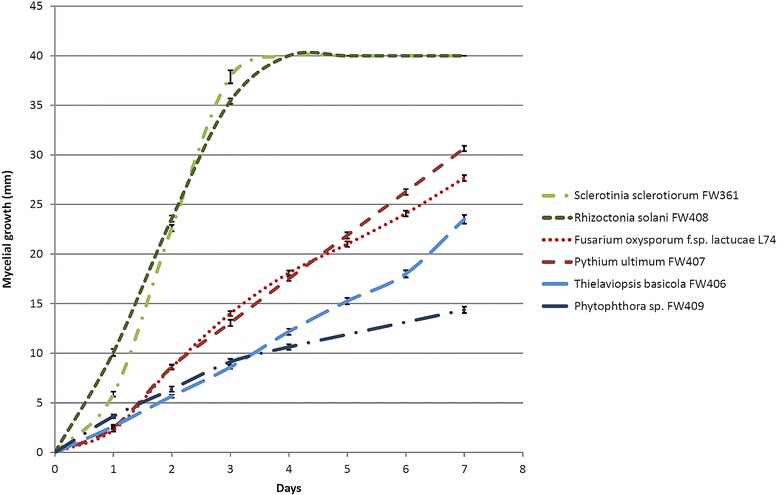
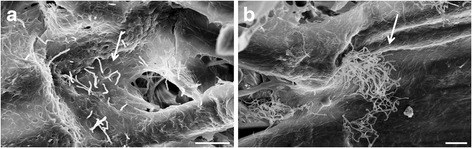
BACKGROUND: In the search for new natural resources for crop protection, streptomycetes are gaining interest in agriculture as plant growth promoting bacteria and/or biological control agents. Because of their peculiar life cycle, in which the production of secondary metabolites is synchronized with the development of aerial hyphae and sporulation, the commonly used methods to screen for bacterial antagonists need to be adapted. RESULTS: The dual culture assay was standardized in terms of inoculation timing of Streptomyces antagonist and pathogen, and growth rate of different fungal pathogens. In case of fast-growing fungi, inoculation of the antagonist 2 or 3 days prior to the pathogen resulted in significantly stronger inhibition of mycelium growth. One hundred and thirty Streptomyces strains were evaluated against six destructive soil borne pathogens. The activity of strains varied from broad-spectrum to highly specific inhibition of individual pathogens. All strains inhibited at least one tested pathogen. Three strains, which combined the largest broad-spectrum with the highest inhibition activity, were selected for further characterization with four vegetable species. All of them were able to colonize seed surface of all tested vegetable crops. They mostly improved radicle and hypocotyl growth in vitro, although no statistically significant enhancement of biomass weight was observed in vivo. Occasionally, transient negative effects on germination and plant growth were observed. CONCLUSIONS: The adapted dual culture assay allowed us to compare the inhibition of individual Streptomyces strains against six fungal soil borne pathogens. The best selected strains were able to colonize the four vegetable crops and have a potential to be developed into biocontrol products. Although they occasionally negatively influenced plant growth, these effects did not persist during the further development. Additional in vivo studies are needed to confirm their potential as biological control or plant growth promoting agents.
Overview
The claims and statistics of this paper haven’t been checked yet.
Free: it reads the open-access text and checks the first 5 claims that cite a source we can check. Create a free account to check every claim.
Integrity signals
Registry
Cites
Statistics
Figures
Verification
Claims the paper makes
The claims and statistics of this paper haven’t been checked yet.
Free: it reads the open-access text and checks the first 5 claims that cite a source we can check. Create a free account to check every claim.
Self-check
Percentages, sums and reported differences re-computed from the paper’s own numbers.
The self-check needs the paper’s full text.
Citations
Cites
R: A Language and Environment for Statistical Computing
R Core Team (2025) · doi:10.32614/r.manuals · Cited by 352,181
Universal chemical assay for the detection and determination of siderophores
Schwyn, B., & Neilands, J. B. (1987) · Analytical Biochemistry · doi:10.1016/0003-2697(87)90612-9 · Cited by 6,549 · cited 1×
“After 14 days of incubation at 24 °C in the dark, the Streptomyces colony was overlaid by 15 mL of the chrome azurol S agar [59] as proposed by Pérez-Miranda et al.”
Plant-Growth-Promoting Rhizobacteria
Lugtenberg, B., & Kamilova, F. (2009) · Annual Review of Microbiology · doi:10.1146/annurev.micro.62.081307.162918 · Cited by 3,987
Berg, G. (2009) · Applied Microbiology and Biotechnology · doi:10.1007/s00253-009-2092-7 · Cited by 1,648 · cited 1×
“Biological control and PGP are two different but linked components associated with beneficial plantmicrobe interactions [38], and can share the same molecular mechanisms.”
Plant growth-promoting rhizobacteria (PGPR): their potential as antagonists and biocontrol agents
Beneduzi, A., Ambrosini, A., & Passaglia, L. M. P. (2012) · Genetics and Molecular Biology · doi:10.1590/s1415-47572012000600020 · Cited by 1,463
How many antibiotics are produced by the genus Streptomyces ?
Watve, M., Tickoo, R., Jog, M., & Bhole, B. (2001) · Archives of Microbiology · doi:10.1007/s002030100345 · Cited by 923 · cited 1×
“These observations, the ability of Streptomyces to produce a huge variety of antimicrobial secondary products [24] and their presence in soil make them promising candidates for the selection and development as plant protection products and biofertilizers.”
M OLECULAR D ETERMINANTS OF R HIZOSPHERE C OLONIZATION BY P SEUDOMONAS
Lugtenberg, B. J. J., Dekkers, L., & Bloemberg, G. V. (2001) · Annual Review of Phytopathology · doi:10.1146/annurev.phyto.39.1.461 · Cited by 804
Beneficial bacteria of agricultural importance
Babalola, O. O. (2010) · Biotechnology Letters · doi:10.1007/s10529-010-0347-0 · Cited by 781 · cited 1×
“- have been tested as BCAs, mostly studying the antagonism as the mechanism of action to suppress pathogen growth through the production of antifungal compounds [40, 45].”
Indole-3-acetic acid in plant–microbe interactions
Duca, D., Lorv, J., Patten, C. L., Rose, D., & Glick, B. R. (2014) · Antonie van Leeuwenhoek · doi:10.1007/s10482-013-0095-y · Cited by 774
Antibiotics produced by Streptomyces
de Lima Procópio, R. E., da Silva, I. R., Martins, M. K., de Azevedo, J. L., & de Araújo, J. M. (2012) · The Brazilian Journal of Infectious Diseases · doi:10.1016/j.bjid.2012.08.014 · Cited by 735 · cited 1×
“However, until now they have been exploited mostly in pharmaceutical industry for the production of antibiotics, antitumorals or immunosuppressives [47, 48].”
Research works printed but not linked: 3
- Trejo-Estrada SR Sepulveda IR Crawford DL In vitro and in vivo antagonism of Streptomyces violaceusniger YCED9 against fungal pathogens of turfgrass World J Microbiol Biotechnol 1998 14 865 72 10.1023/A:1008877224089 · doi:10.1023/a:1008877224089
- Koch E Effect of biocontrol agents on plant growth in the absence of pathogens IOBC/WPRS Bull 2001 24 81 9
- Faria JC Jelihovschi EG Allaman IB Conventinal Tukey Test 2014 Ilheus Universidade Estadual de Santa Cruz
Cited by
Items 101–118 of 118
HUYNH, N. H., Pham, T. T., NGUYEN, N. L., & Nguyen, N. N. (2022) · PLANT CELL BIOTECHNOLOGY AND MOLECULAR BIOLOGY · doi:10.56557/pcbmb/2022/v23i27-287763
Saratha, M., & Angappan, K. (2024) · Research Biotica · doi:10.54083/resbio/6.2.2024/38-45
“Further, in the peculiar actinobacterial life cycle, potential bioactive metabolite production is associated with their sporulation and it was increased during stress (Kunova et al ., 2016).”
Jo, M., An, S., Kim, D. S., Chi, W., & Park, S. (2025) · Research in Plant Disease · doi:10.5423/rpd.2025.31.1.125
Castañeda-Cisneros, Y. E., Zafra, G., Mercado-Flores, Y., Anducho-Reyes, M. Á., Ramírez-Vargas, M. D. R., & Téllez‐Jurado, A. (2025) · BIOtecnia · doi:10.18633/biotecnia.v27.2666
Noorizadeh, S., Golmohammadi, M., Farhangi, M. B., Banihashemian, S. N., Mahdavi, V., Atighi, M. R., Unc, A., & Gholamian, E. (2025) · Journal of Plant Pathology · doi:10.1007/s42161-025-02043-5
“The dual culture assay (Kunova et al. 2016) was used to examine the antifungal activity against A. alternata : actinobacteria isolates were streaked on both sides of ISP2 medium in 12 cm Petri dishes, placed 1 cm from each edge, and incubated at 28 °C for five days.”
Matveev, S., Reingold, V., Doron‐Faigenboim, A., Livne, Y., Davidovitz, M., & Ment, D. (2025) · bioRxiv (Cold Spring Harbor Laboratory) · doi:10.1101/2025.11.02.686131
Suárez, M. B., González-García, M., González-Hernández, A. I., Gómez‐Sánchez, M. Á., Andreo‐Jiménez, B., & Morales‐Corts, M. R. (2025) · SSRN Electronic Journal · doi:10.2139/ssrn.5798343
Suárez, M. B., González-García, M., González-Hernández, A. I., Gómez‐Sánchez, M. Á., Andreo‐Jiménez, B., & Morales‐Corts, M. R. (2025) · SSRN Electronic Journal · doi:10.2139/ssrn.5806867
Anh, N. P. (2017) · theses.fr (ABES) · doi:10.70675/a4c2f0acza4c7z45d3zb96ez298376028f3d
Décryptage des mécanismes impliqués dans le biocontrôle des champignons mycotoxinogènes des céréales
Pellan, L. (2020) · theses.fr (ABES) · doi:10.70675/b1fbc4f1z173az49c1za148zd59232d5359a · Cited by 3
Baimakhanova, G. B., Trenozhnikova, L. P., Tleubekova, D., GERASSIMOVA, I. N., Smirnova, I. E., ФАЙЗУЛИНА, Э. Р., Tatarkina, L. G., СПАНКУЛОВА, Г. А., & Urazova, Z. K. (2026) · МИКРОБИОЛОГИЯ ЖӘНЕ ВИРУСОЛОГИЯ · doi:10.53729/mv-as.2026.02.06
Using Recycled Glass Substrate for Seed Germination in 17 Common Coastal Dune and Maritime Plants
Allen, K. E., Hammer, T. G., & Henning, J. A. (2026) · Journal of Coastal Research · doi:10.2112/jcoastres-d-25-00037.1
Salehi, F., Hasanzadeh, N., Moslemkhani, C., Razmi, J., & Sheidaei, S. (2026) · European Journal of Plant Pathology · doi:10.1007/s10658-026-03262-x
Zaman, S. S., & Kayang, H. (2026) · Journal of Plant Diseases and Protection · doi:10.1007/s10343-026-01438-3
“In vitro antagonistic evaluation of isolated rhizobacteria against fungal pathogens was carried out by the dual culture technique following the method of Kunova et al. (2016).”
Thenappan, D. P., González-Salazar, L. Á., Gallardo‐Camarena, M. V., Martı́nez, A., Annapurna, K., & Licona‐Cassani, C. (2026) · Research Square · doi:10.21203/rs.3.rs-10030259/v1
Tumbariya, A. K., Sharma, V., Trivedi, B., Sheershwal, A., Swati, Begum, H., & Singh, S. (2026) · Journal of soil science and plant nutrition · doi:10.1007/s42729-026-03600-2
Kitwetch, B., Mukjang, N., Chromkaew, Y., Chobyen, J., Chinachanta, K., Rangseekaew, P., & ., W. P.-A. (2026) · Life · doi:10.3390/life16101699
“In a screening of 130 Streptomyces strains on four vegetable crops, the bacteria colonized the seed surface and mostly improved radicle and hypocotyl growth yet occasionally caused transient negative effects on germination [60].”
Metadata
- Authors
- Kunova, A., Bonaldi, M., Saracchi, M., Pizzatti, C., Chen, X., & Cortesi, P.
- Affiliations
- University of Milan (IT)
- Corresponding author
- Kunova, Andrea
- Venue
- BMC Microbiology
- Published
- 2016-11-09
- Volume
- 16
- Issue
- 1
- Pages
- 272-272
- ISSN
- 1471-2180 (ISSN-L)
- PMC
- PMC5103511
- OpenAlex
- W2550759246
- Cited by
- 118
- References
- 60
- Citations by year
- 2026: 14 · 2025: 13 · 2024: 8 · 2023: 16 · 2022: 17 · 2021: 19 · 2020: 7 · 2019: 14 · 2018: 4 · 2017: 6
- FWCI
- 9.35
- Type
- journal article
- Language
- en
- Open access
- gold
- doi.org
- Licence
- cc-by
- Locations
- BMC Microbiology (publishedVersion, cc-by)
- Europe PMC (PubMed Central) (publishedVersion, cc-by)
- PubMed Central (publishedVersion, cc-by)
- PubMed (publishedVersion)
- Archivio Istituzionale della Ricerca (Universita Degli Studi Di Milano) (submittedVersion, other-oa)
- Funders
- Regione Lombardia
- Topics
- Life Sciences › Agricultural and Biological Sciences › Plant Science › Plant-Microbe Interactions and Immunity
- Life Sciences › Agricultural and Biological Sciences › Plant Science › Plant Disease Management Techniques
- Life Sciences › Immunology and Microbiology › Applied Microbiology and Biotechnology › Microbial Natural Products and Biosynthesis
- Keywords
- Streptomyces, biological control, soil-borne fungal pathogens, dual culture assay, plant growth-promoting bacteria, seed germination, vegetable crops, mycelial growth inhibition, inoculation timing, biocontrol products
- MeSH terms
- Antibiosis, Fungi, Indoleacetic Acids, Plant Diseases, Seeds, Soil Microbiology, Streptomyces, Plant Roots, Hypocotyl, Crops, Agricultural, Mycelium, Hyphae, Biological Control Agents
About these checks
Registry, retraction, Cites and statistics results are computed, not judged, with one exception: a printed reference that no index lists is read once by a model before it counts as a citation error. Claims are extracted by a model and kept only when their quote appears verbatim in the text; each cited source is then checked, with a model’s help, for whether it says what the claim relies on. Those verdicts can be wrong — read the claim’s quote and the cited source before relying on one.
Statistics and arithmetic are recomputed, not judged.
Confidence bands are shown only for fields calibrated on our annotated test set. None is calibrated yet, so no band is shown.
What counts as a claim ›How we measure confidence ›How we check this ›
Are you an author, or do you see a problem with this page? Request a review
Data sources
Bibliographic data: Semantic Scholar, OpenAlex, Crossref.
Contains information from the Semantic Scholar Academic Graph Datasets, made available under the ODC Attribution License (ODC-BY 1.0).
Semantic Scholar’s data is described in: Kinney, R., et al. (2023). The Semantic Scholar Open Data Platform. arXiv:2301.10140.
