

An endophytic isolate of the fungus Yarrowia lipolytica produces metabolites that ameliorate the negative impact of salt stress on the physiology of maize
Open accessThe DOI matches its Crossref record; 45 of the 46 references it cites were found in a registry or an index.
Abstract
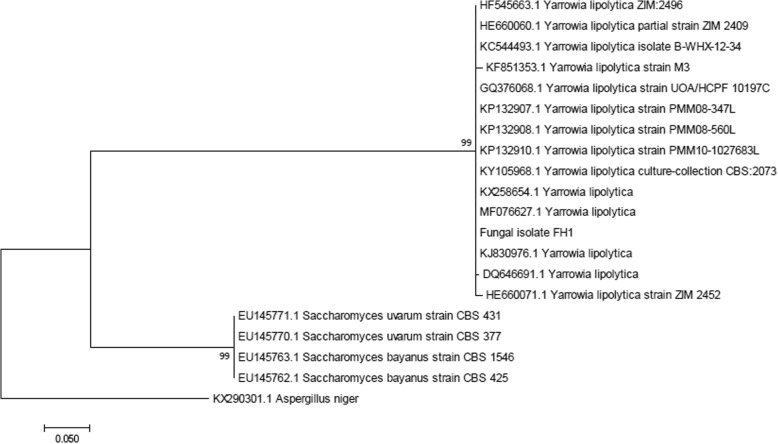
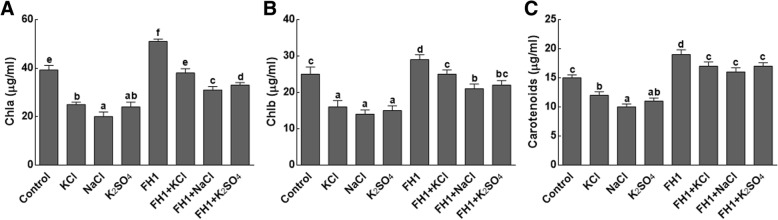
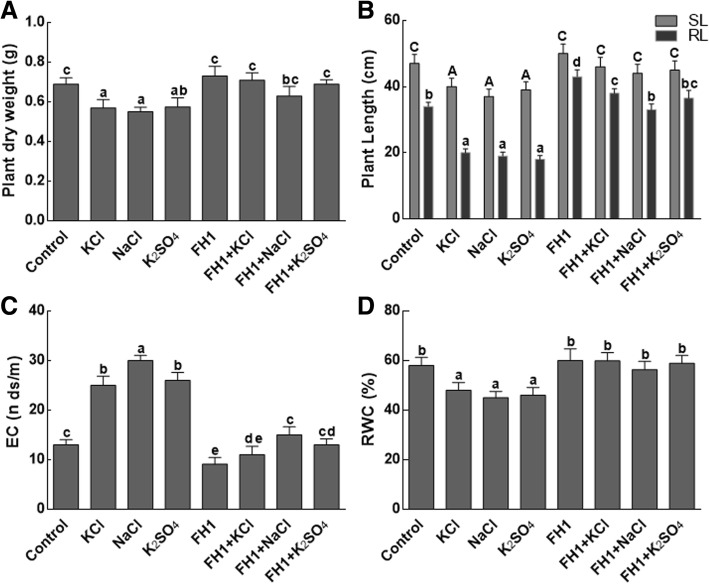
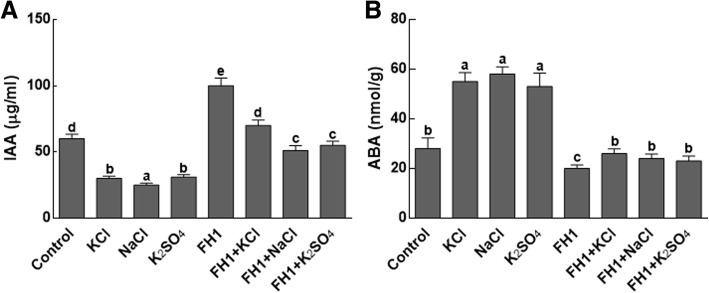
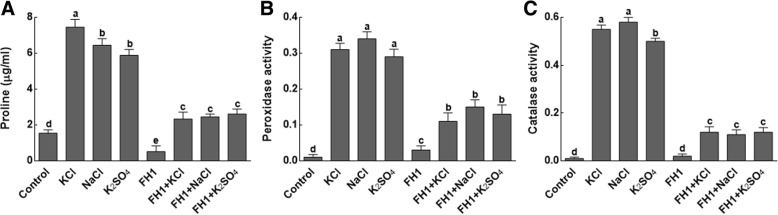
BACKGROUND: To combat salinity, plants need easily accessible, safe and sustainable mechanisms for optimum growth. Recently, endophytes proved to be the promising candidates that helped the host plant to thrive under stress conditions. Therefore, the aim was to discover endophytic strain(s) and their mechanism of action to alleviate salt stress in maize. RESULTS: Keeping the diverse role of endophytes in view, 9 endophytic fungi from the spines of Euphorbia milli L. were isolated. Among the isolated fungal isolates, isolate FH1 was selected for further study on the basis of high antioxidant activity and capability to produce high indole-3-acetic acid (IAA), indole-3-acetamide (IAM), phenol and flavonoid contents. The 18S rDNA sequence homology and phylogenetic analysis of the fungal isolate FH1 revealed to be Yarrowia lipolytica. Furthermore, the inoculation of Y. lipolytica FH1 had significantly promoted plant growth attributes in treated maize as compared to positive (salt stress) and negative (salt stress free) controls. Likewise, differences in chlorophyll, carotenes, electrolyte leakage, leaf relative water, peroxidase, catalase, ABA, IAA and proline contents were observed between treated maize and controls. Interestingly, Y. lipolytica FH1 inoculated plants showed lower endogenous ABA and higher endogenous IAA contents. CONCLUSION: From the results, we have concluded that Y. lipolytica inoculation has promoted the growth of maize plants through controlled metabolism and hormonal secretions (ABA and IAA) under salinity stress. Because of the fact, Y. lipolytica can be tried as an eco-friendly bio-fertilizer to achieve optimum crop productivity under saline conditions.
Overview
The claims and statistics of this paper haven’t been checked yet.
Free: it reads the open-access text and checks the first 5 claims that cite a source we can check. Create a free account to check every claim.
Integrity signals
Registry
Cites
Statistics
Figures
Verification
Claims the paper makes
The claims and statistics of this paper haven’t been checked yet.
Free: it reads the open-access text and checks the first 5 claims that cite a source we can check. Create a free account to check every claim.
Self-check
Percentages, sums and reported differences re-computed from the paper’s own numbers.
The self-check needs the paper’s full text.
Citations
Cites
MEGA7: Molecular Evolutionary Genetics Analysis Version 7.0 for Bigger Datasets
Kumar, S., Stecher, G., & Tamura, K. (2016) · Molecular Biology and Evolution · doi:10.1093/molbev/msw054 · Cited by 44,059
Reactive oxygen species: Metabolism, oxidative stress, and signal transduction
Apel, K., & Hirt, H. (2004) · Annual Review of Plant Biology · doi:10.1146/annurev.arplant.55.031903.141701 · Cited by 11,723 · cited 1×
“Endophytes can regulate plant physiological activities against abiotic stresses by releasing and/or enhancing the capability of the host plant to produce phytohormones (gibberellins, auxin, cytokinin, abscisic acid) and secondary metabolites (phenols and flavonoids) [9].”
Background(1993) · Molecular Biology and Evolution · doi:10.1093/oxfordjournals.molbev.a040023 · Cited by 11,229
GARDES, M., & BRUNS, T. D. (1993) · Molecular Ecology · doi:10.1111/j.1365-294x.1993.tb00005.x · Cited by 10,480
Comparative physiology of salt and water stress
Munns, R. (2002) · Plant, Cell & Environment · doi:10.1046/j.0016-8025.2001.00808.x · Cited by 6,331
Polish journal of environmental studies
Ryczkowski, J. (1993) · Applied Catalysis A: General · doi:10.1016/0926-860x(93)80167-o · Cited by 3,982
Plant Growth-Promoting Bacteria: Mechanisms and Applications
Glick, B. R. (2012) · Scientifica · doi:10.6064/2012/963401 · Cited by 3,346 · cited 1×
“Certainly, IAA (either exogenous or endogenous) can regulate various developmental processes in plants under abiotic stress [20, 21].”
BackgroundCell Signaling during Cold, Drought, and Salt Stress
Xiong, L., Schumaker, K. S., & Zhu, J.-K. (2002) · The Plant Cell · doi:10.1105/tpc.000596 · Cited by 2,372
Plant hormone-mediated regulation of stress responses
Verma, V., Ravindran, P., & Kumar, P. P. (2016) · BMC Plant Biology · doi:10.1186/s12870-016-0771-y · Cited by 2,176
Properties of bacterial endophytes and their proposed role in plant growth
Hardoim, P. R., van Overbeek, L. S., & Elsas, J. D. V. (2008) · Trends in Microbiology · doi:10.1016/j.tim.2008.07.008 · Cited by 1,688
Cited by
Wahab, A., Muhammad, M., Munir, A., Abdi, G., Zaman, W., Ayaz, A., Khizar, C., & Reddy, S. P. P. (2023) · Plants · doi:10.3390/plants12173102 · Cited by 556
Endophytic fungi: a tool for plant growth promotion and sustainable agriculture
Baron, N. C., & Rigobelo, E. C. (2022) · Mycology · doi:10.1080/21501203.2021.1945699 · Cited by 371
Endophytic Fungi: Biological Control and Induced Resistance to Phytopathogens and Abiotic Stresses
Fontana, D. C., de Paula, S., Torres, A. G., de Souza, V. H. M., Pascholati, S. F., Schmidt, D., & Dourado Neto, D. (2021) · Pathogens · doi:10.3390/pathogens10050570 · Cited by 289
Benefits to Plant Health and Productivity From Enhancing Plant Microbial Symbionts
Harman, G., Khadka, R., Doni, F., & Uphoff, N. (2021) · Frontiers in Plant Science · doi:10.3389/fpls.2020.610065 · Cited by 254
Gupta, S., Schillaci, M., Walker, R., Smith, P. M. C., Watt, M., & Roessner, U. (2021) · Plant and Soil · doi:10.1007/s11104-020-04618-w · Cited by 252
“Under saline conditions, endophytic colonization also increases the concentrations of non-enzymatic antioxidant molecules such as AsA, GSH and carotenoids in plants as shown by several studies (Jan et al. 2019; Jogawat et al. 2013; Prasad et al. 2013; Waller et al. 2005).”
BackgroundOmomowo, O. I., & Babalola, O. O. (2019) · Microorganisms · doi:10.3390/microorganisms7110481 · Cited by 205
“Plant-growth-promoting and salinity stress tolerance [78]”
Rhizosphere microbes enhance plant salt tolerance: Toward crop production in saline soil
Liu, Y., Xun, W., Chen, L., Xu, Z., Zhang, N., Feng, H., Zhang, Q., & Zhang, R. (2022) · Computational and Structural Biotechnology Journal · doi:10.1016/j.csbj.2022.11.046 · Cited by 146
Sampangi-Ramaiah, M. H., Jagadheesh, Dey, P., Jambagi, S., Kumari, M. M. V., Oelmüller, R., Nataraja, K. N., Ravishankar, K. V., Ravikanth, G., & Shaanker, R. U. (2020) · Scientific Reports · doi:10.1038/s41598-020-59998-x · Cited by 131
Huang, X., Ren, J., Li, P., Feng, S., Dong, P., & Ren, M. (2020) · Journal of the Science of Food and Agriculture · doi:10.1002/jsfa.10829 · Cited by 126
Niu, S., Gao, Y., Zi, H., Liu, Y., Liu, X., Xiong, X., Yao, Q., Qin, Z., Chen, N., Guo, L., et al. (2021) · The Crop Journal · doi:10.1016/j.cj.2021.06.008 · Cited by 119
Pandey, P., Tripathi, A., Dwivedi, S., Lal, K., & Jhang, T. (2023) · Frontiers in Plant Science · doi:10.3389/fpls.2023.1250020 · Cited by 125
Fungal Endophytes as Mitigators against Biotic and Abiotic Stresses in Crop Plants
Gowtham, H. G., Hema, P., Murali, M., Shilpa, N. C., Nataraj, K., Basavaraj, G. L., Singh, S. B., Aiyaz, M., Udayashankar, A. C., & Amruthesh, K. N. (2024) · Journal of Fungi · doi:10.3390/jof10020116 · Cited by 101
Is —— the rhizosphere a source of applicable multi-beneficial microorganisms for plant enhancement?
Chamkhi, I., Omari, N. E., Balahbib, A., Menyiy, N. E., Benali, T., & Ghoulam, C. (2021) · Saudi Journal of Biological Sciences · doi:10.1016/j.sjbs.2021.09.032 · Cited by 106
Sena, L., Mica, E., Valè, G., Vaccino, P., & Pecchioni, N. (2024) · Frontiers in Plant Science · doi:10.3389/fpls.2024.1349401 · Cited by 110
Ahmed, B., Syed, A., Rizvi, A., Shahid, M., Bahkali, A. H., Khan, M. S., & Musarrat, J. (2020) · Environmental Pollution · doi:10.1016/j.envpol.2020.116218 · Cited by 78
Abdelaziz, A. M., El-Wakil, D. A., Attia, M. S., Ali, O. M., AbdElgawad, H., & Hashem, A. H. (2022) · Journal of Fungi · doi:10.3390/jof8050482 · Cited by 87
Trichoderma reesei improved the nutrition status of wheat crop under salt stress
Ikram, M., Ali, N., Jan, G., Iqbal, A., Hamayun, M., Jan, F. G., Hussain, A., & Lee, I. (2019) · Journal of Plant Interactions · doi:10.1080/17429145.2019.1684582 · Cited by 91
Self-citationYarrowia lipolytica: a multitalented yeast species of ecological significance
Mamaev, D. V., & Zvyagilskaya, R. A. (2021) · FEMS Yeast Research · doi:10.1093/femsyr/foab008 · Cited by 71
Tripathi, A., Pandey, P., Tripathi, S. N., & Kalra, A. (2022) · Frontiers in Plant Science · doi:10.3389/fpls.2022.985429 · Cited by 65
The role of root‐associated microbes in growth stimulation of plants under saline conditions
Liu, H., Lu, X., Li, Z., Tian, C., & Song, J. (2021) · Land Degradation and Development · doi:10.1002/ldr.3955 · Cited by 60
Tarroum, M., Romdhane, W. B., Al‐Qurainy, F., Ali, A. A. M., Al-Doss, A., Fki, L., & Hassairi, A. (2022) · Frontiers in Microbiology · doi:10.3389/fmicb.2022.996054 · Cited by 68
Saleem, S., & Khan, M. S. (2022) · Plant Physiology and Biochemistry · doi:10.1016/j.plaphy.2022.11.013 · Cited by 58
Ismail, Hamayun, M., Hussain, A., Iqbal, A., Khan, S. A., & Lee, I. (2020) · Journal of Plant Interactions · doi:10.1080/17429145.2020.1771444 · Cited by 60
Self-citationMicrobial endophytes: application towards sustainable agriculture and food security
Dwibedi, V., Rath, S. K., Joshi, M., Kaur, R., Kaur, G., Singh, D. P., Kaur, G., & Kaur, S. (2022) · Applied Microbiology and Biotechnology · doi:10.1007/s00253-022-12078-8 · Cited by 56
Effects of salt stress levels on nutritional quality and microorganisms of alfalfa-influenced soil
Lü, Q., Ge, G., Sa, D., Wang, Z., Hou, M., & Jia, Y. S. (2021) · PeerJ · doi:10.7717/peerj.11729 · Cited by 52
Khushdil, F., Jan, F. G., Jan, G., Hamayun, M., Iqbal, A., Hussain, A., & Bibi, N. (2019) · Plant Physiology and Biochemistry · doi:10.1016/j.plaphy.2019.09.038 · Cited by 51
Self-citationAziz, L., Hamayun, M., Rauf, M., Iqbal, A., Arif, M., Husssin, A., & Khan, S. A. (2021) · Environmental and Experimental Botany · doi:10.1016/j.envexpbot.2021.104456 · Cited by 54
Self-citationJan, F. G., Hamayun, M., Hussain, A., Iqbal, A., Jan, G., Khan, S. A., Khan, H., & Lee, I. (2019) · Bioscience Reports · doi:10.1042/bsr20190290 · Cited by 50
Self-citationAli, R., Gul, H., Hamayun, M., Rauf, M., Iqbal, A., Shah, M., Hussain, A., Bibi, H., & Lee, I. (2021) · Chemical and Biological Technologies in Agriculture · doi:10.1186/s40538-021-00208-9 · Cited by 49
Self-citationIkram, M., Ali, N., Jan, G., Hamayun, M., Jan, F. G., & Iqbal, A. (2019) · Acta Physiologiae Plantarum · doi:10.1007/s11738-019-2957-z · Cited by 42
Self-citationPhytomicrobiome Community: An Agrarian Perspective Towards Resilient Agriculture
Sharma, M. M. M., Sharma, P., Kapoor, D., Beniwal, P., & Mehta, S. (2021) · Springer eBooks · doi:10.1007/978-3-030-78521-5_20 · Cited by 41
Galeano, R. M. S., Silva, S. M., Yonekawa, M. K. A., Guimarães, N. C. D. A., Giannesi, G. C., Masui, D. C., Corrêa, B. O., Brasil, M. D. S., & Zanoelo, F. F. (2023) · Rhizosphere · doi:10.1016/j.rhisph.2023.100710 · Cited by 36
Endophytic Fusarium oxysporum GW controlling weed and an effective biostimulant for wheat growth
Asim, S., Hussain, A., Murad, W., Hamayun, M., Iqbal, A., Rehman, H., Tawab, A., Irshad, M. S., Alataway, A., Dewidar, A. Z., et al. (2022) · Frontiers in Plant Science · doi:10.3389/fpls.2022.922343 · Cited by 35
Self-citationAdvances in endophytic fungi research: a data analysis of 25 years of achievements and challenges
Liu-Xu, L., Vicedo, B., García‐Agustín, P., & Llorens, E. (2022) · Journal of Plant Interactions · doi:10.1080/17429145.2022.2032429 · Cited by 37
Chauhan, P., Singh, M., Sharma, A., Singh, M., Chadha, P., & Kaur, A. (2024) · Frontiers in Microbiology · doi:10.3389/fmicb.2024.1336533 · Cited by 40
Effect of plant growth-promoting rhizobacteria on alleviating salinity stress in plants: a review
Kumar, A., Behera, I., Langthasa, M., & PrakashNaroju, S. (2022) · Journal of Plant Nutrition · doi:10.1080/01904167.2022.2155548 · Cited by 33
Khan, M. I., Ali, N., Jan, G., Hamayun, M., Jan, F. G., Iqbal, A., Hussain, A., & Lee, I. (2022) · Frontiers in Plant Science · doi:10.3389/fpls.2022.779623 · Cited by 36
Self-citationMicrobial Utilization to Nurture Robust Agroecosystems for Food Security
Qadir, M., Hussain, A., Iqbal, A., Shah, F., Wu, W., & Cai, H. (2024) · Agronomy · doi:10.3390/agronomy14091891 · Cited by 36
Self-citationGonzález‐Teuber, M., Contreras, R. A., Zúñiga, G. E., Barrera, D., & Bascuñán‐Godoy, L. (2022) · Frontiers in Ecology and Evolution · doi:10.3389/fevo.2021.787318 · Cited by 35
Santra, H. K., & Banerjee, D. (2022) · Frontiers in Fungal Biology · doi:10.3389/ffunb.2021.796010 · Cited by 35
Hamayun, M., Khan, N., Khan, M. N., Qadir, M., Hussain, A., Iqbal, A., Khan, S. A., Rehman, K. U., & Lee, I. (2021) · Biocell · doi:10.32604/biocell.2021.013907 · Cited by 29
Self-citationHao, Y., Ma, C., White, J. C., Adeel, M., Jiang, R., Zhao, Z., Rao, Y., Chen, G., Rui, Y., & Xing, B. (2020) · Environmental Science Nano · doi:10.1039/c9en01400d · Cited by 45
Nature’s Most Fruitful Threesome: The Relationship between Yeasts, Insects, and Angiosperms
Fenner, E. D., Scapini, T., Diniz, M. D. C., Giehl, A., Treichel, H., Álvarez‐Pérez, S., & Júnior, S. L. A. (2022) · Journal of Fungi · doi:10.3390/jof8100984 · Cited by 33
Yang, R., Qin, Z., Wang, J., Zhang, X., Xu, S., Zhao, W., & Huang, Z. (2022) · Microorganisms · doi:10.3390/microorganisms10051042 · Cited by 27
Khan, A., Ali, S., Khan, M., Hamayun, M., & Moon, Y. (2022) · Microorganisms · doi:10.3390/microorganisms10112217 · Cited by 31
Self-citationIsmail, I., Hamayun, M., Hussain, A., Iqbal, A., Khan, S. A., Khan, M. A., & Lee, I. (2020) · Polish Journal of Environmental Studies · doi:10.15244/pjoes/125770 · Cited by 25
Self-citationWang, G., Shen, W., Zhang, Z., Guo, S., Hu, J., Feng, R., Zhao, Q., Du, J., & Du, Y. (2022) · Agronomy · doi:10.3390/agronomy12112708 · Cited by 29
Penicillium Glabrum Acted as a Heat Stress Relieving Endophyte in Soybean and Sunflower
Ismail, I., Hamayun, M., Hussain, A., Iqbal, A., Khan, S. A., Gul, S., Khan, H., Rehman, K. U., Bibi, H., & Lee, I. (2021) · Polish Journal of Environmental Studies · doi:10.15244/pjoes/128579 · Cited by 25
Self-citationNojadeh, M. S., Pouresmaeil, M., Amani, M., Younessi‐Hamzekhanlu, M., & Maggi, F. (2023) · Industrial Crops and Products · doi:10.1016/j.indcrop.2023.117831 · Cited by 26
Mehmood, A., Hussain, A., Irshad, M. S., Hamayun, M., Iqbal, A., Tawab, A., & Khan, N. (2020) · Symbiosis · doi:10.1007/s13199-020-00690-z · Cited by 28
Self-citationEndophytic Fungi Controls the Physicochemical Status of Maize Crop under Salt Stress
Ali, R., Gul, H., Hamayun, M., Rauf, M., Iqbal, A., Hussain, A., & Lee, I. (2021) · Polish Journal of Environmental Studies · doi:10.15244/pjoes/134540 · Cited by 23
Self-citationZhang, J., Huang, X., Hou, Y., Xia, X., Zhu, Z., Huang, A., Feng, S., Li, P., Shi, L., & Dong, P. (2023) · Plants · doi:10.3390/plants12040909 · Cited by 23
Ikram, M., Ali, N., Jan, G., Jan, F. G., Pervez, R., Romman, M., Zainab, R., Yasmin, H., & Khan, N. (2022) · Journal of Plant Growth Regulation · doi:10.1007/s00344-022-10685-3 · Cited by 24
Self-citationGul, S. L., Moon, Y., Hamayun, M., Khan, S. A., Iqbal, A., Khan, M. A., Hussain, A., Shafique, M., Kim, Y.-H., & Ali, S. (2022) · Current Microbiology · doi:10.1007/s00284-022-02853-1 · Cited by 25
Self-citationKaur, R., & Saxena, S. (2023) · Folia Microbiologica · doi:10.1007/s12223-023-01051-1 · Cited by 22
Taheri, P. (2025) · Plant Stress · doi:10.1016/j.stress.2025.100978 · Cited by 22
Prajapati, P., Yadav, M., Nishad, J. H., Gautam, V. S., & Kharwar, R. N. (2023) · Microbiological Research · doi:10.1016/j.micres.2023.127514 · Cited by 21
Qu, Z., Zhang, H., Wang, Q., Zhao, H., Liu, X., Fù, Y., Lin, Y., Xiè, J., Chéng, J., Li, B., et al. (2021) · mSystems · doi:10.1128/msystems.00814-21 · Cited by 19
Silva, F. D. A., Vieira, V. D. O., da Silva, R. C., Pinheiro, D. G., & Soares, M. A. (2021) · Biological Control · doi:10.1016/j.biocontrol.2021.104755 · Cited by 22
Integrated Benefits to Agriculture with Trichoderma and Other Endophytic or Root-Associated Microbes
Harman, G. E. (2024) · Microorganisms · doi:10.3390/microorganisms12071409 · Cited by 17
Kumar, S., Diksha, D., Sindhu, S. S., & Kumar, R. (2024) · Elsevier eBooks · doi:10.1016/b978-0-443-13365-7.00015-4 · Cited by 20
Khaekhum, S., Ekprasert, J., Suebrasri, T., Mongkolthanaruk, W., Riddech, N., Jogloy, S., & Boonlue, S. (2021) · Rhizosphere · doi:10.1016/j.rhisph.2021.100379 · Cited by 15
Rizvi, A., Chandrawal, R., Khan, M. H., Ahmed, B., Umar, S., & Khan, M. S. (2023) · Journal of Plant Growth Regulation · doi:10.1007/s00344-023-11119-4 · Cited by 16
Exploring the role of endophytic fungi in the amelioration of drought stress in plants
Nombamba, A., Fadiji, A. E., & Babalola, O. O. (2024) · Plant Protection Science · doi:10.17221/25/2023-pps · Cited by 14
Chauhan, P., Singh, M., Sharma, A., Chadha, P., & Kaur, A. (2025) · BMC Microbiology · doi:10.1186/s12866-025-04209-8 · Cited by 14
Solanki, B., & Khan, M. S. (2024) · South African Journal of Botany · doi:10.1016/j.sajb.2024.07.002 · Cited by 12
Xiao, S., Wan, Y., Zheng, Y., Wang, Y., Fan, J., Xu, Q., Gao, Z., & Wu, C. (2023) · Plant-Environment Interactions · doi:10.1002/pei3.10122 · Cited by 10
Sampangi-Ramaiah, M. H., Ravishankar, K. V., Nataraja, K. N., & Shaanker, R. U. (2019) · Plant Physiology Reports · doi:10.1007/s40502-019-00487-3 · Cited by 10
Iqbal, U. N., Moin, A., & Alam, M. (2024) · Phytochemistry Reviews · doi:10.1007/s11101-024-10057-7 · Cited by 8
Endophytic seed pretreatment: a strategy for boosting morphophysiological traits in tomato seedlings
Dargiri, S. A., & Samsampour, D. (2025) · BMC Plant Biology · doi:10.1186/s12870-025-06107-7 · Cited by 8
Nacoon, S., Seemakram, W., Gateta, T., Theerakulpisut, P., Sanitchon, J., Kuyper, T. W., & Boonlue, S. (2023) · Journal of Fungi · doi:10.3390/jof9121152 · Cited by 11
Fungal Endophytes: Potential Benefits of Their Future Use in Plant Stress Tolerance and Agriculture
Shelke, D. B., Chambhare, M. R., & Sonawane, H. B. (2022) · Environmental and microbial biotechnology · doi:10.1007/978-981-19-0733-3_7 · Cited by 7
Biodiversity of Genus Trichoderma and Their Potential Applications
Madbouly, A. K. (2021) · Fungal biology · doi:10.1007/978-3-030-67561-5_13 · Cited by 7
Xiao, X., Wang, Q., Lang, D., Chu, Y., Zhang, Y., Li, Z., & Zhang, X. (2021) · Journal of Plant Interactions · doi:10.1080/17429145.2021.2006328 · Cited by 6
Deciphering fungal endophytes combating abiotic stresses in crop plants (cereals and vegetables)
Patel, P., Kumar, S., Modi, A. R., & Kumar, A. (2021) · Elsevier eBooks · doi:10.1016/b978-0-323-85193-0.00009-7 · Cited by 7
Singh, S., Singh, S. B., Singh, A., & Kalra, A. (2022) · Elsevier eBooks · doi:10.1016/b978-0-323-99900-7.00001-8 · Cited by 7
A Review of Endophytic Fungi and their Applications in Different Fields of Biotechnology
Kaur, M. (2024) · Open Access Journal of Microbiology & Biotechnology · doi:10.23880/oajmb-16000299 · Cited by 4
Xu, H., Chang, P., Li, S., Lü, J., Lin, X., & Xie, C. (2021) · Journal of Plant Growth Regulation · doi:10.1007/s00344-021-10375-6 · Cited by 4
Salinity Mitigation Using Microbial Inoculants
Poria, V., Kumar, S., Prasanna, R., Yadav, S., Maurya, P. K., & Singh, S. (2023) · Springer eBooks · doi:10.1007/978-981-99-2973-3_7 · Cited by 4
Szpyrka, E., Książek-Trela, P., Bielak, E., & Słowik‐Borowiec, M. (2024) · Journal of soil science and plant nutrition · doi:10.1007/s42729-024-01671-7 · Cited by 5
Meng, W., Lateef, A. A., Wen, Z., Kasanen, R., Miettinen, O., & Asiegbu, F. O. (2026) · Environmental Microbiome · doi:10.1186/s40793-025-00843-x · Cited by 2
Xu, H., Zhu, M., & Chen, X. (2023) · Environmental Science and Pollution Research · doi:10.1007/s11356-023-31540-2 · Cited by 3
Kar, S., Jaiswal, P., Misra, S., & Chauhan, P. S. (2021) · Rhizosphere biology · doi:10.1007/978-981-16-0889-6_14 · Cited by 3
New roles for Yarrowia lipolytica in molecules synthesis and biocontrol
Sanya, D. R. A., & Onésime, D. (2022) · Applied Microbiology and Biotechnology · doi:10.1007/s00253-022-12227-z · Cited by 4
Plant-microbe interactions in photosynthesis, nutrient acquisition, and plant growth
Mishra, A., & Tailor, S. (2023) · Elsevier eBooks · doi:10.1016/b978-0-323-91875-6.00019-0 · Cited by 3
Conditional protein degradation in Yarrowia lipolytica using the auxin-inducible degron
Han, Z., Maruwan, J., Tang, Y., & Su, W. (2023) · Frontiers in Bioengineering and Biotechnology · doi:10.3389/fbioe.2023.1188119 · Cited by 3
Рафаиловна, Ф. Е., Golubtsova, Y. V., Neverova, O. A., Larichev, T., & Khoroshkina, N. N. (2023) · Agricultural science Euro-North-East · doi:10.30766/2072-9081.2023.24.5.720-738 · Cited by 3
Insights into Role of Invisible Partners in Plant Growth and Development
Bharadwaj, R., Kumar, S. R., & Ramalingam, S. (2021) · Plant in challenging environments · doi:10.1007/978-3-030-78420-1_2 · Cited by 3
AIBECHE, C., Sidhoum, W., Khelil, O., CHERIFI, F., Errouane, K., Selami, N., Choubane, S., SENINA, A., MARDHI, C., & Djabeur, A. (2023) · Notulae Scientia Biologicae · doi:10.55779/nsb15211442 · Cited by 2
Taheri, P. (2025) · Elsevier eBooks · doi:10.1016/b978-0-443-23818-5.00012-0 · Cited by 2
Kiran, K. R., Shivappa, S., Kaniyassery, A., Thorat, S. A., Murali, T. S., & Muthusamy, A. (2026) · Journal of Plant Diseases and Protection · doi:10.1007/s10343-026-01353-7 · Cited by 2
Migut, D., Sobaszek, M., Jańczak-Pieniążek, M., & Skrobacz, K. (2025) · International Journal of Molecular Sciences · doi:10.3390/ijms26031233 · Cited by 3
The Multifaceted Biocontrol Mechanisms of Endophytic Fungi
Mehmood, M. A., Rauf, A., Abd-Elsalam, K. A., Ashfaq, M., Kayani, S. B., & Javeed, S. (2025) · Springer eBooks · doi:10.1007/978-981-97-8804-0_15 · Cited by 4
Deep Insights into the Role of Endophytic Fungi in Abiotic Stress Tolerance in Plants
Toppo, P., & Mathur, P. (2022) · Advances in Science, Technology & Innovation/Advances in science, technology & innovation · doi:10.1007/978-3-030-95365-2_21 · Cited by 3
Chaubey, A. K., Sharma, V. K., Prajapati, P. K., Mishra, S., Pandey, R., Dwivedi, S. V., SINGH, A. K., & Soni, R. (2023) · Springer eBooks · doi:10.1007/978-3-031-40082-7_13 · Cited by 2
Multifunctional Efficacy and Eco-friendly Applications of Fungal Endophytes
Dutta, R., Santra, H. K., & Banerjee, D. (2025) · Springer eBooks · doi:10.1007/978-981-97-8804-0_2 · Cited by 1
Saleem, S., Rizvi, A., & Khan, M. S. (2025) · Next research. · doi:10.1016/j.nexres.2025.101165 · Cited by 1
Suphaphan, S., Gateta, T., Seemakram, W., Suebrasri, T., Chantawong, S., Klinsukon, C., Theerakulpisut, P., & Boonlue, S. (2025) · Journal of Fungi · doi:10.3390/jof12010002 · Cited by 1
Endophytes as Biological Control Agents of Plant Diseases
Elshahawy, I. E., & Haggag, W. M. (2026) · Microorganisms for sustainability · doi:10.1007/978-981-95-4817-0_14 · Cited by 1
Siderophilic microbes and their role in abatement of abiotic stress in plants
Kumar, H., Rathia, P., Lata, R., Khan, U., & Gond, S. K. (2026) · Elsevier eBooks · doi:10.1016/b978-0-443-32932-6.00006-0 · Cited by 1
Metadata
- Authors
- Gul Jan, F., Hamayun, M., Hussain, A., Jan, G., Iqbal, A., Khan, A., & Lee, I.-J.
- Affiliations
- Abdul Wali Khan University Mardan (PK)
- Lanzhou University (CN)
- Kyungpook National University (KR)
- Corresponding author
- Lee, In-Jung
- Venue
- BMC Microbiology
- Published
- 2019-01-07
- Volume
- 19
- Issue
- 1
- Pages
- 3-3
- ISSN
- 1471-2180 (ISSN-L)
- PMC
- PMC6323777
- OpenAlex
- W2914846125
- Cited by
- 116
- References
- 46
- Citations by year
- 2026: 11 · 2025: 11 · 2024: 13 · 2023: 18 · 2022: 23 · 2021: 24 · 2020: 9 · 2019: 7
- FWCI
- 12.33
- Type
- journal article
- Language
- en
- Open access
- gold
- doi.org
- Licence
- cc-by
- creativecommons.org/licenses/by/4.0/ (tdm)
- Locations
- BMC Microbiology (publishedVersion, cc-by)
- Europe PMC (PubMed Central) (publishedVersion, cc-by)
- PubMed Central (publishedVersion, cc-by)
- PubMed (publishedVersion)
- Lanzhou University Institutional Repository (submittedVersion)
- DOAJ (DOAJ: Directory of Open Access Journals) (submittedVersion, cc-by-sa)
- Funders
- National Research Foundation of Korea (2017R1D1A1B04035601)
- Topics
- Life Sciences › Agricultural and Biological Sciences › Ecology, Evolution, Behavior and Systematics › Plant and fungal interactions
- Life Sciences › Agricultural and Biological Sciences › Plant Science › Plant-Microbe Interactions and Immunity
- Life Sciences › Agricultural and Biological Sciences › Plant Science › Plant Stress Responses and Tolerance
- Keywords
- Yarrowia lipolytica, endophytic fungi, salt stress, maize, salt tolerance, abscisic acid, indole-3-acetic acid, indole-3-acetamide, antioxidant activity, flavonoids, proline, biofertilizers, plant growth promotion, stress reduction
- MeSH terms
- Abscisic Acid, Salt Stress, Zea mays, Indoleacetic Acids, Phylogeny, RNA, Ribosomal, 18S, Yarrowia, Host-Pathogen Interactions, Endophytes
About these checks
Registry, retraction, Cites and statistics results are computed, not judged, with one exception: a printed reference that no index lists is read once by a model before it counts as a citation error. Claims are extracted by a model and kept only when their quote appears verbatim in the text; each cited source is then checked, with a model’s help, for whether it says what the claim relies on. Those verdicts can be wrong — read the claim’s quote and the cited source before relying on one.
Statistics and arithmetic are recomputed, not judged.
Confidence bands are shown only for fields calibrated on our annotated test set. None is calibrated yet, so no band is shown.
What counts as a claim ›How we measure confidence ›How we check this ›
Are you an author, or do you see a problem with this page? Request a review
Data sources
Bibliographic data: Semantic Scholar, OpenAlex, Crossref.
Contains information from the Semantic Scholar Academic Graph Datasets, made available under the ODC Attribution License (ODC-BY 1.0).
Semantic Scholar’s data is described in: Kinney, R., et al. (2023). The Semantic Scholar Open Data Platform. arXiv:2301.10140.
