

An endophytic isolate of the fungus Yarrowia lipolytica produces metabolites that ameliorate the negative impact of salt stress on the physiology of maize
Open accessThe DOI matches its Crossref record; 45 of the 46 references it cites were found in a registry or an index.
Abstract
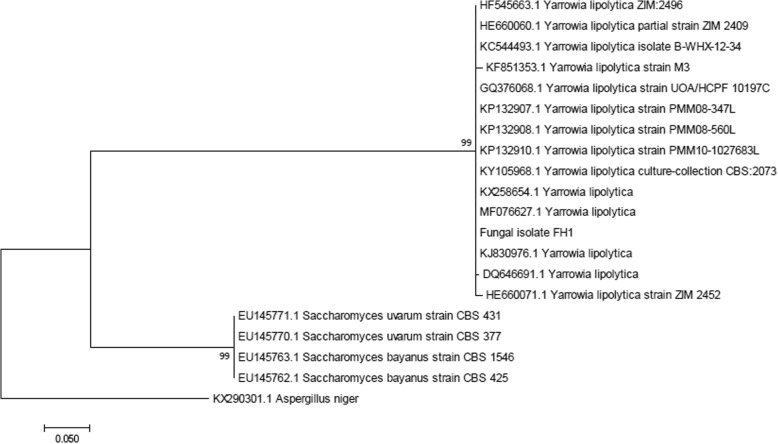
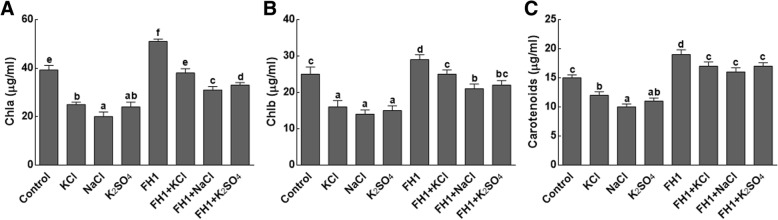
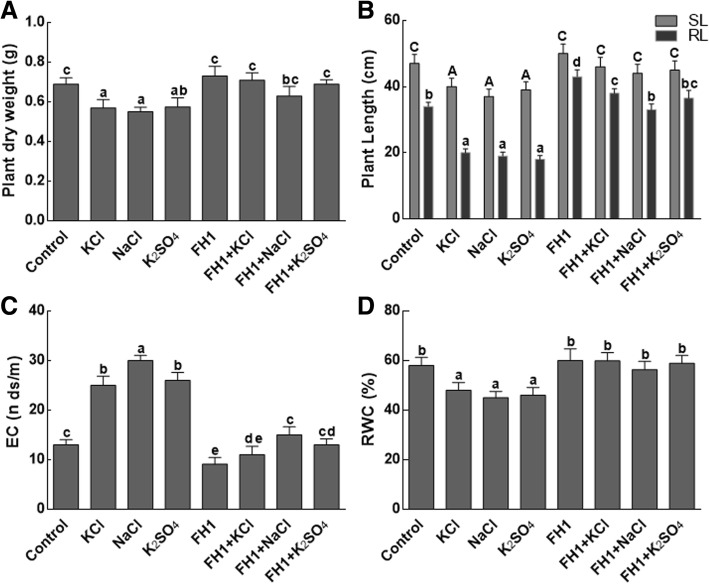
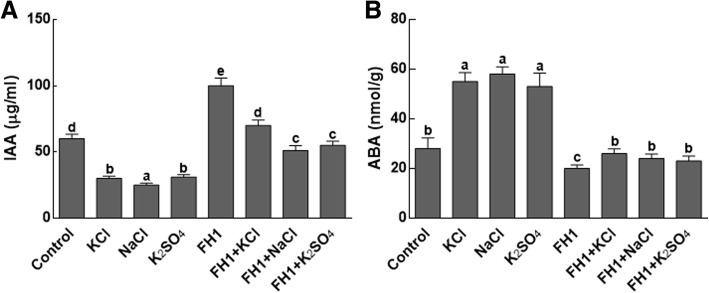
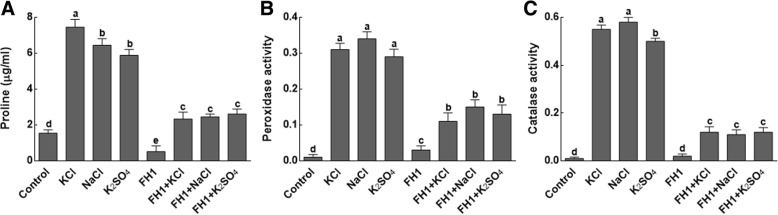
BACKGROUND: To combat salinity, plants need easily accessible, safe and sustainable mechanisms for optimum growth. Recently, endophytes proved to be the promising candidates that helped the host plant to thrive under stress conditions. Therefore, the aim was to discover endophytic strain(s) and their mechanism of action to alleviate salt stress in maize. RESULTS: Keeping the diverse role of endophytes in view, 9 endophytic fungi from the spines of Euphorbia milli L. were isolated. Among the isolated fungal isolates, isolate FH1 was selected for further study on the basis of high antioxidant activity and capability to produce high indole-3-acetic acid (IAA), indole-3-acetamide (IAM), phenol and flavonoid contents. The 18S rDNA sequence homology and phylogenetic analysis of the fungal isolate FH1 revealed to be Yarrowia lipolytica. Furthermore, the inoculation of Y. lipolytica FH1 had significantly promoted plant growth attributes in treated maize as compared to positive (salt stress) and negative (salt stress free) controls. Likewise, differences in chlorophyll, carotenes, electrolyte leakage, leaf relative water, peroxidase, catalase, ABA, IAA and proline contents were observed between treated maize and controls. Interestingly, Y. lipolytica FH1 inoculated plants showed lower endogenous ABA and higher endogenous IAA contents. CONCLUSION: From the results, we have concluded that Y. lipolytica inoculation has promoted the growth of maize plants through controlled metabolism and hormonal secretions (ABA and IAA) under salinity stress. Because of the fact, Y. lipolytica can be tried as an eco-friendly bio-fertilizer to achieve optimum crop productivity under saline conditions.
Overview
The claims and statistics of this paper haven’t been checked yet.
Free: it reads the open-access text and checks the first 5 claims that cite a source we can check. Create a free account to check every claim.
Integrity signals
Registry
Cites
Statistics
Figures
Verification
Claims the paper makes
The claims and statistics of this paper haven’t been checked yet.
Free: it reads the open-access text and checks the first 5 claims that cite a source we can check. Create a free account to check every claim.
Self-check
Percentages, sums and reported differences re-computed from the paper’s own numbers.
The self-check needs the paper’s full text.
Citations
Cites
MEGA7: Molecular Evolutionary Genetics Analysis Version 7.0 for Bigger Datasets
Kumar, S., Stecher, G., & Tamura, K. (2016) · Molecular Biology and Evolution · doi:10.1093/molbev/msw054 · Cited by 44,059
Reactive oxygen species: Metabolism, oxidative stress, and signal transduction
Apel, K., & Hirt, H. (2004) · Annual Review of Plant Biology · doi:10.1146/annurev.arplant.55.031903.141701 · Cited by 11,723 · cited 1×
“Endophytes can regulate plant physiological activities against abiotic stresses by releasing and/or enhancing the capability of the host plant to produce phytohormones (gibberellins, auxin, cytokinin, abscisic acid) and secondary metabolites (phenols and flavonoids) [9].”
Background(1993) · Molecular Biology and Evolution · doi:10.1093/oxfordjournals.molbev.a040023 · Cited by 11,229
GARDES, M., & BRUNS, T. D. (1993) · Molecular Ecology · doi:10.1111/j.1365-294x.1993.tb00005.x · Cited by 10,480
Comparative physiology of salt and water stress
Munns, R. (2002) · Plant, Cell & Environment · doi:10.1046/j.0016-8025.2001.00808.x · Cited by 6,331
Polish journal of environmental studies
Ryczkowski, J. (1993) · Applied Catalysis A: General · doi:10.1016/0926-860x(93)80167-o · Cited by 3,982
Plant Growth-Promoting Bacteria: Mechanisms and Applications
Glick, B. R. (2012) · Scientifica · doi:10.6064/2012/963401 · Cited by 3,346 · cited 1×
“Certainly, IAA (either exogenous or endogenous) can regulate various developmental processes in plants under abiotic stress [20, 21].”
BackgroundCell Signaling during Cold, Drought, and Salt Stress
Xiong, L., Schumaker, K. S., & Zhu, J.-K. (2002) · The Plant Cell · doi:10.1105/tpc.000596 · Cited by 2,372
Plant hormone-mediated regulation of stress responses
Verma, V., Ravindran, P., & Kumar, P. P. (2016) · BMC Plant Biology · doi:10.1186/s12870-016-0771-y · Cited by 2,176
Properties of bacterial endophytes and their proposed role in plant growth
Hardoim, P. R., van Overbeek, L. S., & Elsas, J. D. V. (2008) · Trends in Microbiology · doi:10.1016/j.tim.2008.07.008 · Cited by 1,688
Saeed, N., Khan, M. R., & Shabbir, M. (2012) · BMC Complementary and Alternative Medicine · doi:10.1186/1472-6882-12-221 · Cited by 1,111
Dark septate endophytes: a review of facultative biotrophic root‐colonizing fungi
JUMPPONEN, A., & TRAPPE, J. M. (1998) · New Phytologist · doi:10.1046/j.1469-8137.1998.00265.x · Cited by 1,002
Phytohormones and plant responses to salinity stress: a review
Fahad, S., Hussain, S., Matloob, A., Khan, F. A., Khaliq, A., Saud, S., Hassan, S., Shan, D., Khan, F., Ullah, N., et al. (2015) · Plant Growth Regulation · doi:10.1007/s10725-014-0013-y · Cited by 835
Self-citationSofo, A., Scopa, A., Nuzzaci, M., & Vitti, A. (2015) · International Journal of Molecular Sciences · doi:10.3390/ijms160613561 · Cited by 795
Positive regulatory role of strigolactone in plant responses to drought and salt stress
Ha, C. V., Leyva-González, M. A., Osakabe, Y., Tran, U. T., Nishiyama, R., Watanabe, Y., Tanaka, M., Seki, M., Yamaguchi, S., Dong, N. V., et al. (2014) · Proceedings of the National Academy of Sciences · doi:10.1073/pnas.1322135111 · Cited by 712
Sumanta, N., Haque, C. I., Jaishee, N., & Suprakash, R. (2014) · Cited by 695
Mohite, B. (2013) · Journal of soil science and plant nutrition · doi:10.4067/s0718-95162013005000051 · Cited by 501
Redman, R. S., Kim, Y. O., Woodward, C. J. D. A., Greer, C., Espino, L., Doty, S. L., & Rodriguez, R. J. (2011) · PLoS ONE · doi:10.1371/journal.pone.0014823 · Cited by 462
New phenotyping methods for screening wheat and barley for beneficial responses to water deficit
Munns, R., James, R. A., Sirault, X. R. R., Furbank, R. T., & Jones, H. G. (2010) · Journal of Experimental Botany · doi:10.1093/jxb/erq199 · Cited by 422
Hamid Badawi, G., Yamauchi, Y., Shimada, E., Sasaki, R., Kawano, N., Tanaka, K., & Tanaka, K. (2004) · Plant Science · doi:10.1016/j.plantsci.2003.12.007 · Cited by 346
Lutts, S., Kinet, J. M., & Bouharmont, J. (1996) · Plant Growth Regulation · doi:10.1007/bf00037793 · Cited by 338
Sherameti, I., Shahollari, B., Venus, Y., Altschmied, L., Varma, A., & Oelmüller, R. (2005) · Journal of Biological Chemistry · doi:10.1074/jbc.m500447200 · Cited by 281
Tefera, T., & Vidal, S. (2009) · BioControl · doi:10.1007/s10526-009-9216-y · Cited by 257
Bilal, L., Asaf, S., Hamayun, M., Gul, H., Iqbal, A., Ullah, I., Lee, I.-J., & Hussain, A. (2018) · Symbiosis · doi:10.1007/s13199-018-0545-4 · Cited by 252
Self-citationHamayun, M., Hussain, A., Khan, S. A., Kim, H.-Y., Khan, A. L., Waqas, M., Irshad, M., Iqbal, A., Rehman, G., Jan, S., et al. (2017) · Frontiers in Microbiology · doi:10.3389/fmicb.2017.00686 · Cited by 235
Self-citationThe plant hormone indoleacetic acid induces invasive growth in Saccharomyces cerevisiae
Prusty, R., Grisafi, P., & Fink, G. R. (2004) · Proceedings of the National Academy of Sciences · doi:10.1073/pnas.0400659101 · Cited by 220
The National and International Importance of Drought and Salinity Effects on Agricultural Production
McWilliam, J. (1986) · Australian Journal of Plant Physiology · doi:10.1071/pp9860001 · Cited by 147
Biosynthesis and metabolism of abscisic acid in tomato leaves infected withBotrytis cinerea
Kettner, J., & D�rffling, K. (1995) · Planta · doi:10.1007/bf01106753 · Cited by 133
Pan, F., Su, T.-J., Cai, S.-M., & Wu, W. (2017) · Scientific Reports · doi:10.1038/srep42008 · Cited by 131
Lehmann, T. J., Hoffmann, M., Hentrich, M., & Pollmann, S. (2010) · European Journal of Cell Biology · doi:10.1016/j.ejcb.2010.06.021 · Cited by 124
Qawasmeh, A., Obied, H. K., Raman, A., & Wheatley, W. (2012) · Journal of Agricultural and Food Chemistry · doi:10.1021/jf204105k · Cited by 122
Fecht-Christoffers, M. M., Führs, H., Braun, H.-P., & Horst, W. J. (2006) · Plant Physiology · doi:10.1104/pp.105.070474 · Cited by 121
Zhang, X., Fan, X., Li, C., & Nan, Z. (2009) · Plant Growth Regulation · doi:10.1007/s10725-009-9422-8 · Cited by 83
ANTIOXIDANT ACTIVITY OF ENDOPHYTIC FUNGUS PHYLLOSTICTA SP. ISOLATED FROM GUAZUMA TOMENTOSA
Srinivasan, K., Loganathan, J., Shenbhagaraman, R., & Muthumary, J. (2010) · DOAJ (DOAJ: Directory of Open Access Journals) · Cited by 71
Effect of salinity stress on dry matter production and ion accumulation in hybrid maize varieties
Eker, S., Cömertpay, G., Konuşkan, Ö., Ülger, A., Öztürk, L., & Çakmak, İ. (2006) · Sabanci University · Cited by 63
Toll-like receptor 4-mediated growth of endometriosis by human heat-shock protein 70
Khan, K. N., Kitajima, M., Imamura, T., Hiraki, K., Fujishita, A., Sekine, I., Ishimaru, T., & Masuzaki, H. (2008) · Human Reproduction · doi:10.1093/humrep/den195 · Cited by 62
Shaw, J. J., Spakowicz, D. J., Dalal, R. S., Davis, J., Lehr, N. A., Dunican, B. F., Orellana, E. A., Narváez‐Trujillo, A., & Strobel, S. A. (2015) · Applied Microbiology and Biotechnology · doi:10.1007/s00253-014-6206-5 · Cited by 61
Responses of Batis maritima plants challenged with up to two‐fold seawater NaCl salinity
Debez, A., Saadaoui, D., Slama, I., Huchzermeyer, B., & Abdelly, C. (2010) · Journal of Plant Nutrition and Soil Science · doi:10.1002/jpln.200900222 · Cited by 55
Rapid DNA Extraction for Screening Soil Filamentous Fungi Using PCR Amplification
Płaza, G. A., Upchurch, R. G., Brigmon, R. L., Whitman, W. B., & Ulfig, K. (2004) · Cited by 50
Estimating Willingness to Pay: Why and How?
Böhm, P. (1981) · Palgrave Macmillan UK eBooks · doi:10.1007/978-1-349-05090-1_1 · Cited by 49
Water Security Problem in North China: Research and Perspective
Xia, J., Jun, J., Liu, Mengyu, Jia, & Shaofeng (2005) · Institute of Geographic Sciences and Natural Resources Research, CAS Institutional Repository · Cited by 45
Silicon mediated biochemical changes in wheat under salinized and non-salinzed solution cultures
Ali, A. (2012) · AFRICAN JOURNAL OF BIOTECHNOLOGY · doi:10.5897/ajb11.1757 · Cited by 20
Potential business opportunities from saline water and salt-affected land resources
(2015) · CGSPace A Repository of Agricultural Research Outputs (Consultative Group for International Agricultural Research) · doi:10.5337/2015.206 · Cited by 19
Gul, F., Hussain, A., Jan, G., & Hamayun, M. (2017) · Biosciences Biotechnology Research Asia · doi:10.13005/bbra/2492 · Cited by 10
Self-citationEnvy and Altruism: Contrasting Bivariate and Univariate Prospect Preferences
Kaplanski, G., & Levy, H. (2017) · Scandinavian Journal of Economics · doi:10.1111/sjoe.12168 · Cited by 2
Cited by
Wahab, A., Muhammad, M., Munir, A., Abdi, G., Zaman, W., Ayaz, A., Khizar, C., & Reddy, S. P. P. (2023) · Plants · doi:10.3390/plants12173102 · Cited by 556
Endophytic fungi: a tool for plant growth promotion and sustainable agriculture
Baron, N. C., & Rigobelo, E. C. (2022) · Mycology · doi:10.1080/21501203.2021.1945699 · Cited by 371
Endophytic Fungi: Biological Control and Induced Resistance to Phytopathogens and Abiotic Stresses
Fontana, D. C., de Paula, S., Torres, A. G., de Souza, V. H. M., Pascholati, S. F., Schmidt, D., & Dourado Neto, D. (2021) · Pathogens · doi:10.3390/pathogens10050570 · Cited by 289
Gupta, S., Schillaci, M., Walker, R., Smith, P. M. C., Watt, M., & Roessner, U. (2021) · Plant and Soil · doi:10.1007/s11104-020-04618-w · Cited by 252
Benefits to Plant Health and Productivity From Enhancing Plant Microbial Symbionts
Harman, G., Khadka, R., Doni, F., & Uphoff, N. (2021) · Frontiers in Plant Science · doi:10.3389/fpls.2020.610065 · Cited by 254
Metadata
- Authors
- Gul Jan, F., Hamayun, M., Hussain, A., Jan, G., Iqbal, A., Khan, A., & Lee, I.-J.
- Affiliations
- Abdul Wali Khan University Mardan (PK)
- Lanzhou University (CN)
- Kyungpook National University (KR)
- Corresponding author
- Lee, In-Jung
- Venue
- BMC Microbiology
- Published
- 2019-01-07
- Volume
- 19
- Issue
- 1
- Pages
- 3-3
- ISSN
- 1471-2180 (ISSN-L)
- PMC
- PMC6323777
- OpenAlex
- W2914846125
- Cited by
- 116
- References
- 46
- Citations by year
- 2026: 11 · 2025: 11 · 2024: 13 · 2023: 18 · 2022: 23 · 2021: 24 · 2020: 9 · 2019: 7
- FWCI
- 12.33
- Type
- journal article
- Language
- en
- Open access
- gold
- doi.org
- Licence
- cc-by
- creativecommons.org/licenses/by/4.0/ (tdm)
- Locations
- BMC Microbiology (publishedVersion, cc-by)
- Europe PMC (PubMed Central) (publishedVersion, cc-by)
- PubMed Central (publishedVersion, cc-by)
- PubMed (publishedVersion)
- Lanzhou University Institutional Repository (submittedVersion)
- DOAJ (DOAJ: Directory of Open Access Journals) (submittedVersion, cc-by-sa)
- Funders
- National Research Foundation of Korea (2017R1D1A1B04035601)
- Topics
- Life Sciences › Agricultural and Biological Sciences › Ecology, Evolution, Behavior and Systematics › Plant and fungal interactions
- Life Sciences › Agricultural and Biological Sciences › Plant Science › Plant-Microbe Interactions and Immunity
- Life Sciences › Agricultural and Biological Sciences › Plant Science › Plant Stress Responses and Tolerance
- Keywords
- Yarrowia lipolytica, endophytic fungi, salt stress, maize, salt tolerance, abscisic acid, indole-3-acetic acid, indole-3-acetamide, antioxidant activity, flavonoids, proline, biofertilizers, plant growth promotion, stress reduction
- MeSH terms
- Abscisic Acid, Salt Stress, Zea mays, Indoleacetic Acids, Phylogeny, RNA, Ribosomal, 18S, Yarrowia, Host-Pathogen Interactions, Endophytes
About these checks
Registry, retraction, Cites and statistics results are computed, not judged, with one exception: a printed reference that no index lists is read once by a model before it counts as a citation error. Claims are extracted by a model and kept only when their quote appears verbatim in the text; each cited source is then checked, with a model’s help, for whether it says what the claim relies on. Those verdicts can be wrong — read the claim’s quote and the cited source before relying on one.
Statistics and arithmetic are recomputed, not judged.
Confidence bands are shown only for fields calibrated on our annotated test set. None is calibrated yet, so no band is shown.
What counts as a claim ›How we measure confidence ›How we check this ›
Are you an author, or do you see a problem with this page? Request a review
Data sources
Bibliographic data: Semantic Scholar, OpenAlex, Crossref.
Contains information from the Semantic Scholar Academic Graph Datasets, made available under the ODC Attribution License (ODC-BY 1.0).
Semantic Scholar’s data is described in: Kinney, R., et al. (2023). The Semantic Scholar Open Data Platform. arXiv:2301.10140.
