

Epidemiological and clinical profiles of acute poisoning in patients admitted to the intensive care unit in eastern Iran (2010 to 2017)
Open accessThe DOI matches its Crossref record; 45 of the 46 references it cites were found in a registry or an index.
Abstract
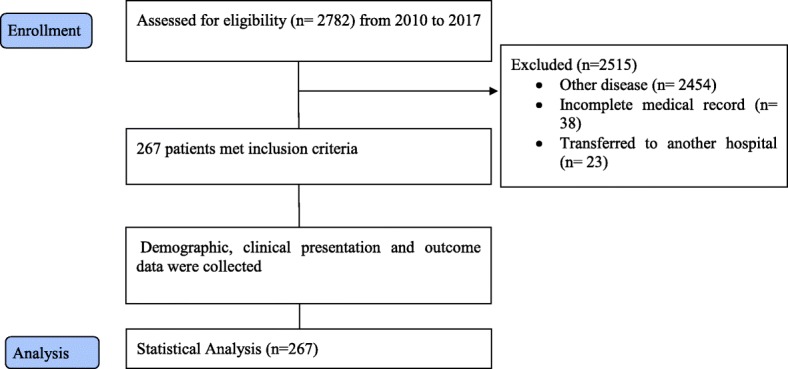
BACKGROUND: Acute poisoning is a common chief complaint leading to emergency department visits and hospital admissions in developing countries such as Iran. Data describing the epidemiology of different poisonings, characteristics of the clinical presentations, and the predictors of outcome are lacking. Such data can help develop more efficient preventative and management strategies to decrease morbidity and mortality related to these poisonings. This manuscript describes the epidemiology of acute poisoning among patients admitted to the intensive care unit (ICU) in Birjand, Iran. METHODS: This retrospective, cross-sectional study was conducted to characterize acute poisonings managed in the ICU during a 7-year period from March 2010 to March 2017 in a single center in Birjand, Iran. Patient characteristics, suspected exposure, the route of exposure, and outcome data were collected from hospital medical records. RESULTS: During the study period, 267 (64% male and 36% female) patients met inclusion criteria. Pharmaceutical medication (36.6%), opioids (26.2%) followed by pesticides (13.9%) were the most common exposures 38.2% of these cases were identified as suicide attempts. There were different frequencies in terms of xenobiotic exposure in relation to gender (p = 0.04) and the survival (p = 0.001). There was a significant difference between various xenobiotics identified as the cause of poisoning (p = 0.001). Mortality rate in our study was 19.5%. The incidence of outcomes was significantly higher in patients poisoned with opioids, pesticides, benzodiazepines, and tricyclic antidepressants (p < 0.05). The median length of hospital stay was higher in pesticide-poisoned patients (p = 0.04). CONCLUSION: Opioids and pesticides were the most common exposures. The mortality rate of the poisoned patients in the ICU was proportionately high. The mortality rate due to opioid poisoning is a major concern and the most significant cause death due to poisoning in the region. Further monitoring and characterization of acute poisoning in Birjand, Iran is needed. These data can help develop educational and preventative programs to reduce these exposures and improve management of exposures in the prehospital and hospital settings.
Overview
The claims and statistics of this paper haven’t been checked yet.
Free: it reads the open-access text and checks the first 5 claims that cite a source we can check. Create a free account to check every claim.
Integrity signals
Registry
Cites
Statistics
Figures
Verification
Claims the paper makes
The claims and statistics of this paper haven’t been checked yet.
Free: it reads the open-access text and checks the first 5 claims that cite a source we can check. Create a free account to check every claim.
Claims other papers make about this one
Each is checked against this paper’s own text: does it say what the citing paper says it does?
In the citing paper
“An Iranian source reported that paracetamol accounted for only 0.7% of ICU poisonings [186].”
From Paracetamol (acetaminophen) overdose and hepatotoxicity: mechanism, treatment, prevention measures, and estimates of burden of disease (2023) · cites this paper as [186]
Self-check
Percentages, sums and reported differences re-computed from the paper’s own numbers.
The self-check needs the paper’s full text.
Citations
Cites
Adverse drug reactions: definitions, diagnosis, and management
Edwards, I. R., & Aronson, J. K. (2000) · The Lancet · doi:10.1016/s0140-6736(00)02799-9 · Cited by 2,979
Patterns and problems of deliberate self-poisoning in the developing world
Eddleston, M. (2000) · QJM · doi:10.1093/qjmed/93.11.715 · Cited by 828
Annual Summary of Vital Statistics: 2010–2011
Hamilton, B. E., Hoyert, D. L., Martin, J. A., Strobino, D. M., & Guyer, B. (2013) · Pediatrics · doi:10.1542/peds.2012-3769 · Cited by 375
Indian Journal of Forensic Medicine & Toxicology
Chidananda, P., Nadaf, A. A., Deepak Kumar, B., Kg, R., Mr, V., Ragab, A. R., Zaki, N. S., & Jaiswal, A. (2013) · Cited by 294
A Systematic Review of Aluminium Phosphide Poisoning
Mehrpour, O., Jafarzadeh, M., & Abdollahi, M. (2012) · Archives of Industrial Hygiene and Toxicology · doi:10.2478/10004-1254-63-2012-2182 · Cited by 221
Self-citationPattern of acute poisoning in Tehran-Iran in 2003
Shadnia, S., Esmaily, H., Sasanian, G., Pajoumand, A., Hassanian-Moghaddam, H., & Abdollahi, M. (2007) · Human & Experimental Toxicology · doi:10.1177/0960327107083017 · Cited by 158 · cited 2×
“For example, in developed countries the most common cause of acute poisoning is the abuse of commercially available pharmaceuticals [7], in contrast, in developing countries, insecticides are the most common [8].”
BackgroundA Restrospective Study of Poisoning in Tehran
Abdollahi, M., Jalali, N., Sabzevari, O., Hoseini, R., & Ghanea, T. (1997) · Journal of Toxicology: Clinical Toxicology · doi:10.3109/15563659709043371 · Cited by 133 · cited 1×
“For example, in developed countries the most common cause of acute poisoning is the abuse of commercially available pharmaceuticals [7], in contrast, in developing countries, insecticides are the most common [8].”
BackgroundAn epidemiological study of poisoning in northern Islamic Republic of Iran
Moghadamnia, A. A., & Abdollahi, M. (2002) · Eastern Mediterranean Health Journal · doi:10.26719/2002.8.1.88 · Cited by 131
A Narrative Review of Acute Adult Poisoning in Iran.
Alinejad, S., Zamani, N., Abdollahi, M. R., & Mehrpour, O. (2017) · PubMed Central · Cited by 124
Self-citationAcute adult and adolescent poisoning in Tehran, Iran; the epidemiologic trend between 2006 and 2011.
Hassanian‐Moghaddam, H., Zamani, N., Rahimi, M., Shadnia, S., Pajoumand, A., & Sarjami, S. (2014) · PubMed · Cited by 91
The hazards of gastric lavage for intentional self-poisoning in a resource poor location
Eddleston, M., Haggalla, S., Reginald, K., Sudarshan, K., Senthilkumaran, M., Karalliedde, L. D., Ariaratnam, A., Sheriff, M. H. R., Warrell, D. A., & Buckley, N. A. (2007) · Clinical Toxicology · doi:10.1080/15563650601006009 · Cited by 85
Prognostic Factors in Acute Aluminium Phosphide Poisoning: A Risk‐Prediction Nomogram Approach
Farzaneh, E., Ghobadi, H., Akbarifard, M., Nakhaee, S., Amirabadizadeh, A., Akhavanakbari, G., Keyler, D. E., & Mehrpour, O. (2018) · Basic & Clinical Pharmacology & Toxicology · doi:10.1111/bcpt.13005 · Cited by 83
Self-citationSchwake, L., Wollenschläger, I., Stremmel, W., & Encke, J. (2008) · Intensive Care Medicine · doi:10.1007/s00134-008-1250-1 · Cited by 80
International Journal of Medical Toxicology and Forensic Medicine
(2019) · International Journal of Medical Toxicology and Forensic Medicine · doi:10.32598/ijmtfm · Cited by 72
Ahuja, H. (2015) · JOURNAL OF CLINICAL AND DIAGNOSTIC RESEARCH · doi:10.7860/jcdr/2015/16008.6632 · Cited by 69
Over 8 years experience on severe acute poisoning requiring intensive care in Hong Kong, China
Lam, S.-M., Lau, A. C.-W., & Yan, W.-W. (2010) · Human & Experimental Toxicology · doi:10.1177/0960327110361753 · Cited by 68
Agricultural and Horticultural Chemical Poisonings: Mortality and Morbidity in the United States
Klein‐Schwartz, W., & Smith, G. S. (1997) · Annals of Emergency Medicine · doi:10.1016/s0196-0644(97)70274-9 · Cited by 66
(2024) · doi:10.32592/ijt · Cited by 66
Alizadeh, A. M., Hassanian‐Moghaddam, H., Shadnia, S., Zamani, N., & Mehrpour, O. (2014) · Basic & Clinical Pharmacology & Toxicology · doi:10.1111/bcpt.12210 · Cited by 60
Self-citationLee, H.-L., Lin, H., Yeh, S.-Y., Ch, C., & Guo, H.-R. (2008) · Human & Experimental Toxicology · doi:10.1177/0960327108094609 · Cited by 58
Profile of poisoning admissions in Malaysia
Rajasuriar, R., Awang, R., Hashim, S., & Rahmat, H. (2007) · Human & Experimental Toxicology · doi:10.1177/0960327107071857 · Cited by 52
Pattern and Risk Factors for Intentional Drug Overdose in Saudi Arabia
Al-Jahdali, H. H., Aljohani, A., Al-Hakawi, A., Arabi, Y. M., Ahmed, Q. A. A., Altowirky, J., Moamary, M. A., & Binsalih, S. (2004) · The Canadian Journal of Psychiatry · doi:10.1177/070674370404900509 · Cited by 51
Orsini, J., Din, N., Elahi, E., Gomez, A., Rajayer, S. R., Malik, R., & Jean, E. (2017) · Journal of Community Hospital Internal Medicine Perspectives · doi:10.1080/20009666.2017.1356189 · Cited by 51
A hospital base epidemiology and pattern of acute adult poisoning across Iran: a systematic review
Moradi, M., Ghaemi, K., & Mehrpour, O. (2016) · Electronic physician · doi:10.19082/2860 · Cited by 49
Self-citationMehrpour, O., Amouzeshi, A., Dadpour, B., Oghabian, Z., Zamani, N., Amini, S., & Hoffman, R. S. (2014) · Archives of Industrial Hygiene and Toxicology · doi:10.2478/10004-1254-65-2014-2393 · Cited by 48
Self-citationClinical Review: Emergency management of acute poisoning
van Hoving, D. J., Veale, D. J. H., & Müller, G. (2011) · African Journal of Emergency Medicine · doi:10.1016/j.afjem.2011.07.006 · Cited by 45
Fatal poisonings in Oslo: a one-year observational study
Bjornaas, M. A., Teige, B., Hovda, K. E., Ekeberg, O., Heyerdahl, F., & Jacobsen, D. (2010) · BMC Emergency Medicine · doi:10.1186/1471-227x-10-13 · Cited by 44
Early Clinical Outcome of Acute Poisoning Cases Treated in Intensive Care Unit
Sulaj, Z., Prifti, E., Demiraj, A., & Strakosha, A. (2015) · Medical Archives · doi:10.5455/medarh.2015.69.400-404 · Cited by 43 · cited 1×
“4% of patients underwent mechanical ventilation[31].”
Poison treatment centers in Iran
Mehrpour, O., & Abdollahi, M. R. (2010) · Human & Experimental Toxicology · doi:10.1177/0960327110392086 · Cited by 40
Self-citationAddiction and seizure ability of tramadol in high-risk patients
Mehrpour, O. (2013) · Indian Journal of Anaesthesia · doi:10.4103/0019-5049.108584 · Cited by 34
Self-citationComment on Aluminum and zinc phosphide poisoning
Mehrpour, O., Keyler, D. E., & Shadnia, S. (2009) · Clinical Toxicology · doi:10.1080/15563650903203684 · Cited by 32
Self-citationA study to evaluate factors associated with seizure in tramadol poisoning in Iran
Fazel, G., Mehrpour, O., & Eizadi‐Mood, N. (2011) · Journal of Forensic Medicine · Cited by 29
Self-citationA Prospective Study of Acute Poisonings in a Sample of Greek Patients
Exiara, T., Mavrakanas, T. A., Papazoglou, L., Papazoglou, D., Christakidis, D., & Maltezos, E. S. (2009) · Central European Journal of Public Health · doi:10.21101/cejph.a3522 · Cited by 25
Pattern of Acute Poisoning in Shahrekord (Western Iran)
Akhlaghi, M., Arbabi, Z., & Khadivi, R. (2008) · Asian Journal of Epidemiology · doi:10.3923/aje.2009.9.12 · Cited by 23
Retrospective evaluation of patients at follow-up with acute poisoning in Intensive Care Unit
Yaylacı, S., Genc, A. B., Demir, M., Cinemre, H., & Tamer, A. (2015) · Nigerian Journal of Clinical Practice · doi:10.4103/1119-3077.164340 · Cited by 22
Mehrpour, O. (2012) · Journal of Clinical Toxicology · doi:10.4172/2161-0495.s1-007 · Cited by 21
Self-citationEpidemiological Assessment of acute poisoning Death–One year Survey
Khodabandeh, F., Emamhadi, M. A., & Mostafazadeh, B. (2012) · International Journal of Medical Toxicology and Forensic Medicine · doi:10.22037/ijmtfm.v2i3(summer).3864 · Cited by 16 · cited 1×
“[35] reported an approximately 27% mortality rate in the Tehran-based Loghman-Hakim Hospital ICU.”
BackgroundCharacteristic features of patients hospitalized with Narcotic poisoning in Yazd, Iran
Ayatollahi, V., Shokoufeh, B., Hamid, O., Reza, H. M., Maryam, D., & Mehrpour, O. (2011) · Iranian Journal of Toxicology · Cited by 15
Self-citationTorkashvand, F., Fathollahi, M. S., Shamsi, S., Kamali, M. F., & Rezaeian, M. (2015) · Journal of Rafsanjan University of Medical Sciences · Cited by 8
Pattern of Mortality Due to Poisoning by Drugs and Chemical Agents in Hamadan, Iran, 2005-2007
Afzali, S., Kashani, K. H. M., & Kolsoum, F. A. (2008) · DOAJ (DOAJ: Directory of Open Access Journals) · Cited by 8
Hassaniam-Moghaddam, H., Baghbanian, N., & Kolah, A. A. (2007) · Iranian Journal of Toxicology · Cited by 6
Demirel, İ. (2010) · Fırat Tıp Dergisi · Cited by 5
Demirel, İ. (2010) · DergiPark (Istanbul University) · Cited by 4
Azin, S. A., Mahani, A. S., Abadi, M., Omidvari, S., & Montazeri, A. (2008) · DOAJ (DOAJ: Directory of Open Access Journals) · Cited by 3
Farzaneh, E., Amani, F., & Etemad, F. (2016) · DOAJ (DOAJ: Directory of Open Access Journals) · doi:10.22038/apjmt.2016.8137 · Cited by 1 · cited 2×
“For instance, Farzaneh et al.[18] in the northwestern city of Ardabil, Afzali [19] in Hamadan City (west of Iran), and Ayatollahi et al.”
Background
Research works printed but not linked: 1
- Kamau MS Kipbichii CA Ruiru MH Intensive care management of poisoning in a resource-limited health care setting in Western Kenya Int J Humanit Soc Sci 2014 4 189 189 194
Cited by
Chidiac, A. S., Buckley, N. A., Noghrehchi, F., & Cairns, R. (2023) · Expert Opinion on Drug Metabolism & Toxicology · doi:10.1080/17425255.2023.2223959 · Cited by 215
Impact of chronic lead exposure on liver and kidney function and haematologic parameters
Nakhaee, S., Amirabadizadeh, A., Brent, J., & Mehrpour, O. (2018) · Basic & Clinical Pharmacology & Toxicology · doi:10.1111/bcpt.13179 · Cited by 111
Self-citationTramadol use and public health consequences in Iran: a systematic review and meta‐analysis
Abadi, Y. R., Gholami, J., Amin‐Esmaeili, M., Safarcherati, A., Mojtabai, R., Ghadirzadeh, M. R., Rahimi, H., & Rahimi‐Movaghar, A. (2020) · Addiction · doi:10.1111/add.15059 · Cited by 54
Diquat Poisoning: Care Management and Medico-Legal Implications
Basilicata, P., Pieri, M. C., Simonelli, A., Capasso, E., Casella, C., Noto, T., Policino, F., & Lorenzo, P. D. (2022) · Toxics · doi:10.3390/toxics10040166 · Cited by 40
“Exposure to chemicals represents a major source of accidents and hospitalizations; applications for compensation may derive from incorrect patient management [1,2].”
BackgroundSalimi, A., Jamali, Z., & Shabani, M. (2021) · Frontiers in Pharmacology · doi:10.3389/fphar.2021.719081 · Cited by 35
“In developing countries such as Iran and India, AlP is emerging as a common selfpoisoning agent (Etemadi-Aleagha et al., 2015; Mehrpour et al., 2018).”
Background
Metadata
- Authors
- Mehrpour, O., Akbari, A., Jahani, F., Amirabadizadeh, A., Allahyari, E., Mansouri, B., & Ng, P. C.
- Affiliations
- Birjand University of Medical Sciences (IR)
- Corresponding author
- Mehrpour, Omid
- Venue
- BMC Emergency Medicine
- Published
- 2018-09-19
- Volume
- 18
- Issue
- 1
- Pages
- 30-30
- ISSN
- 1471-227X (ISSN-L)
- PMC
- PMC6146606
- OpenAlex
- W2890641181
- Cited by
- 88
- References
- 46
- Citations by year
- 2026: 2 · 2025: 8 · 2024: 11 · 2023: 20 · 2022: 14 · 2021: 12 · 2020: 16 · 2019: 3 · 2018: 2
- FWCI
- 10.08
- Type
- journal article
- Language
- en
- Open access
- gold
- doi.org
- Licence
- cc-by
- creativecommons.org/licenses/by/4.0/ (tdm)
- Locations
- BMC Emergency Medicine (publishedVersion, cc-by)
- Europe PMC (PubMed Central) (publishedVersion, other-oa)
- PubMed Central (publishedVersion, cc-by)
- PubMed (publishedVersion)
- DOAJ (DOAJ: Directory of Open Access Journals) (submittedVersion, cc-by-sa)
- Funders
- Birjand University of Medical Sciences (95/739)
- Topics
- Health Sciences › Medicine › Emergency Medicine › Poisoning and overdose treatments
- Life Sciences › Pharmacology, Toxicology and Pharmaceutics › Pharmacology › Plant-based Medicinal Research
- Life Sciences › Pharmacology, Toxicology and Pharmaceutics › Toxicology › Forensic Toxicology and Drug Analysis
- Keywords
- acute poisoning, intensive care unit admission, opioid toxicity, pesticide poisoning, suicide attempts, xenobiotic exposure, mortality, length of hospital stay, benzodiazepines, tricyclic antidepressants, clinical outcome predictors
- MeSH terms
- Acute Disease, Adolescent, Adult, Age Factors, Aged, Analgesics, Opioid, Cross-Sectional Studies, Drug Administration Routes, Female, Humans, Intensive Care Units, Iran, Male, Middle Aged, Pesticides, Poisoning, Retrospective Studies, Sex Factors, Socioeconomic Factors, Hospital Mortality, Prescription Drugs, Young Adult
About these checks
Registry, retraction, Cites and statistics results are computed, not judged, with one exception: a printed reference that no index lists is read once by a model before it counts as a citation error. Claims are extracted by a model and kept only when their quote appears verbatim in the text; each cited source is then checked, with a model’s help, for whether it says what the claim relies on. Those verdicts can be wrong — read the claim’s quote and the cited source before relying on one.
Statistics and arithmetic are recomputed, not judged.
Confidence bands are shown only for fields calibrated on our annotated test set. None is calibrated yet, so no band is shown.
What counts as a claim ›How we measure confidence ›How we check this ›
Are you an author, or do you see a problem with this page? Request a review
Data sources
Bibliographic data: Semantic Scholar, OpenAlex, Crossref.
Contains information from the Semantic Scholar Academic Graph Datasets, made available under the ODC Attribution License (ODC-BY 1.0).
Semantic Scholar’s data is described in: Kinney, R., et al. (2023). The Semantic Scholar Open Data Platform. arXiv:2301.10140.
