

The art and science of study identification: a comparative analysis of two systematic reviews
Open accessThe DOI matches its Crossref record; 79 of the 80 references it cites were found in a registry or an index.
Abstract
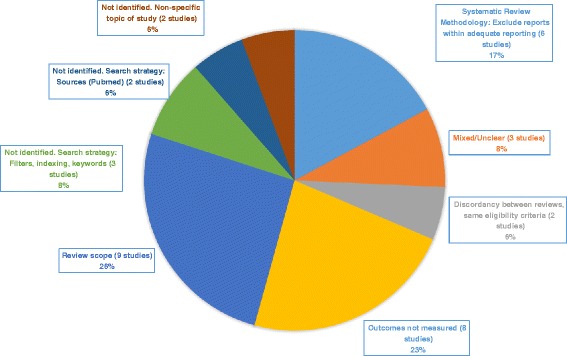
BACKGROUND: Systematic reviews (SRs) form the foundation for guidelines and evidence-based policy in medicine and public health. Although similar systematic reviews may include non-identical sets of studies, and it is recognized that different sets of studies may lead to different conclusions, little work has been published on why SR study cohorts differ. METHODS: We took advantage of concurrent publication of two SRs on the same topic - prevention of child exposure to tobacco smoke - to understand why study cohorts differed in the two reviews. We identified all studies included in just one review, investigated validity of specified reasons for exclusions, and, using database records, explored reasons for study non-identification. We assessed review methods and discordancy, and attempted to assess whether changes in study cohorts would have changed conclusions. RESULTS: Sixty-one studies were included in the two reviews. Thirty-five studies were present in just one review; of these, twenty were identified and excluded by the parallel review. Omissions were due to: review scope (9 studies, 26%), outcomes of interest not measured (8 studies, 23%), exclusion of reports with inadequate reporting (6 studies, 17%), mixed or unclear reasons (3 studies, 8%), search strategies concerning filters, tagging, and keywords (3 studies, 8%), search strategies regarding sources (PUBMED not searched) (2 studies, 6%); discordant interpretation of same eligibility criteria (2 studies, 6%), and non-identification due to non-specific study topic (2 studies, 6%). Review conclusions differed, but were likely due to differences in synthesis methods, not differences in study cohorts. CONCLUSIONS: The process of study identification for SRs is part art and part science. While some differences are due to differences in review scope, outcomes measured, or reporting practices, others are caused by search methods or discrepancies in reviewer interpretations. Different study cohorts may or may not be a cause of differing SR results. Completeness of SR study cohorts could be enhanced by 1 - independent identification of studies by at least two reviewers, as recommended by recent guidelines, 2 - searching PUBMED with free-text keywords in addition to MEDLINE to identify recent studies, and 3 - Using validated search filters.
Overview
The claims and statistics of this paper haven’t been checked yet.
Free: it reads the open-access text and checks the first 5 claims that cite a source we can check. Create a free account to check every claim.
Integrity signals
Registry
Cites
Statistics
Figures
Verification
Claims the paper makes
The claims and statistics of this paper haven’t been checked yet.
Free: it reads the open-access text and checks the first 5 claims that cite a source we can check. Create a free account to check every claim.
Claims other papers make about this one
Each is checked against this paper’s own text: does it say what the citing paper says it does?
The source backs part of the claim, not all of it — or backs it for a different population, condition or comparison.
In the citing paper
“Even when the proportion of missed records is small, excluding key studies could seriously bias effect estimates [22], resulting in misleading conclusions.”
From Technology-assisted title and abstract screening for systematic reviews: a retrospective evaluation of the Abstrackr machine learning tool (2018) · cites this paper as [22]
Experimental — accuracy not yet measured
Self-check
Percentages, sums and reported differences re-computed from the paper’s own numbers.
The self-check needs the paper’s full text.
Citations
Cites
Preferred Reporting Items for Systematic Reviews and Meta-Analyses: the PRISMA statement
Moher, D., Liberati, A., Tetzlaff, J., Altman, D. G., & for the PRISMA Group (2009) · BMJ · doi:10.1136/bmj.b2535 · Cited by 83,823
Preferred reporting items for systematic reviews and meta-analyses: the PRISMA Statement.
(2009) · PubMed Central · Cited by 44,859
Preferred Reporting Items for Systematic Reviews and Meta-Analyses: The PRISMA Statement
Moher, D., Liberati, A., Tetzlaff, J., & Altman, D. G. (2009) · Journal of Clinical Epidemiology · doi:10.1016/j.jclinepi.2009.06.005 · Cited by 19,575
Borenstein, M., Hedges, L. V., Higgins, J. P. T., & Rothstein, H. R. (2009) · doi:10.1002/9780470743386 · Cited by 14,225
Borenstein, M., Hedges, L. V., Higgins, J. P. T., & Rothstein, H. R. (2021) · doi:10.1002/9781119558378 · Cited by 9,799
Moher, D., Cook, D. J., Eastwood, S., Olkin, I., Rennie, D., & Stroup, D. F. (1999) · The Lancet · doi:10.1016/s0140-6736(99)04149-5 · Cited by 4,826
Development of AMSTAR: A measurement tool to assess the methodological quality of systematic reviews
Shea, B. J., Grimshaw, J. M., Wells, G. A., Boers, M., Andersson, N., Hamel, C., Porter, A. C., Tugwell, P., Moher, D., & Bouter, L. M. (2007) · BMC Medical Research Methodology · doi:10.1186/1471-2288-7-10 · Cited by 4,374
ROBIS: A new tool to assess risk of bias in systematic reviews was developed
Whiting, P., Savović, J., Higgins, J. P. T., Caldwell, D. M., Reeves, B. C., Shea, B., Davies, P., Kleijnen, J., & Churchill, R. (2016) · Journal of Clinical Epidemiology · doi:10.1016/j.jclinepi.2015.06.005 · Cited by 2,272
Systematic Reviews: Rationale for systematic reviews
Mulrow, C. D. (1994) · BMJ · doi:10.1136/bmj.309.6954.597 · Cited by 1,677
Andrews, J., Guyatt, G., Oxman, A. D., Alderson, P., Dahm, P., Falck-Ytter, Y., Nasser, M., Meerpohl, J., Post, P. N., Kunz, R., et al. (2013) · Journal of Clinical Epidemiology · doi:10.1016/j.jclinepi.2012.03.013 · Cited by 1,416
Epidemiology and reporting characteristics of systematic reviews.
Moher, D., Tetzlaff, J., Tricco, A. C., Sampson, M., & Altman, D. G. (2007) · PLoS Medicine · doi:10.1371/journal.pmed.0040078 · Cited by 891 · cited 1×
“The scientific community has approached this issue by 1 – creating reporting standards [4–6]; 2 – developing tools to validate SR quality [7] and risk of bias [8]; and 3 – applying those standards and tools to published SRs [4, 9–16].”
BackgroundStress Ulcer Prophylaxis in Critically III Patients: Resolving Discordant Meta-analyses
Cook, D. J. (1996) · JAMA · doi:10.1001/jama.1996.03530280060038 · Cited by 608
Jadad, A. R., Cook, D. J., Jones, A., Klassen, T. P., Tugwell, P., Moher, M., & Moher, D. (1998) · JAMA · doi:10.1001/jama.280.3.278 · Cited by 534
A guide to interpreting discordant systematic reviews.
Jadad, A., Cook, D. J., & Browman, G. P. (1997) · Europe PMC (PubMed Central) · Cited by 444
Baxi, R., Sharma, M., Roseby, R., Polnay, A., Priest, N., Waters, E., Spencer, N., & Webster, P. (2014) · Cochrane Database of Systematic Reviews · doi:10.1002/14651858.cd001746.pub3 · Cited by 332
Quality Control in Systematic Reviews and Meta-analyses
Bown, M. J., & Sutton, A. J. (2010) · European Journal of Vascular and Endovascular Surgery · doi:10.1016/j.ejvs.2010.07.011 · Cited by 323 · cited 1×
“A fourth approach, made possible by the proliferation of published SRs on similar topics, is based on empirical comparisons of SR methods, results, and conclusions [17–25].”
MethodBias in meta-analytic research
Felson, D. T. (1992) · Journal of Clinical Epidemiology · doi:10.1016/0895-4356(92)90072-u · Cited by 231 · cited 1×
“It has previously been suggested that bias can be “injected” into meta-analysis at the stages of finding studies, selection of studies for inclusion, and data extraction [82].”
BackgroundA Randomized Trial to Reduce Passive Smoke Exposure in Low-Income Households With Young Children
Emmons, K. M., Hammond, S. K., Fava, J. L., Velicer, W. F., Evans, J. L., & Monroe, A. D. (2001) · Pediatrics · doi:10.1542/peds.108.1.18 · Cited by 215 · cited 3×
“We found that omissions were attributable to: review scope (9 studies, 26 %) [40, 42–44, 46, 47, 56, 64, 70], outcomes of interest not measured (8 studies, 23 %) [38, 41, 45, 50, 54, 58, 59, 68], exclusion of reports with inadequate reporting (6 studies, 17 %) [39, 48, 51, 52, 61, 69], mixed or unclear reasons (3 stud…”
BackgroundEvaluation of methodological search filters—a review
Jenkins, M. (2004) · Health Information & Libraries Journal · doi:10.1111/j.1471-1842.2004.00511.x · Cited by 202 · cited 1×
“These filters differ in the way and the time they were developed, tested and validated, and their performance is not always well reported [80].”
BackgroundParental Smoking Cessation to Protect Young Children:A Systematic Review and Meta-analysis
Rosen, L. J., Noach, M. B., Winickoff, J. P., & Hovell, M. F. (2012) · Pediatrics · doi:10.1542/peds.2010-3209 · Cited by 197 · cited 1×
“Rosen’s review was the second in a series of meta-analyses; the first of which focused on parental cessation [32, 33].”
BackgroundSelf-citationIs meta-analysis the platinum standard of evidence?
Stegenga, J. (2011) · Studies in History and Philosophy of Science Part C: Studies in History and Philosophy of Biological and Biomedical Sciences · doi:10.1016/j.shpsc.2011.07.003 · Cited by 193 · cited 1×
“Background Systematic reviews (SRs) of the professional literature, sometimes termed the “platinum” standard of evidence [1], form the foundation for clinical guidelines and evidence-based health policy, thus shaping the policy agenda in medicine and public health [2, 3].”
BackgroundHow objective are systematic reviews? Differences between reviews on complementary medicine
Linde, K., & Willich, S. N. (2003) · Journal of the Royal Society of Medicine · doi:10.1258/jrsm.96.1.17 · Cited by 171 · cited 2×
“Unlike the few previous comparisons which explored reasons for discrepancies in SR cohorts [19, 21, 28], this study focused on the study identification process, and used detailed, date-specific information from MEDLINE, PUBMED, and EMBASE to understand why some studies were missed.”
BackgroundMethodControlled Trial of a Home and Ambulatory Program for Asthmatic Children
Hughes, D. M., McLeod, M., Garner, B., & Goldbloom, R. B. (1991) · Pediatrics · doi:10.1542/peds.87.1.54 · Cited by 163 · cited 3×
“We found that omissions were attributable to: review scope (9 studies, 26 %) [40, 42–44, 46, 47, 56, 64, 70], outcomes of interest not measured (8 studies, 23 %) [38, 41, 45, 50, 54, 58, 59, 68], exclusion of reports with inadequate reporting (6 studies, 17 %) [39, 48, 51, 52, 61, 69], mixed or unclear reasons (3 stud…”
BackgroundTeach, S. J., Crain, E. F., Quint, D. M., Hylan, M. L., & Joseph, J. G. (2006) · Archives of Pediatrics & Adolescent Medicine · doi:10.1001/archpedi.160.5.535 · Cited by 151
Armstrong, K. L., & Morris, J. (2000) · Journal of Paediatrics and Child Health · doi:10.1046/j.1440-1754.2000.00591.x · Cited by 146 · cited 3×
“Two additional studies which were included by Baxi but not identified by Rosen [36, 67], addressed very general health outcomes, without a stated objective regarding protection of children from tobacco smoke.”
BackgroundPediatric-Based Smoking Cessation Intervention for Low-Income Women: A Randomized Trial
Curry, S. J., Ludman, E. J., Graham, E., Stout, J., Grothaus, L., & Lozano, P. (2003) · Archives of Pediatrics & Adolescent Medicine · doi:10.1001/archpedi.157.3.295 · Cited by 140
Reduction of Environmental Tobacco Smoke Exposure Among Asthmatic Children: A Controlled Trial
Hovell, M. F., Meltzer, S. B., Zakarian, J. M., Wahlgren, D. R., Emerson, J. A., Hofstetter, C. R., Leaderer, B. P., Meltzer, E. O., Zeiger, R. S., O’Connor, R. D., et al. (1994) · CHEST Journal · doi:10.1378/chest.106.2.440 · Cited by 132 · cited 1×
“Rosen excluded one paper [66] because it was a follow-up study of a paper by Hovell 1994 [71] which she was planning to include.”
BackgroundRetrieving randomized controlled trials from medline : a comparison of 38 published search filters
McKibbon, K. A., Wilczynski, N. L., Haynes, R. B., & for the Hedges Team (2009) · Health Information & Libraries Journal · doi:10.1111/j.1471-1842.2008.00827.x · Cited by 126 · cited 1×
“Over the years, numerous filters have been developed, and one study compared between as many as 38 RCT filters for MEDLINE [79].”
BackgroundDelaney, A., Bagshaw, S. M., Ferland, A., Laupland, K., Manns, B., & Doig, C. (2007) · Critical Care Medicine · doi:10.1097/01.ccm.0000253394.15628.fd · Cited by 112 · cited 1×
“The scientific community has approached this issue by 1 – creating reporting standards [4–6]; 2 – developing tools to validate SR quality [7] and risk of bias [8]; and 3 – applying those standards and tools to published SRs [4, 9–16].”
BackgroundLanphear, B. P., Hornung, R. W., Khoury, J., Yolton, K., Lierl, M., & Kalkbrenner, A. (2011) · Pediatrics · doi:10.1542/peds.2009-2312 · Cited by 107 · cited 6×
“In our comparison, two identified studies were omitted on the basis of differences in judgments between reviewers [37, 53].”
BackgroundResultInfluentialHutton, B., Salanti, G., Chaimani, A., Caldwell, D. M., Schmid, C., Thorlund, K., Mills, E., Catalá-López, F., Turner, L., Altman, D. G., et al. (2014) · PLoS ONE · doi:10.1371/journal.pone.0092508 · Cited by 105
Reduction of Environmental Tobacco Smoke Exposure in Asthmatic Children
Wahlgren, D. R., Hovell, M. F., Meltzer, S. B., Hofstetter, C. R., & Zakarian, J. M. (1997) · CHEST Journal · doi:10.1378/chest.111.1.81 · Cited by 102
Which resources should be used to identify RCT/CCTs for systematic reviews: a systematic review
Crumley, E. T., Wiebe, N., Cramer, K., Klassen, T. P., & Hartling, L. (2005) · BMC Medical Research Methodology · doi:10.1186/1471-2288-5-24 · Cited by 95
Campbell, J., Bellamy, N., & Gee, T. (2007) · Osteoarthritis and Cartilage · doi:10.1016/j.joca.2007.01.022 · Cited by 93
Elder, J. P., Perry, C. L., Stone, E. J., Johnson, C., Yang, M., Edmundson, E. W., Smyth, M. H., Galati, T., Feldman, H. A., Cribb, P. W., et al. (1996) · Preventive Medicine · doi:10.1006/pmed.1996.0080 · Cited by 92 · cited 4×
“Elder JP, Perry CL, Stone EJ, Johnson CC, Yang M, Edmundson EW, et al. Tobacco use measurement, prediction, and intervention in elementary schools in four states: The CATCH study.”
BackgroundMethodResultInfluentialMotivating Latino caregivers of children with asthma to quit smoking: A randomized trial.
Borrelli, B., McQuaid, E. L., Novak, S. P., Hammond, S. K., & Becker, B. (2010) · Journal of Consulting and Clinical Psychology · doi:10.1037/a0016932 · Cited by 90 · cited 3×
“In our comparison, two identified studies were omitted on the basis of differences in judgments between reviewers [37, 53].”
BackgroundResultSchönberger, H. J. A. M., Dompeling, E., Knottnerus, J. A., Maas, T., Muris, J. W. M., van Weel, C., & van Schayck, C. P. (2005) · European Respiratory Journal · doi:10.1183/09031936.05.00067704 · Cited by 90 · cited 4×
“Use of grey literature Yes The absence of key data from six studies [39, 48, 51, 52, 61, 69] caused the exclusion of those studies from Rosen’s review, which employed a meta-analytic approach, but not from Baxi’s review, which used a narrative approach to synthesizing the data.”
BackgroundMethodInfluentialMeta-analysis of Parental Protection of Children From Tobacco Smoke Exposure
Rosen, L., Myers, V., Hovell, M. F., Zucker, D. M., & Noach, M. B. (2014) · PEDIATRICS · doi:10.1542/peds.2013-0958 · Cited by 85 · cited 2×
“Methods In order to compare the sets of studies included in two reviews published almost simultaneously on the topic of child protection from tobacco smoke exposure (Rosen 2014 [29] and Baxi 2014 [30]), we did the following: 1 Compared inclusion and exclusion criteria in the two reviews; 2 - Compared the search proces…”
BackgroundSelf-citationThe reporting quality of meta-analyses improves: a random sampling study
Wen, J., Ren, Y., Wang, L., Li, Y., Liu, Y., Zhou, M., Liu, P., Ye, L., Li, Y., & Tian, W. (2008) · Journal of Clinical Epidemiology · doi:10.1016/j.jclinepi.2007.10.008 · Cited by 84 · cited 1×
“The scientific community has approached this issue by 1 – creating reporting standards [4–6]; 2 – developing tools to validate SR quality [7] and risk of bias [8]; and 3 – applying those standards and tools to published SRs [4, 9–16].”
BackgroundWiggins, M., Oakley, A., Roberts, I., Turner, H., Rajan, L., Austerberry, H., Mujica, R., Mugford, M., & Barker, M. (2005) · Journal of Epidemiology and Community Health · doi:10.1136/jech.2004.021808 · Cited by 82 · cited 2×
“Two additional studies which were included by Baxi but not identified by Rosen [36, 67], addressed very general health outcomes, without a stated objective regarding protection of children from tobacco smoke.”
BackgroundTHE PROMISE AND PITFALLS OF SYSTEMATIC REVIEWS
Mullen, P. D., & Ramírez, G. (2006) · Annual Review of Public Health · doi:10.1146/annurev.publhealth.27.021405.102239 · Cited by 82 · cited 1×
“Background Systematic reviews (SRs) of the professional literature, sometimes termed the “platinum” standard of evidence [1], form the foundation for clinical guidelines and evidence-based health policy, thus shaping the policy agenda in medicine and public health [2, 3].”
BackgroundChilmonczyk, B. A., Palomaki, G. E., Knight, G. J., Williams, J., & Haddow, J. E. (1992) · Archives of Pediatrics and Adolescent Medicine · doi:10.1001/archpedi.1992.02160150097031 · Cited by 78 · cited 3×
“Use of grey literature Yes The absence of key data from six studies [39, 48, 51, 52, 61, 69] caused the exclusion of those studies from Rosen’s review, which employed a meta-analytic approach, but not from Baxi’s review, which used a narrative approach to synthesizing the data.”
BackgroundMethodUsing the Postpartum Hospital Stay to Address Mothers' and Fathers' Smoking: The NEWS Study
Winickoff, J. P., Healey, E. A., Regan, S., Park, E. R., Cole, C., Friebely, J., & Rigotti, N. A. (2010) · Pediatrics · doi:10.1542/peds.2009-0356 · Cited by 72 · cited 3×
“We found that omissions were attributable to: review scope (9 studies, 26 %) [40, 42–44, 46, 47, 56, 64, 70], outcomes of interest not measured (8 studies, 23 %) [38, 41, 45, 50, 54, 58, 59, 68], exclusion of reports with inadequate reporting (6 studies, 17 %) [39, 48, 51, 52, 61, 69], mixed or unclear reasons (3 stud…”
BackgroundWillis, B. H., & Quigley, M. (2011) · BMC Medical Research Methodology · doi:10.1186/1471-2288-11-163 · Cited by 71
Trial of an intervention to reduce passive smoking in infancy
Woodward, A. J., Owen, N. G., Grgurinovich, N., Griffith, F., & Linke, H. (1987) · Pediatric Pulmonology · doi:10.1002/ppul.1950030311 · Cited by 66 · cited 3×
“Use of grey literature Yes The absence of key data from six studies [39, 48, 51, 52, 61, 69] caused the exclusion of those studies from Rosen’s review, which employed a meta-analytic approach, but not from Baxi’s review, which used a narrative approach to synthesizing the data.”
BackgroundMethodRandomised controlled trial of a postpartum relapse prevention intervention
Van't Hof, S. M. (2000) · Tobacco Control · doi:10.1136/tc.9.suppl_3.iii64 · Cited by 58
Katerndahl, D. A., & Lawler, W. R. (1999) · American Journal of Epidemiology · doi:10.1093/oxfordjournals.aje.a009830 · Cited by 56 · cited 1×
“A fourth approach, made possible by the proliferation of published SRs on similar topics, is based on empirical comparisons of SR methods, results, and conclusions [17–25].”
MethodFord, A. C., Guyatt, G. H., Talley, N. J., & Moayyedi, P. (2010) · American Journal of Gastroenterology · doi:10.1038/ajg.2009.658 · Cited by 54 · cited 1×
“” Ford [25], in his study of 8 meta-analyses on similar topics, found that 6 of the 8 meta-analyses missed relevant studies, and that 5 of 8 meta-analysis included studies which were ineligible according to the review’s stated inclusion criteria.”
BackgroundThe Impact of Tailored Self-Help Smoking Cessation Guides on Young Mothers
Davis, S. W., Cummings, K. M., Rimer, B. K., Sciandra, R., & Stone, J. C. (1992) · Health Education Quarterly · doi:10.1177/109019819201900412 · Cited by 52 · cited 4×
“Fourteen studies were not identified by the parallel review [36, 42, 44, 46, 47, 49, 55–57, 62, 64, 65, 67, 70].”
BackgroundInfluentialHannöver, W., Thyrian, J. R., Röske, K., Grempler, J., Rumpf, H., John, U., & Hapke, U. (2008) · Addictive Behaviors · doi:10.1016/j.addbeh.2008.07.021 · Cited by 52
Chan, S. S. C., Lam, T. H., Salili, F., Leung, G. M., Wong, D., Botelho, R., Lo, S. L., & Lau, Y. (2005) · Applied Nursing Research · doi:10.1016/j.apnr.2005.01.002 · Cited by 50 · cited 3×
“We found that omissions were attributable to: review scope (9 studies, 26 %) [40, 42–44, 46, 47, 56, 64, 70], outcomes of interest not measured (8 studies, 23 %) [38, 41, 45, 50, 54, 58, 59, 68], exclusion of reports with inadequate reporting (6 studies, 17 %) [39, 48, 51, 52, 61, 69], mixed or unclear reasons (3 stud…”
BackgroundHuang, C., Wu, H., Huang, S.-H., Chien, L., & Guo, J. (2013) · European Journal of Public Health · doi:10.1093/eurpub/cks177 · Cited by 48 · cited 6×
“The time period for Stotts 2013 [35] to move from "Publisher" status to "In-Process" and enter MEDLINE was five months, the time period for Huang 2013 [49] was more than 8 months.”
BackgroundInfluentialStaying smoke free: An intervention to prevent postpartum relapse
French, G. M., Groner, J. A., Wewers, M. E., & Ahijevych, K. (2007) · Nicotine & Tobacco Research · doi:10.1080/14622200701365277 · Cited by 42 · cited 4×
“Five studies which were included by Baxi but not identified by Rosen addressed topics not included in Rosen’s review (prevention of postpartum relapse to smoking [46, 47, 56, 64]; cessation among young mothers [42]).”
BackgroundInfluentialGoodyear-Smith, F. A., van Driel, M. L., Arroll, B., & Del Mar, C. (2012) · BMC Medical Research Methodology · doi:10.1186/1471-2288-12-76 · Cited by 42 · cited 3×
“Unlike the few previous comparisons which explored reasons for discrepancies in SR cohorts [19, 21, 28], this study focused on the study identification process, and used detailed, date-specific information from MEDLINE, PUBMED, and EMBASE to understand why some studies were missed.”
BackgroundMethodEkerbiçer, H. Ç., Celik, M. S., Güler, E., Davutoğlu, M., & Kılınç, M. (2007) · BMC Public Health · doi:10.1186/1471-2458-7-202 · Cited by 42 · cited 2×
“Differences in age criteria (up to age 12 in Rosen, and up to age 18 in Baxi) caused the exclusion of two studies [40, 43] and were likely responsible for the nonidentification of two additional studies [44, 70].”
BackgroundResultRalston, S., & Roohi, M. (2008) · Pediatric Pulmonology · doi:10.1002/ppul.20810 · Cited by 39 · cited 4×
“We found that omissions were attributable to: review scope (9 studies, 26 %) [40, 42–44, 46, 47, 56, 64, 70], outcomes of interest not measured (8 studies, 23 %) [38, 41, 45, 50, 54, 58, 59, 68], exclusion of reports with inadequate reporting (6 studies, 17 %) [39, 48, 51, 52, 61, 69], mixed or unclear reasons (3 stud…”
BackgroundInfluentialPrevention of postpartum smoking relapse in mothers of infants in the neonatal intensive care unit
Phillips, R. M., Merritt, T. A., Goldstein, M. R., Deming, D. D., Slater, L. E., & Angeles, D. M. (2012) · Journal of Perinatology · doi:10.1038/jp.2011.106 · Cited by 37 · cited 4×
“Five studies which were included by Baxi but not identified by Rosen addressed topics not included in Rosen’s review (prevention of postpartum relapse to smoking [46, 47, 56, 64]; cessation among young mothers [42]).”
BackgroundInfluentialStotts, A. L., Green, C., Northrup, T. F., Dodrill, C. L., Evans, P. W., Tyson, J. E., Velasquez, M. M., Hammond, S. K., & Hovell, M. F. (2013) · Journal of Perinatology · doi:10.1038/jp.2013.43 · Cited by 35 · cited 5×
“The time period for Stotts 2013 [35] to move from "Publisher" status to "In-Process" and enter MEDLINE was five months, the time period for Huang 2013 [49] was more than 8 months.”
BackgroundResultInfluentialDuffy, S., de Kock, S., Misso, K., Noake, C., Ross, J., & Stirk, L. (2016) · Journal of the Medical Library Association : JMLA · doi:10.3163/1536-5050.104.4.011 · Cited by 33
Kallio, K., Jokinen, E. V., Hämäläinen, M. M., Kaitosaari, T., Volanen, I., Viikari, J. S. A., Rönnemaa, T., & Simell, O. (2005) · Acta Paediatrica · doi:10.1080/08035250500375145 · Cited by 30 · cited 3×
“Use of grey literature Yes The absence of key data from six studies [39, 48, 51, 52, 61, 69] caused the exclusion of those studies from Rosen’s review, which employed a meta-analytic approach, but not from Baxi’s review, which used a narrative approach to synthesizing the data.”
BackgroundMethodRalston, S. L., Grohman, C., Word, D., & Williams, J. F. (2012) · Pediatric Pulmonology · doi:10.1002/ppul.22614 · Cited by 28 · cited 2×
“We found that omissions were attributable to: review scope (9 studies, 26 %) [40, 42–44, 46, 47, 56, 64, 70], outcomes of interest not measured (8 studies, 23 %) [38, 41, 45, 50, 54, 58, 59, 68], exclusion of reports with inadequate reporting (6 studies, 17 %) [39, 48, 51, 52, 61, 69], mixed or unclear reasons (3 stud…”
BackgroundMultiple systematic reviews: methods for assessing discordances of results
Moja, L., Fernandez del Rio, M. P., Banzi, R., Cusi, C., D’Amico, R., Liberati, A., Lodi, G., Lucenteforte, E., Minozzi, S., Pecoraro, V., et al. (2012) · Internal and Emergency Medicine · doi:10.1007/s11739-012-0846-1 · Cited by 27 · cited 3×
“The two SRs would probably be considered discordant by Moja’s criteria.”
BackgroundMethodInfluentialVineis, P., Ronco, G., Ciccone, G., Vernero, E., Troia, B., D'Incalci, T., & Gogliani, F. (1993) · Tumori Journal · doi:10.1177/030089169307900304 · Cited by 27 · cited 4×
“The Vineis study [65] was missed by Rosen’s MEDLINE search.”
BackgroundMethodInfluentialStreja, L., Crespi, C. M., Bastani, R., Wong, G. C. L., Jones, C. A., Bernert, J. T., Tashkin, D. P., Hammond, S. K., & Berman, B. A. (2012) · Journal of Immigrant and Minority Health · doi:10.1007/s10903-012-9713-4 · Cited by 23 · cited 7×
“Baxi (personal communication, July 31, 2014) thought that of these studies, only Streja [62] would have been included.”
BackgroundInfluentialHealth and safety intervention with first-time mothers
Culp, A. M., Culp, R., Anderson, J., & Carter, S. (2006) · Health Education Research · doi:10.1093/her/cyl079 · Cited by 23 · cited 2×
“Differences in age criteria (up to age 12 in Rosen, and up to age 18 in Baxi) caused the exclusion of two studies [40, 43] and were likely responsible for the nonidentification of two additional studies [44, 70].”
BackgroundResultHerbert, R. J., Gagnon, A. J., O’Loughlin, J. L., & Rennick, J. E. (2011) · Journal of Community Health · doi:10.1007/s10900-011-9356-8 · Cited by 21 · cited 3×
“Use of grey literature Yes The absence of key data from six studies [39, 48, 51, 52, 61, 69] caused the exclusion of those studies from Rosen’s review, which employed a meta-analytic approach, but not from Baxi’s review, which used a narrative approach to synthesizing the data.”
BackgroundMethodThacker, S. B., & Stroup, D. F. (2002) · American Journal of Obstetrics and Gynecology · doi:10.1016/s0002-9378(02)70183-x · Cited by 19 · cited 1×
“A fourth approach, made possible by the proliferation of published SRs on similar topics, is based on empirical comparisons of SR methods, results, and conclusions [17–25].”
MethodReporting methodological search filter performance comparisons: a literature review
Harbour, J., Fraser, C., Lefebvre, C., Glanville, J., Beale, S., Boachie, C., Duffy, S., McCool, R., & Smith, L. (2014) · Health Information & Libraries Journal · doi:10.1111/hir.12070 · Cited by 18 · cited 1×
“A recent study suggested that filter performance be presented as a forest plot, to allow visualization by reviewers of benefits [81].”
BackgroundRosen, L., & Noach, M. B. (2010) · Journal of Clinical Epidemiology · doi:10.1016/j.jclinepi.2009.09.010 · Cited by 14
Self-citationAlperson, S. Y., & Berger, V. W. (2011) · The Journal of Alternative and Complementary Medicine · doi:10.1089/acm.2010.0175 · Cited by 13 · cited 1×
“A fourth approach, made possible by the proliferation of published SRs on similar topics, is based on empirical comparisons of SR methods, results, and conclusions [17–25].”
MethodCessation of passive smoking reduces allergic responses and plasma neurotrophin
Kimata, H. (2004) · European Journal of Clinical Investigation · doi:10.1111/j.1365-2362.2004.01297.x · Cited by 13 · cited 3×
“Use of grey literature Yes The absence of key data from six studies [39, 48, 51, 52, 61, 69] caused the exclusion of those studies from Rosen’s review, which employed a meta-analytic approach, but not from Baxi’s review, which used a narrative approach to synthesizing the data.”
BackgroundMethodMothers’ Efforts to Protect Their Infants from Environmental Tobacco Smoke
Ratner, P. A., Johnson, J. L., & Bottorff, J. L. (2001) · Canadian Journal of Public Health · doi:10.1007/bf03404843 · Cited by 12 · cited 2×
“The Ratner paper [60] was excluded by Rosen due to lack of a control group.”
BackgroundPatel, S. J., Hendry, P. L., Kalynych, C. J., Butterfield, R. C., Lott, M., & Lukens-Bull, K. (2012) · International Journal on Disability and Human Development · doi:10.1515/ijdhd-2012-0052 · Cited by 12 · cited 7×
“ROSEN: Of the studies not identified by Rosen, three would have been excluded on the basis of inclusion criteria (age: Elder [44], Zhang [70], minimum follow-up: Pulley [57]), five on the basis of goals (postpartum relapse: French [46], Hannover [47], Phillips [56], Van’t Hopf [64], cessation of young mothers Davis [4…”
BackgroundMethodInfluentialMütterlicher Tabakkonsum lässt sich durch einfache Intervention des Kinderarztes reduzieren
Nuesslein, T. G., Struwe, A., Maiwald, N., RIEGER, C. H. L., & Stephan, V. (2006) · Klinische Pädiatrie · doi:10.1055/s-2005-872459 · Cited by 10 · cited 3×
“We found that omissions were attributable to: review scope (9 studies, 26 %) [40, 42–44, 46, 47, 56, 64, 70], outcomes of interest not measured (8 studies, 23 %) [38, 41, 45, 50, 54, 58, 59, 68], exclusion of reports with inadequate reporting (6 studies, 17 %) [39, 48, 51, 52, 61, 69], mixed or unclear reasons (3 stud…”
BackgroundPulley, K. R., & Flanders-Stepans, M. B. (2002) · PubMed · doi:10.1624/105812402x88812 · Cited by 6
Pulley, K. R., & Flanders-Stepans, M. B. (2002) · The Journal of Perinatal Education · doi:10.1891/1058-1243.11.3.28 · Cited by 6 · cited 5×
“Pulley KR, Flanders-Stepans MB. Smoking hygiene: an educational intervention to reduce respiratory symptoms in breastfeeding infants exposed to tobacco.”
BackgroundInfluentialThacker, S. B. (2002) · American Journal of Obstetrics and Gynecology · doi:10.1067/mob.2002.123635 · Cited by 1
Research works printed but not linked: 2
- 26. Higgins JPT, Green S E. Cochrane Handbook for Systematic Reviews of Interventions 4.2.6 [updated September 2006]. Chichester, UK: The Cochrane Library, Issue 4. John Wiley & Sons, Ltd.; 2006.
- 33. Rosen LJ. E-letter: Revised tables re: Parental Smoking Cessation to Protect Young Children: A Systematic Review and Meta-analysis. Pediatrics. 2013.
Cited by
Schütze, R., Rees, C., Smith, A., Slater, H., Campbell, J. M., & O'Sullivan, P. (2018) · The Journal of Pain · doi:10.1016/j.jpain.2017.09.010 · Cited by 231
Gates, A., Johnson, C., & Hartling, L. (2018) · Systematic Reviews · doi:10.1186/s13643-018-0707-8 · Cited by 148
“Even when the proportion of missed records is small, excluding key studies could seriously bias effect estimates [22], resulting in misleading conclusions.”
BackgroundNeale, E. P., Tapsell, L. C., Guan, V. X., & Batterham, M. J. (2017) · BMJ Open · doi:10.1136/bmjopen-2017-016863 · Cited by 129
“Furthermore, where possible, Medical Subject Heading terms as well as free-text search terms were used in the search.(26) Reference lists of eligible articles and relevant reviews were also reviewed for potential studies.”
Ali, N. B., & Usman, M. (2018) · Information and Software Technology · doi:10.1016/j.infsof.2018.02.002 · Cited by 58
Wills, O. C., & Probst, Y. (2022) · Health and Quality of Life Outcomes · doi:10.1186/s12955-022-02046-1 · Cited by 58
“Although PubMed is a subset of MEDLINE, both MEDLINE and PubMed databases were searched to ensure that the most recent studies were identified [27].”
Method
Metadata
- Authors
- Rosen, L., & Suhami, R.
- Affiliations
- Tel Aviv University (IL)
- Corresponding author
- Rosen, Laura
- ORCID
- Rosen, Laura
- Venue
- BMC Medical Research Methodology
- Published
- 2016-02-24
- Volume
- 16
- Issue
- 1
- Pages
- 24-24
- ISSN
- 1471-2288 (ISSN-L)
- PMC
- PMC4766738
- OpenAlex
- W2287655111
- Cited by
- 22
- References
- 80
- Citations by year
- 2026: 2 · 2025: 1 · 2024: 1 · 2023: 5 · 2022: 3 · 2021: 2 · 2020: 2 · 2019: 1 · 2018: 2 · 2017: 2 · 2016: 1
- FWCI
- 0.69
- Type
- journal article
- Language
- en
- Open access
- gold
- doi.org
- Licence
- cc-by
- Locations
- BMC Medical Research Methodology (publishedVersion, cc-by)
- Europe PMC (PubMed Central) (publishedVersion, cc-by)
- PubMed Central (publishedVersion, cc-by)
- PubMed (publishedVersion)
- DOAJ (DOAJ: Directory of Open Access Journals) (submittedVersion)
- Funders
- Flight Attendant Medical Research Institute (072086_YCSA)
- Topics
- Social Sciences › Decision Sciences › Statistics, Probability and Uncertainty › Meta-analysis and systematic reviews
- Health Sciences › Medicine › Public Health, Environmental and Occupational Health › Clinical practice guidelines implementation
- Health Sciences › Health Professions › General Health Professions › Health Sciences Research and Education
- Keywords
- search strategies, search filters, reviewer disagreement, MEDLINE, PubMed, study eligibility criteria
- MeSH terms
- Child, Female, Humans, Male, Pediatrics, Publications, Quality Control, Review Literature as Topic, Tobacco Smoke Pollution, Meta-Analysis as Topic, Randomized Controlled Trials as Topic, Evidence-Based Medicine, Editorial Policies
About these checks
Registry, retraction, Cites and statistics results are computed, not judged, with one exception: a printed reference that no index lists is read once by a model before it counts as a citation error. Claims are extracted by a model and kept only when their quote appears verbatim in the text; each cited source is then checked, with a model’s help, for whether it says what the claim relies on. Those verdicts can be wrong — read the claim’s quote and the cited source before relying on one.
Statistics and arithmetic are recomputed, not judged.
Confidence bands are shown only for fields calibrated on our annotated test set. None is calibrated yet, so no band is shown.
What counts as a claim ›How we measure confidence ›How we check this ›
Are you an author, or do you see a problem with this page? Request a review
Data sources
Bibliographic data: Semantic Scholar, OpenAlex, Crossref.
Contains information from the Semantic Scholar Academic Graph Datasets, made available under the ODC Attribution License (ODC-BY 1.0).
Semantic Scholar’s data is described in: Kinney, R., et al. (2023). The Semantic Scholar Open Data Platform. arXiv:2301.10140.
