

The DOI matches its Crossref record; 48 of the 49 references it cites were found in a registry or an index.
DeepSurv: personalized treatment recommender system using a Cox proportional hazards deep neural network
Open accessAbstract
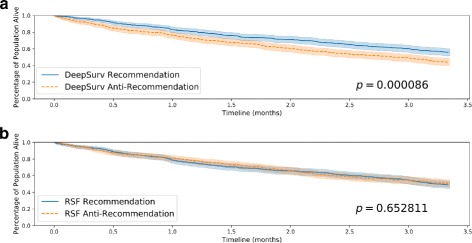
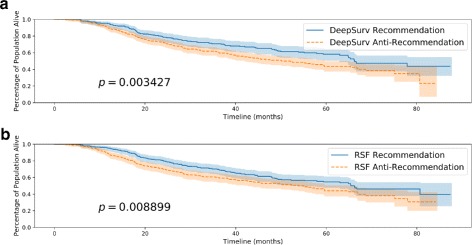
BACKGROUND: Medical practitioners use survival models to explore and understand the relationships between patients' covariates (e.g. clinical and genetic features) and the effectiveness of various treatment options. Standard survival models like the linear Cox proportional hazards model require extensive feature engineering or prior medical knowledge to model treatment interaction at an individual level. While nonlinear survival methods, such as neural networks and survival forests, can inherently model these high-level interaction terms, they have yet to be shown as effective treatment recommender systems. METHODS: We introduce DeepSurv, a Cox proportional hazards deep neural network and state-of-the-art survival method for modeling interactions between a patient's covariates and treatment effectiveness in order to provide personalized treatment recommendations. RESULTS: We perform a number of experiments training DeepSurv on simulated and real survival data. We demonstrate that DeepSurv performs as well as or better than other state-of-the-art survival models and validate that DeepSurv successfully models increasingly complex relationships between a patient's covariates and their risk of failure. We then show how DeepSurv models the relationship between a patient's features and effectiveness of different treatment options to show how DeepSurv can be used to provide individual treatment recommendations. Finally, we train DeepSurv on real clinical studies to demonstrate how it's personalized treatment recommendations would increase the survival time of a set of patients. CONCLUSIONS: The predictive and modeling capabilities of DeepSurv will enable medical researchers to use deep neural networks as a tool in their exploration, understanding, and prediction of the effects of a patient's characteristics on their risk of failure.
Overview
The claims and statistics of this paper haven’t been checked yet.
Run the check — free, no account needed. It reads the open-access text and checks the sources it cites.
Integrity signals
Registry
Cites
Statistics
Figures
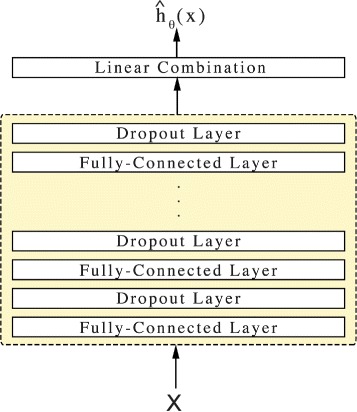
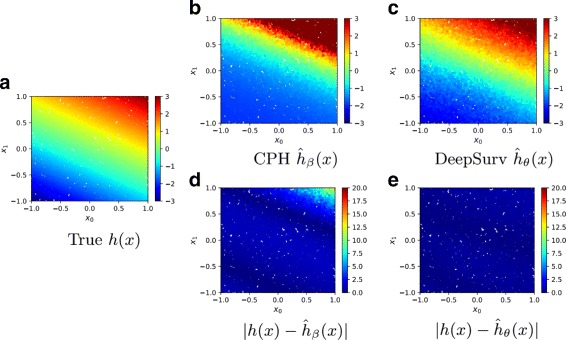
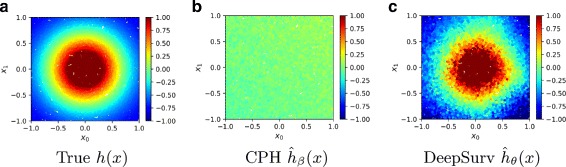
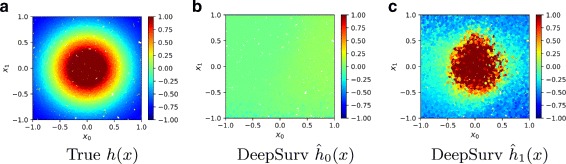
Verification
Claims the paper makes
The claims and statistics of this paper haven’t been checked yet.
Run the check — free, no account needed. It reads the open-access text and checks the sources it cites.
Self-check
Percentages, sums and reported differences re-computed from the paper’s own numbers.
The self-check needs the paper’s full text.
Citations
Cites
Adam: A Method for Stochastic Optimization
Kingma, D. P., & Ba, J. (2014) · arXiv · doi:10.48550/arxiv.1412.6980 · Cited by 98,946 · cited 1×
“more than one hidden layer) and apply modern techniques such as weight decay regularization, Rectified Linear Units (ReLU) [17] with batch normalization [18], Scaled Exponential Linear Units (SELU) [19], dropout [20], gradient descent optimization algorithms (Stochastic Gradient Descent and Adaptive Moment Estimation…”
MethodAn Introduction to the Bootstrap
Efron, B., & Tibshirani, R. J. (1994) · doi:10.1201/9780429246593 · Cited by 40,500
(2014) · Cited by 33,419
Batch Normalization: Accelerating Deep Network Training by Reducing Internal Covariate Shift
Ioffe, S., & Szegedy, C. (2015) · arXiv · doi:10.48550/arxiv.1502.03167 · Cited by 27,818
Regression Models and Life-Tables
Cox, D. R. (1992) · Springer Series in Statistics · doi:10.1007/978-1-4612-4380-9_37 · Cited by 26,297 · cited 1×
“iables in outcomes such as death or cancer recurrence and subsequently inform patients of their treatment options [1, 2, 3, 4]. One standard survival model is the Cox proportional hazards model (CPH) [5]. The CPH arXiv:1606.00931v3 [stat.ML] 9 Aug 2017 is a semiparametric model that calculates the effects of observed…”
MethodAn Introduction to the Bootstrap
Efron, B., & Tibshirani, R. J. (1993) · doi:10.1007/978-1-4899-4541-9 · Cited by 21,230
(2010) · International Conference on Machine Learning · Cited by 13,995
Modeling Survival Data: Extending the Cox Model
Therneau, T. M., & Grambsch, P. M. (2000) · Statistics for Biology and Health · doi:10.1007/978-1-4757-3294-8 · Cited by 8,674
(2012) · Cited by 8,009
The genomic and transcriptomic architecture of 2,000 breast tumours reveals novel subgroups
METABRIC Group, Curtis, C., Shah, S. P., Chin, S.-F., Turashvili, G., Rueda, O. M., Dunning, M. J., Speed, D., Lynch, A. G., Samarajiwa, S., et al. (2012) · Nature · doi:10.1038/nature10983 · Cited by 6,097 · cited 1×
“First, we simulate clinical treatment data by including an additional covariate to the simulated data from Section 4.1.2.”
MethodInfluentialHosmer, D. W., Lemeshow, S. A., & May, S. J. (2008) · Wiley series in probability and statistics · doi:10.1002/9780470258019 · Cited by 3,851 · cited 1×
“We show that if all patients follow the network’s recommended treatment option, we gain a significant increase in patient lifespan.”
BackgroundApplied Survival Analysis: Regression Modeling of Time-to-Event Data
Hosmer, D. W., Lemeshow, S. A., & May, S. J. (2008) · Cited by 3,030
Ishwaran, H., Kogalur, U. B., Blackstone, E. H., & Lauer, M. S. (2008) · The Annals of Applied Statistics · doi:10.1214/08-aoas169 · Cited by 2,714 · cited 1×
“Another popular machine learning approach to modeling patients’ hazard function is the random survival forest (RSF) [15, 16].”
BackgroundAn Introduction to the Bootstrap
Grimshaw, S. D., Efron, B., & Tibshirani, R. J. (1995) · Technometrics · doi:10.2307/1269918 · Cited by 2,281
Self-Normalizing Neural Networks
Klambauer, G., Unterthiner, T., Mayr, A., & Hochreiter, S. (2017) · arXiv · doi:10.48550/arxiv.1706.02515 · Cited by 2,267 · cited 1×
“These include: standardizing the input, Scaled Exponential Linear Units (SELU) [19] as the activation function, Adaptive Moment Estimation (Adam) [20] for the gradient descent algorithm, Nesterov momentum [21], and learning rate scheduling [22].”
MethodRegression modelling strategies for improved prognostic prediction
Harrell, F. E., Lee, K. L., Califf, R. M., Pryor, D. B., & Rosati, R. A. (1984) · Statistics in Medicine · doi:10.1002/sim.4780030207 · Cited by 1,804
Ishwaran, H., Kogalur, U. B., Blackstone, E. H., & Lauer, M. S. (2008) · Cited by 1,310
Gradient methods for minimizing composite functions
Nesterov, Y. E. (2012) · Mathematical Programming · doi:10.1007/s10107-012-0629-5 · Cited by 1,300 · cited 1×
“These include: standardizing the input, Scaled Exponential Linear Units (SELU) [19] as the activation function, Adaptive Moment Estimation (Adam) [20] for the gradient descent algorithm, Nesterov momentum [21], and learning rate scheduling [22].”
MethodReducing and meta-analysing estimates from distributed lag non-linear models
Gasparrini, A., & Armstrong, B. (2013) · BMC Medical Research Methodology · doi:10.1186/1471-2288-13-1 · Cited by 1,081
Yeh, R. W., Secemsky, E. A., Kereiakes, D. J., Normand, S.-L. T., Gershlick, A. H., Cohen, D. J., Spertus, J. A., Steg, P. G., Cutlip, D. E., Rinaldi, M. J., et al. (2016) · JAMA · doi:10.1001/jama.2016.3775 · Cited by 934 · cited 1×
“Medical researchers use survival models to evaluate the significance of prognostic variables in outcomes such as death or cancer recurrence and subsequently inform patients of their treatment options [1, 2, 3, 4].”
BackgroundExternal validation of a Cox prognostic model: principles and methods
Royston, P. J., & Altman, D. G. (2013) · BMC Medical Research Methodology · doi:10.1186/1471-2288-13-33 · Cited by 911 · cited 1×
“Medical researchers use survival models to evaluate the significance of prognostic variables in outcomes such as death or cancer recurrence and subsequently inform patients of their treatment options [1, 2, 3, 4].”
BackgroundApplied Survival Analysis: Regression Modeling of Time to Event Data
Rao, P., Hosmer, D. W., & Lemeshow, S. A. (2000) · Journal of the American Statistical Association · doi:10.2307/2669422 · Cited by 878
Uniformly distributed sequences with an additional uniform property
Sobol, I. M. (1976) · USSR Computational Mathematics and Mathematical Physics · doi:10.1016/0041-5553(76)90154-3 · Cited by 778 · cited 1×
“We use the Sobol solver [35, 36] to sample each hyper-parameter from a predefined range and evaluate the performance of the configuration using k-means cross validation (k = 3).”
MethodSemi-Supervised Methods to Predict Patient Survival from Gene Expression Data
Bair, E., & Tibshirani, R. J. (2004) · PLoS Biology · doi:10.1371/journal.pbio.0020108 · Cited by 749 · cited 2×
“It is a common practice in medical applications to determine the relationship between a patient’s observable covariates and his or her risk of an event [13, 3, 26].”
Background(1992) · Springer series in statistics · doi:10.1007/978-1-4612-4380-9 · Cited by 616
The SUPPORT Prognostic Model: Objective Estimates of Survival for Seriously Ill Hospitalized Adults
Knaus, W. A., Harrell, F. E., Lynn, J., Goldman, L., Phillips, R. S., Connors, A. F., Dawson, N. V., Fulkerson, W. J., Califf, R. M., Desbiens, N., et al. (1995) · Annals of Internal Medicine · doi:10.7326/0003-4819-122-3-199502010-00007 · Cited by 586
A neural network model for survival data
Faraggi, D., & Simon, R. M. (1995) · Statistics in Medicine · doi:10.1002/sim.4780140108 · Cited by 467 · cited 3×
“As previous research suggests, the Faraggi-Simon network has not been shown to outperform the linear CPH [10, 12, 13].”
BackgroundResultDayhoff, J. E., & DeLeo, J. M. (2001) · Cancer · doi:10.1002/1097-0142(20010415)91:8+ · Cited by 437
The urokinase system of plasminogen activation and prognosis in 2780 breast cancer patients.
Foekens, J. A., Peters, H. A., Look, M. P., Portengen, H., Schmitt, M., Kramer, M. D., Brünner, N., Jänicke, F., Gelder, M. E. M., Henzen-Logmans, S. C., et al. (2000) · PubMed · Cited by 419
Understanding the exploding gradient problemPreprint
Pascanu, R., Mikolov, T., & Bengio, Y. (2012) · arXiv (Cornell University) · Cited by 413
Biganzoli, E. M., Boracchi, P., Mariani, L., & Marubini, E. (1998) · Statistics in Medicine · doi:10.1002/(sici)1097-0258(19980530)17:10 · Cited by 274
Schumacher, M. C., Bastert, G., Bojar, H., Hübner, K., Olschewski, M., Sauerbrei, W., Schmoor, C., Beyerle, C., Neumann, R. L. A., & Rauschecker, H. (1994) · Journal of Clinical Oncology · doi:10.1200/jco.1994.12.10.2086 · Cited by 241 · cited 4×
“Next, we calculate the recommender function (Equation 5) for all patients in the GBSG test set and determine the recommended treatment for each patient.”
BackgroundInfluentialIshwaran, H., & Kogalur, U. B. (2007) · Cited by 207
Generating survival times to simulate Cox proportional hazards models with time‐varying covariates
Austin, P. C. (2012) · Statistics in Medicine · doi:10.1002/sim.5452 · Cited by 197 · cited 1×
“To quantify these differences, we calculate the mean-squared-error (MSE) between a model’s predicted risk and the true risk values.”
MethodAn empirical study of learning rates in deep neural networks for speech recognition
Senior, A., Heigold, G., Ranzato, M., & Yang, K. (2013) · IEEE International Conference on Acoustics Speech and Signal Processing · doi:10.1109/icassp.2013.6638963 · Cited by 176 · cited 1×
“These include: standardizing the input, Scaled Exponential Linear Units (SELU) [19] as the activation function, Adaptive Moment Estimation (Adam) [20] for the gradient descent algorithm, Nesterov momentum [21], and learning rate scheduling [22].”
MethodAlgorithm 647: Implementation and Relative Efficiency of Quasirandom Sequence Generators
Fox, B. L. (1986) · ACM Transactions on Mathematical Software · doi:10.1145/22721.356187 · Cited by 164 · cited 1×
“We use the Sobol solver [35, 36] to sample each hyper-parameter from a predefined range and evaluate the performance of the configuration using k-means cross validation (k = 3).”
MethodDevelopment of a Prognostic Model for Breast Cancer Survival in an Open Challenge Environment
Cheng, W., Yang, T.-H. O., & Anastassiou, D. (2013) · Science Translational Medicine · doi:10.1126/scitranslmed.3005974 · Cited by 138 · cited 3×
“The competition winners found four metagene factors (CIN, MES, LYM, FGD3-SUSD3) to be high predictors of survival rates [34, 4].”
BackgroundMethodDeep Survival AnalysisPreprint
Ranganath, R., Perotte, A., Elhadad, N., & Blei, D. M. (2016) · arXiv (Cornell University) · doi:10.48550/arxiv.1608.02158 · Cited by 124 · cited 1×
“A more recent deep learning approach models the event time according to a Weibull distribution with parameters given by latent variables generated by a deep exponential family [17].”
BackgroundSurvival analysis and neural nets
Liestbl, K., Andersen, P. K., & Andersen, U. (1994) · Statistics in Medicine · doi:10.1002/sim.4780131202 · Cited by 117 · cited 1×
“These include variants of: (i) classification methods (see details in [6, 7]), (ii) timeencoded methods (see details in [8, 9]), (iii) and riskpredicting methods (see details in [10]).”
Xiang, A. H., Lapuerta, P., Ryutov, A., Buckley, J. D., & Azen, S. P. (2000) · Computational Statistics & Data Analysis · doi:10.1016/s0167-9473(99)00098-5 · Cited by 86 · cited 1×
“As previous research suggests, the Faraggi-Simon network has not been shown to outperform the linear CPH [10, 12, 13].”
ResultMariani, L., Coradini, D., Biganzoli, E. M., Boracchi, P., Marubini, E., Pilotti, S., Salvadori, B., Silvestrini, R., Veronesi, U., Zucali, R., et al. (1997) · Breast Cancer Research and Treatment · doi:10.1023/a:1005765403093 · Cited by 81 · cited 3×
“However, perhaps because the practice of NNs was not as developed as it is today, they failed to demonstrate improvements beyond the linear Cox model, see [7] and [13].”
BackgroundResultJerez, J. M., Franco, L., Alba, E., Llombart‐Cussac, A., Lluch, A. M., Ribelles, N., Munárriz, B., & Martín, M. (2005) · Breast Cancer Research and Treatment · doi:10.1007/s10549-005-9013-y · Cited by 62 · cited 1×
“These include variants of: (i) classification methods (see details in [6, 7]), (ii) timeencoded methods (see details in [8, 9]), (iii) and riskpredicting methods (see details in [10]).”
A Neural Network Model for Prognostic Prediction
Street, W. N. (1998) · Cited by 59
Organochlorine and mercury residues in the harp seal (Pagophilus groenlandicus)
Jones, D., Ronald, K., Lavigne, D. M., Frank, R., Holdrinet, M. V. H., & Uthe, J. F. (1976) · The Science of The Total Environment · doi:10.1016/0048-9697(76)90054-1 · Cited by 44
IHC4 score plus clinical treatment score predicts locoregional recurrence in early breast cancer
Lakhanpal, R., Šestak, I., Shadbolt, B., Bennett, G., Brown, M. T., Phillips, T., Zhang, Y., Bullman, A., & Rezo, A. (2016) · The Breast · doi:10.1016/j.breast.2016.06.019 · Cited by 21 · cited 1×
“We prepare the dataset in line with the Immunohistochemical 4 plus Clinical (IHC4+C) test, which is a common prognostic tool for evaluating treatment options for breast cancer patients [30].”
MethodArtificial neural networks and prognosis in medicine. Survival analysis in breast cancer patients.
Franco, L., Jerez, J. M., & Alba, E. (2005) · The European Symposium on Artificial Neural Networks · Cited by 6
jaredleekatzman/DeepSurv: First Release of DeepSurv
Katzman, J. L. (2017) · Figshare · doi:10.5281/zenodo.1134131 · Cited by 3
Cited by
Sorted by citations
Opportunities and obstacles for deep learning in biology and medicine
Ching, T., Himmelstein, D. S., Beaulieu-Jones, B. K., Kalinin, A. A., Do, B. T., Way, G. P., Ferrero, E., Agapow, P.-M., Zietz, M., Hoffman, M. M., et al. (2018) · Journal of The Royal Society Interface · doi:10.1098/rsif.2017.0387 · Cited by 2,310
An overview of deep learning in medical imaging focusing on MRI
Lundervold, A. S., & Lundervold, A. (2019) · Zeitschrift für Medizinische Physik · doi:10.1016/j.zemedi.2018.11.002 · Cited by 2,058
Predicting cancer outcomes from histology and genomics using convolutional networks
Mobadersany, P., Yousefi, S., Amgad, M., Gutman, D. A., Barnholtz-Sloan, J. S., Velázquez Vega, J. E., Brat, D. J., & Cooper, L. A. D. (2018) · Proceedings of the National Academy of Sciences · doi:10.1073/pnas.1717139115 · Cited by 1,084
An overview of deep learning in medical imaging focusing on MRI
Lundervold, A. S., & Lundervold, A. (2018) · NORA - Norwegian Open Research Archives · Cited by 1,012
Deep learning in cancer diagnosis, prognosis and treatment selection
Tran, K. A., Kondrashova, O., Bradley, A., Williams, E. D., Pearson, J. V., & Waddell, N. (2021) · Genome Medicine · doi:10.1186/s13073-021-00968-x · Cited by 932
Metadata
- Authors
- Katzman, J. L., Shaham, U., Cloninger, A., Bates, J., Jiang, T., & Kluger, Y.
- Affiliations
- Yale University (US)
- Yale New Haven Hospital (US)
- Yale Cancer Center (US)
- Corresponding author
- Kluger, Yuval
- Venue
- BMC Medical Research Methodology
- Published
- 2018-02-26
- Volume
- 18
- Issue
- 1
- Pages
- 24-24
- ISSN
- 1471-2288 (ISSN-L)
- PMC
- PMC5828433
- OpenAlex
- W2753919178
- Cited by
- 1,995
- References
- 49
- Citations by year
- 2026: 376 · 2025: 386 · 2024: 321 · 2023: 301 · 2022: 238 · 2021: 206 · 2020: 94 · 2019: 54 · 2018: 18
- FWCI
- 52.41
- Type
- journal article
- Language
- en
- Open access
- gold
- doi.org
- Locations
- BMC Medical Research Methodology (publishedVersion, cc-by)
- PubMed Central (publishedVersion, cc-by)
- PubMed (publishedVersion)
- arXiv (Cornell University) (submittedVersion)
- DOAJ (DOAJ: Directory of Open Access Journals) (submittedVersion, cc-by-sa)
- arXiv (Cornell University)
- Funders
- National Human Genome Research Institute (1R01HG008383-01A1)
- Directorate for Mathematical and Physical Sciences (DMS-1402254)
- Topics
- Physical Sciences › Computer Science › Artificial Intelligence › Machine Learning in Healthcare
- Physical Sciences › Mathematics › Statistics and Probability › Statistical Methods and Inference
- Physical Sciences › Computer Science › Information Systems › Recommender Systems and Techniques
- Keywords
- DeepSurv, Cox proportional hazards model, deep neural network, survival analysis, personalized treatment recommendations, treatment effectiveness, clinical trials
- MeSH terms
- Algorithms, Humans, Proportional Hazards Models, Neural Networks, Computer, Outcome Assessment, Health Care, Kaplan-Meier Estimate, Precision Medicine
About these checks
Registry, retraction, Cites and statistics results are computed, not judged, with one exception: a printed reference that no index lists is read once by a model before it counts as a citation error. Claims are extracted by a model and kept only when their quote appears verbatim in the text; each cited source is then checked, with a model’s help, for whether it says what the claim relies on. Those verdicts can be wrong — read the claim’s quote and the cited source before relying on one.
Statistics and arithmetic are recomputed, not judged.
Confidence bands are shown only for fields calibrated on our annotated test set. None is calibrated yet, so no band is shown.
What counts as a claim ›How we measure confidence ›How we check this ›
Are you an author, or do you see a problem with this page? Request a review
