

The DOI matches its Crossref record; 48 of the 49 references it cites were found in a registry or an index.
DeepSurv: personalized treatment recommender system using a Cox proportional hazards deep neural network
Open accessAbstract
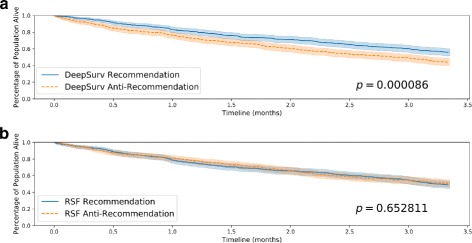
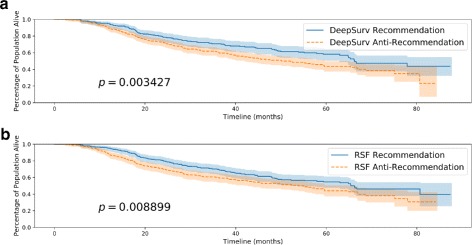
BACKGROUND: Medical practitioners use survival models to explore and understand the relationships between patients' covariates (e.g. clinical and genetic features) and the effectiveness of various treatment options. Standard survival models like the linear Cox proportional hazards model require extensive feature engineering or prior medical knowledge to model treatment interaction at an individual level. While nonlinear survival methods, such as neural networks and survival forests, can inherently model these high-level interaction terms, they have yet to be shown as effective treatment recommender systems. METHODS: We introduce DeepSurv, a Cox proportional hazards deep neural network and state-of-the-art survival method for modeling interactions between a patient's covariates and treatment effectiveness in order to provide personalized treatment recommendations. RESULTS: We perform a number of experiments training DeepSurv on simulated and real survival data. We demonstrate that DeepSurv performs as well as or better than other state-of-the-art survival models and validate that DeepSurv successfully models increasingly complex relationships between a patient's covariates and their risk of failure. We then show how DeepSurv models the relationship between a patient's features and effectiveness of different treatment options to show how DeepSurv can be used to provide individual treatment recommendations. Finally, we train DeepSurv on real clinical studies to demonstrate how it's personalized treatment recommendations would increase the survival time of a set of patients. CONCLUSIONS: The predictive and modeling capabilities of DeepSurv will enable medical researchers to use deep neural networks as a tool in their exploration, understanding, and prediction of the effects of a patient's characteristics on their risk of failure.
Overview
The claims and statistics of this paper haven’t been checked yet.
Run the check — free, no account needed. It reads the open-access text and checks the sources it cites.
Integrity signals
Registry
Cites
Statistics
Figures
Verification
Claims the paper makes
The claims and statistics of this paper haven’t been checked yet.
Run the check — free, no account needed. It reads the open-access text and checks the sources it cites.
Self-check
Percentages, sums and reported differences re-computed from the paper’s own numbers.
The self-check needs the paper’s full text.
Citations
Cites
Adam: A Method for Stochastic Optimization
Kingma, D. P., & Ba, J. (2014) · arXiv · doi:10.48550/arxiv.1412.6980 · Cited by 98,946 · cited 1×
“more than one hidden layer) and apply modern techniques such as weight decay regularization, Rectified Linear Units (ReLU) [17] with batch normalization [18], Scaled Exponential Linear Units (SELU) [19], dropout [20], gradient descent optimization algorithms (Stochastic Gradient Descent and Adaptive Moment Estimation…”
MethodAn Introduction to the Bootstrap
Efron, B., & Tibshirani, R. J. (1994) · doi:10.1201/9780429246593 · Cited by 40,500
(2014) · Cited by 33,419
Batch Normalization: Accelerating Deep Network Training by Reducing Internal Covariate Shift
Ioffe, S., & Szegedy, C. (2015) · arXiv · doi:10.48550/arxiv.1502.03167 · Cited by 27,818
Regression Models and Life-Tables
Cox, D. R. (1992) · Springer Series in Statistics · doi:10.1007/978-1-4612-4380-9_37 · Cited by 26,297 · cited 1×
“iables in outcomes such as death or cancer recurrence and subsequently inform patients of their treatment options [1, 2, 3, 4]. One standard survival model is the Cox proportional hazards model (CPH) [5]. The CPH arXiv:1606.00931v3 [stat.ML] 9 Aug 2017 is a semiparametric model that calculates the effects of observed…”
MethodAn Introduction to the Bootstrap
Efron, B., & Tibshirani, R. J. (1993) · doi:10.1007/978-1-4899-4541-9 · Cited by 21,230
(2010) · International Conference on Machine Learning · Cited by 13,995
Modeling Survival Data: Extending the Cox Model
Therneau, T. M., & Grambsch, P. M. (2000) · Statistics for Biology and Health · doi:10.1007/978-1-4757-3294-8 · Cited by 8,674
(2012) · Cited by 8,009
The genomic and transcriptomic architecture of 2,000 breast tumours reveals novel subgroups
METABRIC Group, Curtis, C., Shah, S. P., Chin, S.-F., Turashvili, G., Rueda, O. M., Dunning, M. J., Speed, D., Lynch, A. G., Samarajiwa, S., et al. (2012) · Nature · doi:10.1038/nature10983 · Cited by 6,097 · cited 1×
“First, we simulate clinical treatment data by including an additional covariate to the simulated data from Section 4.1.2.”
MethodInfluential
Cited by
Sorted by citations
Opportunities and obstacles for deep learning in biology and medicine
Ching, T., Himmelstein, D. S., Beaulieu-Jones, B. K., Kalinin, A. A., Do, B. T., Way, G. P., Ferrero, E., Agapow, P.-M., Zietz, M., Hoffman, M. M., et al. (2018) · Journal of The Royal Society Interface · doi:10.1098/rsif.2017.0387 · Cited by 2,310
An overview of deep learning in medical imaging focusing on MRI
Lundervold, A. S., & Lundervold, A. (2019) · Zeitschrift für Medizinische Physik · doi:10.1016/j.zemedi.2018.11.002 · Cited by 2,058
Predicting cancer outcomes from histology and genomics using convolutional networks
Mobadersany, P., Yousefi, S., Amgad, M., Gutman, D. A., Barnholtz-Sloan, J. S., Velázquez Vega, J. E., Brat, D. J., & Cooper, L. A. D. (2018) · Proceedings of the National Academy of Sciences · doi:10.1073/pnas.1717139115 · Cited by 1,084
An overview of deep learning in medical imaging focusing on MRI
Lundervold, A. S., & Lundervold, A. (2018) · NORA - Norwegian Open Research Archives · Cited by 1,012
Deep learning in cancer diagnosis, prognosis and treatment selection
Tran, K. A., Kondrashova, O., Bradley, A., Williams, E. D., Pearson, J. V., & Waddell, N. (2021) · Genome Medicine · doi:10.1186/s13073-021-00968-x · Cited by 932
Metadata
- Authors
- Katzman, J. L., Shaham, U., Cloninger, A., Bates, J., Jiang, T., & Kluger, Y.
- Affiliations
- Yale University (US)
- Yale New Haven Hospital (US)
- Yale Cancer Center (US)
- Corresponding author
- Kluger, Yuval
- Venue
- BMC Medical Research Methodology
- Published
- 2018-02-26
- Volume
- 18
- Issue
- 1
- Pages
- 24-24
- ISSN
- 1471-2288 (ISSN-L)
- PMC
- PMC5828433
- OpenAlex
- W2753919178
- Cited by
- 1,995
- References
- 49
- Citations by year
- 2026: 376 · 2025: 386 · 2024: 321 · 2023: 301 · 2022: 238 · 2021: 206 · 2020: 94 · 2019: 54 · 2018: 18
- FWCI
- 52.41
- Type
- journal article
- Language
- en
- Open access
- gold
- doi.org
- Locations
- BMC Medical Research Methodology (publishedVersion, cc-by)
- PubMed Central (publishedVersion, cc-by)
- PubMed (publishedVersion)
- arXiv (Cornell University) (submittedVersion)
- DOAJ (DOAJ: Directory of Open Access Journals) (submittedVersion, cc-by-sa)
- arXiv (Cornell University)
- Funders
- National Human Genome Research Institute (1R01HG008383-01A1)
- Directorate for Mathematical and Physical Sciences (DMS-1402254)
- Topics
- Physical Sciences › Computer Science › Artificial Intelligence › Machine Learning in Healthcare
- Physical Sciences › Mathematics › Statistics and Probability › Statistical Methods and Inference
- Physical Sciences › Computer Science › Information Systems › Recommender Systems and Techniques
- Keywords
- DeepSurv, Cox proportional hazards model, deep neural network, survival analysis, personalized treatment recommendations, treatment effectiveness, clinical trials
- MeSH terms
- Algorithms, Humans, Proportional Hazards Models, Neural Networks, Computer, Outcome Assessment, Health Care, Kaplan-Meier Estimate, Precision Medicine
About these checks
Registry, retraction, Cites and statistics results are computed, not judged, with one exception: a printed reference that no index lists is read once by a model before it counts as a citation error. Claims are extracted by a model and kept only when their quote appears verbatim in the text; each cited source is then checked, with a model’s help, for whether it says what the claim relies on. Those verdicts can be wrong — read the claim’s quote and the cited source before relying on one.
Statistics and arithmetic are recomputed, not judged.
Confidence bands are shown only for fields calibrated on our annotated test set. None is calibrated yet, so no band is shown.
What counts as a claim ›How we measure confidence ›How we check this ›
Are you an author, or do you see a problem with this page? Request a review
