

The DOI matches its Crossref record; 58 of the 58 references it cites were found in a registry or an index.
Improving the normalization of complex interventions: part 1 - development of the NoMAD instrument for assessing implementation work based on normalization process theory (NPT)
Open accessAbstract
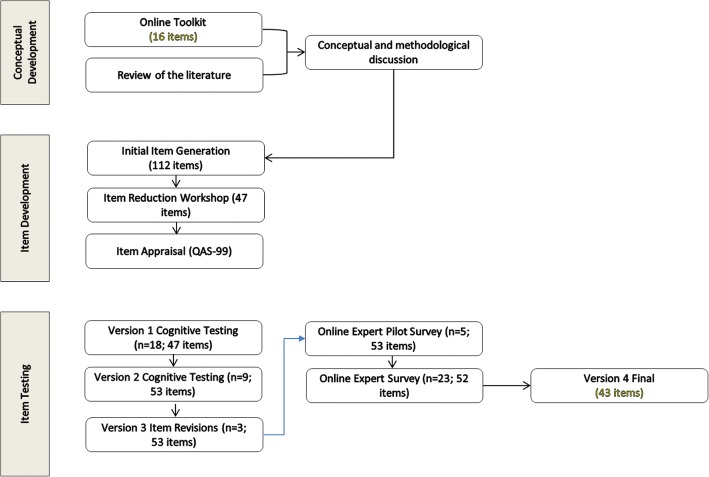
BACKGROUND: Understanding and measuring implementation processes is a key challenge for implementation researchers. This study draws on Normalization Process Theory (NPT) to develop an instrument that can be applied to assess, monitor or measure factors likely to affect normalization from the perspective of implementation participants. METHODS: An iterative process of instrument development was undertaken using the following methods: theoretical elaboration, item generation and item reduction (team workshops); item appraisal (QAS-99); cognitive testing with complex intervention teams; theory re-validation with NPT experts; and pilot testing of instrument. RESULTS: We initially generated 112 potential questionnaire items; these were then reduced to 47 through team workshops and item appraisal. No concerns about item wording and construction were raised through the item appraisal process. We undertook three rounds of cognitive interviews with professionals (n = 30) involved in the development, evaluation, delivery or reception of complex interventions. We identified minor issues around wording of some items; universal issues around how to engage with people at different time points in an intervention; and conceptual issues around the types of people for whom the instrument should be designed. We managed these by adding extra items (n = 6) and including a new set of option responses: 'not relevant at this stage', 'not relevant to my role' and 'not relevant to this intervention' and decided to design an instrument explicitly for those people either delivering or receiving an intervention. This version of the instrument had 53 items. Twenty-three people with a good working knowledge of NPT reviewed the items for theoretical drift. Items that displayed a poor alignment with NPT sub-constructs were removed (n = 8) and others revised or combined (n = 6). The final instrument, with 43 items, was successfully piloted with five people, with a 100% completion rate of items. CONCLUSION: The process of moving through cycles of theoretical translation, item generation, cognitive testing, and theoretical (re)validation was essential for maintaining a balance between the theoretical integrity of the NPT concepts and the ease with which intended respondents could answer the questions. The final instrument could be easily understood and completed, while retaining theoretical validity. NoMAD represents a measure that can be used to understand implementation participants' experiences. It is intended as a measure that can be used alongside instruments that measure other dimensions of implementation activity, such as implementation fidelity, adoption, and readiness.
Overview
The claims and statistics of this paper haven’t been checked yet.
Run the check — free, no account needed. It reads the open-access text and checks the sources it cites.
Integrity signals
Registry
Cites
Statistics
Figures
Verification
Claims the paper makes
The claims and statistics of this paper haven’t been checked yet.
Run the check — free, no account needed. It reads the open-access text and checks the sources it cites.
Claims other papers make about this one
Each is checked against this paper’s own text: does it say what the citing paper says it does?
The check wasn’t confident either way, so it gives no verdict — never disputed.
In the citing paper
“The measure is characterized by a Cronbach's Alpha of 0.89 (83).”
From Clinical and Cost-Effectiveness of PSYCHOnlineTHERAPY: Study Protocol of a Multicenter Blended Outpatient Psychotherapy Cluster Randomized Controlled Trial for Patients With Depressive and Anxiety Disorders (2021) · cites this paper as [83]
Experimental — accuracy not yet measured
Self-check
Percentages, sums and reported differences re-computed from the paper’s own numbers.
The self-check needs the paper’s full text.
Citations
Cites
Damschroder, L. J., Aron, D. C., Keith, R. E., Kirsh, S. R., Alexander, J. A., & Lowery, J. C. (2009) · Implementation Science · doi:10.1186/1748-5908-4-50 · Cited by 14,496
Developing and evaluating complex interventions: the new Medical Research Council guidance
Craig, P., Dieppe, P., Macintyre, S., Michie, S., Nazareth, I., & Petticrew, M. (2008) · BMJ · doi:10.1136/bmj.a1655 · Cited by 10,995
Proctor, E., Silmere, H., Raghavan, R., Hovmand, P., Aarons, G., Bunger, A., Griffey, R., & Hensley, M. (2011) · Administration and Policy in Mental Health and Mental Health Services Research · doi:10.1007/s10488-010-0319-7 · Cited by 8,721
Diffusion of Innovations in Service Organizations: Systematic Review and Recommendations
GREENHALGH, T., ROBERT, G., MACFARLANE, F., BATE, P., & KYRIAKIDOU, O. (2004) · The Milbank Quarterly · doi:10.1111/j.0887-378x.2004.00325.x · Cited by 7,448
Making sense of implementation theories, models and frameworks
Nilsen, P. (2015) · Implementation Science · doi:10.1186/s13012-015-0242-0 · Cited by 4,447
Implementing, Embedding, and Integrating Practices: An Outline of Normalization Process Theory
May, C., & Finch, T. (2009) · Sociology · doi:10.1177/0038038509103208 · Cited by 2,115
Self-citationThe Meaning of Translational Research and Why It Matters
Woolf, S. H. (2008) · JAMA · doi:10.1001/jama.2007.26 · Cited by 1,910
Willis, G. (2005) · doi:10.4135/9781412983655 · Cited by 1,778
Development of a theory of implementation and integration: Normalization Process Theory
May, C. R., Mair, F., Finch, T., MacFarlane, A., Dowrick, C., Treweek, S., Rapley, T., Ballini, L., Ong, B. N., Rogers, A., et al. (2009) · Implementation Science · doi:10.1186/1748-5908-4-29 · Cited by 1,409
Self-citationPlanning and Studying Improvement in Patient Care: The Use of Theoretical Perspectives
GROL, R. P. T. M., BOSCH, M. C., HULSCHER, M. E. J. L., ECCLES, M. P., & WENSING, M. (2007) · The Milbank Quarterly · doi:10.1111/j.1468-0009.2007.00478.x · Cited by 943
Chaudoir, S. R., Dugan, A. G., & Barr, C. H. (2013) · Implementation Science · doi:10.1186/1748-5908-8-22 · Cited by 800
Weiner, B. J., Amick, H., & Lee, S.-Y. D. (2008) · Medical Care Research and Review · doi:10.1177/1077558708317802 · Cited by 786
Organizational readiness for implementing change: a psychometric assessment of a new measure
Shea, C., Jacobs, S., Esserman, D. A., Bruce, K., & Weiner, B. (2014) · Implementation Science · doi:10.1186/1748-5908-9-7 · Cited by 785
May, C., Finch, T., Mair, F., Ballini, L., Dowrick, C., Eccles, M., Gask, L., MacFarlane, A., Murray, E., Rapley, T., et al. (2007) · BMC Health Services Research · doi:10.1186/1472-6963-7-148 · Cited by 768
Self-citationStewart, D. W., Schwarz, N., & Sudman, S. (1996) · Journal of Marketing Research · doi:10.2307/3152152 · Cited by 692
Towards a general theory of implementation
May, C. (2013) · Implementation Science · doi:10.1186/1748-5908-8-18 · Cited by 656
Self-citationAarons, G. A., Ehrhart, M. G., & Farahnak, L. R. (2014) · Implementation Science · doi:10.1186/1748-5908-9-45 · Cited by 559
Lewis, C. C., Fischer, S., Weiner, B. J., Stanick, C., Kim, M., & Martinez, R. G. (2015) · Implementation Science · doi:10.1186/s13012-015-0342-x · Cited by 430
McEvoy, R., Ballini, L., Maltoni, S., O’Donnell, C. A., Mair, F. S., & MacFarlane, A. (2014) · Implementation Science · doi:10.1186/1748-5908-9-2 · Cited by 413
Self-citationGallacher, K., May, C. R., Montori, V. M., & Mair, F. S. (2011) · The Annals of Family Medicine · doi:10.1370/afm.1249 · Cited by 356
Self-citationThe analysis and interpretation of cognitive interviews for instrument development
Knafl, K. A., Deatrick, J. A., Gallo, A. M., Holcombe, G., Bakitas, M. A., Dixon, J. K., & Grey, M. J. (2007) · Research in Nursing & Health · doi:10.1002/nur.20195 · Cited by 342
Finch, T. L., Girling, M., May, C. R., Mair, F. S., Murray, E., Treweek, S., McColl, E., Steen, I. N., Cook, C., Vernazza, C. R., et al. (2018) · BMC Medical Research Methodology · doi:10.1186/s12874-018-0591-x · Cited by 337
Self-citationGlasgow, R. E., & Riley, W. T. (2013) · American Journal of Preventive Medicine · doi:10.1016/j.amepre.2013.03.010 · Cited by 318
Why is it difficult to implement e-health initiatives? A qualitative study
Murray, E., Burns, J., May, C., Finch, T., O'Donnell, C., Wallace, P., & Mair, F. (2011) · Implementation Science · doi:10.1186/1748-5908-6-6 · Cited by 270
Self-citationUsing a Theory-Driven Conceptual Framework in Qualitative Health Research
MacFarlane, A. E., & Brún, M. O.-D. (2011) · Qualitative Health Research · doi:10.1177/1049732311431898 · Cited by 263
Instrumentation issues in implementation science
Martinez, R. G., Lewis, C. C., & Weiner, B. J. (2014) · Implementation Science · doi:10.1186/s13012-014-0118-8 · Cited by 243
May, C. R., Finch, T. L., Ballini, L., MacFarlane, A. E., Mair, F. S., Murray, E., Treweek, S., & Rapley, T. (2011) · Arrow@dit (Dublin Institute of Technology) · doi:10.34961/10032 · Cited by 235
Self-citationContext matters: measuring implementation climate among individuals and groups
Jacobs, S., Weiner, B. J., & Bunger, A. C. (2014) · Implementation Science · doi:10.1186/1748-5908-9-46 · Cited by 189
Finch, T. L., Rapley, T., Girling, M., Mair, F. S., Murray, E., Treweek, S., McColl, E., Steen, I. N., & May, C. R. (2013) · Implementation Science · doi:10.1186/1748-5908-8-43 · Cited by 177
Self-citationElwyn, G., Légaré, F., Weijden, T. V. D., Edwards, A., & May, C. (2008) · Implementation Science · doi:10.1186/1748-5908-3-57 · Cited by 159
Self-citationFoy, R., Ovretveit, J., Shekelle, P. G., Pronovost, P. J., Taylor, S. L., Dy, S., Hempel, S., McDonald, K. M., Rubenstein, L. V., & Wachter, R. M. (2011) · BMJ Quality & Safety · doi:10.1136/bmjqs.2010.047993 · Cited by 148
Rogers, A. E., Vassilev, I., Sanders, C., Kirk, S. A., Chew-Graham, C. A., Kennedy, A. P., Protheroe, J., Bower, P., Blickem, C., Reeves, D., et al. (2011) · Implementation Science · doi:10.1186/1748-5908-6-56 · Cited by 129
Finch, T. L., Mair, F. S., O’Donnell, C., Murray, E., & May, C. R. (2012) · BMC Medical Research Methodology · doi:10.1186/1471-2288-12-69 · Cited by 127
Self-citationImplementation research: state of the art and future directions
Linton, J. D. (2002) · Technovation · doi:10.1016/s0166-4972(01)00075-x · Cited by 126
Gagnon, M., Attieh, R., Ghandour, E., Légaré, F., Ouimet, M., Estabrooks, C., & Grimshaw, J. (2014) · PLoS ONE · doi:10.1371/journal.pone.0114338 · Cited by 119
Clinton-McHarg, T., Yoong, S. L., Tzelepis, F., Regan, T., Fielding, A., Skelton, E., Kingsland, M., Ooi, J. Y., & Wolfenden, L. (2016) · Implementation Science · doi:10.1186/s13012-016-0512-5 · Cited by 116
Understanding factors that inhibit or promote the utilization of telecare in chronic lung disease
Mair, F. S., Hiscock, J., & Beaton, S. C. (2008) · Chronic Illness · doi:10.1177/1742395308092482 · Cited by 115
Self-citationImplementing a stepped-care approach in primary care: results of a qualitative study
Franx, G., Oud, M., de Lange, J., Wensing, M., & Grol, R. (2012) · Implementation Science · doi:10.1186/1748-5908-7-8 · Cited by 106
Understanding the implementation and integration of e-health services
Mair, F., May, C., Finch, T., Murray, E., Anderson, G. K., Sullivan, F., O'Donnell, C., Wallace, P., & Epstein, O. (2007) · Journal of Telemedicine and Telecare · doi:10.1258/135763307781645112 · Cited by 105
Self-citationSquires, J. E., Estabrooks, C. A., O'Rourke, H. M., Gustavsson, P., Newburn-Cook, C. V., & Wallin, L. (2011) · Implementation Science · doi:10.1186/1748-5908-6-83 · Cited by 101
Development and formative evaluation of the e-Health Implementation Toolkit (e-HIT)
Murray, E., May, C., & Mair, F. (2010) · BMC Medical Informatics and Decision Making · doi:10.1186/1472-6947-10-61 · Cited by 96
Self-citationBlakeman, T., Protheroe, J., Chew-Graham, C., Rogers, A., & Kennedy, A. (2012) · British Journal of General Practice · doi:10.3399/bjgp12x636056 · Cited by 96
Sanders, T., Foster, N. E., & Ong, B. N. (2011) · BMC Medicine · doi:10.1186/1741-7015-9-49 · Cited by 84
Dyson, J., Lawton, R., Jackson, C., & Cheater, F. (2013) · Implementation Science · doi:10.1186/1748-5908-8-111 · Cited by 81
Exploring implementation and sustainability of models of care: can theory help?
Forster, D. A., Newton, M. S., McLachlan, H., & Willis, K. F. (2011) · BMC Public Health · doi:10.1186/1471-2458-11-s5-s8 · Cited by 76
Embedding effective depression care: using theory for primary care organisational and systems change
Gunn, J. M., Palmer, V. J., Dowrick, C. F., Herrman, H., Griffiths, F. E., Kokanović, R., Blashki, G. A., Hegarty, K. L., Johnson, C., Potiriadis, M., et al. (2010) · Implementation Science · doi:10.1186/1748-5908-5-62 · Cited by 75
Self-citationGask, L., Bower, P., Lovell, K., Escott, D., Archer, J., Gilbody, S., Lankshear, A. J., Simpson, A. E., & Richards, D. A. (2010) · Implementation Science · doi:10.1186/1748-5908-5-15 · Cited by 75
A coding system for appraising questionnaires.
Lessler, J. T., & Forsyth, B. (1996) · Cited by 68
Kennedy, A., Chew-Graham, C., Blakeman, T., Bowen, A., Gardner, C., Protheroe, J., Rogers, A., & Gask, L. (2010) · Implementation Science · doi:10.1186/1748-5908-5-7 · Cited by 66
Measurement of a model of implementation for health care: toward a testable theory
Cook, J. M., O’Donnell, C., Dinnen, S., Coyne, J. C., Ruzek, J. I., & Schnurr, P. P. (2012) · Implementation Science · doi:10.1186/1748-5908-7-59 · Cited by 62
QUAID: A questionnaire evaluation aid for survey methodologists
Graesser, A. C., Wiemer-Hastings, K., Kreuz, R. J., Hastings, P., & Marquis, K. H. (2000) · Behavior Research Methods, Instruments, & Computers · doi:10.3758/bf03207792 · Cited by 56
Beyond the limits of clinical governance? The case of mental health in English primary care
Gask, L. L., Rogers, A. E., Campbell, S., & Sheaff, R. (2008) · BMC Health Services Research · doi:10.1186/1472-6963-8-63 · Cited by 55
Atkins, S., Lewin, S., Ringsberg, K. C., & Thorson, A. (2011) · BMC Health Services Research · doi:10.1186/1472-6963-11-275 · Cited by 42
Stamatakis, K. A., McQueen, A., Filler, C., Boland, E., Dreisinger, M., Brownson, R. C., & Luke, D. A. (2012) · Implementation Science · doi:10.1186/1748-5908-7-65 · Cited by 42
James, D. M. (2011) · Implementation Science · doi:10.1186/1748-5908-6-95 · Cited by 22
Information systems development: a normalisation process theory perspective
Sooklal, R., Παπαδόπουλος, Θ., & Ojiako, U. (2011) · Industrial Management & Data Systems · doi:10.1108/02635571111170794 · Cited by 20
Process evaluation of infertility management in primary care: has open access HSG been normalized?
Wilkes, S., & Rubin, G. P. (2009) · Primary Health Care Research & Development · doi:10.1017/s1463423609990168 · Cited by 10
May, C. R., Finch, T., Ballini, L., MacFarlane, A., Mair, F., Murray, E., Treweek, S., & Rapley, T. (2011) · BMC Health Services Research · doi:10.1186/1472-6963-11-245 · Cited by 3
Self-citation
Cited by
Sorted by citations
Action, actor, context, target, time (AACTT): a framework for specifying behaviour
Presseau, J., McCleary, N., Lorencatto, F., Patey, A. M., Grimshaw, J. M., & Francis, J. J. (2019) · Implementation Science · doi:10.1186/s13012-019-0951-x · Cited by 411
Finch, T. L., Girling, M., May, C. R., Mair, F. S., Murray, E., Treweek, S., McColl, E., Steen, I. N., Cook, C., Vernazza, C. R., et al. (2018) · BMC Medical Research Methodology · doi:10.1186/s12874-018-0591-x · Cited by 337
Self-citationMay, C. R., Albers, B., Bracher, M., Finch, T. L., Gilbert, A. W., Girling, M., Greenwood, K., MacFarlane, A. E., Mair, F. S., May, C., et al. (2022) · Implementation Science · doi:10.1186/s13012-022-01191-x · Cited by 283
Self-citationVis, C., Ruwaard, J., Finch, T. L., Rapley, T., Beurs, D. P. D., van Stel, H. F., van Lettow, B., Mol, M., Kleiboer, A. M., Riper, H. M., et al. (2019) · Journal of Medical Internet Research · doi:10.2196/12376 · Cited by 85
Self-citationHall, A., Shoesmith, A., Doherty, E., McEvoy, B., Mettert, K., Lewis, C. C., Wolfenden, L., Yoong, S., Kingsland, M., Shelton, R. C., et al. (2022) · Implementation Science · doi:10.1186/s13012-022-01252-1 · Cited by 81
Metadata
- Authors
- Rapley, T., Girling, M., Mair, F. S., Murray, E., Treweek, S., McColl, E., Steen, I. N., May, C. R., & Finch, T. L.
- Affiliations
- Northumbria University (GB)
- Newcastle University (GB)
- University of Glasgow (GB)
- The Royal Free Hospital (GB)
- University of Aberdeen (GB)
- London School of Hygiene & Tropical Medicine (GB)
- Corresponding author
- Rapley, Tim
- ORCID
- Venue
- BMC Medical Research Methodology
- Published
- 2018-11-15
- Volume
- 18
- Issue
- 1
- Pages
- 133-133
- ISSN
- 1471-2288 (ISSN-L)
- PMC
- PMC6238361
- OpenAlex
- W2982498515
- Cited by
- 193
- References
- 57
- Citations by year
- 2026: 19 · 2025: 31 · 2024: 28 · 2023: 23 · 2022: 37 · 2021: 30 · 2020: 16 · 2019: 7 · 2018: 2
- FWCI
- 21.00
- Type
- journal article
- Language
- en
- Open access
- gold
- doi.org
- Licence
- Locations
- BMC Medical Research Methodology (publishedVersion, cc-by)
- Europe PMC (PubMed Central) (publishedVersion, other-oa)
- PubMed Central (publishedVersion, cc-by)
- PubMed (publishedVersion)
- Northumbria Research Link (Northumbria University) (acceptedVersion)
- ENLIGHTEN (Jurnal Bimbingan dan Konseling Islam) (acceptedVersion, cc-by-sa)
- LSHTM Research Online (London School of Hygiene and Tropical Medicine) (acceptedVersion)
- Aberdeen University Research Archive (Aberdeen University) (submittedVersion, other-oa)
- DOAJ (DOAJ: Directory of Open Access Journals) (submittedVersion, cc-by-sa)
- UCL Discovery (University College London) (submittedVersion)
- Funders
- Economic and Social Research Council (RES-062-23-3274)
- National Institute for Health Research (Collaboration for Leadership in Applied Health Research and Care North Thames., School for Primary Care Research)
- Topics
- Health Sciences › Health Professions › General Health Professions › Health Policy Implementation Science
- Social Sciences › Sociology and Political Science › Delphi Technique in Research
- Health Sciences › Medicine › Public Health, Environmental and Occupational Health › Clinical practice guidelines implementation
- Keywords
- Normalization Process Theory, complex interventions, implementation research, NOMAD instrument, instrument development, cognitive interviewing, item generation, theory validation
- MeSH terms
- Implementation Science, Cognition, Delivery of Health Care, Health Services Research, Humans, Interview, Psychological, Pilot Projects, Surveys and Questionnaires
About these checks
Registry, retraction, Cites and statistics results are computed, not judged, with one exception: a printed reference that no index lists is read once by a model before it counts as a citation error. Claims are extracted by a model and kept only when their quote appears verbatim in the text; each cited source is then checked, with a model’s help, for whether it says what the claim relies on. Those verdicts can be wrong — read the claim’s quote and the cited source before relying on one.
Statistics and arithmetic are recomputed, not judged.
Confidence bands are shown only for fields calibrated on our annotated test set. None is calibrated yet, so no band is shown.
What counts as a claim ›How we measure confidence ›How we check this ›
Are you an author, or do you see a problem with this page? Request a review
