

The DOI matches its Crossref record; 35 of the 35 references it cites were found in a registry or an index.
Evaluating complex interventions and health technologies using normalization process theory: development of a simplified approach and web-enabled toolkit
Open accessAbstract
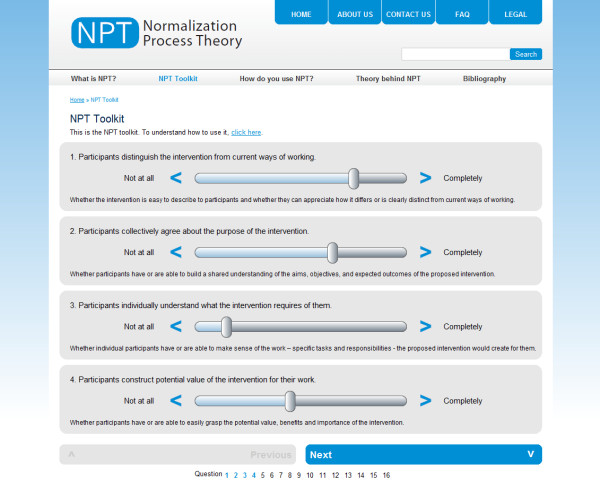
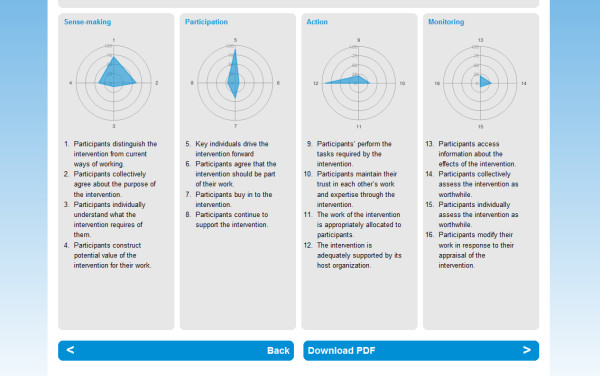
Background: Normalization Process Theory (NPT) can be used to explain implementation processes in health care relating to new technologies and complex interventions. This paper describes the processes by which we developed a simplified version of NPT for use by clinicians, managers, and policy makers, and which could be embedded in a web-enabled toolkit and on-line users manual. Methods: Between 2006 and 2010 we undertook four tasks. (i) We presented NPT to potential and actual users in multiple workshops, seminars, and presentations. (ii) Using what we discovered from these meetings, we decided to create a simplified set of statements and explanations expressing core constructs of the theory (iii) We circulated these statements to a criterion sample of 60 researchers, clinicians and others, using SurveyMonkey to collect qualitative textual data about their criticisms of the statements. (iv) We then reconstructed the statements and explanations to meet users' criticisms, embedded them in a web-enabled toolkit, and beta tested this 'in the wild'. Results: On-line data collection was effective: over a four week period 50/60 participants responded using SurveyMonkey (40/60) or direct phone and email contact (10/60). An additional nine responses were received from people who had been sent the SurveyMonkey form by other respondents. Beta testing of the web enabled toolkit produced 13 responses, from 327 visits to http://www.normalizationprocess.org. Qualitative analysis of both sets of responses showed a high level of support for the statements but also showed that some statements poorly expressed their underlying constructs or overlapped with others. These were rewritten to take account of users' criticisms and then embedded in a web-enabled toolkit. As a result we were able translate the core constructs into a simplified set of statements that could be utilized by non-experts. Conclusion: Normalization Process Theory has been developed through transparent procedures at each stage of its life. The theory has been shown to be sufficiently robust to merit formal testing. This project has provided a user friendly version of NPT that can be embedded in a web-enabled toolkit and used as a heuristic device to think through implementation and integration problems.
Overview
The claims and statistics of this paper haven’t been checked yet.
Free: it reads the open-access text and checks the first 5 claims that cite a source we can check. Create a free account to check every claim.
Integrity signals
Registry
Cites
Statistics
Figures
Verification
Claims the paper makes
The claims and statistics of this paper haven’t been checked yet.
Free: it reads the open-access text and checks the first 5 claims that cite a source we can check. Create a free account to check every claim.
Claims other papers make about this one
Each is checked against this paper’s own text: does it say what the citing paper says it does?
The source backs part of the claim, not all of it — or backs it for a different population, condition or comparison.
In the citing paper
“When applied to the 22 case studies, NPT 121,134 had sufficient explanatory power to predict which case studies had PPI embedded as normal practice; therefore, it predicted both policy outcomes and the processes and infrastructure required for effective PPI that had positive outcomes both methodologically and morally.”
From ReseArch with Patient and Public invOlvement: a RealisT evaluation – the RAPPORT study (2015) · cites this paper as [134]
Experimental — accuracy not yet measuredThe source backs part of the claim, not all of it — or backs it for a different population, condition or comparison.
In the citing paper
“From this, tools were developed to assist implementation practitioners and researchers [13–16] in thinking through and measuring important elements of implementation processes.”
From Using Normalization Process Theory in feasibility studies and process evaluations of complex healthcare interventions: a systematic review (2018) · cites this paper as [16]
Experimental — accuracy not yet measuredIn the citing paper
“As an 'action' theory, NPT also sharpens our analytical focus on the actual work that people performing PPI do, or do not do, rather than people's attitudes (how they feel about what they do) or their intentions (what they say they are going to do).134”
From ReseArch with Patient and Public invOlvement: a RealisT evaluation – the RAPPORT study (2015) · cites this paper as [134]
In the citing paper
“There is currently no published review of its empirical application, but it has been seen to have been applied to good effect in a number of social and health-care settings.121,134,135”
From ReseArch with Patient and Public invOlvement: a RealisT evaluation – the RAPPORT study (2015) · cites this paper as [134]
In the citing paper
“To this end, the NPT toolkit (www.normalizationprocess.org) has been developed to help researchers consider implementation issues from the early stages of developing and evaluating complex interventions [119].”
From Web-Based Interventions for Behavior Change and Self-Management: Potential, Pitfalls, and Progress (2012) · cites this paper as [119]
Self-check
Percentages, sums and reported differences re-computed from the paper’s own numbers.
The self-check needs the paper’s full text.
Citations
Cites
The theory of planned behavior
Ajzen, I. (1991) · Organizational Behavior and Human Decision Processes · doi:10.1016/0749-5978(91)90020-t · Cited by 90,587
Reassembling the Social: An Introduction to Actor-Network-Theory
Latour, B. (2005) · doi:10.1093/oso/9780199256044.001.0001 · Cited by 16,778
Qualitative data analysis for applied policy research
Ritchie, J., & Spencer, L. (2010) · Analyzing qualitative data · doi:10.4324/9780203413081_chapter_9 · Cited by 4,800
Framework for design and evaluation of complex interventions to improve health
Campbell, M. (2000) · BMJ · doi:10.1136/bmj.321.7262.694 · Cited by 3,474 · cited 1×
“In particular, evaluation frameworks like that proposed by the UK Medical Research Council have emphasized the need to understand the complex components and contingent underpinnings of outcomes studies, especially clinical trials [1,2].”
MethodImplementing, Embedding, and Integrating Practices: An Outline of Normalization Process Theory
May, C., & Finch, T. (2009) · Sociology · doi:10.1177/0038038509103208 · Cited by 2,115
Self-citationMurray, E., Treweek, S., Pope, C., MacFarlane, A., Ballini, L., Dowrick, C., Finch, T., Kennedy, A., Mair, F., O'Donnell, C., et al. (2010) · BMC Medicine · doi:10.1186/1741-7015-8-63 · Cited by 1,478 · cited 1×
“and the multiple everyday needs of researchers and practitioners in applied settings [46].”
Self-citationDevelopment of a theory of implementation and integration: Normalization Process Theory
May, C. R., Mair, F., Finch, T., MacFarlane, A., Dowrick, C., Treweek, S., Rapley, T., Ballini, L., Ong, B. N., Rogers, A., et al. (2009) · Implementation Science · doi:10.1186/1748-5908-4-29 · Cited by 1,409 · cited 1×
“This included work to stabilize the constructs of the theory that we have described else-where [40], apply them in practice to statement development for surveys, systematic reviews and qualitative investigations [41,42] and to define appropriate ways to apply the theory.”
MethodSelf-citationDesigning and evaluating complex interventions to improve health care
Campbell, N. C., Murray, E., Darbyshire, J., Emery, J., Farmer, A., Griffiths, F., Guthrie, B., Lester, H., Wilson, P., & Kinmonth, A. L. (2007) · BMJ · doi:10.1136/bmj.39108.379965.be · Cited by 1,331 · cited 2×
“In particular, evaluation frameworks like that proposed by the UK Medical Research Council have emphasized the need to understand the complex components and contingent underpinnings of outcomes studies, especially clinical trials [1,2].”
BackgroundMethodSelf-citationPlanning and Studying Improvement in Patient Care: The Use of Theoretical Perspectives
GROL, R. P. T. M., BOSCH, M. C., HULSCHER, M. E. J. L., ECCLES, M. P., & WENSING, M. (2007) · The Milbank Quarterly · doi:10.1111/j.1468-0009.2007.00478.x · Cited by 943 · cited 1×
“At the same time, there have been calls for theory-driven approaches to such work [3,4].”
BackgroundMay, C., Finch, T., Mair, F., Ballini, L., Dowrick, C., Eccles, M., Gask, L., MacFarlane, A., Murray, E., Rapley, T., et al. (2007) · BMC Health Services Research · doi:10.1186/1472-6963-7-148 · Cited by 768 · cited 3×
“Normalization Process Theory (NPT) [7], and its pre-decessor, the Normalization Process Model [8,9] provides a conceptual framework to assist in understanding and explaining the dynamic processes that are encountered during the implementation of complex interventions and technological or…”
Self-citation
Research works printed but not linked: 10
- Angus D, Brouwers M, Driedger M, Eccles M, Francis J, Godin G, Graham I, Grimshaw J, Hanna S, Harrison MB, et al: Designing theoretically-informed implementation interventions The Improved Clinical Effectiveness through Behavioural Research Group (ICEBeRG). Implement Sci. 2006, 1.
- Goldthorpe JH: On Sociology: Critique and Program. 2006, Stanford: Stanford University Press
- Hechter M, Horne C: Theory is explanation. Theories of social order. Edited by: Hechter M, Horne C. 2003, Stanford CA, Stanford University Press
- Rogers EM: The Diffusion of Innovations. 1995, New York: Free Press, 4
- Gagnon MP, Legare F, Fortin JP, Lamothe L, Labrecque M, Duplantie J: An integrated strategy of knowledge application for optimal e-health implementation: A multi-method study protocol. BMC Med Inform Decis Mak. 2008, 8.
- King G, Richards H, Godden D: Adoption of telemedicine in Scottish remote and rural general practices: a qualitative study. J Telemed Telecare. 2007, 13 (8): 382-386. 10.1258/135763307783064430. · DOI
- Boddy D, King G, Clark J, Heaney D, Mair F: The influence of context and process when implementing e-health. Bmc Med Inform Decis. 2009, 9 (1): 9-10.1186/1472-6947-9-9. · DOI
- Stinchcombe A: Constructing social theories. 1968, New York: Harcourt, Brace and World
- Mair F, May C, Murray E, Finch T, Anderson G, O'Donnell C, Wallace P, Sullivan F: Understanding the Implementation and Integration of E-Health Services London: National Co-ordinating. 2009, Centre for the National Institute for Health Research Service Delivery and Organisation Programme (NCCSDO)
- Banister P, Burman E, Parker I, Taylor M, Tindall C: Qualitative methods in psychology. 1994, Buckingham: Open University Press
Cited by
Implementation, context and complexity
May, C. R., Johnson, M., & Finch, T. (2016) · Implementation Science · doi:10.1186/s13012-016-0506-3 · Cited by 978
“At each stage in the development of NPT, we have been concerned with its utility as a way of understanding the dynamics of complex intervention trials [27–29].”
MethodSelf-citationMay, C. R., Cummings, A., Girling, M., Bracher, M., Mair, F. S., May, C. M., Murray, E., Myall, M., Rapley, T., & Finch, T. (2018) · Implementation Science · doi:10.1186/s13012-018-0758-1 · Cited by 683
Self-citationJohnson, M. J., & May, C. R. (2015) · BMJ Open · doi:10.1136/bmjopen-2015-008592 · Cited by 513
Self-citationScreening women for intimate partner violence in healthcare settings
O'Doherty, L., Hegarty, K., Ramsay, J., Davidson, L. L., Feder, G., & Taft, A. (2015) · Cochrane Database of Systematic Reviews · doi:10.1002/14651858.cd007007.pub3 · Cited by 452
McEvoy, R., Ballini, L., Maltoni, S., O’Donnell, C. A., Mair, F. S., & MacFarlane, A. (2014) · Implementation Science · doi:10.1186/1748-5908-9-2 · Cited by 413
“[31] NPT Presented NPT to potential and actual users for review.”
InfluentialSelf-citation
Metadata
- Authors
- May, C. R., Finch, T., Ballini, L., MacFarlane, A., Mair, F., Murray, E., Treweek, S., & Rapley, T.
- Affiliations
- University of Southampton (GB)
- Newcastle University (GB)
- Agenzia Sanitaria e Sociale Regionale (IT)
- Ollscoil na Gaillimhe – University of Galway (IE)
- University of Glasgow (GB)
- University College London (GB)
- University of Dundee (GB)
- Corresponding author
- Rapley, Tim
- ORCID
- Venue
- BMC Health Services Research
- Published
- 2011-09-30
- Volume
- 11
- Issue
- 1
- Pages
- 245-245
- ISSN
- 1472-6963 (ISSN-L)
- PMC
- PMC3205031
- OpenAlex
- W6884888902
- Cited by
- 3
- References
- 28
- Citations by year
- 2026: 2 · 2013: 1
- FWCI
- 0.59
- Type
- journal article
- Language
- en
- Open access
- gold
- doi.org
- Licence
- Locations
- BMC Health Services Research (publishedVersion, cc-by)
- PubMed Central (publishedVersion, cc-by)
- PubMed (publishedVersion)
- ARAN (University of Galway Research Repository) (Ollscoil na Gaillimhe – University of Galway) (acceptedVersion, cc-by-nc-nd)
- Northumbria Research Link (Northumbria University) (acceptedVersion)
- ENLIGHTEN (Jurnal Bimbingan dan Konseling Islam) (acceptedVersion)
- ePrints Soton (University of Southampton) (acceptedVersion)
- LSHTM Research Online (London School of Hygiene and Tropical Medicine) (acceptedVersion)
- Aberdeen University Research Archive (Aberdeen University) (submittedVersion)
- Arrow@dit (Dublin Institute of Technology) (submittedVersion)
- ARAN (University of Galway Research Repository) (Ollscoil na Gaillimhe – University of Galway) (submittedVersion, cc-by-nc-nd)
- Discovery Research Portal (University of Dundee) (submittedVersion, cc-by)
- DOAJ (DOAJ: Directory of Open Access Journals) (submittedVersion)
- UCL Discovery (University College London) (submittedVersion)
- University of Galway Research Repository (submittedVersion, cc-by-nc)
- Lenus, The Irish Health Repository (Dr Steevens Hospital Library) (submittedVersion)
- Research Repository UCD (University College Dublin) (cc-by-nc)
- Newcastle University ePrints (Newcastle Univesity) (cc-by)
- Funders
- Economic and Social Research Council
- Topics
- Health Sciences › Health Professions › General Health Professions › Health Policy Implementation Science
- Social Sciences › Sociology and Political Science › Delphi Technique in Research
- Health Sciences › Medicine › Public Health, Environmental and Occupational Health › Clinical practice guidelines implementation
- Keywords
- Normalization Process Theory, complex interventions, health technology implementation, user feedback, theory development
- MeSH terms
- Delivery of Health Care, Health Services Research, Humans, Outcome and Process Assessment, Health Care, Technology Assessment, Biomedical, User-Computer Interface, Models, Organizational, Internet, Qualitative Research
About these checks
Registry, retraction, Cites and statistics results are computed, not judged, with one exception: a printed reference that no index lists is read once by a model before it counts as a citation error. Claims are extracted by a model and kept only when their quote appears verbatim in the text; each cited source is then checked, with a model’s help, for whether it says what the claim relies on. Those verdicts can be wrong — read the claim’s quote and the cited source before relying on one.
Statistics and arithmetic are recomputed, not judged.
Confidence bands are shown only for fields calibrated on our annotated test set. None is calibrated yet, so no band is shown.
What counts as a claim ›How we measure confidence ›How we check this ›
Are you an author, or do you see a problem with this page? Request a review
How to cite
Cite CoChat for the checks on this page, and the paper for its own findings.
- This page
- CoChat. (2026). Citation check: Evaluating complex interventions and health technologies using normalization process theory: development of a simplified approach and web-enabled toolkit. https://app.cochat.ai/papers/10.1186/1472-6963-11-245
- The paper
- May, C. R., Finch, T., Ballini, L., MacFarlane, A., Mair, F., Murray, E., Treweek, S., & Rapley, T. (2011). Evaluating complex interventions and health technologies using normalization process theory: development of a simplified approach and web-enabled toolkit. BMC Health Services Research. https://doi.org/10.1186/1472-6963-11-245
Data sources
Bibliographic data: Semantic Scholar, OpenAlex, Crossref.
Contains information from the Semantic Scholar Academic Graph Datasets, made available under the ODC Attribution License (ODC-BY 1.0).
Semantic Scholar’s data is described in: Kinney, R., et al. (2023). The Semantic Scholar Open Data Platform. arXiv:2301.10140.
