

The DOI matches its Crossref record; 29 of the 31 references it cites were found in a registry or an index.
COSMIN Risk of Bias tool to assess the quality of studies on reliability or measurement error of outcome measurement instruments: a Delphi study
Open accessPublished version of a preprint
Abstract
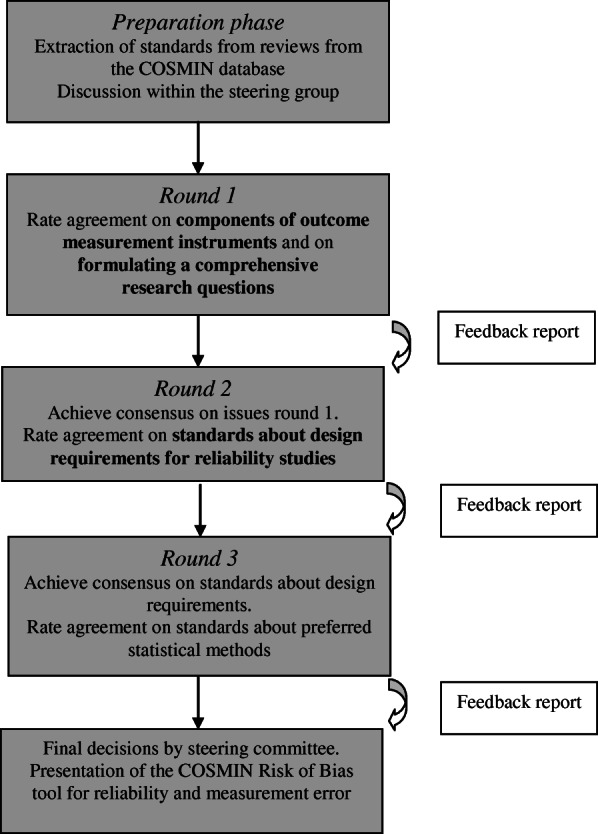
Background: Scores on an outcome measurement instrument depend on the type and settings of the instrument used, how instructions are given to patients, how professionals administer and score the instrument, etc. The impact of all these sources of variation on scores can be assessed in studies on reliability and measurement error, if properly designed and analyzed. The aim of this study was to develop standards to assess the quality of studies on reliability and measurement error of clinician-reported outcome measurement instruments, performance-based outcome measurement instrument, and laboratory values. Methods: We conducted a 3-round Delphi study involving 52 panelists. Results: Consensus was reached on how a comprehensive research question can be deduced from the design of a reliability study to determine how the results of a study inform us about the quality of the outcome measurement instrument at issue. Consensus was reached on components of outcome measurement instruments, i.e. the potential sources of variation. Next, we reached consensus on standards on design requirements ( n = 5), standards on preferred statistical methods for reliability ( n = 3) and measurement error ( n = 2), and their ratings on a four-point scale. There was one term for a component and one rating of one standard on which no consensus was reached, and therefore required a decision by the steering committee. Conclusion: We developed a tool that enables researchers with and without thorough knowledge on measurement properties to assess the quality of a study on reliability and measurement error of outcome measurement instruments.
Overview
The claims and statistics of this paper haven’t been checked yet.
Run the check — free, no account needed. It reads the open-access text and checks the sources it cites.
Integrity signals
Registry
Cites
Statistics
Figures
Verification
Claims the paper makes
The claims and statistics of this paper haven’t been checked yet.
Run the check — free, no account needed. It reads the open-access text and checks the sources it cites.
Self-check
Percentages, sums and reported differences re-computed from the paper’s own numbers.
The self-check needs the paper’s full text.
Citations
Cites
Intraclass correlations: Uses in assessing rater reliability.
Shrout, P. E., & Fleiss, J. L. (1979) · Psychological Bulletin · doi:10.1037/0033-2909.86.2.420 · Cited by 24,532
Convergent and discriminant validation by the multitrait-multimethod matrix.
Campbell, D. T., & Fiske, D. W. (1959) · Psychological Bulletin · doi:10.1037/h0046016 · Cited by 17,116
Confirmatory factor analysis for applied research
Brown, T. A. (2007) · Choice Reviews Online · doi:10.5860/choice.44-2769 · Cited by 15,621
QUADAS-2: a revised tool for the quality assessment of diagnostic accuracy studies
Whiting, P. F., Rutjes, A. W. S., Westwood, M. E., Mallett, S., Deeks, J. J., Reitsma, J. B., Leeflang, M. M. G., Sterne, J. A. C., Bossuyt, P. M. M., & the QUADAS-2 Group* (2011) · Annals of Internal Medicine · doi:10.7326/0003-4819-155-8-201110180-00009 · Cited by 14,199
Health Measurement Scales: A Practical Guide to Their Development and Use
Streiner, D. L., Norman, G. R., & Cairney, J. (1989) · Cited by 9,595
Forming inferences about some intraclass correlation coefficients.
McGraw, K. O., & Wong, S. P. (1996) · Psychological Methods · doi:10.1037/1082-989x.1.1.30 · Cited by 6,903
Mokkink, L. B., Terwee, C. B., Patrick, D. L., Alonso, J., Stratford, P. W., Knol, D. L., Bouter, L. M., & de Vet, H. C. W. (2010) · Journal of Clinical Epidemiology · doi:10.1016/j.jclinepi.2010.02.006 · Cited by 4,465
Self-citationMokkink, L. B., Terwee, C. B., Patrick, D. L., Alonso, J., Stratford, P. W., Knol, D. L., Bouter, L. M., & de Vet, H. C. W. (2010) · Quality of Life Research · doi:10.1007/s11136-010-9606-8 · Cited by 4,260
Self-citationCOSMIN guideline for systematic reviews of patient-reported outcome measures
Prinsen, C. A. C., Mokkink, L. B., Bouter, L. M., Alonso, J., Patrick, D. L., de Vet, H. C. W., & Terwee, C. B. (2018) · Quality of Life Research · doi:10.1007/s11136-018-1798-3 · Cited by 3,345
Self-citationThe Delphi technique: myths and realities
Powell, C. (2003) · Journal of Advanced Nursing · doi:10.1046/j.1365-2648.2003.02537.x · Cited by 2,611
Research works printed but not linked: 2
- Shavelson RJ, Webb NM. Generalizability Theory. A primer. Measurement Methods for the Social Science, vol. 1. Newbury Park: Sage Publishing; 1991.
- CANCHILD Centre for disability research, I.o.a.h.s., McMaster University. Outcome measures rating form guideline. 2004[31/8/2017]; Available from: https://www.canchild.ca/system/tenon/assets/attachments/000/000/372/original/measrate.pdf?license=yes.
Cited by
Sorted by citations
Items 501–587 of 587
de Morais, N. M., Silva, A. C. M., Sousa, J. M., Nogueira, L. E. F. L., & Caixeta, C. C. (2025) · Journal of Nursing and Health · doi:10.15210/jonah.v15i3.28130
Spavieri, J. H. P., de Lira, M. R., Aguiar, A. D. S., & Chaves, T. C. (2026) · Journal of Oral Rehabilitation · doi:10.1111/joor.70140
ARAUJO, F. D. S., Medeiros, F. B., Miranda, L. M. M., Cardoso, A. V. D. A., Freire, H. P., & Carvalho, R. G. D. S. (2026) · Perceptual and Motor Skills · doi:10.1177/00315125261421715
“This experimental study examined acute and subacute recovery over 72 hours following a HIIT-BW session, as well as the validity and reliability of the Perceived Recovery Status (PRS) scale, following COSMIN guidelines (Mokkink et al., 2020).”
Nawawi, Y. S., Hanafi, M., Firdaus, Z. J., & Adhie, A. W. (2026) · Biomedicine Hub · doi:10.1159/000550915
“The COSMIN Risk of Bias checklist will be used to measure methodological quality of included primary studies [28].”
InfluentialVerbeelen, K., Fernández-Gualda, M. Á., Gürşen, C., Dams, L., Mertens, M. G., Devoogdt, N., & Groef, A. D. (2026) · Sonography · doi:10.1002/sono.70047
“Methodological quality was assessed using version 3 of the Consensus Based Standards for the Selection of Health Measurement Instruments (COSMIN) checklist [39].”
Humeres, P. Á., & Leppe, J. (2026) · PeerJ · doi:10.7717/peerj.20834
“A key aspect in interpreting these findings is the role of SEM and MDC in evaluating reliability within longitudinal designs ( Mokkink et al., 2020 ; Mokkink et al., 2023 ).”
Kortianou, E. A., Isakoglou, M., Karagianni, E., Antoniou, V., Sapouna, V., & Pepera, G. (2026) · Healthcare · doi:10.3390/healthcare14050576
“…by two researchers (E.A.K. and M.I. for CPDs’ studies; G.P. and E.Ka for HF studies) using the COSMIN Risk of Bias tool for the reliability studies [34], the Risk of Bias in Non-Randomized Studies of Interventions (ROBINS-I) tool [35] for non-randomized studies, and the Quality in Prognosis…”
Vicentini, A., Mens, M. A., Malekzadeh, A., van Netten, J. J., Maas, M. M., & Bus, S. A. (2026) · BMC Biomedical Engineering · doi:10.1186/s42490-026-00106-x · Cited by 1
“Methodological quality was assessed independently by two reviewers (A.V. and M.A.M.) using the COSMIN (consensus-based standards for the selection of health status measurement instruments) Risk of Bias tool [65].”
Peres, P. L. P., Simeon, R., Souza, M. H. D. N., Galeoto, G., da Conceição, T. E., Berardi, A., Valente, D., & Griep, R. H. (2026) · Journal of Evaluation in Clinical Practice · doi:10.1111/jep.70409
“Methodological quality was appraised, when applicable, using the COSMIN (COnsensus‐based Standards for the selection of health Measurement INstruments) checklist [17].”
Saengsin, K., Intamul, K., Wongyikul, P., Phinyo, P., Sittiwangkul, R., Petcharat, S., Rattanang, J., Chindarungrueangkun, P., & Prakash, A. (2026) · PLoS ONE · doi:10.1371/journal.pone.0344373
“Measurement error of 3D echo to CMR was assessed by calculating the mean bias, limit of agreement (LOA), and P10 (defined as the percentage of echocardiogram values within ±10% of CMR values) [18].”
Barbosa, F. D. S., de Santana, R. P., Matos, M. I. S., & Santos, A. R. G. (2026) · Occupational Therapy International · doi:10.1155/oti/5525893
“…the guidelines for reporting reliability and agreement studies (GRRAS) [13] and the consensus-based standards for the selection of health measurement instruments (COSMIN) risk of bias tool to assess the quality of studies on reliability and measurement error of outcome measurement instruments [14].”
Breastfeeding Measurement Instruments: A COSMIN Review and Recommendation
Liu, B., Zhou, F., Lv, Y., Lin, K., Wang, Y., Xu, B., & Yuan, T. (2026) · Journal of Human Lactation · doi:10.1177/08903344261420017
Aguilaniu, A., Grosdent, S., Schwartz, C., Martens, G., Croisier, J., & Durieux, N. (2026) · Journal of Sport Rehabilitation · doi:10.1123/jsr.2024-0424
Exercise Interventions and Pregnancy-Related Back Pain: Evidence and Gaps From a Systematic Review
Chen, J., Yu, H., Damps, D., & Szumilewicz, A. (2026) · International Journal of Public Health · doi:10.3389/ijph.2026.1608730
“Cells in this standard with a gray background are prohibited for use [24].”
The Minimal Detectable Change for Balance and Balance Confidence After Chronic Spinal Cord Injury
Heffron, L., Plawecki, A., Lotter, J., Shoger, L. H., Voigtmann, C. J., Hornby, T. G., & Henderson, C. E. (2026) · Neurology Report · doi:10.1097/npt.0000000000000555
Galeoto, G., Cirinà, S., Berardi, A., Simeon, R., Panuccio, F., Lucia, B., Savona, A., González-Bernal, J. J., & Seco‐Calvo, J. (2026) · Spinal Cord Series and Cases · doi:10.1038/s41394-026-00734-4
Figura, M., Saurini, M., Bartoli, D., Latina, R., Vellone, E., & Maria, M. D. (2026) · JBI Evidence Synthesis · doi:10.11124/jbies-25-00140
Selva-Sevilla, C., Cerrato, A. O., Pérez‐Martínez, J., & Gerónimo‐Pardo, M. (2026) · The European Journal of Health Economics · doi:10.1007/s10198-026-01929-0
Pedrosa, R., Castillo-García, J., & Fernández-Puebla, A. G. (2026) · International Emergency Nursing · doi:10.1016/j.ienj.2026.101830
Gamble, C., Sabico, S., Honvo, G., Abubakar, S., Boehnke, J. R., Baets, S. D., Veronese, N., Knoop, V., Cooper, C. C., Brandi, M. L., et al. (2026) · Age and Ageing · doi:10.1093/ageing/afag124
“For each study, results were judged against COSMIN criteria for good measurement properties and classified as sufficient, insufficient, or indeterminate [12, 21].”
Market orientation in higher education: a student-focused scale validation
Sandoval, J. E. B., & Casadiego-Alzate, R. (2026) · Spanish Journal of Marketing - ESIC · doi:10.1108/sjme-07-2024-0194
Cramer, I. C., van Esch, R., Verstappen, C. C. A. G., Kloeze, C., Twisk, J. W. R., Stuijk, S., Bergmans, J., Zinger, S., Dekker, A. D. B., Veer, M. V. ’., et al. (2026) · Journal of Clinical Monitoring and Computing · doi:10.1007/s10877-026-01440-0
“Reliability was expressed as intra-class correlation (ICC) and determined using two-way mixed effects models [15, 16].”
The troy sleep scale: clinical validation and establishment of a screening cut-off
Korkmaz, Ş. A., Akalın, D., Atlı, C., TEKİN, M., Kılınçarslan, M. G., & Akıncı, E. (2026) · BMC Psychology · doi:10.1186/s40359-026-04724-x
“…times the number of items and ≥ 100; Considering the 11-item structure of the TSS, the study was planned with a total of n ≈ 400 participants, including a clinical sample ( n ≈ 250) presenting with sleep complaints and a healthy control group ( n ≈ 150), to remain above these thresholds [30, 31].”
Physiotherapy for Degenerative Lumbar Spine Disease
Alsobayel, H., & Alimam, D. M. (2026) · Springer eBooks · doi:10.1007/978-3-032-18097-1_9
Vugts, D. F., Spigt, J. P., Pauw, R. D., Kregel, J., Bier, J. D., & Graaf, M. T.-D. (2026) · Musculoskeletal Science and Practice · doi:10.1016/j.msksp.2026.103593
Reliability of the 3-Meter Backwards Walk Test in Patients with Revision Total Knee Arthroplasty
Ünver, B., Kaçmaz, K. Ş., & Karatosun, V. (2026) · Zeitschrift für Orthopädie und Unfallchirurgie · doi:10.1055/a-2868-0677
Pauciulo, F., Tofani, M., Stella, G., Lacopo, A., Summa, S., Tullo, G., Delia, C., Cerchiari, A., & Bella, G. D. (2026) · Children · doi:10.3390/children13060757
“In line with these aims, a set of a priori hypotheses was defined according to COSMIN recommendations [15,16].”
Dastafkan, S., Vosoghi, N., Belil, F. E., & Shahmari, M. (2026) · Midwifery · doi:10.1016/j.midw.2026.104893
Groen, S. R. R., Keszthelyi, D., Weerts, Z. Z. R. M., Assmann, S. L., Breukink, S. O., & Essers, B. A. B. (2026) · Health and Quality of Life Outcomes · doi:10.1186/s12955-026-02566-0
“Psychometric evaluation was conducted in accordance with the COSMIN (COnsensus-based Standards for the selection of health Measurement INstruments) taxonomy of measurement properties [27].”
Mankan, K., Wongyikul, P., Khongthon, N., Sripusanapan, A., Noppakun, K., Tantisattamo, E., Danpanichkul, P., Phinyo, P., Chatatikun, M., & Phongphithakchai, A. (2026) · Kidney Medicine · doi:10.1016/j.xkme.2026.101444
Li, S., Zhong, J., Wang, Z. L., Liu, S., Liang, R., Liu, W. T., & Yip, J. Y. W. (2026) · BMC Musculoskeletal Disorders · doi:10.1186/s12891-026-10097-4
“[8, 13].”
InfluentialVaca, J. I. M., Chica, J. F. Á., & Gómez, M. A. G. (2026) · Acta Colombiana de Cuidado Intensivo · doi:10.1016/j.acci.2026.100638
Herrera, I. P., Guerra, S. A., Castañeda, A. O., & Arias-Monsalve, A. M. (2024) · Cuadernos Hispanoamericanos de Psicología · doi:10.18270/chps.5208
Fatchiya, A., Andriani, I., Alif, M., ., S., Firmansyah, A., Metalisa, R., Dewi, S. U., & Rachmat, M. (2026) · F1000Research · doi:10.12688/f1000research.179421.1
Martínez-Pozo, V., Barbado, D., Díaz-Marín, C., Campos, J. G., Blasco‐Peris, C., Ros‐Arlanzón, P., Moreno-Navarro, L., Popivanov, I. D., Mehrabian-Spasova, S., Traykov, L., et al. (2026) · Brain Sciences · doi:10.3390/brainsci16070662
“…quality and risk of bias of the included studies were independently assessed by two reviewers (V.M.-P. and D.S.-G.) using a modified version [32] of the Consensus-based Standards for the Selection of Health Measurement Instruments (COS-MIN) risk-of-bias tool for observational studies [33].”
Manettas, A. I., Campbell, K. L., Charalampopoulou, M., Greco, N., Wiskemann, J., Tsaklis, P., & Mokkink, L. B. (2026) · Journal of Cancer Survivorship · doi:10.1007/s11764-026-02060-y
Self-citationNawawi, Y. S., Stern, C., Khairan, P., & Whitehorn, A. (2026) · JBI Evidence Synthesis · doi:10.11124/jbies-25-00471
A Systematic Review of Stair Fall Risk Assessment Instruments in Older Adults
Makkong, T., & Brienza, D. M. (2026) · Archives of Rehabilitation Research and Clinical Translation · doi:10.1016/j.arrct.2026.100668
Eggmann, S., Cáceres-Parra, C., Hills, A., Hodgson, C. L., & Paton, M. (2026) · Journal of physiotherapy · doi:10.1016/j.jphys.2026.06.009
Amundsen, R., Sjølie, E. S., McKay, C., Gjesdal, S., Grindem, H., Myklebust, G., Bjørndal, C. T., & Møller, M. (2026) · Scandinavian Journal of Medicine and Science in Sports · doi:10.1111/sms.70329
Establishing Core Outcome Sets to Advance Evidence Synthesis in Behavior Analysis
Tennyson, A., May, R. J., & Tiernan, A. M. (2026) · Perspectives on Behavior Science · doi:10.1007/s40614-026-00507-2
“COSMIN (Consensus-based Standards for the Selection of Health Measurement Instruments) guidance is widely used during COS development to evaluate the measurement properties of candidate instruments (Mokkink et al., 2020).”
Gajardo-Burgos, R. E., de la Barra, T. J., Ramírez‐Campillo, R., Waiteman, M. C., & de Villarreal, E. S. (2026) · Journal of Orthopaedic and Sports Physical Therapy · doi:10.2519/jospt.2026.14091
Measuring What Matters: Validating the HANDFULS Tool With Pediatric Burn Survivors
Parry, I. S., Taylor, S. L., Greenhalgh, D., & James, M. A. (2026) · Journal of Burn Care & Research · doi:10.1093/jbcr/irag088
Kochuvilayil, A., & Varma, R. P. (2026) · Indian Journal of Palliative Care · doi:10.25259/ijpc_243_2025
“[24] Caregiver burden is a multifaceted strain commonly marked by psychological, social and financial aspects.”
Heroes, A., Fourgeaud, C., Fourneau, I., Vrieze, T. D., Frippiat, J., Deltombe, T., Thomis, S., Abba, S., Vignes, S., & Devoogdt, N. (2026) · Disability and Rehabilitation · doi:10.1080/09638288.2026.2704565
Simeon, R., Usai, M., Tramonti, A., Canova, R., Frigerio, D., Berardi, A., Pelosin, E., & Cosentino, C. (2026) · Journal of Patient-Reported Outcomes · doi:10.1186/s41687-026-01155-5
“…validity was assessed in twenty-two scales and subscales: one study was rated sufficient (+) with very good RoB [72]; two studies were rated sufficient (+) with adequate RoB [71, 76]; and two studies were rated sufficient (+), one with doubtful RoB [69, 77] and one with inadequate RoB [17].”
Szatmári, É., Makai, A., Prémusz, V., Ács, P., & Hock, M. (2026) · Health Science Reports · doi:10.1002/hsr2.72834
Ekici, E., Esen, D. H., Yüzbaşıoğlu, Ü., & Taş, S. (2026) · Journal of Bodywork and Movement Therapies · doi:10.1016/j.jbmt.2026.07.037
Buitenhuis, M. B., Gürşen, C., Hidding, J. T., Bramer, W. M., de Bree, R., Gane, E. M., & Speksnijder, C. M. (2026) · European Journal of Radiology · doi:10.1016/j.ejrad.2026.113103
Doskaliuk, B., Üşen, A., Fedorovych, K., & Yatsyshyn, R. (2026) · Rheumatology International · doi:10.1007/s00296-026-06260-8 · Cited by 1
“PROM scores may be analysed as continuous change, interpreted according to clinically meaningful thresholds, assessed in relation to an acceptable symptom state, or used to classify individual patients as responders or non-responders [69–71 ].”
Alvarez, M. T., Oliveira, R., Cordovil, R., Cavalheiro, L. M., & Martins, M. E. (2026) · Next research. · doi:10.1016/j.nexres.2026.102281
Estresse, ansiedade e depressão em segundas vítimas: revisão integrativa
Gallo, E. B. R., & la Cruz, S. G. T.-D. (2026) · Revista Bioética · doi:10.1590/1983-803420264060pt
Stress, anxiety, and depression in second victims: an integrative review
Gallo, E. B. R., & la Cruz, S. G. T.-D. (2026) · Revista Bioética · doi:10.1590/1983-803420264060en
Williams, J., Comfort, P., Ripley, N. J., Fahey, J. T., Barber, R., & Bramah, C. (2026) · Journal of Sports Sciences · doi:10.1080/02640414.2026.2711158
Estrés, ansiedad, depresión en las segundas víctimas: revisión integrativa
Gallo, E. B. R., & la Cruz, S. G. T.-D. (2026) · Revista Bioética · doi:10.1590/1983-803420264060es
Ramalho, R. B., Antonio, G. L. N., & Selistre, L. F. A. (2026) · Archives of Physical Medicine and Rehabilitation · doi:10.1016/j.apmr.2026.07.031
Delvaux, B. V., Elmaleh, Y. D., Guessous, K., Garnier, T., Morel, B., Yao, K., Giral, T., Bowness, J. S., & Herbelet, S. (2026) · Frontiers in Medicine · doi:10.3389/fmed.2026.1879747
Wahlström, O., Barsoum, E., Strigård, K., Stark, B., & Nyberg, A. (2026) · European Journal of Physiotherapy · doi:10.1080/21679169.2026.2715469
“Furthermore, the study adhered to GRaas and cOsMiN guidelines for validity and reliability studies [37–39]. there are also weaknesses.”
Jiao, Y., Jiang, J., Chen, Z., Lin, B., Wang, H., Hang, C., Zhang, T., Wan, X., Li, J., Zhao, T., et al. (2026) · American Journal of Ophthalmology · doi:10.1016/j.ajo.2026.08.027
Lacombe, J., Piagno, S., Lepage, B., Morin, M., Ranka, J. L., Cormier, C., Gasq, D., & Villepinte, C. (2026) · Clinical Rehabilitation · doi:10.1177/02692155261474839
Dong, J., Yi, Y., Hu, Y., Mei, Y., Fu, Y., & Wu, Y. (2026) · Behavioral Psychology/Psicología Conductual · doi:10.31083/bp52713
Ireland, M. J., Weerasinghe, S. A., Pallant, R. D., & Marshall, A. P. (2026) · Australian Critical Care · doi:10.1016/j.aucc.2026.101674
Measurement Properties of Delirium Tools in Pediatric Intensive Care: A Systematic Review
Zilezinski, M., Denninger, N.-E., Müller, M., Tannen, A., & Kottner, J. (2026) · PEDIATRICS · doi:10.1542/peds.2026-077184
Ackah, M., Abonie, U. S., Hettinga, F. J., Hackett, K. L., & Deary, V. (2026) · PLoS ONE · doi:10.1371/journal.pone.0355730
“Moreover, the study adhered to the COSMIN guidelines to ensure a rigorous and standardised approach to the development, validation, and reliability assessment of the MRES [40].”
Burggraaf, F., Jellema, H. M., Tjon-Fo-Sang, M. J. H., van Nispen, R. M. A., & Elsman, E. B. M. (2026) · Quality of Life Research · doi:10.1007/s11136-026-04348-z
“…formula: The standard error of measurement (SEM), used to determine the SDC, was based on test–retest parameters (intraclass correlation coefficients, ICC 3,1 ) calculated in the previous study ( SEM consistency = ( SD ) × ( √ 1 − ICC )) , SD refers to the SD pooled of the study sample) [12, 37 ].”
Head vs Screen-Mounted Eye Trackers: Comparisons Across Ethnic Diversity
Cade, A. E., Zoest, J., 美沙紀, 亀., Dukes, L., & Turnbull, P. (2026) · Current Eye Research · doi:10.1080/02713683.2026.2727290
Siddiqi, H., Sharif, M., Rasheed, U., Khursheed, T., & Saeed, M. A. (2026) · International Journal of Rheumatic Diseases · doi:10.1111/1756-185x.70863
Bijapuri, S. M., Parmar, S. T., Dudhani, S., Szturm, T. J., & Gururaj, H. (2026) · Physiotherapy Quarterly · doi:10.5114/pq/215648
“The study adheres to COSMIN standards [28] by assessing test–retest reliability with two measurements (day one and day seven, n = 30), a suitable interval ensuring stable conditions, as no intervention was applied.”
Bloch‐Nielsen, J. R., Schmidt, A., & Maribo, T. (2026) · European Journal of Physiotherapy · doi:10.1080/21679169.2026.2736258
Nagahori, H., Goodman, X. Y., Teng, H., & Ho, K. (2026) · BMJ Open · doi:10.1136/bmjopen-2026-120355
Chen, X., Chen, H., Hu, L., & Yue, L. (2026) · BMJ Open · doi:10.1136/bmjopen-2026-123227
Seven, B., Kaya, K., SARGIN, H., Durmuş, M., & Saygili, F. N. (2026) · Adnan Menderes Üniversitesi Sağlık Bilimleri Fakültesi Dergisi · doi:10.46237/amusbfd.2017126
Standardising the Posterior Shoulder Endurance Test: A Narrative Review and Operational Framework
Barber, R., Broughton, G., & Ripley, N. J. (2026) · Standards · doi:10.3390/standards6040040
Guinot, S. M., Valenzuela, C. S. M., Asensi, V. A., & Tomás, J. M. (2026) · Neurology International · doi:10.3390/neurolint18100187
“The manuscript follows the STROBE Statement [19] and COSMIN standards [20].”
Zhang, X., He, T., & Yan, Z. (2026) · Complementary Therapies in Medicine · doi:10.1016/j.ctim.2026.103441
Ibeneme, S. C., Fatai, K. E., Eleje, C. U., Onyekwelu, A. I., Ekowa, J. L., Utazi, C. N., Ezuma, A. D., Ibeneme, G. C., Ibeneme, C. N., & Ibeneme, B. U. (2026) · Research Square · doi:10.21203/rs.3.rs-11265754/v1
Kim, M., Han, A., & Hong, I. (2026) · Journal of Spinal Cord Medicine · doi:10.1080/10790268.2026.2735649
Du, Z., Dong, T., & Wei, B. (2026) · Interactive Learning Environments · doi:10.1080/10494820.2026.2744398
Pfister, P. B., Bärlocher, A., Solé, A. J., Knols, R. H., Pecorelli, N., & de Bruin, E. D. (2026) · Archives of Physiotherapy · doi:10.33393/aop.2026.3928
“The RoB of each measure - ment property reported in an article was determined as the lowest rating of any standard in that criteria box (the worst-score-count method) (24,25).”
Utida, V. H. D. S., Silva, L. T., & Lopes, F. M. (2026) · Cadernos de Saúde Pública · doi:10.1590/0102-311xpt025126
HAZIR, A., Çil, E., Sönmez, Ö. F., & Başer, A. (2026) · Healthcare · doi:10.3390/healthcare14203399
Quality Assessment of Physician Discharge Summaries: Instrument Development and Reliability Study
Bentheim, L., Fehring, L., Friederichs, H., Alsofy, S. Z., & Unnewehr, M. (2026) · JMIR Formative Research · doi:10.2196/105705
“…Standards for the Selection of Health Measurement Instruments)–related methodological work emphasizes content validity and rigorous assessment of measurement properties, although COSMIN was originally developed mainly for health status and patient-reported outcome instruments [25-27].”
Warneke, K., Blazevich, A. J., Nunes, J. P., Gronwald, T., Clemente, F. M., Afonso, J. R., Andrade, R., Wallot, S., Sandig, D., Nimmerichter, A., et al. (2026) · European Journal of Applied Physiology · doi:10.1007/s00421-026-06435-y
Sangkarit, N., Tapanya, W., & Amput, P. (2026) · Journal of Bodywork and Movement Therapies · doi:10.1016/j.jbmt.2026.10.023
The COSMIN Clubs initiative: improving health measurement through collaborative learning
de Arruda, G. T., Corrêa, L. A., Elsman, E. B., Chambers, R. L., Pelouto, F., Mehdipour, A., Dutch, D., Freeman-Sanderson, A., van der Braak, K., Lahuerta-Martín, S., et al. (2026) · Quality of Life Research · doi:10.1007/s11136-026-04418-2
“The solution: We discussed that the focus of the researchers was on only some of the components of the measurement (that is, assignment of the score ) [14 ], as the observations were based on videos in a lab/fixed environment, rather than on live clinical observations.”
Self-citationOutcome Measures in Dermatology
Donhauser, T., Yiu, Z., & Apfelbacher, C. (2026) · Springer eBooks · doi:10.1007/978-3-032-37598-8_4
Arman, N., Akyurek, E., YEKDANEH, A. A., Kurt, İ., Bayraktar, B., Şahinkaya, T., & Alpözgen, A. Z. (2026) · Sensors · doi:10.3390/s26216757
Metadata
- Authors
- Mokkink, L. B., Boers, M., van der Vleuten, C. P. M., Bouter, L. M., Alonso, J., Patrick, D. L., de Vet, H. C. W., & Terwee, C. B.
- Affiliations
- Amsterdam Public Health (NL)
- Universitat Pompeu Fabra (ES)
- University of Washington (US)
- Corresponding author
- Mokkink, L. B.
- Venue
- BMC Medical Research Methodology
- Published
- 2020-12
- Volume
- 20
- Issue
- 1
- Pages
- 293-293
- ISSN
- 1471-2288 (ISSN-L)
- PMC
- PMC7712525
- OpenAlex
- W3107903990
- Cited by
- 588
- References
- 31
- Citations by year
- 2026: 106 · 2025: 121 · 2024: 149 · 2023: 101 · 2022: 72 · 2021: 37 · 2020: 2
- FWCI
- 32.32
- Type
- journal article
- Language
- en
- Open access
- gold
- doi.org
- Licence
- Locations
- BMC Medical Research Methodology (publishedVersion, cc-by)
- Research Square (acceptedVersion, cc-by)
- PubMed Central (publishedVersion, cc-by)
- PubMed (publishedVersion)
- Research Publications (Maastricht University) (publishedVersion, cc-by)
- VU Research Portal (publishedVersion, other-oa)
- Pure Amsterdam UMC (submittedVersion, other-oa)
- Data Archiving and Networked Services (DANS) (submittedVersion, other-oa)
- DOAJ (DOAJ: Directory of Open Access Journals) (submittedVersion, cc-by-sa)
- Amsterdam UMC (VU Amsterdam) - Institutional Repository (submittedVersion)
- Repositori digital de la UPF (Universitat Pompeu Fabra) (submittedVersion, cc-by)
- Research Publications (Maastricht University) (submittedVersion, other-oa)
- Data Archiving and Networked Services (DANS) (submittedVersion)
- Funders
- Nederlandse Organisatie voor Wetenschappelijk Onderzoek (91617098)
- Topics
- Social Sciences › Decision Sciences › Statistics, Probability and Uncertainty › Reliability and Agreement in Measurement
- Social Sciences › Sociology and Political Science › Delphi Technique in Research
- Social Sciences › Decision Sciences › Statistics, Probability and Uncertainty › Meta-analysis and systematic reviews
- Keywords
- COSMIN, risk of bias, reliability statistics, measurement error, outcome measurement instruments, clinician-reported outcomes, performance-based outcome measures, laboratory parameters, study quality assessment, Delphi consensus, measurement properties
- MeSH terms
- Delphi Technique, Humans, Reproducibility of Results, Bias, Consensus
About these checks
Registry, retraction, Cites and statistics results are computed, not judged, with one exception: a printed reference that no index lists is read once by a model before it counts as a citation error. Claims are extracted by a model and kept only when their quote appears verbatim in the text; each cited source is then checked, with a model’s help, for whether it says what the claim relies on. Those verdicts can be wrong — read the claim’s quote and the cited source before relying on one.
Statistics and arithmetic are recomputed, not judged.
Confidence bands are shown only for fields calibrated on our annotated test set. None is calibrated yet, so no band is shown.
What counts as a claim ›How we measure confidence ›How we check this ›
Are you an author, or do you see a problem with this page? Request a review
