

The DOI matches its Crossref record; 116 of the 117 references it cites were found in a registry or an index.
Methodological guidance for the evaluation and updating of clinical prediction models: a systematic review
Open accessAbstract
Background: Clinical prediction models are often not evaluated properly in specific settings or updated, for instance, with information from new markers. These key steps are needed such that models are fit for purpose and remain relevant in the long-term. We aimed to present an overview of methodological guidance for the evaluation (i.e., validation and impact assessment) and updating of clinical prediction models. Methods: We systematically searched nine databases from January 2000 to January 2022 for articles in English with methodological recommendations for the post-derivation stages of interest. Qualitative analysis was used to summarize the 70 selected guidance papers. Results: Key aspects for validation are the assessment of statistical performance using measures for discrimination (e.g., C-statistic) and calibration (e.g., calibration-in-the-large and calibration slope). For assessing impact or usefulness in clinical decision-making, recent papers advise using decision-analytic measures (e.g., the Net Benefit) over simplistic classification measures that ignore clinical consequences (e.g., accuracy, overall Net Reclassification Index). Commonly recommended methods for model updating are recalibration (i.e., adjustment of intercept or baseline hazard and/or slope), revision (i.e., re-estimation of individual predictor effects), and extension (i.e., addition of new markers). Additional methodological guidance is needed for newer types of updating (e.g., meta-model and dynamic updating) and machine learning-based models. Conclusion: Substantial guidance was found for model evaluation and more conventional updating of regression-based models. An important development in model evaluation is the introduction of a decision-analytic framework for assessing clinical usefulness. Consensus is emerging on methods for model updating.
Overview
The claims and statistics of this paper haven’t been checked yet.
Run the check — free, no account needed. It reads the open-access text and checks the sources it cites.
Integrity signals
Registry
Cites
Statistics
Figures
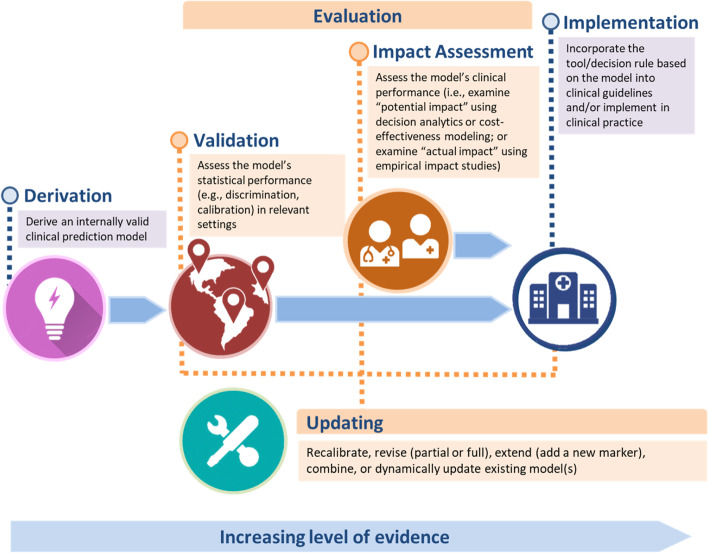
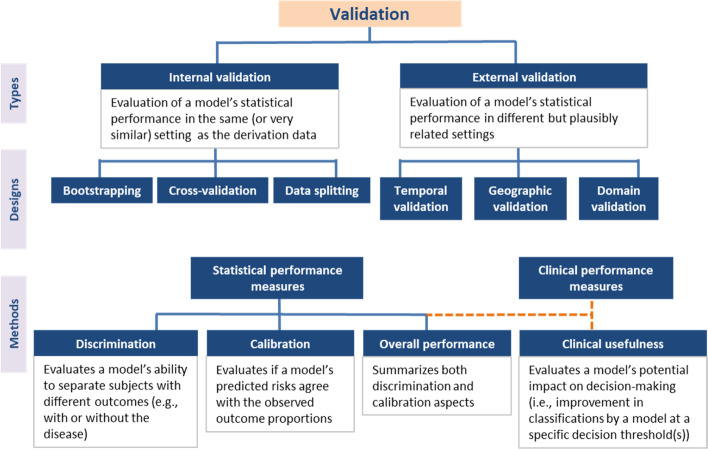
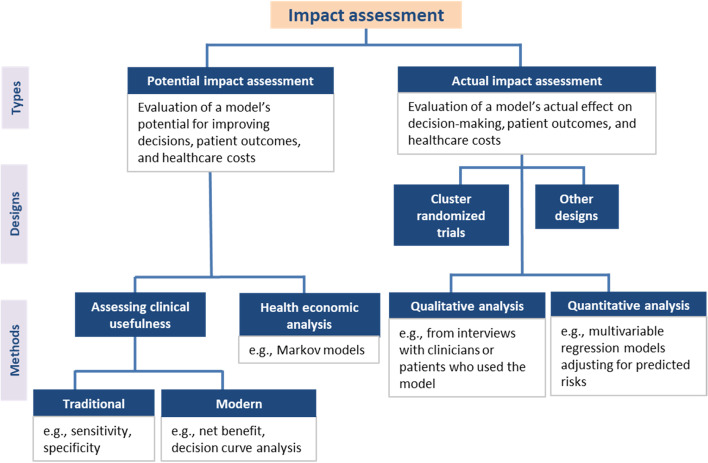
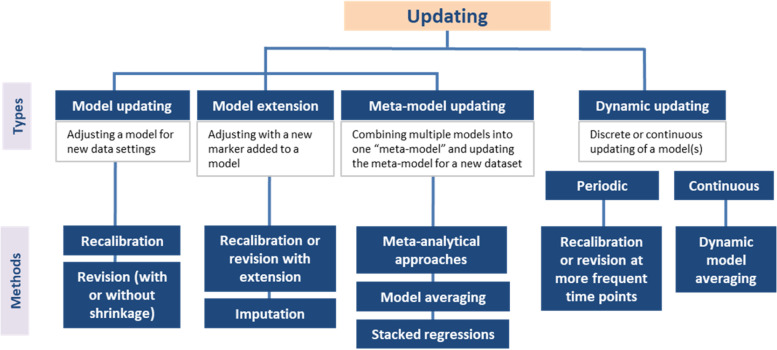
Verification
Claims the paper makes
The claims and statistics of this paper haven’t been checked yet.
Run the check — free, no account needed. It reads the open-access text and checks the sources it cites.
Claims other papers make about this one
Each is checked against this paper’s own text: does it say what the citing paper says it does?
The source backs part of the claim, not all of it — or backs it for a different population, condition or comparison.
In the citing paper
“Crucially, most studies evaluate models exclusively against retrospective labels, without systematic comparison to clinician judgment or assessment of clinical significance [13].”
From A Multimodal Deep Learning Framework for Predicting ICU Deterioration: Integrating ECG Waveforms with Clinical Data and Clinician Benchmarking (2026) · cites this paper as [13]
Experimental — accuracy not yet measured
Self-check
Percentages, sums and reported differences re-computed from the paper’s own numbers.
The self-check needs the paper’s full text.
Citations
Cites
The relationship between Precision-Recall and ROC curves
Davis, J., & Goadrich, M. (2006) · Proceedings of the 23rd international conference on Machine learning - ICML '06 · doi:10.1145/1143844.1143874 · Cited by 6,559
Pencina, M. J., D' Agostino, R. B., D' Agostino, R. B., & Vasan, R. S. (2008) · Statistics in Medicine · doi:10.1002/sim.2929 · Cited by 6,493
Decision curve analysis: a novel method for evaluating prediction models
Vickers, A. J., & Elkin, E. B. (2006) · Medical Decision Making · doi:10.1177/0272989x06295361 · Cited by 6,341
Assessing the Performance of Prediction Models: A Framework for Traditional and Novel Measures
Steyerberg, E. W., Vickers, A. J., Cook, N. R., Gerds, T., Gonen, M., Obuchowski, N., Pencina, M. J., & Kattan, M. W. (2010) · Epidemiology · doi:10.1097/ede.0b013e3181c30fb2 · Cited by 5,170
Self-citationRajkomar, A., Dean, J., & Kohane, I. (2019) · New England Journal of Medicine · doi:10.1056/nejmra1814259 · Cited by 4,579
Clinical Prediction Models: A Practical Approach to Development, Validation, and Updating
Steyerberg, E. W. (2019) · Statistics for Biology and Health · doi:10.1007/978-3-030-16399-0 · Cited by 3,281
Self-citationWynants, L., Van Calster, B., Bonten, M. M., Collins, G. S., Debray, T. P., De Vos, M., Haller, M. C., Heinze, G., Moons, K. G., Riley, R. D., et al. (2020) · doi:10.1101/2020.03.24.20041020 · Cited by 3,070
Self-citationTime‐Dependent ROC Curves for Censored Survival Data and a Diagnostic Marker
Heagerty, P. J., Lumley, T., & PEPE, M. S. (2000) · Biometrics · doi:10.1111/j.0006-341x.2000.00337.x · Cited by 2,870
Antlanger, M., Aschauer, S., Kopecky, C., Hecking, M., Kovarik, J. J., Werzowa, J. M., Mascherbauer, J., Genser, B., Säemann, M. D., & Bonderman, D. (2017) · Kidney & Blood Pressure Research · doi:10.1159/000473868 · Cited by 2,808
Calibration: the Achilles heel of predictive analytics
On behalf of Topic Group ‘Evaluating diagnostic tests and prediction models’ of the STRATOS initiative, Van Calster, B., McLernon, D. J., van Smeden, M., Wynants, L., & Steyerberg, E. W. (2019) · BMC Medicine · doi:10.1186/s12916-019-1466-7 · Cited by 2,650
Self-citation
Research works printed but not linked: 2
- Moorthie S. What is clinical utility?: PHG Foundation - University of Cambridge. [Available from: https://www.phgfoundation.org/explainer/clinical-utility]. Accessed 11 Aug 2022.
- Cox DR, Snell EJ. Analysis of binary data. The concise encyclopedia of statistics. New York: Springer New York; 2008. p. 4–5.
Cited by
Sorted by citations
Items 201–247 of 247
Wang, S., Li, J., Zhang, H., Zhang, Q., Wang, T., Xie, Z., & Yang, J. (2026) · Journal of Endovascular Therapy · doi:10.1177/15266028261477984
Gao, H., Liu, H., Wan, S., Dan, Z., Xiong, J., Xing, Z., YIN, Y., Han, F., Yong, Y., TIAN, M., et al. (2026) · Environmental Pollution · doi:10.1016/j.envpol.2026.129015
Assessing comorbidities and predicting risk
Vessey, J. A., Strout, T. D., & DiFazio, R. L. (2026) · The Nurse Practitioner · doi:10.1097/01.npr.0000000000000472
Segawa, Y., Okamoto, A., Sumiyoshi, S., Watase, H., Iwata, M., Tomita, A., & Terasawa, T. (2026) · Journal of the Formosan Medical Association · doi:10.1016/j.jfma.2026.08.053
Dai, Y., Shu, Y., Fu, J., Lu, X., Zhang, K., Gao, W., Wu, J., Jiang, K., Miao, Y., Xu, Q., et al. (2026) · Surgical Endoscopy · doi:10.1007/s00464-026-13305-3
Wu, Z., Zhou, D., Hu, Y., Chen, R., Huang, M., Zhang, B., & Xiu, W. (2026) · Frontiers in Nutrition · doi:10.3389/fnut.2026.1788647
Chen, D., Liu, Y., Zhou, K., Gong, Y., & Xu, Z. (2026) · Research Square · doi:10.21203/rs.3.rs-10550110/v1
Wang, T., Yang, J., Zhang, X., Wang, J., & Li, L. (2026) · Journal of Biosciences and Medicines · doi:10.4236/jbm.2026.149012
Tubular secretion in chronic kidney disease: from established physiology to clinical utility
Stepanova, N. M. (2026) · Frontiers in Cell and Developmental Biology · doi:10.3389/fcell.2026.1945081
Sramek, M. T., Kumar, N., Patel, S., Miglani, A., Marino, M. J., & Lal, D. (2026) · International Forum of Allergy & Rhinology · doi:10.1002/alr.70273
Zhang, C., Zhou, L., Tang, L., Wang, Z., Li, S., Tang, Y., Tian, C., Liu, Z., & Liu, S. (2026) · Clinical Breast Cancer · doi:10.1016/j.clbc.2026.09.006
MATSUMOTO, K., Nakamura, Y., Kamouchi, M., & Steyerberg, E. W. (2026) · Research Square · doi:10.21203/rs.3.rs-10300997/v1
Self-citationThe Epigenetic Aging–Cancer Continuum: Biomarkers, Metabolism, and Therapy
Papaneophytou, C. P., Pieri, M., Maria-Eleni, M., Charidemou, E., & Andreou, E. P. (2026) · Genes · doi:10.3390/genes17091130
Zhang, Q., Wu, F., Zhu, M., & Sun, L. (2026) · Frontiers in Psychiatry · doi:10.3389/fpsyt.2026.1887667
Clinical trial success prediction from open registry text using classical machine learningPreprint
Doane, M. R. (2026) · Research Square · doi:10.21203/rs.3.rs-10809937/v1
Ilyas, R., Putri, D. I. P., Apriani, L., & istiqammah, I. (2026) · Research Square · doi:10.21203/rs.3.rs-10736091/v1
Shen, X., Liu, Z., Yu, W., Li, F., Lu, Y., Li, M., Sun, P., & Liu, A. (2026) · Frontiers in Immunology · doi:10.3389/fimmu.2026.1970256
Otabor, E., Hassan, A., Okunlola, A. O., Lam, J. R., Alomari, L., & Hamilton, M. (2026) · European Heart Journal - Digital Health · doi:10.1093/ehjdh/ztag147 · Cited by 2
Malini, K. P., Srikanth, M., & Vijayasimha, M. (2026) · Journal of Hospital Infection · doi:10.1016/j.jhin.2026.09.016
Zhang, Y., Martin, G. P., Ashcroft, D. M., van Staa, T. P., & Palin, V. (2026) · medRxiv · doi:10.64898/2026.09.21.26363564
Hirani, K., Blaschke, C., Olloqui, C., & Mittal, R. (2026) · Frontiers in Public Health · doi:10.3389/fpubh.2026.1915502
Ryu, S. J., Baek, J. Y., Kim, J. H., Hur, J.-W., Kwon, W. K., Moon, B. J., Oh, J. K., Kim, I. S., Chough, C. K., Jang, S. W., et al. (2026) · Research Square · doi:10.21203/rs.3.rs-10428412/v1
Chan, C. T., Pletcher, M. J., Balakrishnan, K., Hswen, Y., & Scheffler, A. (2026) · Journal of the American Medical Informatics Association · doi:10.1093/jamia/ocag162
Zhang, Y., Xu, X., Tang, L., Ma, J., & Wang, Y. (2026) · Diagnostics · doi:10.3390/diagnostics16193133
Wu, J., Zheng, K., Liu, H., & Yan, L. (2026) · Frontiers in Medicine · doi:10.3389/fmed.2026.1846099
Xu, N., Chen, A., Ruan, H., Yang, D.-L., Liao, R.-J., Qi, X., Fong, S., Cao, D.-D., Yu, L., Huang, Y.-H., et al. (2026) · PLOS Digital Health · doi:10.1371/journal.pdig.0001744
Hong, Y., Hu, W., Tang, J., & Xiong, F. (2026) · Frontiers in Neurology · doi:10.3389/fneur.2026.1837085
AI Prognosis in Healthcare, Bias, Misprediction, and Governance Gaps
Düffelmeyer, M. (2026) · Advances in computational intelligence and robotics book series · doi:10.4018/979-8-2600-0403-6.ch008
Sun¹, X., Yang, L., Zheng, R., Shen¹, L., & Yi², S. (2026) · Research Square · doi:10.21203/rs.3.rs-10929928/v1
Yang, F., Jiang, Q., Wei, Z., & Hu, T. (2026) · Frontiers in Immunology · doi:10.3389/fimmu.2026.1970912
Zhou, Z., Wang, W., Zhou, H., Chen, Z., Jiang, M., Li, Z., & Li, L. (2026) · Frontiers in Cardiovascular Medicine · doi:10.3389/fcvm.2026.1931950
Statistics in Brief: A Surgeon’s Guide to Creating and Interpreting Risk Calculator Tools
Giannakis, P., Poeran, J., Valle, A. G. D., & Wang, J. (2026) · Clinical Orthopaedics and Related Research · doi:10.1097/corr.0000000000004125
Wang, R., Yao, S., Huang, L., & Liu, Q. (2026) · Journal of Clinical Medicine · doi:10.3390/jcm15197715
Parra-Vilchis, M. A., Garibaldi-Ríos, A. F., Gallegos‐Arreola, M. P., Alonzo-Rojo, A., Sanchez‐Ante, G., & García‐Ortíz, J. E. (2026) · Archives of Medical Research · doi:10.1016/j.arcmed.2026.103518
Liu, Q., Liu, C., Lv, Y., & Liu, Y. (2026) · Frontiers in Endocrinology · doi:10.3389/fendo.2026.1957473
Liu, G., Yang, C., chen, W., Ding, N., Tian, W., Ye, X., Luo, M., Mao, X., Zhang, G., & Zheng, K. (2026) · JMIR Pediatrics and Parenting · doi:10.2196/95340
Greco, G. (2026) · Human Movement · doi:10.5114/hm/225606 · Cited by 1
Zhang, Y., Li, Z., & Ding, B. (2026) · Ecological Informatics · doi:10.1016/j.ecoinf.2026.104102
The bedside consequences of model design
Bellini, V., Panizzi, M., & Bignami, E. G. (2026) · International Journal of Medical Informatics · doi:10.1016/j.ijmedinf.2026.106774
Yang, S. (2026) · International Conference of Data and Information Systems (DIS) · doi:10.1109/dis72268.2026.11725865
Yang, X., Cao, Y., Wang, H., Li, H., Jiang, X., Xu, H., Yao, T., Zhang, X., Chen, Y., Li, J., et al. (2026) · Frontiers in Psychiatry · doi:10.3389/fpsyt.2026.1942164
Qiao, C., Yang, S., Wang, Y., Yang, C., He, Y., & Zeng, S. (2026) · Frontiers in Public Health · doi:10.3389/fpubh.2026.1964356
Sato, K., Baba, M., Morita, T., Mori, M., Hamano, J., Ishiki, H., Yokomichi, N., & Hattori, Y. (2026) · BMJ Supportive & Palliative Care · doi:10.1136/spcare-2026-006461
Learning from drops: AI-guided integration of liquid biopsy features in cancer studies
Andueza, M., Villoslada-Blanco, P., Dreuille, B. D., Alonso, L., Sabroso‐Lasa, S., Pantel, K., Alix‐Panabières, C., de Maturana, E. L., & Malats, N. (2026) · Frontiers in Artificial Intelligence · doi:10.3389/frai.2026.1937336
Duquenne, P., Liposits, G. I., Wing-Lok, C., Akagündüz, B., Beauplet, B., & Pilleron, S. (2026) · Journal of Geriatric Oncology · doi:10.1016/j.jgo.2026.104666
Wu, Q., Yu, Z., Wu, Z., Yang, L., & Lin, X. (2026) · Frontiers in Medicine · doi:10.3389/fmed.2026.1882053
Metadata
- Authors
- Binuya, M. A. E., Engelhardt, E. G., Schats, W., Schmidt, M. K., & Steyerberg, E. W.
- Affiliations
- Leiden University Medical Center (NL)
- The Netherlands Cancer Institute (NL)
- Corresponding author
- Binuya, M. A. E.
- Venue
- BMC Medical Research Methodology
- Published
- 2022-12-12
- Volume
- 22
- Issue
- 1
- Pages
- 316-316
- ISSN
- 1471-2288 (ISSN-L)
- PMC
- PMC9742671
- OpenAlex
- W4311668966
- Cited by
- 246
- References
- 117
- Citations by year
- 2026: 114 · 2025: 58 · 2024: 51 · 2023: 23
- FWCI
- 4.77
- Type
- journal article
- Language
- en
- Open access
- gold
- doi.org
- Locations
- BMC Medical Research Methodology (publishedVersion, cc-by)
- PubMed Central (publishedVersion, cc-by)
- PubMed (publishedVersion)
- Data Archiving and Networked Services (DANS) (submittedVersion)
- Leiden Repository (Leiden University) (submittedVersion)
- DOAJ (DOAJ: Directory of Open Access Journals) (submittedVersion, cc-by-sa)
- Funders
- Health~Holland (LSHM19121)
- Topics
- Physical Sciences › Mathematics › Statistics and Probability › Statistical Methods in Epidemiology
- Social Sciences › Decision Sciences › Statistics, Probability and Uncertainty › Meta-analysis and systematic reviews
- Health Sciences › Medicine › Family Practice › Clinical Reasoning and Diagnostic Skills
- Keywords
- clinical prediction model, model validation, model updating, methodological recommendations, discrimination (statistics), calibration, net benefit, recalibration, model revision, model extension, meta-model, dynamic updating, machine learning models, clinical utility
- MeSH terms
- Calibration, Humans, Prognosis, Models, Statistical
About these checks
Registry, retraction, Cites and statistics results are computed, not judged, with one exception: a printed reference that no index lists is read once by a model before it counts as a citation error. Claims are extracted by a model and kept only when their quote appears verbatim in the text; each cited source is then checked, with a model’s help, for whether it says what the claim relies on. Those verdicts can be wrong — read the claim’s quote and the cited source before relying on one.
Statistics and arithmetic are recomputed, not judged.
Confidence bands are shown only for fields calibrated on our annotated test set. None is calibrated yet, so no band is shown.
What counts as a claim ›How we measure confidence ›How we check this ›
Are you an author, or do you see a problem with this page? Request a review
