

The DOI matches its Crossref record; 37 of the 37 references it cites were found in a registry or an index.
CAT HPPR: a critical appraisal tool to assess the quality of systematic, rapid, and scoping reviews investigating interventions in health promotion and prevention
Abstract
Background: For over three decades researchers have developed critical appraisal tools (CATs) for assessing the scientific quality of research overviews. Most established CATs for reviews in evidence-based medicine and evidence-based public health (EBPH) focus on systematic reviews (SRs) with studies on experimental interventions or exposure included. EBPH- and implementation-oriented organisations and decision-makers, however, often seek access to rapid reviews (RRs) or scoping reviews (ScRs) for rapid evidence synthesis and research field exploration. Until now, no CAT is available to assess the quality of SRs, RRs, and ScRs following a unified approach. We set out to develop such a CAT. Methods: The development process of the Critical Appraisal Tool for Health Promotion and Prevention Reviews (CAT HPPR) included six phases: (i) the definition of important review formats and complementary approaches, (ii) the identification of relevant CATs, (iii) prioritisation, selection and adaptation of quality criteria using a consensus approach, (iv) development of the rating system and bilingual guidance documents, (v) engaging with experts in the field for piloting/optimising the CAT, and (vi) approval of the final CAT. We used a pragmatic search approach to identify reporting guidelines/standards (n = 3; e.g. PRISMA, MECIR) as well as guidance documents (n = 17; e.g. for reviews with mixed-methods approach) to develop working definitions for SRs, RRs, ScRs, and other review types (esp. those defined by statistical methods or included data sources). Results: We successfully identified 14 relevant CATs, predominantly for SRs (e.g. AMSTAR 2), and extracted 46 items. Following consensual discussions 15 individual criteria were included in our CAT and tailored to the review types of interest. The CAT was piloted with 14 different reviews which were eligible to be included in a new German database looking at interventions in health promotion and prevention in different implementation settings. Conclusions: The newly developed CAT HPPR follows a unique uniformed approach to assess a set of heterogeneous reviews (e.g. reviews from problem identification to policy evaluations) to assist end-users needs. Feedback of external experts showed general feasibility and satisfaction with the tool. Future studies should further formally test the validity of CAT HPPR using larger sets of reviews.
Overview
The claims and statistics of this paper haven’t been checked yet.
Run the check — free, no account needed. It reads the open-access text and checks the sources it cites.
Integrity signals
Registry
Cites
Statistics
Figures
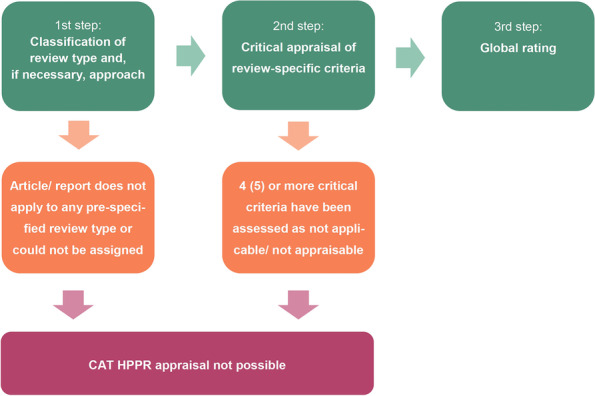
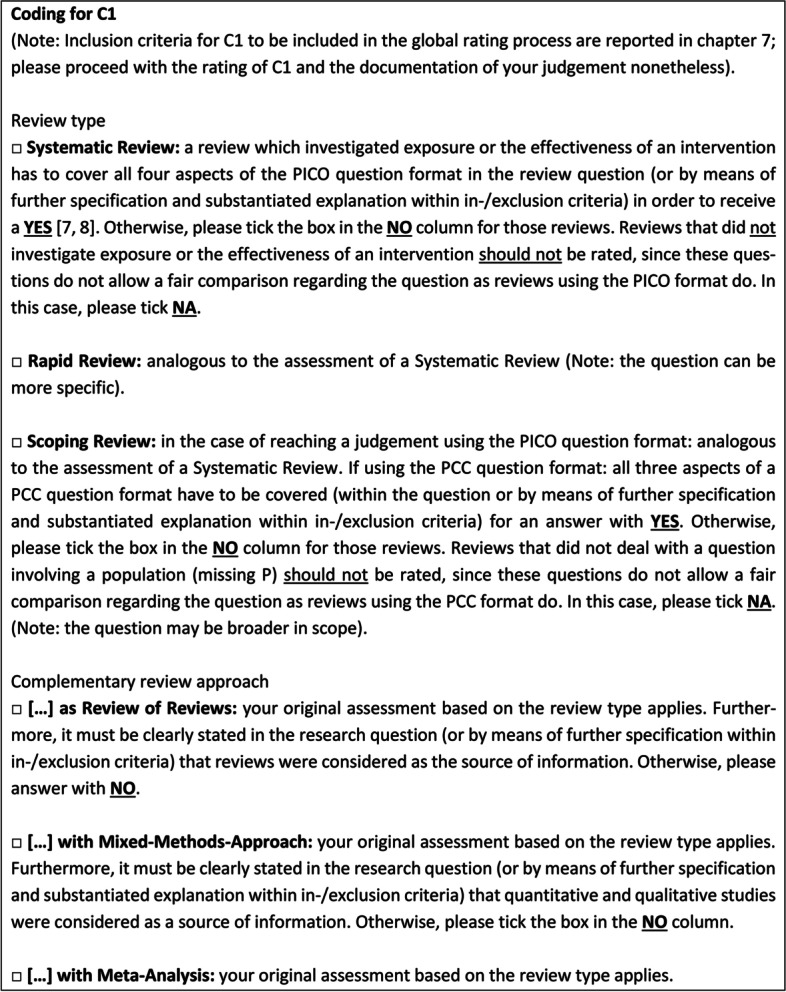
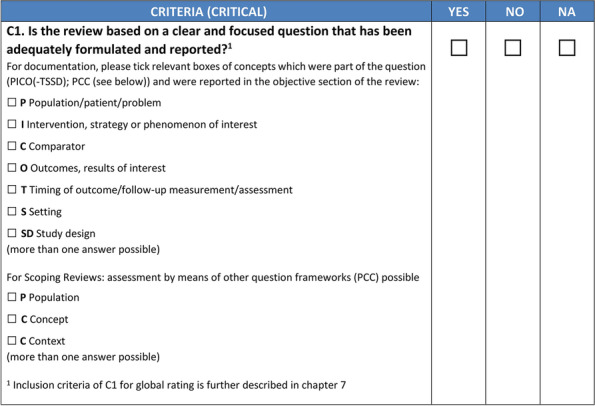
Verification
Claims the paper makes
The claims and statistics of this paper haven’t been checked yet.
Run the check — free, no account needed. It reads the open-access text and checks the sources it cites.
Claims other papers make about this one
Each is checked against this paper’s own text: does it say what the citing paper says it does?
The cited source says what the claim attributes to it.
In the citing paper
“Heise et al [60] used the PRISMA-ScR 2018 [18], PRISMA-Protocols [58], and PRISMA 2009 [12] guidelines to create working definitions of review types to set the scope for CAT HPPR (Critical Appraisal Tool for Health Promotion and Prevention Reviews) and develop an appraisal tool to assess the quality of systematic reviews, rapid reviews and ScRs.”
From Updating the PRISMA reporting guideline for scoping reviews: a scoping review (2026) · cites this paper as [60]
Self-check
Percentages, sums and reported differences re-computed from the paper’s own numbers.
The self-check needs the paper’s full text.
Citations
Cites
The PRISMA 2020 statement: An updated guideline for reporting systematic reviews
Page, M. J., McKenzie, J. E., Bossuyt, P. M., Boutron, I., Hoffmann, T. C., Mulrow, C. D., Shamseer, L., Tetzlaff, J. M., Akl, E. A., Brennan, S. E., et al. (2021) · BMJ · doi:10.1136/bmj.n71 · Cited by 108,283
Preferred Reporting Items for Systematic Reviews and Meta-Analyses: the PRISMA statement
Moher, D., Liberati, A., Tetzlaff, J., Altman, D. G., & for the PRISMA Group (2009) · BMJ · doi:10.1136/bmj.b2535 · Cited by 83,823
Preferred Reporting Items for Systematic Reviews and Meta-Analyses: The PRISMA Statement
Moher, D., Liberati, A., Tetzlaff, J., Altman, D. G., & The PRISMA Group (2009) · PLoS Medicine · doi:10.1371/journal.pmed.1000097 · Cited by 64,042
PRISMA Extension for Scoping Reviews (PRISMA-ScR): Checklist and Explanation
Tricco, A. C., Lillie, E., Zarin, W., O'Brien, K. K., Colquhoun, H., Levac, D., Moher, D., Peters, M. D. J., Horsley, T., Weeks, L., et al. (2018) · Annals of Internal Medicine · doi:10.7326/m18-0850 · Cited by 43,565
Scoping studies: towards a methodological framework
Arksey, H., & O'Malley, L. (2005) · International Journal of Social Research Methodology · doi:10.1080/1364557032000119616 · Cited by 36,742
Wang, G., Ma, R., Qiao, G., Wada, K., Aizawa, Y., & Satoh, T. (2015) · Integrative Medicine International · doi:10.1159/000368408 · Cited by 18,657
Scoping studies: advancing the methodology
Levac, D., Colquhoun, H., & O'Brien, K. K. (2010) · Implementation Science · doi:10.1186/1748-5908-5-69 · Cited by 15,268
Shamseer, L., Moher, D., Clarke, M., Ghersi, D., Liberati, A., Petticrew, M., Shekelle, P., Stewart, L. A., & the PRISMA-P Group (2015) · BMJ · doi:10.1136/bmj.g7647 · Cited by 13,120
Bundesgesundheitsblatt - Gesundheitsforschung - Gesundheitsschutz
(2013) · Bundesgesundheitsblatt - Gesundheitsforschung - Gesundheitsschutz · doi:10.1007/103.1437-1588 · Cited by 11,797
Munn, Z., Peters, M. D. J., Stern, C., Tufanaru, C., McArthur, A., & Aromataris, E. (2018) · BMC Medical Research Methodology · doi:10.1186/s12874-018-0611-x · Cited by 11,385
A typology of reviews: an analysis of 14 review types and associated methodologies
Grant, M. J., & Booth, A. (2009) · Health Information & Libraries Journal · doi:10.1111/j.1471-1842.2009.00848.x · Cited by 10,817
Shea, B. J., Reeves, B. C., Wells, G., Thuku, M., Hamel, C., Moran, J., Moher, D., Tugwell, P., Welch, V., Kristjansson, E., et al. (2017) · BMJ · doi:10.1136/bmj.j4008 · Cited by 10,636
Guidance for conducting systematic scoping reviews
Peters, M. D. J., Godfrey, C. M., Khalil, H., McInerney, P., Parker, D., & Soares, C. B. (2015) · International Journal of Evidence-Based Healthcare · doi:10.1097/xeb.0000000000000050 · Cited by 7,472
Development of AMSTAR: A measurement tool to assess the methodological quality of systematic reviews
Shea, B. J., Grimshaw, J. M., Wells, G. A., Boers, M., Andersson, N., Hamel, C., Porter, A. C., Tugwell, P., Moher, D., & Bouter, L. M. (2007) · BMC Medical Research Methodology · doi:10.1186/1471-2288-7-10 · Cited by 4,374
A scoping review of scoping reviews: advancing the approach and enhancing the consistency
Pham, M. T., Rajić, A., Greig, J. D., Sargeant, J. M., Papadopoulos, A., & McEwen, S. A. (2014) · Research Synthesis Methods · doi:10.1002/jrsm.1123 · Cited by 3,078
ROBIS: A new tool to assess risk of bias in systematic reviews was developed
Whiting, P., Savović, J., Higgins, J. P. T., Caldwell, D. M., Reeves, B. C., Shea, B., Davies, P., Kleijnen, J., & Churchill, R. (2016) · Journal of Clinical Epidemiology · doi:10.1016/j.jclinepi.2015.06.005 · Cited by 2,272
A scoping review on the conduct and reporting of scoping reviews
Tricco, A. C., Lillie, E., Zarin, W., O’Brien, K., Colquhoun, H., Kastner, M., Levac, D., Ng, C., Sharpe, J. P., Wilson, K., et al. (2016) · BMC Medical Research Methodology · doi:10.1186/s12874-016-0116-4 · Cited by 2,250 · cited 2×
“In stark contrast to a systematic review, some methodological aspects (four-eyes principle, quality assessment of included evidence sources) are often not defined as minimum requirements by (reporting) guidelines for reporting a rapid review or a scoping review (especially RRs), or in practice are simply not taken int…”
BackgroundMeta-Analyses of Randomized Controlled Trials
Sacks, H. S., Berrier, J., Reitman, D., Ancona-Berk, V. A., & Chalmers, T. C. (1987) · New England Journal of Medicine · doi:10.1056/nejm198702193160806 · Cited by 1,250
Methodology in conducting a systematic review of systematic reviews of healthcare interventions
Smith, V., Devane, D., Begley, C. M., & Clarke, M. (2011) · BMC Medical Research Methodology · doi:10.1186/1471-2288-11-15 · Cited by 1,227
A scoping review of rapid review methods
Tricco, A. C., Antony, J., Zarin, W., Strifler, L., Ghassemi, M., Ivory, J., Perrier, L., Hutton, B., Moher, D., & Straus, S. E. (2015) · BMC Medicine · doi:10.1186/s12916-015-0465-6 · Cited by 1,146
Users' Guides to the Medical Literature
Oxman, A. D. (1994) · JAMA · doi:10.1001/jama.1994.03520170077040 · Cited by 925
The Medical Review Article: State of the Science
MULROW, C. D. (1987) · Annals of Internal Medicine · doi:10.7326/0003-4819-106-3-485 · Cited by 856
Validation of an index of the quality of review articles
Oxman, A. D., & Guyatt, G. H. (1991) · Journal of Clinical Epidemiology · doi:10.1016/0895-4356(91)90160-b · Cited by 786
Implementation research: new imperatives and opportunities in global health
Theobald, S., Brandes, N., Gyapong, M., El-Saharty, S., Proctor, E. K., Diaz, T., Wanji, S., Elloker, S., Raven, J., Elsey, H., et al. (2018) · The Lancet · doi:10.1016/s0140-6736(18)32205-0 · Cited by 519
Oxman, A. D. (1994) · JAMA · doi:10.1001/jama.272.17.1367 · Cited by 486
Kung, J. (2010) · The Open Dentistry Journal · doi:10.2174/1874210601004020084 · Cited by 329
A mixed-methods approach to systematic reviews
Pearson, A., White, H., Bath-Hextall, F. J., Salmond, S. W., Apóstolo, J., & Kirkpatrick, P. (2015) · International Journal of Evidence-Based Healthcare · doi:10.1097/xeb.0000000000000052 · Cited by 286
Where to prospectively register a systematic review
Pieper, D., & Rombey, T. (2022) · Systematic Reviews · doi:10.1186/s13643-021-01877-1 · Cited by 225
Advocating evidence-based health promotion: reflections and a way forward
Rychetnik, L. (2004) · Health Promotion International · doi:10.1093/heapro/dah212 · Cited by 165
RAPID REVIEW: AN EMERGING APPROACH TO EVIDENCE SYNTHESIS IN HEALTH TECHNOLOGY ASSESSMENT
Khangura, S., Polisena, J., Clifford, T. J., Farrah, K., & Kamel, C. (2014) · International Journal of Technology Assessment in Health Care · doi:10.1017/s0266462313000664 · Cited by 138 · cited 3×
“In stark contrast to a systematic review, some methodological aspects (four-eyes principle, quality assessment of included evidence sources) are often not defined as minimum requirements by (reporting) guidelines for reporting a rapid review or a scoping review (especially RRs), or in practice are simply not taken int…”
BackgroundHarker, J., & Kleijnen, J. (2012) · International Journal of Evidence-Based Healthcare · doi:10.1111/j.1744-1609.2012.00290.x · Cited by 137
The assessment of systematic reviews in dentistry
Glenny, A., Esposito, M. A., Coulthard, P., & Worthington, H. V. (2003) · European Journal Of Oral Sciences · doi:10.1034/j.1600-0722.2003.00013.x · Cited by 122
A proposed framework for developing quality assessment tools
Whiting, P., Wolff, R., Mallett, S., Simera, I., & Savović, J. (2017) · Systematic Reviews · doi:10.1186/s13643-017-0604-6 · Cited by 121
Nussbaumer-Streit, B., Klerings, I., Wagner, G., Heise, T. L., Dobrescu, A. I., Armijo-Olivo, S., Stratil, J. M., Persad, E., Lhachimi, S. K., Van Noord, M. G., et al. (2018) · Journal of Clinical Epidemiology · doi:10.1016/j.jclinepi.2018.05.022 · Cited by 72 · cited 1×
“A well-documented and comprehensive search strategy includes search approaches for multiple literature databases and other search streams to identify relevant evidence sources, this can particular differ between systematic and rapid reviews which can be assessed with C4 [57].”
BackgroundSelf-citationDevelopment of the Documentation and Appraisal Review Tool for systematic reviews
Diekemper, R. L. (2015) · World Journal of Meta-Analysis · doi:10.13105/wjma.v3.i3.142 · Cited by 44
Tools for critically appraising different study designs, systematic review and literature searches
(EFSA), E. F. S. A. (2015) · EFSA Supporting Publications · doi:10.2903/sp.efsa.2015.en-836 · Cited by 35
Alayli, A., Witte, C., Haß, W., Zeeb, H., Heise, T. L., & Hupfeld, J. (2021) · Bundesgesundheitsblatt - Gesundheitsforschung - Gesundheitsschutz · doi:10.1007/s00103-021-03309-w · Cited by 5
Self-citation
Research works printed but not linked: 9
- Healthevidence.org: quality assessment tool - Review Articles https://www.healthevidence.org/documents/our-appraisal-tools/QA_Tool&Dictionary_10Nov16.pdf Accessed 24 July 2019.
- Evidence analysis manual - appendix 10: quality criteria Checklist: Review Article https://www.andeal.org/vault/2440/web/files/2016_April_EA_Manual.pdf Accessed 24 July 2019.
- Reviews and Meta-Analyses Checklist https://bestbets.org/ca/pdf/review.pdf Accessed 24 July 2019.
- Critical Appraisal of a Meta-analysis or Systematic Review https://www.cebma.org/wp-content/uploads/Critical-Appraisal-Questions-for-a-SR-or-MA-july-2014.pdf Accessed 24 July 2019.
- Critical appraisal worksheets: Systematic Reviews https://www.cebm.net/systematic-review-4/ Accessed 24 July 2019.
- CASP Checklist: 10 questions to help you make sense of a Systematic Review https://casp-uk.net/wp-content/uploads/2018/01/CASP-Systematic-Review-Checklist_2018.pdf Accessed 24 July 2019.
- Systematic review (of therapy) worksheet https://ebm-tools.knowledgetranslation.net/themes/blue/files/uploads/sr-worksheet.doc Accessed 24 July 2019.
- Kung J, Chiappelli F, Cajulis OO, Avezova R, Kossan G, Chew L, et al. From systematic reviews to clinical recommendations for evidence-based health care: validation of revised assessment of multiple systematic reviews (R-AMSTAR) for grading of clinical relevance. Open Dent J. 2010;4:84–91.
- EPC Methods: An Exploration of Methods and Context for the Production of Rapid Reviews https://www.ncbi.nlm.nih.gov/books/NBK274092/pdf/Bookshelf_NBK274092.pdf Accessed 24 July 2019.
Cited by
Updating the PRISMA reporting guideline for scoping reviews: a scoping review
Tricco, A. C., Robinson, E., Straus, S. E., Colquhoun, H., Godfrey, C. M., Moher, D., Munn, Z., Pollock, D., Logan, S., Elsman, E. B. M., et al. (2026) · Journal of Clinical Epidemiology · doi:10.1016/j.jclinepi.2026.112314 · Cited by 9
Metadata
- Authors
- Heise, T. L., Seidler, A., Girbig, M., Freiberg, A., Alayli, A., Fischer, M., Haß, W., & Zeeb, H.
- Venue
- BMC Medical Research Methodology
- Published
- 2022-12-26
- Volume
- 22
- Issue
- 1
- ISSN
- 1471-2288
- PMC
- PMC9791771
- Cited by
- 20
- References
- 37
- Language
- en
- Licence
- creativecommons.org/licenses/by/4.0 (tdm)
- creativecommons.org/licenses/by/4.0 (vor)
- Funders
- GKV-Bündnis für Gesundheit, a joint initiative of all German health insurance funds
- Leibniz-Institut für Präventionsforschung und Epidemiologie – BIPS GmbH
About these checks
Registry, retraction, Cites and statistics results are computed, not judged, with one exception: a printed reference that no index lists is read once by a model before it counts as a citation error. Claims are extracted by a model and kept only when their quote appears verbatim in the text; each cited source is then checked, with a model’s help, for whether it says what the claim relies on. Those verdicts can be wrong — read the claim’s quote and the cited source before relying on one.
Statistics and arithmetic are recomputed, not judged.
Confidence bands are shown only for fields calibrated on our annotated test set. None is calibrated yet, so no band is shown.
What counts as a claim ›How we measure confidence ›How we check this ›
Are you an author, or do you see a problem with this page? Request a review
Data sources
Bibliographic data: Semantic Scholar, OpenAlex, Crossref.
Contains information from the Semantic Scholar Academic Graph Datasets, made available under the ODC Attribution License (ODC-BY 1.0).
Semantic Scholar’s data is described in: Kinney, R., et al. (2023). The Semantic Scholar Open Data Platform. arXiv:2301.10140.
