

The DOI matches its Crossref record; 9 of the 9 references it cites were found in a registry or an index.
A scoping review on the methodological and reporting quality of scoping reviews in China
Published version of a preprint
Abstract
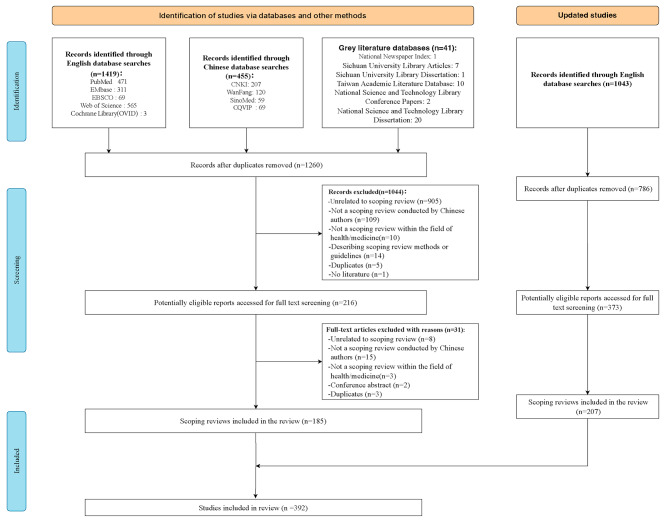
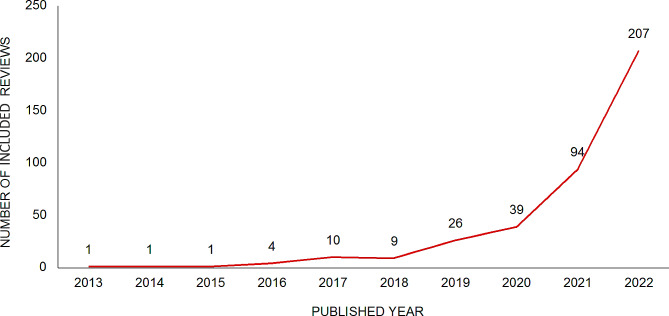
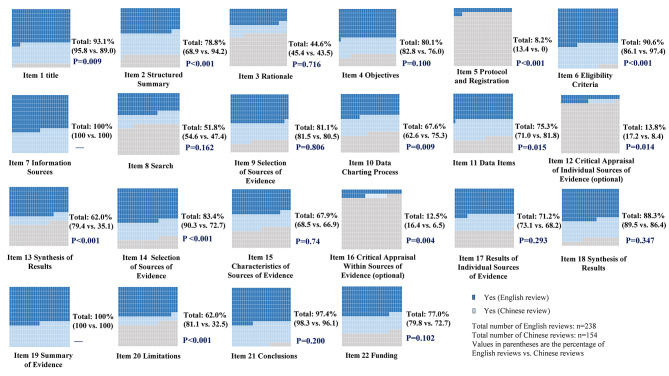
Background: Scoping reviews have emerged as a valuable method for synthesizing emerging evidence, providing a comprehensive contextual overview, and influencing policy and practice developments. The objective of this study is to provide an overview of scoping reviews conducted in Chinese academic institutions over the last decades. Method: We conducted a comprehensive search of nine databases and six grey literature databases for scoping reviews conducted in Chinese academic institutions. The reporting quality of the included reviews was assessed using the Preferred Reporting Items for PRISMA-ScR checklist. We performed both quantitative and qualitative analyses, examining the conduct of the scoping reviews and exploring the breadth of research topics covered. We used Chi-squared and Wilcoxon rank-sum tests to compare methodological issues and reporting quality in English and Chinese-language reviews. Results: A total of 392 reviews published between 2013 and 2022 were included, 238 English-reported reviews and 154 Chinese-reported reviews, respectively. The primary purposes of these reviews were to map and summarize the evidence, with a particular focus on health and nursing topics. 98.7% of reviews explicitly used the term “scoping review”, and the Arksey and O’Malley framework was the most frequently cited framework. Thirty-five English-reported scoping reviews provided a protocol for scoping review. PubMed was the most common source in English-reported reviews and CNKI in Chinese-reported reviews. Reviews published in English were more likely to search the grey literature ( P = 0.005), consult information specialists ( P < 0.001) and conduct an updated search ( P = 0.012) than those in Chinese. Reviews published in English had a significantly high score compared to those published in Chinese (16 vs. 14; P < 0.001). The reporting rates in English-reported reviews were higher than those in Chinese reviews for seven items, but lower for structured summary ( P < 0.001), eligibility criteria ( P < 0.001), data charting process ( P = 0.009) and data items ( P = 0.015). Conclusion: There has been a significant increase in the number of scoping reviews conducted in Chinese academic institutions each year since 2020. While the research topics covered are diverse, the overall reporting quality of these reviews is need to be improved. And there is a need for greater standardization in the conduct of scoping reviews in Chinese academic institutions.
Overview
The claims and statistics of this paper haven’t been checked yet.
Run the check — free, no account needed. It reads the open-access text and checks the sources it cites.
Integrity signals
Registry
Cites
Statistics
Figures

Verification
Claims the paper makes
The claims and statistics of this paper haven’t been checked yet.
Run the check — free, no account needed. It reads the open-access text and checks the sources it cites.
Claims other papers make about this one
Each is checked against this paper’s own text: does it say what the citing paper says it does?
In the citing paper
“There were four papers that also emphasized the deficiency of reporting quality in ScRs across different areas of research (eg, nursing, dental health) despite the existence of current reporting guidelines [5,7,8,62].”
From Updating the PRISMA reporting guideline for scoping reviews: a scoping review (2026) · cites this paper as [5]
In the citing paper
“Conversely, the shortest timeframe of 9 years spanned from 2013 to 2022 [5].”
From Updating the PRISMA reporting guideline for scoping reviews: a scoping review (2026) · cites this paper as [5]
Self-check
Percentages, sums and reported differences re-computed from the paper’s own numbers.
The self-check needs the paper’s full text.
Citations
Cites
PRISMA Extension for Scoping Reviews (PRISMA-ScR): Checklist and Explanation
Tricco, A. C., Lillie, E., Zarin, W., O'Brien, K. K., Colquhoun, H., Levac, D., Moher, D., Peters, M. D. J., Horsley, T., Weeks, L., et al. (2018) · Annals of Internal Medicine · doi:10.7326/m18-0850 · Cited by 43,565
Munn, Z., Peters, M. D. J., Stern, C., Tufanaru, C., McArthur, A., & Aromataris, E. (2018) · BMC Medical Research Methodology · doi:10.1186/s12874-018-0611-x · Cited by 11,385
Updated methodological guidance for the conduct of scoping reviews
Peters, M. D. J., Marnie, C., Tricco, A. C., Pollock, D., Munn, Z., Alexander, L., McInerney, P., Godfrey, C. M., & Khalil, H. (2020) · JBI Evidence Synthesis · doi:10.11124/jbies-20-00167 · Cited by 9,046
A scoping review on the conduct and reporting of scoping reviews
Tricco, A. C., Lillie, E., Zarin, W., O’Brien, K., Colquhoun, H., Kastner, M., Levac, D., Ng, C., Sharpe, J. P., Wilson, K., et al. (2016) · BMC Medical Research Methodology · doi:10.1186/s12874-016-0116-4 · Cited by 2,250 · cited 2×
“Scoping reviews have been widely conducted in various fields, including health, technology and social sciences over the past decades [7].”
BackgroundResultDaudt, H. M., van Mossel, C., & Scott, S. J. (2013) · BMC Medical Research Methodology · doi:10.1186/1471-2288-13-48 · Cited by 1,891
Clarifying differences between review designs and methods
Gough, D., Thomas, J., & Oliver, S. (2012) · Systematic Reviews · doi:10.1186/2046-4053-1-28 · Cited by 1,063
What are scoping studies? A review of the nursing literature
Davis, K., Drey, N., & Gould, D. (2009) · International Journal of Nursing Studies · doi:10.1016/j.ijnurstu.2009.02.010 · Cited by 855 · cited 1×
“Scoping reviews are a valuable approach to synthesizing emerging evidence, providing a comprehensive overview of the context and the potential to influence policy and practice developments [5, 6].”
BackgroundKnowledge translation is the use of knowledge in health care decision making
Straus, S. E., Tetroe, J. M., & Graham, I. D. (2011) · Journal of Clinical Epidemiology · doi:10.1016/j.jclinepi.2009.08.016 · Cited by 383 · cited 2×
“…resources (e.g. explore breadth/extent of evidence, grey literature, consulted experts, crosscheck references), title and abstract screening, full-text screening, pre-defined charting form, flow diagram, result presentation (tables and/or diagrams), the implication for research and practice [22].”
BackgroundConducting high quality scoping reviews-challenges and solutions
Khalil, H., Peters, M. D., Tricco, A. C., Pollock, D., Alexander, L., McInerney, P., Godfrey, C. M., & Munn, Z. (2021) · Journal of Clinical Epidemiology · doi:10.1016/j.jclinepi.2020.10.009 · Cited by 305
Research works printed but not linked: 18
- Moher D, Stewart L, Shekelle P. All in the family: systematic reviews, rapid reviews, scoping reviews, realist reviews, and more. Syst Rev Dec. 2015;22:4:183. https://doi.org/10.1186/s13643-015-0163-7. · DOI · Paper page
- Grant MJ, Booth A. A typology of reviews: an analysis of 14 review types and associated methodologies. Health Info Libr J Jun. 2009;26(2):91–108. https://doi.org/10.1111/j.1471-1842.2009.00848.x. · DOI · Paper page
- Sutton A, Clowes M, Preston L, Booth A. Meeting the review family: exploring review types and associated information retrieval requirements. Health Info Libr J Sep. 2019;36(3):202–22. https://doi.org/10.1111/hir.12276. · DOI · Paper page
- Colquhoun HL, Levac D, O’Brien KK, et al. Scoping reviews: time for clarity in definition, methods, and reporting. J Clin Epidemiol Dec. 2014;67(12):1291–4. https://doi.org/10.1016/j.jclinepi.2014.03.013. · DOI · Paper page
- Levac D, Colquhoun H, O’Brien KK. Scoping studies: advancing the methodology. Implement Sci Sep. 2010;20:5:69. https://doi.org/10.1186/1748-5908-5-69. · DOI · Paper page
- G MDJPC, BS PMC, K H. D. P. Chapter 11: scoping reviews. The Joanna Briggs Institute. Accessed April 1, 2020. https://reviewersmanual.joannabriggs.org.
- Harms MC, Goodwin VA. Scoping reviews. Physiotherapy Dec. 2019;105(4):397–8. https://doi.org/10.1016/j.physio.2019.10.005. · DOI
- Mays N, Popay RE. J. Studying the organization and delivery of health services: research methods. In: Fulop. N, Allen. P, Clarke. A, Black. N, eds. Synthesising research evidence. Routledge; 2001:194.
- Arksey H, O’Malley L. Scoping studies: towards a methodological framework. Int J Soc Res Methodol. 2005;8:19–32. https://doi.org/10.1080/1364557032000119616. · DOI · Paper page
- Peters MD, Godfrey CM, Khalil H, McInerney P, Parker D, Soares CB. Guidance for conducting systematic scoping reviews. Int J Evid Based Healthc Sep. 2015;13(3):141–6. https://doi.org/10.1097/xeb.0000000000000050. · DOI · Paper page
- Peters MDJ, Marnie C, Tricco AC, et al. Updated methodological guidance for the conduct of scoping reviews. JBI Evid Implement Mar. 2021;19(1):3–10. https://doi.org/10.1097/xeb.0000000000000277. · DOI · Paper page
- Xiyi W, Zhihong Y, Leiwen T. An integrative review of scoping review applied in nursing iterature. Chin J Nurs. 2019;54(08):1259–63.
- Mu F, Tang M, Guan Y, et al. Knowledge mapping of the Links between the gut microbiota and heart failure: a Scientometric Investigation (2006–2021). Front Cardiovasc Med. 2022;9:882660. https://doi.org/10.3389/fcvm.2022.882660. · DOI
- Lin Z, Ji X, Tian N, Gan Y, Ke L. Mapping intellectual structure for the long non-coding RNA in Hepatocellular Carcinoma Development Research. Front Genet. 2021;12:771810. https://doi.org/10.3389/fgene.2021.771810. · DOI
- Pham MT, Rajić A, Greig JD, Sargeant JM, Papadopoulos A, McEwen SA. A scoping review of scoping reviews: advancing the approach and enhancing the consistency. Res Synth Methods Dec. 2014;5(4):371–85. https://doi.org/10.1002/jrsm.1123. · DOI · Paper page
- Qian J, Sun S, Wang M, Yu X. Nonpharmacological pain management interventions in medical and surgical abortion: a scoping review. Int J Nurs Pract Apr. 2022;3:e13056. https://doi.org/10.1111/ijn.13056. · DOI
- Wang Y, Wang Z, Liu G, et al. Application of Serious games in Health Care: scoping review and bibliometric analysis. Front Public Health. 2022;10:896974. https://doi.org/10.3389/fpubh.2022.896974. · DOI
- Huang L, Chang H, Peng X, Zhang F, Mo B, Liu Y. Formally reporting incidents of workplace violence among nurses: a scoping review. J Nurs Manag Sep. 2022;30(6):1677–87. https://doi.org/10.1111/jonm.13567. · DOI
Cited by
Sorted by citations
Updating the PRISMA reporting guideline for scoping reviews: a scoping review
Tricco, A. C., Robinson, E., Straus, S. E., Colquhoun, H., Godfrey, C. M., Moher, D., Munn, Z., Pollock, D., Logan, S., Elsman, E. B. M., et al. (2026) · Journal of Clinical Epidemiology · doi:10.1016/j.jclinepi.2026.112314 · Cited by 9
Metadata
- Authors
- Xue, X., Tang, X., Liu, S., Yu, T., Chen, Z., Chen, N., & Yu, J.
- Venue
- BMC Medical Research Methodology
- Published
- 2024-02-22
- Volume
- 24
- Issue
- 1
- ISSN
- 1471-2288
- PMC
- PMC10882808
- Cited by
- 13
- References
- 9
- Language
- en
- Funders
- the Sichuan Provincial Department of Science and Technology Project (2023NSFSC0520)
About these checks
Registry, retraction, Cites and statistics results are computed, not judged, with one exception: a printed reference that no index lists is read once by a model before it counts as a citation error. Claims are extracted by a model and kept only when their quote appears verbatim in the text; each cited source is then checked, with a model’s help, for whether it says what the claim relies on. Those verdicts can be wrong — read the claim’s quote and the cited source before relying on one.
Statistics and arithmetic are recomputed, not judged.
Confidence bands are shown only for fields calibrated on our annotated test set. None is calibrated yet, so no band is shown.
What counts as a claim ›How we measure confidence ›How we check this ›
Are you an author, or do you see a problem with this page? Request a review
