

Consensus and evidence-based medication review to optimize and potentially reduce psychotropic drug prescription in institutionalized dementia patients
Open accessThe DOI matches its Crossref record; 30 of the 30 references it cites were found in a registry or an index.
Abstract
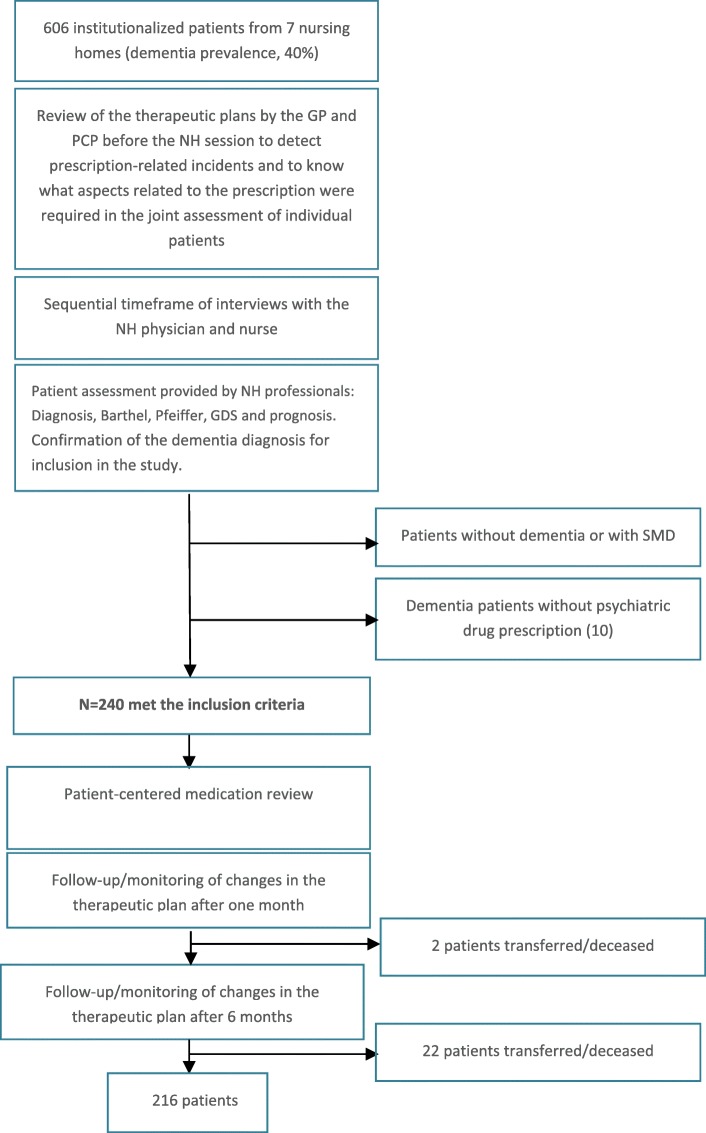
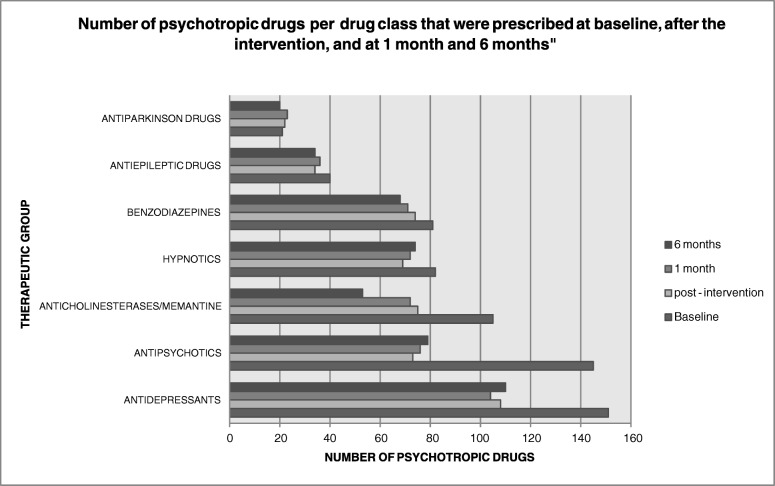
BACKGROUND: Dementia patients often show neuropsychiatric symptoms, known as behavioral and psychological symptoms of dementia (BPSD). These are a common motive for medical consultations, hospitalizations, and nursing home stays. Various studies have suggested that the high prevalence of psychotropic drug use to treat BPSD in institutionalized dementia patients may lead to impaired cognitive capacity, rigidity, somnolence, and other complications during the course of the illness. The aim of this study was to design a consensus-based intervention between care levels to optimize and potentially reduce prescription of psychotropic drugs in institutionalized patients with dementia and assess the changes occurring following its implementation. METHODS: Design: Prospective, quasi-experimental, pre/post intervention, multicenter study. SCOPE: 7 nursing homes associated with a single primary care team. INCLUSION CRITERIA: Institutionalized patients diagnosed with dementia and under treatment with 1 or more psychotropic drugs for at least 3 months. SAMPLE: 240 individuals; mean age, 87 years (SD: 6.795); 75% (180) women. INTERVENTION: Creation of evidence-based therapeutic guidelines for psychotropic drug use in the treatment of BPSD by consensus between reference professionals. Joint review (primary care and geriatric care nursing home professionals) of the medication based on the guidelines and focusing on individual patient needs. Primary variable: Number of psychotropic drugs used per patient. ASSESSMENT: Preintervention, immediate postintervention, and at 1 and 6 months. RESULTS: Overall, the number of psychotropic drugs prescribed was reduced by 28% (from 636 before to 458 after the intervention). The mean number of psychotropic drugs prescribed per patient decreased from 2.71 at baseline to 1.95 at 1 month postintervention and 2.01 at 6 months (p < 0.001 for both time points). Antipsychotics were the drug class showing the highest reduction rate (49.66%). Reintroduction of discontinued psychotropic drugs was 2% at 1 month following the intervention and 12% at 6 months. CONCLUSIONS: A consensus guidelines-based therapeutic intervention with a patient-centered medication review by a multidisciplinary team led to a reduction in prescription of psychotropic drugs in institutionalized dementia patients.
Overview
The claims and statistics of this paper haven’t been checked yet.
Free: it reads the open-access text and checks the first 5 claims that cite a source we can check. Create a free account to check every claim.
Integrity signals
Registry
Cites
Statistics
Figures
Verification
Claims the paper makes
The claims and statistics of this paper haven’t been checked yet.
Free: it reads the open-access text and checks the first 5 claims that cite a source we can check. Create a free account to check every claim.
Claims other papers make about this one
Each is checked against this paper’s own text: does it say what the citing paper says it does?
The source backs part of the claim, not all of it — or backs it for a different population, condition or comparison.
In the citing paper
“Where utilised, psychotropic reviews have been useful, reducing prescribing rates by 28–82% [36, 96, 97].”
From Stakeholders' views on the use of psychotropic medication in older people: a systematic review (2022) · cites this paper as [97]
Experimental — accuracy not yet measured
Self-check
Percentages, sums and reported differences re-computed from the paper’s own numbers.
The self-check needs the paper’s full text.
Citations
Cites
Faul, F., Erdfelder, E., Lang, A.-G., & Buchner, A. (2007) · Behavior Research Methods · doi:10.3758/bf03193146 · Cited by 65,971
Scottish Intercollegiate Guidelines Network
Twaddle, S., & Qureshi, S. (2005) · Evidence-based Healthcare and Public Health · doi:10.1016/j.ehbc.2005.09.008 · Cited by 4,084
Antidepressant use and risk of adverse outcomes in older people: population based cohort study
Coupland, C., Dhiman, P., Morriss, R., Arthur, A., Barton, G., & Hippisley-Cox, J. (2011) · BMJ · doi:10.1136/bmj.d4551 · Cited by 833 · cited 1×
“[15] examined the association between antidepressant use and serious drug-related adverse events in patients older than 65 years with depression.”
BackgroundPoint and 5‐year period prevalence of neuropsychiatric symptoms in dementia: the Cache County Study
Steinberg, M., Shao, H., Zandi, P., Lyketsos, C. G., Welsh‐Bohmer, K. A., Norton, M. C., Breitner, J. C. S., Steffens, D. C., & Tschanz, J. T. (2008) · International Journal of Geriatric Psychiatry · doi:10.1002/gps.1858 · Cited by 780
Reed, M. W. R. (2007) · Clinical Oncology · doi:10.1016/j.clon.2007.06.006 · Cited by 571
Ballard, C., Hanney, M. L., Theodoulou, M., Douglas, S., McShane, R., Kossakowski, K., Gill, R., Juszczak, E., Yu, L.-M., & Jacoby, R. (2009) · The Lancet Neurology · doi:10.1016/s1474-4422(08)70295-3 · Cited by 567
Fossey, J., Ballard, C., Juszczak, E., James, I., Alder, N., Jacoby, R., & Howard, R. (2006) · BMJ · doi:10.1136/bmj.38782.575868.7c · Cited by 512 · cited 1×
“While several studies have demonstrated the effectiveness of interventions aimed at reducing the use of psychotropic drugs in institutionalized dementia patients (18)(19)(20)(21), few have evaluated their costeffectiveness or the impact of these interventions on patients' quality of life (22).”
BackgroundBenzodiazepine use and risk of dementia: prospective population based study
Billioti de Gage, S., Begaud, B., Bazin, F., Verdoux, H., Dartigues, J.-F., Peres, K., Kurth, T., & Pariente, A. (2012) · BMJ · doi:10.1136/bmj.e6231 · Cited by 436 · cited 1×
“Psychotropic drug use has been associated with decreased cognitive capacity, rigidity, and somnolence and may result in complications such as pneumonia (4), increased risk of experiencing dementia (around 50%) (5) and mortality (6)(2) in institutionalized dementia patients.”
BackgroundAmerican Geriatrics Society Expert Panel on the Care of Older Adults with Multimorbidity (2012) · Journal of the American Geriatrics Society · doi:10.1111/j.1532-5415.2012.04187.x · Cited by 308
Antipsychotic use in dementia: a systematic review of benefits and risks from meta-analyses
Tampi, R. R., Tampi, D. J., Balachandran, S., & Srinivasan, S. (2016) · Therapeutic Advances in Chronic Disease · doi:10.1177/2040622316658463 · Cited by 267 · cited 1×
“Psychotropic drug use has been associated with decreased cognitive capacity, rigidity, and somnolence and may result in complications such as pneumonia (4), increased risk of experiencing dementia (around 50%) (5) and mortality (6)(2) in institutionalized dementia patients.”
Background
Research works printed but not linked: 4
- Banerjee S The use of antipsychotic medication for people with dementia: time for action. A report for the minister of state for care services 2009 London Department of Health
- Estudio EARCAS Eventos Adversos en Residencias geriátricas y centros Asistenciales Sociosanitarios Madrid: Ministerio de Sanidad, Política Social e Igualdad 2011
- Bergh S Selbæk G Engedal K Discontinuation of antidepressants in people with dementia and neuropsychiatric symptoms (DESEP study): double blind, randomised, parallel group, placebo controlled trial BMJ 2012 344 e1566 10.1136/bmj.e1566 22408266 · DOI · Paper page
- Massot M Tristany M Franzi A Garcia I Reducing the number of antidepressants, antipsychotics and benzodiazepines in nursing home residents with dementia European Journal of General Practice 2016 2 22 147 154
Cited by
Quek, H. W., Page, A. T., Lee, K., Lee, G. B., Hawthorne, D., Clifford, R. M., Potter, K., & Etherton‐Beer, C. (2024) · British Journal of Clinical Pharmacology · doi:10.1111/bcp.16200 · Cited by 85
Gedde, M. H., Husebo, B. S., Mannseth, J., Kjome, R. L. S., Naik, M., & Berge, L. I. (2020) · American Journal of Geriatric Psychiatry · doi:10.1016/j.jagp.2020.07.004 · Cited by 61
Impact of pharmacists on outcomes for patients with psychiatric or neurologic disorders
Werremeyer, A. B., Bostwick, J. R., Cobb, C. D., Moore, T. D., Park, S. H., Price, C., & McKee, J. R. (2020) · Mental Health Clinician · doi:10.9740/mhc.2020.11.358 · Cited by 59
Prevalence of psychotropic polypharmacy in nursing home residents with dementia: a meta-analysis
Jester, D. J., Molinari, V., Zgibor, J. C., & Volicer, L. (2021) · International Psychogeriatrics · doi:10.1017/s1041610220004032 · Cited by 60
Medicaid Savings From The New York University Caregiver Intervention for Families with Dementia
Foldes, S. S., Moriarty, J. P., Farseth, P., Mittelman, M. S., & Long, K. H. (2017) · The Gerontologist · doi:10.1093/geront/gnx077 · Cited by 49
Stakeholders' views on the use of psychotropic medication in older people: a systematic review
Bednarczyk, E., Cook, S., Brauer, R., & Garfield, S. (2022) · Age and Ageing · doi:10.1093/ageing/afac060 · Cited by 22
“Where utilised, psychotropic reviews have been useful, reducing prescribing rates by 28–82% [36, 96, 97].”
BackgroundGender Differences in Disease, Function, and Behavioral Symptoms in Residents with Dementia
Resnick, B. M., Galik, E. M., McPherson, R., Boltz, M. P., Haitsma, K. S. V., & Kolanowski, A. M. (2021) · Western Journal of Nursing Research · doi:10.1177/01939459211018822 · Cited by 23
Múñiz, R., Pérez-Wehbe, A. I., Couto, F., Pérez, M. A. H., Ramírez, N., López, A., Rodriguez, J. M., Usieto, T., Lavin, L., Rigueira, A., et al. (2019) · International Psychogeriatrics · doi:10.1017/s104161021900111x · Cited by 20
“The “ frequency and BPSD ” approach has recently been described in an intervention using patient-centered medication reviews for BPSD (Massot Mesquida et al. , 2019).”
Kwak, J., Ha, J., & Valuch, K. O. (2020) · Dementia · doi:10.1177/1471301220962234 · Cited by 18
“Behavioral symptoms of dementia affect between 75%–90% of patients with significant impact on quality of life among residents (Massot Mesquida et al., 2019).”
BackgroundParajuli, D. R., Kuot, A., Hamiduzzaman, M., Gladman, J., & Isaac, V. (2021) · BMC Psychiatry · doi:10.1186/s12888-020-03033-w · Cited by 20
Andrews, N., Brooks, C., Michèle Board, Fraser, S. D., Latter, S. M., Aplin, K., McCausland, B. M. S., Radcliffe, E., Amin, J., Lim, R. H. M., et al. (2025) · Drugs & Aging · doi:10.1007/s40266-025-01189-2 · Cited by 18
Gedde, M. H., Husebo, B. S., Mannseth, J., Naik, M., Selbæk, G., Vislapuu, M., & Berge, L. I. (2022) · BMC Medicine · doi:10.1186/s12916-022-02382-5 · Cited by 14
Medications and cognitive decline in Alzheimer's disease: Cohort cluster analysis of 15,428 patients
Jurado, P. G., Mostafaei, S., Xu, H., Mo, M., Petek, B., Kalar, I., Naia, L., Kele, J., Maioli, S., Pereira, J. B., et al. (2025) · Journal of Alzheimer s Disease · doi:10.1177/13872877241307870 · Cited by 9
Stötzner, P., Abate, R. E. F., Henssler, J. F., Seethaler, M., Just, S. A., & Brandl, E. J. (2022) · Journal of Clinical Psychopharmacology · doi:10.1097/jcp.0000000000001521 · Cited by 9
Timler, A., Bulsara, C., Bulsara, M. K., Vickery, A. W., Jacques, A., & Codde, J. (2023) · Australian Journal on Ageing · doi:10.1111/ajag.13224 · Cited by 13
Positive behaviour support for people with dementia
Fisher, A. C., Connolly, T., O’Connor, C. M. C., & KELLY, G. L. (2022) · International Journal of Geriatric Psychiatry · doi:10.1002/gps.5844 · Cited by 7
Fermoso, A. G., Domínguez-Berrueta, M. C. H., de Pipaón, M. R.-P., Dahl, A. B., Carreño, B. B., & Alcántara, A. D. (2021) · Journal of Healthcare Quality Research · doi:10.1016/j.jhqr.2021.07.002 · Cited by 6
Pharmacoepidemiology of medications omitted in New Zealand Residential Aged Care Homes
Garratt, S., Kerse, N. M., Peri, K., Jonas, M., & Scahill, S. L. (2020) · Australian Journal on Ageing · doi:10.1111/ajag.12812 · Cited by 6
Mesquida, M. M., Folkvord, F., Gombau, G. S., Lupiáñez‐Villanueva, F., & Torán‐Monserrat, P. (2021) · BMC Geriatrics · doi:10.1186/s12877-021-02287-7 · Cited by 5
Self-citationGerritsen, A. A. J., Bakker, C., Bruls, E., Verhey, F. R. J., Pijnenburg, Y. A. L., Millenaar, J., de Vugt, M. E., & Koopmans, R. T. C. M. (2019) · Aging & Mental Health · doi:10.1080/13607863.2019.1691145 · Cited by 7
Parajuli, D. R., Kuot, A., Hamiduzzaman, M., Gladman, J., & Isaac, V. (2021) · BMC Psychiatry · doi:10.1186/s12888-021-03141-1 · Cited by 5
Medication Reviews and Clinical Outcomes in Persons with Dementia: A Scoping Review
Sharma, R., Mahajan, N., Fadaleh, S. M. A., Patel, H., Ivo, J., Faisal, S., Chang, F., Lee, L. S., & Patel, T. (2023) · Pharmacy · doi:10.3390/pharmacy11050168 · Cited by 7
Balasundaram, B., Loh, S. Y., Rosario, B. H., Tun, M. H., Ooi, C. H., Li, F., & Bishara, D. (2023) · Delirium · doi:10.56392/001c.87943 · Cited by 3
Drugs for the Treatment of Alzheimer’s Disease
Seifert, R. (2019) · Springer eBooks · doi:10.1007/978-3-030-18899-3_30 · Cited by 1
Biering, P., & Hjaltadóttir, I. (2021) · Læknablaðið · doi:10.17992/lbl.2021.01.615 · Cited by 5
The ABCD approach for managing neuropsychiatric symptoms of dementia
Siple, A. (2023) · Nursing · doi:10.1097/01.nurse.0000942784.14340.1f · Cited by 1
Individualised Nursing Care in Older People Care
Rodríguez‐Martin, B. (2018) · Springer eBooks · doi:10.1007/978-3-319-89899-5_11 · Cited by 1
Ansart, M., Epelbaum, S., Houot, M., Nédelec, T., Lekens, B., Gantzer, L., Dormont, D., & Durrleman, S. (2021) · Alzheimer s & Dementia Translational Research & Clinical Interventions · doi:10.1002/trc2.12210 · Cited by 1
Positive behaviour support for people with dementiaPreprint
Fisher, A. C., Connolly, T., O’Connor, C. M. C., & KELLY, G. L. (2021) · doi:10.31234/osf.io/vnjyf
Aalto, U. L., Rantsi, M., Juola, A.-L., Kautiainen, H., & Pitkälä, K. H. (2022) · Scandinavian Journal of Primary Health Care · doi:10.1080/02813432.2022.2074055 · Cited by 2
Valle, M. A. V., & Astorgano, L. P. (2025) · FarmaJournal · doi:10.14201/fj2025101715
Gedde, M. H., Husebo, B. S., Mannseth, J., Naik, M., Selbaek, G., Vislapuu, M., & Berge, L. I. (2022) · Figshare · doi:10.6084/m9.figshare.19881559
Gedde, M. H., Husebo, B. S., Mannseth, J., Naik, M., Selbaek, G., Vislapuu, M., & Berge, L. I. (2022) · Figshare · doi:10.6084/m9.figshare.19881556
Gedde, M. H., Husebo, B. S., Mannseth, J., Naik, M., Selbaek, G., Vislapuu, M., & Berge, L. I. (2022) · Figshare · doi:10.6084/m9.figshare.19881562
Parajuli, D. R., Kuot, A., Hamiduzzaman, M., Gladman, J., & Isaac, V. (2021) · Figshare · doi:10.6084/m9.figshare.13571981
Sharma, R., Aslam, Y., Faisal, S. B., McAiney, C. A., Chang, F., Sadowski, C. A., Lee, L., Roy, M., Baby, B., Mamdani, M., et al. (2026) · PLoS ONE · doi:10.1371/journal.pone.0341014
Olazarán, J., Perea, L., Rigueira, A., López‐Álvarez, J., & Múñiz, R. (2026) · Journal of the American Medical Directors Association · doi:10.1016/j.jamda.2025.106093
Carabine, F., Hughes, C. M., & Barry, H. E. (2026) · Research in Social and Administrative Pharmacy · doi:10.1016/j.sapharm.2026.07.011
Metadata
- Authors
- Massot Mesquida, M., Tristany Casas, M., Franzi Sisó, A., García Muñoz, I., Hernández Vian, Ó., & Torán Monserrat, P.
- Venue
- BMC Geriatrics
- Published
- 2019-01-08
- Volume
- 19
- Issue
- 1
- Pages
- 7-7
- ISSN
- 1471-2318 (ISSN-L)
- PMC
- PMC6323667
- OpenAlex
- W2947767330
- Cited by
- 38
- References
- 30
- Citations by year
- 2026: 3 · 2025: 3 · 2024: 1 · 2023: 4 · 2022: 8 · 2021: 9 · 2020: 5 · 2019: 3
- FWCI
- 3.29
- Type
- journal article
- Language
- en
- Open access
- gold
- doi.org
- Licence
- cc-by
- creativecommons.org/licenses/by/4.0/ (tdm)
- Locations
- BMC Geriatrics (publishedVersion, cc-by)
- Europe PMC (PubMed Central) (publishedVersion, other-oa)
- PubMed Central (publishedVersion, cc-by)
- PubMed (publishedVersion)
- DOAJ (DOAJ: Directory of Open Access Journals) (submittedVersion)
- Topics
- Health Sciences › Medicine › Geriatrics and Gerontology › Pharmaceutical Practices and Patient Outcomes
- Health Sciences › Medicine › Psychiatry and Mental health › Dementia and Cognitive Impairment Research
- Health Sciences › Medicine › Geriatrics and Gerontology › Geriatric Care and Nursing Homes
- Keywords
- dementia, psychotropic drugs, behavioral and psychological symptoms of dementia, nursing homes, institutionalized elderly, medication review, antipsychotic drugs, consensus recommendations, multidisciplinary care, primary care, elderly care, polypharmacy reduction, patient-centered care
- MeSH terms
- Aged, Aged, 80 and over, Dementia, Female, Follow-Up Studies, Homes for the Aged, Humans, Longitudinal Studies, Male, Nursing Homes, Drug Prescriptions, Prospective Studies, Psychotropic Drugs, Antipsychotic Agents, Evidence-Based Medicine, Consensus, Medication Reconciliation
About these checks
Registry, retraction, Cites and statistics results are computed, not judged, with one exception: a printed reference that no index lists is read once by a model before it counts as a citation error. Claims are extracted by a model and kept only when their quote appears verbatim in the text; each cited source is then checked, with a model’s help, for whether it says what the claim relies on. Those verdicts can be wrong — read the claim’s quote and the cited source before relying on one.
Statistics and arithmetic are recomputed, not judged.
Confidence bands are shown only for fields calibrated on our annotated test set. None is calibrated yet, so no band is shown.
What counts as a claim ›How we measure confidence ›How we check this ›
Are you an author, or do you see a problem with this page? Request a review
Data sources
Bibliographic data: Semantic Scholar, OpenAlex, Crossref.
Contains information from the Semantic Scholar Academic Graph Datasets, made available under the ODC Attribution License (ODC-BY 1.0).
Semantic Scholar’s data is described in: Kinney, R., et al. (2023). The Semantic Scholar Open Data Platform. arXiv:2301.10140.
