

Relationship between meaning in life and death anxiety in the elderly: self-esteem as a mediator
Open accessThe DOI matches its Crossref record; 61 of the 65 references it cites were found in a registry or an index; 7 of the 45 sources its claims cite were checked for support.
Abstract
Abstract Background Death anxiety is a common phenomenon in all societies. Older adults may be more prone to death anxiety than their younger counterparts; however, death anxiety among older adults is not well understood. This study explores the relationship between meaning in life, self-esteem, and death anxiety in senior citizens in China. Methods A total of 283 older adults participated in this study; data were collected via the Meaning in Life Questionnaire, the Rosenberg Self-Esteem Scale, and the Death Anxiety Scale. Results Results show that the dimensions of meaning in life, presence of meaning (r = − 0.43,p < 0.01), search for meaning (r = − 0.31,p < 0.01), and self-esteem (r = − 0.54,p < 0.01) were each negatively correlated with death anxiety. Regression analysis reveals that meaning in life significantly predicted self-esteem and death anxiety (F = 45.70,p < 0.01; R2 = 0.33). Path analysis indicated that self-esteem either completely or partially mediated the effects of meaning in life on death anxiety in older adults. Conclusions Overall, meaning in life appears to be significantly correlated with death anxiety in older adults, and self-esteem can mediate this effect.
Overview
CoChat Summary
TL;DR
In a cross-sectional sample of 283 Chinese older adults, meaning in life and self-esteem were negatively correlated with death anxiety, and self-esteem mediated the relationship between meaning in life and death anxiety. The authors conclude that enhancing meaning in life may raise self-esteem and thereby reduce death anxiety.
Key findings
- Presence of meaning (r = −0.43, p < 0.01), search for meaning (r = −0.31, p < 0.01), and self-esteem (r = −0.54, p < 0.01) were each negatively correlated with death anxiety; presence and search were positively correlated with self-esteem (r = 0.52 and r = 0.36, respectively, p < 0.01).
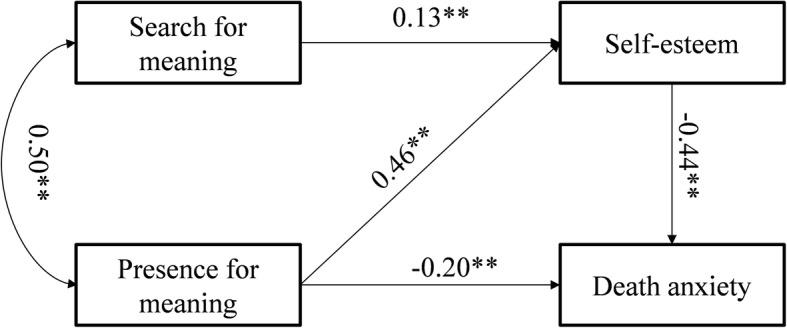
- Regression analysis showed meaning in life significantly predicted self-esteem and death anxiety (F = 45.70, p < 0.01; R² = 0.33). In the final model, presence of meaning β = −0.17, p < 0.01; search for meaning β = −0.07, p = 0.22; self-esteem β = −0.43, p < 0.01.
- Path analysis indicated self-esteem partially mediated the effect of presence of meaning on death anxiety and completely mediated the effect of search for meaning on death anxiety; model fit was χ²(df = 1) = 1.53, RMSEA = 0.02, SRMR = 0.046, CFI = 0.99. Bootstrap indirect effects were search→self-esteem→death anxiety = −0.06 (95% CI −0.13 to −0.03) and presence→self-esteem→death anxiety = −0.20 (95% CI −0.35 to −0.10).
Methods
- Cross-sectional questionnaire study; 294 older adults were recruited by convenience from four large communities, with 283 valid questionnaires after excluding 11 incomplete responses. Participants were aged 65–73 years (M = 67.16, SD = 1.82); 124 men (42.1%) and 170 women (57.9%); all were married and retired; 271 (92.3%) lived with spouse, children, or relatives, and 23 (7.7%) lived alone.
- Measures included the Meaning in Life Questionnaire (presence α = 0.81; search α = 0.74), Rosenberg Self-Esteem Scale (α = 0.82), and Templer Death Anxiety Scale (α = 0.71).
- Analyses used Pearson correlations, hierarchical regression following Baron and Kenny’s mediation steps, path analysis in Amos 17.0, and bootstrap estimation with 1,500 samples for direct and indirect effects.
Limitations
- Paper-stated: the cross-sectional design prevents causal conclusions; self-reported death anxiety may be affected by social desirability; other mediators such as attribution styles and dispositional optimism may exist; and the findings may conflict with studies suggesting death salience can enhance death anxiety through regret or thoughts about meaninglessness.
- Evident from the text: the convenience sample from four communities, all married/retired participants, narrow age range of 65–73, and Chinese older-adult context limit generalizability; 13 illiterate participants (4.4%) completed questionnaires with researcher help, which may introduce administration differences.
Model-written summary. Check it against the paper before relying on it.
Integrity signals
Registry
Cites
Statistics
Figures
Verification
Claims the paper makes
7 Valid · 0 Not valid · 26 Not checked · 34 Own results and interpretations
The cited sources support only part of this claim — read each source’s verdict below.
In the paper
“Other studies have indicated that death anxiety is related to low self-esteem [2, 29].”
§ Relationship between meaning in life and death anxiety in the elderly: self-esteem as a mediator > Background
What the sources say
- Not checked — no full text of the sourcecites [2] Fortner BV Neimeyer RA Death anxiety in older adults: a quantitative review Death Stud 1999 23 5 387 411 10.1080/074811899200920 10558505 source
- Partly supportedcites [29] Missler M Stroebe M Geurtsen L Mastenbroek M Chmoun S Van Der Houwen K Exploring death anxiety among elderly people: a literature review and empirical investigation Omega-J Death Dying 2012 64 4 357 379 10.2190/OM.64.4.e 22530298 sourceExperimental — accuracy not yet measured
Our copy (Abstract) reports that among the elderly participants in an assisted living facility (N = 49, ages 60-96), 'fear of the dying process was related to low self-esteem, little purpose in life, and poor mental well-being.' So the self-esteem association is stated for one component/subscale of death anxiety, not for death anxiety overall, and within a small, specific institutionalised elderly sample; the citing sentence's unqualified 'death anxiety is related to low self-esteem' extends it. Note also that the indexed portion of our copy is the repository record/abstract, which carries this finding but no body-text correlation for total death anxiety. (LLM, conf=0.75)
hedgedstates an association- Asserted: passes — The authors put it forward as true.
- Checkable: passes — It can be checked against evidence.
- Load-bearing: passes — The paper’s conclusions depend on it.
- Based: passes — The paper gives a reason why it holds.
A result the paper reports from its own data — it cites no other source for it, so there is none to check. The quote shows it is in the paper.
In the paper
“presence of meaning (β = − 0.37, p < 0.01) and search for meaning (β = − 0.13, p < 0.05) were each negatively associated with death anxiety (Model 1)”
§ Relationship between meaning in life and death anxiety in the elderly: self-esteem as a mediator > Results
plainstates an association- Asserted: passes — The authors put it forward as true.
- Checkable: passes — It can be checked against evidence.
- Load-bearing: passes — The paper’s conclusions depend on it.
- Based: passes — The paper gives a reason why it holds.
A result the paper reports from its own data — it cites no other source for it, so there is none to check. The quote shows it is in the paper.
In the paper
“This model exhibited a good fit with the data [χ2(df = 1) = 1.53, RMSEA = 0.02, SRMR = 0.046, CFI = 0.99]”
§ Relationship between meaning in life and death anxiety in the elderly: self-esteem as a mediator > Results
plain- Asserted: passes — The authors put it forward as true.
- Checkable: passes — It can be checked against evidence.
- Load-bearing: passes — The paper’s conclusions depend on it.
- Based: passes — The paper gives a reason why it holds.
A result the paper reports from its own data — it cites no other source for it, so there is none to check. The quote shows it is in the paper.
In the paper
“presence of meaning (β = 0.36, p < 0.01) and search for meaning (β = 0.12, p < 0.05) were each positively correlated with self-esteem (Model 2)”
§ Relationship between meaning in life and death anxiety in the elderly: self-esteem as a mediator > Results
plainstates an association- Asserted: passes — The authors put it forward as true.
- Checkable: passes — It can be checked against evidence.
- Load-bearing: passes — The paper’s conclusions depend on it.
- Based: passes — The paper gives a reason why it holds.
23 more claims
Create a free account to see all 67 claims and to verify the 2 references still open.
- Probably not a substantial claim. 34
- It may state two separate claims as one. 12
Claims other papers make about this one
Each is checked against this paper’s own text: does it say what the citing paper says it does?
The source backs part of the claim, not all of it — or backs it for a different population, condition or comparison.
In the citing paper
“Previous researches on the interrelationships among social support, self-esteem, and presence of meaning show that these factors are positively correlated with each other (Zhang et al., 2019; Poudel et al., 2020; Li et al., 2021b).”
From Mediator role of presence of meaning and self-esteem in the relationship of social support and death anxiety (2022) · cites this paper as Zhang et al., 2019
Experimental — accuracy not yet measuredThe source backs part of the claim, not all of it — or backs it for a different population, condition or comparison.
In the citing paper
“The TMT suggests (Schmeichel et al., 2009; Martela and Steger, 2016; Barnett et al., 2019; Dewitte et al., 2019; Harris and Orth, 2020) that social support, presence of meaning, and self-esteem are protective factors against death anxiety (Zhang et al., 2019; Bibi and Khalid, 2020).”
From Mediator role of presence of meaning and self-esteem in the relationship of social support and death anxiety (2022) · cites this paper as Zhang et al., 2019
Experimental — accuracy not yet measuredThe source backs part of the claim, not all of it — or backs it for a different population, condition or comparison.
In the citing paper
“Previous studies have consistently reported that social support increases the level of presence of meaning and self-esteem, and that presence of meaning and self-esteem reduce death anxiety (Ebrahimi et al., 2018; Zhang et al., 2019; He and Li, 2022).”
From Mediator role of presence of meaning and self-esteem in the relationship of social support and death anxiety (2022) · cites this paper as Zhang et al., 2019
Experimental — accuracy not yet measuredThe source backs part of the claim, not all of it — or backs it for a different population, condition or comparison.
In the citing paper
“However, in the COVID-19 pandemic, people require more social support, presence of meaning, and self-esteem to protect against increasing death anxiety level (Zhang et al., 2019; He and Li, 2022).”
From Mediator role of presence of meaning and self-esteem in the relationship of social support and death anxiety (2022) · cites this paper as Zhang et al., 2019
Experimental — accuracy not yet measuredThe source backs part of the claim, not all of it — or backs it for a different population, condition or comparison.
In the citing paper
“Although previous research implies the potential bidirectional association between presence of meaning and self-esteem (Barnett et al., 2019; Lin, 2019; Zhang et al., 2019)”
From Mediator role of presence of meaning and self-esteem in the relationship of social support and death anxiety (2022) · cites this paper as Zhang et al., 2019
Experimental — accuracy not yet measured
2 more claims about this paper
Create a free account to see every claim other papers make about this one.
Self-check
Percentages, sums and reported differences re-computed from the paper’s own numbers.
Each contradiction between two passages listed here was confirmed by an independent check.
Rated minor: it would not touch a result — a value no result rests on, a p-value that stays on the same side of the significance level, or a conflict that is clerical, resolved elsewhere in the paper, or outside its own findings.
In the paper
§ Relationship between meaning in life and death anxiety in the elderly: self-esteem as a mediator > Results
“presence of meaning (β = 0.36, p < 0.01) and search for meaning (β = 0.12, p < 0.05) were each positively correlated with self-esteem (Model 2)”
§ Relationship between meaning in life and death anxiety in the elderly: self-esteem as a mediator > Results
“| 2 | Self-esteem | Presence of meaning | 54.87** | 0.28 | 0.36 | 0.04 | 0.46** |”
Citations
Cites
Baron, R. M., & Kenny, D. A. (1986) · Journal of Personality and Social Psychology · doi:10.1037/0022-3514.51.6.1173 · Cited by 91,532 · cited 3×
“Baron RM, Kenny DA.”
BackgroundInfluentialAdvances In Experimental Social Psychology
(2022) · Advances in Experimental Social Psychology · doi:10.1016/s0065-2601(22)x0002-6 · Cited by 22,259
A Caution Regarding Rules of Thumb for Variance Inflation Factors
O’brien, R. M. (2007) · Quality & Quantity · doi:10.1007/s11135-006-9018-6 · Cited by 11,217
Positive Psychology Progress: Empirical Validation of Interventions.
Seligman, M. E. P., Steen, T. A., Park, N., & Peterson, C. (2005) · American Psychologist · doi:10.1037/0003-066x.60.5.410 · Cited by 5,947
The meaning in life questionnaire: assessing the presence of and search for meaning in life
Steger, M. F., Frazier, P., Oishi, S., & Kaler, M. (2006) · Journal of Counseling Psychology · doi:10.1037/0022-0167.53.1.80 · Cited by 4,843
Greenberg, J., Solomon, S., & Pyszczynski, T. (1997) · Advances in Experimental Social Psychology · doi:10.1016/s0065-2601(08)60016-7 · Cited by 1,505 · cited 2×
“Put simply, if individuals believe their existence is meaningful and that they play important roles in their community, then they may not feel threatened by inevitable death [23, 24].”
BackgroundThe construction and validation of a death anxiety scale
Templer, D. I. (1970) · The Journal of General Psychology · doi:10.1080/00221309.1970.9920634 · Cited by 1,421
The three meanings of meaning in life: Distinguishing coherence, purpose, and significance
Martela, F., & Steger, M. F. (2016) · The Journal of Positive Psychology · doi:10.1080/17439760.2015.1137623 · Cited by 1,401
Rosenblatt, A., Greenberg, J., Solomon, S., Pyszczynski, T., & Lyon, D. (1989) · Journal of Personality and Social Psychology · doi:10.1037/0022-3514.57.4.681 · Cited by 1,323
Why positive psychology is necessary.
Sheldon, K. M., & King, L. (2001) · American Psychologist · doi:10.1037//0003-066x.56.3.216 · Cited by 1,001
Research works printed but not linked: 1
- Wong PT. Meaning management theory and death acceptance. In: Existential and spiritual issues in death attitudes. Mahwa: Psychology Press; 2013. p. 91–114.
Cited by
Epidemiology of anxiety disorders: global burden and sociodemographic associations
Javaid, S. F., Hashim, I. J., Hashim, M. J., Stip, E., Samad, M. A., & Ahbabi, A. A. (2023) · Middle East Current Psychiatry · doi:10.1186/s43045-023-00315-3 · Cited by 426
The COVID‐19 pandemic and death anxiety in the elderly
Khademi, F., Moayedi, S., Golitaleb, M., & karbalaie, N. (2021) · International Journal of Mental Health Nursing · doi:10.1111/inm.12824 · Cited by 89
Death Anxiety, Religiosity and Culture: Implications for Therapeutic Process and Future Research
Pandya, A., & Kathuria, T. (2021) · Religions · doi:10.3390/rel12010061 · Cited by 113
“As death anxiety is a common human experience, relieving death anxiety may play a vital role in improving quality of life (Zhang et al. 2019).”
BackgroundDeath anxiety among advanced cancer patients: a cross-sectional survey
Hong, Y., Yuhan, L., Youhui, G., Zhanying, W., Shili, Z., Xiaoting, H., & Wenhua, Y. (2022) · Supportive Care in Cancer · doi:10.1007/s00520-022-06795-z · Cited by 112
“In addition, further correlational and regression studies aimed to examine in depth the predictive role of death anxiety on positive constructs such as meaning of life [52], coping mode, and quality of life [53] are recommended.”
BackgroundChen, Y., & Gao, Q. (2023) · International Journal of Human–Computer Interaction · doi:10.1080/10447318.2022.2062855 · Cited by 70
“In addition, strong associations have been found between less loneliness (or more social connectedness), higher selfesteem, and happiness (or less depression; Deci & Ryan, 1995; Murphy et al., 2020; Zhang et al., 2019).”
BackgroundFeng, Y., Liu, X., Lin, T., Luo, B., Mou, Q., Ren, J., & Chen, J. (2021) · BMC Palliative Care · doi:10.1186/s12904-021-00778-3 · Cited by 81
“, "I’m very much afraid to die"), six items are reverse scored[5].”
BackgroundDepression in older adults during the COVID ‐19 pandemic: A systematic review
Silva, C., da Fonseca, C. J. V., Ferreira, R., Weidner, A., Morgado, B., Lopes, M. J., Moritz, S., Jelinek, L., Schneider, B. C., & de Pinho, L. G. (2023) · Journal of the American Geriatrics Society · doi:10.1111/jgs.18363 · Cited by 78
Dursun, P., Alyagut, P., & Yılmaz, I. (2022) · Current Psychology · doi:10.1007/s12144-021-02695-3 · Cited by 56
Spiritual Needs of the Muslim Elderly Living in Nursing Homes: A Qualitative Study
Jadidi, A., Sadeghian, E., Khodaveisi, M., et al. (2021) · Journal of Religion and Health · doi:10.1007/s10943-021-01263-0 · Cited by 49
“This study’s results are consistent with those of other studies, as they reported searching for meaning and purpose in life as the most significant indicator of existential health (Byun et al., 2017; Sytsma et al., 2018; Zhang et al., 2019).”
ResultDeath Anxiety and Loneliness among Older Adults: Role of Parental Self-Efficacy
Greenblatt‐Kimron, L., Kestler‐Peleg, M., Even‐Zohar, A., & Lavenda, O. (2021) · International Journal of Environmental Research and Public Health · doi:10.3390/ijerph18189857 · Cited by 62
“Yet, despite the existing research on death anxiety among older adults [47], the associations linked with this construct are not well understood in old age [48,49].”
BackgroundAlkozei, A., Smith, R. S., Demers, L. A., Weber, M., Berryhill, S. M., & Killgore, W. D. S. (2018) · Psychological Reports · doi:10.1177/0033294118771705 · Cited by 49
Liu, H., Liu, X., Liu, Z., Wang, Y., Feng, R., Zheng, R., Xie, R., Tao, H., Wu, Y., Li, X., et al. (2022) · Asia-Pacific Journal of Oncology Nursing · doi:10.1016/j.apjon.2022.100134 · Cited by 49
Religiosity, Spirituality, and Death Anxiety Among Filipino Older Adults: A Correlational Study
Soriano, G. P., & Calong, K. A. C. (2020) · OMEGA - Journal of Death and Dying · doi:10.1177/0030222820947315 · Cited by 42
“As older adults embrace one’s impermanence, they tend to experience anxiety, decrease sense of safety, and strong fear which is termed as death anxiety (Zhang et al., 2019).”
BackgroundThe development and validation of the Death Anxiety Beliefs and Behaviours Scale
Menzies, R. E., Sharpe, L., & Dar‐Nimrod, I. (2022) · British Journal of Clinical Psychology · doi:10.1111/bjc.12387 · Cited by 45
“…of areas, including reduced self- esteem (e.g. Özdemir et al., 2019), attachment stability (e.g. Zuccala et al., 2021) and meaning in life (e.g. Zhang et al., 2019), as well as poorer quality of life and fear of recurrence in the context of chronic illness (e.g. Curran et al., 2020; Onu et…”
BackgroundLiu, X., Liu, Z., Cheng, Q., Xu, N., Liu, H., & Ying, W. (2020) · Supportive Care in Cancer · doi:10.1007/s00520-020-05732-2 · Cited by 44
Wang, Y. (2021) · Psychological Reports · doi:10.1177/00332941211016751 · Cited by 41
“OGA symptomatology also aggravates the aggressiveness of adolescents and induces a series of criminal behaviors, including robbery, hurting other people, and self-injury (E. J. Kim et al., 2008; Su et al., 2018; Turner et al., 2013; Zhang et al., 2019).”
BackgroundAfrashteh, M. Y., Majzoobi, M. R., Janjani, P., & Forstmeier, S. (2024) · Heliyon · doi:10.1016/j.heliyon.2024.e30124 · Cited by 53
Tan, J. Y., Tam, W., Goh, H. S., Ow, C. C., & Wu, X. V. (2021) · Journal of Advanced Nursing · doi:10.1111/jan.14940 · Cited by 38
Szczęśniak, M., Falewicz, A., Strochalska, K., & Rybarski, R. (2022) · International Journal of Environmental Research and Public Health · doi:10.3390/ijerph19106065 · Cited by 37
“[69] found that older Chinese adults feeling threatened by death expressed lower presence of and searching for meaning.”
BackgroundCross-Contextual Examination of Older Adults' Privacy Concerns, Behaviors, and Vulnerabilities
Zou, Y., Sun, K., Afnan, T., Abu-Salma, R., Brewer, R. N., & Schaub, F. (2024) · Proceedings on Privacy Enhancing Technologies · doi:10.56553/popets-2024-0009 · Cited by 48
“We studied account and device sharing by older adults considering they will need to face the prospect of death but may experience anxiety and uncertainty in planning [167].”
BackgroundWilt, J. A., Grubbs, J. B., Exline, J. J., & Pargäment, K. I. (2021) · Journal of Research in Personality · doi:10.1016/j.jrp.2021.104104 · Cited by 31
Rashid, M. R. A., Mohamad, S. N. S., Tajjudin, A. I. A., Roslan, N., Jaffar, A., Mohideen, F. B. S., Addnan, F. H., Baharom, N., & Ithnin, M. (2023) · International Journal of Environmental Research and Public Health · doi:10.3390/ijerph20054476 · Cited by 36
“It is a psychological state arising from one’s fear of death or being harmed [58,59].”
BackgroundDevelopment and validation of a brief self-assessed wisdom scale
Fung, S.-F., Chow, E. O.-W., & Cheung, C. (2020) · BMC Geriatrics · doi:10.1186/s12877-020-1456-9 · Cited by 34
Cho, S., & Cho, O. (2022) · Geriatric Nursing · doi:10.1016/j.gerinurse.2022.02.018 · Cited by 29
Lei, L., Zhao, H., Ran, L., Wang, L., & Luo, Y. (2022) · BMC Public Health · doi:10.1186/s12889-022-13655-2 · Cited by 33
Yan, Y., Chen, Y., Ou, M., Gong, Y., Yang, R., Liu, X., Xia, W., Chen, F., Zheng, H., & Xu, X. (2024) · BMC Cancer · doi:10.1186/s12885-024-12433-0 · Cited by 36
Evde Yaşayan Yaşlılarda Yalnızlık, Yaşam Doyumu ve Ölüm Kaygısının Belirlenmesi
Tel, H., Koç, M., & Aydın, H. T. (2020) · IBAD Sosyal Bilimler Dergisi · doi:10.21733/ibad.760027 · Cited by 25
Validation of the Occupational Self-Efficacy Scale in a Sample of Chinese Employees
Peng, J., Zhang, J., Zhou, X., Wan, Z., Yuan, W., Gui, J., & Xia Shuang, Z. H. U. (2021) · Frontiers in Psychology · doi:10.3389/fpsyg.2021.755134 · Cited by 43
Self-citationPentaris, P., & Tripathi, K. (2022) · International Journal of Environmental Research and Public Health · doi:10.3390/ijerph19106031 · Cited by 38
“Introduction A terminal diagnosis can potentially evoke death anxiety, which in turn generates a reduced sense of safety [1].”
BackgroundAisenberg-Shafran, D., Bar-Tur, L., & Levi‐Belz, Y. (2021) · Death Studies · doi:10.1080/07481187.2021.1947416 · Cited by 25
“Notably, several studies of older adults have indicated that death anxiety may influence distress levels (Zhang et al., 2019).”
BackgroundA Systematic Review of Death Anxiety and Related Factors Among Nurses
Norouzi, M., Vajargah, P. G., Falakdami, A., Mollaei, A., Takasi, P., Ghazanfari, M. J., Miri, S., Javadi‐Pashaki, N., Osuji, J. C., Soltani, Y., et al. (2022) · OMEGA - Journal of Death and Dying · doi:10.1177/00302228221095710 · Cited by 29
“High DA experience can negatively affect mental health, nurse-patient relationships, quality of patient care, and quality of life of patients and nurses (Arab et al., 2019; Dadfar et al., 2018; Pehlivan et al., 2020; Zhang et al., 2019).”
Sentido da vida e espiritualidade em idosos institucionalizados
Miranda, R. D. C. N. A., Pereira, E. R., Silva, R. M. C. R. A., et al. (2020) · Research Society and Development · doi:10.33448/rsd-v9i6.2799 · Cited by 21
Factors influencing death anxiety among Chinese patients with cancer: a cross-sectional study
Gong, Y., Yan, Y., Yang, R., Cheng, Q., Zheng, H., Chen, Y., & Xu, X. (2022) · BMJ Open · doi:10.1136/bmjopen-2022-064104 · Cited by 26
Rayatpisheh, F., Torabizadeh, C., Kalyani, M. N., & Farsi, Z. (2023) · BMC Geriatrics · doi:10.1186/s12877-023-04086-8 · Cited by 26
“Resilience can be effective in promoting mental health and managing psychological problems in adverse conditions [24].”
BackgroundTang, L., Zhang, Y., Pang, Y. K., Zhou, Y., Li, J., Lili, S., He, Y., Li, Z., & Wang, Y. (2021) · Frontiers in Psychiatry · doi:10.3389/fpsyt.2021.715756 · Cited by 21
Ergin, E., Yıldırım, D., Yıldız, C. Ç., & ÜŞENMEZ, S. Y. (2022) · OMEGA - Journal of Death and Dying · doi:10.1177/00302228221106054 · Cited by 29
“When the studies conducted in the literature are examined, a limited number of studies conducted on only the elderly can be accessed (Cavusoglu et al., 2020; Kurt Magrebi and Akca, 2020; Nal et al., 2016; Zhang et al., 2019).”
Zhang, S., Tang, Y., & Yong, S. (2022) · Frontiers in Psychology · doi:10.3389/fpsyg.2022.843276 · Cited by 27
Death Anxiety in the Elderly in Iran: A Systematic Review and Meta-analysis
Khalvati, M., Babakhanian, M., Khalvati, M., Nafei, A., Khalvati, M., & Ghafuri, R. (2021) · Salmand · doi:10.32598/sija.16.2.862.2 · Cited by 21
Zábó, V., Lehoczki, A., Fekete, M., Szappanos, Á., Varga, P., Moizs, M., Giovannetti, G., Loscalzo, Y., Giannini, M., Polidori, M. C., et al. (2025) · GeroScience · doi:10.1007/s11357-025-01625-6 · Cited by 26
“This resilience acts as a protective buffer against mental health conditions that commonly accompany aging, such as depression [73] and anxiety [74].”
Gori, A., Topino, E., Svicher, A., & Fabio, A. D. (2022) · International Journal of Environmental Research and Public Health · doi:10.3390/ijerph191911901 · Cited by 25
“Concerning the mediation effect of career adaptability, on the basis of previous findings [30,32], we hypothesize a partial mediation.”
BackgroundResultChang, B., Cheng, J., Fang, J., & Dang, J. (2021) · Frontiers in Psychology · doi:10.3389/fpsyg.2021.673460 · Cited by 23
“That is, human beings are creatures that create meaning and seek meaning, and the pursuit of meaning in life is the best way to alleviate the fear of death (Zhang et al., 2019).”
BackgroundDOĞRUSEVER, C., Türk, N., & Batmaz, H. (2022) · İnönü Üniversitesi Eğitim Fakültesi Dergisi · doi:10.17679/inuefd.1029866 · Cited by 22
Korkut, S. (2022) · Therapeutic Apheresis and Dialysis · doi:10.1111/1744-9987.13905 · Cited by 22
“Accordingly, previous studies have also evaluated that elderly patients experience severe death anxiety during COVID-19 [46, 47].”
Lutzman, M., & Sommerfeld, E. (2021) · Current Psychology · doi:10.1007/s12144-021-02332-z · Cited by 22
“A higher sense of meaning in life was associated with lower death anxiety, an association mediated by self-esteem (Zhang et al., 2019).”
BackgroundXiao, Z., Zhao, Y., Zheng, Y., Bao, Y., & Zhang, C. (2022) · International Journal of Environmental Research and Public Health · doi:10.3390/ijerph191610179 · Cited by 19
“Other researchers have found that a sense of life’s meaning can significantly negatively predict the elderly’s fear of death [48].”
BackgroundMüceldili, B., Tatar, B., & Erdil, O. (2023) · International Journal for Educational and Vocational Guidance · doi:10.1007/s10775-023-09617-8 · Cited by 30
“Past studies demonstrated that people having meaningful lives are more likely to experience higher well-being, higher self-esteem (Zhang et al., 2019), positive affects (King et al., 2006), and optimism (Ho et al., 2010).”
Zhang, B., Wang, A., Ye, Y., Liu, J., & Lin, L. (2024) · Behavioral Sciences · doi:10.3390/bs14080720 · Cited by 16
“…path of meaning in life– self-esteem–mental health, indicating that self-esteem plays an independent mediating role between Chinese undergraduates’ meaning in life and their level of mental health, which is consistent with the results of previous studies [35,36]; so, Hypothesis 1 was verified.”
ResultValidation of the Revised Collett–Lester Fear of Death Scale in a French Population
Cuniah, M., Bréchon, G., & Bailly, N. (2021) · Frontiers in Psychology · doi:10.3389/fpsyg.2021.736171 · Cited by 17
Mirzaeian, R., Nopour, R., Varzaneh, Z. A., Shafiee, M., Shanbehzadeh, M., & Kazemi-Arpanahi, H. (2023) · BioMedical Engineering OnLine · doi:10.1186/s12938-023-01140-9 · Cited by 22
“A score of 1 indicates Strongly Disagree and a score of 4 means Strongly Agree [44, 45].”
BackgroundBoukhary, R. A., Hallit, R. R., Postigo, Á., Malaeb, D. N., Dabbous, M., Sakr, F., Khatib, S. E., Fekih‐Romdhane, F., Hallit, S. R., & Obeïd, S. (2024) · BMC Psychology · doi:10.1186/s40359-023-01509-4 · Cited by 16
“In fact, dispositional optimism has been recognized as a protective factor against death anxiety [19].”
BackgroundDeath Anxiety and Resilience in Older Adults: The Moderating Role of Attachment Patterns
Bergman, Y. S. (2024) · Behavioral Sciences · doi:10.3390/bs14111031 · Cited by 19
“This finding is in line with studies confirming the inverse connection between existential concerns and protective psychological factors in older adults, such as emotional complexity [54], self-esteem, and a sense of meaning in life [55].”
High death anxiety and ambiguous loss: Lessons learned from teaching through the COVID-19 pandemic
Weaver, R. H., Bolkan, C. R., & Decker, A. (2021) · Gerontology & Geriatrics Education · doi:10.1080/02701960.2021.1966775 · Cited by 17
“In many studies, death anxiety has been linked to negative outcomes such as low subjective wellbeing and low self-esteem (Zhang et al., 2019).”
Mani, A., Fereidooni, R., Salehi‐Marzijarani, M., Ardekani, A., Sasannia, S., Habibi, P., Zarei, L., Heydari, S. T., & Lankarani, K. B. (2022) · Health Science Reports · doi:10.1002/hsr2.706 · Cited by 18
“It is defined as a psychological state arising from one's fear of death or being harmed.(1,2) Encountering situations that lead to anticipation or awareness of dying is known as death anxiety.”
BackgroundHuang, Y., Guan, Z., Yan, F., Wiley, J. A., Reynolds, N. R., Tang, S., & Sun, M. (2022) · Frontiers in Psychology · doi:10.3389/fpsyg.2022.1018097 · Cited by 13
“Presence of meaning scale (MLQ-P) The Chinese version (Zhang et al., 2019) of presence of meaning scale is derived from the meaning in life questionnaire (MLQ) (Steger et al.”
BackgroundMethodInfluentialIncidence of Death Anxiety in Palliative Care: A Systematic Review and Meta-Analysis
Hu, S., Tang, W. H., Zhang, W., Chen, H., & Shen, W. (2022) · OMEGA - Journal of Death and Dying · doi:10.1177/00302228221104298 · Cited by 14
Liu, X., Wu, X., Cheng, Q., Ying, W., Gong, X., Lu, D., Zhang, Y., & Liu, Z. (2022) · Asia-Pacific Journal of Oncology Nursing · doi:10.1016/j.apjon.2022.100118 · Cited by 19
Zhao, N., Liu, B., & Wang, Y. (2022) · International Journal of Environmental Research and Public Health · doi:10.3390/ijerph192013430 · Cited by 16
“However, death anxiety was negatively correlated with both presence of meaning and search for meaning in older adults [70].”
BackgroundElzohairy, N. W., Alfayomy, N. A. M., & Hassan, N. I. (2022) · International Egyptian Journal of Nursing Sciences and Research · doi:10.21608/ejnsr.2022.247080 · Cited by 12
“As a result, reducing death anxiety in older adults may play an important role in improving their mental health and quality of life (Zhang et al., 2019).”
BackgroundGonçalves, G., AL-Dossary, S. A., & Sousa, C. (2023) · Current Psychology · doi:10.1007/s12144-023-04659-1 · Cited by 14
“Death anxiety is a common human experience, so its attenuation can play a vital role in improv - ing the quality of life of individuals (Zhang et al., 2019), and being based on a symptomatic perspective, SDA cre - ates a link between clinical and counselling diagnoses and psychological assessment,…”
Corpuz, J. C. G. (2023) · Palliative & Supportive Care · doi:10.1017/s1478951523001268 · Cited by 12
Wang, L., Li, S., Liu, X., Li, R., & Li, R. (2024) · Frontiers in Psychology · doi:10.3389/fpsyg.2024.1414989 · Cited by 13
“Humans are inherently driven to create and seek meaning, and pursuing meaning in life is one of the best ways to alleviate the fear of death (Zhang et al., 2019).”
InfluentialZhao, X., Zhang, W., Su, Y., Song, Y., Si, H., & Zhu, L. (2022) · Psychogeriatrics · doi:10.1111/psyg.12807 · Cited by 13
Death Anxiety in Psychopathology: A Systematic Review
Gürbüz, A. A., & Yorulmaz, O. (2024) · Psikiyatride Guncel Yaklasimlar - Current Approaches in Psychiatry · doi:10.18863/pgy.1267748 · Cited by 27
Younes, R. S., Rahme, E., Rajha, F., & Mzawak, M. A. (2024) · OMEGA - Journal of Death and Dying · doi:10.1177/00302228241272578 · Cited by 23
“…have high spiritual well-being, or have the sense that life has meaning and purpose tend to have lower levels of DA (Ghasemi et al., 2020; Missler et al., 2011; Rababa et al., 2021; Roushani, 2012; Sharma et al., 2019; Solaimanizadeh et al., 2019; Taghiabadi et al., 2017; Zhang et al., 2019).”
Zhu, W., Jusoh, N. H. M., Alan, R., Latip, M., & Saad, J. M. (2025) · Behavioral Sciences · doi:10.3390/bs15030306 · Cited by 20
“On the other hand, late adulthood brings decreased self-esteem, often occasioned by challenges related to retirement, health decline, and loss of social roles (Zhang et al., 2019).”
When meaning in life protects against fear of death: The moderating role of self‐alienation
Maffly‐Kipp, J., Gause, C., Hicks, J. A., & Vess, M. (2023) · Journal of Personality · doi:10.1111/jopy.12875 · Cited by 16
Li, T., Tien, H. S., & Wang, J. (2024) · Education Sciences · doi:10.3390/educsci14040436 · Cited by 14
Impact of death anxiety on mental health during COVID-19: The mediating role of the meaning in life
Jin, Y., Zeng, Q., Cong, X., An, J., & Zheng, P. (2023) · Journal of Pacific Rim Psychology · doi:10.1177/18344909231165187 · Cited by 12
“For example, Lyke (2013) found that people who actively sought meaning in life had less fear of death, and Zhang et al. (2019) found that meaning in life was signi fi - cantly negatively correlated with death anxiety and could predict death anxiety.”
BackgroundBelak, R. M., & Goh, K. H. (2024) · Frontiers in Psychology · doi:10.3389/fpsyg.2024.1398620 · Cited by 21
Meng, X., Li, Q., Yanbang, Z. H. O. U., & Wang, J. (2021) · Advances in Psychological Science · doi:10.3724/sp.j.1042.2021.00492 · Cited by 17
“00 01 0v 1 带来不确定感有何不同?未来可以侧重对环境不确定感与死亡的关系进行研究。其次,死 亡所带来的不确定感可能仍然与一些未被明确的变量相关,比如自尊水平。之后的研究者 需要着重验证目前的发现与其他潜在变量的关系。最后,文化的潜在影响也是研究者需要 考虑的因素,例如集体主义文化下的个体对准确信息和社会认同的需求较高,这或许会干 扰死亡与不确定性之间的研究,未来可以着重在跨文化研究中进行探讨。 4.1.2 人生意义 与死亡相关的另一个重要变量是人生意义。研究者发现,人生意义感较弱的个体会经 历死亡焦虑,而有更大人生意义感的个体能更好地接纳死亡(Routledge & Juhl,…”
InfluentialKarkhah, S., Jafari, A., Paryad, E., Leyli, E. K., Ghazanfari, M. J., Osuji, J. C., & Javadi‐Pashaki, N. (2021) · OMEGA - Journal of Death and Dying · doi:10.1177/00302228211062368 · Cited by 13
“Perceptions of high levels of DA among nurses can lead to adverse outcomes such as poor communication between the nurse and the patient, reduced quality of nursing care (Peters et al., 2013) and patients ’ quality of life (Zhang et al., 2019).”
BackgroundAliche, C. J., Ifeagwazi, C. M., & Ezaka, E. S. (2023) · South African Journal of Psychology · doi:10.1177/00812463231186328 · Cited by 9
“Empirically, a higher sense of meaning in life has been found to be associated with decreased thoughts of mortality and death anxiety (Yuksel et al., 2017; Zhang et al., 2019).”
BackgroundJiang, X., Lu, W., Luo, H., Yang, J., Chen, M., Wang, J., Wu, M., Chen, X., Tang, Y., Hu, Y., et al. (2023) · Journal of Religion and Health · doi:10.1007/s10943-023-01794-8 · Cited by 12
Khait, A. F. A., Menger, A., Al-Modallal, H. M., et al. (2023) · Journal of the American Psychiatric Nurses Association · doi:10.1177/10783903231174464 · Cited by 9
“This may also allow them to know the risks of death and what exacerbates death-related fears (Zhang et al., 2019).”
BackgroundSzczęśniak, M., Potemkowski, A., Brola, W., Kroplewski, Z., Szałachowski, R. R., Žák, M., Wilski, M., Sobolewski, P. K., Bartosik-Psujek, H., Kapica-Topczewska, K., et al. (2022) · International Journal of Environmental Research and Public Health · doi:10.3390/ijerph19095426 · Cited by 13
“[61] found in a group of older adults between 65 and 73 that both the presence of and search for meaning correlated positively with self-esteem.”
BackgroundInfluencing Factors on Death Acceptance Among Thai Older Persons
Suwannapong, K., Thanasilp, S., Pudtong, N., et al. (2024) · Clinical Gerontologist · doi:10.1080/07317115.2024.2337118 · Cited by 7
“It is a common phenomenon in all societies, although older adults may be more susceptible to death anxiety than their younger counterparts (Zhang et al., 2019).”
Hou, X., Hu, J., & Liu, Z. (2025) · Frontiers in Psychiatry · doi:10.3389/fpsyt.2025.1494074 · Cited by 9
Death anxiety among caregivers of patients with advanced cancer: a cross-sectional survey
Li, Y., Duan, Y., Zhao, Q., Yu, Y., Qingxuan, N., & Zhou, Z. (2024) · Supportive Care in Cancer · doi:10.1007/s00520-024-08707-9 · Cited by 10
“…mindful-ness-based intervention [48] (such as meditation, laughter yoga), rational emotive hospice care therapy [6, 49], and spirituality support [50] as the main strategies to help caregivers find their meaning in life and improve their trait anxious personality and QoL to better deal with…”
Jiang, Y., Chen, Z., Nuerdawulieti, B., Chen, M., Nan, J., Li, J., & Ge, Y. (2023) · Journal of Advanced Nursing · doi:10.1111/jan.15825 · Cited by 9
Perception of Old Age by the Inhabitants of Poland
Wysokiński, M., Fidecki, W., Plech, T., Wrońska, I., Pawelec, M., & Dziedzic, B. (2020) · International Journal of Environmental Research and Public Health · doi:10.3390/ijerph17072389 · Cited by 7
“It is also connected with preserving a better physical activity [28,29], and influences the intensity of the fear of death [30].”
BackgroundBagherinia, H., & Saghebi, S. A. (2023) · Journal of Education and Health Promotion · doi:10.4103/jehp.jehp_597_22 · Cited by 8
“[17] In another study on students, the highest prevalence of social anxiety was among students with low self‑esteem and the lowest prevalence of social anxiety was among students with high self‑esteem.”
BackgroundVarela, M. D. R. F., Ojeda, D. P. A., & Pacheco, R. R. H. (2021) · PSICUMEX · doi:10.36793/psicumex.v11i2.397 · Cited by 6
Dargahi, S., Pireinaladin, S., Ahmadboukani, S., Bashirgonbadi, S., Molaei, B., & Fathi, D. (2023) · Iranian Journal of Psychiatry · doi:10.18502/ijps.v18i2.12365 · Cited by 6
“Moreover, considering the role of self-esteem and death anxiety in coping with the disease in the elderly, research shows that meaning in life can play an important role in the psychological adjustment of the elderly by reducing death anxiety and increasing their self-esteem (38).”
BackgroundAlizadeh, S., Borhaninejad, V., Sadeghi, R., Khanjani, N., Saber, M., & Abolghaseminejad, P. (2023) · Perspectives In Psychiatric Care · doi:10.1155/2023/5522664 · Cited by 6
Brudek, P. J., Krok, D., & Steuden, S. (2021) · Aging & Mental Health · doi:10.1080/13607863.2021.1989378 · Cited by 7
“Research in this area shows that religiosity is positively associated with such aspects of the psychosocial functioning of the older adults as health, quality of life and attitude to death (Ardelt & Ferrari, 2019; Brudek & Sękowski, 2020; Soriano & Calong, 2020; Zhang et al., 2019).”
BackgroundImpact of Digital and Traditional Coloring on Death Anxiety Among Older Adults
Roh, H., Krumrei-Mancuso, E. J., & Miller‐Perrin, C. (2023) · Art Therapy · doi:10.1080/07421656.2023.2228678 · Cited by 7
“Further, older adults may be more prone to anxiety and fear of death when encountering death-related events than young adults (Zhang et al., 2019).”
BackgroundAn analysis of student bucket lists in death and dying courses: data from three U.S. Universities
Ritter, L. J., Bagasra, A. B., & Richards, S. (2023) · Mortality · doi:10.1080/13576275.2023.2263387 · Cited by 5
“…they are assumed to be ‘closer to death’ and are more likely to see their friends and immediate family members die as they age (Suhail & Akram, 2002; Zhang et al., 2019) or on healthcare providers or those in regularly close proximity to death (Lee et al., 2020; Menzies et al., 2020; Zhao et al.,…”
Chang, B., Cheng, J., Fang, J., & Lyu, Z. (2025) · Frontiers in Psychiatry · doi:10.3389/fpsyt.2025.1507212 · Cited by 6
THE RELATIONS BETWEEN FEAR OF COVID-19, ANXIETY OF DEATH, AND MEANING OF LIFE AMONG NURSING STUDENTS
Yiğitalp, G., & Gümüş, F. (2022) · International Journal of Health Services Research and Policy · doi:10.33457/ijhsrp.1112061 · Cited by 6
Effects of death anxiety on fear of missing out
Naidu, K. N. C., & Chew, P. K. H. (2023) · Current Psychology · doi:10.1007/s12144-023-05382-7 · Cited by 8
“Third, and most importantly, self-esteem in individuals, where low self-esteem could amplify vulnerability and fear of missing out on crucial life experiences (in FOMO; Ser-vidio, 2021), and contribute to a heightened sense of mortality and deeper fears of death (in DA; Zhang et al., 2019).”
BackgroundResultSeyedfatemi, N., Abbasi, Z., Bahrami, R., & khorin, Z. S. (2023) · SAGE Open Nursing · doi:10.1177/23779608231219125 · Cited by 8
“Death anxiety is a conscious or unconscious psychological state that is associated with feelings of insecurity, anxiety, or fear related to death or near-death experiences or it occurs when people feel the threat of death/dying (Zhang et al., 2019).”
BackgroundThe Effect of Death Anxiety on Work Passion: Moderating Roles of Work Centrality and Work Connection
AL-Dossary, S. A., Sousa, C., & Gonçalves, G. (2024) · OMEGA - Journal of Death and Dying · doi:10.1177/00302228241236227 · Cited by 9
“Third, human reactions to death anxiety are dynamic and multifaceted (e.g., Kesebir, 2014; Zhang et al., 2019), thus additional moderating factors may in fl uence the relationship between death anxiety and obsessive work passion.”
Death Anxiety and Related Factors Among Older Adults in Iran: Findings From a National Study
Nafei, A., Rashedi, V., Ghafori, R., Khalvati, M., Eslamian, A., Sharifi, D., & Haghi, M. (2024) · Salmand · doi:10.32598/sija.2023.1106.1 · Cited by 5
Li, Y., Duan, Y., Zhao, Q., & Zhou, Z. (2024) · Supportive Care in Cancer · doi:10.1007/s00520-024-08653-6 · Cited by 9
“…mindfulness-based intervention [42] (such as meditation and laughter yoga), rational emotive hospice care therapy [4, 43], and spirituality support [44] as the main strategies to help caregivers find their meaning in life and improve their trait anxious personality and QoL to better deal with…”
Turkish Version of the Interpretation of Death Scale: Cultural Adaptation and Validation
Bulut, M. B. (2021) · Journal of Gerontological Social Work · doi:10.1080/01634372.2021.1920536 · Cited by 5
“The difference between these two studies can be attributed to the sample groups whereas in Lyke’s (2013) study the participants are young adults and in Zhang et al. (2019) study the participants are elderly individuals.”
BackgroundHow Do Older Adults Learn Informally via Social Media? A Pilot Study of Chinese Urban Older Adults
Chen, Y., & Gao, Q. (2021) · Lecture notes in computer science · doi:10.1007/978-3-030-78108-8_28 · Cited by 5
Examining Nietzsche’s Epigram: Having a Why Helps You Bear Almost Any How?
Li, P. F. J., Wong, Y. J., & McDermott, R. C. (2021) · Journal of Humanistic Psychology · doi:10.1177/00221678211041828 · Cited by 7
Urgensi Pengembangan Konseling Spiritual Bagi Pecandu Narkoba Untuk Mereduksi Thanatophobia
Zatrahadi, M. F., Suhaili, N., Ifdil, I., Marjohan, M., & Afdal, A. (2022) · JRTI (Jurnal Riset Tindakan Indonesia) · doi:10.29210/30031270000 · Cited by 14
Meaning in life as a mediator between death anxiety and life satisfaction
Yağan, F., Kaya, Z., & Kaya, S. F. (2025) · Death Studies · doi:10.1080/07481187.2025.2511255 · Cited by 5
“Previous studies have typically investigated these variables either individually or in pairs (Afrashteh et al., 2024; Kahraman & Erkent, 2022; Zhang et al., 2019); thus, the mediating role of meaning in life has largely been overlooked.”
Psychosocial Problems in Community-dwelling Older Adults: A Cross-sectional Study
Charan, G. S., Kaur, A., Kaur, K., & Kaur, N. (2024) · Annals of African Medicine · doi:10.4103/aam.aam_139_23 · Cited by 4
“[30] A similar negative correlation between anxiety and self‑esteem was found by Zhang et al. [31] According to the findings of previous research by Hosseini et al ., stress and anxiety have a significant positive relationship.”
Metadata
- Authors
- Zhang, J., Peng, J., Gao, P., Huang, H., Cao, Y., Zheng, L., & Miao, D.
- Affiliations
- Chengdu University (CN)
- Air Force Medical University (CN)
- Corresponding author
- Peng, Jiaxi
- Miao, Danmin
- Venue
- BMC Geriatrics
- Published
- 2019-11-12
- Volume
- 19
- Issue
- 1
- Pages
- 308-308
- ISSN
- 1471-2318 (ISSN-L)
- PMC
- PMC6852934
- OpenAlex
- W2986881262
- Semantic Scholar
- 27b75c0046deedaa27f8b52ea6bd3bb9a904da28
- Cited by
- 206
- References
- 65
- Citations by year
- 2026: 18 · 2025: 31 · 2024: 32 · 2023: 40 · 2022: 44 · 2021: 32 · 2020: 8
- FWCI
- 26.37
- Type
- journal article
- Language
- en
- Open access
- gold
- doi.org
- Licence
- cc-by
- creativecommons.org/licenses/by/4.0/ (tdm)
- creativecommons.org/licenses/by/4.0/ (vor)
- Locations
- BMC Geriatrics (publishedVersion, cc-by)
- PubMed Central (publishedVersion, cc-by)
- PubMed (publishedVersion)
- DOAJ (DOAJ: Directory of Open Access Journals) (submittedVersion, cc-by-sa)
- Funders
- National Natural Science Foundation of China (31900791)
- MOE (Ministry of Education in China) Project of Humanities and Social Sciences (19YJC190020)
- Topics
- Social Sciences › Psychology › Social Psychology › Death Anxiety and Social Exclusion
- Social Sciences › Psychology › Developmental and Educational Psychology › Aging and Gerontology Research
- Social Sciences › Anthropology › Death, Funerary Practices, and Mourning
- Keywords
- meaning in life, fear of death, self-esteem, older adults, mediation, search for meaning, presence of meaning, aging
- MeSH terms
- Aged, Anxiety, Attitude to Death, China, Female, Humans, Male, Surveys and Questionnaires, Self Concept
About these checks
Registry, retraction, Cites and statistics results are computed, not judged, with one exception: a printed reference that no index lists is read once by a model before it counts as a citation error. Claims are extracted by a model and kept only when their quote appears verbatim in the text; each cited source is then checked, with a model’s help, for whether it says what the claim relies on. Those verdicts can be wrong — read the claim’s quote and the cited source before relying on one.
The claim verdicts this report counts are experimental: their accuracy is not yet measured.
A language model drew the claims from the paper on 2026-10-10, under version 3 of the claim definition (model deepseek-v4.1-flash, prompt extract-v3).
A second model labelled each claim on 2026-10-10 (model jev-1.13-20260917, definition revision gold-guideline-v0.2).
Cited sources are checked with a language model’s help (qwen3.8-omni-flash).
Statistics and arithmetic are recomputed, not judged.
Confidence bands are shown only for fields calibrated on our annotated test set. None is calibrated yet, so no band is shown.
What counts as a claim ›How we measure confidence ›How we check this ›
Are you an author, or do you see a problem with this page? Request a review
Data sources
Bibliographic data: Semantic Scholar, OpenAlex, Crossref.
Contains information from the Semantic Scholar Academic Graph Datasets, made available under the ODC Attribution License (ODC-BY 1.0).
Semantic Scholar’s data is described in: Kinney, R., et al. (2023). The Semantic Scholar Open Data Platform. arXiv:2301.10140.
