

Relationship between meaning in life and death anxiety in the elderly: self-esteem as a mediator
Open accessThe DOI matches its Crossref record; 59 of the 65 references it cites were found in a registry or an index; 7 of the 45 sources its claims cite were checked for support.
Abstract
Abstract Background Death anxiety is a common phenomenon in all societies. Older adults may be more prone to death anxiety than their younger counterparts; however, death anxiety among older adults is not well understood. This study explores the relationship between meaning in life, self-esteem, and death anxiety in senior citizens in China. Methods A total of 283 older adults participated in this study; data were collected via the Meaning in Life Questionnaire, the Rosenberg Self-Esteem Scale, and the Death Anxiety Scale. Results Results show that the dimensions of meaning in life, presence of meaning (r = − 0.43,p < 0.01), search for meaning (r = − 0.31,p < 0.01), and self-esteem (r = − 0.54,p < 0.01) were each negatively correlated with death anxiety. Regression analysis reveals that meaning in life significantly predicted self-esteem and death anxiety (F = 45.70,p < 0.01; R2 = 0.33). Path analysis indicated that self-esteem either completely or partially mediated the effects of meaning in life on death anxiety in older adults. Conclusions Overall, meaning in life appears to be significantly correlated with death anxiety in older adults, and self-esteem can mediate this effect.
Overview
CoChat Summary
TL;DR
In a cross-sectional sample of 283 Chinese older adults, meaning in life and self-esteem were negatively correlated with death anxiety, and self-esteem mediated the relationship between meaning in life and death anxiety. The authors conclude that enhancing meaning in life may raise self-esteem and thereby reduce death anxiety.
Key findings
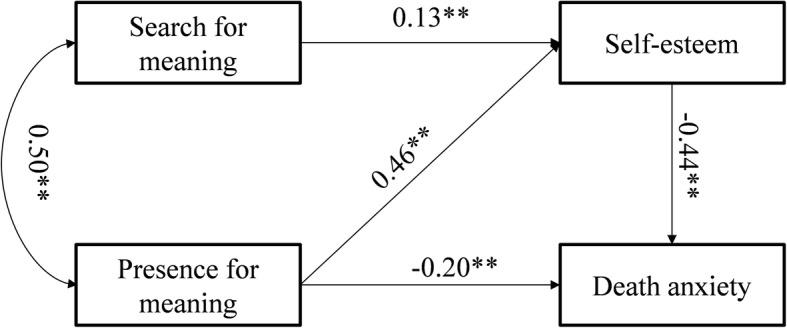
- Presence of meaning (r = −0.43, p < 0.01), search for meaning (r = −0.31, p < 0.01), and self-esteem (r = −0.54, p < 0.01) were each negatively correlated with death anxiety; presence and search were positively correlated with self-esteem (r = 0.52 and r = 0.36, respectively, p < 0.01).
- Regression analysis showed meaning in life significantly predicted self-esteem and death anxiety (F = 45.70, p < 0.01; R² = 0.33). In the final model, presence of meaning β = −0.17, p < 0.01; search for meaning β = −0.07, p = 0.22; self-esteem β = −0.43, p < 0.01.
- Path analysis indicated self-esteem partially mediated the effect of presence of meaning on death anxiety and completely mediated the effect of search for meaning on death anxiety; model fit was χ²(df = 1) = 1.53, RMSEA = 0.02, SRMR = 0.046, CFI = 0.99. Bootstrap indirect effects were search→self-esteem→death anxiety = −0.06 (95% CI −0.13 to −0.03) and presence→self-esteem→death anxiety = −0.20 (95% CI −0.35 to −0.10).
Methods
- Cross-sectional questionnaire study; 294 older adults were recruited by convenience from four large communities, with 283 valid questionnaires after excluding 11 incomplete responses. Participants were aged 65–73 years (M = 67.16, SD = 1.82); 124 men (42.1%) and 170 women (57.9%); all were married and retired; 271 (92.3%) lived with spouse, children, or relatives, and 23 (7.7%) lived alone.
- Measures included the Meaning in Life Questionnaire (presence α = 0.81; search α = 0.74), Rosenberg Self-Esteem Scale (α = 0.82), and Templer Death Anxiety Scale (α = 0.71).
- Analyses used Pearson correlations, hierarchical regression following Baron and Kenny’s mediation steps, path analysis in Amos 17.0, and bootstrap estimation with 1,500 samples for direct and indirect effects.
Limitations
- Paper-stated: the cross-sectional design prevents causal conclusions; self-reported death anxiety may be affected by social desirability; other mediators such as attribution styles and dispositional optimism may exist; and the findings may conflict with studies suggesting death salience can enhance death anxiety through regret or thoughts about meaninglessness.
- Evident from the text: the convenience sample from four communities, all married/retired participants, narrow age range of 65–73, and Chinese older-adult context limit generalizability; 13 illiterate participants (4.4%) completed questionnaires with researcher help, which may introduce administration differences.
Model-written summary. Check it against the paper before relying on it.
Integrity signals
Registry
Cites
Statistics
Figures
Verification
Claims the paper makes
7 Valid · 0 Not valid · 26 Not checked · 34 Own results and interpretations
The cited sources support only part of this claim — read each source’s verdict below.
In the paper
“Other studies have indicated that death anxiety is related to low self-esteem [2, 29].”
§ Relationship between meaning in life and death anxiety in the elderly: self-esteem as a mediator > Background
What the sources say
- Not checked — no full text of the sourcecites [2] Fortner BV Neimeyer RA Death anxiety in older adults: a quantitative review Death Stud 1999 23 5 387 411 10.1080/074811899200920 10558505 source
- Partly supportedcites [29] Missler M Stroebe M Geurtsen L Mastenbroek M Chmoun S Van Der Houwen K Exploring death anxiety among elderly people: a literature review and empirical investigation Omega-J Death Dying 2012 64 4 357 379 10.2190/OM.64.4.e 22530298 sourceExperimental — accuracy not yet measured
Our copy (Abstract) reports that among the elderly participants in an assisted living facility (N = 49, ages 60-96), 'fear of the dying process was related to low self-esteem, little purpose in life, and poor mental well-being.' So the self-esteem association is stated for one component/subscale of death anxiety, not for death anxiety overall, and within a small, specific institutionalised elderly sample; the citing sentence's unqualified 'death anxiety is related to low self-esteem' extends it. Note also that the indexed portion of our copy is the repository record/abstract, which carries this finding but no body-text correlation for total death anxiety. (LLM, conf=0.75)
hedgedstates an association- Asserted: passes — The authors put it forward as true.
- Checkable: passes — It can be checked against evidence.
- Load-bearing: passes — The paper’s conclusions depend on it.
- Based: passes — The paper gives a reason why it holds.
A result the paper reports from its own data — it cites no other source for it, so there is none to check. The quote shows it is in the paper.
In the paper
“presence of meaning (β = − 0.37, p < 0.01) and search for meaning (β = − 0.13, p < 0.05) were each negatively associated with death anxiety (Model 1)”
§ Relationship between meaning in life and death anxiety in the elderly: self-esteem as a mediator > Results
plainstates an association- Asserted: passes — The authors put it forward as true.
- Checkable: passes — It can be checked against evidence.
- Load-bearing: passes — The paper’s conclusions depend on it.
- Based: passes — The paper gives a reason why it holds.
A result the paper reports from its own data — it cites no other source for it, so there is none to check. The quote shows it is in the paper.
In the paper
“This model exhibited a good fit with the data [χ2(df = 1) = 1.53, RMSEA = 0.02, SRMR = 0.046, CFI = 0.99]”
§ Relationship between meaning in life and death anxiety in the elderly: self-esteem as a mediator > Results
plain- Asserted: passes — The authors put it forward as true.
- Checkable: passes — It can be checked against evidence.
- Load-bearing: passes — The paper’s conclusions depend on it.
- Based: passes — The paper gives a reason why it holds.
A result the paper reports from its own data — it cites no other source for it, so there is none to check. The quote shows it is in the paper.
In the paper
“presence of meaning (β = 0.36, p < 0.01) and search for meaning (β = 0.12, p < 0.05) were each positively correlated with self-esteem (Model 2)”
§ Relationship between meaning in life and death anxiety in the elderly: self-esteem as a mediator > Results
plainstates an association- Asserted: passes — The authors put it forward as true.
- Checkable: passes — It can be checked against evidence.
- Load-bearing: passes — The paper’s conclusions depend on it.
- Based: passes — The paper gives a reason why it holds.
23 more claims
Create a free account to see all 67 claims and to verify the 2 references still open.
- Probably not a substantial claim. 34
- It may state two separate claims as one. 12
Claims other papers make about this one
Each is checked against this paper’s own text: does it say what the citing paper says it does?
The source backs part of the claim, not all of it — or backs it for a different population, condition or comparison.
In the citing paper
“Previous researches on the interrelationships among social support, self-esteem, and presence of meaning show that these factors are positively correlated with each other (Zhang et al., 2019; Poudel et al., 2020; Li et al., 2021b).”
From Mediator role of presence of meaning and self-esteem in the relationship of social support and death anxiety (2022) · cites this paper as Zhang et al., 2019
Experimental — accuracy not yet measuredThe source backs part of the claim, not all of it — or backs it for a different population, condition or comparison.
In the citing paper
“The TMT suggests (Schmeichel et al., 2009; Martela and Steger, 2016; Barnett et al., 2019; Dewitte et al., 2019; Harris and Orth, 2020) that social support, presence of meaning, and self-esteem are protective factors against death anxiety (Zhang et al., 2019; Bibi and Khalid, 2020).”
From Mediator role of presence of meaning and self-esteem in the relationship of social support and death anxiety (2022) · cites this paper as Zhang et al., 2019
Experimental — accuracy not yet measuredThe source backs part of the claim, not all of it — or backs it for a different population, condition or comparison.
In the citing paper
“Previous studies have consistently reported that social support increases the level of presence of meaning and self-esteem, and that presence of meaning and self-esteem reduce death anxiety (Ebrahimi et al., 2018; Zhang et al., 2019; He and Li, 2022).”
From Mediator role of presence of meaning and self-esteem in the relationship of social support and death anxiety (2022) · cites this paper as Zhang et al., 2019
Experimental — accuracy not yet measuredThe source backs part of the claim, not all of it — or backs it for a different population, condition or comparison.
In the citing paper
“However, in the COVID-19 pandemic, people require more social support, presence of meaning, and self-esteem to protect against increasing death anxiety level (Zhang et al., 2019; He and Li, 2022).”
From Mediator role of presence of meaning and self-esteem in the relationship of social support and death anxiety (2022) · cites this paper as Zhang et al., 2019
Experimental — accuracy not yet measuredThe source backs part of the claim, not all of it — or backs it for a different population, condition or comparison.
In the citing paper
“Although previous research implies the potential bidirectional association between presence of meaning and self-esteem (Barnett et al., 2019; Lin, 2019; Zhang et al., 2019)”
From Mediator role of presence of meaning and self-esteem in the relationship of social support and death anxiety (2022) · cites this paper as Zhang et al., 2019
Experimental — accuracy not yet measured
2 more claims about this paper
Create a free account to see every claim other papers make about this one.
Self-check
Percentages, sums and reported differences re-computed from the paper’s own numbers.
Each contradiction between two passages listed here was confirmed by an independent check.
Rated minor: it would not touch a result — a value no result rests on, a p-value that stays on the same side of the significance level, or a conflict that is clerical, resolved elsewhere in the paper, or outside its own findings.
In the paper
§ Relationship between meaning in life and death anxiety in the elderly: self-esteem as a mediator > Results
“presence of meaning (β = 0.36, p < 0.01) and search for meaning (β = 0.12, p < 0.05) were each positively correlated with self-esteem (Model 2)”
§ Relationship between meaning in life and death anxiety in the elderly: self-esteem as a mediator > Results
“| 2 | Self-esteem | Presence of meaning | 54.87** | 0.28 | 0.36 | 0.04 | 0.46** |”
Citations
Cites
Baron, R. M., & Kenny, D. A. (1986) · Journal of Personality and Social Psychology · doi:10.1037/0022-3514.51.6.1173 · Cited by 91,532 · cited 3×
“Baron RM, Kenny DA.”
BackgroundInfluentialAdvances In Experimental Social Psychology
(2022) · Advances in Experimental Social Psychology · doi:10.1016/s0065-2601(22)x0002-6 · Cited by 22,259
A Caution Regarding Rules of Thumb for Variance Inflation Factors
O’brien, R. M. (2007) · Quality & Quantity · doi:10.1007/s11135-006-9018-6 · Cited by 11,217
Positive Psychology Progress: Empirical Validation of Interventions.
Seligman, M. E. P., Steen, T. A., Park, N., & Peterson, C. (2005) · American Psychologist · doi:10.1037/0003-066x.60.5.410 · Cited by 5,947
The meaning in life questionnaire: assessing the presence of and search for meaning in life
Steger, M. F., Frazier, P., Oishi, S., & Kaler, M. (2006) · Journal of Counseling Psychology · doi:10.1037/0022-0167.53.1.80 · Cited by 4,843
Greenberg, J., Solomon, S., & Pyszczynski, T. (1997) · Advances in Experimental Social Psychology · doi:10.1016/s0065-2601(08)60016-7 · Cited by 1,505 · cited 2×
“Put simply, if individuals believe their existence is meaningful and that they play important roles in their community, then they may not feel threatened by inevitable death [23, 24].”
BackgroundThe construction and validation of a death anxiety scale
Templer, D. I. (1970) · The Journal of General Psychology · doi:10.1080/00221309.1970.9920634 · Cited by 1,421
The three meanings of meaning in life: Distinguishing coherence, purpose, and significance
Martela, F., & Steger, M. F. (2016) · The Journal of Positive Psychology · doi:10.1080/17439760.2015.1137623 · Cited by 1,401
Rosenblatt, A., Greenberg, J., Solomon, S., Pyszczynski, T., & Lyon, D. (1989) · Journal of Personality and Social Psychology · doi:10.1037/0022-3514.57.4.681 · Cited by 1,323
Why positive psychology is necessary.
Sheldon, K. M., & King, L. (2001) · American Psychologist · doi:10.1037//0003-066x.56.3.216 · Cited by 1,001
Research works printed but not linked: 1
- Wong PT. Meaning management theory and death acceptance. In: Existential and spiritual issues in death attitudes. Mahwa: Psychology Press; 2013. p. 91–114.
Cited by
Items 101–200 of 204
Güngör, A. (2022) · Eğitim Bilimleri Dergisi · doi:10.15285/maruaebd.1026649 · Cited by 5
Wang, G., & Xu, J. (2024) · Psychology Research and Behavior Management · doi:10.2147/prbm.s449852 · Cited by 4
“46 High self-esteem is recognized as an indicator of older adults’ superior mental health, often associated with reduced feelings of loneliness, diminished death anxiety, 47 and a more optimistic outlook on life.”
BackgroundAhmed, F., Bhatti, R., Malik, N. I., Haleem, M. S., Rehman, A., Yousaf, A., Saleem, M., Kahlid, N., Nawaz, R., & Gong, S. (2025) · BMC Psychology · doi:10.1186/s40359-025-02399-4 · Cited by 5
“Additionally, 30% of patients continued to experience depression even after recovering from the illness [27].”
Peng, J., Zhang, J., Zhao, K., Wang, X., Wu, Y. Q., Fang, P., & Lv, J. (2021) · Frontiers in Psychology · doi:10.3389/fpsyg.2021.677015 · Cited by 4
“RSES was translated into Chinese with proven high reliability and validity (Zhang et al., 2019).”
MethodSelf-citationSarfraz, M., Mushtaque, I., Mamun, M. A., & Raza, M. (2023) · OMEGA - Journal of Death and Dying · doi:10.1177/00302228231186360 · Cited by 10
“A review of 84 studies on religiosity and death anxiety found a positive correlation in 27 studies, no correlation in 41 studies, and a negative correlation in 40 studies (Pandya & Kathuria, 2021; Zhang et al., 2019).”
Officer, A., Prina, M. A., Badache, A. C., Broers, B., Gnanapragasam, S., & Pautex, S. (2024) · Death Studies · doi:10.1080/07481187.2024.2414248 · Cited by 12
Abolghaseminejad, P., Borhaninejad, V., Khanjani, N., Saber, M., & Alizadeh, S. (2022) · Research Square · doi:10.21203/rs.3.rs-1542332/v1 · Cited by 4
Afrashteh, M. Y., Fartash, A., & Aboutorabi, K. (2025) · BMC Geriatrics · doi:10.1186/s12877-025-06040-2 · Cited by 6
“Moreover, death anxiety is a significant factor influencing the mental health of the older people [17].”
Dinçer, B., Demir, S., Demir, K., Özalp, K., Ayaz, E. Y., BAHÇECİK, A. N., Çelik, S., & Bozkurt, D. (2026) · Geriatric Nursing · doi:10.1016/j.gerinurse.2026.103956 · Cited by 3
El‐Ashry, A. M., Fatah, N. K. A. E., & Abdelhamid, E. A. (2024) · Geriatric Nursing · doi:10.1016/j.gerinurse.2024.05.035 · Cited by 4
Strategies of coping with existential concerns in educationally active older adults
Fabiś, A., & Muszyński, M. (2024) · Aging & Mental Health · doi:10.1080/13607863.2024.2385449 · Cited by 4
“Literature indicates that individuals with a purpose and meaning in life experience less fear of death (Zhang et al., 2019).”
Chen, H., Wang, X., Ma, M. Z., & Wu, J. (2025) · Current Psychology · doi:10.1007/s12144-025-07915-8 · Cited by 3
“The emphasis on reducing self-instrumentality and acknowledging one’s humanness aligns with the idea that mindfulness promotes non-judgmental awareness (Neff, 2003 ; Zhang et al., 2019a , 2019b ), which, in turn, counteracts objectifying tendencies.”
Yu, J., Wu, M., Liang, Y., Peng, H., Li, N., & Liu, H. (2025) · Frontiers in Psychiatry · doi:10.3389/fpsyt.2025.1594720 · Cited by 6
Mojahed, H. S., & Nakhaei, S. (2022) · Universa Medicina · doi:10.18051/univmed.2022.v41.56-63 · Cited by 4
“A recent study conducted by Zhang et al.((32))”
MethodLedesma, G. C. M., Reyes, M. E. S., & Delariarte, C. F. (2022) · Sexuality & Culture · doi:10.1007/s12119-022-10032-4 · Cited by 5
“For death anxiety, we also used “fear of death, " fear of dying, " and “thanatophobia, " banking on its common notion as the dread and agitation towards dying (Lehto & Stein, 2009; Zhang et al., 2019).”
MethodDeath Anxiety in Obsessive-Compulsive Disorders
Becker, S., Lee-Grimm, S.-I., Juckel, G., & Mavrogiorgou, P. (2023) · OMEGA - Journal of Death and Dying · doi:10.1177/00302228231215521 · Cited by 6
“Zhang et al.(2019) investigated the relationships between death anxiety, self-esteem and meaning in life and were able to demonstrate that self-esteem mediated the effect between meaning in life and death anxiety.”
Psikolojik Dayanıklılık ve Stresle Başa Çıkmada Anlam Algısı Oluşturma Modellerinin Rolleri
Dursun, P., & Karslı, T. A. (2024) · Ahi Evran Üniversitesi Sosyal Bilimler Enstitüsü Dergisi · doi:10.31592/aeusbed.1510696 · Cited by 3
Kho, S. (2025) · OMEGA - Journal of Death and Dying · doi:10.1177/00302228251351074 · Cited by 3
A Comparative Study of Death Anxiety Levels and Reflections among University Students
Atmaca, Ç. (2021) · Spiritual Psychology and Counseling · doi:10.37898/spc.2021.6.3.156 · Cited by 5
Huzurevinde Yaşayan 65 Yaş Üstü Yaşlılarda Ölüm Kaygısının İncelenmesi
Kutlu, L., Kendirkıran, G., & ŞEKO, P. (2021) · European Journal of Science and Technology · doi:10.31590/ejosat.962359 · Cited by 3
“Yaşamın anlamının ve amaçlarının daha iyi anlaşılmasının, ölüm veya ölüme yakınlıkla ilgili kaygı ve olumsuz duyguları azaltabileceği veya ortadan kaldırabileceği vurgulanmaktadır (Zhang et al., 2019).”
A scoping review of the effects of serotonergic psychedelics on attitudes towards death
Barr, N. N. T., Giese, K. J., & Moreton, S. G. (2025) · Psychopharmacology · doi:10.1007/s00213-025-06787-x · Cited by 3
“…of death related fears, such as fear of one’s own death or the annihilation of the self, the death of others or the ultimate separation, and guilt and concern at the effect one’s own death will have on others (Lehto and Stein 2009; Zhang et al. 2019; Zuccala et al. 2019; Menzies and Menzies 2023).”
Exploring Fears of Death and Dying Using Network Analysis
Calkin, C. J., Singh, N. N., & Medvedev, O. N. (2025) · Mindfulness · doi:10.1007/s12671-025-02600-0 · Cited by 4
“The relationship between meaning in life and death anxiety has been rigorously studied (Zhang et al., 2019).”
InfluentialPark, M., & Chung, S. (2025) · Aging & Mental Health · doi:10.1080/13607863.2025.2543512 · Cited by 2
“Older adults with higher self-esteem report lower levels of aging anxiety, a pattern also observed in studies on death anxiety (Zhang et al., 2019).”
Şolpan, N. Ö., Keskin, A. Y., & Değirmenci, H. (2023) · Online Türk Sağlık Bilimleri Dergisi · doi:10.26453/otjhs.1316642 · Cited by 2
Sorgerová, S. G., & Rahmat, H. (2023) · Advances in Social Science, Education and Humanities Research/Advances in social science, education and humanities research · doi:10.2991/978-2-38476-196-8_10 · Cited by 5
Essentialist beliefs about the self predict psychological well-being
Christy, A. G., Maffly‐Kipp, J., Friedman, M., Cimpian, A., & Schlegel, R. J. (2024) · Self and Identity · doi:10.1080/15298868.2024.2336940 · Cited by 2
“It is a well-established notion that greater self-esteem facilitates psychological health (Paradise & Kernis, 2002; Scannell et al., 2002; Sowislo & Orth, 2013; Zhang et al., 2019).”
BackgroundA different side of the COVID-19 pandemic: Narratives told by older adults
Tavares, L., Vagos, P., & Xavier, A. (2024) · Psychologica · doi:10.14195/1647-8606_67_1 · Cited by 2
Alwis, J. D., Shi, G., Li, Y., & Xu, W. (2024) · Children and Youth Services Review · doi:10.1016/j.childyouth.2024.107863 · Cited by 5
Gómes, A., AL-Dossary, S. A., Sousa, C., & Gonçalves, G. (2024) · OMEGA - Journal of Death and Dying · doi:10.1177/00302228241307256 · Cited by 5
“Additionally, individuals who have a strong sense of life ’ s meaning, who feel engaged with life ’ s goals and purposes, appear to experience less anxiety about death (Zhang et al., 2019).”
Tsitseli, A., Prodromitis, G., Yotsidi, V., & Pavlopoulos, V. (2025) · Asian Journal Of Social Psychology · doi:10.1111/ajsp.12673 · Cited by 2
ABORDAJE DE ENFERMERíA SOBRE EL MIEDO Y ANSIEDAD ANTE LA MUERTE EN PERSONAS ADULTAS MAYORES
Herrera-Garibay, I. M., Fernández, I. A. M., Carrillo-Cervantes, A. L., & Montelongo, D. B. C. (2021) · African journal of rhetoric · doi:10.21134/haaj.v21i1.544 · Cited by 2
Illness Experiences of Advanced Cancer Patients in Taiwan
Hsu, M., & Ko, H. (2022) · OMEGA - Journal of Death and Dying · doi:10.1177/00302228221101281 · Cited by 2
“Some death researchers use “ death anxiety ” interchangeably with the term “ fear of death, ” described as the basis for numerous psychological conditions (Iverach et al., 2014; see also Steger & Frazier, 2005; Zhang et al., 2019).”
Hamza, H., Hassan, M., & Ali, S. (2022) · Assiut Scientific Nursing Journal · doi:10.21608/asnj.2022.131582.1353 · Cited by 2
“Sample Size The sample size is calculated to detect a mean score of death anxiety in older adults with a mean of 12.65 and 5.15 standard deviation (Zhang et al., 2019), with 1.0 absolute precision at a 95% confidence level.”
BackgroundInfluentialRETRACTED: Death Anxiety in the Iranian Elderly: A Systematic Review and Meta-Analysis Study
Raziani, Y., Mahdavi, A., Huy, D. T. N., et al. (2022) · OMEGA - Journal of Death and Dying · doi:10.1177/00302228221110965 · Cited by 2
RetractedPsychometric Characteristics of the Persian Version of the Revised Fear of Personal Death Scale
Saffarzadeh, A., Rahiminezhad, A., Ehsan, H. B., Noferesti, A., Shahmansouri, N., & صالحی, ک. (2023) · Iranian Journal of Psychiatry and Behavioral Sciences · doi:10.5812/ijpbs-129657 · Cited by 2
“Furthermore, the research literature based on self-reports provides ample evidence that positive self-esteem is an effective protective mechanism against death anxiety (48).”
BackgroundLee, E. B., Lee, J. M., Park, Y., Lee, J., Stalnaker, M., & Kim, J. (2024) · Deviant Behavior · doi:10.1080/01639625.2024.2358976 · Cited by 6
“…have a lower SPL. Prior studies found significant relationships between self-esteem and SPL among emerging adults (Bajaj, Gupta, and Sengupta 2019; Zhang et al. 2019), but, to our knowledge, no study has investigated whether self-esteem has an indirect role between cyberbullying victimization and…”
Korkut, S. (2022) · Research Square · doi:10.21203/rs.3.rs-1211968/v1 · Cited by 2
Ryu, K., & Chen, Z. (2025) · International Journal of Environmental Research and Public Health · doi:10.3390/ijerph22040501 · Cited by 1
“A study on older individuals in China by Zhang et al. [25] further suggests that inter-generational family support can enhance older individuals’ sense of purpose and subjective satisfaction, but that the degree of this impact varies depending on the individual’s perceived social status [25].”
Loneliness Perception's Impact on Death Anxiety in Home-Dwelling Elderly Individuals
ERDOĞAN, S. Ç., & Bahar, Z. (2025) · Hitit sağlık dergisi. · doi:10.69563/hititsaglikderg.1560404 · Cited by 3
Çevık, O., Şimşek, O. M., VUÇİNAS, O., Yıldırım, M., Koçak, O., & ÖZMEN, N. (2025) · Social Work With Groups · doi:10.1080/01609513.2025.2539420 · Cited by 1
“Similar findings have been emphasized in previous studies (Dursun et al., 2022; Jong et al., 2017; Princy & Kang, 2013; Shiah et al., 2015; Steger & Frazier, 2005; Steger et al., 2006; Testoni et al., 2018; Zhang et al., 2019).”
Death anxiety during warfare: Roles of meaning, cognitive age, and uncertainty intolerance
Maytles, R., & Hamama‐Raz, Y. (2025) · Death Studies · doi:10.1080/07481187.2025.2556127 · Cited by 2
Hu, Z., & Zhao, K. (2025) · Applied Research in Quality of Life · doi:10.1007/s11482-025-10522-1 · Cited by 2
“Moreover, recent studies show that meaning in life is inversely associated with death anxiety among Chinese elders, underscoring the importance of meaning-making in managing end-of-life distress (Liu et al., 2022; Zhang et al., 2019).”
Yuan, X., He, Y., Cao, Q. J., Hu, Y., Li, X., Ran, Z., Li, Y., He, J., Yan, C., & Xiong, J. (2026) · European Archives of Psychiatry and Clinical Neuroscience · doi:10.1007/s00406-025-02182-x · Cited by 2
Death anxiety among older adults: A comprehensive bibliometric analysis
Atılgan, E., & ATILGAN, H. (2026) · Death Studies · doi:10.1080/07481187.2026.2649288 · Cited by 2
Talu, E. (2026) · Frontiers in Psychology · doi:10.3389/fpsyg.2026.1745222 · Cited by 3
Akanni, O. O., & Koleoso, O. N. (2022) · The Journal of Clinical and Scientific Research · doi:10.4103/jcsr.jcsr_35_21 · Cited by 1
Lee, J., Kwon, G., & Shin, J. (2022) · Journal of Social Science · doi:10.16881/jss.2022.07.33.3.105 · Cited by 2
Death anxiety and extra-role performance in military and non-military employees: A predictive study
Telecan, M. I., Ratiu, L. C. I., & Rus, C. L. (2023) · Psihologia Resurselor Umane · doi:10.24837/pru.v21i1.525 · Cited by 3
孟, 祥. (2023) · Advances in Social Sciences · doi:10.12677/ass.2023.129670 · Cited by 1
Navigating Vaccine Uncertainty: Anxiety and Fourth Dose Hesitancy Among Saudi Adults
Althomali, M. M., Almalki, A. S., Alotaibi, S. M., Alsalman, A. M., Alqhatani, S. M., Shehab, G. M. G., & Abdel-Moneim, A. S. (2023) · Cureus · doi:10.7759/cureus.48766 · Cited by 2
Personality Traits Differences in Young People Opting for Online vs. Traditional Dating
David, L. T., & Nitu, A. G. (2024) · Bulletin of the Transilvania University of Braşov Series VII Social Sciences • Law · doi:10.31926/but.ssl.2023.16.65.2.1 · Cited by 2
“…according to "Maslow's pyramid" and explained by Mbuva (2016) as an important step to achieve self-actualization, as a monitor of social relations, according to "sociometric theory" (Liu, & Zhang, 2016), and as a mediator of anxiety, according to "terror management theory” (Zhang et al., 2019).”
Çuvadar, A., & Özcan, H. (2025) · Journal of Evaluation in Clinical Practice · doi:10.1111/jep.70035 · Cited by 1
Shaygan, M., Hosseini, F. A., Tehranineshat, B., & Taklif, M. H. (2025) · BMC Psychology · doi:10.1186/s40359-025-03333-4 · Cited by 3
“As a multidimensional concept, death anxiety is defined as fear of one’s own death or the death of a loved one [7].”
الذکاء الروحي والأمن النفسي وقلق الموت لدى طلاب الجامعة في ظل جائحة کورونا: دراسة تنبؤية
مسافر, ع. ع. ع. (2021) · المجلة التربوية لکلية التربية بسوهاج · doi:10.21608/edusohag.2021.164332 · Cited by 1
Death Anxiety and Locus of Control during Corona virus (COVID-19) Pandemic in Pakistan
Kiran, F., Asghar, U., Arif, S., & Arif, M. (2021) · Journal of Professional & Applied Psychology · doi:10.52053/jpap.v2i1.26 · Cited by 1
“A recent study recommended that people with high locus of control would display less anxiety about death-related acts (Zhang et al., 2019).”
BackgroundAn Exploration of Death Anxiety of Family Members of Silent Mentor Body Donation Program
Wong, L. P., Alias, H., Tan, S., Sia, T. E., & Saw, A. (2022) · OMEGA - Journal of Death and Dying · doi:10.1177/00302228221132902 · Cited by 1
“A study reported that relieving death anxiety plays an important role in improving mental health, general well-being, and quality of life (Zhang et al., 2019).”
Ahmadidarrehsima, S., Rafati, F., Shafiei, S., Mehni, E. B., Abbasi, M., Mashayekhi, F., & Salari, N. (2024) · Research Square · doi:10.21203/rs.3.rs-4241618/v1 · Cited by 1
Psychological well-being and the charitable bequest decision
Lowthian, L. M. (2020) · PEARL (University of Plymouth) · doi:10.24382/866
Grant, D. B. (2021) · Cambridge University Press eBooks · doi:10.1017/9781108883931.004
قلق الموت وعلاقته بقوة الأنا لدى طلبة الدراسات العلیا بالجامعة المشتبه فی إصابتهم بفیروس کورونا
الطنطاوي, ح. ش. م. (2021) · مجلة جامعة الفيوم للعلوم التربوية والنفسية · doi:10.21608/jfust.2021.61339.1271
The Effect of Clay Therapy: Increase Self Esteem Among Elderly
Putri, T. H. (2021) · Jurnal Aisyah Jurnal Ilmu Kesehatan · doi:10.30604/jika.v6i2.441
الله, ح. م. ا. ع. (2021) · مجلة قطاع الدراسات الإنسانیة · doi:10.21608/jsh.2021.211230
Liu, X., Wu, X., Cheng, Q., Ying, W., Gong, X., Lu, D., Zhang, Y., & Liu, Z. (2022) · Research Square · doi:10.21203/rs.3.rs-1397643/v1
Gökmen, B. D., & ÇEKER, E. (2022) · Turkiye Klinikleri Journal of Nursing Sciences · doi:10.5336/nurses.2021-83275
Examination of death concerns of physical education and sports school students
HOŞVER, P. U., & SARIKOL, E. (2022) · ECORFAN Journal Mexico · doi:10.35429/ejm.2022.29.13.10.16
Noorbakhsh, S., Bagheri, M. M. S., & Zoghi, L. (2022) · Social Welfare · doi:10.32598/refahj.22.86.4055.1
Dynamic of Death Anxiety in People with Gastroesophageal Reflux Disease
Zarkasi, M., & Saifuddin, A. (2022) · Jurnal Psikologi · doi:10.22146/jpsi.71139 · Cited by 1
“…& Sudarji, 2013; Farmawati et al., 2019; Hamid et al., 2019; Ilyas & Effendi, 2019; Kaloeti & Hartati, 2017; Khalvati et al., 2021; Kurniasih & Nurjanah, 2020; Lim et al., 2017; Maramis, 2015; Missler et al., 2012; Nazira et al., 2020; Sharma et al., 2019; Zahirah et al., 2021; Zhang et al., 2019).”
BackgroundDeath Anxiety among Older Adults during the COVID-19 Pandemic: Implications for Nursing Practice
Aldiabat, K. M., Alsrayheen, E., & Navenec, C.-L. L. (2023) · Universal Journal of Public Health · doi:10.13189/ujph.2023.110110
Anxiety Disorders in Older Age: Prevention and Intervention from a Positive Psychology Perspective
Crăciun, I. C. (2023) · Springer eBooks · doi:10.1007/978-3-031-24449-0_17
Resilience, Death Anxiety, and Mental Health of COVID-19 Survivors
Pandey, R. P., Bansal, S., Sharma, T., Singh, V. V., Kumar, D., & Kumar, P. (2023) · American Journal of Applied Psychology · doi:10.11648/j.ajap.20231203.12
How Migration Stress and Covid-19 Threat Cause Prolonged Grief Disorder, A Multi-country studyPreprint
Hassan, S., Haider, S. M. I., Rizvi, S. H. A., Li, X., & Jiang, E. (2023) · Research Square · doi:10.21203/rs.3.rs-3279107/v1
Angststörungen im Alter: Prävention und Intervention aus der Perspektive der Positiven Psychologie
Crăciun, I. C. (2023) · Springer eBooks · doi:10.1007/978-3-031-44679-5_17
Varoluşsal Anlamsızlık Ölçeğinin Türkçeye Uyarlanması: Üniversite Öğrencileri için Bir Ön Çalışma
HARMAN, E., & Duran, N. O. (2023) · Uludağ Üniversitesi Eğitim Fakültesi Dergisi · doi:10.19171/uefad.1255425 · Cited by 2
Oker, K. (2023) · Eötvös Loránd Tudományegyetem · doi:10.15476/elte.2023.049
سالم, ا. (2024) · مجلة البحوث الإعلامیة · doi:10.21608/jsb.2024.271500.1704
Salamat, A., khorin, Z. S., Abbasi, Z., Ghanbari, L., & Khalili, M. (2023) · Iran Journal of Nursing · doi:10.32598/ijn.36.144.3066.2
The Depiction of the Meaning of Death through Iola and Anest Character in Salt Root and Roe
Puspita, Y. M. (2023) · Cultural Narratives. · doi:10.59066/cn.v1i2.553
“Zhang et al. (2019) explain that parents have the experience of 'commonly' suffering from mental disorders or anxiety of death.”
BackgroundHamidi, R., Ghodsi, P., & Taghiloo, S. (2024) · Journal of Assessment and Research in Applied Counseling · doi:10.61838/kman.jarac.6.3.6 · Cited by 5
Sengupta, J., & Dey, S. (2024) · Mortality · doi:10.1080/13576275.2024.2418349
“…being touched and hugged), finding meaning and purpose of life, feeling of closure and preparation for death, maintaining dignity and self-respect are qualities of ‘good death’ (Kehl, 2006; Krikorian et al., 2020; Macaden et al., 2014; Meier et al., 2016; Patrick et al., 2001; Zhang et al., 2019).”
Lisa, G., & Macle, E. (2024) · Safety and Health For Medical Workers · doi:10.69725/shmw.v1i3.154
“…anxiety can be defined as a negative emotional response that some people experience, especially at the thought of death Menzies & Menzies (2020), Zhang et al. (2019), this forms the basis for the fear, discomfort and psychological distress experienced by a caregiver when they are close to death.”
Gheshlaghi, M. Z., Salehi, M., & Roshan, M. J. (2025) · Practice in Clinical Psychology · doi:10.32598/jpcp.13.1.908.2
Li, X., Sun, L., Liu, Y., Wang, C., Yuan, T., Wei, H., Lei, Y., Li, J., Liu, M., Zhang, D., et al. (2025) · SAGE Open · doi:10.1177/21582440251322602 · Cited by 1
“Based on this theory, meaning and purpose in life were suggested to be integrated into DA management, extensive studies have indicated that meaning in life is significantly and negatively correlated with DA (Kahraman & Erkent, 2022; J. Zhang et al., 2019).”
Huang, R., Yuan, Y., Shen, H., Sun, Y., Wang, Z., Qiu, H., Jeong, J., Yan, W., & Jiang, K. (2025) · Frontiers in Psychology · doi:10.3389/fpsyg.2025.1459306
Pashkevich, V. (2025) · Journal of Marketing Development and Competitiveness · doi:10.33423/jmdc.v19i2.7728
Yue, Q., Lin, Y., Yang, B., & Zheng, M. (2025) · Behavioral Sciences · doi:10.3390/bs15101311
“Meaning in life is widely recognized as a protective factor against depression, promoting resilience and psychological flexibility (Bamonti et al., 2016; Bła˙zek et al., 2015; Dezutter et al., 2015; Raji Lahiji et al., 2022; Zhang et al., 2019).”
Yıldırım, M., Batmaz, H., Kurtuluş, E., & KURTULUŞ, H. Y. (2025) · Journal of Psychologists and Counsellors in Schools · doi:10.1177/20556365251386650 · Cited by 1
“…resilience, psychological health, and positive outcomes such as optimism and life satisfaction, while reducing depression and negative emotions (Frankl, 1984; Ryff & Singer, 2006; King et al., 2006; Hedayati & Khazaei, 2014; Zhang et al., 2019; Arslan et al., 2020; Platsidou & Daniilidou, 2021).”
Plužarić, J., Barišić, M., Farčić, N., Mudri, Ž., & Barać, I. (2025) · Central European Journal of Nursing and Midwifery · doi:10.15452/cejnm.2025.16.0025
Žydžiūnaitė, V., & Bulkina, K. (2025) · Nursing Research and Practice · doi:10.1155/nrp/5060286
Aslan, Y., Yelboğa, N., & Koçak, O. (2025) · OMEGA - Journal of Death and Dying · doi:10.1177/00302228251414756 · Cited by 1
Death reflection and meaning in life: Mediation by self-transcendence and authentic-self pursuit
Wang, X., Hu, X., Tian, M., Sun, F., & Sun, Q. (2026) · Death Studies · doi:10.1080/07481187.2026.2628745
Mousa, S. S., & Mustafa, I. M. (2026) · International Journal of Religious and Interdisciplinary Studies (IJoRIS) · doi:10.64529/qfhq8173
Zhao, J., Wang, R., Li, Y., Zang, X., Gao, Y., & Wu, B. (2026) · BMC Psychology · doi:10.1186/s40359-026-04187-0
“Importantly, some studies have shown that MIL is closely related to perceived stigma [16], and that the disruption of MIL reduces an individual’s sense of self-worth, making them more susceptible to forming irrational self-stig-matizing cognitions [17].”
Mehrabi, H. A., Karimi, Z., & Tamini, B. K. (2025) · Psychological Studies · doi:10.1007/s12646-025-00854-1
Identity, meaning in life, and death anxiety: When authenticity and self-worth matter
Koç, V., Seçgin, P. Ç., Kahraman, F., Coşkun, A. K., & Candan, Y. Ö. N. (2026) · Death Studies · doi:10.1080/07481187.2026.2659892
The effects of a work-strengths affirmation intervention on death anxiety
Orhan, B., & Nauta, M. M. (2026) · Death Studies · doi:10.1080/07481187.2026.2659888
Meaning-making processes among older adults with life-limiting conditions: an integrative review
Edwards, C. E., Mao, L., Rhee, J., & Sinclair, C. (2026) · Aging & Mental Health · doi:10.1080/13607863.2026.2661807
Soriano, G. P., Rafol, M. E. R., Samonte, E. Z. C., Asturias, R. A., de Luzuriaga-Balaria, C. J. R., Silud, M. I. A., Betriana, F., & Calong, K. A. C. (2026) · International Journal of Environmental Research and Public Health · doi:10.3390/ijerph23050654
“Higher meaning in life is consistently linked to lower depressive symptoms in both community-dwelling and institutionalized older adults, often through improved coping, increased acceptance, and a greater perceived value of life experiences [5,13].”
InfluentialValidation of the Korean version of the death anxiety beliefs and behaviours scale
Park, S., & Seo, J. (2026) · BMC Psychology · doi:10.1186/s40359-026-04722-z
“…with clinical diagnoses, death anxiety has been linked to a range of maladaptive psychological outcomes, such as low self-esteem [13], attachment insecurity [14], a diminished sense of meaning in life [15], and reduced quality of life, particularly among individuals with chronic illnesses [16, 17].”
Turan, M. E., KARAGÖZ, L., & Cengiz, S. (2026) · OMEGA - Journal of Death and Dying · doi:10.1177/00302228261455640 · Cited by 1
Navigating Death Anxiety in Later Life: A Grounded Theory Study of Older Women’s Coping Strategies
Mohammadbeighi, M., Falsafinejad, M. R., & Khodabakhshi‐Koolaee, A. (2026) · Middle East Journal of Rehabilitation and Health Studies · doi:10.5812/mejrh-170197
“Participants’ reflections highlighted that personal meaning-making, shaped by prior experiences, beliefs, and internal narratives, strongly influenced how death was perceived and emotionally managed (28).”
Metadata
- Authors
- Zhang, J., Peng, J., Gao, P., Huang, H., Cao, Y., Zheng, L., & Miao, D.
- Affiliations
- Chengdu University (CN)
- Air Force Medical University (CN)
- Corresponding author
- Peng, Jiaxi
- Miao, Danmin
- Venue
- BMC Geriatrics
- Published
- 2019-11-12
- Volume
- 19
- Issue
- 1
- Pages
- 308-308
- ISSN
- 1471-2318 (ISSN-L)
- PMC
- PMC6852934
- OpenAlex
- W2986881262
- Semantic Scholar
- 27b75c0046deedaa27f8b52ea6bd3bb9a904da28
- Cited by
- 206
- References
- 65
- Citations by year
- 2026: 18 · 2025: 31 · 2024: 32 · 2023: 40 · 2022: 44 · 2021: 32 · 2020: 8
- FWCI
- 26.37
- Type
- journal article
- Language
- en
- Open access
- gold
- doi.org
- Licence
- cc-by
- creativecommons.org/licenses/by/4.0/ (tdm)
- creativecommons.org/licenses/by/4.0/ (vor)
- Locations
- BMC Geriatrics (publishedVersion, cc-by)
- PubMed Central (publishedVersion, cc-by)
- PubMed (publishedVersion)
- DOAJ (DOAJ: Directory of Open Access Journals) (submittedVersion, cc-by-sa)
- Funders
- National Natural Science Foundation of China (31900791)
- MOE (Ministry of Education in China) Project of Humanities and Social Sciences (19YJC190020)
- Topics
- Social Sciences › Psychology › Social Psychology › Death Anxiety and Social Exclusion
- Social Sciences › Psychology › Developmental and Educational Psychology › Aging and Gerontology Research
- Social Sciences › Anthropology › Death, Funerary Practices, and Mourning
- Keywords
- meaning in life, fear of death, self-esteem, older adults, mediation, search for meaning, presence of meaning, aging
- MeSH terms
- Aged, Anxiety, Attitude to Death, China, Female, Humans, Male, Surveys and Questionnaires, Self Concept
About these checks
Registry, retraction, Cites and statistics results are computed, not judged, with one exception: a printed reference that no index lists is read once by a model before it counts as a citation error. Claims are extracted by a model and kept only when their quote appears verbatim in the text; each cited source is then checked, with a model’s help, for whether it says what the claim relies on. Those verdicts can be wrong — read the claim’s quote and the cited source before relying on one.
The claim verdicts this report counts are experimental: their accuracy is not yet measured.
A language model drew the claims from the paper on 2026-10-10, under version 3 of the claim definition (model deepseek-v4.1-flash, prompt extract-v3).
A second model labelled each claim on 2026-10-10 (model jev-1.13-20260917, definition revision gold-guideline-v0.2).
Cited sources are checked with a language model’s help (qwen3.8-omni-flash).
Statistics and arithmetic are recomputed, not judged.
Confidence bands are shown only for fields calibrated on our annotated test set. None is calibrated yet, so no band is shown.
What counts as a claim ›How we measure confidence ›How we check this ›
Are you an author, or do you see a problem with this page? Request a review
Data sources
Bibliographic data: Semantic Scholar, OpenAlex, Crossref.
Contains information from the Semantic Scholar Academic Graph Datasets, made available under the ODC Attribution License (ODC-BY 1.0).
Semantic Scholar’s data is described in: Kinney, R., et al. (2023). The Semantic Scholar Open Data Platform. arXiv:2301.10140.
