

Sarcopenic obesity and associations with mortality in older women and men - a prospective observational study
Open accessPublished version of a preprint
The DOI matches its Crossref record; 35 of the 35 references it cites were found in a registry or an index.
Abstract
Background: The combined effect of sarcopenia and obesity, i.e., sarcopenic obesity, has been associated with disability and worse outcomes in older adults, but results are conflicting. The objectives of this study were to describe the prevalence of sarcopenic obesity (SO) in older adults, and to examine how the risk of mortality is associated with SO and its various components. Methods: Data were obtained from two Swedish population studies, the Gothenburg H70 Birth Cohort Studies of 521 women and men at the age of 75, and the Uppsala Longitudinal Study of Adult Men (ULSAM), which included 288 men aged 87 years. Sarcopenia was defined using the recently updated EWGSOP2 definition. Obesity was defined by any of three established definitions: body mass index ≥30 kg/m 2 , fat mass > 30%/ > 42% or waist circumference ≥ 88 cm/≥102 cm for women and men, respectively. The Kaplan-Meier survival curve and the Cox proportional hazard model were used for 10-year and 4-year survival analyses in the H70 and ULSAM cohorts, respectively. Results: SO was observed in 4% of the women and 11% of the men in the H70 cohort, and in 10% of the ULSAM male cohort. The 75-year-old women with SO had a higher risk (HR 3.25, 95% confidence interval (1.2–8.9)) of dying within 10 years compared to those with a “normal” phenotype. A potential similar association with mortality among the 75-year-old men was not statistically significant. In the older men aged 87 years, obesity was associated with increased survival. Conclusions: SO was observed in 4–11% of community-dwelling older adults. In 75-year-old women SO appeared to associate with an increased risk of dying within 10 years. In 87-year-old men, the results indicated that obesity without sarcopenia was related to a survival benefit over a four-year period.
Overview
The claims and statistics of this paper haven’t been checked yet.
Free: it reads the open-access text and checks the first 5 claims that cite a source we can check. Create a free account to check every claim.
Integrity signals
Registry
Cites
Statistics
Figures
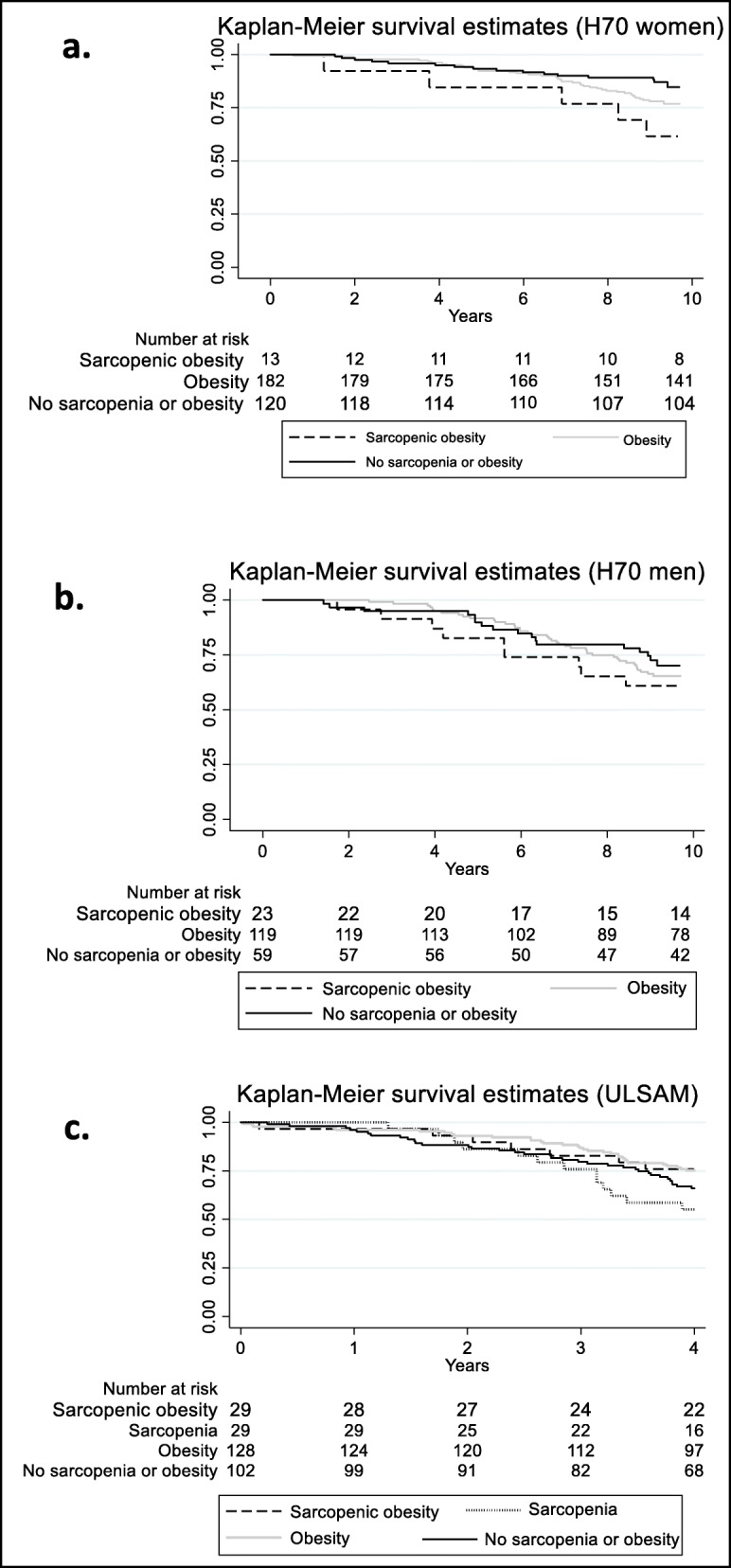
Verification
Claims the paper makes
The claims and statistics of this paper haven’t been checked yet.
Free: it reads the open-access text and checks the first 5 claims that cite a source we can check. Create a free account to check every claim.
Claims other papers make about this one
Each is checked against this paper’s own text: does it say what the citing paper says it does?
The source backs part of the claim, not all of it — or backs it for a different population, condition or comparison.
In the citing paper
“Sarcopenic obesity (SO) is a clinical condition defined by the coexistence of high body fat mass and low muscle function and mass, which increases the risk of adverse health outcomes, including disability and mortality.”
From Sarcopenic Obesity Phenotype Index (SOP i ): A Population‐Based Study (2025) · cites this paper as [7]
Experimental — accuracy not yet measuredThe cited source says what the claim attributes to it.
In the citing paper
“Women aged 75 years with sarcopenic obesity had a higher risk of 10-year mortality compared to those without sarcopenia or obesity.”
From Sarcopenic obesity: epidemiology, pathophysiology, cardiovascular disease, mortality, and management (2023) · cites this paper as [69]
In the citing paper
“Among men aged 75 years, a similar association with mortality was observed, although it did not reach statistical significance (69).”
From Sarcopenic obesity: epidemiology, pathophysiology, cardiovascular disease, mortality, and management (2023) · cites this paper as [69]
Self-check
Percentages, sums and reported differences re-computed from the paper’s own numbers.
The self-check needs the paper’s full text.
Citations
Cites
Charlson, M. E., Pompei, P., Ales, K. L., & MacKenzie, C. R. (1987) · Journal of Chronic Diseases · doi:10.1016/0021-9681(87)90171-8 · Cited by 49,742
Sarcopenia: revised European consensus on definition and diagnosis
Cruz-Jentoft, A. J., Bahat, G., Bauer, J., Boirie, Y., Bruyère, O., Cederholm, T., Cooper, C., Landi, F., Rolland, Y., Sayer, A. A., et al. (2019) · Age and Ageing · doi:10.1093/ageing/afy169 · Cited by 13,818 · cited 3×
“Probable or severe sarcopenia [5] was not considered for the SO definition.”
BackgroundInfluentialSelf-citation(2000) · PubMed · Cited by 13,173
Sarcopenia: European consensus on definition and diagnosis
Cruz-Jentoft, A. J., Baeyens, J. P., Bauer, J. M., Boirie, Y., Cederholm, T., Landi, F., Martin, F. C., Michel, J.-P., Rolland, Y., Schneider, S. M., et al. (2010) · Age and Ageing · doi:10.1093/ageing/afq034 · Cited by 11,601
Self-citationCoding algorithms for defining comorbidities in ICD-9-CM and ICD-10 administrative data
Quan, H., Sundararajan, V., Halfon, P., Fong, A., Burnand, B., Luthi, J.-C., Saunders, L. D., Beck, C. A., Feasby, T. E., & Ghali, W. A. (2005) · Medical Care · doi:10.1097/01.mlr.0000182534.19832.83 · Cited by 10,669
Sarcopenia: revised European consensus on definition and diagnosis
Cruz-Jentoft, A. J., Bahat, G., Bauer, J., Boirie, Y., Bruyère, O., Cederholm, T., Cooper, C., Landi, F., Rolland, Y., Sayer, A. A., et al. (2019) · Age and Ageing · doi:10.1093/ageing/afz046 · Cited by 3,803
Self-citationFielding, R. A., Vellas, B., Evans, W. J., Bhasin, S., Morley, J. E., Newman, A. B., Abellan van Kan, G., Andrieu, S., Bauer, J., Breuille, D., et al. (2011) · Journal of the American Medical Directors Association · doi:10.1016/j.jamda.2011.01.003 · Cited by 3,256
Self-citationESPEN guidelines on definitions and terminology of clinical nutrition
Cederholm, T., Barazzoni, R., Austin, P., Ballmer, P., Biolo, G., Bischoff, S. C., Compher, C., Correia, I., Higashiguchi, T., Holst, M., et al. (2017) · Clinical Nutrition · doi:10.1016/j.clnu.2016.09.004 · Cited by 2,560
Self-citationHealthy percentage body fat ranges: an approach for developing guidelines based on body mass index
Gallagher, D., Heymsfield, S. B., Heo, M., Jebb, S. A., Murgatroyd, P. R., & Sakamoto, Y. (2000) · The American Journal of Clinical Nutrition · doi:10.1093/ajcn/72.3.694 · Cited by 2,139
Cruz-Jentoft, A. J., Landi, F., Schneider, S. M., Zuniga, C., Arai, H., Boirie, Y., Chen, L.-K., Fielding, R. A., Martin, F. C., Michel, J.-P., et al. (2014) · Age and Ageing · doi:10.1093/ageing/afu115 · Cited by 1,963
Self-citation
Cited by
Global prevalence of sarcopenic obesity in older adults: A systematic review and meta-analysis
Gao, Q., Mei, F., Shang, Y., Hu, K., Chen, F., Zhao, L., & Ma, B. (2021) · Clinical Nutrition · doi:10.1016/j.clnu.2021.06.009 · Cited by 376
Sarcopenic obesity: epidemiology, pathophysiology, cardiovascular disease, mortality, and management
Wei, S., Nguyen, T. T., Zhang, Y., Ryu, D., & Gariani, K. (2023) · Frontiers in Endocrinology · doi:10.3389/fendo.2023.1185221 · Cited by 291
“The Gothenburg H70 Birth Cohort and the Uppsala Longitudinal Study of Adult Men (69) 809 Obesity was defined by any of 3 established definitions: WC 88 cm/ 102 cm for women and men, BMI > 30 kg/ m(2) or fat mass > 30% for men and > 42% for women, and sarcopenia was defined using EWGSOP2 definition.”
MethodRelevance of body composition in phenotyping the obesities
Salmón-Gómez, L., Catalán, V., Frühbeck, G., & Gómez-Ambrosi, J. (2023) · Reviews in Endocrine and Metabolic Disorders · doi:10.1007/s11154-023-09796-3 · Cited by 158
Sex Differences in Adiposity and Cardiovascular Diseases
Li, H., Konja, D., Wang, L., & Wang, Y. (2022) · International Journal of Molecular Sciences · doi:10.3390/ijms23169338 · Cited by 80
Low muscle mass in older adults and mortality: A systematic review and meta-analysis
de Santana, F. M., Premaor, M. O., Tanigava, N. Y., & Pereira, R. M. R. (2021) · Experimental Gerontology · doi:10.1016/j.exger.2021.111461 · Cited by 75
“…nine articles were considered eligible for the study and were then included for analysis (Bianchi et al., 2016; De Buyser et al., 2016; de Santana et al., 2019; Kruse et al., 2018; Moon et al., 2016; Nakamura et al., 2020; Seino et al., 2020; von Berens et al., 2020; Woo and Leung, 2018) (Table 1).”
BackgroundObesity paradox in older sarcopenic adults ― a delay in aging: A systematic review and meta-analysis
Eitmann, S., Mátrai, P., Hegyi, P. J., Balaskó, M., Erőss, B. M., Dorogi, K., & Pétervári, E. (2023) · Ageing Research Reviews · doi:10.1016/j.arr.2023.102164 · Cited by 66
Tallis, J., Shelley, S., Degens, H., & Hill, C. (2021) · Biomolecules · doi:10.3390/biom11030372 · Cited by 41
“The combined effects of ageing and obesity on skeletal muscle are commonly referred to as sarcopenic obesity [13,14,38].”
BackgroundNutrition for the older adult – Current concepts. Report from an ESPEN symposium
Volkert, D., Delzenne, N. M., Demirkan, K., Schneider, S., Abbasoğlu, O., Bahat, G., Barazzoni, R., Bauer, J. M., Cuerda, C., de van der Schueren, M. A. E., et al. (2024) · Clinical Nutrition · doi:10.1016/j.clnu.2024.06.020 · Cited by 57
Self-citationDu, Y., Xu, T., Yin, Z., Espinoza, S., Xie, Y., Gentry, C., Tian, Q., Zhao, L.-J., Shen, H., Luo, Z., et al. (2022) · BMC Public Health · doi:10.1186/s12889-022-13288-5 · Cited by 39
Murawiak, M., Krzymińska-Siemaszko, R., Kaluźniak-Szymanowska, A., Lewandowicz, M., Tobis, S., Wieczorowska-Tobis, K., & Deskur-Śmielecka, E. (2022) · Nutrients · doi:10.3390/nu14142889 · Cited by 37
“The cut-off points for excessive adiposis were >42% in women and >30% in men [35,44,45].”
BackgroundMethodPal, R., Bhadada, S. K., Aggarwal, A., & Singh, T. (2021) · Osteoporosis and Sarcopenia · doi:10.1016/j.afos.2020.12.003 · Cited by 44
“Hitherto, very few studies have defined sarcopenia (in SO) based on the EWGSOP2 consensus that lays more emphasis on muscle strength than muscle mass [30].”
BackgroundChuan, F., Chen, S., Ye, X., Kang, S., Mei, M., Tian, W., Liao, K., Li, Y., Gong, L., Li, R., et al. (2022) · Clinical Nutrition · doi:10.1016/j.clnu.2022.10.023 · Cited by 38
Associations between body mass index and all‐cause mortality: A systematic review and meta‐analysis
Wiebe, N., Lloyd, A. M., Crumley, E. T., & Tonelli, M. A. (2023) · Obesity Reviews · doi:10.1111/obr.13588 · Cited by 42
Luo, Y., Wang, Y., Tang, S., Xu, L., Zhao, X., Han, M., Liu, Y., Xu, Y. J., & Han, B. (2024) · BMC Geriatrics · doi:10.1186/s12877-024-04952-z · Cited by 45
Akazawa, N., Kishi, M., Hino, T., Tsuji, R., Tamura, K., & Moriyama, H. (2020) · Clinical Nutrition · doi:10.1016/j.clnu.2020.08.029 · Cited by 37
Domingos, C., Santos, N. C., & Pêgo, J. M. (2021) · Sensors · doi:10.3390/s21072258 · Cited by 44
“, sarcopenia, is a geriatric condition associated with adverse effects on function, quality of life, and survival [57].”
BackgroundMetabolic-associated fatty liver disease and sarcopenia: A double whammy
Viswanath, A., Fouda, S., Fernandez, C. J., & Pappachan, J. M. (2024) · World Journal of Hepatology · doi:10.4254/wjh.v16.i2.152 · Cited by 22
Lan, L., Shao, S., & Zheng, X. (2024) · Archives of Public Health · doi:10.1186/s13690-024-01329-x · Cited by 23
Kumari, M., & Khanna, A. (2022) · Annals of Geriatric Medicine and Research · doi:10.4235/agmr.22.0081 · Cited by 20
Franz, K., Deutschbein, J., Riedlinger, D., Pigorsch, M., Schenk, L., Lindner, T., Möckel, M., Norman, K., & Müller‐Werdan, U. (2023) · Frontiers in Medicine · doi:10.3389/fmed.2023.1173528 · Cited by 18
“A higher BMI was recently found to be a nutritional risk factor for malnutrition in older adults (42) and the geriatric syndrome sarcopenic obesity is equally important in this context (43).”
BackgroundQu, Q., Guo, Q., Sun, J.-Y., Lu, X., Cheang, I., Zhu, X., Yao, W., Li, X., Zhang, H., Zhou, Y., et al. (2023) · BMC Geriatrics · doi:10.1186/s12877-023-04326-x · Cited by 19
Clinical outcome changes in sarcopenic obesity: a meta-analysis of exercise training methods
Chen, L., Zhou, H., Gong, Y., Tang, Y., Su, H., Zhang, Z., Tong, P., & Chen, G. (2025) · BMC Geriatrics · doi:10.1186/s12877-024-05655-1 · Cited by 15
Metabolic Syndrome Screening and Nutritional Status of Patients with Psoriasis: A Scoping Review
Haris, N. H. M., Krishnasamy, S., Chin, K., Mariappan, V., & Arumugam, M. (2023) · Nutrients · doi:10.3390/nu15122707 · Cited by 14
Associations of Dynapenic Obesity and Sarcopenic Obesity with the Risk of Complications in COVID-19
Mayoral, L. P.-C., Matias‐Cervantes, C. A., Pérez‐Campos, E., Díaz, C. R., Barrios, L. Á. L., Pina-Canseco, M. D. S., Cruz, M. M., Mayoral, E. P., Solórzano-Mata, C. J., Canales, F. J. R., et al. (2022) · International Journal of Molecular Sciences · doi:10.3390/ijms23158277 · Cited by 14
Haigis, D., Matting, L., Wagner, S., Sudeck, G., Frahsa, A., Thiel, A., Eschweiler, G. W., & Niess, A. M. (2021) · Nutrients · doi:10.3390/nu13113791 · Cited by 11
“The FM cut-off values (in %) were >42% for women and >30% for men [5,33].”
BackgroundResultImmunogenetic Aspects of Sarcopenic Obesity
Mazurkiewicz, Ł., Czernikiewicz, K., & Grygiel‐Górniak, B. (2024) · Genes · doi:10.3390/genes15020206 · Cited by 15
“Higher all-cause mortality rate in women suffering from SO was observed and a higher risk of death within 10 years in 75-years-old SO women was reported [7,8].”
BackgroundSarcopenia and sarcopenic obesity among older adults in the nordic countries: a scoping review
Baygi, F., Buhl, S. F., Thilsing, T., Søndergaard, J., & Nielsen, J. B. (2024) · BMC Geriatrics · doi:10.1186/s12877-024-04970-x · Cited by 14
“In terms of study design, most of the studies were observation studies with a cross-sectional or longitudinal design (22–31, 33, 34, 36–39–45, 46–54), while three studies [32, 35, 46] applied interventions.”
BackgroundMethodInfluentialBanack, H. R., LaMonte, M. J., Manson, J. E., Zhu, K., Evans, W. J., Shankaran, M., & Wactawski‐Wende, J. (2022) · PLoS ONE · doi:10.1371/journal.pone.0278723 · Cited by 13
“There is an additional methodologic challenge for research on sarcopenic obesity, related to the need for a gold-standard definition of obesity for this construct [36, 37].”
BackgroundMasri, D. E., Itani, L., Tannir, H., Kreidieh, D., & Ghoch, M. E. (2021) · Clinics and Practice · doi:10.3390/clinpract11030069 · Cited by 8
“, a decrease in muscle mass and strength) [2–4]—was declared a priority for both researchers and clinicians by international scientific bodies, such as the European Society for Clinical Nutrition and Metabolism (ESPEN) and the European Association for the Study of Obesity (EASO) [5], since the presence of SO seems to…”
BackgroundZhang, C., Huang, X., Lü, H., Chen, M., Wang, J., & Deng, H. (2024) · Frontiers in Nutrition · doi:10.3389/fnut.2024.1492191 · Cited by 8
Onset and progression of chronic disease and disability in a large cohort of older Australian women
Rahman, M. M., Jagger, C., Princehorn, E. M., Holliday, E. G., Leigh, L., Loxton, D. J., Beard, J., Kowal, P. R., & Byles, J. (2021) · Maturitas · doi:10.1016/j.maturitas.2021.11.007 · Cited by 10
Bahat, G., İlhan, B., Çatıkkaş, N. M., Tufan, A., Öztürk, S., Dogan, H., & Karan, M. A. (2022) · Acta Clinica Belgica · doi:10.1080/17843286.2022.2075180 · Cited by 9
“merely reflect an absence of chronic disease [43].”
BackgroundAssociation between Body Composition Contents and Hepatic Fibrosis in Sarcopenic Obesity
Kim, T., Jeong, C., Lee, C., Noh, S.-H., Lim, D. W., Kim, J. W., Kim, H. J., & Kim, Y. R. (2023) · Journal of Clinical Medicine · doi:10.3390/jcm12134279 · Cited by 7
Altınkaynak, M., Gürel, E., Ören, M. M., Kılıç, C., Karan, M. A., & Bahat, G. (2023) · Clinical Nutrition · doi:10.1016/j.clnu.2023.09.019 · Cited by 6
Body compositions phenotypes of older adults with COPD
Kaluźniak-Szymanowska, A., Talarska, D., Tobis, S., Styszyński, A., Cofta, S., Wieczorowska–Tobis, K., & Deskur-Śmielecka, E. (2024) · Frontiers in Nutrition · doi:10.3389/fnut.2024.1449189 · Cited by 6
Ayçiçek, G. Ş., Baş, A. O., Karabulut, E., & Halil, M. G. (2025) · Acta Clinica Belgica · doi:10.1080/17843286.2025.2583187 · Cited by 5
Ghoch, M. E., Rossi, A. P., Verde, L., Barrea, L., Muscogiuri, G., Savastano, S., & Colao, A. (2022) · Panminerva Medica · doi:10.23736/s0031-0808.22.04784-x · Cited by 4
Vijewardane, S. C., Balasuriya, A., Johnstone, A. M., & Myint, P. K. (2024) · Heliyon · doi:10.1016/j.heliyon.2024.e27064 · Cited by 4
“Studies conducted among people with sarcopenic obesity have indicated an increased risk of disability and mortality [13,14], a condition resulting from changes in biological pathways due to old age characterized by low body muscle mass (sarcopenia) and high body fat mass (obesity) [7].”
Meys, R., Machado, F. V. C., Spruit, M. A., Stoffels, A. A. F., van Hees, H. W. H., van den Borst, B., Klijn, P. H. C., Burtin, C., Pitta, F. D. O., & Franssen, F. M. E. (2023) · Obesity Facts · doi:10.1159/000531196 · Cited by 5
“[33], in patients with COPD (10 – 27”
BackgroundAkgül, Y. S. S., Akın, S., Cengiz, B. E., Koçaslan, D., & Özer, N. T. (2024) · Journal of Parenteral and Enteral Nutrition · doi:10.1002/jpen.2613 · Cited by 4
Pleshchev, I. E., Nikolenko, V. N., Ачкасов, Е. Е., Preobrazhenskiy, Y. I., Александрович, Г. Л., Николаевич, Ш. А., & Tsoller, M. V. (2024) · Бюллетень Восточно-Сибирского научного центра Сибирского отделения Российской академии медицинских наук · doi:10.29413/abs.2024-9.3.2 · Cited by 4
Sarcopenic Obesity Phenotype Index (SOP i ): A Population‐Based Study
Benz, E., Pinel, A., Guillet, C., Capel, F., Pereira, B., Rizopoulos, D., Cruz‐Jentoft, A. J., Eglseer, D., Topinkova, E., Barazzoni, R., et al. (2025) · Journal of Cachexia, Sarcopenia and Muscle · doi:10.1002/jcsm.70099 · Cited by 5
Mela, V., Agüera, Z., Alvarez-Bermudez, M. D., Martín‐Reyes, F., Granero, R., García, A. M. S., Oliva‐Olivera, W., Tomé, M., Moreno‐Ruiz, F. J., Soler-Humanes, R., et al. (2023) · Nutrients · doi:10.3390/nu15194109 · Cited by 6
“This medical condition is highly correlated with an increased risk of obesityrelated comorbidities [69] and is associated with increased mortality [71].”
BackgroundPrevalence of Sarcopenic Obesity in Elderly Population: A Meta-Analysis
Rupolo, V. L., Camargo, T. L., Pureza, I. R. D. O. M., Beretta, M. V., & Garcêz, A. (2024) · Current Aging Science · doi:10.2174/0118746098331277241101025928 · Cited by 2
The Capability Approach in Epidemiological Studies
Skoog, I. G., Falk, H., Kern, S., Sterner, T. R., Samuelsson, J., & Zettergren, A. (2022) · International perspectives on aging · doi:10.1007/978-3-030-78063-0_4 · Cited by 4
“In the H70 birth cohort study (at 75 years), and the Uppsala Longitudinal Study of Adult Men (at 87 years), 4% of the women and 10–11% of the men were obese (von Berens et al., 2020).”
BackgroundSelf-citationGuandalini, V. R., Tofani, P. S., Lima, S. S., Silveira, L. C., Cochar‐Soares, N., da Silva, T. B. P., de Souza, T. B., Luiz, M. M., Ramírez, P. C., Máximo, R. D. O., et al. (2024) · Aging Clinical and Experimental Research · doi:10.1007/s40520-024-02866-9 · Cited by 3
Feraco, A., Camajani, E., Muscogiuri, G., Barrea, L., Colao, A., & Caprio, M. (2026) · Current Obesity Reports · doi:10.1007/s13679-026-00695-7 · Cited by 2
Nipu, N., Wentzel, A., Heshmati, N., Sangi, N. K., Zhang, X., Canahuate, G. M., Fuller, C. D., & Marai, G. E. (2025) · Annual International Conference of the IEEE Engineering in Medicine and Biology Society (EMBC) · doi:10.1109/embc58623.2025.11254617 · Cited by 3
Nikolaou, M. A., & Nikolaou, D. A. (2022) · Journal of Research and Practice on the Musculoskeletal System · doi:10.22540/jrpms-06-027
Jiang, F., Liu, X., Hu, Z. J., Ma, L., Liao, W., Li, S., Zhu, R., Wang, C., & Li, Y. (2023) · Journal of Public Health · doi:10.1007/s10389-023-02005-0
“Presumably, obesity is accompanied by an increase in muscle mass, which may mediate a potential protective effect (von Berens et al. 2020).”
Abud, G. F., Ortiz, G. U., Venturini, A. C. R., Travieso, S. G., Fogagnolo, C., Viliod, M. C. D. L., Esteves, G. P., Silva, B. M., da Silva, A. S. R., & de Freitas, E. C. (2025) · Menopause The Journal of The North American Menopause Society · doi:10.1097/gme.0000000000002716 · Cited by 1
Luo, Y., Wang, Y., Tang, S., Xu, L., Zhao, X., Han, M., Liu, Y., Xu, Y., & Han, B. (2024) · Figshare · doi:10.6084/m9.figshare.26709950
Baygi, F., Buhl, S. F., Thilsing, T., Søndergaard, J., & Nielsen, J. B. (2024) · Figshare · doi:10.6084/m9.figshare.26719845
Qu, Q., Guo, Q., Sun, J., Lu, X., Cheang, I., Zhu, X., Yao, W., Li, X., Zhang, H., Zhou, Y., et al. (2023) · Figshare · doi:10.6084/m9.figshare.24240194
Luo, Y., Wang, Y., Tang, S., Xu, L., Zhao, X., Han, M., Liu, Y., Xu, Y., & Han, B. (2024) · Figshare · doi:10.6084/m9.figshare.25670337
Luo, Y., Wang, Y., Tang, S., Xu, L., Zhao, X., Han, M., Liu, Y., Xu, Y., & Han, B. (2024) · Figshare · doi:10.6084/m9.figshare.26709956
Luo, Y., Wang, Y., Tang, S., Xu, L., Zhao, X., Han, M., Liu, Y., Xu, Y., & Han, B. (2024) · Figshare · doi:10.6084/m9.figshare.25670181
Luo, Y., Wang, Y., Tang, S., Xu, L., Zhao, X., Han, M., Liu, Y., Xu, Y., & Han, B. (2024) · Figshare · doi:10.6084/m9.figshare.26709953
Chen, X., Liu, C., Fu, W., Liu, Y., Lu, B., & Tang, H. (2026) · Food Science & Nutrition · doi:10.1002/fsn3.71703
Unseen and untreated: implementing sarcopenic obesity care in Nordic general practice
Baygi, F., Haastrup, P., Buhl, S. F., Nielsen, J. B., Suetta, C., Rathleff, M. S., & Søndergaard, J. (2026) · Frontiers in Aging · doi:10.3389/fragi.2026.1815247 · Cited by 1
Adverse outcomes of sarcopenic obesity in older adults: a scoping review
Chang, H., Zhao, Y., Tian, Y., & Hao, L. (2026) · Frontiers in Nutrition · doi:10.3389/fnut.2026.1917374
“However, this association was not statistically significant in male patients (26).”
Influential
Metadata
- Authors
- von Berens, Å., Obling, S. R., Nydahl, M., Koochek, A., Lissner, L., Skoog, I., Frändin, K., Skoglund, E., Rothenberg, E., & Cederholm, T.
- Affiliations
- Odense University Hospital (DK)
- Uppsala University (SE)
- University of Gothenburg (SE)
- Kristianstad University (SE)
- ORCID
- Venue
- BMC Geriatrics
- Published
- 2020-06-09
- Volume
- 20
- Issue
- 1
- Pages
- 199-199
- ISSN
- 1471-2318 (ISSN-L)
- PMC
- PMC7285448
- OpenAlex
- W3033939896
- Cited by
- 62
- References
- 35
- Citations by year
- 2026: 4 · 2025: 5 · 2024: 20 · 2023: 13 · 2022: 11 · 2021: 8 · 2020: 1
- FWCI
- 4.95
- Type
- journal article
- Language
- en
- Open access
- gold
- doi.org
- Licence
- cc-by
- creativecommons.org/licenses/by/4.0 (tdm)
- creativecommons.org/licenses/by/4.0 (vor)
- Locations
- BMC Geriatrics (publishedVersion, cc-by)
- Research Square (acceptedVersion, cc-by)
- PubMed Central (publishedVersion, cc-by)
- PubMed (publishedVersion)
- University of Southern Denmark Research Portal (University of Southern Denmark) (submittedVersion, cc-by)
- Högskolan Kristianstad Publikationer (submittedVersion, other-oa)
- Uppsala University Publications (Uppsala University) (submittedVersion, other-oa)
- DOAJ (DOAJ: Directory of Open Access Journals) (submittedVersion, cc-by-sa)
- Funders
- Vetenskapsrådet (2015-02830, 2013-8717, 2013-2300, 2006-1506, 2013-2496)
- the Swedish state under the agreement between the Swedish government and the county councils, the ALF-agreement (ALF 716681)
- Topics
- Health Sciences › Medicine › Physiology (medical) › Nutrition and Health in Aging
- Health Sciences › Medicine › Physiology (medical) › Body Composition Measurement Techniques
- Health Sciences › Medicine › Geriatrics and Gerontology › Frailty in Older Adults
- Keywords
- sarcopenic obesity, sarcopenia, obesity, mortality, older adults, prevalence, sex differences, fat mass, waist circumference, community-dwelling older adults
- MeSH terms
- Aged, Aged, 80 and over, Female, Humans, Longitudinal Studies, Male, Obesity, Sweden, Body Mass Index, Sarcopenia
About these checks
Registry, retraction, Cites and statistics results are computed, not judged, with one exception: a printed reference that no index lists is read once by a model before it counts as a citation error. Claims are extracted by a model and kept only when their quote appears verbatim in the text; each cited source is then checked, with a model’s help, for whether it says what the claim relies on. Those verdicts can be wrong — read the claim’s quote and the cited source before relying on one.
Statistics and arithmetic are recomputed, not judged.
Confidence bands are shown only for fields calibrated on our annotated test set. None is calibrated yet, so no band is shown.
What counts as a claim ›How we measure confidence ›How we check this ›
Are you an author, or do you see a problem with this page? Request a review
Data sources
Bibliographic data: Semantic Scholar, OpenAlex, Crossref.
Contains information from the Semantic Scholar Academic Graph Datasets, made available under the ODC Attribution License (ODC-BY 1.0).
Semantic Scholar’s data is described in: Kinney, R., et al. (2023). The Semantic Scholar Open Data Platform. arXiv:2301.10140.
