

BEFRIENding for Depression, Anxiety and Social support in older adults living in Australian residential aged care facilities (BEFRIENDAS): randomised controlled trial protocol
Open accessThe DOI matches its Crossref record; 42 of the 42 references it cites were found in a registry or an index.
Abstract
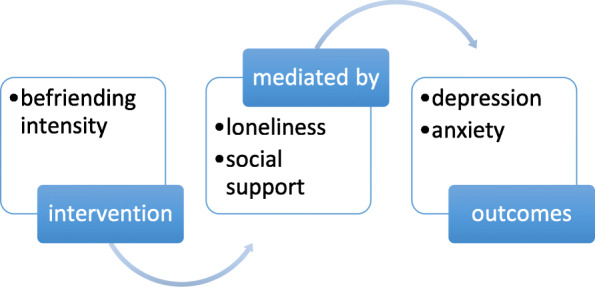
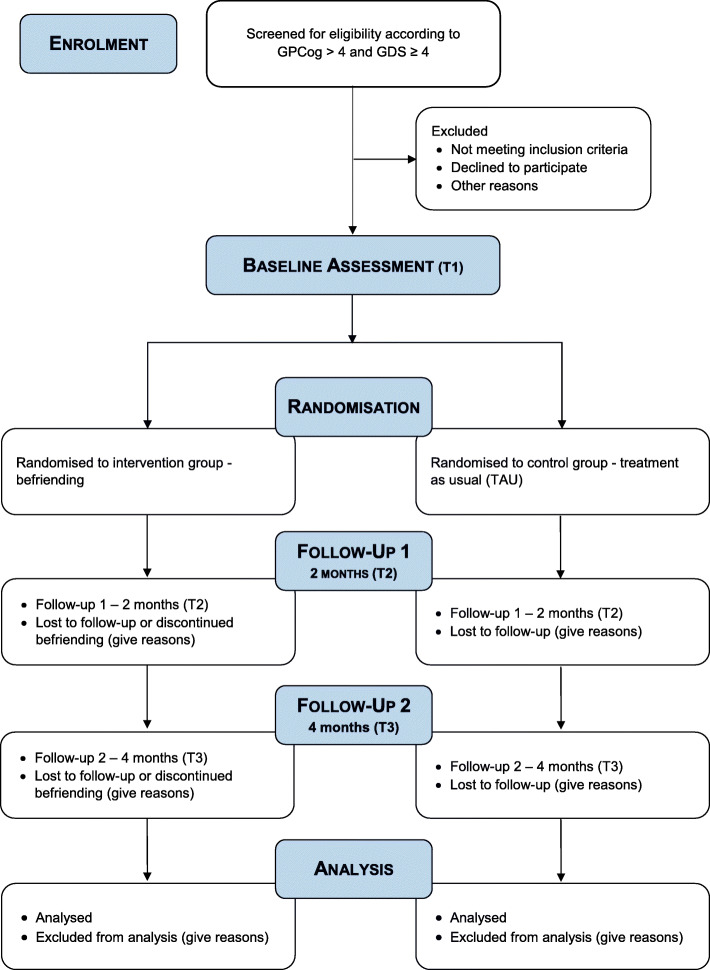
Background: This protocol describes an ongoing study of the impact of befriending on depression, anxiety and loneliness in older people living in residential aged care facilities in Australia. While systematic reviews of befriending have indicated positive benefits of befriending for people in a range of ages and settings, there have been no randomised controlled trials (RCTs) of befriending for older people living in residential aged care with depression and no studies of the cost effectiveness of befriending in residential aged care facilities (RACFs) in Australia. Methods and analysis: We are conducting a single blind pragmatic RCT comparing two groups of older people living in RACFs, one receiving an intervention consisting of weekly befriending for 4 months from a trained volunteer and the other receiving treatment as usual. Participants undergo eligibility screening for depression (GDS-15 ≥ 4) and cognitive impairment (GPCog ≥ 4) and assessments at three measurement time points: baseline prior to randomisation, 2 months post-baseline and 4 months post-baseline. The primary outcome measure is depression, and secondary outcome measures are anxiety, loneliness, social isolation and quality of life. The economic evaluation will take the form of a cost-utility analysis based on the outcome of quality of life. The primary and secondary outcomes will be analysed using negative binomial and logistic regressions utilizing the Generalised Estimating Equations approach. Discussion: To our knowledge, this is the first RCT evaluating the effectiveness of befriending on older people with depression living in residential aged care. It is expected that the befriending intervention will reduce the severity of depression symptoms experienced by older people living in residential aged care. If the intervention proves effective it may be incorporated into volunteer training programs and adopted as a way of supporting older people’s mental health. Trial registration: Trial registered with the Australian and New Zealand Clinical Trial Registry (ANZCTR) Number: ACTRN12619000676112, registered 06/05/2019 – retrospectively registered.
Overview
The claims and statistics of this paper haven’t been checked yet.
Free: it reads the open-access text and checks the first 5 claims that cite a source we can check. Create a free account to check every claim.
Integrity signals
Registry
Cites
Statistics
Figures
Verification
Claims the paper makes
The claims and statistics of this paper haven’t been checked yet.
Free: it reads the open-access text and checks the first 5 claims that cite a source we can check. Create a free account to check every claim.
Claims other papers make about this one
Each is checked against this paper’s own text: does it say what the citing paper says it does?
The cited source says what the claim attributes to it.
In the citing paper
“we lack clear evidence of the effectiveness of non-psychological interventions such as befriending (Doyle 2021) and video calls (Noone 2020) in LTC settings.”
From Psychological therapies for depression in older adults residing in long-term care settings (2024) · cites this paper as Doyle 2021
Self-check
Percentages, sums and reported differences re-computed from the paper’s own numbers.
The self-check needs the paper’s full text.
Citations
Cites
Charlson, M. E., Pompei, P., Ales, K. L., & MacKenzie, C. R. (1987) · Journal of Chronic Diseases · doi:10.1016/0021-9681(87)90171-8 · Cited by 49,742 · cited 1×
“…of birth, county of birth, date of admission to the residence, medical conditions and comorbidities as measured by the Charlson Comorbidity Index [36], activities of daily living capabilities as measured by the Aged Care Funding Instrument (ACFI) Activities of Daily Living domain which consists…”
MethodLongitudinal data analysis using generalized linear models
LIANG, K.-Y., & ZEGER, S. L. (1986) · Biometrika · doi:10.1093/biomet/73.1.13 · Cited by 18,550 · cited 1×
“…and social isolation) will be analysed using negative binomial and logistic regressions utilizing the Generalised Estimating Equations (GEE) approach, a marginal model in which the effect of covariates on the outcome is averaged over individuals at each point in time and is compared over time [38].”
MethodSheikh (1986) · doi:10.1300/j018v05n01_09 · Cited by 7,236
(2014) · Medical Entomology and Zoology · Cited by 6,828
UCLA loneliness scale (version 3): reliability, validity, and factor structure
Russell, D. W. (1996) · Journal of Personality Assessment · doi:10.1207/s15327752jpa6601_2 · Cited by 5,800 · cited 1×
“Loneliness is measured by the UCLA Lone-liness Scale [33], a 20-item scale designed to measure a participant ’ s subjective feelings of loneliness as well as feelings of social isolation.”
MethodCornell scale for depression in dementia
Alexopoulos, G. S., Abrams, R. C., Young, R. C., & Shamoian, C. A. (1988) · Biological Psychiatry · doi:10.1016/0006-3223(88)90038-8 · Cited by 2,678
Cacioppo, J. T., Hughes, M. E., Waite, L. J., Hawkley, L. C., & Thisted, R. A. (2006) · Psychology and Aging · doi:10.1037/0882-7974.21.1.140 · Cited by 2,380 · cited 1×
“Social isolation and loneliness are closely associated with symptoms of depression [8] and a recent qualitative study found that residents in RACFs attributed their sadness to loss of health and functional ability, and feeling alone in a crowd [9].”
The National Institute for Clinical Excellence (NICE)
Rodgers, A.-T. (2002) · Annals of the Rheumatic Diseases · doi:10.1136/ard.61.suppl_2.ii92 · Cited by 966
Development and validation of the Geriatric Anxiety Inventory
Pachana, N. A., Byrne, G. J., Siddle, H., Koloski, N., Harley, E., & Arnold, E. (2007) · International Psychogeriatrics · doi:10.1017/s1041610206003504 · Cited by 860 · cited 1×
“Anxiety is measured by the Geriatric Anxiety Inventory (GAI 20item) [32], consisting of 20 “Agree/Disagree” items designed to assess typical common anxiety symptoms in older adults.”
MethodThe GPCOG: A New Screening Test for Dementia Designed for General Practice
Brodaty, H., Pond, D., Kemp, N. M., Luscombe, G., Harding, L., Berman, K., & Huppert, F. A. (2002) · Journal of the American Geriatrics Society · doi:10.1046/j.1532-5415.2002.50122.x · Cited by 493 · cited 1×
“General Practitioner Assessment of Cognition (GPCOG) [30] score of 4 or greater as assessed by the research assistant.”
MethodGeriatric Depression Scale (GDS)
(2001) · Management of Dementia · doi:10.3109/9780203213896-32 · Cited by 487
Prevalence and risk indicators of depression in elderly nursing home patients: the AGED study
Jongenelis, K., Pot, A. M., Eisses, A. M. H., Beekman, A. T. F., Kluiter, H., & Ribbe, M. W. (2004) · Journal of Affective Disorders · doi:10.1016/j.jad.2004.06.001 · Cited by 426 · cited 1×
“Major depressive disorder has been estimated at 10 – 14.4%, which is higher than that reported within community dwelling older adults [3 – 6].”
BackgroundInfluentialSanders, C. (2003) · Contemporary Nurse · doi:10.5172/conu.14.3.292 · Cited by 319 · cited 1×
“Colaizzi ’ s phenomenological data analysis steps will be used to describe the phenomena experienced by the participants and by the volunteers [40, 41].”
MethodVideo calls for reducing social isolation and loneliness in older people: a rapid review
Noone, C., McSharry, J., Smalle, M., Burns, A., Dwan, K., Devane, D., & Morrissey, E. C. (2020) · Cochrane Database of Systematic Reviews · doi:10.1002/14651858.cd013632 · Cited by 226 · cited 1×
“iveness of befriending via video calls [20].”
Effects of befriending on depressive symptoms and distress: systematic review and meta-analysis
Mead, N., Lester, H., Chew-Graham, C., Gask, L., & Bower, P. (2010) · British Journal of Psychiatry · doi:10.1192/bjp.bp.109.064089 · Cited by 189 · cited 1×
“When provided by volunteers, befriend-ing has been found to significantly reduce depression symptoms in carers, those with a chronic illness, and the socially isolated, but again studies in RACF settings have not been published to date [26].”
BackgroundVan der Roest, H. G., Prins, M., van der Velden, C., Steinmetz, S., Stolte, E., van Tilburg, T. G., & de Vries, D. H. (2020) · Journal of the American Medical Directors Association · doi:10.1016/j.jamda.2020.09.007 · Cited by 184 · cited 1×
“In light of the COVID-19 pandemic and the impact of lockdowns on the mental health of older people living in RACFs, the results of this study will be especially important to inform future models of care of the mental health of frail older people living in residential care [42, 43].”
Henderson, A. S., Jorm, A. F., Mackinnon, A., Christensen, H., Scott, L. R., Korten, A. E., & Doyle, C. (1993) · Psychological Medicine · doi:10.1017/s0033291700025496 · Cited by 177
Self-citationEffectiveness of befriending interventions: a systematic review and meta-analysis
Siette, J., Cassidy, M., & Priebe, S. (2017) · BMJ Open · doi:10.1136/bmjopen-2016-014304 · Cited by 169 · cited 2×
“A review by Siette et al. [18] included 14 papers that focused on befriending, however none evaluated befriending in RACFs.”
BackgroundLow, L.-F., Fletcher, J., Goodenough, B., Jeon, Y.-H., Etherton-Beer, C., MacAndrew, M., & Beattie, E. (2015) · PLOS ONE · doi:10.1371/journal.pone.0140711 · Cited by 164 · cited 1×
“One reason for the higher prevalence of depression in RACFs may be that staff are not trained to manage depression, but studies of training staff in the detection and management of depression have met with short-term success and little sustainable change [10].”
BackgroundDepression in adults: recognition and management
(2017) · Pharmaceutical journal/The pharmaceutical journal · doi:10.1211/pj.2017.20202439 · Cited by 138
Cattan, M., Kime, N., & Bagnall, A.-M. (2010) · Health & Social Care in the Community · doi:10.1111/j.1365-2524.2010.00967.x · Cited by 129 · cited 1×
“Telephone befriending has been shown to help recipients gain confidence, re-engage with the community and become socially active again [17].”
BackgroundPsychotropic medication use among nursing home residents in Austria: a cross-sectional study
Mann, E., Köpke, S., Haastert, B., Pitkälä, K., & Meyer, G. (2009) · BMC Geriatrics · doi:10.1186/1471-2318-9-18 · Cited by 93 · cited 1×
“In general the prescription of psychotropic medication is high among RACF residents [12, 13], but older adults have expressed concerns about using anti-depressants due to side-effects, stigma, fear of addiction and prevention of natural sadness [14].”
BackgroundRoberts, G., Morley, C., Walters, W., Malta, S., & Doyle, C. (2014) · Geriatric Nursing · doi:10.1016/j.gerinurse.2014.11.003 · Cited by 82 · cited 1×
“In general the prescription of psychotropic medication is high among RACF residents [12, 13], but older adults have expressed concerns about using anti-depressants due to sideeffects, stigma, fear of addiction and prevention of natural sadness [14].”
BackgroundSelf-citationPhillips, C. J., & Henderson, A. S. (1991) · Psychological Medicine · doi:10.1017/s0033291700022376 · Cited by 67
Amare, A. T., Caughey, G. E., Whitehead, C., Lang, C. E., Bray, S. C., Corlis, M., Visvanathan, R., Wesselingh, S., & Inacio, M. C. (2020) · Australian & New Zealand Journal of Psychiatry · doi:10.1177/0004867420945367 · Cited by 53 · cited 2×
“Up to 53% of people living in Australian RACFs have been shown to have significant symptoms of depression [1, 2].”
BackgroundDoyle, C., Bhar, S., Fearn, M., Ames, D., Osborne, D., You, E., Gorelik, A., & Dunt, D. (2017) · British Journal of Health Psychology · doi:10.1111/bjhp.12245 · Cited by 49 · cited 1×
“…through: assisting with activities for socially isolated residents in aged care [22, 23]; engaging in social visits with residents in aged care [24]; and providing social support over the phone for people in the community with depression, anxiety and comorbid physical health problems [25].”
BackgroundSelf-citationSimning, A., & Simons, K. V. (2017) · International Psychogeriatrics · doi:10.1017/s1041610216001733 · Cited by 47 · cited 1×
“Internationally, the prevalence of depressive symptoms in people living in RACFs has been estimated to range between 11 and 78% [3].”
BackgroundBeliefs about medications predict adherence to antidepressants in older adults
Fawzi, W., Abdel Mohsen, M. Y., Hashem, A. H., Moussa, S., Coker, E., & Wilson, K. C. M. (2012) · International Psychogeriatrics · doi:10.1017/s1041610211001049 · Cited by 45 · cited 1×
“In general the prescription of psychotropic medication is high among RACF residents [12, 13], but older adults have expressed concerns about using anti-depressants due to sideeffects, stigma, fear of addiction and prevention of natural sadness [14].”
BackgroundResidents’ perceptions of their own sadness - a qualitative study in Norwegian nursing homes
Iden, K. R., Ruths, S., & Hjörleifsson, S. (2015) · BMC Geriatrics · doi:10.1186/s12877-015-0019-y · Cited by 40 · cited 1×
“Social isolation and loneliness are closely associated with symptoms of depression [8] and a recent qualitative study found that residents in RACFs attributed their sadness to loss of health and functional ability, and feeling alone in a crowd [9].”
DEPRESSION AND LONELINESS/SOCIAL ISOLATION AMONG PATIENTS WITH COGNITIVE IMPAIRMENT IN NURSING HOME
Nikmat, A. W., Hashim, N. A., Omar, S. A., & Razali, S. (2015) · ASEAN Journal of Psychiatry · Cited by 35
van der Ploeg, E. S., Walker, H., & O’Connor, D. (2013) · Geriatric Nursing · doi:10.1016/j.gerinurse.2013.12.003 · Cited by 34 · cited 1×
“Research on the role of volunteers in health services has consistently shown positive effects for volunteers and older recipients of the service [21] including through: assisting with activities for socially isolated residents in aged care [22, 23]; engaging in social visits with residents in aged care [24]; and provi…”
Self-citationStargatt, J., Bhar, S., Davison, T., Pachana, N., Mitchell, L. K., Koder, D., Hunter, C., Doyle, C., Wells, Y., & Helmes, E. (2017) · Australian Psychologist · doi:10.1111/ap.12244 · Cited by 34 · cited 1×
“On the other hand, psychological services can be difficult for RACF residents to access in Australia [15], as psychologists are not typically employed in Australia in such settings [16].”
BackgroundSelf-citationCOVID-19 and psychogeriatrics: the view from Australia
Pachana, N. A., Beattie, E., Byrne, G. J., & Brodaty, H. (2020) · International Psychogeriatrics · doi:10.1017/s1041610220000885 · Cited by 31 · cited 1×
“In light of the COVID-19 pandemic and the impact of lockdowns on the mental health of older people living in RACFs, the results of this study will be especially important to inform future models of care of the mental health of frail older people living in residential care [42, 43].”
BackgroundRatcliffe, J., Flint, T., Easton, T., Killington, M., Cameron, I. D., Davies, O., Whitehead, C., Kurrle, S. E., Miller, M., Liu, E., et al. (2016) · Applied Health Economics and Health Policy · doi:10.1007/s40258-016-0293-7 · Cited by 29
Self-citationRosa, F., Bagnasco, A., Ghirotto, L., Rocco, G., Catania, G., Aleo, G., Zanini, M. P., Dasso, N., Hayter, M., & Sasso, L. (2017) · Journal of Clinical Nursing · doi:10.1111/jocn.14189 · Cited by 26 · cited 1×
“Colaizzi ’ s phenomenological data analysis steps will be used to describe the phenomena experienced by the participants and by the volunteers [40, 41].”
MethodBrief on the role of psychologists in residential and home care services for older adults
Davison, T. E., Koder, D., Helmes, E., Doyle, C., Bhar, S., Mitchell, L., Hunter, C., Knight, B., & Pachana, N. (2017) · Australian Psychologist · doi:10.1111/ap.12209 · Cited by 22 · cited 1×
“On the other hand, psychological services can be difficult for RACF residents to access in Australia [15], as psychologists are not typically employed in Australia in such settings [16].”
BackgroundSelf-citationSupporting women with perinatal mental health problems : the role of the voluntary sector
Coe, C., & Barlow, J. (2013) · PubMed · doi:10.82444/warw.33708964 · Cited by 18
Volunteers Befriending Older Adults in Aged Care Residencies: Three Case Studies
Stephens, J., Simpson, T. N., Holmes, O. S., Collins, R., Silver, M., & Bhar, S. S. (2016) · Australian Psychologist · doi:10.1111/ap.12160 · Cited by 14 · cited 1×
“…through: assisting with activities for socially isolated residents in aged care [22, 23]; engaging in social visits with residents in aged care [24]; and providing social support over the phone for people in the community with depression, anxiety and comorbid physical health problems [25].”
BackgroundSelf-citationPsychogeriatric Assessment Scales
Jorm, A. F. (2002) · doi:10.1002/0470846410.ch27(v · Cited by 10
Revising the Lubben Social Network Scale for use in residential long-term care settings
Munn, J., Radey, M., Brown, K. L., & Kim, H. (2018) · Journal of Evidence-Informed Social Work · doi:10.1080/23761407.2018.1460734 · Cited by 9 · cited 1×
“Social isolation is measured by The Lubben Social Network Scale-6 [34].”
MethodVolunteer-led behavioural activation to reduce depression in residential care: a feasibility study
Bryant, C., Brown, L., Polacsek, M., Batchelor, F., Capon, H., & Dow, B. (2020) · Pilot and Feasibility Studies · doi:10.1186/s40814-020-00640-y · Cited by 8 · cited 1×
“…volunteers and older recipients of the service [21] including through: assisting with activities for socially isolated residents in aged care [22, 23]; engaging in social visits with residents in aged care [24]; and providing social support over the phone for people in the community with…”
BackgroundSelf-citationPsychogeriatric Assessment Scales
Jorm, A. F., Mackinnon, A. J., Henderson, A. S., Scott, R., Christensen, H. B., Korten, A. E., Cullen, J. S., & Mulligan, R. (2011) · PsycTESTS Dataset · doi:10.1037/t03172-000 · Cited by 8
Research works printed but not linked: 5
- Australian Institute of Health and Welfare. Depression in residential aged care 2008-2012. Aged care statistics series no. 39 cat. No. AGE 73. Canberra: AIHW; 2013.
- Corporation for National Community Service. Office of Research Policy Development. The health benefits of volunteering: A review of recent research. Washington DC: Corporation for National & Community Service, [Office of Research and Policy Development]; 2007.
- Oxford English Dictionary. Available from: https://www.lexico.com/definition/befriend. Accessed 7 Sept 2020.
- Australian Government Department of Health. Aged Care Funding Instrument User Guide. Canberra: Health AGD; 2017.
- Doyle, C., Bhar, S., Bryant, C., Dow, B., Dunt, D., Mnatzaganian, G., O'Connor, D., Ratcliffe, J., You, E., Bagnall, A. -M., Major, G., Harper, R. & Fearn, M. (2021). BEFRIENding for Depression, Anxiety and Social support in older adults living in Australian residential aged care facilities (BEFRIENDAS): randomised controlled trial protocol. BMC GERIATRICS, 21 (1), https://doi.org/10.1186/s12877-021-02233-7. Persistent Link: http://hdl.handle.net/11343/278248 License: CC BY
Cited by
Family visits and depression among residential aged care residents: An integrative review
Tan, J. D. L., Maneze, D., Montayre, J., Ramjan, L. M., Wang, D., & Salamonson, Y. (2023) · International Journal of Nursing Studies · doi:10.1016/j.ijnurstu.2023.104568 · Cited by 33
Psychological therapies for depression in older adults residing in long-term care settings
Davison, T. E., Bhar, S., Wells, Y., Owen, P. J., You, E., Doyle, C., Bowe, S. J., & Flicker, L. (2024) · Cochrane Database of Systematic Reviews · doi:10.1002/14651858.cd013059.pub2 · Cited by 25
Self-citationLaermans, J., Scheers, H., Vandekerckhove, P. G., & Buck, E. D. J. D. (2023) · Campbell Systematic Reviews · doi:10.1002/cl2.1359 · Cited by 19
Devassy, S. M., Allagh, K. P., Benny, A. M., Scaria, L., Cheguvera, N., & Pathrose, S. I. (2021) · Trials · doi:10.1186/s13063-021-05465-5 · Cited by 9
Kennedy‐Behr, A., Rosso, E. G. F., McMullen‐Roach, S., Berndt, A., Hauschild, A., Bakewell, H., Boshoff, K., Antonello, D., Jeizan, B., & Murray, C. M. (2021) · Frontiers in Public Health · doi:10.3389/fpubh.2021.768778 · Cited by 8
“Befriending refers to a relationship where a younger person becomes friends with an older person and interactions are based around topics that are meaningful to the older person (23).”
Background
Metadata
- Authors
- Doyle, C., Bhar, S., Bryant, C., Dow, B., Dunt, D., Mnatzaganian, G., O’Connor, D., Ratcliffe, J., You, E., Bagnall, A.-M., Major, G., Harper, R., & Fearn, M.
- Affiliations
- Deakin University (AU)
- Swinburne University of Technology (AU)
- The University of Melbourne (AU)
- La Trobe University (AU)
- Monash University (AU)
- Flinders University (AU)
- Leeds Beckett University (GB)
- National Ageing Research Institute (AU)
- Corresponding author
- Doyle, Colleen
- ORCID
- Venue
- BMC Geriatrics
- Published
- 2021-05-12
- Volume
- 21
- Issue
- 1
- Pages
- 305-305
- ISSN
- 1471-2318 (ISSN-L)
- PMC
- PMC8115389
- OpenAlex
- W3160759613
- Cited by
- 11
- References
- 42
- Citations by year
- 2026: 1 · 2025: 3 · 2024: 2 · 2023: 2 · 2021: 3
- FWCI
- 1.97
- Type
- journal article
- Language
- en
- Update notices
- correction (2025-07-15)
- Open access
- gold
- doi.org
- Licence
- cc-by
- creativecommons.org/licenses/by/4.0 (tdm)
- creativecommons.org/licenses/by/4.0 (vor)
- Locations
- BMC Geriatrics (publishedVersion, cc-by)
- PubMed Central (publishedVersion, cc-by)
- PubMed (publishedVersion)
- Leeds Beckett Repository (Leeds Beckett University) (submittedVersion, other-oa)
- Minerva Access (University of Melbourne) (submittedVersion, cc-by)
- DOAJ (DOAJ: Directory of Open Access Journals) (submittedVersion, cc-by-sa)
- Figshare (submittedVersion, cc-by)
- La Trobe University (cc-by)
- Funders
- National Health and Medical Research Council (GNT1151065)
- Topics
- Health Sciences › Medicine › Geriatrics and Gerontology › Geriatric Care and Nursing Homes
- Health Sciences › Medicine › Public Health, Environmental and Occupational Health › Aging, Health, and Disability
- Social Sciences › Psychology › Clinical Psychology › Health and Well-being Studies
- Keywords
- befriending, depression, anxiety, loneliness, social support, older adults, nursing homes, social isolation, quality of life, cost-utility analysis, geriatric mental health
- MeSH terms
- Aged, Anxiety, Australia, Depression, Humans, Quality of Life, Social Support, Treatment Outcome, Pragmatic Clinical Trials as Topic
About these checks
Registry, retraction, Cites and statistics results are computed, not judged, with one exception: a printed reference that no index lists is read once by a model before it counts as a citation error. Claims are extracted by a model and kept only when their quote appears verbatim in the text; each cited source is then checked, with a model’s help, for whether it says what the claim relies on. Those verdicts can be wrong — read the claim’s quote and the cited source before relying on one.
Statistics and arithmetic are recomputed, not judged.
Confidence bands are shown only for fields calibrated on our annotated test set. None is calibrated yet, so no band is shown.
What counts as a claim ›How we measure confidence ›How we check this ›
Are you an author, or do you see a problem with this page? Request a review
Data sources
Bibliographic data: Semantic Scholar, OpenAlex, Crossref.
Contains information from the Semantic Scholar Academic Graph Datasets, made available under the ODC Attribution License (ODC-BY 1.0).
Semantic Scholar’s data is described in: Kinney, R., et al. (2023). The Semantic Scholar Open Data Platform. arXiv:2301.10140.
