

Clinical outcome changes in sarcopenic obesity: a meta-analysis of exercise training methods
Open accessThe DOI matches its Crossref record; 48 of the 48 references it cites were found in a registry or an index.
Abstract
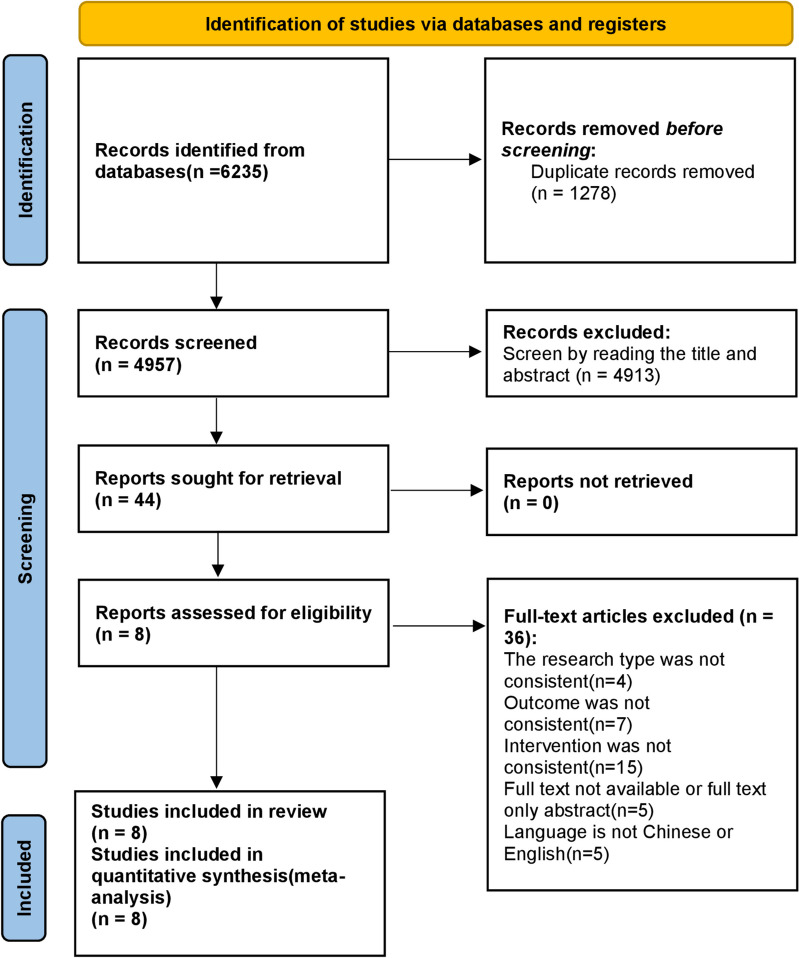
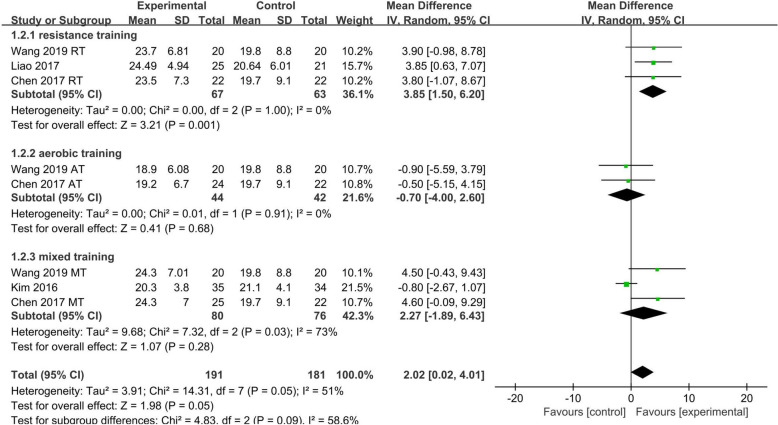
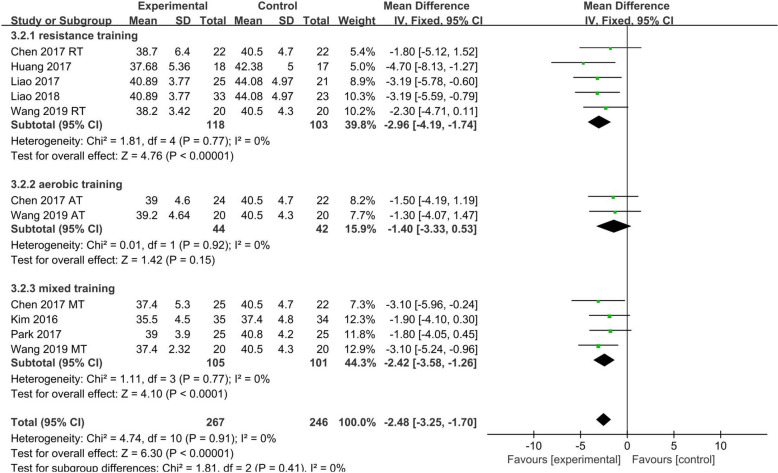
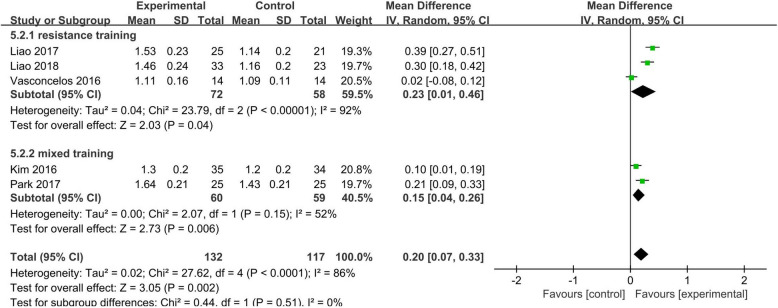
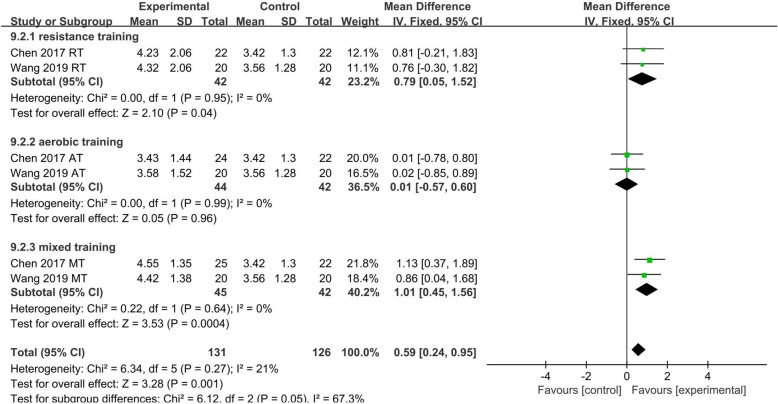
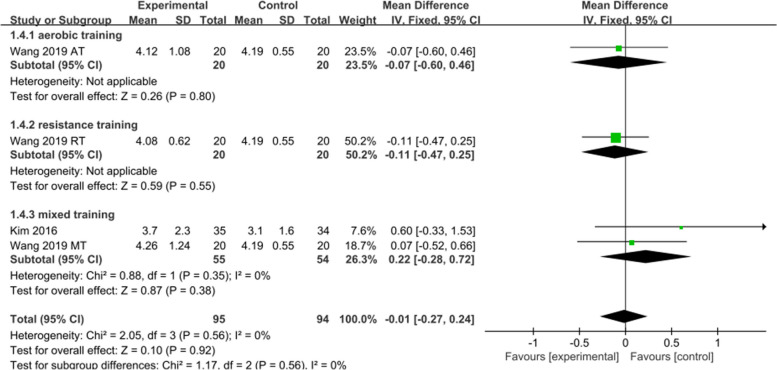
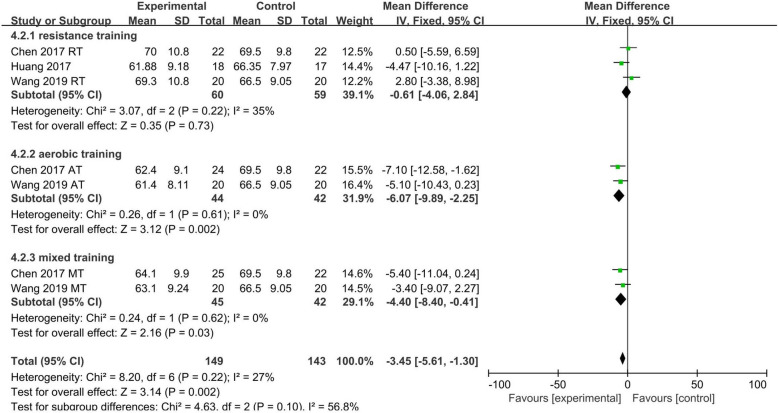
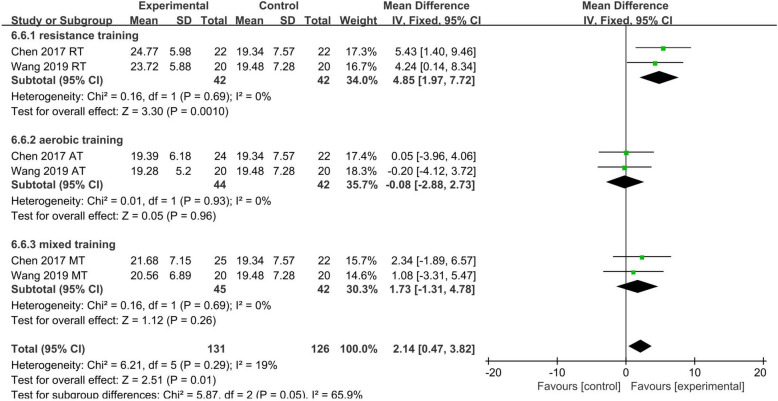
AIM: Assessing the effect of various forms of exercise training on patients with sarcopenic obesity. METHODS: Two independent reviewers systematically searched English and Chinese databases (PubMed, Embase, Cochrane Library, Web of Science, CNKI) for randomized controlled trials on various exercise training effects in sarcopenic obesity patients until October 2023. Reference materials and grey literature were also included. Selected studies underwent screening, data extraction, and quality assessment. Meta-analysis was conducted using Review Manager 5.4 software. RESULTS: A total of 8 studies were included in the final analysis. The Meta-analysis results indicated that resistance training (RT) significantly improved grip strength (MD = 3.85, 95%CI: 1.50 to 6.20, P < 0.01), percentage of body fat (MD = -2.96, 95%CI: -4.19 to -1.74, P < 0.01), walking speed (MD = 0.23, 95%CI: 0.01 to 0.46, P = 0.04), IGF-1(MD = 0.79, 95%CI: 0.05 to 1.52, P = 0.04) and knee extension strength (MD = 4.85, 95%CI: 1.97 to 7.72, P < 0.01). There was no statistically significant difference observed in weight (MD = -0.61, 95%CI: -4.06 to 2.84, P = 0.73). Aerobic training (AT) resulted in a significant reduction in weight among patients with SO (MD = -6.07, 95%CI: -9.89 to -2.25, P < 0.01), while no statistically significant differences were observed in other outcome measures. Mixed training (MT) significantly improved percentage of body fat (MD = -2.42, 95%CI: -3.58 to -1.26, P < 0.01), weight (MD = -4.40, 95%CI: -8.40 to -0.40, P = 0.03), IGF-1 (MD = 1.01, 95%CI: 0.45 to 1.56, P < 0.01), and walking speed (MD = 0.15, 95%CI: 0.04 to 0.26, P < 0.01). However, no statistically significant differences were observed in grip strength (MD = -0.70, 95%CI: -4.00 to 2.60, P = 0.68) and knee extension strength (MD = 1.73, 95%CI: -1.31 to 4.78, P = 0.26). RT, AT, and MT exercise could not significantly improve the level of serum IL-6 in patients with SO, and the difference was not statistically significant [MD = -0.01,95%CI:-0.27 to 0.24, P = 0.92]. CONCLUSION: Various exercise training methods have differing effects on muscle-reducing obesity treatment. Compared to aerobic training, resistance training, and mixed training may offer more pronounced improvements, enhancing physical functioning in sarcopenic obesity patients. This underscores the clinical significance of exercise intervention in treating muscle-reducing obesity, suggesting future studies explore exercise intervention's role and mechanism, particularly related to IGF-1, IL-6, and other cytokines.
Overview
The claims and statistics of this paper haven’t been checked yet.
Free: it reads the open-access text and checks the first 5 claims that cite a source we can check. Create a free account to check every claim.
Integrity signals
Registry
Cites
Statistics
Figures
Verification
Claims the paper makes
The claims and statistics of this paper haven’t been checked yet.
Free: it reads the open-access text and checks the first 5 claims that cite a source we can check. Create a free account to check every claim.
Claims other papers make about this one
Each is checked against this paper’s own text: does it say what the citing paper says it does?
The source backs part of the claim, not all of it — or backs it for a different population, condition or comparison.
In the citing paper
“MD + 0.20 m/s for walking speed in Chen et al. (18)”
From Exercise-based interventions for sarcopenic obesity in middle-aged and older adults: an umbrella review of systematic reviews with pairwise meta-analyses and network meta-analyses (2026) · cites this paper as [18]
Experimental — accuracy not yet measuredThe cited source says what the claim attributes to it.
In the citing paper
“MD + 3.85 kg for resistance training in Chen et al. (18)”
The cited source says what the claim attributes to it.
In the citing paper
“Chen et al. (18) reported weight reduction for any exercise and for aerobic and mixed training subgroups”
The cited source says what the claim attributes to it.
In the citing paper
“Zhuang et al. (17) and Chen et al. (18) reported favorable IGF-1 findings”
The cited source says what the claim attributes to it.
In the citing paper
“Chen et al. (18) reported no clear IL-6 effect”
Self-check
Percentages, sums and reported differences re-computed from the paper’s own numbers.
The self-check needs the paper’s full text.
Citations
Cites
The PRISMA 2020 statement: An updated guideline for reporting systematic reviews
Page, M. J., McKenzie, J. E., Bossuyt, P. M., Boutron, I., Hoffmann, T. C., Mulrow, C. D., Shamseer, L., Tetzlaff, J. M., Akl, E. A., Brennan, S. E., et al. (2021) · BMJ · doi:10.1136/bmj.n71 · Cited by 108,283
Cumpston, M., Li, T., Page, M. J., Chandler, J., Welch, V. A., Higgins, J. P., & Thomas, J. (2019) · Cochrane Database of Systematic Reviews · doi:10.1002/14651858.ed000142 · Cited by 7,218 · cited 1×
“Two researchers will independently conduct a quality assessment of the included literature using the tool recommended in the Cochrane Handbook for Systematic Reviews of Interventions (Version 5.1.0) for evaluating randomized controlled trials (RCTs) [17].”
InfluentialMuscle as an Endocrine Organ: Focus on Muscle-Derived Interleukin-6
Pedersen, B. K., & Febbraio, M. A. (2008) · Physiological Reviews · doi:10.1152/physrev.90100.2007 · Cited by 2,388 · cited 1×
“Furthermore, IL-6 can induce hepatic glucose release, and stimulate the secretion of glucagon-like peptide in the intestine and pancreas, thereby increasing insulin secretion [43, 44].”
Sarcopenic obesity in older adults: aetiology, epidemiology and treatment strategies
Batsis, J. A., & Villareal, D. T. (2018) · Nature Reviews Endocrinology · doi:10.1038/s41574-018-0062-9 · Cited by 1,382
Body Composition in Healthy Aging
BAUMGARTNER, R. N. (2000) · Annals of the New York Academy of Sciences · doi:10.1111/j.1749-6632.2000.tb06498.x · Cited by 1,078 · cited 1×
“Sarcopenic obesity (SO) was introduced in 2000, defined as an age-related condition characterized by reduced skeletal muscle mass or strength, muscle dysfunction, and concurrent obesity, forming a geriatric syndrome [1, 2].”
Definition and Diagnostic Criteria for Sarcopenic Obesity: ESPEN and EASO Consensus Statement
Donini, L. M., Busetto, L., Bischoff, S. C., Cederholm, T., Ballesteros-Pomar, M. D., Batsis, J. A., Bauer, J. M., Boirie, Y., Cruz-Jentoft, A. J., Dicker, D., et al. (2022) · Obesity Facts · doi:10.1159/000521241 · Cited by 1,019 · cited 2×
“Inclusion criteria: ① Studies involving subjects meeting the latest diagnostic criteria for SO as proposed by ESPEN and EASO in 2022 [16]; ② Research of randomized controlled trials (RCTs); ③ Interventions: The experimental group receives exercise interventions, while the control group receives…”
Ellingsgaard, H., Hauselmann, I., Schuler, B., Habib, A. M., Baggio, L. L., Meier, D. T., Eppler, E., Bouzakri, K., Wueest, S., Muller, Y. D., et al. (2011) · Nature Medicine · doi:10.1038/nm.2513 · Cited by 922 · cited 1×
“Furthermore, IL-6 can induce hepatic glucose release, and stimulate the secretion of glucagon-like peptide in the intestine and pancreas, thereby increasing insulin secretion [43, 44].”
Carey, A. L., Steinberg, G. R., Macaulay, S. L., Thomas, W. G., Holmes, A. G., Ramm, G., Prelovsek, O., Hohnen-Behrens, C., Watt, M. J., James, D. E., et al. (2006) · Diabetes · doi:10.2337/db05-1404 · Cited by 898 · cited 1×
“During aerobic exercise, upon binding with its corresponding receptor, IL-6 activates the Erk/MAPK, PI3K, Akt, and AMPK signaling pathways, consequently increasing glucose uptake and fatty acid oxidation, and influencing mitochondrial coupling rates [41, 42].”
Mann, S., Beedie, C., & Jimenez, A. (2014) · Sports Medicine · doi:10.1007/s40279-013-0110-5 · Cited by 801 · cited 1×
“This disparity might impact outcomes, as higher-intensity exercise, shown in studies by Mann et al. [31] might yield more benefits than moderate-intensity exercises like those in studies by Chen, Wang et al. [20, 25].”
Wilson, J. M., Marin, P. J., Rhea, M. R., Wilson, S. M., Loenneke, J. P., & Anderson, J. C. (2012) · Journal of Strength and Conditioning Research · doi:10.1519/jsc.0b013e31823a3e2d · Cited by 587 · cited 1×
“When both methods are used together, there might be interference, potentially affecting patients’ grip strength [37].”
Research works printed but not linked: 2
- Wang LZ, Guo YB, Lou JH. Effects of home exercise on sarcopenia obesity for aging people. Chin J Rehabil Theory Pract. 2019;25:90–6.
- Qin JJ, Wang M, Sun LK, Le X, Huang LL, Xu JQ. Research status of non-pharmacological interventions for sarcopenic obesity in the elderly. Chin Evid Based Nurs. 2023;9:1966–9.
Cited by
Sarcopenic obesity and weight loss-induced muscle mass loss
Caturano, A., Amaro, A., Berra, C., & Conte, C. (2025) · Current Opinion in Clinical Nutrition & Metabolic Care · doi:10.1097/mco.0000000000001131 · Cited by 75
“Low physical activity levels are a major risk factor for sarcopenia, whereas higher physical activity levels are associated with a & reduced risk of sarco-penic obesity [68,81,97,98 ].”
Yang, Y. S., Pan, N., Luo, J., Liu, Y., & Ossowski, Z. M. (2025) · Nutrients · doi:10.3390/nu17142342 · Cited by 42
Xu, S., Tu, S., Hao, X., Chen, X., Pan, D., Liao, W., Wu, R., Yang, L., Xia, H., Wang, S., et al. (2025) · Nutrients · doi:10.3390/nu17091504 · Cited by 26
Ru, Q., Xu, C., Wan, C., Cheng, B., Xiang, X., Fang, L., Ren, J., Chen, L., & Wu, Y. (2026) · International Journal of Molecular Sciences · doi:10.3390/ijms27031187 · Cited by 185
“Exercise is a well-established effective intervention for sarcopenic obesity [16,17], and multiple meta-analyses have demonstrated that moderate physical exercise increases muscle strength and muscle mass while decreasing fat mass [18–20].”
Self-citationMetabolic Dysfunction-Associated Steatotic Liver Disease and Sarcopenia: Review of Literature
Nishikawa, H., Kim, S. K., Yoshio, S., & ASAI, A. (2026) · Journal of Clinical Medicine · doi:10.3390/jcm15041661 · Cited by 7
“In a condition called “sarcopenic obesity,” where both obesity and sarcopenia are present, achieving two conflicting goals (i.e., reducing weight and maintaining muscle mass) is considered an important factor in improving prognosis [86].”
Hernández-Martínez, J., Vásquez-Carrasco, E., Cid-Calfucura, I., Sandoval, C., Herrera-Valenzuela, T., Núñez-Espinosa, C. A., Branco, B. H. M., & Valdés-Badilla, P. A. (2025) · Medicina · doi:10.3390/medicina61091697 · Cited by 6
“…indicating that training duration and cumulative volume are critical factors for eliciting favorable changes in body composition, particularly in adults with sarcopenic obesity [71], a population characterized by greater resistance to metabolic changes and attenuated anabolic responses [71].”
Álvarez‐Bustos, A., Aguiar, S. D. S., Gonçalves, I. D. O., Rodríguez-Sánchez, I., Marzetti, E., & Coelho‐Júnior, H. J. (2025) · Journal of Clinical Medicine · doi:10.3390/jcm14217839 · Cited by 6
Lingfang, H., Wang, Z., Hu, Z., Wang, D., & Luo, Y. (2026) · BMC Geriatrics · doi:10.1186/s12877-026-06973-2 · Cited by 4
“A systematic review has established that exercise is widely recognized as an effective intervention for SO, demonstrating significant improvements across various outcomes, including body composition, muscle strength, and physical function [13].”
Barak, S., Eldor, R., Dotan, I., Brown, R., Izkhakov, E., Greenman, Y., Prado, C. M., & Buch, A. (2026) · Frontiers in Medicine · doi:10.3389/fmed.2025.1747916 · Cited by 3
“Finally, combined aerobic and resistance training appears to provide superior benefits compared with aerobic training alone for improving physical function in individuals with SO (55).”
Deng, Y., Xu, L., Martín-Payo, R., Deng, K., Huang, L., Yang, Y., Xie, Z., Qiu, M., Li, C., & Zhang, F. (2026) · Frontiers in Public Health · doi:10.3389/fpubh.2026.1758325 · Cited by 1
Ma, X., Sun, G., Liu, C., Yan, X., Liang, W., & Ma, Z. (2026) · Frontiers in Nutrition · doi:10.3389/fnut.2026.1859967
“Chen et al. (18) and Wei et al. (22) were the only reviews that explicitly used an ESPEN/EASO-based framework, although Wei et al. (22) further restricted eligibility to Stage I, complication-free SO.”
Sarcopenic Obesity and Hormones: A Narrative Review
Yu, D., & Zhou, B. (2025) · Journal of Biosciences and Medicines · doi:10.4236/jbm.2025.1312003 · Cited by 1
Unseen and untreated: implementing sarcopenic obesity care in Nordic general practice
Baygi, F., Haastrup, P., Buhl, S. F., Nielsen, J. B., Suetta, C., Rathleff, M. S., & Søndergaard, J. (2026) · Frontiers in Aging · doi:10.3389/fragi.2026.1815247 · Cited by 1
“Sarcopenic obesity (SO) is a clinical condition characterized by the coexistence of excess adiposity and sarcopenia, defined by low muscle mass and strength (Chen et al., 2025).”
Lin, J., Zhu, Z., & Zhang, Y. (2026) · Medicine · doi:10.1097/md.0000000000049003
“Although physical activity has been shown to ameliorate both sarcopenia and obesity in individuals with SO, [12,13] the dose–response relationship between physical activity intensity and SO remains unclear.”
Barotsis, N., Oral, A., Kiekens, C., Négrini, S., Michail, X., Christodoulou, N., Dinçer, F., Quittan, M., Branco, C. A., & Zampolini, M. (2026) · European Journal of Physical and Rehabilitation Medicine · doi:10.23736/s1973-9087.26.09224-5
Campos, J. F. (2025) · RIUFLO - Repositorio Institucional UFLO
Metadata
- Authors
- Chen, L., Zhou, H., Gong, Y., Tang, Y., Su, H., Zhang, Z., Tong, P., & Chen, G.
- Affiliations
- Zhejiang Chinese Medical University (CN)
- Corresponding author
- Tong, Peijian
- Chen, Guoqian
- Venue
- BMC Geriatrics
- Published
- 2025-01-15
- Volume
- 25
- Issue
- 1
- Pages
- 33-33
- ISSN
- 1471-2318 (ISSN-L)
- PMC
- PMC11734427
- OpenAlex
- W4406401244
- Cited by
- 15
- References
- 48
- Citations by year
- 2026: 9 · 2025: 6
- FWCI
- 1.96
- Type
- journal article
- Language
- en
- Open access
- gold
- doi.org
- Licence
- cc-by-nc-nd
- creativecommons.org/licenses/by-nc-nd/4.0 (tdm)
- creativecommons.org/licenses/by-nc-nd/4.0 (vor)
- Locations
- BMC Geriatrics (publishedVersion, cc-by-nc-nd)
- PubMed Central (publishedVersion, cc-by-nc-nd)
- PubMed (publishedVersion)
- DOAJ (DOAJ: Directory of Open Access Journals) (submittedVersion, cc-by-sa)
- Funders
- National Natural Science Foundation of China (82274547)
- Natural Science Foundation of Zhejiang Province (LD22C060002)
- Topics
- Health Sciences › Medicine › Physiology (medical) › Nutrition and Health in Aging
- Life Sciences › Biochemistry, Genetics and Molecular Biology › Molecular Biology › Muscle Physiology and Disorders
- Health Sciences › Medicine › Physiology (medical) › Cardiovascular and exercise physiology
- Keywords
- sarcopenic obesity, exercise training, resistance training, aerobic exercise, mixed training, grip strength, body fat percentage, insulin-like growth factor I, quadriceps strength, walking speed, weight loss, clinical outcomes
- MeSH terms
- Aged, Exercise Therapy, Humans, Obesity, Exercise, Randomized Controlled Trials as Topic, Treatment Outcome, Hand Strength, Muscle Strength, Resistance Training, Sarcopenia
About these checks
Registry, retraction, Cites and statistics results are computed, not judged, with one exception: a printed reference that no index lists is read once by a model before it counts as a citation error. Claims are extracted by a model and kept only when their quote appears verbatim in the text; each cited source is then checked, with a model’s help, for whether it says what the claim relies on. Those verdicts can be wrong — read the claim’s quote and the cited source before relying on one.
Statistics and arithmetic are recomputed, not judged.
Confidence bands are shown only for fields calibrated on our annotated test set. None is calibrated yet, so no band is shown.
What counts as a claim ›How we measure confidence ›How we check this ›
Are you an author, or do you see a problem with this page? Request a review
Data sources
Bibliographic data: Semantic Scholar, OpenAlex, Crossref.
Contains information from the Semantic Scholar Academic Graph Datasets, made available under the ODC Attribution License (ODC-BY 1.0).
Semantic Scholar’s data is described in: Kinney, R., et al. (2023). The Semantic Scholar Open Data Platform. arXiv:2301.10140.
