

Incidence and characteristics of invasive fungal diseases in allogeneic hematopoietic stem cell transplant recipients: a retrospective cohort study
Open accessThe DOI matches its Crossref record; 29 of the 29 references it cites were found in a registry or an index.
Abstract
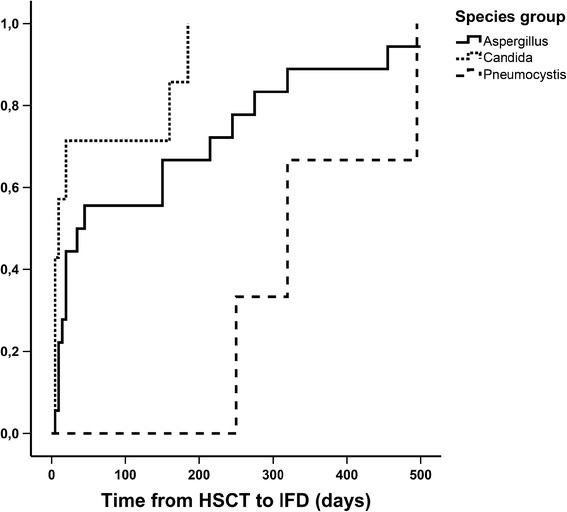
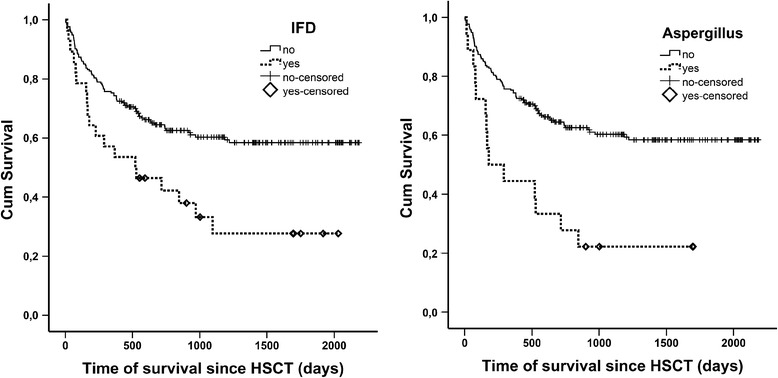
BACKGROUND: Allogeneic hematopoietic stem cell transplant (HSCT) recipients experience an increased risk for invasive fungal diseases (IFDs). METHODS: This retrospective cohort study at the Medical University of Vienna aspired to assess the incidence, characteristics and the outcome of IFDs as well as the associated risk factors in a setting where only 43 % of patients were given systemic antifungal prophylaxis during aplasia. IFDs were classified as probable or proven according to the EORTC/MSG consensus group. All adult patients (n = 242) receiving an allogeneic HSCT at the University Hospital of Vienna from January 2009 to December 2013 were enrolled. RESULTS: The primary outcome of this study was the one-year incidence for IFDs after HSCT, which was 10.3 % (25/242). Overall 28 patients experienced an IFD - 20 probable and 8 proven - with invasive aspergillosis being the predominant IFD (n = 18), followed by invasive candidiasis (n = 7) and pneumocystis pneumonia (n = 3). Patients with an IFD were more likely to be admitted to an intensive care unit (64 % versus 12 %, p < 0.0001) and had a significantly higher mortality in the first year after HSCT (48 % versus 25 %, p = 0.02). Multivariate regression analysis revealed that intensified immunosuppressive therapy (high-dose cortisone and basiliximab or etanercept) because of severe graft-versus-host disease (adjusted odds ratio (AOR) 3.6, p = 0.01) and transplant-associated microangiopathy (AOR 3.7, p = 0.04) were associated with an increased risk for IFD, while antifungal prophylaxis given during aplasia and post-engraftment was associated with a decreased risk (AOR 0.3, p = 0.02). CONCLUSIONS: We documented a one-year incidence for IFDs of 10.3 % and no selection of rare pathogens at a centre with moderate use of antifungal prophylaxis. Intensified immunosuppressive therapy and transplant-associated microangiopathy were significant risk factors for IFDs.
Overview
The claims and statistics of this paper haven’t been checked yet.
Free: it reads the open-access text and checks the first 5 claims that cite a source we can check. Create a free account to check every claim.
Integrity signals
Registry
Cites
Statistics
Figures
Verification
Claims the paper makes
The claims and statistics of this paper haven’t been checked yet.
Free: it reads the open-access text and checks the first 5 claims that cite a source we can check. Create a free account to check every claim.
Claims other papers make about this one
Each is checked against this paper’s own text: does it say what the citing paper says it does?
The cited source says what the claim attributes to it.
In the citing paper
“Recent large epidemiological studies in several European countries confirm the predominance of IPA over other IFIs in patients with leukemia and HSCT transplantation (56–59, 69–71).”
From Aspergillus fumigatus and Aspergillosis in 2019 (2019) · cites this paper as [70]
In the citing paper
“These studies also reveal that IPA is the most common invasive fungal infection (IFI) in HSCT and in solid-organ transplant recipients (43% and 59% of all IFIs, respectively), with a 12-month cumulative incidence of 1.6%.”
From Aspergillus fumigatus and Aspergillosis in 2019 (2019) · cites this paper as [70]
Self-check
Percentages, sums and reported differences re-computed from the paper’s own numbers.
The self-check needs the paper’s full text.
Citations
Cites
Jagasia, M. H., Greinix, H. T., Arora, M., Williams, K. M., Wolff, D., Cowen, E. W., Palmer, J., Weisdorf, D., Treister, N. S., Cheng, G.-S., et al. (2015) · Biology of Blood and Marrow Transplantation · doi:10.1016/j.bbmt.2014.12.001 · Cited by 5,459
Self-citationDe Pauw, B., Walsh, T. J., Donnelly, J. P., Stevens, D. A., Edwards, J. E., Calandra, T., Pappas, P. G., Maertens, J., Lortholary, O., Kauffman, C. A., et al. (2008) · Clinical Infectious Diseases · doi:10.1086/588660 · Cited by 4,917 · cited 2×
“IFDs were classified as probable or proven according to the revised definitions of the EORTC/MSG consensus group [9].”
BackgroundMethodFilipovich, A. H., Weisdorf, D., Pavletic, S., Socie, G., Wingard, J. R., Lee, S. J., Martin, P., Chien, J., Przepiorka, D., Couriel, D., et al. (2005) · Biology of Blood and Marrow Transplantation · doi:10.1016/j.bbmt.2005.09.004 · Cited by 3,556
Kontoyiannis, D. P., Marr, K. A., Park, B. J., Alexander, B. D., Anaissie, E. J., Walsh, T. J., Ito, J., Andes, D. R., Baddley, J. W., Brown, J. M., et al. (2010) · Clinical Infectious Diseases · doi:10.1086/651263 · Cited by 1,456
Posaconazole or Fluconazole for Prophylaxis in Severe Graft-versus-Host Disease
Ullmann, A. J., Lipton, J. H., Vesole, D. H., Chandrasekar, P., Langston, A., Tarantolo, S. R., Greinix, H., Morais de Azevedo, W., Reddy, V., Boparai, N., et al. (2007) · New England Journal of Medicine · doi:10.1056/nejmoa061098 · Cited by 1,345
Self-citationGoodman, J. L., Winston, D. J., Greenfield, R. A., Chandrasekar, P. H., Fox, B., Kaizer, H., Shadduck, R. K., Shea, T. C., Stiff, P., Friedman, D. J., et al. (1992) · New England Journal of Medicine · doi:10.1056/nejm199203263261301 · Cited by 1,174
Slavin, M. A., Osborne, B., Adams, R., Levenstein, M. J., Schoch, H. G., Feldman, A. R., Meyers, J. D., & Bowden, R. A. (1995) · Journal of Infectious Diseases · doi:10.1093/infdis/171.6.1545 · Cited by 820
Neofytos, D., Horn, D., Anaissie, E., Steinbach, W., Olyaei, A., Fishman, J., Pfaller, M., Chang, C., Webster, K., & Marr, K. (2009) · Clinical Infectious Diseases · doi:10.1086/595846 · Cited by 801 · cited 2×
“Invasive fungal diseases (IFDs) still cause a considerably high mortality among these patients [3], despite the development of new antifungal agents for prophylaxis and treatment [4–7].”
Backgroundvan Burik, J.-A. H., Ratanatharathorn, V., Stepan, D. E., Miller, C. B., Lipton, J. H., Vesole, D. H., Bunin, N., Wall, D. A., Hiemenz, J. W., Satoi, Y., et al. (2004) · Clinical Infectious Diseases · doi:10.1086/422312 · Cited by 744
Maertens, J., Marchetti, O., Herbrecht, R., Cornely, O. A., Flückiger, U., Frêre, P., Gachot, B., Heinz, W. J., Lass-Flörl, C., Ribaud, P., et al. (2011) · Bone Marrow Transplantation · doi:10.1038/bmt.2010.175 · Cited by 470
Cited by
Aspergillus fumigatus and Aspergillosis in 2019
Latgé, J.-P., & Chamilos, G. (2019) · Clinical Microbiology Reviews · doi:10.1128/cmr.00140-18 · Cited by 1,400
Barber, A. E., Sae-Ong, T., Kang, K., Seelbinder, B., Li, J., Walther, G., Panagiotou, G., & Kurzai, O. (2021) · Nature Microbiology · doi:10.1038/s41564-021-00993-x · Cited by 129
Seif, M., Kakoschke, T. K., Ebel, F., Bellet, M. M., Trinks, N., Renga, G., Pariano, M., Romani, L. R., Tappe, B., Espie, D., et al. (2022) · Science Translational Medicine · doi:10.1126/scitranslmed.abh1209 · Cited by 123
Rosenthal, J. (2016) · Journal of Blood Medicine · doi:10.2147/jbm.s102235 · Cited by 79
Reichert‐Lima, F., Lyra, L., Pontes, L., Moretti, M. L., Pham, C. D., Lockhart, S. R., & Schreiber, A. Z. (2018) · Mycoses · doi:10.1111/myc.12759 · Cited by 78
Metadata
- Authors
- Harrison, N., Mitterbauer, M., Tobudic, S., Kalhs, P., Rabitsch, W., Greinix, H., Burgmann, H., Willinger, B., Presterl, E., & Forstner, C.
- Affiliations
- Medical University of Vienna (AT)
- Medical University of Graz (AT)
- Jena University Hospital (DE)
- Corresponding author
- Forstner, Christina
- ORCID
- Venue
- BMC Infectious Diseases
- Published
- 2015-12
- Volume
- 15
- Issue
- 1
- Pages
- 584-584
- ISSN
- 1471-2334 (ISSN-L)
- PMC
- PMC4696168
- OpenAlex
- W2213628597
- Cited by
- 73
- References
- 29
- Citations by year
- 2025: 5 · 2024: 7 · 2023: 8 · 2022: 7 · 2021: 10 · 2020: 6 · 2019: 8 · 2018: 6 · 2017: 11 · 2016: 5
- FWCI
- 5.70
- Type
- journal article
- Language
- en
- Open access
- gold
- doi.org
- Licence
- cc-by
- Locations
- BMC Infectious Diseases (publishedVersion, cc-by)
- Europe PMC (PubMed Central) (publishedVersion, cc-by)
- PubMed Central (publishedVersion, cc-by)
- PubMed (publishedVersion)
- Funders
- No funding
- Topics
- Health Sciences › Medicine › Infectious Diseases › Antifungal resistance and susceptibility
- Health Sciences › Medicine › Oncology › Neutropenia and Cancer Infections
- Health Sciences › Medicine › Hematology › Hematopoietic Stem Cell Transplantation
- Keywords
- invasive fungal infections, allogeneic hematopoietic stem cell transplantation, invasive aspergillosis, invasive candidiasis, Pneumocystis carinii pneumonia, antifungal prophylaxis, graft-versus-host disease, immunosuppressive therapy, risk factors, mortality, incidence
- MeSH terms
- Adult, Aged, Antifungal Agents, Aspergillosis, Austria, Female, Graft vs Host Disease, Humans, Immunosuppressive Agents, Male, Middle Aged, Mycoses, Pneumonia, Pneumocystis, Retrospective Studies, Risk Factors, Transplantation, Homologous, Cohort Studies, Incidence, Hematopoietic Stem Cell Transplantation, Candidiasis, Invasive
About these checks
Registry, retraction, Cites and statistics results are computed, not judged, with one exception: a printed reference that no index lists is read once by a model before it counts as a citation error. Claims are extracted by a model and kept only when their quote appears verbatim in the text; each cited source is then checked, with a model’s help, for whether it says what the claim relies on. Those verdicts can be wrong — read the claim’s quote and the cited source before relying on one.
Statistics and arithmetic are recomputed, not judged.
Confidence bands are shown only for fields calibrated on our annotated test set. None is calibrated yet, so no band is shown.
What counts as a claim ›How we measure confidence ›How we check this ›
Are you an author, or do you see a problem with this page? Request a review
How to cite
Cite CoChat for the checks on this page, and the paper for its own findings.
- This page
- CoChat. (2026). Citation check: Incidence and characteristics of invasive fungal diseases in allogeneic hematopoietic stem cell transplant recipients: a retrospective cohort study. https://app.cochat.ai/papers/10.1186/s12879-015-1329-6
- The paper
- Harrison, N., Mitterbauer, M., Tobudic, S., Kalhs, P., Rabitsch, W., Greinix, H., Burgmann, H., Willinger, B., Presterl, E., & Forstner, C. (2015). Incidence and characteristics of invasive fungal diseases in allogeneic hematopoietic stem cell transplant recipients: a retrospective cohort study. BMC Infectious Diseases. https://doi.org/10.1186/s12879-015-1329-6
Data sources
Bibliographic data: Semantic Scholar, OpenAlex, Crossref.
Contains information from the Semantic Scholar Academic Graph Datasets, made available under the ODC Attribution License (ODC-BY 1.0).
Semantic Scholar’s data is described in: Kinney, R., et al. (2023). The Semantic Scholar Open Data Platform. arXiv:2301.10140.
