

The DOI matches its Crossref record; 47 of the 47 references it cites were found in a registry or an index.
Identification of uncommon oral yeasts from cancer patients by MALDI-TOF mass spectrometry
Open accessAbstract
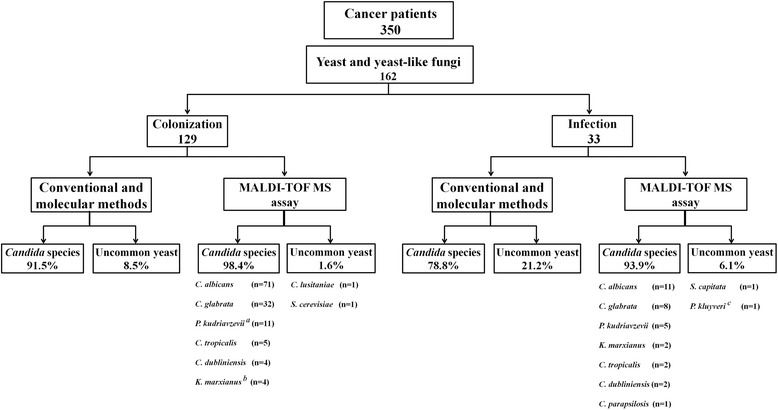
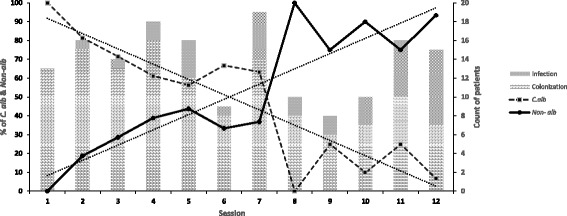
BACKGROUND: Opportunistic infections due to Candida species occur frequently in cancer patients because of their inherent immunosuppression. The aim of the present study was to investigate the epidemiology of yeast species from the oral cavity of patients during treatment for oncological and haematological malignancies. METHODS: MALDI-TOF was performed to identify yeasts isolated from the oral cavity of 350 cancer patients. Moreover, antifungal susceptibility testing was performed in according to CLSI guidelines (M27-A3). RESULTS: Among 162 yeasts and yeast-like fungi isolated from the oral cavity of cancer patients, Candida albicans was the most common species (50.6%), followed by Candida glabrata (24.7%), Pichia kudriavzevii (Candida krusei (9.9%)), Candida tropicalis (4.3%), Candida dubliniensis (3.7%), Kluyveromyces marxianus (Candida kefyr (3.7%)) and Candida parapsilosis (1%). In addition, uncommon yeast species i.e., Saprochaete capitata, Saccharomyces cerevisiae, Clavispora lusitaniae (C. lusitaniae) and Pichia kluyveri (C. eremophila) were recovered from oral lesions. Oral colonization by C. albicans, non-albicans Candida species and uncommon yeasts were as follow; 55%, 44% and 1%, whereas oral infection due to C. albicans was 33.3%, non-albicans Candida species 60.6%, and uncommon yeasts 6.1%. Poor oral hygiene and xerostomia were identified as independent risk factors associated with oral yeast colonization. The overall resistance to fluconazole was 11.7% (19/162). Low MIC values were observed for anidulafungin for all Candida and uncommon yeast species. CONCLUSIONS: This current study provides insight into the prevalence and susceptibility profiles of Candida species, including emerging Candida species and uncommon yeasts, isolated from the oral cavity of Iranian cancer patients. The incidence of oral candidiasis was higher amongst patients with hematological malignancies. The majority of oral infections were caused by non-albicans Candida species which were often more resistant to anti-fungal agents. Our findings suggest that anidulafungin should be used as antifungal of choice for prophylaxis in clinically high-risk patients with documented oral colonization or infection.
Overview
The claims and statistics of this paper haven’t been checked yet.
Run the check — free, no account needed. It reads the open-access text and checks the sources it cites.
Integrity signals
Registry
Cites
Statistics
Figures
Verification
Claims the paper makes
The claims and statistics of this paper haven’t been checked yet.
Run the check — free, no account needed. It reads the open-access text and checks the sources it cites.
Claims other papers make about this one
Each is checked against this paper’s own text: does it say what the citing paper says it does?
The cited source says what the claim attributes to it.
In the citing paper
“All isolates were highly susceptible to anidulafungin except C. glabrata with 10% resistance.”
From Candida glabrata: pathogenicity and resistance mechanisms for adaptation and survival (2021) · cites this paper as [106]
In the citing paper
“Based on Aslani et al. [106] findings in the study conducted in Iran on echinocandins, 27.8% of the Candida isolates showed resistance to caspofungin.”
From Candida glabrata: pathogenicity and resistance mechanisms for adaptation and survival (2021) · cites this paper as [106]
Self-check
Percentages, sums and reported differences re-computed from the paper’s own numbers.
The self-check needs the paper’s full text.
Citations
Cites
Epidemiology of Invasive Candidiasis: a Persistent Public Health Problem
Pfaller, M. A., & Diekema, D. J. (2007) · Clinical Microbiology Reviews · doi:10.1128/cmr.00029-06 · Cited by 4,174 · cited 1×
“Background Worldwide the incidence of mild to severe fungal infections (FI) has dramatically increased in the last several decades, especially in patients infected with human immunodeficiency virus (HIV), those that prolongedly use broadspectrum antibiotics, patients undergoing hematopoietic stem cell transplantation…”
BackgroundCornely, O. A., Bassetti, M., Calandra, T., Garbino, J., Kullberg, B. J., Lortholary, O., Meersseman, W., Akova, M., Arendrup, M. C., Arikan-Akdagli, S., et al. (2012) · Clinical Microbiology and Infection · doi:10.1111/1469-0691.12039 · Cited by 1,217
Emerging opportunistic yeast infections
Miceli, M. H., Díaz, J. A., & Lee, S. A. (2011) · The Lancet Infectious Diseases · doi:10.1016/s1473-3099(10)70218-8 · Cited by 811
Interventions for treating oral mucositis for patients with cancer receiving treatment
Clarkson, J., Worthington, H. V., Furness, S., McCabe, M. G., Khalid, T., & Meyer, S. (2010) · Cochrane Database of Systematic Reviews · doi:10.1002/14651858.cd001973.pub4 · Cited by 702
Kathuria, S., Singh, P. K., Sharma, C., Prakash, A., Masih, A., Kumar, A., Meis, J. F. G. M., & Chowdhary, A. (2015) · Journal of Clinical Microbiology · doi:10.1128/jcm.00367-15 · Cited by 553
Self-citationMarklein, G., Josten, M., Klanke, U., Muller, E. E., Horré, R., Maier, T., Wenzel, T. J., Kostrzewa, M., Bierbaum, G., Hoerauf, A. M., et al. (2009) · Journal of Clinical Microbiology · doi:10.1128/jcm.00389-09 · Cited by 456
Ullmann, A. J., Akova, M., Herbrecht, R., Viscoli, C., Arendrup, M. C., Arikan-Akdagli, S., Bassetti, M., Bille, J., Calandra, T., Castagnola, E., et al. (2012) · Clinical Microbiology and Infection · doi:10.1111/1469-0691.12041 · Cited by 334
Tan, K. E., Ellis, B. C., Lee, R. T., Stamper, P. D., Zhang, S., & Carroll, K. C. (2012) · Journal of Clinical Microbiology · doi:10.1128/jcm.01405-12 · Cited by 326
Interventions for preventing oral mucositis for patients with cancer receiving treatment
Worthington, H. V., Clarkson, J., Bryan, G., Furness, S., Glenny, A., Littlewood, A., McCabe, M. G., Meyer, S., Khalid, T., & Riley, P. (2011) · Cochrane Database of Systematic Reviews · doi:10.1002/14651858.cd000978.pub5 · Cited by 265
Cendejas‐Bueno, E., Kolecka, A., Alastruey‐Izquierdo, A., Theelen, B., Groenewald, M., Kostrzewa, M., Cuenca‐Estrella, M., Gómez‐López, A., & Boekhout, T. (2012) · Journal of Clinical Microbiology · doi:10.1128/jcm.02248-12 · Cited by 234
Self-citation
Research works printed but not linked: 2
- CLSI. Reference method for broth dilution antifungal susceptibility testing of yeasts; approved standard-third edition, M27–A3. Wayne: CLSI; 2008.
- Clinical and Laboratory Standards Institute (CLSI). Reference method for broth dilution antifungal susceptibility testing of yeasts: fourth informational supplement M27-S4. Wayne: CLSI; 2012.
Cited by
Sorted by citations
Items 101–114 of 114
Avaliação de isolados clínicos e ambientais de Aspergillus spp.
Reichert‐Lima, F. (2018) · doi:10.47749/t/unicamp.2018.1061754 · Cited by 1
dos Santos, R. L. O., Ruiz, L. D. S., Auler, M. E., Chavasco, J. K., Moreira, D., Ramos, R. T. B., Lara, B. R., & Paula, C. R. (2020) · Revista de Patologia Tropical / Journal of Tropical Pathology · doi:10.5216/rpt.v49i2.63481
Kazancı, D., Kadir, T., & Ulucan, K. (2021) · European Journal of Research in Dentistry · doi:10.29228/erd.10
Mahmood, D. M., Osman, Y., Nidhamaddin, S., Ahmadissa, S., Rahim, A., Salih, M. A. H., & Hamasoor, T. (2022) · Egyptian Academic Journal of Biological Sciences. E, Medical Entomology and Parasitology · doi:10.21608/eajbse.2022.269215
Compostos naturais com ação inibitória contra Candida tropicalis e Candida glabrata:uma revisão
de Santana, A. C., de Castro, A. P., & de Paiva, M. C. (2022) · Brazilian Journal of Health and Pharmacy · doi:10.29327/226760.4.2-2
da Costa, P. C. T., Santos, T. L. B., Ramos, J. F., Santos, J. A. M., de Medeiros, F. D., Freitas, J. C. R., & de Oliveira, W. A. (2023) · Brazilian Journal of Pharmaceutical Sciences · doi:10.1590/s2175-97902023e22045
AL-DARRAJI, Z. D. G., & Mohammed-Ameen, M. K. (2023) · Biodiversitas Journal of Biological Diversity · doi:10.13057/biodiv/d240761
Infections Due to Non-Candidal Yeasts
Colombo, R. E., & Vázquez, J. A. (2023) · Springer eBooks · doi:10.1007/978-3-031-35803-6_10
Agbo-Godeau, S., & Guedj, A. (2023) · EMC - Otorrinolaringología · doi:10.1016/s1632-3475(23)48366-x
Mamytova, A. B., Бекташева, А. К., Садыбакасова, Г. К., Izaeva, T., & Tsoi, A. (2025) · Journal of international oral health · doi:10.4103/jioh.jioh_207_24
Mitra, S., Sharma, P., & Ganguly, K. (2025) · Cureus · doi:10.7759/cureus.87949
Metadata
- Authors
- Aslani, N., Janbabaei, G., Abastabar, M., Meis, J. F., Babaeian, M., Khodavaisy, S., Boekhout, T., & Badali, H.
- Affiliations
- Mazandaran University of Medical Sciences (IR)
- Radboud University Medical Center (NL)
- Tehran University of Medical Sciences (IR)
- Westerdijk Fungal Biodiversity Institute (NL)
- Corresponding author
- Badali, Hamid
- ORCID
- Venue
- BMC Infectious Diseases
- Published
- 2018-01-08
- Volume
- 18
- Issue
- 1
- Pages
- 24-24
- ISSN
- 1471-2334 (ISSN-L)
- PMC
- PMC5759378
- OpenAlex
- W2782643503
- Cited by
- 114
- References
- 47
- Citations by year
- 2026: 1 · 2025: 6 · 2024: 8 · 2023: 20 · 2022: 22 · 2021: 21 · 2020: 10 · 2019: 15 · 2018: 9
- FWCI
- 10.40
- Type
- journal article
- Language
- en
- Open access
- gold
- doi.org
- Licence
- cc-by
- Locations
- BMC Infectious Diseases (publishedVersion, cc-by)
- PubMed Central (publishedVersion, cc-by)
- PubMed (publishedVersion)
- KNAW Research Portal (The Royal Netherlands Academy of Arts and Sciences) (publishedVersion, other-oa)
- UvA-DARE (University of Amsterdam) (submittedVersion, cc-by)
- Data Archiving and Networked Services (DANS) (submittedVersion, other-oa)
- DOAJ (DOAJ: Directory of Open Access Journals) (submittedVersion, cc-by-sa)
- Radboud Repository (Radboud University) (submittedVersion)
- Radboud Repository (Radboud University) (submittedVersion, other-oa)
- Funders
- Mazandaran University of Medical Sciences (1298)
- Topics
- Health Sciences › Medicine › Infectious Diseases › Antifungal resistance and susceptibility
- Life Sciences › Immunology and Microbiology › Microbiology › Yeasts and Rust Fungi Studies
- Health Sciences › Medicine › Infectious Diseases › Fungal Infections and Studies
- Keywords
- oral candidiasis, oral yeasts, Candida species, non-albicans Candida, Candida glabrata, Candida albicans, antifungal susceptibility, fluconazole resistance, anidulafungin, hematologic malignancies, oral colonization, xerostomia, oral hygiene
- MeSH terms
- Adolescent, Adult, Aged, Aged, 80 and over, Antifungal Agents, Candida, Candidiasis, Oral, Saccharomycetales, Female, Humans, Male, Microbial Sensitivity Tests, Middle Aged, Mouth, Neoplasms, Pichia, Risk Factors, Xerostomia, Fluconazole, Prevalence, Spectrometry, Mass, Matrix-Assisted Laser Desorption-Ionization, Young Adult
About these checks
Registry, retraction, Cites and statistics results are computed, not judged, with one exception: a printed reference that no index lists is read once by a model before it counts as a citation error. Claims are extracted by a model and kept only when their quote appears verbatim in the text; each cited source is then checked, with a model’s help, for whether it says what the claim relies on. Those verdicts can be wrong — read the claim’s quote and the cited source before relying on one.
Statistics and arithmetic are recomputed, not judged.
Confidence bands are shown only for fields calibrated on our annotated test set. None is calibrated yet, so no band is shown.
What counts as a claim ›How we measure confidence ›How we check this ›
Are you an author, or do you see a problem with this page? Request a review
