

Use of a mobile application for Ebola contact tracing and monitoring in northern Sierra Leone: a proof-of-concept study
Open accessThe DOI matches its Crossref record; 22 of the 23 references it cites were found in a registry or an index.
Abstract
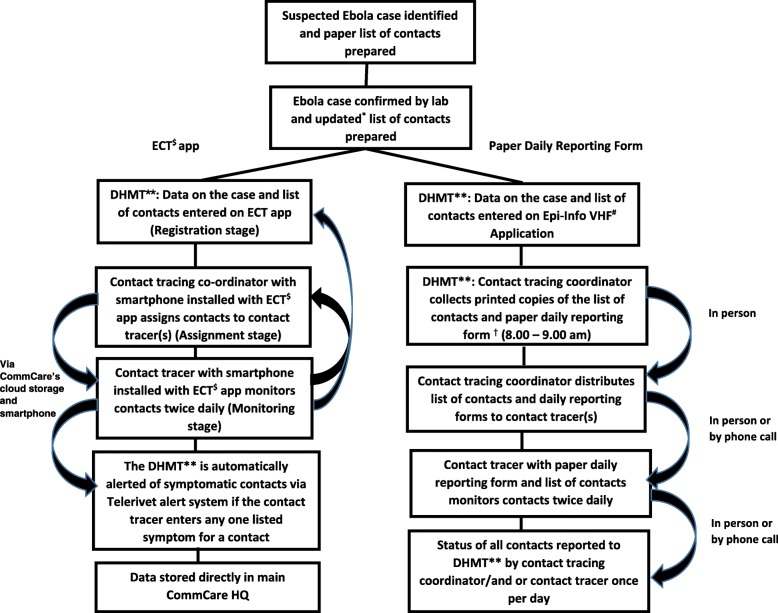
Background: The 2014–2016 Ebola epidemic in West Africa was the largest Ebola epidemic to date. Contact tracing was a core surveillance activity. Challenges with paper-based contact tracing systems include incomplete identification of contacts, delays in communication and response, loss of contact lists, inadequate data collection and transcription errors. The aim of this study was to design and evaluate an electronic system for tracing contacts of Ebola cases in Port Loko District, Sierra Leone, and to compare this with the existing paper-based system. The electronic system featured data capture using a smartphone application, linked to an alert system to notify the District Ebola Response Centre of symptomatic contacts. Methods: The intervention was a customised three-tier smartphone application developed using Dimagi’s CommCare platform known as the Ebola Contact Tracing application (ECT app). Eligible study participants were all 26 Contact Tracing Coordinators (CTCs) and 86 Contact Tracers (CTs) working in the 11 Chiefdoms of Port Loko District during the study period (April–August 2015). Case detection was from 13th April to 17th July 2015. The CTCs and their CTs were provided with smartphones installed with the ECT app which was used to conduct contact tracing activities. Completeness and timeliness of contact tracing using the app were compared with data from April 13th-June 7th 2015, when the standard paper-based system was used. Results: For 25 laboratory-confirmed cases for whom paper-based contact tracing was conducted, data for only 39% of 408 contacts were returned to the District, and data were often incomplete. For 16 cases for whom app-based contact tracing was conducted, 63% of 556 contacts were recorded as having been visited on the app, and the median recorded duration from case confirmation to first contact visit was 70 h. Conclusion: There were considerable challenges to conducting high-quality contact tracing in this setting using either the paper-based or the app-based system. However, the study demonstrated that it was possible to implement mobile health (mHealth) in this emergency setting. The app had the benefits of improved data completeness, storage and accuracy, but the challenges of using an app in this setting and epidemic context were substantial.
Overview
The claims and statistics of this paper haven’t been checked yet.
Free: it reads the open-access text and checks the first 5 claims that cite a source we can check. Create a free account to check every claim.
Integrity signals
Registry
Cites
Statistics
Figures
Verification
Claims the paper makes
The claims and statistics of this paper haven’t been checked yet.
Free: it reads the open-access text and checks the first 5 claims that cite a source we can check. Create a free account to check every claim.
Self-check
Percentages, sums and reported differences re-computed from the paper’s own numbers.
The self-check needs the paper’s full text.
Citations
Cites
Using thematic analysis in psychology
Braun, V., & Clarke, V. (2006) · Qualitative Research in Psychology · doi:10.1191/1478088706qp063oa · Cited by 194,414 · cited 2×
“A six-step approach was undertaken for the thematic analysis as described by Braun and Clarke (2006) [33].”
The emerging field of mobile health
Steinhubl, S. R., Muse, E. D., & Topol, E. J. (2015) · Science Translational Medicine · doi:10.1126/scitranslmed.aaa3487 · Cited by 822 · cited 1×
“Most studies of mHealth applications are small-scale or pilot implementation studies, with few rigorously designed evaluation studies [28 – 30].”
BackgroundScaling Up mHealth: Where Is the Evidence?
Tomlinson, M., Rotheram-Borus, M. J., Swartz, L., & Tsai, A. C. (2013) · PLoS Medicine · doi:10.1371/journal.pmed.1001382 · Cited by 673 · cited 1×
“Most studies of mHealth applications are small-scale or pilot implementation studies, with few rigorously designed evaluation studies [28 – 30].”
BackgroundAranda-Jan, C. B., Mohutsiwa-Dibe, N., & Loukanova, S. (2014) · BMC Public Health · doi:10.1186/1471-2458-14-188 · Cited by 644 · cited 1×
“…literacy, and to reduce time to collect data, distance travelled to collect and return information and the cost of information delivery [11, 12, 15, 16]. mHealth applications have been used for epidemic tracking of tuberculosis (TB) and Japanese encephalitis, but few mHealth applications have been…”
Labrique, A. B., Vasudevan, L., Kochi, E., Fabricant, R., & Mehl, G. (2013) · Global Health: Science and Practice · doi:10.9745/ghsp-d-13-00031 · Cited by 601 · cited 1×
“Previous studies comparing paper-based methods of data collection with electronic methods have tended to show the electronic method was superior [17, 35].”
ResultHall, C. S., Fottrell, E., Wilkinson, S., & Byass, P. (2014) · Global Health Action · doi:10.3402/gha.v7.25606 · Cited by 384
Mobile health use in low- and high-income countries: an overview of the peer-reviewed literature
Bastawrous, A., & Armstrong, M. J. (2013) · Journal of the Royal Society of Medicine · doi:10.1177/0141076812472620 · Cited by 236 · cited 1×
“…and literacy, and to reduce time to collect data, distance travelled to collect and return information and the cost of information delivery [11, 12, 15, 16]. mHealth applications have been used for epidemic tracking of tuberculosis (TB) and Japanese encephalitis, but few mHealth applications have…”
BackgroundFaye, O., Boëlle, P.-Y., Heleze, E., Faye, O., Loucoubar, C., Magassouba, N., Soropogui, B., Keita, S., Gakou, T., Bah, E. H. I., et al. (2015) · The Lancet Infectious Diseases · doi:10.1016/s1473-3099(14)71075-8 · Cited by 220 · cited 1×
“Previous epidemics have been controlled through contact tracing and isolation, which limits onward transmission [4].”
BackgroundInformation and communications for development 2012 : maximizing mobile
Kelly, T. B., Friederici, N., Minges, M., & Yamamichi, M. (2012) · Cited by 212
Introduction of Mobile Health Tools to Support Ebola Surveillance and Contact Tracing in Guinea
Sacks, J. A., Zehe, E., Redick, C., Bah, A., Cowger, K., Camara, M., Diallo, A., Gigo, A. N. I., Dhillon, R. S., & Liu, A. (2015) · Global Health: Science and Practice · doi:10.9745/ghsp-d-15-00207 · Cited by 142 · cited 4×
“This consisted of a smartphone application developed using the CommCare application for collecting and analysing contact tracing data in Guinea [10].”
BackgroundMethodInfluential
Research works printed but not linked: 1
- Vital Wave Consulting mHealth for development: the opportunity of mobile technology for healthcare in the developing world 2009 Washington D.C. and Berkshire UN Foundation - Vodaphone Foundation Partnership
Cited by
Diagnosing COVID-19: The Disease and Tools for Detection
Udugama, B., Kadhiresan, P., Kozlowski, H. N., Malekjahani, A., Osborne, M., Li, V. Y. C., Chen, H., Mubareka, S., Gubbay, J. B., & Chan, W. C. W. (2020) · ACS Nano · doi:10.1021/acsnano.0c02624 · Cited by 1,754
“89 Smartphones can digitize the process of contact tracing to provide more complete and shareable records.”
BackgroundBraithwaite, I., Callender, T., Bullock, M., & Aldridge, R. W. (2020) · The Lancet Digital Health · doi:10.1016/s2589-7500(20)30184-9 · Cited by 325
“36,40 One study reported that training contact tracers took 2–3 days 39 and another study stated that training took 3 days.”
InfluentialAgbehadji, I. E., Awuzie, B. O., Ngowi, A. B., & Millham, R. C. (2020) · International Journal of Environmental Research and Public Health · doi:10.3390/ijerph17155330 · Cited by 248
“The contact tracing method has been applied for disease outbreak detection such as tuberculosis [17], Ebola outbreak in 2014 [18], severe acute respiratory syndrome (SARS) outbreak in 2003 [19], Middle East respiratory syndrome (MERS) outbreak in 2012 in the Middle East Saudi Arabian Peninsula…”
MethodAnonymity Preserving IoT-Based COVID-19 and Other Infectious Disease Contact Tracing Model
Garg, L., Chukwu, E., Nasser, N., Chakraborty, C., & Garg, G. (2020) · IEEE Access · doi:10.1109/access.2020.3020513 · Cited by 223
“A similar system was used for Ebola contact tracing, and the proof-of-concept study found that despite many challenges, the use of the application was evaluated and found to improve completeness, accuracy, and storage of data [17].”
MethodTesting for COVID-19: A way to lift confinement restrictions
OECD (2020) · OECD policy responses to coronavirus (Covid-19) · doi:10.1787/89756248-en · Cited by 219
Digital contact tracing technologies in epidemics: a rapid review
Anglemyer, A., Moore, T. H., Parker, L., Chambers, T., Grady, A., Chiu, K., Parry, M., Wilczynska, M., Flemyng, E., & Bero, L. (2020) · Cochrane Database of Systematic Reviews · doi:10.1002/14651858.cd013699 · Cited by 202
“Other accessibility issues related to financial costs; contact training personnel in Sierra Leone were concerned at increased personal costs resulting from a need for them to travel and recharge phone batteries in the field using commercial tele-charging stations.”
BackgroundMethodInfluentialContact-tracing apps and alienation in the age of COVID-19
Rowe, F., Ngwenyama, O. K., & Richet, J. (2020) · European Journal of Information Systems · doi:10.1080/0960085x.2020.1803155 · Cited by 169
Osei, E., & Mashamba-Thompson, T. P. (2021) · Heliyon · doi:10.1016/j.heliyon.2021.e06639 · Cited by 166
The Use of Digital Health in the Detection and Management of COVID-19
Alwashmi, M. (2020) · International Journal of Environmental Research and Public Health · doi:10.3390/ijerph17082906 · Cited by 159
“Such methods caused incomplete identification of contacts and delays in contact tracing steps, such as the identification of contacts involved in suspected cases that required isolation [42].”
BackgroundKaspar, K. (2020) · Journal of Medical Internet Research · doi:10.2196/21613 · Cited by 138
“Importantly, the utility of mobile apps has already been examined in the context of previous epidemics, such as the Ebola epidemic in West Africa between 2014 and 2016 [13,14].”
BackgroundA Comprehensive Review of Detection Methods for SARS-CoV-2
Eftekhari, A., Alipour, M., Chodari, L., Dizaj, S. M., Ardalan, M., Samiei, M., Sharifi, S., Vahed, S. Z., Huseynova, I. M., Khalilov, R. I., et al. (2021) · Microorganisms · doi:10.3390/microorganisms9020232 · Cited by 135
“In the Ebola outbreak, smartphones were utilized as a contact tracing tool, facilitating tracking and identifying people in contact with the patient [71].”
MethodTackling COVID-19 through Responsible AI Innovation: Five Steps in the Right Direction
Leslie, D. (2020) · Harvard Data Science Review · doi:10.1162/99608f92.4bb9d7a7 · Cited by 94
Zimmerling, A., & Chen, D. (2021) · Technology in Society · doi:10.1016/j.techsoc.2021.101541 · Cited by 124
“Mobile phone data and big-data analysis have previously been used to predict the spread of infectious diseases such as Ebola and tuberculosis [93,94].”
BackgroundMethodKhan, J. I., Khan, J., Ali, F., Ullah, F., Bacha, J., & Lee, S. (2022) · IEEE Access · doi:10.1109/access.2022.3181605 · Cited by 117
“In this direction, [54] utilized a smartphone application, using Dimagi’s CommCare platform, known as the Ebola Contact Tracing applica-”
MethodPrivacy concerns and digital government: exploring citizen willingness to adopt the COVIDSafe app
Lin, J., Carter, L. D., & Liu, D. (2021) · European Journal of Information Systems · doi:10.1080/0960085x.2021.1920857 · Cited by 107
“Danquah et al. (2019) find that a contact tracing app is quicker and more accurate than a paper-based system.”
BackgroundAn overview of mobile applications (apps) to support the coronavirus disease 2019 response in India
Bassi, A., Arfin, S., John, O., & Jha, V. (2020) · The Indian Journal of Medical Research · doi:10.4103/ijmr.ijmr_1200_20 · Cited by 103
“The Ebola and Zika virus epidemics have shown the utility of mobile health (mHealth) applications (apps) for improving access to testing, contact tracing, supporting frontline healthcare workers, and raising public awareness 7-9 .”
BackgroundA First Look at Privacy Analysis of COVID-19 Contact-Tracing Mobile Applications
Azad, M. A., Arshad, J., Akmal, A., Riaz, F., Abdullah, S., Imran, M. A., & Ahmad, F. (2020) · IEEE Internet of Things Journal · doi:10.1109/jiot.2020.3024180 · Cited by 103
Kostkova, P., Saigí-Rubió, F., Eguia, H. A., Borbolla, D. A., Verschuuren, M., Hamilton, C., Muscat, N. A., & Novillo-Ortiz, D. (2021) · Frontiers in Digital Health · doi:10.3389/fdgth.2021.707902 · Cited by 101
“Due to the universal ownership of mobile devices with Bluetooth, these types of applications can be used all over the world, including low-connectivity and low-resource environments like rural Sierra Leone (43).”
BackgroundUser Concerns & Tradeoffs in Technology-facilitated COVID-19 Response
Redmiles, E. M. (2020) · Digital Government Research and Practice · doi:10.1145/3428093 · Cited by 93
Akintunde, T. Y., Akintunde, O. D., Musa, T. H., Muhideen, S., Tassang, A. E., Reed, L. M., & Chen, S. (2021) · Global Health Journal · doi:10.1016/j.glohj.2021.07.006 · Cited by 91
Lai, A., Tang, C. Q. Y., Kurup, A., & Thevendran, G. (2020) · International Orthopaedics · doi:10.1007/s00264-020-04646-2 · Cited by 89
“The idea of smartphone application for contact tracing was used in Sierra Leone during the 2014–2016 Ebola epidemic and demonstrated the potential to improve surveillance data via digital applications to collect and analyse contact tracing data [37].”
Mobile technology: A tool for healthcare and a boon in pandemic
Sharma, S., Kumari, B., Ali, A., Yadav, R. K., Sharma, A. K., Sharma, K. K., Hajela, K., & Singh, G. K. (2022) · Journal of Family Medicine and Primary Care · doi:10.4103/jfmpc.jfmpc_1114_21 · Cited by 85
Digital Solutions for Community and Primary Health Workers: Lessons From Implementations in Africa
Owoyemi, A., Osuchukwu, J. I., Azubuike, C., Ikpe, R. K., Nwachukwu, B. C., Akinde, C. B., Biokoro, G. W., Ajose, A. B., Nwokoma, E. I., Mfon, N. E., et al. (2022) · Frontiers in Digital Health · doi:10.3389/fdgth.2022.876957 · Cited by 78
“Other barriers such as unavailability, poor accessibility and unreliable power supply are direct symptoms of poor infrastructure and ICT development (20, 22–24, 31, 32, 66, 71).”
BackgroundMethodResultInfluentialKozyreva, A., Lorenz-Spreen, P., Lewandowsky, S., Garrett, P. M., Herzog, S. M., Pachur, T., & Hertwig, R. (2021) · Scientific Reports · doi:10.1038/s41598-021-98249-5 · Cited by 71
Mensah, I. K., Adams, S., Adjei, J. K., & Mwakapesa, D. S. (2021) · Information Development · doi:10.1177/02666669211010872 · Cited by 63
“Also, many e-government solutions have been implemented specifically in response to the global pandemic (Danquah et al., 2019; Goh and Arenas, 2020).”
BackgroundPoongodi, M., Nguyen, T. N., Hamdi, M., & Cengiz, K. (2021) · Neural Processing Letters · doi:10.1007/s11063-021-10602-x · Cited by 61
RetractedDigital Contact Tracing for Pandemic Response
Kahn, J. P. (2020) · Johns Hopkins University Press eBooks · doi:10.1353/book.75831 · Cited by 59
Salehinejad, S., Kalhori, S. R. N., Hajesmaeel‐Gohari, S., Bahaadinbeigy, K., & Fatehi, F. (2020) · Informatics for Health and Social Care · doi:10.1080/17538157.2020.1837838 · Cited by 57
Efficient Monitoring and Contact Tracing for COVID-19: A Smart IoT-Based Framework
Roy, A., Kumbhar, F. H., Dhillon, H. S., Saxena, N., Shin, S. Y., & Singh, S. (2020) · IEEE Internet of Things Magazine · doi:10.1109/iotm.0001.2000145 · Cited by 55
“COVID-19 patients [10–20]”
ResultDiagnosis of COVID-19, vitality of emerging technologies and preventive measures
Asif, M., Xu, Y., Xiao, F., & Sun, Y. (2021) · Chemical Engineering Journal · doi:10.1016/j.cej.2021.130189 · Cited by 54
“Many researchers have focused on utilizing smartphones in geospatial tracking of transferable ailments including HIV, Ebola and tuberculosis [114,115].”
El‐Sherif, D. M., & Abouzid, M. (2022) · Globalization and Health · doi:10.1186/s12992-022-00856-y · Cited by 50
“challenging, previous epidemics have been successfully regulated by contact tracing and isolation initiatives [16].”
BackgroundHogan, K. J., Macedo, B., Macha, V., Barman, A., & Jiang, X. (2021) · JMIR Medical Informatics · doi:10.2196/27449 · Cited by 48
“During recent Ebola outbreaks, contact tracing apps developed in Guinea and Sierra Leone have provided a means for contact tracers to increase the speed and accuracy of contact tracing and efficient centralization of real-time data, as well as the coordination of resources and interventions [5,6].”
BackgroundThe Clinical Information Systems Response to the COVID-19 Pandemic
Reeves, J. J., Pageler, N. M., Wick, E. C., Melton, G. B., Tan, Y.-H. G., Clay, B. J., & Longhurst, C. (2021) · Yearbook of Medical Informatics · doi:10.1055/s-0041-1726513 · Cited by 48
“Mobile phone data was used to track the patterns of human mobility across West Africa, estimate the spread of disease, and was featured in a feasibility study of an electronic system for contact tracing [39, 40].”
MethodMining user reviews of COVID contact-tracing apps: An exploratory analysis of nine European apps
Garousi, V., Cutting, D., & Felderer, M. (2021) · Journal of Systems and Software · doi:10.1016/j.jss.2021.111136 · Cited by 46
“Where technology such as apps have been previously used, they have been aids for the contact tracers to record data and/or systems for centralized use, analysis, and visualization of generated data (Sacks et al., 2015; Danquah et al., 2019).”
Moulahoum, H., Ghorbanizamani, F., Zihnioğlu, F., Turhan, K., & Tımur, S. (2020) · Talanta · doi:10.1016/j.talanta.2020.121534 · Cited by 42
CONTAIN: Privacy-oriented Contact Tracing Protocols for EpidemicsPreprint
Hekmati, A., Ramachandran, G. S., & Krishnamachari, B. (2020) · arXiv (Cornell University) · doi:10.48550/arxiv.2004.05251 · Cited by 41
“A number of mobile phone based contact tracing applications have been presented in the literature [1, 4, 5, [8] [9] [10] [11] [12] .”
BackgroundOyibo, K., Sahu, K. S., Oetomo, A., & Morita, P. P. (2022) · Frontiers in Digital Health · doi:10.3389/fdgth.2022.862466 · Cited by 39
“Hence, our reviews did not cover CTAs [e.g., Ebola-related CTAs (56)] prior to the COVID-19 pandemic.”
BackgroundMilenkovic, A. M., Jankovic, D. S., & Rajkovic, P. J. (2020) · International Journal of Medical Informatics · doi:10.1016/j.ijmedinf.2020.104224 · Cited by 37
“During the largest Ebola epidemic in West Africa (2014–2016) researches developed an Ebola contact tracing (ECT) application for tracing contacts [33].”
Ghodake, G. S., Shinde, S. K., Kadam, A. A., Saratale, R. G., Saratale, G. D., Syed, A., Elgorban, A. M., Marraiki, N., & Kim, D.-Y. (2021) · Biosensors and Bioelectronics · doi:10.1016/j.bios.2021.112969 · Cited by 34
Osei, E., Agyei, K., Tlou, B., & Mashamba-Thompson, T. P. (2021) · Diagnostics · doi:10.3390/diagnostics11071233 · Cited by 33
Bardus, M., Daccache, M. A., Maalouf, N., Sarih, R. A., & Elhajj, I. H. (2022) · JMIR mhealth and uhealth · doi:10.2196/35195 · Cited by 32
“On the basis of the experience with the Ebola [18] and H1N1 [19,20] viruses, digital technologies have been increasingly used to support governments in carrying out manual contact-tracing activities.”
Laskar, P., Yallapu, M. M., & Chauhan, S. C. (2020) · Diseases · doi:10.3390/diseases8030030 · Cited by 34
Shelby, T., Hennein, R., Schenck, C. S., Clark, K. A. J., Meyer, A. J., Goodwin, J., Weeks, B., Bond, M., Niccolai, L. M., Davis, J. L., et al. (2021) · PLoS ONE · doi:10.1371/journal.pone.0251033 · Cited by 31
“Two simple suggestions for improving efficiency included adopting more accessible tools for data collection and management, as shown with contact tracing for other diseases [33, 38, 39, 41, 47], and coordinating case and contact interviews within the same household as is commonly done in tuberculosis contact investiga…”
MethodThe Case for Case Studies: Methods and Applications in International Development
Widner, J. A., Woolcock, M. J. V., Nieto, D. O., Cartwright, N. D., Achen, C. H., Bennett, A. J., Pavone, T., Moravcsik, A. M., Cammett, M. C., Levi, M., et al. (2022) · Cambridge University Press eBooks · doi:10.1017/9781108688253 · Cited by 31
Keïta, M., Polonsky, J. A., Ahuka‐Mundeke, S., Ilumbulumbu, M. K., Dakissaga, A., Boiro, H., Anoko, J. N., Diassy, L., Ngwama, J. K., Bah, H., et al. (2023) · BMJ Global Health · doi:10.1136/bmjgh-2023-011907 · Cited by 31
McLachlan, S., Lucas, P., Dube, K., Hitman, G. A., Osman, M., Kyrimi, E., Neil, M., & Fenton, N. (2020) · arXiv (Cornell University) · doi:10.48550/arxiv.2005.06621 · Cited by 31
“Examples of diseases where contact tracing has been applied include: tuberculosis, HIV/AIDS, Ebola and sexually transmitted diseases (Armbruster & Brandeau, 2007; Danquah et al, 2019; Eames, 2007; Yasaka et al, 2020).”
BackgroundAslani, N., Lazem, M., Mahdavi, S., & Garavand, A. (2020) · Archives of Clinical Infectious Diseases · doi:10.5812/archcid.103649 · Cited by 31
“(20) 2019 Developmental 26 contact tracing coordinators (CTCs) and 86 contact tracers (CTs) working in 11 chiefdoms Designing and evaluating an electronic system for tracking contacts of Ebola cases”
BackgroundEpidemiological methods in transition: Minimizing biases in classical and digital approaches
Mesquita, S., Perfeito, L., Paolotti, D., & Gonçalves-Sá, J. (2025) · PLOS Digital Health · doi:10.1371/journal.pdig.0000670 · Cited by 26
Políticas para combatir la pandemia de COVID-19
Jaramillo, M., & López, K. (2021) · LA Referencia (Red Federada de Repositorios Institucionales de Publicaciones Científicas) · Cited by 25
Magklaras, G., & Bojorquez, L. N. L. (2020) · IFIP advances in information and communication technology · doi:10.1007/978-3-030-57404-8_3 · Cited by 24
Accounting for health inequities in the design of contact tracing interventions: A rapid review
Mathevet, I., Ost, K., Traverson, L., Zinszer, K., & Ridde, V. (2021) · International Journal of Infectious Diseases · doi:10.1016/j.ijid.2021.03.010 · Cited by 23
TraceAll: A Real-Time Processing for Contact Tracing Using Indoor Trajectories
Alarabi, L., Basalamah, S. M., Hendawi, A., & Abdalla, M. (2021) · Information · doi:10.3390/info12050202 · Cited by 23
“As a result, the authors in [31] utilize smartphone technology and develop a system for tracking contacts of Ebola cases in Sierra Leone.”
BackgroundKaptchuk, G., Goldstein, D. G., Hargittai, E., Hofman, J. M., & Redmiles, E. M. (2022) · Digital Threats Research and Practice · doi:10.1145/3488307 · Cited by 23
“Contact-tracing apps—a new type of data-driven decision aid not widely implemented [20] until the COVID-19 pandemic—are designed to support the scaling of manual contact-tracing efforts.”
BackgroundThe Use of Digital Health in the Detection and Management of COVID-19 (Preprint)Preprint
Alwashmi, M. F. (2020) · doi:10.2196/preprints.19103 · Cited by 23
Contact Tracing: An Opportunity for Social Work to Lead
Ross, A. M., Zerden, L. D. S., Ruth, B. J., Zelnick, J., & Cederbaum, J. A. (2020) · Social Work in Public Health · doi:10.1080/19371918.2020.1806170 · Cited by 21
The Rise and Fall of COVID-19 Contact-Tracing Apps: when NFRs Collide with Pandemic
Bano, M., Arora, C., Zowghi, D., & Ferrari, A. (2021) · IEEE International Requirements Engineering Conference (RE) · doi:10.1109/re51729.2021.00017 · Cited by 19
An analysis of the COVID-19 contact tracing App in South Africa: Challenges experienced by users
Albertus, R. W., & Makoza, F. (2022) · African Journal of Science Technology Innovation and Development · doi:10.1080/20421338.2022.2043808 · Cited by 18
“Digital contact tracing is not new and has been applied in public health, and epidemiology and was signi fi cant during the 2014 – 2016 Ebola epidemic in West Africa (Danquah et al. 2019).”
BackgroundBehavioural intention to use a contact tracing application: the case of StopCovid in France
Shahidi, N., Tossan, V., Bourliataux-Lajoinie, S., & Cacho-Elizondo, S. (2022) · Journal of Retailing and Consumer Services · doi:10.1016/j.jretconser.2022.102998 · Cited by 17
Soldano, G. J., Fraire, J. A., Finochietto, J. M., & Quiroga, R. (2021) · Scientific Reports · doi:10.1038/s41598-021-93538-5 · Cited by 16
“SERIA comprises manual contact tracing (mCT), which is applied to all detected cases and digital contact tracing (dCT), which only applies to those with an installed smartphone app 30,31 .”
MethodMobile health approaches to disease surveillance in Africa; Wellvis COVID triage tool
Owoyemi, A., Ikpe, R. K., Toye, M., Rewane, A., Abdullateef, M., Obaseki, E., Mustafa, S., & Adeosun, W. (2021) · Digital Health · doi:10.1177/2055207621996876 · Cited by 16
O’Donnell, C. A., Macdonald, S., Browne, S. E., Albanese, A., Blane, D., Ibbotson, T. R., Laidlaw, L., Heaney, D., & Lowe, D. J. (2022) · Health Expectations · doi:10.1111/hex.13593 · Cited by 15
Mudzengi, D. L., Chomutare, H., Nagudi, J., Ntshiqa, T., Davis, J. L., Charalambous, S., & Velen, K. (2024) · JMIR mhealth and uhealth · doi:10.2196/53211 · Cited by 15
“[27,32,38], while Unstructured Supplementary Service Data was used to develop 2 (18”
Digital contact tracing technology in the COVID-19 pandemic: a systematic review
Irwin, N., Aisyah, D. N., Rahman, F. M., & Manikam, L. (2024) · Health and Technology · doi:10.1007/s12553-024-00857-4 · Cited by 14
Contact tracing strategies for infectious diseases: A systematic literature review
Guy, D., Kodjamanova, P., Woldmann, L., Sahota, J., Bannister-Tyrrell, M., Elouard, Y., & Degail, M.-A. (2025) · PLOS Global Public Health · doi:10.1371/journal.pgph.0004579 · Cited by 13
“Mobile applications (in COVID-19, tuberculosis, Ebola, Chlamydia studies) and exposure notification networks (in COVID-19, tuberculosis and Chlamydia studies) were useful for linking contact persons with cases through exchanging data among users [205].”
Wang, J., & Li, Y. (2023) · Information Systems Research · doi:10.1287/isre.2021.0253 · Cited by 12
Dasgupta, A., Bakshi, A., Mukherjee, S., Das, K., Talukdar, S., Chatterjee, P., Mondal, S., Das, P., Ghosh, S., Som, A., et al. (2022) · Wiley Interdisciplinary Reviews Data Mining and Knowledge Discovery · doi:10.1002/widm.1462 · Cited by 12
COVID-19: digital contact tracing technologies and ethical challenges
Thayyil, J., Kuniyil, V., & Cherumanalil, J. M. (2020) · International Journal of Community Medicine and Public Health · doi:10.18203/2394-6040.ijcmph20203027 · Cited by 12
“8,20 As mandated by EU, Apple and Google are developing a common interface to support apps that do not require central data storage.”
BackgroundDigital Contact Tracing Apps for COVID-19: Development of a Citizen-Centered Evaluation Framework
Tsvyatkova, D., Buckley, J., Beecham, S., Chochlov, M., O’Keeffe, I. R., Razzaq, A., Rekanar, K., Richardson, I., Welsh, T., Storni, C., et al. (2022) · JMIR mhealth and uhealth · doi:10.2196/30691 · Cited by 12
“As part of the contact tracing effort in the COVID-19 pandemic, the deployment of mobile apps, and their potential in collecting, storing, and sharing citizens’ contact tracing data have been examined, with early studies showing favorable results [3,4].”
Gao, G., Lang, R., Oxoby, R. J., Mourali, M., Sheikh, H., Fullerton, M. M., Tang, T., Manns, B., Marshall, D. A., Hu, J., et al. (2022) · PLoS ONE · doi:10.1371/journal.pone.0269783 · Cited by 12
“Contact tracing applications have been used for other infectious diseases with variable success [14, 15].”
BackgroundRoles for mHealth to support Community Health Workers addressing COVID-19
O’Donovan, J., Hamala, R., Nalubwama, M., Ameniko, M., Govina, G., Gray, N., Panjabi, R., Palazuelos, D., & Namanda, A. S. (2020) · Global Health Promotion · doi:10.1177/1757975920967924 · Cited by 12
“Ebola epidemic of 2014–16 in West Africa (12, 13).”
BackgroundAndriani, R., & Hakam, F. (2022) · Indonesian of Health Information Management Journal (INOHIM) · doi:10.47007/inohim.v10i1.398 · Cited by 11
Use of mobile phone data to measure behavioral response to SMS evacuation alerts
Elejalde, E., Naushirvanov, T., Kalimeri, K., Omodei, E., Karsai, M., Bravo, L., & Ferres, L. (2025) · International Journal of Disaster Risk Reduction · doi:10.1016/j.ijdrr.2025.105919 · Cited by 10
Importance of Artificial Intelligence and Machine Learning in fighting with COVID-19 Epidemic
Solanki, V., Solanki, U., Baliyan, A., Kukreja, V., Lamba, V. K., & Sahoo, B. K. (2021) · International Conference on Information Systems and Computer Networks (ISCON) · doi:10.1109/iscon52037.2021.9702316 · Cited by 10
Not Only for Contact Tracing: Use of Belgium's Contact Tracing App among Young Adults
Ayalon, O., Li, S., Preneel, B., & Redmiles, E. M. (2022) · Proceedings of the ACM on Interactive Mobile Wearable and Ubiquitous Technologies · doi:10.1145/3570348 · Cited by 10
“While contact-tracing technologies had been prototyped and in some cases deployed prior to the COVID-19 pandemic (hereafter, the pandemic) [1, 13, 14, 47], they were never deployed at such large scale [44].”
Muntoni, A. P., Mazza, F., Braunstein, A., Catania, G., & Dall’Asta, L. (2024) · PNAS Nexus · doi:10.1093/pnasnexus/pgae377 · Cited by 9
“…interactions within schools (for children), workplaces (for adults), and recurrent social activities (for elderly individuals): the occupation networks are modeled as static Watts-Strogatz small-world networks, from which different subsets of interactions are randomly sampled on a daily basis.”
Kulyk, O., Britton-Steele, L., Paja, E., Duckert, M., & Barkhuus, L. (2022) · Proceedings of the ACM on Human-Computer Interaction · doi:10.1145/3546739 · Cited by 9
“The development of these tools is not new to the COVID-19 pandemic; in the past, tools for tracing Ebola and Zika have significantly strengthened contact tracing and consequently limited disease spread [10].”
MethodThe Ethics of Surveillance in Times of Emergency
Macnish, K., & Henschke, A. (2023) · doi:10.1093/oso/9780192864918.001.0001 · Cited by 9
Social Science Perspectives on Global Public Health
Placa, V. L., & Morgan, J. (2022) · Routledge eBooks · doi:10.4324/9781003128373 · Cited by 8
Li, Y., Ran, Z., Tsai, L. L., & Williams, S. (2023) · Environment and Planning B Urban Analytics and City Science · doi:10.1177/23998083231158377 · Cited by 8
“Researchers also used CDR to detect the spread of infectious diseases such as dengue (Wesolowski et al., 2015), Ebola (Danquah et al., 2019), malaria (Chang et al., 2021), and the most recent emergency, COVID-19 pandemic (Oliver et al., 2020).”
MethodKaburi, B. B., Harries, M., Hauri, A. M., Kenu, E., Wyss, K., Silenou, B. C., Klett-Tammen, C. J., Ressing, C., Awolin, J., Lange, B., et al. (2024) · BMC Public Health · doi:10.1186/s12889-024-19205-2 · Cited by 7
Role of digital technology in epidemic control: a scoping review on COVID-19 and Ebola
Abebe, G. F., Alie, M. S., Yosef, T., Asmelash, D., Dessalegn, D., Adugna, A., & Girma, D. (2025) · BMJ Open · doi:10.1136/bmjopen-2024-095007 · Cited by 6
Kokoulina, O. (2023) · Computer law & security review · doi:10.1016/j.clsr.2023.105802 · Cited by 6
Digital Contact Tracing for COVID-19: A Review of Its Application to the Global Pandemic
Nasereddin, M., Bartolacci, M. R., Peca, J. C., Glantz, E. J., Grimes, G. A., & Verlato, T. (2023) · International Journal of Disaster Response and Emergency Management · doi:10.4018/ijdrem.324084 · Cited by 6
Test, track, and trace: How is the NHSX Covid app performing in a hospital setting?Preprint
Filer, J. L., & Gheorghiu, D. (2020) · medRxiv · doi:10.1101/2020.06.01.20116590 · Cited by 5
Alaref, M., Alzoubi, Z., Alkhalil, M., Al-Abdulla, O., & Ekzayez, A. (2022) · Research Square · doi:10.21203/rs.3.rs-2180468/v1 · Cited by 5
How the introduction of the COVID-19 tracing apps affects future tracking technology adoption
Matt, C., Teebken, M., & Özcan, B. (2022) · Digital Transformation and Society · doi:10.1108/dts-05-2022-0015 · Cited by 4
A Cross Platform Contact Tracing Mobile Application for COVID-19 Infections using Deep Learning
Kalezhi, J., Chibuluma, M., Chembe, C., Chama, V., Lungo, F., & Kunda, D. (2022) · International Journal of Advanced Computer Science and Applications · doi:10.14569/ijacsa.2022.0130872 · Cited by 4
“For example, a mobile contact tracing application was developed to trace and monitor Ebola epidemic in Northern Sierra Leone and proved to be effective [6].”
BackgroundDanforth, B., Matthias, J., Jashinsky, J. M., & McCorvey, A. (2023) · Sexually Transmitted Diseases · doi:10.1097/olq.0000000000001767 · Cited by 4
“26,27 Other programsfoundcostsavingsfromauto-mating aspects of their surveillance systems with lower volume than this evaluation.”
BackgroundHits and Misses: Digital Contact Tracing in a Pandemic
Garry, M., Zajac, R., Hope, L., Salathé, M., Levine, L. J., & Merritt, T. A. (2023) · Perspectives on Psychological Science · doi:10.1177/17456916231179365 · Cited by 4
“Before 2020, digital contact tracing existed as proof of concept (Danquah et al., 2019).”
BackgroundMudzengi, D. L., Ntshiqa, T., Hamada, Y., Ndebele, F., Mpanza, T., Kyobutungi, B., Williams, C., Kennealy, M., Rangaka, M. X., Velen, K., et al. (2025) · JMIR Formative Research · doi:10.2196/71793 · Cited by 3
Isinkaye, F. O., Agushaka, J. O., Ikotun, A. M., Soyemi, J., & Ezugwu, A. E.-S. (2026) · Discover Sustainability · doi:10.1007/s43621-026-03094-z · Cited by 3
Abdalla, M., & Anter, A. M. (2023) · Springer eBooks · doi:10.1007/978-3-031-45952-8_5 · Cited by 3
Youngui, B. T., Mambo, A., Machekano, R. N., Kana, R., Epée, E., Tenkeu, S. Z., Tsigaing, P. N., Ndongo, M. L. A., Njoukam, C. M., Bichara, L., et al. (2024) · EClinicalMedicine · doi:10.1016/j.eclinm.2024.102730 · Cited by 3
“30 – 32 Previous literature synthe-sising key learnings from contact tracing efforts in other African countries highlighted the need for digital technologies that facilitate data-sharing across sites and reduce the HW workload associated with contact tracing activities, while emphasising the need…”
Acceptabilité de l’utilisation de la téléphonie mobile dans la prise en charge du VIH au Togo
Gbeasor‐Komlanvi, F. A., Chokpon, A. C., Zida-Compaore, W. I. C., Sadio, A. J., Bali, L. G., Hounou-Adossi, A. F. E., Mensah, E., Patassi, A., Lepere, P., & Ekouévi, D. K. (2020) · Santé Publique · doi:10.3917/spub.202.0253 · Cited by 3
Privacy and contact tracing efficacy
Benthall, S., Hatna, E., Epstein, J. M., & Strandburg, K. J. (2022) · Journal of The Royal Society Interface · doi:10.1098/rsif.2022.0369 · Cited by 3
“Ultimately, like other attempts at mobile contact tracing before them [12], these attempts at privacysensitive smartphone-based contact tracing applications became a small part of a larger failure to use contact tracing to curb COVID-19 in the USA [13,14].”
BackgroundDigital Contact Tracing Applications (DCTAs): Public Health Ethics and Emergency Surveillance
Latheef, S. (2023) · Oxford University Press eBooks · doi:10.1093/oso/9780192864918.003.0008 · Cited by 3
Ferreira, D. D., Santos, L. O., Alvarenga, T. A., Rodríguez, D. Z., Barbosa, B. H. G., Ferreira, A. C. B. H., Alves, D. F. D. S., Carmona, E. V., Duran, É. C. M., & Lopes, M. H. B. D. M. (2023) · Elsevier eBooks · doi:10.1016/b978-0-323-91794-0.00018-4 · Cited by 3
Handmann, E., Camanor, S. W., Fallah, M. P., Candy, N., Parker, D., Gries, A., & Grünewald, T. (2023) · BMC Public Health · doi:10.1186/s12889-022-14888-x · Cited by 3
E-Governance and Privacy in Pandemic Times
Alexander, K., & Naumov, V. B. (2021) · Lecture notes in networks and systems · doi:10.1007/978-981-16-2380-6_86 · Cited by 2
Role of e-health, m-health, and telemedicine or telehealth during the COVID-19 pandemic
Mondal, R. (2025) · International Journal of Community Medicine and Public Health · doi:10.18203/2394-6040.ijcmph20250651 · Cited by 2
Metadata
- Authors
- Danquah, L. O., Hasham, N., MacFarlane, M., Conteh, F. E., Momoh, F., Tedesco, A. A., Jambai, A., Ross, D. A., & Weiss, H. A.
- Affiliations
- London School of Hygiene & Tropical Medicine (GB)
- Ministry of Health and Sanitation (SL)
- Corresponding author
- Danquah, Lisa O.
- Venue
- BMC Infectious Diseases
- Published
- 2019-09-18
- Volume
- 19
- Issue
- 1
- Pages
- 810-810
- ISSN
- 1471-2334 (ISSN-L)
- PMC
- PMC6749711
- OpenAlex
- W2973657939
- Cited by
- 155
- References
- 23
- Citations by year
- 2026: 8 · 2025: 13 · 2024: 12 · 2023: 20 · 2022: 25 · 2021: 40 · 2020: 37
- FWCI
- 19.54
- Type
- journal article
- Language
- en
- Open access
- gold
- doi.org
- Licence
- cc-by
- creativecommons.org/licenses/by/4.0/ (tdm)
- creativecommons.org/licenses/by/4.0/ (vor)
- Locations
- BMC Infectious Diseases (publishedVersion, cc-by)
- PubMed Central (publishedVersion, cc-by)
- PubMed (publishedVersion)
- LSHTM Research Online (London School of Hygiene and Tropical Medicine) (acceptedVersion)
- DOAJ (DOAJ: Directory of Open Access Journals) (submittedVersion, cc-by-sa)
- Funders
- Deutsche Gesellschaft für Internationale Zusammenarbeit (GIZ) GmbH
- Topics
- Health Sciences › Medicine › Infectious Diseases › Viral Infections and Outbreaks Research
- Health Sciences › Health Professions › General Health Professions › Mobile Health and mHealth Applications
- Health Sciences › Medicine › Epidemiology › Data-Driven Disease Surveillance
- Keywords
- Ebola virus disease, contact tracing, mobile health, mobile application, alert system, 2014 West Africa Ebola outbreak
- MeSH terms
- Adolescent, Adult, Africa, Western, Child, Child, Preschool, Disease Outbreaks, Female, Humans, Male, Middle Aged, Sierra Leone, Contact Tracing, Telemedicine, Hemorrhagic Fever, Ebola, Young Adult, Mobile Applications
About these checks
Registry, retraction, Cites and statistics results are computed, not judged, with one exception: a printed reference that no index lists is read once by a model before it counts as a citation error. Claims are extracted by a model and kept only when their quote appears verbatim in the text; each cited source is then checked, with a model’s help, for whether it says what the claim relies on. Those verdicts can be wrong — read the claim’s quote and the cited source before relying on one.
Statistics and arithmetic are recomputed, not judged.
Confidence bands are shown only for fields calibrated on our annotated test set. None is calibrated yet, so no band is shown.
What counts as a claim ›How we measure confidence ›How we check this ›
Are you an author, or do you see a problem with this page? Request a review
Data sources
Bibliographic data: Semantic Scholar, OpenAlex, Crossref.
Contains information from the Semantic Scholar Academic Graph Datasets, made available under the ODC Attribution License (ODC-BY 1.0).
Semantic Scholar’s data is described in: Kinney, R., et al. (2023). The Semantic Scholar Open Data Platform. arXiv:2301.10140.
