

Epidemiologic features, clinical characteristics, and predictors of mortality in patients with candidemia in Alameda County, California; a 2017–2020 retrospective analysis
Open accessThe DOI matches its Crossref record; 25 of the 25 references it cites were found in a registry or an index.
Abstract
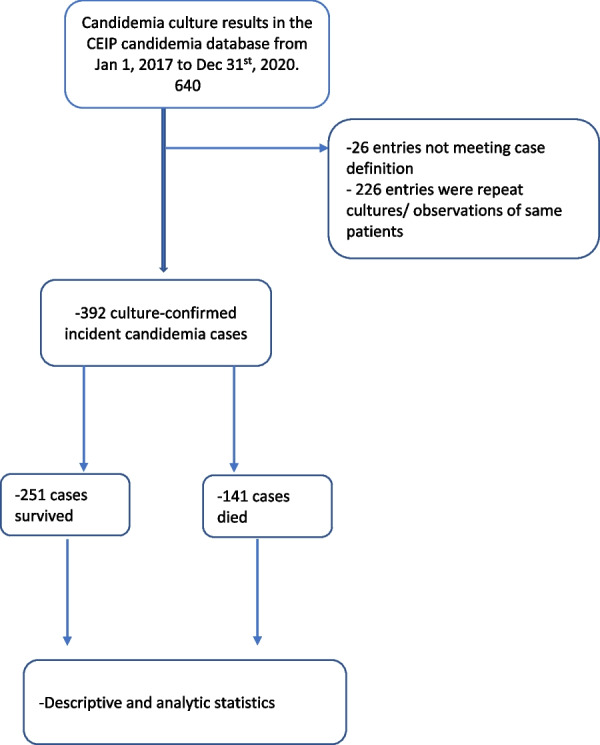
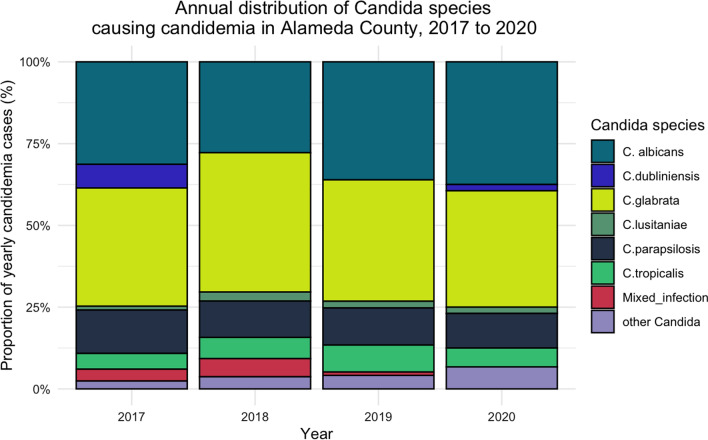
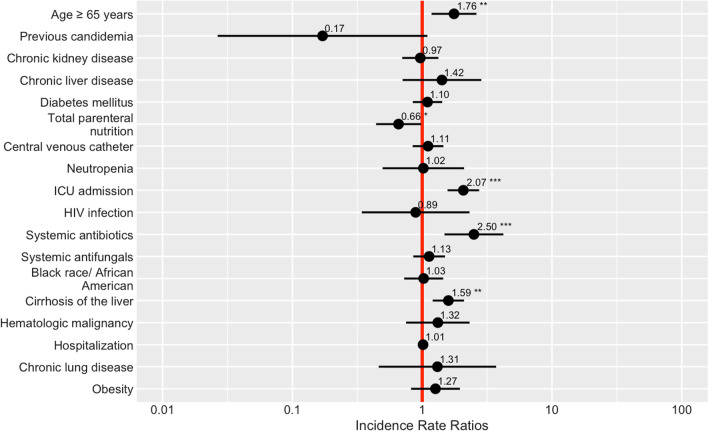
Background: Bloodstream infections caused by Candida species are responsible for significant morbidity and mortality worldwide, with an ever-changing epidemiology. We conducted this study to assess trends in the epidemiologic features, risk factors and Candida species distribution in candidemia patients in Alameda County, California. Methods: We analyzed data collected from patients in Alameda County, California between 2017 and 2020 as part of the California Emerging Infections Program (CEIP). This is a laboratory-based, active surveillance program for candidemia. In our study, we included incident cases only. Results: During the 4-year period from January 1st, 2017, to December 31st, 2020, 392 incident cases of candidemia were identified. The mean crude annual cumulative incidence was 5.9 cases per 100,000 inhabitants (range 5.0–6.5 cases per 100,000 population). Candida glabrata was the most common Candida species and was present as the only Candida species in 149 cases (38.0%), followed by Candida albicans , 130 (33.2%). Mixed Candida species were present in 13 patients (3.3%). Most of the cases of candidemia occurred in individuals with one or more underlying conditions. Multivariate regression models showed that age ≥ 65 years (RR 1.66, CI 1.28–2.14), prior administration of systemic antibiotic therapy, (RR 1.84, CI 1.06–3.17), cirrhosis of the liver, (RR 2.01, CI 1.51–2.68), and prior admission to the ICU (RR1.82, CI 1.36–2.43) were significant predictors of mortality. Conclusions: Non-albicans Candida species currently account for the majority of candidemia cases in Alameda County.
Overview
The claims and statistics of this paper haven’t been checked yet.
Free: it reads the open-access text and checks the first 5 claims that cite a source we can check. Create a free account to check every claim.
Integrity signals
Registry
Cites
Statistics
Figures
Verification
Claims the paper makes
The claims and statistics of this paper haven’t been checked yet.
Free: it reads the open-access text and checks the first 5 claims that cite a source we can check. Create a free account to check every claim.
Claims other papers make about this one
Each is checked against this paper’s own text: does it say what the citing paper says it does?
The source backs part of the claim, not all of it — or backs it for a different population, condition or comparison.
In the citing paper
“In the US, all-cause mortality was highest among older adults and lowest among children.25,27,52”
From Epidemiology of Invasive Candidiasis (2024) · cites this paper as [52]
Experimental — accuracy not yet measuredThe source backs part of the claim, not all of it — or backs it for a different population, condition or comparison.
In the citing paper
“All-cause in-hospital mortality of candidemia has been reported as high as 36% in the US.27,51,52”
From Epidemiology of Invasive Candidiasis (2024) · cites this paper as [52]
Experimental — accuracy not yet measuredThe cited source says what the claim attributes to it.
In the citing paper
“No significant differences in mortality by race or sex were reported.52”
From Epidemiology of Invasive Candidiasis (2024) · cites this paper as [52]
Self-check
Percentages, sums and reported differences re-computed from the paper’s own numbers.
The self-check needs the paper’s full text.
Citations
Cites
A Modified Poisson Regression Approach to Prospective Studies with Binary Data
Zou, G. (2004) · American Journal of Epidemiology · doi:10.1093/aje/kwh090 · Cited by 9,615
Changes in prevalence of health care-associated infections in U.S. hospitals
Magill, S. S., O’Leary, E., Janelle, S. J., Thompson, D. L., Dumyati, G., Nadle, J., Wilson, L. E., Kainer, M. A., Lynfield, R., Greissman, S., et al. (2018) · New England Journal of Medicine · doi:10.1056/nejmoa1801550 · Cited by 1,249 · cited 1×
“In the United States and elsewhere, Candida species are a leading cause of health care–associated bloodstream infections [2].”
BackgroundCornely, O. A., Bassetti, M., Calandra, T., Garbino, J., Kullberg, B. J., Lortholary, O., Meersseman, W., Akova, M., Arendrup, M. C., Arikan-Akdagli, S., et al. (2012) · Clinical Microbiology and Infection · doi:10.1111/1469-0691.12039 · Cited by 1,217
Epidemiology of Invasive Mycoses in North America
Pfaller, M. A., & Diekema, D. J. (2010) · Critical Reviews in Microbiology · doi:10.3109/10408410903241444 · Cited by 901
Pfaller, M. A., Diekema, D. J., Turnidge, J. D., Castanheira, M., & Jones, R. N. (2019) · Open Forum Infectious Diseases · doi:10.1093/ofid/ofy358 · Cited by 825
Global trends in the distribution of Candida species causing candidemia
Guinea, J. (2014) · Clinical Microbiology and Infection · doi:10.1111/1469-0691.12539 · Cited by 680 · cited 2×
“isolates by geographical location [5].”
BackgroundChanges in the epidemiological landscape of invasive candidiasis
Lamoth, F., Lockhart, S. R., Berkow, E. L., & Calandra, T. (2018) · Journal of Antimicrobial Chemotherapy · doi:10.1093/jac/dkx444 · Cited by 547 · cited 1×
“involved in candidemia, including geographical and ecological factors; variability in monitoring and reporting systems; characteristics of the patient populations; and infection prevention and control strategies [24].”
BackgroundTortorano, A. M., Peman, J., Bernhardt, H., Klingspor, L., Kibbler, C. C., Faure, O., Biraghi, E., Canton, E., Zimmermann, K., Seaton, S., et al. (2004) · European Journal of Clinical Microbiology & Infectious Diseases · doi:10.1007/s10096-004-1103-y · Cited by 509
Rees, J. R., Pinner, R. W., Hajjeh, R. A., Brandt, M. E., & Reingold, A. L. (1998) · Clinical Infectious Diseases · doi:10.1093/clinids/27.5.1138 · Cited by 397
Self-citationCleveland, A. A., Farley, M. M., Harrison, L. H., Stein, B., Hollick, R., Lockhart, S. R., Magill, S. S., Derado, G., Park, B. J., & Chiller, T. M. (2012) · Clinical Infectious Diseases · doi:10.1093/cid/cis697 · Cited by 366
Cited by
Epidemiology of Invasive Candidiasis
Bays, D., Jenkins, E., Lyman, M., Chiller, T., Strong, N., Ostrosky-Zeichner, L., Hoenigl, M., Pappas, P., & Thompson, G. (2024) · Clinical Epidemiology · doi:10.2147/clep.s459600 · Cited by 109
“27,51,52 In Europe, the 30-day mortality rate of IC was slightly higher at 38–42%.”
BackgroundBeardsley, J., Kim, H. Y., Dao, A., Kidd, S. E., Alastruey‐Izquierdo, A., Sorrell, T. C., Tacconelli, E., Chakrabarti, A., Harrison, T. S., Bongomin, F., et al. (2024) · Medical Mycology · doi:10.1093/mmy/myae041 · Cited by 61
Novel evidence on sepsis-inducing pathogens: from laboratory to bedside
Gatica, S., Fuentes, B., Rivera-Asín, E., Ramírez-Céspedes, P., Sepúlveda-Alfaro, J., Catalán, E. A., Bueno, S. M., Kalergis, A. M., Simón, F., Riedel, C. A., et al. (2023) · Frontiers in Microbiology · doi:10.3389/fmicb.2023.1198200 · Cited by 43
“, 2022), presence of liver cirrhosis (González-Lara et al., 2017; Bartoletti et al., 2021; Battistolo et al., 2021; Meyahnwi et al., 2022), kidney dysfunction (Poissy et al.”
BackgroundGale, A. N., Pavesic, M. W., Nickels, T. J., Xu, Z., Cormack, B. P., & Cunningham, K. W. (2023) · mSphere · doi:10.1128/msphere.00254-23 · Cited by 27
Candida glabrata: A Tale of Stealth and Endurance
Askari, F., & Kaur, R. (2024) · ACS Infectious Diseases · doi:10.1021/acsinfecdis.4c00477 · Cited by 25
Schroeder, J. A., Wilson, C. M., & Pappas, P. G. (2024) · Infectious Disease Clinics of North America · doi:10.1016/j.idc.2024.11.007 · Cited by 32
Zajac, C., Scott, N. E., Kline, S., Erayil, S. E., & Selmecki, A. M. (2025) · npj Antimicrobials and Resistance · doi:10.1038/s44259-025-00102-6 · Cited by 22
Chen, L., Xie, Z., & Jian, J. (2024) · Infection and Drug Resistance · doi:10.2147/idr.s471171 · Cited by 24
Stewart, A. G., Laupland, K. B., Edwards, F., Koo, S., Hammond, S. P., Harris, P. N. A., Paterson, D. L., Slavin, M. A., & Chen, S. C.-A. (2025) · Journal of Infection · doi:10.1016/j.jinf.2025.106513 · Cited by 21
Chen, M., Hu, D., Li, T., Zheng, D., Liao, W., Xia, X., & Cao, C. (2023) · Mycopathologia · doi:10.1007/s11046-023-00757-7 · Cited by 14
“However, data on the incidence and prevalence from Guangxi Province, which serves as the center of the Association of Southeast Asian Nations, are still lacking.”
BackgroundNaskar, S., Prajapati, A., & Kaur, R. (2025) · FEMS Yeast Research · doi:10.1093/femsyr/foaf025 · Cited by 17
“Candida glabrata infections are associated with some of the worst rates of mortality amongst Candida species, typically be-tween 25% and35% (Meyahnwi et al. 2022 , Salmanton-García et al. 2024 ) and soaring up beyond 50%, as found in some studies (Gupta et al. 2015 , Won et al. 2021 ).”
Tyrosol-gold nanoparticle functionalized acacia gum-PVA nanofibers for mitigation of Candida biofilm
Alhariry, J., Kumar, A., Yadav, T. C., Yadav, E., Prasad, R., Poluri, K. M., & Gupta, P. (2024) · Microbial Pathogenesis · doi:10.1016/j.micpath.2024.106763 · Cited by 13
Aydın, S., Mert, A., Yılmaz, M., Maslamani, M. A. R. S. A., Rahimi, B. A., Ayoade, F., El‐Kholy, A., Belitova, M., Şengel, B. E., Jalal, S., et al. (2024) · Mycoses · doi:10.1111/myc.13687 · Cited by 12
SWI/SNF complex-mediated chromatin remodeling in Candida glabrata promotes immune evasion
Kumar, K., Pareek, A., & Kaur, R. (2024) · iScience · doi:10.1016/j.isci.2024.109607 · Cited by 11
Sahu, M. S., Purushotham, R., & Kaur, R. (2024) · PLoS Genetics · doi:10.1371/journal.pgen.1011281 · Cited by 7
Durmuş, M., Kalkan, S., Karahan, S. G., Bıçakcıoğlu, M., Özdemir, N., GÜN, Z. Ü., & Özer, A. B. (2023) · European Journal of Hospital Pharmacy · doi:10.1136/ejhpharm-2022-003673 · Cited by 5
Pallotta, F., Brescini, L., Ianovitz, A., Luchetti, I., Franca, L., Canovari, B., Cerutti, E., & Barchiesi, F. (2023) · Journal of Fungi · doi:10.3390/jof9060642 · Cited by 6
“parapsilosis, while in Alameda country [28], the dominant species implicated in candidemia was C.”
BackgroundMeyahnwi, D., Siraw, B., Tafesse, Y. T., Issaka, Y., Zinyandu, T., Ahmed, A. M., Opoku, I. A., & Lancaster, G. I. (2025) · The American Journal of Cardiology · doi:10.1016/j.amjcard.2025.06.023 · Cited by 4
Self-citationAspartyl proteases target host actin nucleator complex protein to limit epithelial innate immunity
Patra, S., & Kaur, R. (2024) · EMBO Reports · doi:10.1038/s44319-024-00270-y · Cited by 5
“Despite Cg infections being associated with high mortality (Meyahnwi et al, 2022; Rasheed et al, 2020a), our understanding of Cg -host communication is limited.”
BackgroundCore histones govern echinocandin susceptibility in Candida glabrata
Pareek, A., & Kaur, R. (2025) · Microbiology Spectrum · doi:10.1128/spectrum.02399-24 · Cited by 3
“Finally, our data attribute the elevated caspofungin susceptibility of histone mutants partly to increased ROS levels and underscore the hitherto unknown roles of core histones in the pathobiology of C. glabrata .”
Ödemiş, İ., Arkalı, E., Senger, S. S., Tekin, D., Ersan, G., Atalay, S., & Filiz, M. N. (2025) · BMC Infectious Diseases · doi:10.1186/s12879-025-11997-x · Cited by 2
Liang, C., Xue, Y., Qin, M., Xie, X., Zeng, Y., Tang, X., Qiu, D., & Li, T. (2026) · BMC Infectious Diseases · doi:10.1186/s12879-026-12680-5 · Cited by 1
“…stratified by central venous catheterization status (yes vs no); between-group differences were compared using the log-rank test worldwide, including cardiovascular disease, renal disease, antifungal therapy for less than 7 days, liver cirrhosis, antibiotic exposure, and ICU admission [26, 27].”
Shreya, S., & Bhat, K. S. (2024) · Journal of Current Research in Scientific Medicine · doi:10.4103/jcrsm.jcrsm_140_23
Prado, A., Veiga, F. F., Brito, R. D. O., Pereira, E. D. C. A., Negri, M., & Svidzinski, T. I. E. (2025) · Folia Microbiologica · doi:10.1007/s12223-025-01286-0
“Recently, mixed infections, including bloodstream ones, have been recognized (Meyahnwi et al. 2022), and polymicrobial fungal infections are attributed to mixed biofilms formed on medical devices (Costa et al. 2022a).”
Meyahnwi, D., Siraw, B., Issaka, Y., Tafesse, Y. T., Zinyandu, T., Miftari, R., & Ahmed, A. (2026) · Infection · doi:10.1007/s15010-026-02757-3
“…these patients are more likely to experience persistent fungemia, breakthrough infections with non-albicans Candida species that may demonstrate reduced susceptibility to conventional antifungals, and delayed clearance of infection due to impaired phagocytic and cellular immune responses [11–13].”
Self-citationAlduwayrij, A., Alarfaj, A., Alarbash, M., Parvez, M., Albanyan, O. A., Alquhays, I. A., Alshanqiti, A. A. M., Albaarrak, Y. A., Eldirdiri, S., & Absar, M. M. (2026) · International Journal of Microbiology · doi:10.1155/ijm/6422952
Kılıç, A., & Palavecino, E. L. (2026) · Cureus · doi:10.7759/cureus.115734
Jones, M. N., Nigo, M., Pérez, M. E., Casarin, S., Sanghvi, A., Jones, S. L., Corry, D. B., Arias, C. A., & Adelman, M. W. (2026) · Open Forum Infectious Diseases · doi:10.1093/ofid/ofag558
“Our mortality rate of ∼ 30% in periods 2 and 3 is slightly lower but largely aligned with reported 30-day mortality rates in other studies of candidemia, which range from 32% to 38% [2, 3, 33].”
Metadata
- Authors
- Meyahnwi, D., Siraw, B. B., & Reingold, A.
- Affiliations
- University of California, Berkeley (US)
- Corresponding author
- Meyahnwi, Didien
- Venue
- BMC Infectious Diseases
- Published
- 2022-11-12
- Volume
- 22
- Issue
- 1
- Pages
- 843-843
- ISSN
- 1471-2334 (ISSN-L)
- PMC
- PMC9652840
- OpenAlex
- W4309073127
- Cited by
- 28
- References
- 25
- Citations by year
- 2026: 5 · 2025: 7 · 2024: 11 · 2023: 5
- FWCI
- 2.81
- Type
- journal article
- Language
- en
- Open access
- gold
- doi.org
- Licence
- cc-by
- creativecommons.org/licenses/by/4.0 (tdm)
- creativecommons.org/licenses/by/4.0 (vor)
- Locations
- BMC Infectious Diseases (publishedVersion, cc-by)
- PubMed Central (publishedVersion, cc-by)
- PubMed (publishedVersion)
- DOAJ (DOAJ: Directory of Open Access Journals) (submittedVersion)
- eScholarship (California Digital Library) (submittedVersion, cc-by)
- Topics
- Health Sciences › Medicine › Infectious Diseases › Antifungal resistance and susceptibility
- Health Sciences › Medicine › Infectious Diseases › Fungal Infections and Studies
- Life Sciences › Immunology and Microbiology › Microbiology › Yeasts and Rust Fungi Studies
- Keywords
- candidemia, Candida glabrata, Candida albicans, non-albicans Candida, mortality risk factors, risk factors, fungemia, liver cirrhosis, intensive care unit admission, incidence trends, Alameda County, California
- MeSH terms
- Aged, Antifungal Agents, California, Candida, Candida albicans, Humans, Retrospective Studies, Risk Factors, Candidemia
About these checks
Registry, retraction, Cites and statistics results are computed, not judged, with one exception: a printed reference that no index lists is read once by a model before it counts as a citation error. Claims are extracted by a model and kept only when their quote appears verbatim in the text; each cited source is then checked, with a model’s help, for whether it says what the claim relies on. Those verdicts can be wrong — read the claim’s quote and the cited source before relying on one.
Statistics and arithmetic are recomputed, not judged.
Confidence bands are shown only for fields calibrated on our annotated test set. None is calibrated yet, so no band is shown.
What counts as a claim ›How we measure confidence ›How we check this ›
Are you an author, or do you see a problem with this page? Request a review
Data sources
Bibliographic data: Semantic Scholar, OpenAlex, Crossref.
Contains information from the Semantic Scholar Academic Graph Datasets, made available under the ODC Attribution License (ODC-BY 1.0).
Semantic Scholar’s data is described in: Kinney, R., et al. (2023). The Semantic Scholar Open Data Platform. arXiv:2301.10140.
