

Clinical utility of a cerebrospinal fluid multiplex PCR meningitis/encephalitis panel in children: a retrospective review of positive results
Open accessPublished version of a preprint
The DOI matches its Crossref record; 27 of the 27 references it cites were found in a registry or an index; 9 of the 27 sources its claims cite were checked for support.
Abstract
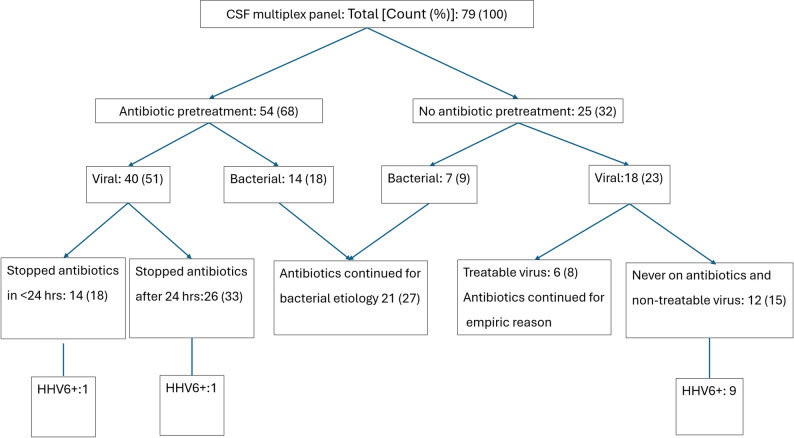
BACKGROUND: Meningitis has significant clinical morbidity and mortality in children. Mortality in children, especially neonates, is high due to diagnostic difficulty. Diagnosis of pediatric meningitis is traditionally made using CSF parameters and cultures. The performance of cerebrospinal fluid (CSF) multiplex polymerase chain reaction (PCR) meningitis/encephalitis (ME) panel needs further evaluation in the pediatric population. METHODS: Medical records of children with a positive CSF ME panel (June 1, 2016 to August 31, 2018) were reviewed retrospectively. We extracted data about antimicrobials used, laboratory and culture results, duration of antibiotic treatment, hospital stay, and follow-up. Long term outcome was evaluated. RESULTS: A total of 79 children (age, 1 d to 12 y) were identified, including 58 children with viral (73%) and 21 children (27%) with bacterial meningitis. The most frequent viruses were enterovirus in all age groups. Empiric antibiotics were discontinued within 24 h in 14 of 40 patients (35%) positive for viral meningitis. Specific antiviral therapy was rapidly initiated in 6 out of 58 patients (10%). Antibiotics were stopped or never initiated when viral etiology was identified. Even when the CSF sample was inadequate for analysis, the pathogenic organism was identified which is particularly helpful in the infants. In antibiotic pretreated patients, the organism was identified even when the cultures were negative. CSF ME panel identified 13 patients who had bacterial meningitis despite negative CSF cultures. Twelve of these 13 patients (92%) were pretreated with antibiotics. In bacterial meningitis cases, modification of antibiotic therapy was not based solely on the result of CSF ME panel. Duration of antibiotic treatment and hospital stay were substantially shorter in patients with viral as opposed to bacterial meningitis. CONCLUSIONS: Delay in diagnosis and targeted antimicrobial therapy may worsen neurologic outcomes. CSF ME panel may enable earlier targeted therapy and reduce unnecessary antimicrobial exposure as it is rapid, specific, and highly sensitive. It is expected to reduce healthcare cost, and its use is recommended in a pediatric population.
Overview
CoChat Summary
## TL;DR
This single-center retrospective review found that a positive CSF multiplex PCR meningitis/encephalitis (ME) panel identified pathogens in 79 children and often supported earlier narrowing or stopping of antimicrobials, especially for viral meningitis. The panel also detected 13 bacterial cases with negative CSF cultures, most of which had prior antibiotic exposure.
## Key findings
- Of 356 CSF ME panels ordered during the study period, 79 were positive, a positivity rate of 22%.
- Among the 79 positive cases, 58 (73%) were viral and 21 (27%) were bacterial; the most frequent viral pathogen was enterovirus (37 cases, 47%), and the most frequent bacterial pathogens varied by age.
- In viral meningitis, empiric antibiotics were discontinued within 24 h in 14 of 40 patients (35%); antibiotics were never initiated in 8 enterovirus cases (22%), 3 HHV-6 cases (27%), and 1 parechovirus case (25%).
- CSF ME panel identified 13 patients with bacterial meningitis despite negative CSF cultures; 12 of these 13 (92%) had antibiotic pretreatment.
- Mean antibiotic duration and hospital stay were much shorter in viral than bacterial meningitis: 2 days vs 18 days for antibiotics (P = 0.0015) and 4 days vs 22 days for hospitalization (P < 0.0001).
## Methods
- Single-center retrospective review of children <18 years with a positive FilmArray Meningitis/Encephalitis panel admitted from June 1, 2016 to August 31, 2018.
- Medical record abstraction included antimicrobials, lab and culture results, antibiotic duration, length of stay, and follow-up; 79 children with at least one pathogen detected were included, grouped by age (<30 d, 30–90 d, >90 d).
- Analysis used descriptive statistics plus 2-sample t-tests, Fisher’s/Chi-square tests, and odds ratios with 95% CIs for associations between meningitis type and CSF findings.
## Limitations
- The paper explicitly states it is a single-center retrospective study with a small sample size, and it assesses only positive results of the CSF ME panel.
- The authors state they could not evaluate sensitivity because false negatives were not assessed.
- Evident from the text: some outcome details are incomplete for individual cases, and not all patients had full CSF testing available (for example, 4 patients lacked complete CSF glucose/protein/cell count analysis due to insufficient sample volume).
Model-written summary. Check it against the paper before relying on it.
Integrity signals
Registry
Cites
Statistics
Figures
Verification
Claims the paper makes
8 Valid · 1 Not valid · 13 Not checked · 134 Own results and interpretations
The cited sources support only part of this claim — read each source’s verdict below.
In the paper
“CSF bacterial culture is positive in 8% of patients who have meningitis [10]”
§ Clinical utility of a cerebrospinal fluid multiplex PCR meningitis/encephalitis panel in children: a retrospective review of positive results > Background
What the sources say
- Partly supportedcites [10] Obaro S, Hassan-Hanga F, Medugu N, Olaosebikan R, Olanipekun G, Jibir B, Gambo S, Ajose T, Duru C, Ebruke B, et al. Comparison of bacterial culture with BioFire ® FilmArray ® multiplex PCR screening of archived cerebrospinal fluid specimens from children with suspected bacterial meningitis in Nigeria. BMC Infect Dis. 2023;23(1):641. 37784010 PMC10544496 sourceExperimental — accuracy not yet measured
The Results report positive bacterial cultures in 32 of 400 CSF specimens (8%). These specimens came from children with suspected bacterial meningitis in Nigeria, not a cohort of patients all confirmed to have meningitis; the claim omits that distinction. (LLM, conf=0.88)
plain- Asserted: passes — The authors put it forward as true.
- Checkable: passes — It can be checked against evidence.
- Load-bearing: passes — The paper’s conclusions depend on it.
- Based: passes — The paper gives a reason why it holds.
- Partly supported
The cited sources support only part of this claim — read each source’s verdict below.
In the paper
“Contrary to a previous report [24], we found that the CSF ME panel does not necessarily simplify antibiotic management in bacterial meningitis.”
§ Clinical utility of a cerebrospinal fluid multiplex PCR meningitis/encephalitis panel in children: a retrospective review of positive results > Discussion
What the sources say
- Partly supportedcites [24] Messacar K, Breazeale G, Robinson CC, Dominguez SR. Potential clinical impact of the film array meningitis encephalitis panel in children with suspected central nervous system infections. Diagn Microbiol Infect Dis. 2016;86(1):118–20. 27342782 PMC4993637 sourceExperimental — accuracy not yet measured
The paper’s Abstract says the ME panel may enable earlier optimization of antimicrobial therapy, supporting the citing sentence’s reference to a more favorable prior report. But its discussion of reduced unnecessary treatment focuses particularly on acyclovir; it does not establish that the panel simplifies antibiotic management in bacterial meningitis. (LLM, conf=0.84)
hedged- Asserted: passes — The authors put it forward as true.
- Checkable: passes — It can be checked against evidence.
- Load-bearing: passes — The paper’s conclusions depend on it.
- Based: passes — The paper gives a reason why it holds.
- Partly supported
The cited sources support only part of this claim — read each source’s verdict below.
In the paper
“Pretreatment with antibiotics significantly decreases the sensitivity of traditional culture methods, making them more likely to produce false-negative results [27].”
§ Clinical utility of a cerebrospinal fluid multiplex PCR meningitis/encephalitis panel in children: a retrospective review of positive results > Discussion
What the sources say
- Partly supportedcites [27] Ghoweba Y, Safizadeh Shabestari SA, Malik ZA. Diagnostic Accuracy of Cerebrospinal Fluid Multiplex Polymerase Chain Reaction Panel Testing in Patients With Suspected Central Nervous System Infections: A Multi-Center Study in the United Arab Emirates. Cureus. 2024;16(1):e51906. 38333447 PMC10851033 sourceExperimental — accuracy not yet measured
The Introduction says antibiotics given before CSF collection can lead to false-negative cultures, and the Discussion describes culture-negative cases after prior antibiotic exposure. The paper does not quantify a decrease in culture sensitivity or establish that the decrease is statistically significant. (LLM, conf=0.84)
plainstates a cause- Asserted: passes — The authors put it forward as true.
- Checkable: passes — It can be checked against evidence.
- Load-bearing: passes — The paper’s conclusions depend on it.
- Based: passes — The paper gives a reason why it holds.
- Partly supported
Every source the paper cites for this claim was checked and supports it.
In the paper
“Currently CSF ME panel does not provide information about antibiotic susceptibility [11].”
§ Clinical utility of a cerebrospinal fluid multiplex PCR meningitis/encephalitis panel in children: a retrospective review of positive results > Discussion
What the sources say
- Supportedcites [11] Leber AL, Everhart K, Balada-Llasat JM, Cullison J, Daly J, Holt S, Lephart P, Salimnia H, Schreckenberger PC, DesJarlais S, et al. Multicenter Evaluation of BioFire FilmArray Meningitis/Encephalitis Panel for Detection of Bacteria, Viruses, and Yeast in Cerebrospinal Fluid Specimens. J Clin Microbiol. 2016;54(9):2251–61. 27335149 PMC5005480 source
The Discussion explicitly states that the FilmArray ME Panel does not provide information on antibiotic susceptibility and that CSF culture therefore remains necessary. (LLM, conf=0.95)
plain- Asserted: passes — The authors put it forward as true.
- Checkable: passes — It can be checked against evidence.
- Load-bearing: passes — The paper’s conclusions depend on it.
- Based: passes — The paper gives a reason why it holds.
- Supported
A result the paper reports from its own data — it cites no other source for it, so there is none to check. The quote shows it is in the paper.
In the paper
“the mean age did not differ significantly between patients with viral versus bacterial meningitis.”
§ Clinical utility of a cerebrospinal fluid multiplex PCR meningitis/encephalitis panel in children: a retrospective review of positive results > Results
plain- Asserted: passes — The authors put it forward as true.
- Checkable: passes — It can be checked against evidence.
- Load-bearing: unclear — It is unclear whether the paper’s conclusions depend on it.
- Based: passes — The paper gives a reason why it holds.
80 more claims
Create a free account to see all 156 claims and every source verdict.
- Probably not a substantial claim. 42
- It may state two separate claims as one. 34
Citations
Cites
Practice Guidelines for the Management of Bacterial Meningitis
Tunkel, A. R., Hartman, B. J., Kaplan, S. L., Kaufman, B. A., Roos, K. L., Scheld, W. M., & Whitley, R. J. (2004) · Clinical Infectious Diseases · doi:10.1086/425368 · Cited by 2,308
Fleming, S., Thompson, M., Stevens, R., Heneghan, C., Plüddemann, A., Maconochie, I., Tarassenko, L., & Mant, D. (2011) · The Lancet · doi:10.1016/s0140-6736(10)62226-x · Cited by 1,282 · cited 1×
“Respiratory distress was defined as tachypnea for age, retractions, or grunting [12].”
Leber, A. L., Everhart, K., Balada-Llasat, J.-M., Cullison, J., Daly, J., Holt, S., Lephart, P., Salimnia, H., Schreckenberger, P. C., DesJarlais, S., et al. (2016) · Journal of Clinical Microbiology · doi:10.1128/jcm.00730-16 · Cited by 609 · cited 3×
“Currently CSF ME panel does not provide information about antibiotic susceptibility [11].”
Acute bacterial meningitis in infants and children
Kim, K. S. (2010) · The Lancet Infectious Diseases · doi:10.1016/s1473-3099(09)70306-8 · Cited by 454 · cited 2×
“The most common symptoms prompting diagnostic lumbar puncture in the emergency room include fever, seizures, and/or unexplained altered mental status [4].”
Garges, H. P., Moody, M. A., Cotten, C. M., Smith, P. B., Tiffany, K. F., Lenfestey, R., Li, J. S., Fowler, V. G., & Benjamin, D. K. (2006) · Pediatrics · doi:10.1542/peds.2005-1132 · Cited by 351 · cited 1×
“In neonates, bacterial meningitis confirmed with positive cultures is possible with normal CSF parameters including CSF WBC count [19].”
Tansarli, G. S., & Chapin, K. C. (2020) · Clinical Microbiology and Infection · doi:10.1016/j.cmi.2019.11.016 · Cited by 263 · cited 1×
“[18].”
Nigrovic, L. E., Malley, R., Macias, C. G., Kanegaye, J. T., Moro-Sutherland, D. M., Schremmer, R. D., Schwab, S. H., Agrawal, D., Mansour, K. M., Bennett, J. E., et al. (2008) · Pediatrics · doi:10.1542/peds.2007-3275 · Cited by 226 · cited 1×
“Antibiotic pretreatment > 12 h before lumbar puncture altered CSF glucose and protein but not CSF WBC count [28].”
Liesman, R. M., Strasburg, A. P., Heitman, A. K., Theel, E. S., Patel, R., & Binnicker, M. J. (2018) · Journal of Clinical Microbiology · doi:10.1128/jcm.01927-17 · Cited by 186 · cited 1×
“Continuing the use of Gram stain and bacterial cultures is still a valid recommendation to confirm the results of the CSF ME panel [23] and guide antimicrobial therapy based on susceptibility results.”
Antimicrobial-associated harm in critical care: a narrative review
Arulkumaran, N., Routledge, M., Schlebusch, S., Lipman, J., & Conway Morris, A. (2020) · Intensive Care Medicine · doi:10.1007/s00134-020-05929-3 · Cited by 175 · cited 1×
“Unnecessary antibiotic use increases the risk of developing multidrug-resistant organisms and leading to serious side effects and complications, including C. difficile infection, allergic reactions, and organ toxicity [22].”
Defining Cerebrospinal Fluid White Blood Cell Count Reference Values in Neonates and Young Infants
Kestenbaum, L. A., Ebberson, J., Zorc, J. J., Hodinka, R. L., & Shah, S. S. (2010) · Pediatrics · doi:10.1542/peds.2009-1181 · Cited by 168
Clinical Features Suggestive of Meningitis in Children: A Systematic Review of Prospective Data
Curtis, S., Stobart, K., Vandermeer, B., Simel, D. L., & Klassen, T. (2010) · Pediatrics · doi:10.1542/peds.2010-0277 · Cited by 147 · cited 1×
“Clinical examination is not sufficient for diagnosis as symptoms and signs of meningitis in children are variable and nonspecific [7].”
Messacar, K., Breazeale, G., Robinson, C. C., & Dominguez, S. R. (2016) · Diagnostic Microbiology and Infectious Disease · doi:10.1016/j.diagmicrobio.2016.05.020 · Cited by 97 · cited 1×
“Contrary to a previous report [24], we found that the CSF ME panel does not necessarily simplify antibiotic management in bacterial meningitis.”
Eichinger, A., Hagen, A., Meyer-Bühn, M., & Huebner, J. (2019) · Infection · doi:10.1007/s15010-018-1212-7 · Cited by 60 · cited 1×
“In Pediatrics, the incidence of meningitis is highest under 6 months of age [5].”
Blaschke, A. J., Holmberg, K. M., Daly, J. A., Leber, A. L., Dien Bard, J., Korgenski, E. K., Bourzac, K. M., & Kanack, K. J. (2018) · Journal of clinical microbiology · doi:10.1128/jcm.00277-18 · Cited by 57 · cited 1×
“FilmArray CSF ME panel analyzes multiple target sequences simultaneously, enabling the testing for multiple pathogens in a single test with a turnaround time of about 1 h [20, 21].”
Nigrovic, L. E., Shah, S. S., & Neuman, M. I. (2011) · The Journal of Pediatrics · doi:10.1016/j.jpeds.2011.02.038 · Cited by 55 · cited 1×
“CSF cell count and protein were adjusted according to the correction formula [14, 15].”
Risk factors associated with the outcomes of pediatric bacterial meningitis: a systematic review
Teixeira, D. C., Diniz, L. M. O., Guimarães, N. S., Moreira, H. M. D. A. S., Teixeira, C. C., & Romanelli, R. M. D. C. (2019) · Jornal de Pediatria · doi:10.1016/j.jped.2019.07.003 · Cited by 51 · cited 1×
“In children with or without disseminated illness, meningitis has significant clinical morbidity and mortality [2].”
A prospective study of risk factors for neurological complications in childhood bacterial meningitis
Namani, S., Milenković, Z., & Koci, B. (2013) · Jornal de Pediatria · doi:10.1016/j.jped.2012.10.001 · Cited by 46 · cited 1×
“Despite the availability of effective antibiotics to treat bacterial meningitis, 50% of children may experience neurologic sequelae, and mortality is high (5% to 30%), especially in neonates, in part because of diagnostic difficulty [3, 4].”
Prasad, N., Kobayashi, M., Collins, J. P., Rubis, A. B., Derado, G., Delahoy, M. J., Payne, D. C., McGee, L., Chochua, S., Marjuki, H., et al. (2025) · The Lancet Regional Health - Americas · doi:10.1016/j.lana.2025.101120 · Cited by 30
Meningitis in Children: Still a Can’t-Miss Diagnosis
Skar, G. L., Flannigan, L., Latch, R. L., & Snowden, J. A. (2024) · Pediatrics in Review · doi:10.1542/pir.2023-006013 · Cited by 25 · cited 2×
“High index of suspicion is critical for prompt investigation and early recognition of meningitis, as recommended by the American Academy of Pediatrics [6].”
Childhood Bacterial Meningitis and Usefulness of C-reactive Protein
Prasad, P., Nair, M., & Kalghatgi, A. (2005) · Medical Journal Armed Forces India · doi:10.1016/s0377-1237(05)80110-8 · Cited by 18 · cited 1×
“Our study shows that the serum CRP level is useful as an adjunct test, higher in bacterial meningitis compared to viral meningitis, and this finding is consistent with existing literature [29, 30].”
Obaro, S., Hassan-Hanga, F., Medugu, N., Olaosebikan, R., Olanipekun, G., Jibir, B., Gambo, S., Ajose, T., Duru, C., Ebruke, B., et al. (2023) · BMC Infectious Diseases · doi:10.1186/s12879-023-08645-7 · Cited by 18 · cited 2×
“The sensitivity of culture and Gram stain is variable according to type of organisms and demographics, but was reported to be 8% and 60%, respectively [10].”
Javali, M., Acharya, P., Mehta, A., John, A. A., Mahale, R., & Srinivasa, R. (2017) · Clinical Neurology and Neurosurgery · doi:10.1016/j.clineuro.2017.08.013 · Cited by 17
Multiplex‐PCR for the detection of viruses in the CSF of infants and young children
Walls, T., McSweeney, A., Anderson, T., & Jennings, L. C. (2017) · Journal of Medical Virology · doi:10.1002/jmv.24461 · Cited by 15 · cited 2×
“FilmArray CSF ME panel analyzes multiple target sequences simultaneously, enabling the testing for multiple pathogens in a single test with a turnaround time of about 1 h [20, 21].”
Expanding Molecular Diagnostics for Central Nervous System Infections
Gutierrez, M., & Emmanuel, P. J. (2018) · Advances in Pediatrics · doi:10.1016/j.yapd.2018.04.005 · Cited by 11 · cited 1×
“In 2015, the U.S. Food and Drug Administration approved the first CSF ME panel for detection of CNS infections [17].”
Ghoweba, Y., Safizadeh Shabestari, S. A., & Malik, Z. A. (2024) · Cureus · doi:10.7759/cureus.51906 · Cited by 5
Barros Domingues, R., Mendes-Correa, M. C., Vilela de Moura Leite, F. B., Vega dos Santos, M., & Senne Soares, C. A. (2022) · Pediatric Emergency Care · doi:10.1097/pec.0000000000002462 · Cited by 4 · cited 1×
“CSF ME panel can identify bacterial pathogens that are missed by Gram stain and culture [26].”
Sievänen, H., Kari, J., Huurre, A., & Palmu, S. (2023) · Scientific Reports · doi:10.1038/s41598-023-46407-2 · Cited by 2 · cited 1×
“CSF cell count and protein were adjusted according to the correction formula [14, 15].”
Research works printed but not linked: 1
- Choi SS, Seo DW, Sohn CH, Oh BJ, Kim WY, Lim KS, Shin JY, Kwak MK. Serum procalcitonin and C-reactive protein level as an early diagnostic marker of bacterial meningitis in the emergency department. J Korean Soc Emerg Med. 2012;23(3):360–5.
Metadata
- Authors
- Tengsupakul, S., Mulekar, M., Bista, B. R., Maertens, P., & Sharma, K.
- Affiliations
- University of South Alabama (US)
- The University of Texas Health Science Center at Houston (US)
- Corresponding author
- Sharma, Kamal
- Venue
- BMC Infectious Diseases
- Published
- 2026-03-05
- Volume
- 26
- Issue
- 1
- ISSN
- 1471-2334 (ISSN-L)
- PMC
- PMC13072580
- OpenAlex
- W7133963948
- Cited by
- 0
- References
- 25
- FWCI
- 0.00
- Type
- journal article
- Language
- en
- Open access
- gold
- doi.org
- Licence
- cc-by-nc-nd
- creativecommons.org/licenses/by-nc-nd/4.0 (tdm)
- creativecommons.org/licenses/by-nc-nd/4.0 (vor, 39 d)
- Locations
- BMC Infectious Diseases (publishedVersion, cc-by-nc-nd)
- Research Square (acceptedVersion, cc-by)
- PubMed Central (publishedVersion, cc-by-nc-nd)
- PubMed (publishedVersion)
- PubMed Central (publishedVersion, cc-by)
- Digital Commons-TMC (Texas Medical Center) (submittedVersion)
- DOAJ (DOAJ: Directory of Open Access Journals) (submittedVersion, cc-by-sa)
- Funders
- National Center for Advancing Translational Sciences (UL1TR001417)
- Topics
- Life Sciences › Immunology and Microbiology › Microbiology › Bacterial Infections and Vaccines
- Health Sciences › Medicine › Infectious Diseases › Infectious Encephalopathies and Encephalitis
- Health Sciences › Medicine › Microbiology (medical) › Bacterial Identification and Susceptibility Testing
- Keywords
- pediatric meningitis, encephalitis, viral meningitis, bacterial meningitis, enterovirus, targeted antimicrobial therapy, antiviral therapy, delayed diagnosis, neonatal meningitis, length of hospital stay, long-term neurologic outcome
About these checks
Registry, retraction, Cites and statistics results are computed, not judged, with one exception: a printed reference that no index lists is read once by a model before it counts as a citation error. Claims are extracted by a model and kept only when their quote appears verbatim in the text; each cited source is then checked, with a model’s help, for whether it says what the claim relies on. Those verdicts can be wrong — read the claim’s quote and the cited source before relying on one.
The claim verdicts this report counts are experimental: their accuracy is not yet measured.
A language model drew the claims from the paper on 2026-09-29, under version 3 of the claim definition (model deepseek-v4.1-flash, prompt extract-v3).
A second model labelled each claim on 2026-09-29 (model jev-1.13-20260917, definition revision gold-guideline-v0.2).
Cited sources are checked with a language model’s help (gpt-6-sol).
Statistics and arithmetic are recomputed, not judged.
Confidence bands are shown only for fields calibrated on our annotated test set. None is calibrated yet, so no band is shown.
What counts as a claim ›How we measure confidence ›How we check this ›
Are you an author, or do you see a problem with this page? Request a review
Data sources
Bibliographic data: Semantic Scholar, OpenAlex, Crossref.
Contains information from the Semantic Scholar Academic Graph Datasets, made available under the ODC Attribution License (ODC-BY 1.0).
Semantic Scholar’s data is described in: Kinney, R., et al. (2023). The Semantic Scholar Open Data Platform. arXiv:2301.10140.
