

The cost-effectiveness of using chronic kidney disease risk scores to screen for early-stage chronic kidney disease
Open accessThe DOI matches its Crossref record; 33 of the 36 references it cites were found in a registry or an index.
Abstract
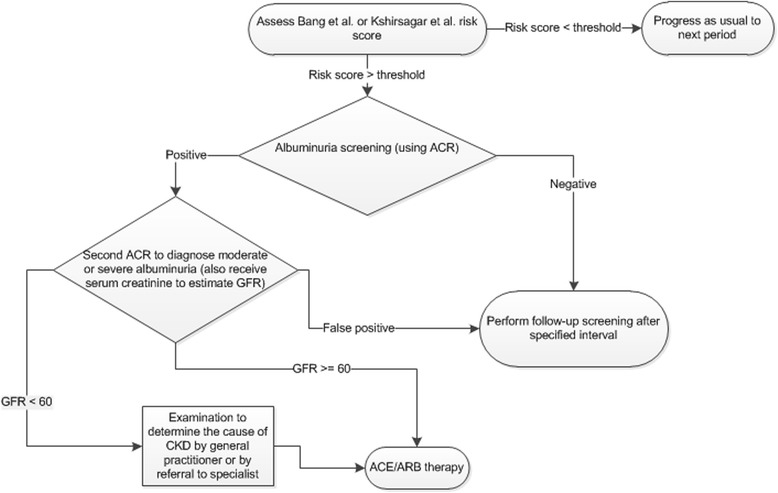
BACKGROUND: Better treatment during early stages of chronic kidney disease (CKD) may slow progression to end-stage renal disease and decrease associated complications and medical costs. Achieving early treatment of CKD is challenging, however, because a large fraction of persons with CKD are unaware of having this disease. Screening for CKD is one important method for increasing awareness. We examined the cost-effectiveness of identifying persons for early-stage CKD screening (i.e., screening for moderate albuminuria) using published CKD risk scores. METHODS: We used the CKD Health Policy Model, a micro-simulation model, to simulate the cost-effectiveness of using CKD two published risk scores by Bang et al. and Kshirsagar et al. to identify persons in the US for CKD screening with testing for albuminuria. Alternative risk score thresholds were tested (0.20, 0.15, 0.10, 0.05, and 0.02) above which persons were assigned to receive screening at alternative intervals (1-, 2-, and 5-year) for follow-up screening if the first screening was negative. We examined incremental cost-effectiveness ratios (ICERs), incremental lifetime costs divided by incremental lifetime QALYs, relative to the next higher screening threshold to assess cost-effectiveness. Cost-effective scenarios were determined as those with ICERs less than $50,000 per QALY. Among the cost-effective scenarios, the optimal scenario was determined as the one that resulted in the highest lifetime QALYs. RESULTS: ICERs ranged from $8,823 per QALY to $124,626 per QALY for the Bang et al. risk score and $6,342 per QALY to $405,861 per QALY for the Kshirsagar et al. risk score. The Bang et al. risk score with a threshold of 0.02 and 2-year follow-up screening was found to be optimal because it had an ICER less than $50,000 per QALY and resulted in the highest lifetime QALYs. CONCLUSIONS: This study indicates that using these CKD risk scores may allow clinicians to cost-effectively identify a broader population for CKD screening with testing for albuminuria and potentially detect people with CKD at earlier stages of the disease than current approaches of screening only persons with diabetes or hypertension.
Overview
The claims and statistics of this paper haven’t been checked yet.
Free: it reads the open-access text and checks the first 5 claims that cite a source we can check. Create a free account to check every claim.
Integrity signals
Registry
Cites
Statistics
Figures
Verification
Claims the paper makes
The claims and statistics of this paper haven’t been checked yet.
Free: it reads the open-access text and checks the first 5 claims that cite a source we can check. Create a free account to check every claim.
Claims other papers make about this one
Each is checked against this paper’s own text: does it say what the citing paper says it does?
The check wasn’t confident either way, so it gives no verdict — never disputed.
In the citing paper
“Measurement of a spot urine sample for albumin alone (whether by immunoassay or by using a sensitive dipstick test specific for albuminuria) without simultaneously measuring urine creatinine is less expensive but susceptible to false-negative and falsepositive determinations as a result of variation in urine concentration due to hydration (7).”
From 11. Chronic Kidney Disease and Risk Management: Standards of Care in Diabetes—2025 (2025) · cites this paper as [7]
Experimental — accuracy not yet measuredThe check wasn’t confident either way, so it gives no verdict — never disputed.
In the citing paper
“Measurement of a spot urine sample for albumin alone (whether by immunoassay or by using a sensitive dipstick test specific for albuminuria) without simultaneously measuring urine creatinine is less expensive but susceptible to falsenegative and false-positive determinations as a result of variation in urine concentration due to hydration (8).”
From 11. Chronic Kidney Disease and Risk Management: Standards of Care in Diabetes—2026 (2026) · cites this paper as [8]
Experimental — accuracy not yet measured
Self-check
Percentages, sums and reported differences re-computed from the paper’s own numbers.
The self-check needs the paper’s full text.
Citations
Cites
1 retracted
Nakao, N., Yoshimura, A., Morita, H., Takada, M., Kayano, T., & Ideura, T. (2003) · The Lancet · doi:10.1016/s0140-6736(03)12229-5 · Cited by 970
RetractedAhmed, A., Jorna, T., & Bhandari, S. (2016) · Nephron · doi:10.1159/000447068 · Cited by 11,717
Chronic kidney disease and the risks of death, cardiovascular events, and hospitalization
Go, A. S., Chertow, G. M., Fan, D., McCulloch, C. E., & Hsu, C.-Y. (2004) · New England Journal of Medicine · doi:10.1056/nejmoa041031 · Cited by 11,369
Lewis, E. J., Hunsicker, L. G., Clarke, W. R., Berl, T., Pohl, M. A., Lewis, J. B., Ritz, E., Atkins, R. C., Rohde, R., & Raz, I. (2001) · New England Journal of Medicine · doi:10.1056/nejmoa011303 · Cited by 5,987
Prevalence of Chronic Kidney Disease in the United States
Coresh, J., Selvin, E., Stevens, L. A., Manzi, J., Kusek, J. W., Eggers, P., Van Lente, F., & Levey, A. S. (2007) · JAMA · doi:10.1001/jama.298.17.2038 · Cited by 4,895
Recommendations of the Panel on Cost-Effectiveness in Health and Medicine
Weinstein, M. C. (1996) · JAMA: The Journal of the American Medical Association · doi:10.1001/jama.1996.03540150055031 · Cited by 2,455
Weiner, D. E., Tighiouart, H., Amin, M. G., Stark, P. C., MacLeod, B., Griffith, J. L., Salem, D. N., Levey, A. S., & Sarnak, M. J. (2004) · Journal of the American Society of Nephrology · doi:10.1097/01.asn.0000123691.46138.e2 · Cited by 1,176
US Renal Data System 2015 Annual Data Report: Epidemiology of Kidney Disease in the United States
Saran, R., Li, Y., Robinson, B., Abbott, K. C., Agodoa, L. Y. C., Ayanian, J., Bragg-Gresham, J., Balkrishnan, R., Chen, J. L. T., Cope, E., et al. (2016) · American Journal of Kidney Diseases · doi:10.1053/j.ajkd.2015.12.014 · Cited by 1,155
Jafar, T. H., Schmid, C. H., Landa, M., Giatras, I., Toto, R., Remuzzi, G., Maschio, G., Brenner, B. M., Kamper, A., Zucchelli, P., et al. (2001) · Annals of Internal Medicine · doi:10.7326/0003-4819-135-2-200107170-00007 · Cited by 1,092
Research works printed but not linked: 1
- Weinstein M Siegel J Gold M Kamlet M Russell L Cost-effectiveness in heath and medicine 1996 New York Oxford University Press
Cited by
Shlipak, M. G., Tummalapalli, S. L., Boulware, L. E., Grams, M. E., Ix, J. H., Jha, V., Kengne, A.-P., Madero, M., Mihaylova, B., Tangri, N., et al. (2021) · Kidney International · doi:10.1016/j.kint.2020.10.012 · Cited by 581
“testing, expected prevalence and incidence (testing yield) of CKD, and costs of confirmatory tests and treatment, among others.(30,108,109)”
BackgroundSelf-citation11. Microvascular Complications and Foot Care: Standards of Medical Care in Diabetes—2021
American Diabetes Association (2021) · Diabetes Care · doi:10.2337/dc21-s011 · Cited by 395
11. Chronic Kidney Disease and Risk Management: Standards of Care in Diabetes—2024
American Diabetes Association Professional Practice Committee, ElSayed, N. A., Aleppo, G., Bannuru, R. R., Bruemmer, D., Collins, B. S., Ekhlaspour, L., Hilliard, M. E., Johnson, E. L., Khunti, K., et al. (2024) · Diabetes Care · doi:10.2337/dc24-s011 · Cited by 275
11. Chronic Kidney Disease and Risk Management: Standards of Medical Care in Diabetes—2022
American Diabetes Association Professional Practice Committee (2022) · Diabetes Care · doi:10.2337/dc22-s011 · Cited by 344
11. Chronic Kidney Disease and Risk Management: Standards of Care in Diabetes—2023
ElSayed, N. A., Aleppo, G., Aroda, V. R., Bannuru, R. R., Brown, F. M., Bruemmer, D., Collins, B. S., Hilliard, M. E., Isaacs, D., Johnson, E. L., et al. (2023) · Diabetes Care · doi:10.2337/dc23-s011 · Cited by 289
11. Chronic Kidney Disease and Risk Management: Standards of Care in Diabetes—2025
American Diabetes Association Professional Practice Committee, ElSayed, N. A., McCoy, R. G., Aleppo, G., Balapattabi, K., Beverly, E. A., Briggs Early, K., Bruemmer, D., Echouffo-Tcheugui, J. B., Ekhlaspour, L., et al. (2025) · Diabetes Care · doi:10.2337/dc25-s011 · Cited by 318
Preventing CKD in Developed Countries
Luyckx, V. A., Cherney, D. Z. I., & Bello, A. K. (2020) · Kidney International Reports · doi:10.1016/j.ekir.2019.12.003 · Cited by 176
Iragorri, N., & Spackman, E. (2018) · Public health reviews · doi:10.1186/s40985-018-0093-8 · Cited by 172
Predicting the Risk of Chronic Kidney Disease (CKD) Using Machine Learning Algorithm
Wang, W., Chakraborty, G., & Chakraborty, B. (2020) · Applied Sciences · doi:10.3390/app11010202 · Cited by 145
“In addition, we found that there is another way to measure CKD as described in the work [5].”
BackgroundMethodEarly Detection of CKD: Implications for Low-Income, Middle-Income, and High-Income Countries
Tonelli, M. A., & Dickinson, J. A. (2020) · Journal of the American Society of Nephrology · doi:10.1681/asn.2020030277 · Cited by 136
11. Chronic Kidney Disease and Risk Management: Standards of Care in Diabetes—2026
American Diabetes Association Professional Practice Committee for Diabetes*, Bajaj, M., McCoy, R. G., Balapattabi, K., Bannuru, R. R., Bellini, N. J., Bennett, A. K., Beverly, E. A., Briggs Early, K., ChallaSivaKanaka, S., et al. (2026) · Diabetes Care · doi:10.2337/dc26-s011 · Cited by 226
Yeo, S. C., Wang, H., Ang, G. Y., Lim, C. K., & Ooi, X. Y. (2023) · Clinical Kidney Journal · doi:10.1093/ckj/sfad137 · Cited by 105
“Nine of the studies were conducted in North America [39, 40, 42, 44, 47, 48, 53, 55, 59], 5 each in Europe [41, 43, 49, 56, 57] and Asia [50, 52, 54, 58, 60], and 2 in Australia [46, 51].”
BackgroundMethodInfluentialThe Landscape of Diabetic Kidney Disease in the United States
Duru, O. K., Middleton, T. R., Tewari, M. K., & Norris, K. C. (2018) · Current Diabetes Reports · doi:10.1007/s11892-018-0980-x · Cited by 82
Jeong, B., Cho, H., Kim, J., Kwon, S. K., Hong, S., Lee, C., 이창식, Park, M. S., Hong, S., & Heo, T. (2020) · Diagnostics · doi:10.3390/diagnostics10060415 · Cited by 54
“The National Health Screening program helps in the early detection of medical problems and contributes to reducing further medical and social costs of diseases [6].”
BackgroundYamada, Y., Ikenoue, T., Saito, Y., & Fukuma, S. (2019) · Journal of Epidemiology & Community Health · doi:10.1136/jech-2019-212858 · Cited by 25
Economic Evaluations of Screening Programs for Chronic Kidney Disease: A Systematic Review
Rokhman, M. R., Alkaff, F. F., van Dorst, P. W. M., Thobari, J. A., Postma, M. J., van der Schans, J., & Boersma, C. (2023) · Value in Health · doi:10.1016/j.jval.2023.08.003 · Cited by 21
Goldman, J. D., Busch, R. S., & Miller, E. M. (2024) · Clinical Diabetes · doi:10.2337/cd23-0074 · Cited by 19
“These issues include 1 ) lack of awareness of clinical trial data (and thus lack of con fi dence in the drug), 2 ) later prescribing when earlier prescribing may bene fi t a patient (i.e., linear vs. pillar treatment approaches), and 3 ) fear of drug side effects.”
BackgroundSimplified Mathematical Modelling of Uncertainty: Cost-Effectiveness of COVID-19 Vaccines in Spain
Marco-Franco, J., Barros, P. P., González-de-Julián, S., Sabat, I., & Vivas-Consuelo, D. (2021) · Mathematics · doi:10.3390/math9050566 · Cited by 17
“In any case, the prediction of our model for COVID-19 vaccine cost-effectiveness is well under the threshold; the vaccine is highly cost-effective [52,53].”
BackgroundLamb, E. J., Barratt, J., Brettell, E. A., Cockwell, P., Dalton, R. N., Deeks, J. J., Eaglestone, G., Pellatt‐Higgins, T., Kalra, P. A., Khunti, K., et al. (2024) · Health Technology Assessment · doi:10.3310/hyhn1078 · Cited by 20
Screening for chronic kidney disease: a systematic review of emerging evidence and perspectives
Li, J., Zhao, M., & He, Q. (2025) · Renal Failure · doi:10.1080/0886022x.2025.2572353 · Cited by 14
“…recommend combining both urine testing and eGFR for cKD detection [46,47], yet among the studies included in this review, only three studies [27,31,32], all from high-income countries, followed this approach. in contrast, urine dipstick testing remains common in low-and middle-income countries…”
InfluentialFramework of Guidelines for Management of CKD in Asia
Pollock, C. A., Moon, J., Ha, L. P. N., Gojaseni, P., Ching, C. H., Gomez, L., Chan, T. M., Wu, M., Yeo, S. C., Nugroho, P., et al. (2023) · Kidney International Reports · doi:10.1016/j.ekir.2023.12.010 · Cited by 16
Hirano, K., Kobayashi, D., Kohtani, N., Uemura, Y., Ohashi, Y., Komatsu, Y., Yanagita, M., & Hishida, A. (2019) · Clinical and Experimental Nephrology · doi:10.1007/s10157-018-01684-4 · Cited by 14
Montero, N., Oliveras, L., Martínez‐Castelao, A., Górriz, J. L., Soler, M. J., Fernández‐Fernández, B., Quero, M., García-Carro, C., García-Sancho, P., Goicoechea, M., et al. (2025) · Nefrología (English Edition) · doi:10.1016/j.nefroe.2025.04.005 · Cited by 18
Swee, M. L., Sanders, M. L., Phisitkul, K., Bailey, G. C., Thumann, A. R., Neuzil, N., Kumar, B., O’Shea, A. M. J., & Dixon, B. S. (2020) · BMC Nephrology · doi:10.1186/s12882-020-02077-0 · Cited by 11
“[3] is the program improving care for Veterans? Group interviews, conducted by BD and AT via video conferencing, with PCPs (n = 9), nephrologists (n = 4), and clinical case managers (n = 9) revealed three themes: [1] delay in getting patients to clinic, [2] concerns about increased workload, and [3] concerns about los…”
BackgroundMethodInfluentialMeng, L., Kwon, K.-S., Kim, D. J., Lee, Y., Kim, J., Kshirsagar, A. V., & Bang, H. (2021) · Diabetes & Metabolism Journal · doi:10.4093/dmj.2021.0054 · Cited by 10
“…scores used in United States for health education and disease surveillance at the American Diabetes Association (ADA), American Medical Association (AMA), and/or Centers for Disease Control and Prevention (CDC), among other authorities/agencies [8-10, 19, 24-26 24-26], and the Korean counterparts.”
Kairys, P., Frese, T., Voigt, P. W., Horn, J., Girndt, M., & Mikolajczyk, R. (2022) · PLoS ONE · doi:10.1371/journal.pone.0262227 · Cited by 10
Tungsanga, S., Fung, W. W., Okpechi, I. G., Ye, F., Ghimire, A., Li, P. K., Shlipak, M. G., Tummalapalli, S. L., Arruebo, S., Caskey, F. J., et al. (2024) · American Journal of Kidney Diseases · doi:10.1053/j.ajkd.2024.03.024 · Cited by 9
Strategies to Improve Long-Term Outcomes for Patients with Chronic Kidney Disease in China
Liu, J., Shi, Y., Diao, Y., Zeng, X., & Fu, P. (2023) · Kidney Diseases · doi:10.1159/000530022 · Cited by 11
“However, 15 – 68% of patients with stage 3 – 5 CKD do not initiate RAASi therapy [62] (cid:129) Among those who receive RAASi therapy, dose reduction and discontinuation are common, mostly due to hyperkalaemia [63].”
BackgroundCost-effectiveness of screening for chronic kidney disease using a cumulative eGFR-based statistic
Zafarnejad, R., Chen, Q., & Griffin, P. M. (2024) · PLoS ONE · doi:10.1371/journal.pone.0299401 · Cited by 9
Aparcana-Granda, D. J., Ascencio, E. J., & Carrillo-Larco, R. (2022) · BMJ Open · doi:10.1136/bmjopen-2021-058921 · Cited by 6
Understanding Similarities and Differences in CKD and Dialysis Care in Children and Adults
Abderraman, G. M., Niang, A., Mohamed, T. H., Mahan, J. D., & Luyckx, V. A. (2023) · Seminars in Nephrology · doi:10.1016/j.semnephrol.2023.151440 · Cited by 8
Alsheikh, A., Al-Jedai, A. H., Almudaiheem, H., Alaidarous, S. B., Alshehri, A., Elbadawi, H., Alghamdi, S., Aljehani, F., Alobaidi, S. A., Altuwaijri, T. A., et al. (2025) · International Journal of Clinical Medicine · doi:10.4236/ijcm.2025.161004 · Cited by 6
Stolpe, S., Kowall, B., Zwanziger, D., Frank, M., Jöckel, K., Erbel, R., & Stang, A. (2022) · BMC Nephrology · doi:10.1186/s12882-022-02899-0 · Cited by 8
“The Kshirsagar and the SCORED model were used in a simulation study that proved costeffectiveness in identifying persons for screening for early stages of CKD [22], SCORED was evaluated as screening tool for CKD in a small number of participants (N = 172) as alternative to regular CKD screening protocols [41].”
BackgroundMethodExamining chronic kidney disease screening frequency among diabetics: a POMDP approach
Wu, C.-C., Cao, Y., Suen, S., & Lin, E. (2024) · Health Care Management Science · doi:10.1007/s10729-024-09677-4 · Cited by 7
“However, 90% of adults with CKD are unaware of their health status [65].”
BackgroundOdubela, O., Odunukwe, N. N., Peer, N., Musa, A. Z., Salako, B. L., & Kengne, A. P. (2024) · BMC Nephrology · doi:10.1186/s12882-024-03711-x · Cited by 6
“This is evidenced by the associated improvement in quality of life in the study evaluating the cost-effectiveness of screening for CKD using risk scores to determine the most at-risk population [73].”
BackgroundMontero, N., Oliveras, L., Martínez‐Castelao, A., Górriz, J. L., Soler, M. J., Fernández‐Fernández, B., Quero, M., García-Carro, C., García-Sancho, P., Goicechea, M., et al. (2024) · Nefrología · doi:10.1016/j.nefro.2024.11.002 · Cited by 5
Uchida, H. A., Wada, J., Nagao, Y., & Ihara, K. (2025) · Clinical and Experimental Nephrology · doi:10.1007/s10157-025-02695-8 · Cited by 5
Liver Function Enzymes are Potential Predictive Markers for Kidney Allograft Dysfunction
Bera, A., Russ, E. U., Jindal, R. M., Watson, M. A., Nee, R., Eidelman, O., Karaian, J., Pollard, H. B., & Srivastava, M. (2020) · Advancements in Journal of Urology and Nephrology · doi:10.33140/ajun.02.01.07 · Cited by 3
“Additionally, approximately 660,000 Americans have kidney failure, 470,000 of whom are on dialysis, and 100,000 are awaiting kidney transplantation [2, 3].”
BackgroundPrevention is less expensive than treatment in chronic kidney disease: a descriptive analysis
Alcalde, P. R., Fernandes, D. E., & Kirsztajn, G. M. (2025) · Brazilian Journal of Nephrology · doi:10.1590/2175-8239-jbn-2025-0122en · Cited by 2
“There is no agreement on populational screening for CKD 11-14 .”
Sarker, J., Abdelaziz, A., Crook, J., Nelson, R. E., LaFleur, J., Nyman, H. A., Lu, C.-C., & Kim, K. (2026) · Kidney Medicine · doi:10.1016/j.xkme.2026.101261 · Cited by 2
“For example, Yarnoff et al 37 assessed the cost-effectiveness of identifying patients at high risk for early-stage kidney screening.”
Yarovoy, S. K., Khoronenko, V. E., Sugaipov, M.-E. L., & Zigangirova, N. A. (2025) · Русский медицинский журнал · doi:10.32364/2225-2282-2025-10-4 · Cited by 3
Cobb, R. J., Thorpe, R. J., & NORRIS, K. (2024) · Innovation in Aging · doi:10.1093/geroni/igae064 · Cited by 1
“Yet, the United States Preventative Services Task Force does not have a screening recommendation for this “silent killer” in the United States, as 90% of adults with CKD do not exhibit symptoms until the late stages of the disease, when older adults may need dialysis or a kidney transplant (4).”
Hazique, M., SURANA, A., Patel, K. N., Basit, J., Lazar, J., Paul, T. K., & Alraies, M. C. (2025) · Critical Pathways in Cardiology A Journal of Evidence-Based Medicine · doi:10.1097/hpc.0000000000000396 · Cited by 1
Role of Pharmacist Interventions in Drug Related Problem among Chronic Kidney Disease Patients
DENNY, D. C., Balamanikandan, G., Radhakrishnan, M., & Sabu, S. (2022) · Indian Journal of Pharmacy Practice · doi:10.5530/ijopp.15.3.39 · Cited by 2
Franco, J. E. M. (2021) · RiuNet (Universitat Politècnica de València) · doi:10.4995/thesis/10251/174883 · Cited by 1
The Surveillance and Burden of Chronic Kidney Disease
Angkurawaranon, C., Nitsch, D., & Caplin, B. (2022) · Wiley eBooks · doi:10.1002/9781119105954.ch2
Dosage Adjustment as an Efficiency in Treatment Costs for Chronic Kidney Disease Patients
Kartikawati, N. D., & Rahmawati, F. (2024) · Journal of Health Economic and Policy Research (JHEPR) · doi:10.30595/jhepr.v2i1.120
Cao, Y., & Suen, S. (2025) · IISE Transactions on Healthcare Systems Engineering · doi:10.1080/24725579.2025.2463625
“For instance, Yarnoff et al. (2017) applied CKD risk scores to guide screening decisions, focusing on high-risk populations to improve the cost-effectiveness of CKD medical screening.”
Priya, V. L. K., & Chandrasekar, V. K. (2025) · AIP conference proceedings · doi:10.1063/5.0272774
Chronic Kidney Disease and Risk Management
(2025) · American Diabetes Association eBooks · doi:10.2337/9781580408462-ch18
A prevenção é menos onerosa que o tratamento da doença renal crônica: análise descritiva
Alcalde, P. R., Fernandes, D. E., & Kirsztajn, G. M. (2025) · Brazilian Journal of Nephrology · doi:10.1590/2175-8239-jbn-2025-0122pt
Stolpe, S., Kowall, B., Zwanziger, D., Frank, M., Jöckel, K.-H., Erbel, R., & Stang, A. (2022) · Figshare · doi:10.6084/m9.figshare.20418217
Swee, M. L., Sanders, M. L., Phisitkul, K., Bailey, G., Thumann, A. R., Neuzil, N., Kumar, B., O’Shea, A. M. J., & Dixon, B. S. (2020) · Figshare · doi:10.6084/m9.figshare.13059137
Swee, M. L., Sanders, M. L., Phisitkul, K., Bailey, G., Thumann, A. R., Neuzil, N., Kumar, B., O’Shea, A. M. J., & Dixon, B. S. (2020) · Figshare · doi:10.6084/m9.figshare.13059134
dos Reis, M. D. S. O. (2024) · LA Referencia (Red Federada de Repositorios Institucionales de Publicaciones Científicas)
Cooper, J. T., Schneider, J. E., McLain, T., Coca, S. G., & Prashar, R. (2026) · Cost Effectiveness and Resource Allocation · doi:10.1186/s12962-026-00775-4
“The magnitude of these outcomes is favorable when compared to other prognostic approaches in the CKD disease space, which report nearly negligible, positive QALY gains resulting from diagnostic testing [54, 55].”
Follow-up monitoring of patients with chronic kidney disease by primary care physicians. Guidelines
Drapkina, O. M., Em, S., Kobalava, Z. D., Drozdova, L. Y., Ipatov, P. V., Калинина, А. М., Martsevich, S. Y., Savchenko, E. D., Смирнова, М. И., Фатенков, О. В., et al. (2026) · Primary Health Care (Russian Federation) · doi:10.15829/3034-4123-2026-145
Metadata
- Authors
- Initiative, O. B. O. T. C. F. D. C. A. P. C., Yarnoff, B. O., Hoerger, T. J., Simpson, S. K., Leib, A., Burrows, N. R., Shrestha, S. S., & Pavkov, M. E.
- Affiliations
- RTI International (US)
- Centers for Disease Control and Prevention (US)
- Corresponding author
- Yarnoff, Benjamin O.
- Venue
- BMC Nephrology
- Published
- 2017-03-13
- Volume
- 18
- Issue
- 1
- Pages
- 85-85
- ISSN
- 1471-2369 (ISSN-L)
- PMC
- PMC5347833
- OpenAlex
- W2595986895
- Semantic Scholar
- a612b66a5842bf1578243d17758e26f87ed30f81
- Cited by
- 55
- References
- 36
- Citations by year
- 2026: 3 · 2025: 11 · 2024: 9 · 2023: 7 · 2022: 7 · 2021: 4 · 2020: 9 · 2019: 3 · 2018: 2
- FWCI
- 6.89
- Type
- journal article
- Language
- en
- Open access
- gold
- doi.org
- Licence
- cc-by
- creativecommons.org/licenses/by/4.0/ (tdm)
- creativecommons.org/licenses/by/4.0/ (vor)
- Locations
- BMC Nephrology (publishedVersion, cc-by)
- PubMed Central (publishedVersion, cc-by)
- PubMed (publishedVersion)
- Funders
- Centers for Disease Control and Prevention (200-2008-27958)
- Topics
- Social Sciences › Economics, Econometrics and Finance › Economics and Econometrics › Health Systems, Economic Evaluations, Quality of Life
- Health Sciences › Medicine › Nephrology › Chronic Kidney Disease and Diabetes
- Health Sciences › Medicine › Public Health, Environmental and Occupational Health › Health Promotion and Cardiovascular Prevention
- Keywords
- chronic kidney disease, CKD screening, albuminuria, cost-effectiveness, screening thresholds, quality-adjusted life years, early detection
- MeSH terms
- Adult, Aged, Albuminuria, Cost-Benefit Analysis, Female, Humans, Male, Mass Screening, Middle Aged, North Carolina, Sensitivity and Specificity, Reproducibility of Results, Comorbidity, Prevalence, Health Care Costs, Cost of Illness, Risk Assessment, Early Diagnosis, Renal Insufficiency, Chronic
About these checks
Registry, retraction, Cites and statistics results are computed, not judged, with one exception: a printed reference that no index lists is read once by a model before it counts as a citation error. Claims are extracted by a model and kept only when their quote appears verbatim in the text; each cited source is then checked, with a model’s help, for whether it says what the claim relies on. Those verdicts can be wrong — read the claim’s quote and the cited source before relying on one.
Statistics and arithmetic are recomputed, not judged.
Confidence bands are shown only for fields calibrated on our annotated test set. None is calibrated yet, so no band is shown.
What counts as a claim ›How we measure confidence ›How we check this ›
Are you an author, or do you see a problem with this page? Request a review
Data sources
Bibliographic data: Semantic Scholar, OpenAlex, Crossref.
Contains information from the Semantic Scholar Academic Graph Datasets, made available under the ODC Attribution License (ODC-BY 1.0).
Semantic Scholar’s data is described in: Kinney, R., et al. (2023). The Semantic Scholar Open Data Platform. arXiv:2301.10140.
